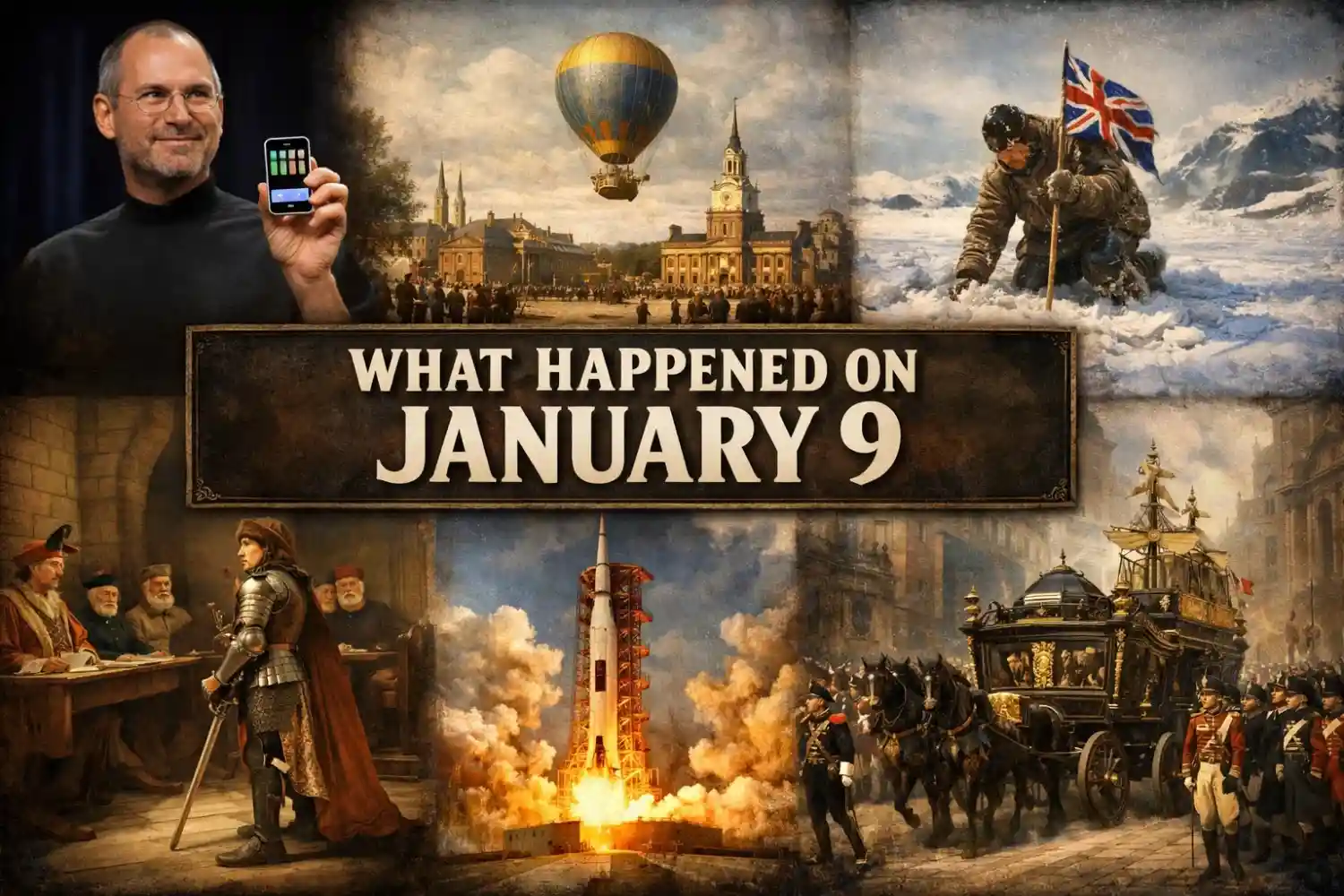
The ninth day of the year serves as a powerful mirror to the human experience, reflecting both our greatest tragedies and our most transformative inventions. To truly understand what happened on this day in history January 9, we must look at the shifting of empires in Constantinople, the birth of modern communication in San Francisco, and the resilience of civilizations following devastating natural disasters.
Important Events That Happened On January 9 In History
400: Aelia Eudoxia Crowned Empress
In a significant display of political power in the Eastern Roman Empire, Aelia Eudoxia was officially crowned as Augusta. As the wife of Emperor Arcadius, she wielded immense influence over the imperial court and was known for her strong personality and public feuds with religious figures. Her coronation solidified her status as one of the most powerful women of the late Roman era.
475: The Flight of Emperor Zeno
The Eastern Roman dowager Empress Verina orchestrated a successful palace coup by instigating a massive riot in Constantinople. She persuaded her son-in-law, Emperor Zeno, to flee the capital for his safety, creating a power vacuum in the Byzantine leadership. However, her plan to install her lover on the throne backfired when the senate acclaimed Basiliscus as the new emperor instead.
681: Twelfth Council of Toledo Begins
King Erwig of the Visigoths convened a major ecclesiastical council in Spain to strengthen his grip on the kingdom and implement new social laws. During the assembly, Erwig initiated a series of harsh and diverse measures specifically targeting the Jewish population within his realm. These decrees were part of a broader effort to unify the kingdom under a single religious and legal framework.
1038: The Dingxiang Earthquake
A catastrophic earthquake struck the region of Dingxiang in Northern Song dynasty China, causing widespread structural collapse. Historical records suggest the devastation was immense, with an estimated death toll of approximately 32,300 people. This natural disaster remains one of the deadliest seismic events recorded in the early history of the Shanxi province.
1127: The Fall of Northern Song
During the Jin–Song Wars, invading Jurchen forces from the Jin dynasty successfully breached the defenses of Bianjing (modern-day Kaifeng). The sacking of the capital led to the abduction of Emperor Qinzong and his predecessor, effectively ending the Northern Song period. This event forced the remnants of the Song court to flee south, marking a major turning point in Chinese history.
1349: The Basel Jewish Massacre
In a tragic episode fueled by the hysteria of the Black Death, the residents of Basel rounded up the city’s Jewish population. Wrongly believing that the Jewish community was responsible for the plague, the mob incinerated them in a wooden building on an island in the Rhine. This horrific act of violence was part of a wave of persecutions that swept across Europe during the pandemic.
1431: The Trial of Joan of Arc
Nineteen-year-old Joan of Arc, famously documented as “Joan the Maid,” faced the beginning of her ecclesiastical trial in Rouen. She was confronted with over 70 accusations, ranging from witchcraft and murder to the “crime” of wearing male clothing. While the trial initially resulted in a life sentence after a confession, the proceedings were eventually escalated to ensure her execution by fire.
1693: Sicily and Malta Earthquake
A powerful earthquake struck the Mediterranean, causing the initial destruction of several towns across Sicily and Malta. This was the first of two massive tremors; the second, occurring two days later, completed the devastation of the region. The combined death toll from this seismic disaster is estimated to be between 60,000 and 100,000 people.
1760: Battle of Barari Ghat
The Afghan leader Ahmad Shah Durrani achieved a decisive military victory over the Maratha forces at the Battle of Barari Ghat. This engagement was a crucial precursor to the larger conflict at Panipat and significantly weakened Maratha influence in Northern India. The defeat of the Marathas allowed Durrani to consolidate his power and influence over the Mughal court.
1787: Traslación of the Black Nazarene
The iconic image of the Black Nazarene was moved from its original location to its permanent home in the Quiapo Church in Manila. This transfer, known as the Traslación, is commemorated every year by millions of barefoot Catholic devotees who parade through the streets. It has since become one of the largest and most intense religious processions in the world.
1788: Connecticut Joins the Union
Connecticut became the fifth state to officially ratify the United States Constitution, signaling strong early support for a unified federal government. The state’s delegates had previously played a vital role in the Constitutional Convention by proposing the “Great Compromise.” This ratification helped build the necessary momentum for the Constitution to become the law of the land.
1792: The Treaty of Jassy
The Russian and Ottoman Empires signed the Treaty of Jassy, bringing an end to the Russo-Turkish War that had raged since 1787. The treaty recognized Russia’s annexation of the Crimean Khanate and shifted the border to the Dniester River. This diplomatic agreement further solidified Russia’s dominance in the Black Sea region at the expense of Ottoman territory.
1793: First U.S. Balloon Flight
French aeronaut Jean-Pierre Blanchard successfully completed the first-ever manned balloon flight in the United States. He launched his hydrogen-filled balloon from Philadelphia and landed safely in New Jersey, carrying a personal letter from George Washington. This event introduced the American public to the possibilities of aerial travel and scientific exploration of the atmosphere.
1799: Introduction of Income Tax
British Prime Minister William Pitt the Younger introduced a revolutionary “income tax” to help fund the massive costs of the Napoleonic Wars. The tax was set at two shillings to the pound on those earning over a certain threshold, marking the first time such a levy was used in Britain. Although intended as a temporary wartime measure, it set a major precedent for modern government finance.
1806: State Funeral of Lord Nelson
Admiral Horatio Lord Nelson was honored with a magnificent state funeral following his heroic death at the Battle of Trafalgar. His body was carried in a grand procession through London and interred in the crypt of St. Paul’s Cathedral. The event was a massive public display of grief and national pride for the man who secured British naval supremacy.
1816: The Davy Safety Lamp Test
Sir Humphry Davy successfully tested his invention, the safety lamp, at the Hebburn Colliery to prevent explosions in coal mines. The lamp used a fine wire gauze to enclose the flame, allowing light to pass through while preventing the ignition of flammable gases. This technological breakthrough saved countless lives and revolutionized the safety standards of the mining industry.
1822: Prince Pedro’s “Dia do Fico”
In a bold act of defiance, the Portuguese Prince Pedro I decided to remain in Brazil despite direct orders from the Portuguese King to return home. His famous declaration, “I stay,” effectively initiated the process of Brazilian independence from Portugal. This moment of rebellion set the stage for him to eventually become the first Emperor of a sovereign Brazil.
1839: Announcement of the Daguerreotype
The French Academy of Sciences made the first formal public announcement of the daguerreotype photographic process. Developed by Louis Daguerre, this was the first method to create a permanent and highly detailed image using a silver-plated copper sheet. This day is celebrated as a cornerstone in the history of photography, as it changed how the world was visually documented.
1857: The Fort Tejon Earthquake
Central and Southern California were rocked by a massive 7.9 magnitude earthquake, one of the strongest in the state’s recorded history. The tremor originated along the San Andreas Fault and was felt from Sacramento to San Diego, causing dramatic changes to the landscape. Despite its intensity, the low population density of the area at the time prevented a massive loss of life.
1858: British Victory in Chittagong
British colonial forces achieved a final military victory over the resistance leader Rajab Ali Khan in the region of Chittagong. This engagement was part of the broader efforts by the British to suppress localized uprisings and consolidate their control over the Indian subcontinent. The defeat of Rajab Ali Khan helped stabilize the border regions under British administrative rule.
1861: The Star of the West Incident
The tensions of the American secession crisis escalated when South Carolina batteries fired upon the Star of the West. The merchant ship was attempting to bring supplies and reinforcements to the Union garrison at Fort Sumter. This hostile action was one of the first direct military provocations leading up to the full-scale outbreak of the American Civil War.
1861: Mississippi Secedes from the Union
Mississippi became the second state to officially withdraw from the United States, following the example set by South Carolina. The state legislature passed an ordinance of secession, citing the protection of slavery and states’ rights as primary motivators. This move further fractured the nation and accelerated the countdown toward a violent domestic conflict.
1878: Umberto I Becomes King of Italy
Following the death of his father, Victor Emmanuel II, Umberto I ascended to the throne as the second King of Italy. His reign was marked by Italy’s colonial expansion in Africa and a rise in social tensions within the newly unified nation. He would go on to lead the country during a period of industrial growth before his eventual assassination years later.
1903: Hallam Tennyson Becomes Governor-General
Hallam Tennyson, the son of the famous poet Alfred Lord Tennyson, was appointed as the second Governor-General of Australia. He had previously served as the Governor of South Australia and was well-regarded for his administrative skills during the early years of the Australian federation. His tenure focused on establishing the protocols and duties of the newly formed federal office.
1909: Shackleton’s “Farthest South”
Ernest Shackleton and his team on the Nimrod Expedition reached a record-breaking latitude of 88° 23′ S, planting the British flag. Although they were only 97 nautical miles from the South Pole, Shackleton made the difficult decision to turn back to ensure the survival of his men. At the time, this was the farthest south any human being had ever traveled.
1914: Founding of Phi Beta Sigma
Three African American students at Howard University founded the Phi Beta Sigma fraternity with the principles of Brotherhood, Scholarship, and Service. The organization was designed to provide a community for Black students and to focus on the social and political issues facing the African American community. It has since grown into an international organization with hundreds of chapters worldwide.
1916: Conclusion of the Gallipoli Campaign
The disastrous Gallipoli Campaign officially ended with an Ottoman Empire victory as the last Allied troops were evacuated from the peninsula. The campaign, intended to knock the Ottomans out of World War I, resulted in staggering casualties on both sides. The successful evacuation was the only part of the operation considered a tactical masterpiece by the Allied command.
1917: The Battle of Rafa
During the Sinai and Palestine Campaign of World War I, Allied forces fought the Battle of Rafa near the Egyptian-Palestine border. The Desert Column successfully captured the Ottoman garrison, securing a vital point for the further advance into Palestine. This victory effectively cleared the Sinai Peninsula of Ottoman forces and boosted Allied momentum in the region.
1918: The Battle of Bear Valley
In what is widely considered the final battle of the American Indian Wars, U.S. troops engaged a group of Yaqui Indians in Arizona. The conflict was a brief skirmish resulting from tensions over the border and the movement of the Yaqui people. While small in scale compared to previous battles, it marked the end of the centuries-long era of armed conflict between the U.S. and Native tribes.
1920: Outlawing the Makhnovshchina
The All-Ukrainian Central Executive Committee issued a decree that officially outlawed the Makhnovshchina, the anarchist movement led by Nestor Makhno. This political move ignited a direct military conflict between the Bolsheviks and the Makhnovists in the midst of the Ukrainian War of Independence. It signaled the Bolsheviks’ intent to consolidate total control over the region.
1921: First Battle of İnönü
The Greco-Turkish War saw its first major engagement as Turkish and Greek forces met near Eskişehir in Anatolia. This battle was significant as it was the first time the newly organized regular army of the Turkish National Movement stood its ground against a modern invader. The Turkish success in holding their positions boosted national morale during their struggle for independence.
1923: First Autogyro Flight
Spanish engineer Juan de la Cierva successfully completed the first flight of his invention, the autogyro, in Madrid. Unlike a traditional helicopter, the autogyro used a free-spinning rotor to provide lift and a conventional propeller for forward motion. This flight was a major milestone in aviation, proving that stable vertical-lift flight was possible through new engineering principles.
1923: The Memel Uprising
Lithuanian residents of the Memel Territory launched a rebellion against the League of Nations’ administration of the region. The territory had been placed under French control following World War I, but the rebels sought to unify the area with the newly independent state of Lithuania. The uprising eventually led to the annexation of Memel by Lithuania shortly thereafter.
1927: The Laurier Palace Theatre Fire
A tragic fire broke out during a busy matinee at the Laurier Palace movie theatre in Montreal, leading to a deadly crush at the exits. The disaster claimed the lives of 78 children, most of whom were trapped by doors that opened inward. The tragedy led to a total ban on children under 16 attending cinemas in Quebec for several decades and sparked new fire safety laws.
1941: First Flight of the Avro Lancaster
The Avro Lancaster, which would become the most famous British heavy bomber of World War II, took its maiden flight on this day. Designed for long-range night bombing raids, the Lancaster was praised for its massive payload capacity and durability. It went on to play a pivotal role in the Allied air campaign against Nazi Germany, including the famous Dambusters raid.
1945: Invasion of Lingayen Gulf
During the liberation of the Philippines, the Sixth United States Army began a massive amphibious invasion of the Lingayen Gulf on the island of Luzon. This operation was a critical step in General Douglas MacArthur’s plan to retake Manila and defeat the Japanese forces in the Pacific. The invasion involved over 175,000 troops and was supported by an enormous naval fleet.
1957: Resignation of Anthony Eden
British Prime Minister Sir Anthony Eden resigned from his position, citing ill health and the political fallout of the Suez Crisis. His failed attempt to retake the Suez Canal from Egypt alongside France and Israel had led to intense international condemnation and a strain on the “Special Relationship” with the U.S. His departure marked a decline in Britain’s status as a top-tier world power.
1959: The Vega de Tera Dam Failure
A devastating engineering disaster occurred in Spain when the Vega de Tera dam collapsed following heavy rainfall. The resulting floodwater surged down the valley, nearly destroying the town of Ribadelago and killing 144 of its residents. The disaster remains one of the worst dam failures in Spanish history and led to significant changes in dam monitoring and construction.
1960: Construction Begins on the Aswan Dam
Egyptian President Gamal Abdel Nasser officially inaugurated the construction of the Aswan High Dam by detonating a massive charge of dynamite. The project was designed to control the flooding of the Nile, provide irrigation for agriculture, and generate immense amounts of hydroelectric power. The dam was a symbol of Egyptian nationalism and modern engineering progress.
1961: Discovery of the Portland Spy Ring
British intelligence authorities announced the successful exposure of the “Portland spy ring,” a Soviet espionage operation based in London. The ring had been stealing top-secret documents from the Admiralty Underwater Weapons Establishment for several years. The high-profile trial that followed revealed the deep reach of Cold War intelligence gathering within Western institutions.
1962: Plans for the C-5 “Advanced Saturn”
NASA announced its ambitious plans to build the C-5 rocket, which would later be famously known as the Saturn V. This massive launch vehicle was designed specifically to carry humans to the Moon as part of the Apollo program. The announcement signaled the beginning of the hardware development phase that would eventually lead to the historic 1969 lunar landing.
1964: Martyrs’ Day in Panama
Tensions in the Panama Canal Zone erupted into violence when Panamanian students attempted to fly their national flag alongside the U.S. flag. The resulting clashes between Panamanian civilians and U.S. military forces led to several days of rioting and numerous deaths. The event is commemorated in Panama as Martyrs’ Day and was a key factor in the eventual return of the Canal to Panama.
1991: The Geneva Peace Conference
Representatives from the United States and Iraq met in Geneva in a final diplomatic attempt to find a peaceful resolution to the invasion of Kuwait. Secretary of State James Baker and Iraqi Foreign Minister Tariq Aziz engaged in hours of talks, but the meeting ended in a stalemate. The failure of the conference made the start of the Gulf War almost inevitable.
1992: Proclamation of Republika Srpska
The Assembly of the Serb People in Bosnia and Herzegovina officially proclaimed the creation of Republika Srpska as a new state within Yugoslavia. This move was a direct response to the moves toward independence by the central Bosnian government and escalated the ethnic tensions in the region. The proclamation was a significant step toward the outbreak of the Bosnian War.
1992: Discovery of Extrasolar Planets
Astronomers Aleksander Wolszczan and Dale Frail announced the first confirmed discovery of planets outside our solar system. Using radio telescope data, they identified two terrestrial-sized planets orbiting the pulsar PSR 1257+12. This groundbreaking discovery proved that planets were not unique to our Sun and opened a new frontier in the study of astronomy and the search for life.
1996: The Kizlyar Hostage Crisis
During the First Chechen War, Chechen separatists launched a daring raid on the city of Kizlyar in Dagestan, targeting a military airfield and a hospital. The operation turned into a massive hostage crisis as thousands of civilians were held by the militants as shields against Russian forces. The standoff resulted in a violent confrontation and high casualties before the separatists retreated.
1997: Comair Flight 3272 Crash
A Comair Embraer EMB 120 Brasilia crashed in Monroe County, Michigan, while on approach to Detroit Metropolitan Airport. All 29 people on board were killed when the aircraft suddenly spiraled out of control during an icing event. The subsequent investigation led to new safety recommendations regarding the operation of turboprop aircraft in freezing conditions.
2003: TANS Perú Flight 222 Tragedy
A TANS Perú Fokker F28 Fellowship crashed into a mountain while attempting to land at Chachapoyas Airport in high-altitude, difficult terrain. All 46 people on board were killed in the accident, which was attributed to the pilots failing to maintain a safe altitude during the approach. The crash highlighted the challenges of aviation safety in the mountainous regions of Peru.
2004: Karaburun Peninsula Disaster
An inflatable boat carrying illegal Albanian migrants stalled in the Adriatic Sea during a dangerous crossing toward Italy. Exposure to the freezing elements and rough seas killed 28 of the people on board, marking the second-deadliest marine disaster in Albania’s history. The tragedy brought international attention to the plight of migrants attempting to cross the Mediterranean.
2005: Mahmoud Abbas Elected President
Mahmoud Abbas won a decisive victory in the election to succeed Yasser Arafat as the President of the Palestinian National Authority. Abbas ran on a platform of ending the armed uprising and returning to diplomatic negotiations with Israel. His election was seen by many international observers as an opportunity for a renewed peace process in the Middle East.
2005: Sudan Comprehensive Peace Agreement
The Government of Sudan and the Sudan People’s Liberation Movement signed the Comprehensive Peace Agreement in Nairobi, Kenya. This historic pact officially ended the Second Sudanese Civil War, which had been one of the longest-running conflicts in Africa. The agreement provided for regional autonomy and set a timeline for a referendum on South Sudanese independence.
2007: Introduction of the Original iPhone
Apple CEO Steve Jobs took the stage at Macworld in San Francisco to introduce the original iPhone, a device he described as three products in one. It combined a revolutionary mobile phone, a widescreen iPod with touch controls, and a breakthrough internet communications device. This product launch fundamentally changed the technology industry and redefined the modern smartphone.
2011: Iran Air Flight 277 Crash
An Iran Air Boeing 727 crashed near the city of Urmia in northwestern Iran during a period of heavy snow and icy conditions. The aircraft was attempting an emergency landing after a failed initial approach when it broke apart in a field, killing 78 people. The crash was one of several major aviation disasters in Iran, often linked to the aging fleet and difficult weather.
2014: Yokkaichi Chemical Plant Explosion
A powerful explosion ripped through a Mitsubishi Materials chemical plant in Yokkaichi, Japan, during a maintenance operation. The blast killed at least five workers and injured 17 others, causing significant damage to the facility. An investigation into the accident revealed that a chemical reaction involving hydrogen and silicon was the likely cause of the explosion.
2015: End of the Charlie Hebdo Siege
The two-day manhunt for the perpetrators of the Charlie Hebdo shooting ended when French security forces killed both gunmen during a standoff at a print shop. Simultaneously, a related hostage situation at a Jewish supermarket in Vincennes ended with the death of a third gunman. These events left France in a state of national mourning and heightened security across Europe.
2015: Mozambique Funeral Poisoning
A mass poisoning occurred at a funeral in Mozambique after attendees consumed traditional beer that had been contaminated. Investigations later revealed that the beer contained the bacterium Burkholderia gladioli, which produced a lethal toxin. The tragedy left 75 people dead and over 230 others seriously ill, prompting a national health emergency.
2021: Sriwijaya Air Flight 182 Crash
A Sriwijaya Air Boeing 737-500 plunged into the Java Sea just minutes after taking off from Jakarta, Indonesia. All 62 people on board were killed when the aircraft experienced a sudden and rapid descent from which the pilots could not recover. The disaster led to a major search and recovery operation and renewed focus on the safety record of the Indonesian aviation industry.
Famous People Born On January 9
| Name | Role / Short Note | Dates |
|---|---|---|
| Bart Starr | American football player & coach (NFL legend) | January 9, 1934 – May 26, 2019 |
| Lee Kun-Hee | South Korean businessman, Samsung chairman | January 9, 1942 – October 25, 2020 |
| Jennie Jerome Churchill | British socialite, mother of Winston Churchill | January 9, 1854 – June 29, 1921 |
| Rigoberta Menchú | Guatemalan activist, Nobel Peace Prize laureate | January 9, 1959 – |
| Har Gobind Khorana | American biochemist, Nobel laureate | January 9, 1922 – November 9, 2011 |
| Karel Čapek | Czech writer, coined the word “robot” | January 9, 1890 – December 25, 1938 |
| Carrie Chapman Catt | American feminist leader, suffrage movement | January 9, 1859 – March 9, 1947 |
| Dame Gracie Fields | British singer & comedienne | January 9, 1898 – September 27, 1979 |
| Sergey Paradzhanov | Armenian film director | January 9, 1924 – July 20, 1990 |
| Brian Friel | Irish playwright | January 9, 1929 – October 2, 2015 |
| St. Josemaría Escrivá | Spanish prelate, founder of Opus Dei | January 9, 1902 – June 26, 1975 |
| Gertrude Vanderbilt Whitney | American sculptor, Whitney Museum founder | January 9, 1875 – April 18, 1942 |
| Richard Halliburton | American travel writer | January 9, 1900 – March 23/24, 1939 |
| Haim Naḥman Bialik | Hebrew poet & writer | January 9, 1873 – July 4, 1934 |
| Kenny Clarke | American jazz drummer | January 9, 1914 – January 25, 1985 |
| Iwasaki Yatarō | Japanese industrialist, founder of Mitsubishi | January 9, 1835 – February 7, 1885 |
| Gregory XV | Pope of the Catholic Church | January 9, 1554 – July 8, 1623 |
| Joseph B. Strauss | American engineer, Golden Gate Bridge | January 9, 1870 – May 16, 1938 |
| Simon Vouet | French Baroque painter | January 9, 1590 – June 30, 1649 |
| William Powell Frith | British genre painter | January 9, 1819 – November 2, 1909 |
| Chic Young | American cartoonist (Blondie) | January 9, 1901 – March 14, 1973 |
| Ferdinand von Wrangel | Russian Arctic explorer | January 9, 1797 – June 6, 1870 |
| John Knowles Paine | American composer & educator | January 9, 1839 – April 25, 1906 |
| Edwin Ray Guthrie | American psychologist | January 9, 1886 – April 23, 1959 |
| Thomas Warton the Younger | English poet & scholar | January 9, 1728 – May 21, 1790 |
| Giovanni Papini | Italian author & critic | January 9, 1881 – July 8, 1956 |
| Reinhard Keiser | German Baroque composer | January 9, 1674 – September 12, 1739 |
| Elizabeth G. Knight Britton | American botanist | January 9, 1858 – February 25, 1934 |
| Mollie Orshansky | American statistician, poverty line creator | January 9, 1915 – December 18, 2006 |
| Henry Blake Fuller | American novelist | January 9, 1857 – July 28, 1929 |
Famous People Died On January 9
| Name | Role / Short Note | Dates |
|---|---|---|
| Victor Emmanuel II | First king of unified Italy | March 14, 1820 – January 9, 1878 |
| Katherine Mansfield | Modernist short-story writer | October 14, 1888 – January 9, 1923 |
| Amiri Baraka | American poet & playwright | October 7, 1934 – January 9, 2014 |
| Anne of Brittany | Queen consort of France | January 25, 1477 – January 9, 1514 |
| Houston Stewart Chamberlain | Political philosopher | September 9, 1855 – January 9, 1927 |
| John Gilbert | Silent-film actor | July 10, 1899 – January 9, 1936 |
| Countee Cullen | Harlem Renaissance poet | May 30, 1903 – January 9, 1946 |
| James M. Buchanan | Economist, Nobel laureate | October 2, 1919 – January 9, 2013 |
| Maria Gaetana Agnesi | Italian mathematician | May 16, 1718 – January 9, 1799 |
| R. G. Collingwood | Historian & philosopher | February 22, 1889 – January 9, 1943 |
| Moẓaffar od-Dīn Shāh | Qajar shah of Iran | 1852 – January 9, 1907 |
| Henry W. Halleck | U.S. Civil War general | January 16, 1815 – January 9, 1872 |
| Wilhelm Busch | German poet & illustrator | April 15, 1832 – January 9, 1908 |
| Karl Mannheim | German sociologist | March 27, 1893 – January 9, 1947 |
| Pier Luigi Nervi | Italian engineer & architect | June 21, 1891 – January 9, 1979 |
| John Brown Gordon | Confederate general & politician | February 6, 1832 – January 9, 1904 |
| Bernard de Fontenelle | French scientist & author | February 11, 1657 – January 9, 1757 |
| Mīrzā Taqī Khān | Iranian reformist prime minister | c.1807 – January 9, 1852 |
| Dale T. Mortensen | Economist, Nobel laureate | February 2, 1939 – January 9, 2014 |
| Ted Shawn | Pioneer of modern dance | October 21, 1891 – January 9, 1972 |
| Samuel Gridley Howe | American educator & abolitionist | November 10, 1801 – January 9, 1876 |
| Antanas Smetona | President of Lithuania | August 10, 1874 – January 9, 1944 |
| K. Alex Müller | Swiss physicist, Nobel laureate | April 20, 1927 – January 9, 2023 |
| Pierre Fresnay | French stage & film actor | April 4, 1897 – January 9, 1975 |
| Kaifu Toshiki | Prime Minister of Japan | January 2, 1931 – January 9, 2022 |
| Fukui Kenichi | Japanese chemist, Nobel laureate | October 4, 1918 – January 9, 1998 |
| Aventinus | German humanist historian | July 4, 1477 – January 9, 1534 |
| Kate Gleason | American engineer & businesswoman | November 25, 1865 – January 9, 1933 |
| Charles Simic | American poet | May 9, 1938 – January 9, 2023 |
| Edward Bok | American editor (Ladies’ Home Journal) | October 9, 1863 – January 9, 1930 |
Observances & Institutional Dates
- Martyrs’ Day (Panama): A day of national mourning commemorating the 1964 riots over the sovereignty of the Panama Canal.
- Non-Resident Indian Day: Also known as Pravasi Bharatiya Divas, celebrated in India to mark the contribution of the overseas Indian community.
- Hōonkō Begins: A week-long period of services in Jōdo Shinshū Buddhism to commemorate the founder, Shinran Shonin.
- Day of Republika Srpska: A holiday in the Serb entity of Bosnia and Herzegovina marking its 1992 proclamation, though it remains legally disputed.
Frequently Asked Questions
What major tech product was launched on January 9?
The original iPhone was introduced by Steve Jobs on January 9, 2007, changing the landscape of mobile technology forever.
Who was the first person to fly a balloon in the US on this day?
Jean-Pierre Blanchard made the first manned balloon flight in United States history on January 9, 1793.
Why is January 9 significant in Panama?
It is Martyrs’ Day, honoring those who died in the 1964 protests that eventually led to Panama gaining control over the Canal Zone.