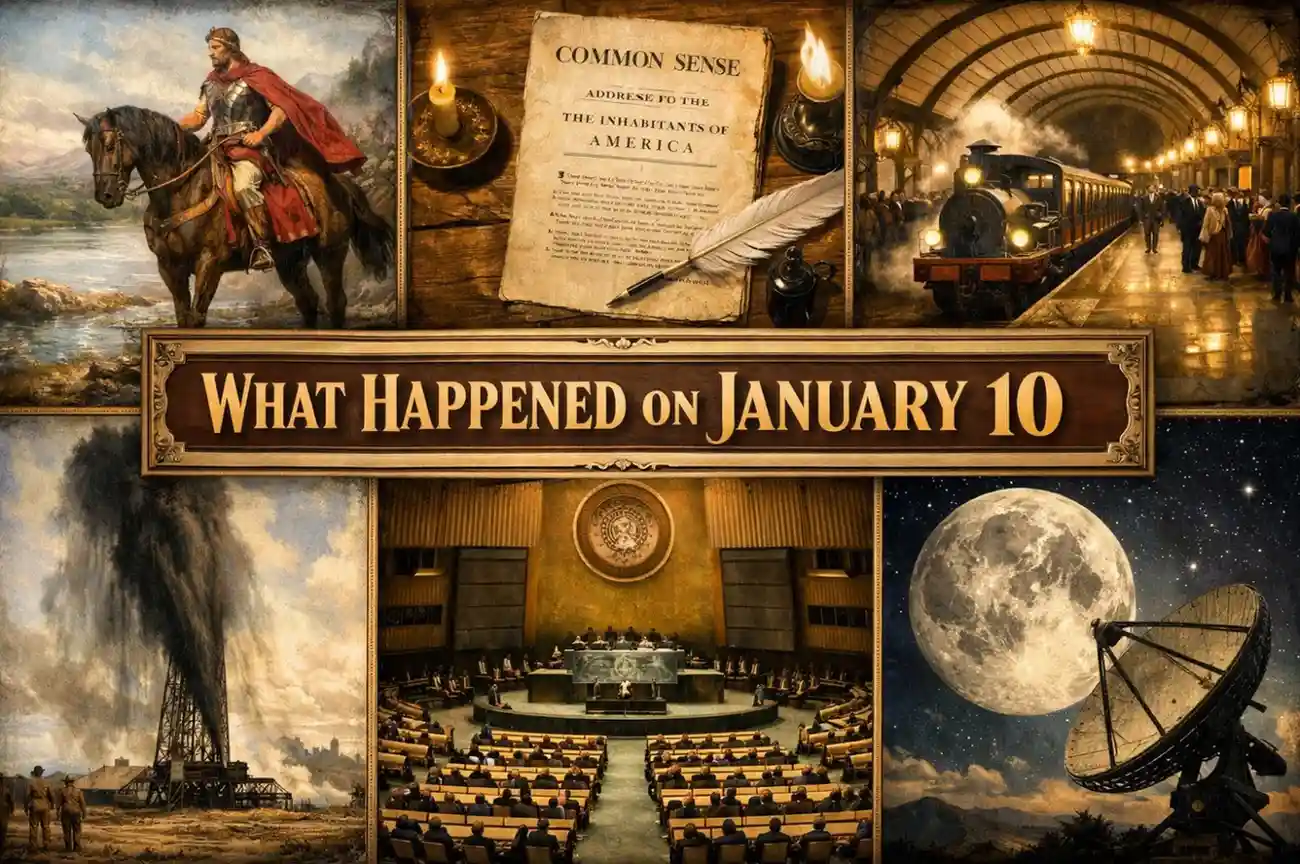
The tenth day of the year stands as a monumental date for legal transformations, the birth of global organizations, and high-stakes military gambles. To truly understand what happened on this day in history January 10, we must look back at Julius Caesar’s irreversible decision to challenge Rome, the first gathering of the United Nations, and the technological breakthrough that allowed humans to reach out and touch the Moon with radio waves.
Important Events That Happened On January 10 In History
49 BC: Julius Caesar Crosses the Rubicon
Julius Caesar led his 13th Legion across the Rubicon River, a shallow stream marking the boundary between Cisalpine Gaul and Italy. By crossing this forbidden line with an army, he committed an act of treason against the Roman Senate, famously uttering “the die is cast.” This bold move effectively signaled the start of a bloody civil war that would lead to the end of the Roman Republic and the rise of the Roman Empire.
9: The Fall of the Western Han Dynasty
The long-standing Western Han dynasty officially came to an end when the ambitious official Wang Mang seized the throne for himself. Claiming that the divine Mandate of Heaven had shifted away from the Han, he established the Xin dynasty as the new ruling power in China. His reign introduced radical social and economic reforms, though the transition remained a chaotic period in Chinese imperial history.
69: Lucius Calpurnius Piso Licinianus Appointed Deputy
In a desperate attempt to stabilize his shaky rule, the elderly Roman Emperor Galba appointed Lucius Calpurnius Piso Licinianus as his deputy and successor. Galba hoped that by choosing a man of noble character, he could appease the restless military and political factions in Rome. However, the choice alienated other powerful figures, most notably Otho, leading to a violent end for both Galba and Piso just days later.
236: Election of Pope Fabian
Following the death of Pope Anterus, Fabian was chosen as the twentieth Bishop of Rome in what was described as a miraculous event. Tradition states that a dove landed on his head during the assembly, which the faithful took as a divine sign for his election despite him being a layman at the time. His papacy was marked by significant organizational growth within the early Church before he died a martyr.
1072: Robert Guiscard Conquers Palermo
The Norman adventurer Robert Guiscard successfully captured the city of Palermo, ending centuries of Arab rule over the Sicilian capital. Alongside his brother Roger I, Guiscard used a combined land and sea blockade to force the city’s surrender, bringing a major part of the island under Norman control. This conquest laid the groundwork for the wealthy and culturally diverse Kingdom of Sicily.
1430: Establishment of the Order of the Golden Fleece
Philip the Good, the Duke of Burgundy, founded the Order of the Golden Fleece to celebrate his marriage to Isabella of Portugal. This order of chivalry became the most prestigious and exclusive in the world, designed to defend the Catholic faith and uphold the highest standards of knightly honor. It was so exclusive that membership was limited to a very small number of elite nobles and royals.
1475: The Battle of Vaslui
Stephen III of Moldavia achieved a stunning military victory against a much larger Ottoman Empire army led by Hadâm Suleiman Pasha. Utilizing the foggy, marshy terrain of Vaslui to his advantage, Stephen trapped the Ottoman forces and inflicted a devastating defeat upon them. This victory halted the Ottoman advance into Eastern Europe for several years and earned Stephen the title of “Athlete of Christ.”
1645: Execution of Archbishop William Laud
Archbishop William Laud was beheaded at the Tower of London after being convicted of high treason by the Long Parliament. As a key advisor to King Charles I, Laud’s strict religious policies and support for the divine right of kings had made him a hated figure among the Puritans. His execution was a significant escalation in the tensions that fueled the English Civil War.
1776: Thomas Paine Publishes Common Sense
In the heat of the American Revolution, Thomas Paine released his influential pamphlet, Common Sense, which argued for complete independence from Great Britain. Writing in clear, accessible language, Paine challenged the authority of the monarchy and urged the colonists to create a new democratic republic. The pamphlet became an immediate sensation, shifting public opinion toward revolution and the eventual Declaration of Independence.
1791: The Siege of Dunlap’s Station
Conflict broke out near Cincinnati during the Northwest Indian War as Native American forces laid siege to the fortified settlement of Dunlap’s Station. The defenders, a small group of soldiers and settlers, faced intense fire and threats of torture from the surrounding warriors. Despite being heavily outnumbered, the garrison held out until reinforcements arrived, marking a small but brutal chapter in the struggle for the Ohio Valley.
1812: First Steamboat Arrives in New Orleans
The New Orleans, the first steamboat to navigate the Ohio and Mississippi Rivers, finally arrived at its namesake city after an 82-day journey from Pittsburgh. This voyage proved that steam-powered vessels could handle the treacherous western waters, even surviving the great New Madrid earthquakes during the trip. This milestone revolutionized trade and travel in the American interior, opening a new era of commercial growth.
1861: Florida Secedes from the Union
Following in the footsteps of South Carolina and Mississippi, Florida became the third state to pass an ordinance of secession from the United States. Delegates in Tallahassee voted 62 to 7 to withdraw, citing the preservation of slavery and states’ rights as their primary justifications. This move brought the nation even closer to the full-scale conflict of the American Civil War.
1863: The London Underground Opens
The world’s first underground passenger railway, the Metropolitan Railway, officially opened for public service between Paddington and Farringdon. Crowds flocked to experience the novel sensation of traveling beneath the streets of London in gas-lit wooden carriages pulled by steam locomotives. This historic opening marked the birth of the London Underground and changed urban transportation forever.
1870: Incorporation of Standard Oil
John D. Rockefeller and his partners formally incorporated the Standard Oil Company in Ohio. By focusing on efficiency and aggressively consolidating smaller refineries, the company quickly grew to dominate the American oil industry. This move laid the foundation for Rockefeller to become the wealthiest man in modern history and led to landmark antitrust battles years later.
1876: The Plan of Tuxtepec
General Porfirio Díaz announced the Plan of Tuxtepec, a political manifesto aimed at overthrowing the re-elected President Sebastián Lerdo de Tejada. The plan centered on the principle of “no re-election,” arguing that the leadership had become stagnant and corrupt. This declaration eventually led to the rise of Díaz and his long, influential presidency over Mexico known as the Porfiriato.
1901: The Spindletop Gusher
Oil history was changed forever when the Lucas Gusher at Spindletop in Beaumont, Texas, erupted with a massive plume of crude oil. The strike was so powerful that it flowed at an estimated 100,000 barrels a day, a rate never before seen in the industry. This discovery launched the modern Texas oil boom and shifted the center of the global energy market to the United States.
1901: First Highway Signs in New York
The Automobile Club of America began a new era for motorists by installing some of the first standardized directional signs on major highways in New York. Before this initiative, driving long distances was often a confusing process of guesswork and local inquiries. These early signs were the precursors to the modern, organized highway marking systems we rely on today.
1916: The Erzurum Offensive
During the First World War, Imperial Russian forces launched a massive surprise winter offensive against the Ottoman Empire’s Third Army. Fighting in brutal mountain conditions, the Russians managed to break the Ottoman lines and capture the strategic fortress city of Erzurum. The victory was a major blow to Ottoman prestige and secured Russian dominance in the Caucasus region for the time being.
1917: Rescue of the Ross Sea Party
Seven survivors of the ill-fated Ross Sea party were finally rescued after being stranded on the Antarctic ice for several months. They had been part of Shackleton’s Imperial Trans-Antarctic Expedition, tasked with laying supply depots, but their ship had blown out to sea, leaving them with minimal supplies. Their rescue was a story of incredible endurance against the harshest environment on Earth.
1920: The Treaty of Versailles Takes Effect
The Treaty of Versailles officially entered into force, legally bringing World War I to an end for the majority of the combatant nations. While the fighting had stopped in 1918, this treaty established the new borders of Europe and imposed heavy reparations and military restrictions on Germany. Notably, the United States did not ratify the treaty, choosing instead to negotiate separate peace agreements.
1920: Birth of the League of Nations
The Covenant of the League of Nations automatically entered into force following the ratification of the Treaty of Versailles. This new international organization was created with the primary goal of maintaining world peace through collective security and diplomatic arbitration. While it ultimately struggled to prevent the next world war, it represented the first major attempt at global intergovernmental cooperation.
1927: Release of Metropolis
Fritz Lang’s groundbreaking science fiction film Metropolis premiered in Germany, dazzled audiences with its futuristic vision and innovative special effects. The film explored themes of class struggle in a massive, stylized urban landscape and featured the iconic “Maschinenmensch” robot. It remains one of the most influential works in cinema history, shaping the visual language of the sci-fi genre.
1941: Greeks Capture Kleisoura
During the Greco-Italian War, the Greek army achieved a significant tactical victory by capturing the strategic mountain pass of Kleisoura. Despite the difficult winter conditions and fierce Italian resistance, the Greek forces pushed through, taking hundreds of prisoners. This victory boosted Allied morale and demonstrated the effective defensive capabilities of the Greek military against Axis aggression.
1946: First UN General Assembly
Fifty-one nations gathered in London’s Methodist Central Hall for the very first General Assembly of the United Nations. This historic meeting was the first time the newly formed global body met to discuss the post-war world order and organizational procedures. It marked the start of a permanent platform for international dialogue and the resolution of global crises.
1946: Project Diana Bounces Signals off the Moon
The U.S. Army Signal Corps successfully conducted Project Diana, marking the birth of radar astronomy by bouncing radio waves off the Moon. For the first time, humans received a reflected signal from an object outside of Earth’s atmosphere, proving that communication beyond the ionosphere was possible. This achievement paved the way for the future of space exploration and satellite technology.
1954: The Crash of BOAC Flight 781
A de Havilland Comet, the world’s first commercial jetliner, exploded in mid-air and fell into the Tyrrhenian Sea shortly after taking off from Rome. All 35 people on board were killed in a disaster that initially baffled investigators. The subsequent inquiry revealed that metal fatigue in the fuselage was the cause, leading to a total redesign of future aircraft windows and structures.
1966: The Tashkent Declaration
The Tashkent Declaration was signed by Indian Prime Minister Lal Bahadur Shastri and Pakistani President Ayub Khan to end the Indo-Pakistani War of 1965. Mediated by the Soviet Union, the agreement required both nations to withdraw their forces to pre-war positions and restore diplomatic ties. Although it successfully halted the fighting, the peace remained fragile in the decades that followed.
1972: Sheikh Mujibur Rahman Returns to Bangladesh
Sheikh Mujibur Rahman, the founding leader of Bangladesh, received a hero’s welcome as he returned to his newly independent country. After spending nine months in a Pakistani prison following his arrest during the war of liberation, his return solidified the new nation’s leadership. He was immediately sworn in as the president of the country he had fought so hard to free.
1980: The “Addiction Rare” Letter
The New England Journal of Medicine published a short letter to the editor titled “Addiction Rare in Patients Treated with Narcotics.” While intended only to describe observations in a controlled hospital setting, the letter was later heavily cited by pharmaceutical companies to argue that opioids were safe for general use. This misuse is now recognized as a significant factor in the start of the opioid epidemic.
1981: FMLN Launches First Major Offensive
The Farabundo Martí National Liberation Front (FMLN) launched its first large-scale military offensive during the Salvadoran Civil War. The guerrillas managed to seize control of significant portions of the Morazán and Chalatenango departments, challenging the authority of the military government. This escalation turned the local unrest into a full-scale civil conflict that would last for over a decade.
1984: US and Holy See Re-establish Relations
The United States and the Vatican formally re-established full diplomatic relations after a gap of nearly 117 years. This move overturned a 19th-century congressional ban on funding for a diplomatic envoy to the Holy See. The restoration allowed for closer cooperation on global humanitarian and political issues during the final years of the Cold War.
1985: Daniel Ortega Inaugurated in Nicaragua
Daniel Ortega was sworn in as the President of Nicaragua, promising to continue the Sandinista revolution’s move toward socialism. During his inauguration, he vowed to maintain strong alliances with the Soviet Union and Cuba, much to the concern of the United States. His presidency became a focal point for Cold War tensions in Central America, particularly through the Contra War.
1990: Formation of Time Warner
The media landscape was reshaped when Time Inc. and Warner Communications officially completed their merger to form Time Warner. At the time, it was the largest media merger in history, creating a massive conglomerate that owned magazines, film studios, and cable networks. This merger signaled the beginning of an era of massive consolidation within the global entertainment industry.
2000: Crossair Flight 498 Crash
A Saab 340 aircraft operating as Crossair Flight 498 crashed into a field in Switzerland shortly after taking off from Zurich. All 10 passengers and 3 crew members were killed when the plane entered a sudden, steep spiral. The investigation later attributed the crash to pilot disorientation and spatial confusion, leading to changes in pilot training and cockpit procedures.
2003: North Korea Withdraws from NPT
North Korea shocked the international community by announcing its official withdrawal from the Treaty on the Non-Proliferation of Nuclear Weapons (NPT). It was the first nation to ever leave the treaty, sparking a major crisis regarding nuclear security on the Korean Peninsula. This move significantly heightened global tensions and led to years of failed diplomatic negotiations.
2007: General Strike in Guinea
A nationwide general strike began in Guinea as citizens and labor unions protested against the long-standing rule of President Lansana Conté. The strikers demanded his resignation and better economic conditions, leading to weeks of civil unrest and clashes with security forces. The strike highlighted deep-seated frustrations with corruption and the lack of political reform in the country.
2012: Jamrud Bombing in Pakistan
A devastating bomb blast occurred at a crowded market in Jamrud, a town in Pakistan’s tribal northwest. The explosion targeted a pro-government militia but resulted in the deaths of at least 30 civilians and injured dozens more. This attack was part of a persistent wave of violence linked to regional militancy and the ongoing struggle for control in the borderlands.
2013: Quetta Bombings
A series of coordinated bomb blasts struck the city of Quetta, Pakistan, killing over 100 people in one of the deadliest days in the city’s history. The attacks primarily targeted the Hazara community and local police, causing massive destruction in crowded public areas. The scale of the violence led to nationwide protests and demands for better protection for religious and ethnic minorities.
2015: Karachi Highway Collision
A tragic traffic accident occurred on the National Highway near Karachi when an oil tanker truck collided with a passenger bus. The resulting inferno was so intense that it killed at least 62 people, many of whom were trapped inside the coach. The disaster prompted a national discussion regarding the poor safety standards of commercial transport and the dangerous conditions of the highways.
2019: Jayme Closs Found Alive
Thirteen-year-old Jayme Closs was found alive in rural Wisconsin, 88 days after being kidnapped from her home. Her captor had murdered her parents before holding her in a remote cabin from which she eventually managed to escape. Her recovery was celebrated as a miracle across the country, though the details of her ordeal horrified the public.
Take A Look at January 9 Facts
Famous People Born On January 10
| Name | Role / Short Note | Dates |
|---|---|---|
| Max Roach | American jazz drummer & composer | January 10, 1924 – August 16, 2007 |
| Barbara Hepworth | British abstract sculptor | January 10, 1903 – May 20, 1975 |
| Fukuzawa Yukichi | Japanese educator, Meiji-era reformer | January 10, 1835 – February 3, 1901 |
| Manuel Azaña | President of Spain, Second Republic | January 10, 1880 – November 4, 1940 |
| Jacob H. Schiff | American banker & philanthropist | January 10, 1847 – September 25, 1920 |
| Robinson Jeffers | American poet | January 10, 1887 – January 20, 1962 |
| Francis X. Bushman | Silent-film actor | January 10, 1883 – August 23, 1966 |
| Gustav Husák | Leader of Czechoslovakia | January 10, 1913 – November 18, 1991 |
| Robert Woodrow Wilson | Astronomer, Nobel laureate | January 10, 1936 – |
| Aleksey N. Tolstoy | Soviet writer | January 10, 1883 – February 23, 1945 |
| Willie McCovey | Baseball Hall of Famer | January 10, 1938 – October 31, 2018 |
| Brian Cowen | Prime Minister of Ireland | January 10, 1960 – |
| Margaret of Austria | Regent of the Netherlands | January 10, 1480 – December 1, 1530 |
| Eduardo Chillida | Spanish sculptor | January 10, 1924 – August 19, 2002 |
| Philip Levine | American poet, U.S. Poet Laureate | January 10, 1928 – February 14, 2015 |
| Abraham-Louis Breguet | Master watchmaker | January 10, 1747 – September 17, 1823 |
| Josef Koudelka | Photographer | January 10, 1938 – |
| Annette von Droste-Hülshoff | German poet | January 10, 1797 – May 24, 1848 |
| John Wellborn Root | American architect (Chicago School) | January 10, 1850 – January 15, 1891 |
| Simon Marius | Astronomer, named Jupiter’s moons | January 10, 1573 – December 26, 1624 |
| Vicente Huidobro | Chilean avant-garde poet | January 10, 1893 – January 2, 1948 |
| Sir Charles G.D. Roberts | Canadian poet | January 10, 1860 – November 26, 1943 |
| Oakes Ames | American politician & businessman | January 10, 1804 – May 8, 1873 |
| Jeremiah S. Black | U.S. Attorney General | January 10, 1810 – August 19, 1883 |
| Sune K. Bergström | Biochemist, Nobel laureate | January 10, 1916 – August 15, 2004 |
| Thomas Erskine | British lawyer & reformer | January 10, 1750 – November 17, 1823 |
| John Held Jr. | Jazz Age cartoonist | January 10, 1889 – March 2, 1958 |
| Bernard Binlin Dadié | Ivorian writer | January 10, 1916 – March 9, 2019 |
| Louis of Nassau | Dutch political leader | January 10, 1538 – April 14, 1574 |
| Walter Travis | Golfer & course architect | January 10, 1862 – July 31, 1927 |
Famous People Died On January 10
| Name | Role / Short Note | Dates |
|---|---|---|
| Howlin’ Wolf | Chicago blues pioneer | June 10, 1910 – January 10, 1976 |
| Qaboos bin Said | Sultan of Oman | November 18, 1940 – January 10, 2020 |
| Samuel Colt | Firearms inventor | July 19, 1814 – January 10, 1862 |
| William Laud | Archbishop of Canterbury | October 7, 1573 – January 10, 1645 |
| Jean-Léon Gérôme | French academic painter | May 11, 1824 – January 10, 1904 |
| Gabriela Mistral | Poet, Nobel laureate | April 7, 1889 – January 10, 1957 |
| Adrien-Marie Legendre | Mathematician | September 18, 1752 – January 10, 1833 |
| John I Tzimiskes | Byzantine emperor | 925 – January 10, 976 |
| Louise Michel | French revolutionary | May 29, 1830 – January 10, 1905 |
| St. Miltiades | Pope | – January 10, 314 |
| Blessed Gregory X | Pope | c.1210 – January 10, 1276 |
| Roman Herzog | President of Germany | April 5, 1934 – January 10, 2017 |
| Valentin Glushko | Rocket scientist | September 2, 1908 – January 10, 1989 |
| Saint Agatho | Pope | c.577 – January 10, 681 |
| Victor Emmanuel I | King of Sardinia | July 24, 1759 – January 10, 1824 |
| Charles Olson | American poet | December 27, 1910 – January 10, 1970 |
| Robert Stone | American novelist | August 21, 1937 – January 10, 2015 |
| Frank Bridge | English composer | February 26, 1879 – January 10, 1941 |
| Victor Noir | French journalist | July 27, 1848 – January 10, 1870 |
| Brian Moore | Novelist | August 25, 1921 – January 10, 1999 |
| Jaroslav Seifert | Poet, Nobel laureate | September 23, 1901 – January 10, 1986 |
| Ōkuma Shigenobu | Prime Minister of Japan | March 11, 1838 – January 10, 1922 |
| George Meany | U.S. labor leader | August 16, 1894 – January 10, 1980 |
| Pavel Belyayev | Soviet cosmonaut | June 26, 1925 – January 10, 1970 |
| Oliver Smithies | Scientist, Nobel laureate | June 23, 1925 – January 10, 2017 |
| Eino Leino | Finnish poet | July 6, 1878 – January 10, 1926 |
| Agustín P. Justo | President of Argentina | February 26, 1876 – January 10, 1943 |
| Wallace C. Sabine | Founder of acoustics | June 13, 1868 – January 10, 1919 |
| Alexander R. Todd | Biochemist, Nobel laureate | October 2, 1907 – January 10, 1997 |
| Étienne Pivert de Senancour | French author | November 16, 1770 – January 10, 1846 |
Observances & Institutional Dates
- Margaret Thatcher Day (Falkland Islands): A day of recognition in the Falklands to honor the former British Prime Minister for her role in the 1982 conflict.
- Fête du Vodoun (Benin): A public holiday celebrating the traditional Voodoo religion, featuring colorful ceremonies and cultural performances.
- Majority Rule Day (Bahamas): Commemorating the 1967 victory that led to the first government elected by the majority of the population.
Frequently Asked Questions
Which Roman leader crossed the Rubicon on January 10?
Julius Caesar famously crossed the Rubicon in 49 BC, an act that triggered a civil war and led to his rise as a dictator.
What was “Project Diana” in 1946?
Project Diana was a U.S. Army experiment that successfully bounced radio waves off the Moon, marking the start of radar astronomy.
What famous book was published on January 10, 1776?
Thomas Paine published his influential pamphlet Common Sense, which helped inspire the American colonies to seek independence from Britain.