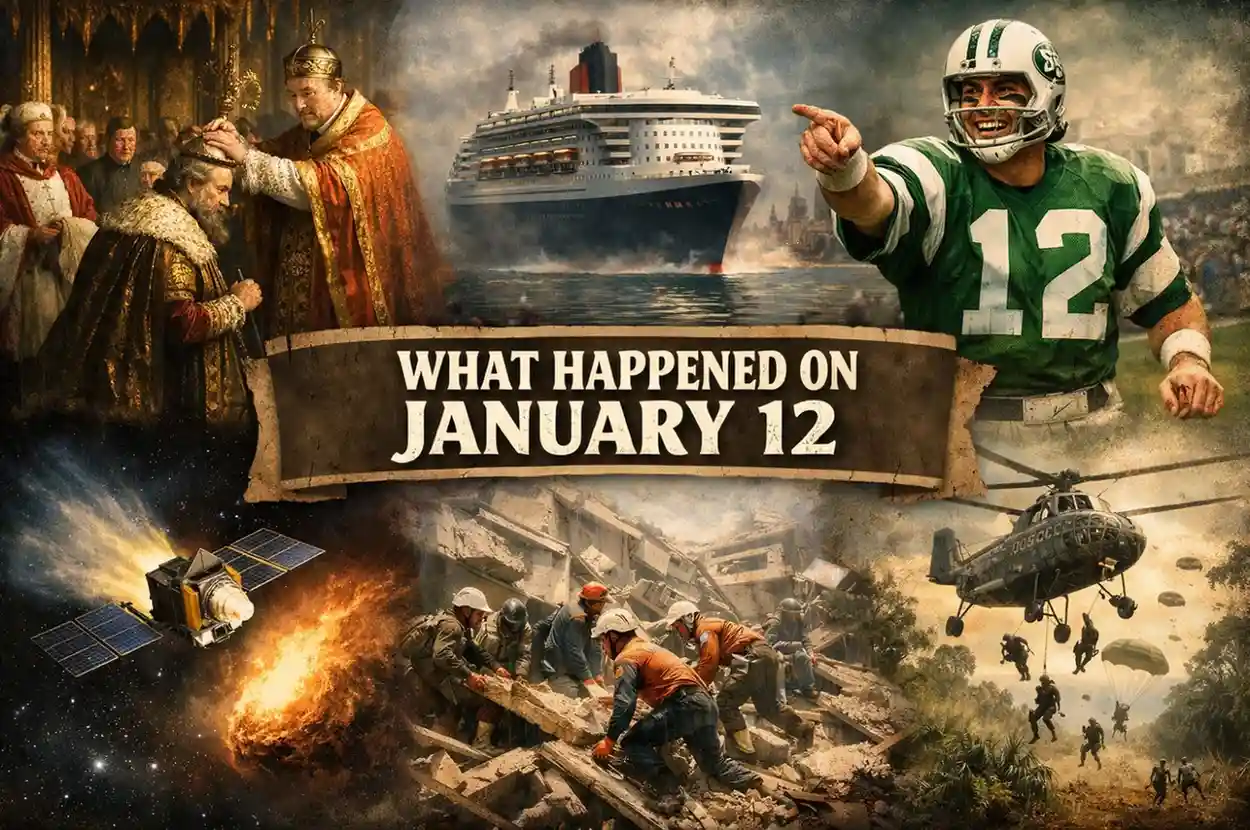
The history of January 12 is a testament to the extremes of human endeavor, from the heights of scientific curiosity to the depths of natural tragedy. To truly understand what happened on this day in history January 12, we must look at the crowning of great kings in Sweden and Burma, the launch of a mission to strike a comet, and the devastating earthquake that forever changed the nation of Haiti.
Important Events That Happened On January 12 In History
475: The Fall of Emperor Zeno
The Byzantine capital of Constantinople fell into chaos as Emperor Zeno was forced to flee for his life following a palace conspiracy. His general, Basiliscus, seized the opportunity to take control of the empire, though his reign would be short-lived and marked by religious controversy. This transition underscored the volatile nature of power in the Eastern Roman Empire during the late 5th century.
1528: Coronation of Gustav I of Sweden
Gustav I, who had already been leading Sweden since his election in 1523, was officially crowned King in a ceremony that solidified his break from the Kalmar Union. His reign is often credited with the founding of modern Sweden, as he established a strong central government and a national church. This coronation was the formal beginning of the Vasa dynasty’s long and influential rule.
1554: Bayinnaung Crowned King of Burma
In Southeast Asia, the legendary leader Bayinnaung was crowned King of Burma, beginning a reign that would redefine the region’s boundaries. He went on to assemble the largest empire in the history of the area, stretching across modern-day Myanmar, Thailand, and Laos. His military brilliance and administrative reforms made him one of the most significant monarchs in Asian history.
1616: Founding of Belém, Brazil
Portuguese captain Francisco Caldeira Castelo Branco founded the city of Belém at the mouth of the Amazon River delta. Originally established as a military outpost called Forte do Presépio to defend against foreign explorers, the settlement became the first European colony on the Amazon. Today, it remains a vital gateway to the Amazon rainforest and a major cultural hub in northern Brazil.
1792: First U.S. Minister to Britain
Federalist Thomas Pinckney was appointed by President George Washington as the first official United States minister to Great Britain. His mission was to stabilize diplomatic relations with the former colonial power and address unresolved issues from the Revolutionary War. This appointment marked a critical step in the early development of American foreign policy and international diplomacy.
1808: Abandonment of St Mary’s Church
In a loss for Anglo-Saxon heritage, John Rennie’s plan to protect the historic St Mary’s Church in Reculver from coastal erosion was officially abandoned. Despite the church’s status as a rare exemplar of 7th-century architecture and sculpture, authorities opted for demolition instead of preservation. Only the two iconic towers were eventually saved to serve as navigational landmarks for sailors.
1808: Formation of the Wernerian Natural History Society
A group of scholars in Edinburgh held an organizational meeting that led to the creation of the Wernerian Natural History Society. Named after the German geologist Abraham Gottlob Werner, the society became a prominent center for the study of the natural world in Scotland. It played a major role in the early 19th-century debates over the origins of the Earth’s geological layers.
1848: The Palermo Rising
Sicily erupted in revolution as the people of Palermo rose up against the rule of the Bourbon Kingdom of the Two Sicilies. This uprising was one of the first in a series of revolutions that would sweep across Europe in 1848, often called the “Springtime of Peoples.” The insurrection successfully forced the King to grant a constitution, though the victory was eventually reversed by military force.
1866: Royal Aeronautical Society Formed
The Royal Aeronautical Society was established in London, dedicated to the scientific study of “aerial navigation.” At a time when human flight was still considered a fantasy by many, the society provided a professional platform for early innovators and engineers. It remains the oldest aeronautical society in the world, having supported the industry from gliders to space exploration.
1872: Coronation of Yohannes IV
Yohannes IV was crowned Emperor of Ethiopia in the ancient city of Axum, marking the first imperial coronation in that holy city in over two centuries. His ascent to the throne followed a period of internal conflict and established him as a warrior-emperor dedicated to defending his nation against foreign invaders. His reign was characterized by his efforts to unify the diverse Ethiopian provinces.
1895: Founding of the National Trust
The National Trust for Places of Historic Interest or Natural Beauty was founded in the United Kingdom by Octavia Hill, Sir Robert Hunter, and Hardwicke Rawnsley. The organization was created to preserve the nation’s heritage and open spaces for the benefit of the public. It has since grown into one of the largest landowners in the UK, protecting thousands of miles of coastline and historic homes.
1911: UP College of Law Established
The University of the Philippines College of Law was officially established, becoming the premier institution for legal education in the country. Since its founding, the college has produced many of the Philippines’ presidents, Supreme Court justices, and influential political leaders. It was designed to provide a rigorous academic foundation for the nation’s burgeoning legal system during the American colonial period.
1915: House Rejects Women’s Suffrage Amendment
The United States House of Representatives rejected a proposed constitutional amendment that would have required states to grant women the right to vote. Despite years of intense lobbying by suffragists, the measure failed to gain the necessary two-thirds majority at the time. This setback only served to further galvanize the women’s suffrage movement, which would eventually succeed five years later.
1916: First German Aviators Receive “Blue Max”
Oswald Boelcke and Max Immelmann became the first German pilots to be awarded the Pour le Mérite, known as the “Blue Max.” The German Empire’s highest military honor was bestowed upon them after each achieved eight aerial victories over Allied aircraft. Their tactical innovations and bravery helped define the early era of aerial dogfighting during World War I.
1918: The Minnie Pit Disaster
One of Britain’s worst coal mining tragedies occurred at the Minnie Pit in Staffordshire, where an underground explosion killed 155 men and boys. The disaster was caused by a buildup of firedamp and coal dust, leaving the local community of Halmer End devastated. The high death toll led to renewed calls for stricter safety regulations and better ventilation in the mining industry.
1932: First Woman Elected to the U.S. Senate
Hattie Caraway made history by becoming the first woman ever elected to the United States Senate. Representing Arkansas, she had initially been appointed to fill her late husband’s seat but won a special election to retain it in her own right. Her victory broke a major gender barrier in American politics and paved the way for future generations of female legislators.
1933: The Casas Viejas Incident
In a dark chapter of Spanish history, 22 peasants were killed by government Security and Assault Corps during an anarchist-inspired uprising in Casas Viejas. The brutal suppression of the local land-less workers caused a national scandal that seriously undermined the credibility of the Second Spanish Republic. The event became a symbol of social injustice and rural poverty in pre-civil war Spain.
1942: Creation of the National War Labor Board
During the early months of U.S. involvement in World War II, President Franklin D. Roosevelt created the National War Labor Board. The agency was designed to mediate labor disputes and prevent strikes that could disrupt vital wartime production. By balancing the needs of workers and industry, the board played a crucial role in maintaining the “Arsenal of Democracy.”
1945: The Vistula–Oder Offensive Begins
The Soviet Red Army launched the Vistula–Oder Offensive, a massive operation aimed at driving German forces out of Poland and advancing toward Berlin. The offensive was one of the most successful of World War II, moving the front line hundreds of miles in just a few weeks. It effectively shattered the German defense in the East and signaled the beginning of the end for the Third Reich.
1955: Mid-Air Collision over Kentucky
Tragedy struck the skies over Boone County, Kentucky, when a Martin 2-0-2 and a Douglas DC-3 collided in mid-air. All 15 people aboard both aircraft were killed in the crash, which occurred during a period of limited visibility. The accident highlighted the urgent need for better air traffic control systems and standardized flight paths to prevent collisions in increasingly crowded airspace.
1962: Operation Chopper
The Vietnam War saw a major escalation with Operation Chopper, the first American combat mission and helicopter assault of the conflict. U.S. Army pilots airlifted over 1,000 South Vietnamese paratroopers to attack a Viet Cong stronghold near Saigon. The success of the operation introduced a new era of “air mobility,” making the helicopter a defining symbol of the war.
1964: The Zanzibar Revolution Begins
African rebels in Zanzibar launched a violent revolt against the ruling Sultan and his predominantly Arab government. The revolution resulted in the overthrow of the monarchy and the proclamation of a new republic, with thousands of civilians killed or displaced in the process. Shortly after, Zanzibar would merge with Tanganyika to form the modern United Republic of Tanzania.
1966: LBJ Defends Vietnam Presence
President Lyndon B. Johnson delivered a firm message during his State of the Union address, stating that U.S. forces should remain in South Vietnam until “Communist aggression” was ended. His speech signaled a commitment to the “containment” policy, despite growing domestic opposition to the war. This stance led to a significant increase in American troop levels and military spending in the years that followed.
1967: First Cryonic Preservation
Dr. James Bedford, a psychology professor, became the first person in history to be cryonically preserved immediately after his death. His body was frozen in liquid nitrogen with the intent of being resuscitated in the future when medical technology had advanced enough to cure his cancer. To this day, Bedford remains in cryopreservation, serving as the longest-running experiment in the field.
1969: The Jets Win Super Bowl III
In one of the most famous upsets in sports history, Joe Namath and the New York Jets defeated the heavily favored Baltimore Colts 16–7. Namath had famously “guaranteed” a victory for the American Football League team over the more established National Football League champions. The win proved the AFL’s legitimacy and accelerated the full merger of the two leagues into the modern NFL.
1970: Capitulation of Biafra
The Nigerian Civil War came to an end as the secessionist state of Biafra officially capitulated to the Nigerian federal government. After three years of brutal fighting and a devastating famine caused by a blockade, the Biafran leaders agreed to a surrender to prevent further loss of life. The conflict left millions dead and remains a significant period of humanitarian crisis in African history.
1971: The Harrisburg Seven Indicted
The U.S. government indicted the “Harrisburg Seven,” a group of anti-war activists including priest Philip Berrigan, on charges of conspiring to kidnap National Security Advisor Henry Kissinger. The group was also accused of plotting to blow up heating tunnels in federal buildings as a protest against the Vietnam War. The trial became a focal point for the 1970s radical protest movement.
1976: UN PLO Debate Vote
The United Nations Security Council voted 11–1 to allow the Palestine Liberation Organization (PLO) to participate in an official debate. While the PLO was not given voting rights, the decision was a significant diplomatic victory that recognized the organization as a representative of the Palestinian people. The move was strongly opposed by the United States but supported by a majority of the council.
1986: Bill Nelson Launches on Columbia
Mission STS-61-C lifted off from the Kennedy Space Center with Congressman Bill Nelson on board as a payload specialist. Nelson, who would later become the NASA Administrator, became the second sitting member of Congress to travel into space. The mission was the final successful shuttle flight before the Challenger disaster occurred just ten days later.
1990: The Baku Pogrom
A violent seven-day pogrom broke out against the Armenian population in Baku, Azerbaijan, resulting in widespread torture, murder, and expulsion. The ethnic violence was part of the growing tensions over the Nagorno-Karabakh region as the Soviet Union began to fracture. Thousands of Armenians were forced to flee their homes, marking a dark chapter in the transition to independence for the Caucasus states.
1991: Authorization for the Gulf War
The United States Congress passed a historic act authorizing President George H.W. Bush to use military force to drive Iraqi forces out of Kuwait. This vote followed months of international diplomacy and the buildup of a massive coalition under Operation Desert Shield. The authorization paved the way for the start of Operation Desert Storm just a few days later.
1997: STS-81 Launches to Mir
The Space Shuttle Atlantis launched on mission STS-81, the fifth shuttle mission to dock with the Russian space station Mir. The shuttle carried astronaut Jerry Linenger, who replaced John Blaha for a four-month stay on the orbiting outpost. This mission was a key part of the Shuttle-Mir program, which fostered cooperation and shared scientific research between the two former Cold War rivals.
1998: European Ban on Human Cloning
Nineteen European nations signed an international agreement in Paris to officially forbid the cloning of human beings. The treaty was a response to the ethical concerns raised by the successful cloning of Dolly the sheep a year earlier. It was the first legally binding international instrument to address the potential for human reproductive cloning, emphasizing human dignity.
2001: Opening of Downtown Disney
The Disneyland Resort in California expanded with the public opening of Downtown Disney, an outdoor shopping, dining, and entertainment district. Designed as a bridge between the theme parks and the hotels, the area offered a “Disney experience” without requiring a park ticket. It was a major component of the resort’s transformation into a multi-day vacation destination.
2004: Maiden Voyage of Queen Mary 2
The RMS Queen Mary 2, the world’s largest and most expensive ocean liner at the time, set sail on its maiden voyage from Southampton to Fort Lauderdale. The ship was designed to capture the elegance of the classic transatlantic liners while incorporating modern luxury and technology. It remains the flagship of the Cunard Line and the only true ocean liner currently in regular service.
2005: Launch of Deep Impact
NASA launched the Deep Impact mission from Cape Canaveral on a journey to intercept the comet Tempel 1. The mission’s goal was to crash a 370-kilogram “impactor” into the comet to study its internal composition and the primordial material of the solar system. The successful impact months later provided unprecedented data about the nature of cometary nuclei.
2006: Hajj Stampede in Mina
A tragic stampede occurred during the “Stoning of the Devil” ritual in Mina, Saudi Arabia, on the final day of the Hajj. At least 362 Muslim pilgrims were killed as a massive crowd surged through a narrow area, leading to one of the deadliest incidents in the history of the pilgrimage. The tragedy led the Saudi government to undertake massive infrastructure projects to improve crowd flow and safety.
2007: Comet McNaught at Zenith
Comet C/2006 P1, popularly known as Comet McNaught, reached its brightest point and was visible to the naked eye even during the day. Discovered by astronomer Robert McNaught, it became one of the brightest comets ever observed in the last century, earning the nickname “The Great Comet of 2007.” Its spectacular fan-shaped tail provided a stunning display for observers in the Southern Hemisphere.
2010: The Haiti Earthquake
A catastrophic 7.0 magnitude earthquake struck Haiti, with its epicenter just miles from the capital, Port-au-Prince. The quake destroyed much of the city’s infrastructure, including the National Palace and the UN headquarters, leaving millions homeless. The death toll was estimated between 220,000 and 300,000 people, making it one of the most devastating natural disasters in modern history.
2012: Austerity Protests in Bucharest
Violent protests erupted in Bucharest and other Romanian cities as citizens demonstrated against President Traian Băsescu’s economic austerity measures. Protesters clashed with law enforcement after the government proposed cuts to healthcare and social services to meet international loan requirements. The unrest eventually led to the resignation of the Prime Minister and a shift in the country’s political landscape.
2015: Government Raid on Boko Haram
Cameroonian government forces carried out a series of heavy raids on Boko Haram militants in the town of Kolofata. The military reported killing 143 of the insurgents who had crossed the border from Nigeria to launch an attack. The engagement was part of an increasing regional effort by African nations to combat the extremist group’s expansion across national borders.
2016: Istanbul Blue Mosque Bombing
A suicide bomber detonated an explosive device in the historic Sultanahmet district of Istanbul, near the famous Blue Mosque. The attack killed ten people, most of whom were German tourists, and wounded 15 others. The Turkish government attributed the bombing to the Islamic State, leading to heightened security and a crackdown on militant cells across the country.
2020: Eruption of Taal Volcano
The Taal Volcano in the Philippines began a powerful phreatic eruption, spewing ash across a wide area including Metro Manila. The eruption forced the evacuation of tens of thousands of people and caused significant damage to agriculture and infrastructure. While the immediate eruption was spectacular, the secondary effects and related health issues resulted in the deaths of 39 people.
Read Also: What Happened On This Day In History January 11: Ancient Empires & Medical Breakthroughs
Famous People Born On January 12
| Name | Role / Short Note | Dates |
|---|---|---|
| John Singer Sargent | American painter, master of portraiture | Jan 12, 1856 – Apr 15, 1925 |
| Joseph-Jacques-Césaire Joffre | French general, “Victor of the Marne” | Jan 12, 1852 – Jan 3, 1931 |
| Johann Heinrich Pestalozzi | Swiss educational reformer | Jan 12, 1746 – Feb 17, 1827 |
| Luise Rainer | Actress, first double Oscar winner | Jan 12, 1910 – Dec 30, 2014 |
| P. W. Botha | State president of South Africa | Jan 12, 1916 – Oct 31, 2006 |
| Ruth Brown | R&B singer, “Miss Rhythm” | Jan 12, 1928 – Nov 17, 2006 |
| David Wechsler | Psychologist, IQ test pioneer | Jan 12, 1896 – May 2, 1981 |
| Igor Kurchatov | Soviet nuclear physicist | Jan 12, 1903 – Feb 7, 1960 |
| Étienne Lenoir | Inventor, internal-combustion engine | Jan 12, 1822 – Aug 4, 1900 |
| Morton Feldman | Avant-garde American composer | Jan 12, 1926 – Sep 3, 1987 |
| Walter Mosley | American crime novelist | Jan 12, 1952 – |
| Texas Guinan | Actress & Prohibition-era icon | Jan 12, 1884 – Nov 5, 1933 |
| Ferdinand II | King of the Two Sicilies | Jan 12, 1810 – May 22, 1859 |
| Max Eastman | Writer & political activist | Jan 12, 1883 – Mar 25, 1969 |
| Charles Emmanuel I | Duke of Savoy | Jan 12, 1562 – Jul 26, 1630 |
| José Limón | Modern dancer & choreographer | Jan 12, 1908 – Dec 2, 1972 |
| James Mark Baldwin | Philosopher & psychologist | Jan 12, 1861 – Nov 8, 1934 |
| Émile Lahoud | President of Lebanon | Jan 12, 1936 – |
| Georges Carpentier | World boxing champion | Jan 12, 1894 – Oct 27, 1975 |
| Ferenc Molnár | Hungarian playwright | Jan 12, 1878 – Apr 1, 1952 |
| Paul Hermann Müller | Chemist, Nobel laureate (DDT) | Jan 12, 1899 – Oct 12, 1965 |
| Philip Speakman Webb | Arts & Crafts architect | Jan 12, 1831 – Apr 17, 1915 |
| Spyridon Louis | Olympic marathon gold medalist | Jan 12, 1873 – Mar 26, 1940 |
| Zhang Binglin | Chinese scholar & revolutionary | Jan 12, 1869 – Jun 14, 1936 |
| Pierre Brossolette | French Resistance leader | Jan 12, 1903 – Mar 22, 1944 |
| Kurt Jooss | German dance innovator | Jan 12, 1901 – May 22, 1979 |
| Gregorio Ricci-Curbastro | Mathematician, tensor calculus | Jan 12, 1853 – Aug 6, 1925 |
| Fevzi Çakmak | Turkish marshal & statesman | Jan 12, 1876 – Apr 10, 1950 |
| Bolesław Leśmian | Polish modernist poet | Jan 12, 1877/78 – Nov 5, 1937 |
| Sandro Penna | Italian lyric poet | Jan 12, 1906 – Jan 21, 1977 |
Famous People Died On January 12
| Name | Role / Short Note | Dates |
|---|---|---|
| Pierre de Fermat | Mathematician, number theory pioneer | Aug 17, 1601 – Jan 12, 1665 |
| Hermann Minkowski | Mathematician, relativity geometry | Jun 22, 1864 – Jan 12, 1909 |
| William Hewlett | HP co-founder, engineer | May 20, 1913 – Jan 12, 2001 |
| Marie-Antoine Carême | Founder of haute cuisine | Jun 8, 1784 – Jan 12, 1833 |
| Cyrus Vance | U.S. Secretary of State | Mar 27, 1917 – Jan 12, 2002 |
| Tongzhi | Qing dynasty emperor | Apr 27, 1856 – Jan 12, 1875 |
| Nevil Shute | Novelist (On the Beach) | Jan 17, 1899 – Jan 12, 1960 |
| Friedrich von Schlegel | German Romantic writer | Mar 10, 1772 – Jan 12, 1829 |
| Laurence J. Peter | Author, Peter Principle | Sep 16, 1919 – Jan 12, 1990 |
| William Wyndham Grenville | British prime minister | Oct 25, 1759 – Jan 12, 1834 |
| Nikolay Podgorny | Soviet head of state | Feb 18, 1903 – Jan 12, 1983 |
| Saint Aelred of Rievaulx | Medieval theologian & abbot | c.1110 – Jan 12, 1167 |
| Georg Forster | Explorer & scientist | Nov 26, 1754 – Jan 12, 1794 |
| Sharad Yadav | Indian politician | Jul 1, 1947 – Jan 12, 2023 |
| Sir Isaac Pitman | Shorthand system inventor | Jan 4, 1813 – Jan 12, 1897 |
| Giacomo Carissimi | Baroque composer | Apr 18, 1605 – Jan 12, 1674 |
| Saint Benedict Biscop | English monastic founder | c.628 – Jan 12, 689/690 |
| Ellen Arthur | Wife of U.S. President Chester A. Arthur | Aug 30, 1837 – Jan 12, 1880 |
| Georg Jellinek | Legal & political philosopher | Jun 16, 1851 – Jan 12, 1911 |
| Charles B. Huggins | Nobel Prize–winning cancer researcher | Sep 22, 1901 – Jan 12, 1997 |
| John M. Stahl | Hollywood film director | Jan 21, 1886 – Jan 12, 1950 |
| Bob Kaufman | Beat poet | Apr 18, 1925 – Jan 12, 1986 |
| Sir Stafford Northcote | British Conservative leader | Oct 27, 1818 – Jan 12, 1887 |
| Ramón Gómez de la Serna | Spanish avant-garde writer | Jul 3, 1888 – Jan 12, 1963 |
| Joshua Humphreys | Naval architect (USS Constitution) | Jun 17, 1751 – Jan 12, 1838 |
| Gösta Ekman | Swedish stage & film actor | Dec 28, 1890 – Jan 12, 1938 |
| Richard Challoner | English Catholic Bible editor | Sep 29, 1691 – Jan 12, 1781 |
| Macarius of Moscow | Russian Orthodox metropolitan | c.1482 – Jan 12, 1564 |
| Vasco Pratolini | Italian novelist | Oct 19, 1913 – Jan 12, 1991 |
| Peter Rochegune Munch | Danish foreign minister | Jul 25, 1870 – Jan 12, 1948 |
Observances & Institutional Dates
- National Youth Day (India): Celebrated to honor the birthday of Swami Vivekananda, focusing on the potential and energy of the youth.
- Memorial Day (Turkmenistan): A day of remembrance for those who died during the 1881 Battle of Geok Tepe against the Russian Empire.
- Zanzibar Revolution Day: A public holiday in Tanzania commemorating the 1964 overthrow of the Sultan of Zanzibar.
- Yennayer (Algeria): The Berber New Year, celebrated with traditional meals and festivities marking the start of the agrarian calendar.
Frequently Asked Questions
What major disaster occurred on January 12, 2010?
Haiti was struck by a massive 7.0 magnitude earthquake that killed hundreds of thousands of people and destroyed the capital city.
Who was the first person cryonically preserved on this day?
Dr. James Bedford became the first person in history to be cryonically frozen on January 12, 1967, with the hope of future resuscitation.
Which historic football game took place on January 12, 1969?
Super Bowl III took place, where Joe Namath and the New York Jets famously upset the Baltimore Colts.