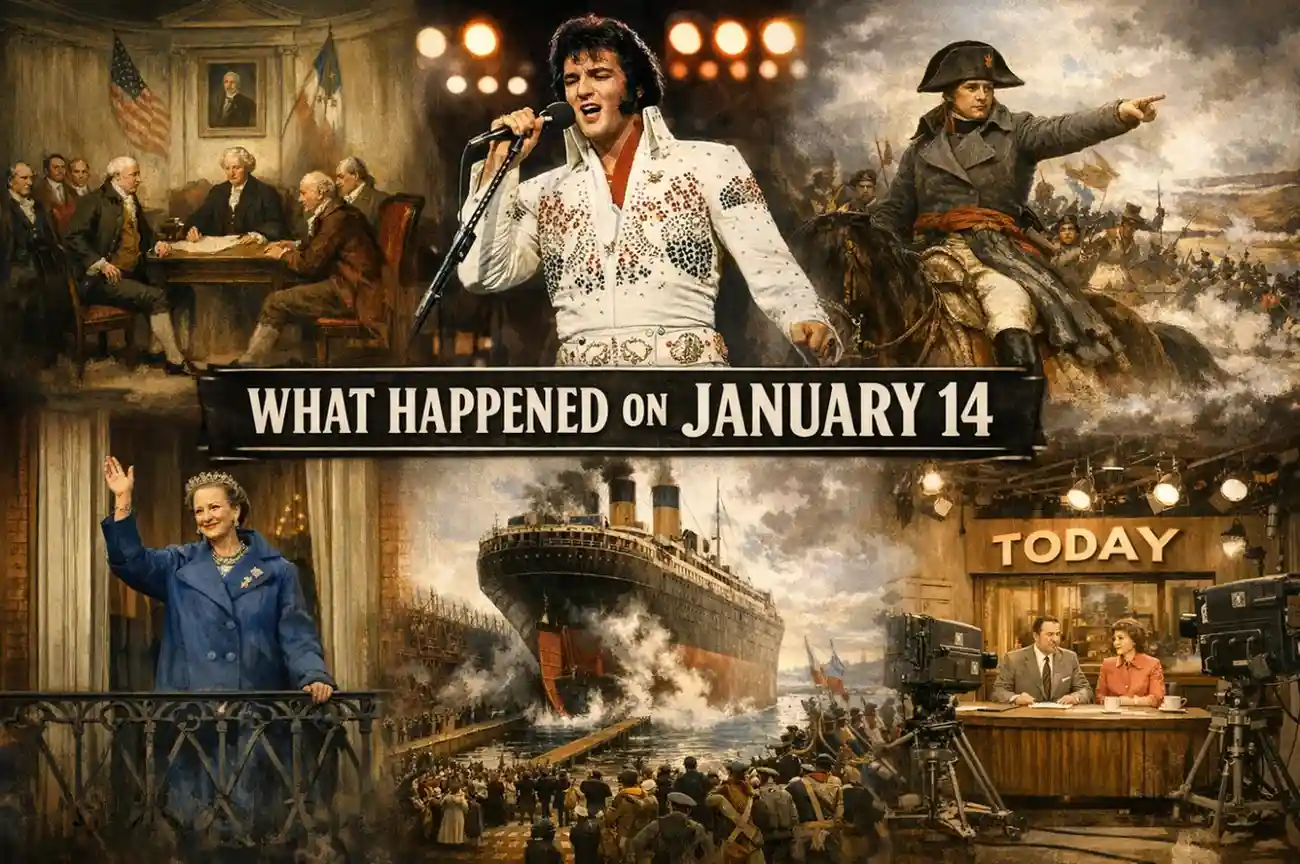
The history of January 14 is a chronicle of the rise and fall of dynasties, the shifting of global borders, and the birth of modern mass media. To understand what happened on this day in history January 14, we look back at the conclusion of the American Revolution with the ratification of the Treaty of Paris, the crowning of a historic Danish Queen, and the moment Elvis Presley reached a global audience of over one billion people via satellite.
Important Events That Happened On January 14 In History
1236: The Marriage of King Henry III and Eleanor of Provence
King Henry III of England wed Eleanor of Provence at Canterbury Cathedral, a union that brought a strong French influence into the English court. Eleanor, known for her sharp intellect and political savvy, became a powerful figure in her own right, though her foreign relatives often drew the ire of English barons. Their marriage lasted over thirty years and produced several children, including the future King Edward I.
1301: The End of the Árpád Dynasty
The death of Andrew III of Hungary brought a definitive end to the Árpád dynasty, the royal house that had ruled Hungary since the late 9th century. Andrew’s passing without a male heir plunged the kingdom into a period of chaotic interregnum and civil strife as various European powers vied for the Hungarian throne. The extinction of this ancient bloodline marked a major structural shift in the power dynamics of Central Europe.
1761: The Third Battle of Panipat
One of the most consequential conflicts of the 18th century took place at Panipat, where the Afghan Durrani Empire clashed with the Maratha Empire. The battle involved massive forces and resulted in a decisive Afghan victory, halting the Maratha expansion toward Northern India. The sheer scale of the casualties and the tactical maneuvers used make it one of the most studied military engagements in Indian history.
1784: Ratification Day in the United States
The American Revolutionary War officially reached its legal conclusion as the Confederation Congress ratified the Treaty of Paris. Meeting at the Maryland State House in Annapolis, the delegates formally accepted the terms that recognized the United States as a sovereign and independent nation. This day, known as Ratification Day, transformed the colonies into a country officially recognized by the global community.
1797: The Battle of Rivoli
Napoleon Bonaparte secured one of his most brilliant tactical victories at the Battle of Rivoli, defeating a numerically superior Austrian force. This decisive win allowed the French to capture Mantua and effectively ended the War of the First Coalition in Italy. The battle established Napoleon’s reputation as a military genius and began twenty years of French hegemony over the Italian peninsula.
1814: The Treaty of Kiel
During the final phases of the Napoleonic Wars, the Treaty of Kiel was signed, forcing Frederick VI of Denmark to cede the Kingdom of Norway to the King of Sweden. In exchange, Denmark received the territory of Western Pomerania, though the deal was deeply unpopular among the Norwegian people. This diplomatic reshuffling broke a 400-year union between Denmark and Norway and led to Norway’s brief struggle for independence later that year.
1858: Assassination Attempt on Napoleon III
Emperor Napoleon III of France and Empress Eugénie narrowly escaped death when Felice Orsini and his fellow conspirators detonated three bombs at their royal carriage in Paris. While the royals were unharmed, the blast killed several bystanders and wounded over 150 people. Orsini, an Italian nationalist, hoped that the Emperor’s death would spark a revolution in Italy, but the attempt only led to his own execution and increased state security.
1861: Birth of Mehmed VI
The man who would become the final leader of the Ottoman Empire, Mehmed VI, was born in Constantinople. His reign would eventually coincide with the collapse of the empire following World War I and the subsequent rise of the Republic of Turkey. His birth marked the beginning of the end for a dynasty that had ruled for six centuries, as he would eventually be sent into exile in 1922.
1899: Launch of the RMS Oceanic
The White Star Line launched the RMS Oceanic, which held the title of the largest ship afloat since the legendary Great Eastern. Built by Harland and Wolff in Belfast, the ship was designed for luxury and comfort rather than speed, setting a new standard for transatlantic travel. It served as a flagship for the line until the arrival of the Olympic class vessels over a decade later.
1900: Premiere of Giacomo Puccini’s Tosca
The Teatro Costanzi in Rome hosted the world premiere of Giacomo Puccini’s opera Tosca, a dramatic tale of love, lust, and political intrigue. Despite receiving mixed reviews from critics at the time, the audience was captivated by the powerful score and the high-stakes plot set during the Napoleonic Wars. Tosca quickly became one of the most performed and beloved operas in the standard repertoire.
1907: The Kingston Earthquake
A devastating 6.5 magnitude earthquake struck Kingston, Jamaica, leveling nearly every building in the city and killing over 1,000 people. The initial tremors were followed by a massive fire that consumed the central business district, leaving thousands of residents homeless. The disaster prompted a major rebuilding effort and led to the implementation of more rigorous seismic building standards on the island.
1911: Amundsen Reaches the Ross Ice Shelf
Roald Amundsen’s South Pole expedition successfully made landfall on the eastern edge of the Ross Ice Shelf at a site they named the Bay of Whales. This location gave the Norwegian team a significant head start over their British rivals led by Robert Falcon Scott. From this base, Amundsen would spend the coming months preparing for his historic trek to the geographic South Pole.
1939: Norway Claims Queen Maud Land
The Norwegian government officially laid claim to Queen Maud Land, a vast sector of Antarctica between 20° west and 45° east. The claim was made primarily to protect the interests of the Norwegian whaling industry in the region and to ensure research opportunities. This territorial assertion remains part of the Antarctic Treaty System today, though it is not universally recognized by all nations.
1943: Operation Ke Begins
Faced with a losing battle on Guadalcanal, the Japanese military high command began Operation Ke, a highly secretive and successful evacuation plan. Over the course of several weeks, Japanese destroyers managed to extract over 10,000 elite troops under the cover of night, right from under the noses of the Allied forces. This maneuver saved much of the Japanese army’s veteran strength for future campaigns in the Pacific.
1943: The Casablanca Conference
President Franklin D. Roosevelt and Prime Minister Winston Churchill met in the Moroccan city of Casablanca to discuss the next phase of Allied strategy in World War II. It was during this high-level summit that the leaders agreed to the policy of “unconditional surrender” for the Axis powers. They also finalized plans for the invasion of Sicily and the cross-channel invasion of France.
1951: Crash of National Airlines Flight 83
National Airlines Flight 83 overshot the runway during a landing attempt at Philadelphia International Airport in snowy conditions. The aircraft skidded through a fence and caught fire, resulting in the deaths of seven people on board. The accident led to a federal investigation into runway safety and the effectiveness of braking systems on commercial airliners during winter weather.
1952: Debut of NBC’s Today Show
Television history was made when host Dave Garroway introduced the first broadcast of NBC’s Today show. As the first program of its kind, it blended news, features, and weather into a morning magazine format that allowed viewers to catch up on the world while getting ready for work. The show became a cornerstone of American media and the longest-running morning news program in the world.
1953: Tito Elected President of Yugoslavia
Josip Broz Tito was officially elected as the first President of the Socialist Federal Republic of Yugoslavia. Having led the Partisan resistance against Axis forces during World War II, Tito became the unifying figure for the ethnically diverse nation. His leadership was marked by the “Tito-Stalin split,” which saw Yugoslavia pursue a unique path of non-alignment during the Cold War.
1954: Formation of American Motors Corporation
The Hudson Motor Car Company merged with the Nash-Kelvinator Corporation to form the American Motors Corporation (AMC). At the time, it was the largest corporate merger in U.S. history, aimed at creating a company large enough to compete with the “Big Three” Detroit automakers. AMC would go on to produce iconic vehicles like the Rambler and the Jeep before eventually being acquired by Chrysler.
1957: Kripalu Maharaj Named Jagadguru
Kripalu Maharaj was bestowed with the title of Jagadguru, or “World Teacher,” the fifth person in history to receive the honor from the Kashi Vidvat Parishat. This prestigious title followed seven days of profound spiritual speeches delivered before 500 of India’s leading Hindu scholars. His teachings focused on the path of Bhakti, or devotion, and he went on to influence millions of followers worldwide.
1960: Establishment of the Reserve Bank of Australia
The Reserve Bank of Australia was formally established as the nation’s central bank, taking over the central banking functions previously held by the Commonwealth Bank. Authorized by the 1959 Reserve Bank Act, the institution was tasked with managing Australia’s monetary policy and issuing its currency. This move ensured a more stable and independent financial system for the country’s growing economy.
1967: The Human Be-In
Tens of thousands of people gathered in San Francisco’s Golden Gate Park for the “Human Be-In,” an event that served as the catalyst for the 1960s counterculture movement. Featuring poetry readings, music from bands like the Grateful Dead, and speeches by Timothy Leary, the event promoted communal living and environmental awareness. It was the precursor to the famous “Summer of Love” that defined a generation.
1969: Explosion Aboard the USS Enterprise
A massive fire and a series of accidental explosions rocked the nuclear-powered aircraft carrier USS Enterprise during a training exercise off the coast of Hawaii. The disaster was triggered when the exhaust from a starter motor ignited a Zuni rocket on a parked aircraft, leading to a chain reaction of detonations. The fire killed 28 sailors and wounded over 300, serving as a tragic lesson in flight deck safety.
1972: Ascension of Queen Margrethe II
Following the death of her father, King Frederik IX, Margrethe II ascended the throne as the Queen of Denmark. She was the first female monarch of Denmark since Margrethe I in the 15th century, made possible by a constitutional amendment in 1953 that allowed for female succession. Her reign became one of the longest in Danish history, characterized by her artistic talents and modern approach to the monarchy.
1973: Elvis Presley’s Aloha from Hawaii
Elvis Presley made television history with his Aloha from Hawaii concert, which was broadcast live via satellite to over 40 countries. Reaching an estimated audience of over one billion people, it was the most-watched broadcast by a single entertainer at the time. Wearing his iconic white studded jumpsuit, Elvis delivered a performance that remains a definitive moment in the history of rock and roll and global media.
1993: Sinking of the MS Jan Heweliusz
In Poland’s worst peacetime maritime disaster, the ferry MS Jan Heweliusz capsized and sank in the Baltic Sea during a violent storm. The ship was traveling from Swinoujscie to Ystad when it succumbed to hurricane-force winds and high waves off the coast of Rügen. Out of the 64 people on board, 55 passengers and crew members perished in the freezing waters.
2010: Yemen Declares War on al-Qaeda
The government of Yemen officially declared “open war” against the terrorist organization al-Qaeda in the Arabian Peninsula (AQAP). This declaration followed a series of attacks and a failed attempt to bomb a U.S. airliner on Christmas Day the previous year. The announcement signaled an intensification of military operations and increased counter-terrorism cooperation with international partners.
2016: Jakarta Terrorist Attacks
Multiple explosions and a series of shootouts occurred near the Sarinah Building in central Jakarta, marking a major security crisis in Indonesia. The Islamic State claimed responsibility for the coordinated attack, which targeted a police post and a Starbucks cafe. Seven people, including five perpetrators and two civilians, were killed in the violence, leading to a massive regional crackdown on militant cells.
2019: Saha Airlines Boeing 707 Crash
A Saha Airlines Boeing 707 cargo plane crashed at Fath Air Base in Iran after the pilot reportedly overshot the runway during an emergency landing. The aircraft was carrying a shipment of meat from Kyrgyzstan when it struck a residential area and burst into flames. Out of the 16 people on board, 15 were killed, with the flight engineer being the sole survivor of the wreckage.
2024: Abdication of Queen Margrethe II
After 52 years on the throne, Queen Margrethe II of Denmark officially abdicated, a move she had announced during her New Year’s Eve speech. She signed the declaration of abdication at Christiansborg Palace, immediately followed by the proclamation of her son as King Frederik X. This historic transition was the first voluntary abdication by a Danish monarch in nearly 900 years.
2026: The Sikhio District Train Disaster
Tragedy struck the Sikhio district of Thailand when a construction crane collapsed onto a passing passenger train. The impact caused several carriages to derail and resulted in the deaths of 32 people, with dozens more suffering serious injuries. The accident led to a national inquiry into construction safety protocols near active railway lines and sparked calls for stricter oversight of heavy machinery operations.
Explore Also Key Eents From January 13
Famous People Born On January 14
| Name | Role / Short Note | Dates |
|---|---|---|
| Martin Niemöller | German theologian, anti-Nazi pastor | Jan 14, 1892 – Mar 6, 1984 |
| Mehmed VI | Last Ottoman sultan | Jan 14, 1861 – May 16, 1926 |
| Andy Rooney | American journalist, 60 Minutes | Jan 14, 1919 – Nov 4, 2011 |
| T Bone Burnett | American music producer & musician | Jan 14, 1948 – |
| John Dos Passos | American novelist, Lost Generation | Jan 14, 1896 – Sep 28, 1970 |
| Hal Roach | Film producer, comedy pioneer | Jan 14, 1892 – Nov 2, 1992 |
| Julian Bond | Civil rights leader & politician | Jan 14, 1940 – Aug 15, 2015 |
| Trevor Nunn | English theatre director | Jan 14, 1940 – |
| Maureen Dowd | Pulitzer Prize–winning columnist | Jan 14, 1952 – |
| Sir Cecil Beaton | British photographer & designer | Jan 14, 1904 – Jan 18, 1980 |
| Giulio Andreotti | Prime minister of Italy | Jan 14, 1919 – May 6, 2013 |
| Alfred Tarski | Mathematician & logician | Jan 14, 1901 – Oct 26, 1983 |
| Carlos P. Romulo | Filipino diplomat & UN leader | Jan 14, 1899 – Dec 15, 1985 |
| Matthew Fontaine Maury | Pioneer oceanographer | Jan 14, 1806 – Feb 1, 1873 |
| Garry Winogrand | Influential street photographer | Jan 14, 1928 – Mar 19, 1984 |
| Henri Fantin-Latour | French painter | Jan 14, 1836 – Aug 25, 1904 |
| Joseph Losey | Film director | Jan 14, 1909 – Jun 22, 1984 |
| Valdemar I | King of Denmark | Jan 14, 1131 – May 12, 1182 |
| Shannon Wells Lucid | American astronaut | Jan 14, 1943 – |
| Hosokawa Morihiro | Prime minister of Japan | Jan 14, 1938 – |
| Pierre Loti | French novelist | Jan 14, 1850 – Jun 10, 1923 |
| Hugh Lofting | Author, Dr. Dolittle | Jan 14, 1886 – Sep 26, 1947 |
| Alberico Gentili | Founder of international law | Jan 14, 1552 – Jun 19, 1608 |
| Thornton W. Burgess | Children’s author & naturalist | Jan 14, 1874 – Jun 5, 1965 |
| Tillie Olsen | American writer & activist | Jan 14, 1912 – Jan 1, 2007 |
| Zacharias Topelius | Finnish national author | Jan 14, 1818 – Mar 12, 1898 |
| Richard Felton Outcault | Creator of The Yellow Kid | Jan 14, 1863 – Sep 25, 1928 |
| Fukuda Takeo | Prime minister of Japan | Jan 14, 1905 – Jul 5, 1995 |
| Jean de Reszke | Operatic tenor | Jan 14, 1850 – Apr 3, 1925 |
| Ralph M. Steinman | Nobel Prize–winning immunologist | Jan 14, 1943 – Sep 30, 2011 |
Famous People Died On January 14
| Name | Role / Short Note | Dates |
|---|---|---|
| George Berkeley | Idealist philosopher | Mar 12, 1685 – Jan 14, 1753 |
| Edmond Halley | Astronomer, Halley’s Comet | Nov 8, 1656 – Jan 14, 1742 |
| Jean-Auguste-Dominique Ingres | French Neoclassical painter | Aug 29, 1780 – Jan 14, 1867 |
| Peter Finch | Academy Award–winning actor | Sep 28, 1916 – Jan 14, 1977 |
| Douglas Sirk | Film director | Apr 26, 1897 – Jan 14, 1987 |
| St. Sava | Founder of Serbian Orthodox Church | 1175 – Jan 14, 1236 |
| Harold Abrahams | Olympic gold medalist | Dec 15, 1899 – Jan 14, 1978 |
| Jerzy Grotowski | Experimental theatre pioneer | Aug 11, 1933 – Jan 14, 1999 |
| Frederick V | King of Denmark & Norway | Mar 31, 1723 – Jan 14, 1766 |
| Johann Philipp Reis | Telephone precursor inventor | Jan 7, 1834 – Jan 14, 1874 |
| Harry Stack Sullivan | Psychiatrist, interpersonal theory | Feb 21, 1892 – Jan 14, 1949 |
| Charles Hermite | Mathematician | Dec 24, 1822 – Jan 14, 1901 |
| Francesco Cavalli | Baroque opera composer | Feb 14, 1602 – Jan 14, 1676 |
| Timothy O’Sullivan | Civil War photographer | c.1840 – Jan 14, 1882 |
| Henry Edward Manning | British cardinal | Jul 15, 1808 – Jan 14, 1892 |
| Victoria de los Ángeles | Spanish opera soprano | Nov 1, 1923 – Jan 14, 2005 |
| Ahmed Ali | Pakistani writer | Jul 1, 1910 – Jan 14, 1994 |
| Joaquín Turina | Spanish composer | Dec 9, 1882 – Jan 14, 1949 |
| Odoric of Pordenone | Medieval traveler | c.1286 – Jan 14, 1331 |
| Robert Napier, 1st Baron Napier | British field marshal | Dec 6, 1810 – Jan 14, 1890 |
| Heinrich Schenker | Music theorist | Jun 19, 1868 – Jan 14, 1935 |
| Paolo Sarpi | Venetian theologian & historian | Aug 14, 1552 – Jan 14, 1623 |
| Alexander Jackson Davis | American architect | Jul 24, 1803 – Jan 14, 1892 |
| Juan Gelman | Argentine poet | May 3, 1930 – Jan 14, 2014 |
| Ṣalāḥ Khalaf | Palestinian political leader | 1933 – Jan 14, 1991 |
| Tokugawa Mitsukuni | Japanese feudal lord | Jul 11, 1628 – Jan 14, 1701 |
| Gustav Cassel | Economist | Oct 20, 1866 – Jan 14, 1945 |
| Holger Henrik Herholdt Drachmann | Danish author | Oct 9, 1846 – Jan 14, 1908 |
| George Cram Cook | Playwright, Provincetown Players | Oct 7, 1873 – Jan 14, 1924 |
| Joseph Herman Hertz | Chief Rabbi of Britain | Sep 25, 1872 – Jan 14, 1946 |
Observances & Institutional Dates
- Ratification Day (United States): Commemorating the 1784 date when the United States officially became a recognized sovereign nation.
- Defender of the Motherland Day (Uzbekistan): A day dedicated to the personnel of the Uzbek Armed Forces and their service to the nation.
- World Logic Day: An international day established by UNESCO to foster the development of logic, both in research and teaching.
- Flag Day (Georgia): A celebration of the national flag and the historical symbols of the country of Georgia.
- National Forest Conservation Day (Thailand): A day focused on raising awareness about the preservation and restoration of Thailand’s forest resources.
Frequently Asked Questions
What major event happened in American history on January 14, 1784?
It was Ratification Day, the day the Confederation Congress ratified the Treaty of Paris, officially ending the Revolutionary War.
Who became the first Queen of Denmark in over 500 years on this day?
Queen Margrethe II ascended the throne on January 14, 1972, following the death of King Frederik IX.
What was unique about Elvis Presley’s 1973 Hawaii concert?
It was the first concert by an individual entertainer to be broadcast live via satellite to a global audience of over one billion people.