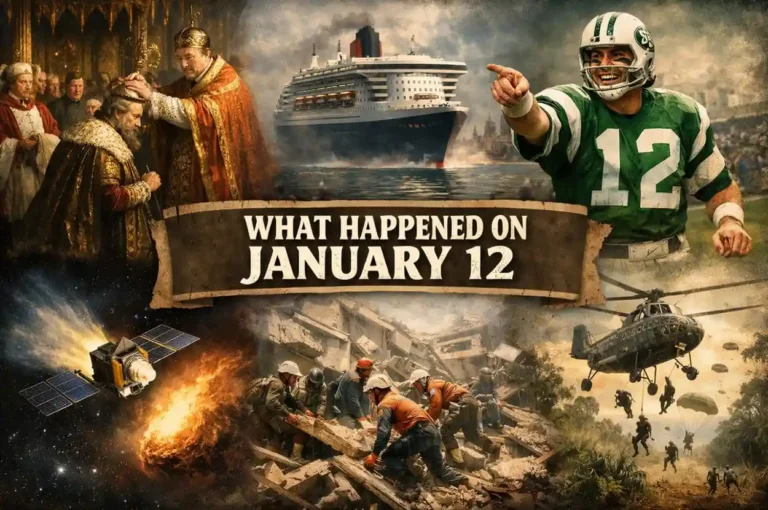
The history of January 15 spans from the rise of Roman emperors and the crowning of English queens to the birth of the world’s most famous digital encyclopedia. To understand what happened on this day in history January 15, we look at the official opening of the British Museum, the “Miracle on the Hudson,” and the moment the rules of basketball were shared with the world.
Important Events That Happened On January 15 In History
69: Otho Seizes Power in Rome
In a year of total political chaos, Otho orchestrated a coup against Emperor Galba and was proclaimed the new Emperor of Rome. His rise was fueled by the support of the Praetorian Guard, but his triumph would be fleeting. His reign lasted only three months before the pressures of civil war led to his downfall.
1535: Henry VIII Becomes Supreme Head
King Henry VIII issued letters patent to officially incorporate the title “Supreme Head of the Church of England” into his royal title. This move followed the Act of Supremacy and legally severed England’s ties with the Roman Catholic Church. It placed the monarch at the peak of both state and religious authority, forever changing English life.
1541: Commission for New France
King Francis I of France granted Jean-François Roberval a commission to lead a settlement in the province of New France, modern-day Canada. The mission was not just territorial; it was tasked with the spread of the “Holy Catholic faith” in the new world. This act marked a renewed French commitment to establishing a permanent presence in North America.
1559: Coronation of Elizabeth I
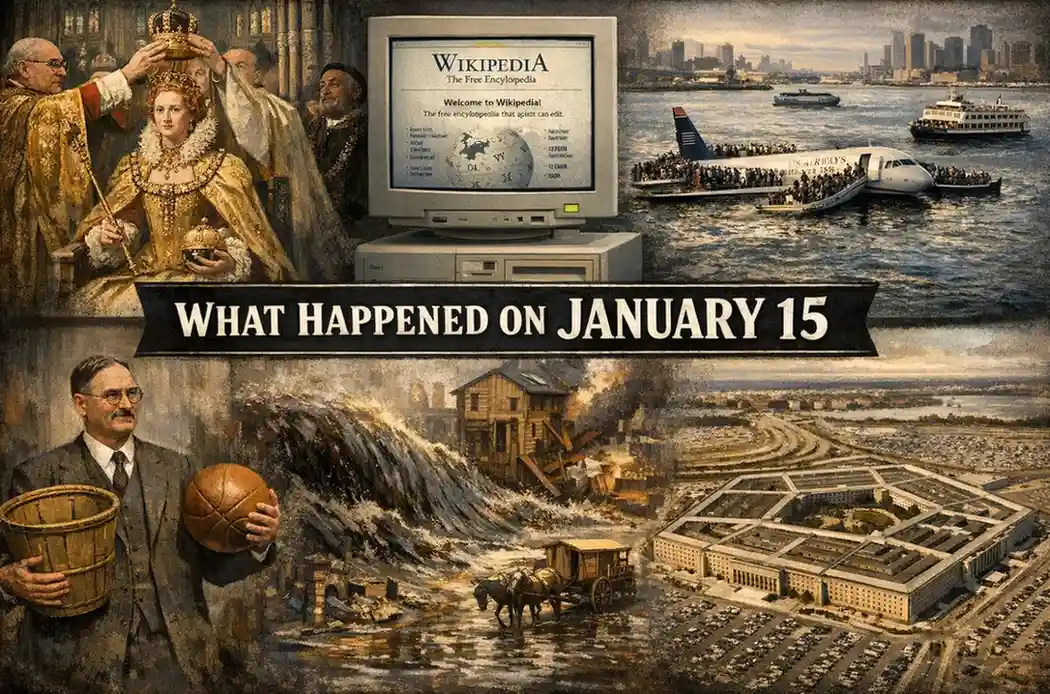
Elizabeth I was officially crowned Queen of England and Ireland in a grand ceremony at Westminster Abbey. As the last monarch of the Tudor dynasty, her coronation began an era of significant cultural and political expansion. Her reign would eventually see England emerge as a major global power and a center for the arts.
1582: Truce of Yam-Zapolsky
The Livonian War saw a major shift as Russia signed the Truce of Yam-Zapolsky, ceding Livonia to the Polish–Lithuanian Commonwealth. This ten-year peace treaty ended a long period of heavy fighting and signaled a temporary retreat for Russian expansion in the Baltic. It solidified the power of Poland-Lithuania in the region for the late 16th century.
1759: The British Museum Opens
The British Museum, the first national public museum in the world, opened its doors to the public in London’s Montagu House. Based largely on the collections of physician and scientist Sir Hans Sloane, it was intended to be “free for all studious and curious persons.” Today, it houses millions of works documenting human history and culture.
1777: New Connecticut Declares Independence
During the early years of the American Revolution, the region known as New Connecticut officially declared its independence. Located in what is now Vermont, the territory sought to separate itself from both the British crown and conflicting land claims from New York and New Hampshire. This declaration laid the groundwork for the state’s eventual entry into the Union.
1782: Recommendation for a National Mint
Robert Morris, the U.S. Superintendent of Finance, addressed the Congress to recommend the establishment of a national mint. He proposed a system of decimal coinage to replace the confusing variety of currencies then in circulation. His vision was a critical step toward creating a unified and stable financial identity for the young United States.
1815: Capture of the USS President
During the War of 1812, the American frigate USS President, under the command of Commodore Stephen Decatur, was intercepted by a British squadron. Despite a valiant attempt to outrun and outfight the four British frigates, the American vessel was captured. The loss was a significant blow to the small U.S. Navy in the final stages of the conflict.
1818: Scientific Breakthroughs in Light
The Royal Society heard a paper by David Brewster announcing his discovery of the biaxial class of doubly-refracting crystals. On the same day, Augustin-Jean Fresnel signed a supplement regarding the reflection of polarized light. These simultaneous developments in optics significantly advanced the world’s understanding of how light interacts with physical matter.
1822: Election of Demetrios Ypsilantis
In the midst of the Greek War of Independence, the legislative assembly elected Demetrios Ypsilantis as its president. Ypsilantis was a prominent figure in the struggle against Ottoman rule, representing the hopes of many Greeks for a unified and sovereign government. His leadership was vital in organizing the early political structures of the Greek revolution.
1865: The Fall of Fort Fisher
Union forces successfully captured Fort Fisher in North Carolina after a massive naval bombardment and land assault. The fall of this “Gibraltar of the South” was a strategic disaster for the Confederacy, as it cut off their last major seaport. Without the supplies coming through Wilmington, the Confederate army’s ability to sustain the war was crippled.
1867: Tragedy at Regent’s Park
Forty people lost their lives in London when the ice covering the boating lake at Regent’s Park suddenly collapsed. Hundreds of people had been skating on the thin ice when the tragedy occurred, leading to a desperate and chaotic rescue attempt. The event shocked the city and led to changes in how public frozen lakes were managed and safety-checked.
1870: The Democratic Donkey
Political cartoonist Thomas Nast published a drawing in Harper’s Weekly that popularized the donkey as a symbol for the Democratic Party. Titled “A Live Jackass Kicking a Dead Lion,” the cartoon was a commentary on northern Democrats who opposed the war effort. While originally meant to be insulting, the party eventually adopted the animal as a symbol of humble persistence.
1876: First Afrikaans Newspaper
The first newspaper in the Afrikaans language, Die Afrikaanse Patriot, began publication in Paarl, South Africa. This was a landmark moment for the development of Afrikaans as a literary and journalistic language. It played a significant role in promoting the cultural identity of the Cape Dutch descendants and the broader Afrikaans-speaking community.
1889: Incorporation of Coca-Cola
The Coca-Cola Company, which was then operating as the Pemberton Medicine Company, was officially incorporated in Atlanta, Georgia. This legal step consolidated the business around the popular soda formula created by John Pemberton. It set the stage for the brand to grow from a local pharmacy tonic into one of the most recognized global corporations.
1892: The Rules of Basketball
Dr. James Naismith published the thirteen basic rules of basketball in a school newspaper at Springfield College. Having invented the game to keep his students active during the winter, Naismith’s simple regulations focused on ball movement and avoiding physical contact. This publication transformed the game from a local experiment into a sport that would eventually sweep the world.
1908: Founding of Alpha Kappa Alpha
Alpha Kappa Alpha became the first Greek-letter sorority founded and established by African American college women at Howard University. The organization was created to provide a support network for Black women in higher education and to promote service to the community. Today, it remains a powerful international organization with hundreds of thousands of members.
1910: Completion of Buffalo Bill Dam
Construction was finished on the Buffalo Bill Dam in Wyoming, which stood as the highest dam in the world at the time, reaching 99 meters. Named after the famous scout and showman William “Buffalo Bill” Cody, the dam was an engineering marvel of the era. It provided essential irrigation and hydroelectric power, transforming the arid Shoshone River valley.
1911: Falastin Newspaper Founded
The Arabic-language newspaper Falastin was founded in Jaffa, becoming a prominent voice for Palestinian news and political thought. The publication was known for its coverage of cultural issues and its opposition to early Zionist movements. It served as an important platform for the development of Palestinian national identity during the Ottoman and Mandate eras.
1919: Murder of Luxemburg and Liebknecht
Rosa Luxemburg and Karl Liebknecht, the leaders of the communist Spartacist uprising in Germany, were captured, clubbed, and shot to death by the Freikorps. Their bodies were dumped into a canal and a park, effectively ending the radical leftist revolt in Berlin. Their deaths made them martyrs for the socialist cause and deepened the political divide in post-war Germany.
1919: The Great Molasses Flood
A massive storage tank in Boston’s North End exploded, releasing a 15-foot-high wave of molasses that swept through the streets at 35 miles per hour. The sticky torrent crushed buildings and trapped horses, resulting in the deaths of 21 people and injuring 150 others. The disaster led to major reforms in industrial safety and engineering standards across the United States.
1934: Nepal–Bihar Earthquake
A powerful 8.0 magnitude earthquake struck Nepal and the Indian state of Bihar, causing catastrophic destruction across the region. The tremors were felt as far away as Lhasa and Mumbai, resulting in an estimated death toll between 6,000 and 10,700 people. The extreme intensity of the quake leveled ancient temples and entire villages in the Himalayan foothills.
1936: The First All-Glass Building
The Owens-Illinois Glass Company completed its new headquarters in Toledo, Ohio, which became the first building in the world to be completely covered in glass. The structure utilized glass blocks rather than traditional windows, showcasing the company’s own products and modern architectural trends. It was a futuristic landmark that highlighted the versatility of glass in large-scale construction.
1937: End of the Second Battle of Corunna Road
In the Spanish Civil War, both Nationalist and Republican forces withdrew after suffering heavy losses during the Second Battle of the Corunna Road. The bloody engagement ended in a stalemate, with neither side able to gain control of the vital highway leading to Madrid. The high casualty count reflected the brutal and attritional nature of the conflict in the suburbs of the capital.
1943: Soviet Counter-Offensive at Voronezh
The Soviet Red Army launched a massive counter-offensive near the city of Voronezh during World War II. The goal was to encircle and destroy German and Hungarian forces occupying the region, further straining the Axis lines in the east. The successful operation pushed the front back and helped clear the path for the eventual liberation of the Soviet heartland.
1943: Dedication of the Pentagon
The Pentagon, the world’s largest office building and the headquarters for the U.S. Department of Defense, was officially dedicated in Arlington, Virginia. Built in just 16 months during the height of World War II, the five-sided structure became a symbol of American military might and organizational scale. It continues to house thousands of military and civilian personnel.
1947: The Black Dahlia Murder
The dismembered corpse of a young woman named Elizabeth Short, later known as the “Black Dahlia,” was discovered in a vacant lot in Los Angeles. The brutal and highly publicized nature of the murder triggered one of the largest investigations in LAPD history. Despite hundreds of suspects and decades of public fascination, the case remains one of the most famous unsolved crimes in the world.
1949: Communists Take Tianjin
During the Chinese Civil War, Communist forces successfully captured the industrial city of Tianjin from the Nationalist government. The fall of the city was a major strategic blow to the Nationalists, as it cleared the way for the Red Army to move toward Beijing. This victory was a key turning point that signaled the nearing end of the struggle for mainland China.
1962: Finding the Derveni Papyrus
Europe’s oldest surviving manuscript, the Derveni papyrus, was discovered in a tomb in northern Greece. Dating back to around 340 BC, the scroll provides a philosophical commentary on an Orphic poem, offering rare insights into ancient Greek religious and intellectual life. The fragile carbonized remains were meticulously preserved and continue to be studied by scholars.
1962: Sinking of the Macan Tutul
In a naval clash during the Netherlands New Guinea Conflict, the Indonesian patrol boat RI Macan Tutul was sunk by the Dutch Navy in the Arafura Sea. The engagement resulted in the death of Commodore Yos Sudarso, who became a national hero in Indonesia for his sacrifice. The incident escalated tensions between the two nations over the sovereignty of West Papua.
1966: Coup in the First Nigerian Republic
The First Nigerian Republic was overthrown in a violent military coup led by Major Chukwuma Kaduna Nzeogwu. The uprising resulted in the assassination of Prime Minister Abubakar Tafawa Balewa and other top political figures. This event ended the era of parliamentary democracy in Nigeria and began a long cycle of military rule and internal conflict.
1967: The First Super Bowl
The Green Bay Packers defeated the Kansas City Chiefs 35–10 in the first-ever AFL-NFL World Championship Game, now known as Super Bowl I. Played at the Los Angeles Memorial Coliseum, the game was a major step toward the merger of the two professional football leagues. Vince Lombardi’s Packers solidified their dominance in the early era of professional football.
1969: Launch of Soyuz 5
The Soviet Union successfully launched the Soyuz 5 spacecraft, carrying three cosmonauts into orbit. The mission was designed to rendezvous and dock with Soyuz 4, which had launched a day earlier. The flight was notable for the first-ever docking of two crewed spacecraft and the transfer of crew members from one vehicle to another in space.
1970: Biafran Rebels Surrender
The Nigerian Civil War came to an end as Biafran forces officially surrendered to the federal government of Nigeria. After 32 months of fighting and a blockade that caused widespread famine, the secessionist state of Biafra ceased to exist. The surrender marked the start of a difficult period of “reintegration, rehabilitation, and reconstruction” for the unified nation.
1970: Muammar Gaddafi Becomes Premier
Following the military coup that overthrew the Libyan monarchy the previous year, Muammar Gaddafi was officially proclaimed the Premier of Libya. He consolidated his power and began implementing his unique political and social ideology, known as the Third International Theory. His rule would define Libyan politics for the next four decades.
1973: Suspension of Action in North Vietnam
Citing significant progress in peace negotiations in Paris, President Richard Nixon announced the suspension of all offensive military actions in North Vietnam. The announcement was a major signal that the United States was nearing a total withdrawal from the Vietnam War. This pause in bombing and shelling paved the way for the signing of the Paris Peace Accords later that month.
1975: The Alvor Agreement
The Alvor Agreement was signed in Portugal, officially ending the Angolan War of Independence. The pact established a transitional government and set a date for Angola to become fully independent from Portuguese colonial rule. However, the agreement failed to prevent a civil war between the various liberation movements that had fought for control of the country.
1976: Sentencing of Sara Jane Moore
Sara Jane Moore, who had attempted to assassinate President Gerald Ford in San Francisco, was sentenced to life in prison. She had fired a single shot at the President before being tackled by a bystander, marking the second attempt on Ford’s life within three weeks. Moore remained in prison for decades before being granted parole in 2007.
1977: Crash of Linjeflyg Flight 618
A Vickers Viscount passenger plane operated by Linjeflyg crashed during its approach to Stockholm Bromma Airport in Sweden. The accident, caused by atmospheric icing on the stabilizers, resulted in the deaths of all 22 people on board. The tragedy led to improved safety protocols for commercial aircraft flying in the icy conditions of Northern Europe.
1981: Pope Receives Solidarity Delegation
Pope John Paul II welcomed a delegation from the Polish trade union Solidarity, led by Lech Wałęsa, at the Vatican. The meeting was a powerful symbol of support for the labor movement in the Pope’s native Poland, which was challenging communist rule. This visit strengthened the international standing of Solidarity and the Catholic Church’s influence in the Cold War.
1991: UN Deadline for Kuwait Expires
The United Nations deadline for the withdrawal of Iraqi forces from Kuwait expired, leaving Iraq in defiance of the international community. The expiration of the grace period meant that the U.S.-led coalition was now authorized to use “all necessary means” to liberate Kuwait. This set the stage for the launch of Operation Desert Storm and the start of the Gulf War.
1991: Australia Institutes Its Own Victoria Cross
Queen Elizabeth II, acting as the Queen of Australia, signed letters patent allowing Australia to create its own Victoria Cross within its honors system. This made Australia the first Commonwealth realm to establish a local version of the highest military award for bravery. While it maintained the traditions of the original British medal, it became a distinctively Australian honor.
2001: Launch of Wikipedia
Wikipedia, the free online encyclopedia that anyone can edit, was officially launched by Jimmy Wales and Larry Sanger. Starting as a side project to the expert-written Nupedia, it utilized wiki software to allow users to collaborate on articles in real-time. Since its inception, it has grown into one of the most visited websites in the world and a cornerstone of global information.
2005: SMART-1 Lunar Discoveries
The European Space Agency’s SMART-1 lunar orbiter successfully detected key chemical elements on the Moon’s surface, including calcium, aluminum, silicon, and iron. Using X-ray spectroscopy, the mission provided valuable data about the Moon’s geological composition and its origin. These findings helped scientists better understand the early history of the Earth-Moon system.
2009: The Miracle on the Hudson
US Airways Flight 1549 made an emergency water landing in the Hudson River after losing both engines to a bird strike shortly after takeoff from LaGuardia Airport. Captain Chesley “Sully” Sullenberger and First Officer Jeffrey Skiles skillfully ditched the plane, and all 155 people on board were safely rescued by nearby ferries. The event was hailed as a miracle and an extraordinary feat of airmanship.
2013: Train Derailment in Giza
A train carrying young Egyptian Army recruits derailed in the Badrashin district near Giza, resulting in the deaths of 19 people. The accident, which left 120 others injured, was blamed on the poor state of the nation’s railway infrastructure. It sparked protests and renewed criticism of the government’s failure to modernize the public transportation system.
2015: Swiss Franc Cap Abandoned
The Swiss National Bank shocked international markets by suddenly abandoning the cap on the value of the Swiss franc relative to the euro. The move caused the franc to surge in value, leading to massive losses for investors and currency traders who were caught off guard. The “Frankenshock” underscored the volatility of global finance and the power of central bank decisions.
2016: Battle of El-Adde
In one of the deadliest days for the Kenyan military, Al-Shabaab insurgents overran a Kenyan army base in El-Adde, Somalia. An estimated 150 Kenyan soldiers were killed in the fierce battle, which involved suicide vehicle bombs and heavy infantry attacks. The defeat prompted a national period of mourning and a review of Kenya’s role in the African Union mission in Somalia.
2018: Liquidation of Carillion
Carillion, a major British multinational construction and facilities management company, went into compulsory liquidation after failing to secure a rescue deal for its massive debts. As one of the largest government contractors in the UK, the company’s collapse threatened thousands of jobs and dozens of major infrastructure projects. It was described as the largest ever trading liquidation in British history.
2019: DusitD2 Hotel Attack
Militants from the al-Shabaab group launched a coordinated attack on the DusitD2 hotel and office complex in Nairobi, Kenya. The assault involved a suicide bomber and gunmen, resulting in the deaths of at least 21 people and injuring 19 others. A rapid response by Kenyan security forces, supported by foreign special forces, eventually neutralized the attackers and rescued hundreds of civilians.
2019: Defeat of Theresa May’s Brexit Deal
In a historic parliamentary session, the UK government under Prime Minister Theresa May suffered the largest modern defeat in the House of Commons. MPs voted 432 to 202 against her proposed European Union withdrawal agreement, a majority of 230. The crushing loss threw the Brexit process into deeper uncertainty and led to further political turmoil within the British government.
2020: First COVID-19 Case in Japan
The Japanese Ministry of Health confirmed the country’s first case of COVID-19 in a man who had recently traveled to Wuhan, China. This was one of the earliest indications of the virus’s spread beyond China’s borders and signaled the beginning of the pandemic’s impact on Japan. The announcement led to the gradual implementation of health screenings and travel restrictions.
2021: Sulawesi Earthquake
A powerful 6.2-magnitude earthquake struck Indonesia’s Sulawesi island, causing widespread destruction in the cities of Mamuju and Majene. The quake killed at least 105 people and left thousands more injured as homes and a hospital collapsed. The disaster added to the challenges faced by the region, which was already dealing with the impacts of the global pandemic.
2022: Eruption of Hunga Tonga-Hunga Haʻapai
An underwater volcano in Tonga, Hunga Tonga-Hunga Haʻapai, underwent a massive eruption that was heard as far away as Alaska. The blast triggered a tsunami that swept across the Pacific and cut off all underwater cable communications with the island nation. The sheer power of the eruption and the resulting ash cloud made it one of the largest volcanic events in decades.
2023: Yeti Airlines Flight 691 Crash
A Yeti Airlines passenger flight crashed while on its final approach to Pokhara International Airport in Nepal, killing all 72 people on board. The ATR 72 aircraft plunged into a gorge just seconds before landing, in what was Nepal’s deadliest air disaster in over 30 years. Investigations into the crash focused on pilot error and the complexities of flying in the Himalayan terrain.
2025: Israel-Hamas Ceasefire Announced
After 15 months of intense conflict, a ceasefire agreement between Israel and Hamas was officially announced to end the war. The truce took effect four days later and provided a brief respite for the region, holding for two months before renewed fighting broke out. The agreement was seen as a fragile but necessary step in the ongoing efforts to find a lasting diplomatic solution.
Read Also: What Happened On This Day In History January 14
Famous People Born On January 15
| Name | Role / Short Note | Dates |
|---|---|---|
| El Hadji Diouf | Senegalese footballer, CAF Player of the Year | Jan 15, 1981 – |
| Gene Krupa | Jazz drummer, swing era icon | Jan 15, 1909 – Oct 16, 1973 |
| Lee Teng-hui | President of Taiwan | Jan 15, 1923 – Jul 30, 2020 |
| Pierre-Joseph Proudhon | French philosopher, anarchist theorist | Jan 15, 1809 – Jan 19, 1865 |
| Andreas Gursky | German photographer | Jan 15, 1955 – |
| Ivor Novello | British composer & playwright | Jan 15, 1893 – Mar 6, 1951 |
| Margaret Beckett | British politician, foreign secretary | Jan 15, 1943 – |
| Alan Lomax | American ethnomusicologist | Jan 15, 1915 – Jul 19, 2002 |
| Pierre Samuel du Pont | American industrialist | Jan 15, 1870 – Apr 5, 1954 |
| Osip Mandelstam | Russian poet | Jan 15, 1891 – Dec 27, 1938 |
| Sofya Kovalevskaya | Russian mathematician | Jan 15, 1850 – Feb 10, 1891 |
| Martin Chalfie | Nobel Prize–winning chemist | Jan 15, 1947 – |
Famous People Died On January 15
| Name | Role / Short Note | Dates |
|---|---|---|
| Meyer Lansky | American organized crime figure | Jul 4, 1902 – Jan 15, 1983 |
| Murad III | Ottoman sultan | Jul 4, 1546 – Jan 15, 1595 |
| Henry H. Arnold | U.S. Army Air Forces general | Jun 25, 1886 – Jan 15, 1950 |
| Mathew Brady | Civil War photographer | c.1823 – Jan 15, 1896 |
| Sammy Cahn | American songwriter | Jun 18, 1913 – Jan 15, 1993 |
| Karl Liebknecht | German socialist leader | Aug 13, 1871 – Jan 15, 1919 |
| Marshall Nirenberg | Nobel Prize–winning biochemist | Apr 10, 1927 – Jan 15, 2010 |
| William T. Piper | Aircraft manufacturer | Jan 8, 1881 – Jan 15, 1970 |
Observances & Institutional Dates
- Wikipedia Day: Commemorating the 2001 launch of the world’s most popular open-source encyclopedia.
- Army Day (India): A day to honor the field marshal and soldiers of the Indian Army for their service and sacrifice.
- Armed Forces Remembrance Day (Nigeria): Celebrating the end of the Nigerian Civil War and remembering fallen veterans.
- Korean Alphabet Day (North Korea): Celebrating the invention of the Chosongul (Hangul) script.
- Teacher’s Day (Venezuela): A day dedicated to the educators who shape the future of the nation.
Frequently Asked Questions
Which major digital resource was launched on January 15, 2001?
Wikipedia, the free online encyclopedia, was officially launched on this day by Jimmy Wales and Larry Sanger.
What was the “Miracle on the Hudson” that occurred on this day in 2009?
It was the successful emergency water landing of US Airways Flight 1549 in the Hudson River after a bird strike disabled both engines.
Which historic queen was crowned on January 15, 1559?
Queen Elizabeth I was crowned at Westminster Abbey, beginning a long and influential reign in English history.