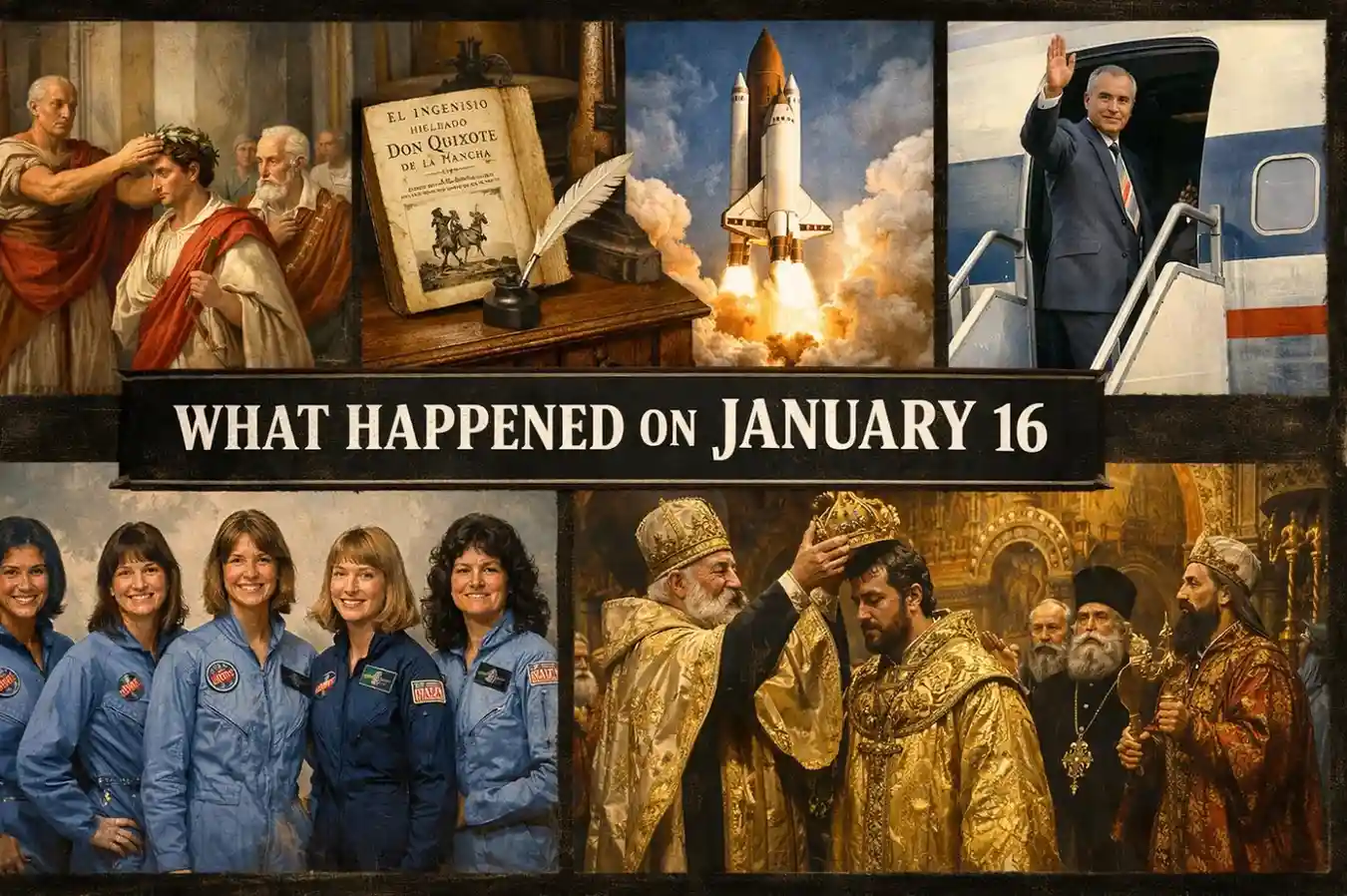
The history of January 16 is defined by the birth of empires, the publication of literary masterpieces, and monumental leaps in space exploration. To understand what happened on this day in history January 16, we look at Octavian receiving the title Augustus, the tragic final launch of the Space Shuttle Columbia, and the historic flight of the Shah of Iran during the revolution.
Important Events That Happened On January 16 In History
1458 BC: Death of Hatshepsut
Hatshepsut, one of the most successful pharaohs of ancient Egypt, died at the age of 50. Her reign was marked by flourishing trade and ambitious building projects, though her successor later attempted to erase her from history. She was laid to rest in the Valley of the Kings, leaving behind a legacy as one of the few women to rule Egypt as a full pharaoh.
27 BC: Octavian Becomes Augustus
The Roman Senate officially granted Gaius Julius Caesar Octavianus the title of Augustus, a name signifying religious and political sanctity. This transition effectively ended the Roman Republic and marked the formal beginning of the Roman Empire. Augustus would go on to lead Rome into a long period of relative peace and stability known as the Pax Romana.
378: Siyaj K’ak’ Conquers Tikal
General Siyaj K’ak’, representing the powerful city of Teotihuacán, arrived in the Mayan city of Tikal and oversaw the installation of a new ruling dynasty. This military and political maneuver significantly expanded the influence of King Spearthrower Owl across the Maya lowlands. The event reshaped the political landscape of Mesoamerica, linking the great powers of the era.
550: Ostrogoths Conquer Rome
During the Gothic War, King Totila of the Ostrogoths successfully captured Rome after a grueling and lengthy siege. The victory was achieved not through direct assault, but by bribing the Isaurian garrison to open the city gates from within. The conquest was a significant moment in the struggle between the Ostrogoths and the Byzantine Empire for control over Italy.
929: Establishment of the Caliphate of Córdoba
Emir Abd-ar-Rahman III proclaimed himself Caliph, officially establishing the Caliphate of Córdoba in Al-Andalus. This move challenged the authority of the Abbasids in Baghdad and the Fatimids in North Africa, asserting the independent religious and political power of the Umayyads in Spain. Under his rule, Córdoba became one of the leading cultural and economic centers of the world.
1120: The Council of Nablus
Following the success of the First Crusade, the Council of Nablus was convened to establish a formal legal framework for the Crusader Kingdom of Jerusalem. This gathering of ecclesiastical and secular leaders produced the earliest surviving written laws for the kingdom. The decrees focused on social order, morality, and the relationship between the various groups living in the Holy Land.
1275: Expulsion of Jews from Worcester and Beyond
King Edward I granted his mother, Eleanor of Provence, permission to expel the Jewish population from several towns, including Worcester, Marlborough, Cambridge, and Gloucester. This act was part of a growing wave of anti-Semitic sentiment and restrictive legislation in 13th-century England. It foreshadowed the total expulsion of Jews from the entire country that would occur fifteen years later.
1349: The Basel Massacre
In a tragic reaction to the Black Death, a mob of Christians in Basel burned dozens to hundreds of Jewish residents to death. The victims were falsely accused of poisoning wells to spread the plague, a common and deadly myth across Europe at the time. This massacre was part of a broader series of pogroms that decimated Jewish communities during the pandemic.
1362: Saint Marcellus’s Flood
A catastrophic storm surge, known as the “Grote Mandrenke” or Great Drowning of Men, struck the shores of the North Sea. The massive flood killed at least 25,000 people and permanently altered the coastline of Germany, Denmark, and the Netherlands. Entire islands and villages were swallowed by the sea, leaving a lasting mark on the geography of Northern Europe.
1537: Bigod’s Rebellion
An armed insurrection known as Bigod’s Rebellion began in northern England, led by Sir Francis Bigod. The rebels sought to resist the English Reformation and the religious changes imposed by King Henry VIII, following the failure of the earlier Pilgrimage of Grace. The uprising was quickly suppressed, leading to the execution of Bigod and many of his followers.
1547: Ivan the Terrible Becomes Tsar
Ivan IV of Muscovy was crowned as the 1st “Tsar of All the Russias,” officially replacing the Grand Duchy of Moscow with the Tsardom of Russia. This title change signified a new era of centralized autocratic power and imperial ambition. Ivan’s reign would be characterized by significant territorial expansion and the brutal suppression of the nobility.
1556: Philip II Ascends the Spanish Throne
Following the abdication of his father, Charles V, Philip II became the King of Spain and its vast overseas territories. Inheriting the most powerful empire in the world at the time, Philip’s reign was defined by his role as the champion of the Catholic Counter-Reformation. His administration oversaw the Spanish Golden Age but also faced numerous wars and economic challenges.
1572: Conviction of the Duke of Norfolk
Thomas Howard, the 4th Duke of Norfolk, was found guilty of high treason for his involvement in the Ridolfi plot. The conspiracy aimed to depose Queen Elizabeth I and replace her with Mary, Queen of Scots, thereby restoring Catholicism to England. Norfolk’s conviction and subsequent execution removed one of the most powerful Catholic nobles from Elizabeth’s court.
1605: Publication of Don Quixote
Miguel de Cervantes published the first edition of The Ingenious Gentleman Don Quixote of La Mancha in Madrid. The novel, telling the story of an aging knight who loses his mind and sets out on a series of adventures, is widely considered the first modern novel. Its influence on Western literature is immeasurable, introducing enduring characters and complex narrative techniques.
1641: The Catalan Republic Proposed
During the Reapers’ War, the parliamentary assembly of Catalonia accepted a proposal to establish a Catalan Republic under the protection of the French crown. This move was a direct rebellion against the Spanish monarchy’s attempts to centralize power and increase taxes. The alliance with France shifted the regional conflict into the broader theater of the Franco-Spanish War.
1707: Ratification of the Act of Union
The Scottish Parliament officially ratified the Act of Union, a historic agreement to join the kingdoms of Scotland and England. This legislative move paved the way for the creation of the Kingdom of Great Britain later that year. While it provided economic opportunities and security, the union remained highly controversial among many Scots who feared the loss of national identity.
1716: The Nueva Planta Decree
King Philip V of Spain promulgated the Nueva Planta decree for Catalonia, which abolished the region’s traditional institutions and legal system. This decree replaced Catalan laws with those of Castile, effectively ending Catalonia’s status as a separate state within the monarchy. The move was part of Philip’s effort to create a more centralized, French-style administration in Spain.
1757: The Battle of Narela
Forces of the Maratha Empire suffered a significant defeat at the hands of the Durrani Empire during the Battle of Narela in northern India. The Afghan forces, led by Ahmad Shah Durrani, utilized superior mobility and tactics to overwhelm the Maratha defenders. This engagement was a precursor to the larger and more decisive Third Battle of Panipat that would occur four years later.
1780: Battle of Cape St. Vincent
In a major naval engagement during the American Revolutionary War, a British fleet under Admiral George Rodney defeated a Spanish squadron off the coast of Portugal. The battle, also known as the “Moonlight Battle” because it continued into the night, resulted in the capture of several Spanish ships. This victory helped relieve the Great Siege of Gibraltar, which was being held by the British.
1786: Virginia Statute for Religious Freedom
The Virginia General Assembly enacted the Statute for Religious Freedom, a landmark document authored by Thomas Jefferson. The law disestablished the Church of England in Virginia and guaranteed that no person should be forced to attend or support any religious institution. It served as a vital precursor to the First Amendment of the U.S. Constitution.
1809: The Battle of La Coruña
During the Peninsular War, British forces fought a rearguard action against the French army at La Coruña to protect their evacuation from Spain. Although the British commander, Sir John Moore, was mortally wounded in the battle, his troops successfully repelled the French and boarded their transport ships. The battle ensured the survival of the British army to fight another day.
1847: Frémont Appointed Governor of California
John C. Frémont was appointed the first American military governor of the newly acquired California Territory following the Mexican-American War. His appointment was controversial and led to a power struggle with General Stephen W. Kearny, who also claimed authority over the region. Frémont’s role was instrumental in the early American administration of what would soon become the 31st state.
1862: The Hartley Colliery Disaster
A tragic mining accident occurred in Northumberland, England, when a massive beam from the pumping engine broke and fell down the only shaft, trapping 204 men and boys inside. All those trapped perished from carbon monoxide poisoning before they could be reached. The disaster led to a change in UK law requiring all collieries to have at least two independent means of escape.
1878: Liberation of Plovdiv
During the Russo-Turkish War, a squadron of Russian Imperial army dragoons led by Captain Aleksandr Burago liberated the city of Plovdiv from Ottoman rule. The daring raid caught the Ottoman defenders by surprise, forcing them to retreat and clearing the way for the Russian advance toward Constantinople. This victory was a major step in the eventual independence of Bulgaria.
1883: Pendleton Civil Service Reform Act
President Chester A. Arthur signed the Pendleton Act, which established the principle that federal government jobs should be awarded on the basis of merit rather than political affiliation. The act created the Civil Service Commission and mandated competitive exams for certain positions. It was a major blow to the “spoils system” and laid the foundation for the modern professional civil service.
1900: U.S. Acceptance of the Samoan Treaty
The United States Senate officially ratified the Anglo-German Treaty of 1899, in which the United Kingdom renounced its claims to the Samoan islands. This agreement partitioned the islands between the United States and Germany, with the U.S. gaining control of what became American Samoa. The treaty ended years of international tension over the strategic Pacific archipelago.
1909: Discovery of the Magnetic South Pole
Members of Ernest Shackleton’s Nimrod expedition, led by Edgeworth David, successfully reached the vicinity of the magnetic South Pole for the first time. The team had to trek across the high Antarctic plateau, facing extreme cold and dwindling supplies. Their achievement was a major milestone in the heroic age of Antarctic exploration and provided valuable scientific data.
1913: Ramanujan’s First Letter to G.H. Hardy
Self-taught Indian mathematician Srinivasa Ramanujan wrote a historic letter to G.H. Hardy at the University of Cambridge, containing dozens of complex mathematical formulas without proof. Hardy was initially skeptical but soon realized the work was the product of a mathematical genius. This letter began a legendary collaboration that brought Ramanujan’s groundbreaking results to the global scientific community.
1919: Ratification of Prohibition
Nebraska became the 36th state to approve the Eighteenth Amendment to the U.S. Constitution, providing the necessary three-quarters majority for its adoption. The amendment mandated the prohibition of the manufacture, sale, or transportation of intoxicating liquors within the United States. Prohibition would officially go into effect one year later, beginning a tumultuous thirteen-year era of “dry” law.
1920: First Meeting of the League of Nations
The League of Nations held its first-ever council meeting in Paris, just days after the Treaty of Versailles came into effect. The organization was established with the primary goal of preventing future global conflicts through collective security and diplomacy. Despite high hopes, the League’s effectiveness was hampered from the start by the absence of the United States.
1921: Founding of the Marxist Left in Slovakia
A founding congress was held in Ľubochňa to establish the Marxist Left in Slovakia and Transcarpathian Ukraine. This political movement sought to unify various socialist and communist factions under a revolutionary banner within the newly formed state of Czechoslovakia. The congress was a significant step in the development of the organized communist movement in Central Europe.
1942: Deperations from the Łódź Ghetto
During the Holocaust, Nazi authorities began the systematic deportation of Jewish residents from the Łódź Ghetto in occupied Poland to the Chełmno extermination camp. The victims were told they were being sent to work elsewhere, but they were actually murdered in mobile gas vans upon arrival. These deportations were a central part of the “Final Solution” in the Wartheland region.
1942: The Death of Carole Lombard
TWA Flight 3 crashed into Potosi Mountain near Las Vegas, Nevada, killing all 22 people on board. Among the victims was the beloved film star Carole Lombard, who was returning from a successful war bond tour. Her death shocked the nation and led her husband, Clark Gable, to join the Army Air Forces in her honor.
1945: Hitler Enters the Führerbunker
As Allied forces closed in on Berlin during the final months of World War II, Adolf Hitler moved his residence and command center into an underground bunker system beneath the Chancellery. Known as the Führerbunker, this reinforced concrete shelter became the site of Hitler’s final days. He would remain in the bunker until his suicide in April, as the Third Reich collapsed around him.
1959: Crash of Austral Flight 205
An Austral Líneas Aéreas Curtiss C-46 Commando crashed into the Atlantic Ocean during a heavy rainstorm while attempting to land in Mar del Plata, Argentina. The accident resulted in the deaths of 51 people, with only one survivor initially rescued from the water. It remains one of the deadliest aviation disasters in Argentine history, highlighting the risks of landing in severe weather.
1969: Suicide of Jan Palach
Jan Palach, a Czech student, set himself on fire in Prague’s Wenceslas Square as a protest against the Soviet-led invasion of Czechoslovakia. His self-immolation was intended to rouse the public from the apathy that followed the crushing of the “Prague Spring” reforms. Palach died three days later, becoming a powerful national symbol of resistance against totalitarian rule.
1969: First Crewed Docking in Space
The Soviet spacecraft Soyuz 4 and Soyuz 5 successfully docked in orbit, marking the first time two crewed space vehicles joined together in space. Two cosmonauts from Soyuz 5 then performed a spacewalk to transfer over to Soyuz 4 for the return to Earth. This mission was a major technical achievement for the Soviet space program during the heat of the Space Race.
1978: NASA’s First Female Astronauts
NASA announced a new class of 35 astronaut candidates that included women for the first time in the agency’s history. The group of six women—Sally Ride, Kathryn Sullivan, Rhea Seddon, Shannon Lucid, Anna Fisher, and Judith Resnik—brought diverse scientific and medical expertise to the program. Sally Ride would eventually become the first American woman in space five years later.
1979: The Shah Flees Iran
Faced with overwhelming opposition and months of violent protests, Mohammad Reza Pahlavi, the last Shah of Iran, fled the country with his family. His departure effectively ended thousands of years of monarchy in Iran and paved the way for the return of Ayatollah Khomeini. The Shah relocated to Egypt, marking the beginning of the end for the Pahlavi dynasty and the start of the Islamic Revolution.
1983: Crash of Turkish Airlines Flight 158
A Turkish Airlines Boeing 727 crashed while attempting to land in heavy snow and fog at Ankara Esenboğa Airport. The aircraft struck the ground short of the runway and broke apart, resulting in the deaths of 47 people and injuring 20 others. The disaster was attributed to pilot error and the difficult weather conditions prevalent at the time of the approach.
1991: The Start of the Gulf War
Coalition forces launched Operation Desert Storm, beginning a massive air campaign against Iraqi military targets in Iraq and occupied Kuwait. The military action followed the expiration of a UN deadline for Iraq to withdraw its forces. This conflict, televised around the world, utilized advanced precision-guided munitions and marked a major shift in modern warfare.
1992: Chapultepec Peace Accords
Representatives of the Salvadoran government and the FMLN rebel group signed the Chapultepec Peace Accords in Mexico City, officially ending 12 years of civil war. The conflict had claimed the lives of at least 75,000 people and devastated the nation’s economy. The accords mandated significant military and political reforms, transforming the FMLN into a legal political party.
1995: Avalanche in Súðavík
A massive avalanche struck the remote Icelandic village of Súðavík in the middle of the night, destroying 25 homes and burying dozens of residents. Rescue teams worked in extreme conditions to save survivors from the snow, but 14 people, including eight children, lost their lives. The tragedy led to the construction of extensive avalanche defenses and the relocation of much of the village.
2001: Assassination of Laurent Kabila
President Laurent-Désiré Kabila of the Democratic Republic of the Congo was assassinated in his palace in Kinshasa by one of his own bodyguards. The motive for the killing remained murky, but it occurred during a period of intense civil war involving multiple neighboring countries. He was succeeded by his son, Joseph Kabila, who oversaw the country’s transition toward a fragile peace.
2001: Posthumous Medal of Honor for Theodore Roosevelt
President Bill Clinton awarded a posthumous Medal of Honor to Theodore Roosevelt for his courageous leadership during the Spanish-American War. Roosevelt had famously led the “Rough Riders” in a charge up San Juan Hill in 1898, an act for which he was originally recommended for the medal but denied. He remains the only U.S. President to receive the nation’s highest military honor.
2002: Sanctions Against al-Qaeda and the Taliban
The United Nations Security Council unanimously adopted Resolution 1390, establishing an arms embargo and freezing the assets of Osama bin Laden, al-Qaeda, and the Taliban. The move was part of the international community’s intensified efforts to dismantle terrorist networks following the September 11 attacks. These sanctions aimed to cripple the financial and logistical capabilities of these extremist groups.
2003: Final Launch of Space Shuttle Columbia
The Space Shuttle Columbia lifted off from Kennedy Space Center on mission STS-107, which was dedicated to various microgravity and earth-science experiments. The crew of seven carried out a successful 16-day scientific mission in orbit. Tragically, the shuttle would disintegrate during re-entry on February 1 due to damage sustained during the launch, claiming the lives of all on board.
2006: Ellen Johnson Sirleaf Inaugurated
Ellen Johnson Sirleaf was sworn in as the President of Liberia, making her the first elected female head of state in African history. A Harvard-educated economist, she took office following years of brutal civil war and was tasked with rebuilding the nation’s economy and institutions. Her presidency was seen as a major milestone for gender equality and democratic progress across the continent.
2011: Establishment of TEV-DEM
In the midst of the escalating Syrian civil war, the Movement for a Democratic Society (TEV-DEM) was established in northern Syria. The organization’s goal was to implement a system of “democratic confederalism,” based on local autonomy, gender equality, and ecological sustainability. This movement served as the political foundation for the autonomous region that would later be known as Rojava.
2012: The Mali War Begins
Tuareg separatist militants launched a series of attacks against government positions in northern Mali, marking the start of a new conflict for independence. The rebels, many of whom were well-armed after fighting in the Libyan civil war, sought to create a separate state called Azawad. The insurgency quickly escalated and eventually involved various Islamist groups and international military interventions.
2016: Ouagadougou Terrorist Attacks
Gunmen linked to al-Qaeda in the Islamic Maghreb launched a series of coordinated attacks on the Splendid Hotel and a nearby restaurant in the capital of Burkina Faso. The siege lasted for hours before security forces could reclaim the area, resulting in the deaths of 23 people from various nationalities. The attack highlighted the growing threat of extremist violence in the Sahel region.
2017: Crash of Turkish Airlines Flight 6491
A Boeing 747 cargo plane operated by ACT Airlines for Turkish Airlines crashed into a residential village while attempting to land in thick fog in Bishkek, Kyrgyzstan. The crash destroyed several homes and killed 39 people, including all four crew members and 35 residents on the ground. It was one of the deadliest aviation accidents involving people on the ground in the country’s history.
2018: Police Fire on Rakhine Protesters
In Myanmar’s Rakhine State, police opened fire on a large group of ethnic Rakhine protesters who had gathered to mark a historical anniversary. The violence resulted in the deaths of seven people and wounded twelve others, further inflaming ethnic tensions in the volatile region. The incident was condemned by human rights groups and underscored the deep-seated divisions within the country.
2020: First Trump Impeachment Trial Begins
The first impeachment of President Donald Trump formally moved into its trial phase in the United States Senate with the swearing-in of Chief Justice John Roberts and the senators. The trial focused on charges of abuse of power and obstruction of Congress related to the President’s dealings with Ukraine. It was only the third time in American history that an impeachment trial of a president had taken place.
2020: USMCA Ratified by U.S. Senate
The United States Senate voted overwhelmingly to ratify the United States–Mexico–Canada Agreement (USMCA), which was designed to replace the North American Free Trade Agreement (NAFTA). The new deal updated rules for trade in various sectors, including automotive manufacturing, digital trade, and labor protections. It was hailed as a major modernization of the trade relationship between the three nations.
Take A look At: January 15 Stories:
Famous People Born On January 16
| Name | Role / Short Note | Dates |
|---|---|---|
| Eric Liddell | Olympic gold medalist & missionary | Jan 16, 1902 – Feb 21, 1945 |
| A. J. Foyt | Legendary American race-car driver | Jan 16, 1935 – |
| Albert Pujols | MLB slugger, World Series champion | Jan 16, 1980 – |
| Lin-Manuel Miranda | Composer & creator of Hamilton | Jan 16, 1980 – |
| Kate Moss | British supermodel & fashion icon | Jan 16, 1974 – |
| Roy Jones Jr. | World-champion boxer | Jan 16, 1969 – |
| Robert W. Service | Poet of the Yukon | Jan 16, 1874 – Sep 11, 1958 |
| Clement Greenberg | Influential American art critic | Jan 16, 1909 – May 7, 1994 |
| Dizzy Dean | Baseball Hall of Fame pitcher | Jan 16, 1911 – Jul 17, 1974 |
| René I of Anjou | Duke & patron of the arts | Jan 16, 1409 – Jul 10, 1480 |
| Franz Brentano | Philosopher, founder of act psychology | Jan 16, 1838 – Mar 17, 1917 |
| Edward Gordon Craig | Theatre innovator & designer | Jan 16, 1872 – Jul 29, 1966 |
| Sir Ian Hamilton | British World War I general | Jan 16, 1853 – Oct 12, 1947 |
| Henry W. Halleck | Union general, U.S. Civil War | Jan 16, 1815 – Jan 9, 1872 |
| Francis II | Last king of the Two Sicilies | Jan 16, 1836 – Dec 27, 1894 |
| Gaspar de Guzmán | Prime minister of Spain | Jan 16, 1587 – Jul 22, 1645 |
| William Kennedy | Pulitzer Prize–winning novelist | Jan 16, 1928 – |
| Laura Riding | Modernist poet & critic | Jan 16, 1901 – Sep 2, 1991 |
| Anatoly Solovyov | Soviet cosmonaut, spacewalk record holder | Jan 16, 1948 – |
| Vittorio Alfieri | Italian tragic poet | Jan 16, 1749 – Oct 8, 1803 |
Famous People Died On January 16
| Name | Role / Short Note | Dates |
|---|---|---|
| Chang and Eng | Famous conjoined twins | May 11, 1811 – Jan 16/17, 1874 |
| Arturo Toscanini | Legendary Italian conductor | Mar 25, 1867 – Jan 16, 1957 |
| George Dewey | U.S. naval hero, Manila Bay | Dec 26, 1837 – Jan 16, 1917 |
| Birju Maharaj | Master of Kathak dance | Feb 4, 1938 – Jan 16, 2022 |
| Andrew Wyeth | American realist painter | Jul 12, 1917 – Jan 16, 2009 |
| Eugene Cernan | Last man to walk on the Moon | Mar 14, 1934 – Jan 16, 2017 |
| Gina Lollobrigida | Italian film icon | Jul 4, 1927 – Jan 16, 2023 |
| David Lynch | Visionary filmmaker | Jan 20, 1946 – Jan 16, 2025 |
Observances & Institutional Dates
- National Religious Freedom Day (United States): Commemorating the 1786 enactment of the Virginia Statute for Religious Freedom.
- Teachers’ Day (Thailand and Myanmar): A day dedicated to expressing gratitude and respect for educators and their role in society.
Frequently Asked Questions
What major title did Octavian receive on January 16, 27 BC?
Octavian was granted the title “Augustus” by the Roman Senate, marking the beginning of the Roman Empire.
Which famous novel was first published on this day in 1605?
Miguel de Cervantes published the first part of Don Quixote in Madrid, Spain.
Who became Africa’s first female elected head of state on January 16, 2006?
Ellen Johnson Sirleaf was sworn in as the President of Liberia.