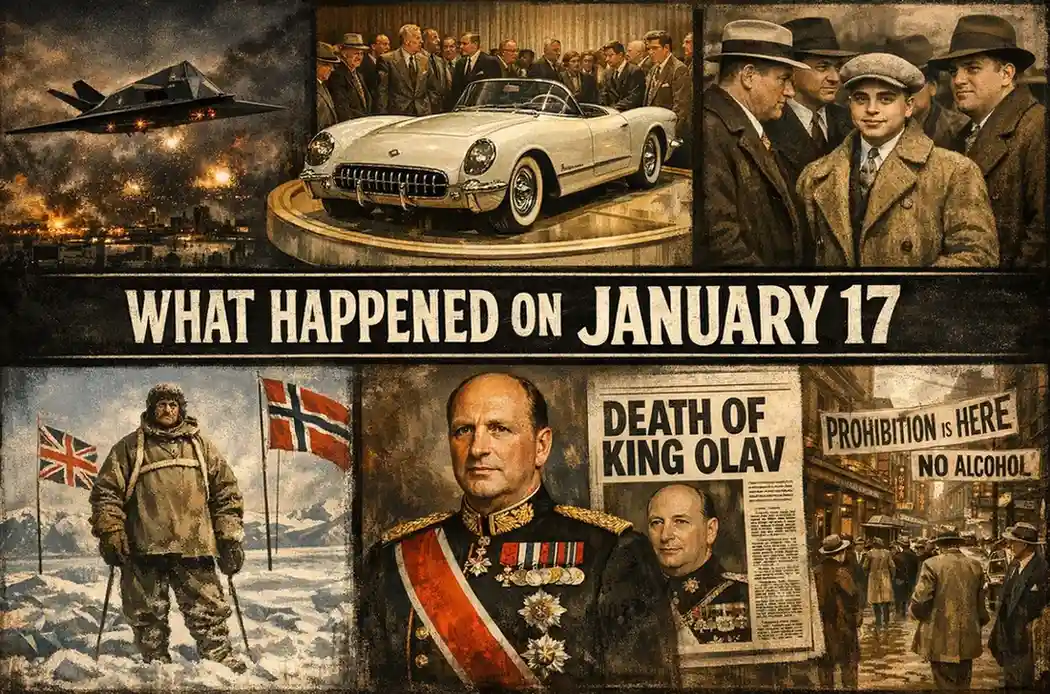
To understand what happened on this day in history January 17, we look at the start of the Gulf War’s air campaign, the birth of an infamous American gangster, and the moment the world’s most recognizable sports car was first shown to the public.
Important Events That Happened On January 17 In History
38 BC: Octavian Marries Livia Drusilla
Octavian, the future Emperor Augustus, took the controversial step of divorcing his pregnant wife Scribonia to marry Livia Drusilla. Livia was also pregnant by her previous husband at the time, making the union a major scandal in Roman society. This marriage was not just romantic but deeply political, as it signaled a break in the fragile peace between the Second Triumvirate and Sextus Pompey.
1362: Saint Marcellus’ Flood
A catastrophic storm surge, often called the “Grote Mandrenke” or the Great Drowning of Men, swept across the shores of the North Sea. The flood claimed at least 25,000 lives and permanently altered the coastlines of the Netherlands, Germany, and Denmark. Entire villages were lost to the rising waters, and the landscape of Northern Europe was geologically transformed in a single day.
1377: The Papacy Returns to Rome
Pope Gregory XI officially arrived in Rome, marking the end of the “Avignon Papacy” where the seat of the Catholic Church had been located in France for nearly 70 years. Despite warnings that Rome was dangerous and in disrepair, Gregory was determined to restore the Papacy to its traditional home. His return was a pivotal moment in Church history, though it led to further internal conflict shortly after.
1524: Verrazzano Sets Sail
Italian explorer Giovanni da Verrazzano departed from Madeira, sailing westward on behalf of the French crown. His goal was to discover a sea route to the Pacific Ocean and eventually reach the riches of Asia. While he did not find a passage to the Pacific, his voyage led to the first European exploration of the Atlantic coast of North America, including New York Bay.
1562: The Edict of Saint-Germain
In an attempt to prevent religious civil war, France issued the Edict of Saint-Germain, which granted a limited degree of religious toleration to the Huguenots (French Protestants). This was the first time the French crown officially recognized the right of Protestants to practice their faith. However, the move was met with fierce resistance from Catholic hardliners, eventually leading to decades of religious conflict.
1595: Henry IV Declares War on Spain
King Henry IV of France officially declared war on Spain, escalating the French Wars of Religion into an international conflict. Henry aimed to secure his borders and curb Spanish influence, which had been supporting his Catholic rivals within France. This declaration forced the Spanish to fight on multiple fronts and solidified Henry’s position as the legitimate ruler of a unified France.
1608: Battle of Ebenat
In Ethiopia, Emperor Susenyos I led his forces in a surprise attack against an Oromo army at Ebenat. Historical records suggest the Emperor’s forces killed 12,000 Oromo soldiers while losing only 400 of their own men. This decisive victory was a major event in the long-standing conflicts between the Ethiopian Empire and the Oromo people during the early 17th century.
1648: The Vote of No Addresses
England’s Long Parliament passed the “Vote of No Addresses,” a resolution that officially broke off all negotiations with King Charles I. This legislative move signaled that Parliament no longer intended to reach a peaceful settlement with the monarch. The act essentially cleared the path for the second phase of the English Civil War and the King’s eventual trial.
1649: The Second Ormonde Peace
An alliance was formed between Irish Royalists and the Catholic Confederates through the Second Ormonde Peace. This coalition was created to resist the English Parliamentarian forces during the War of the Three Kingdoms. Despite this unified front, the alliance was ultimately crushed during the subsequent Cromwellian conquest of Ireland, which had devastating consequences for the region.
1773: Cook Crosses the Antarctic Circle
Captain James Cook, commanding the Resolution, became the first European explorer to lead an expedition south of the Antarctic Circle. Navigating through treacherous ice fields, Cook’s crew reached a latitude that proved the existence of land or ice far to the south. While they did not sight the continent itself, the voyage significantly expanded the global map of the Southern Ocean.
1781: The Battle of Cowpens
During the American Revolutionary War, Continental troops led by Brigadier General Daniel Morgan scored a brilliant tactical victory over British forces at Cowpens, South Carolina. Morgan used a clever “defense in depth” strategy to trap the aggressive British commander Banastre Tarleton. The defeat was a major blow to British morale and a turning point in the Southern campaign of the war.
1799: Execution of Dun Mikiel Xerri
The Maltese patriot and priest Dun Mikiel Xerri was executed by French occupation forces along with several other Maltese insurgents. Xerri had led a failed plot to overthrow the French garrison in Valletta and restore Maltese self-rule. Today, he is remembered as a national hero and a symbol of Maltese resistance against foreign colonial power.
1811: The Battle of Calderón Bridge
In a pivotal moment of the Mexican War of Independence, a small but disciplined Spanish force of 6,000 troops defeated nearly 100,000 Mexican revolutionaries. Despite being heavily outnumbered, the Spanish utilized superior artillery and training to break the insurgent lines. The defeat forced the revolutionary leaders, including Miguel Hidalgo, to flee north, delaying the cause of independence.
1852: The Sand River Convention
The United Kingdom signed the Sand River Convention, officially recognizing the independence of the South African Republic (the Transvaal). This treaty was a major diplomatic step in the relations between the British Empire and the Boer settlers in Southern Africa. It allowed the Boers to govern themselves north of the Vaal River, temporarily easing tensions in the region.
1873: First Battle of the Stronghold
During the Modoc War in California and Oregon, a small group of Modoc warriors utilized the natural volcanic terrain to defeat a much larger United States Army force. Known as the First Battle of the Stronghold, the engagement saw the U.S. troops struggle against heavy fog and jagged lava rocks. The Modoc victory forced the Army to rethink its strategy against the indigenous resistance.
1885: The Battle of Abu Klea
A British desert column defeated a significantly larger Dervish army at the Battle of Abu Klea in the Sudan. The British were part of an expedition sent to relieve General Gordon in Khartoum. The fierce hand-to-hand combat resulted in high casualties on both sides and remains one of the most famous engagements of the Mahdist War.
1893: Overthrow of the Hawaiian Kingdom
A group of American businessmen and residents, known as the Citizens’ Committee of Public Safety, led a coup to overthrow Queen Liliʻuokalani and the Kingdom of Hawaii. Supported by U.S. Marines, the conspirators forced the Queen to surrender her authority to avoid bloodshed. This event paved the way for the eventual annexation of Hawaii by the United States.
1899: U.S. Takes Possession of Wake Island
The United States officially took possession of Wake Island, a remote coral atoll in the central Pacific Ocean. The island was claimed primarily for its strategic value as a cable station for the newly growing American telegraph network and as a refueling stop for ships. It remains an important overseas territory and military installation for the United States today.
1899: Birth of Al Capone
The notorious gangster Al Capone was born in Brooklyn, New York, to Italian immigrant parents. Capone would eventually move to Chicago, where he rose to power as the leader of the Chicago Outfit during the Prohibition era. Known as “Scarface,” his criminal empire and ultimate downfall for tax evasion became a central part of American true crime lore.
1903: Luquillo Forest Reserve Established
What is now known as El Yunque National Forest in Puerto Rico was officially brought into the United States National Forest System as the Luquillo Forest Reserve. It is the only tropical rainforest in the U.S. National Forest System, celebrated for its incredible biodiversity and unique ecosystem. The designation ensured the protection of this vital natural resource for future generations.
1904: Premiere of The Cherry Orchard
Anton Chekhov’s final play, The Cherry Orchard, received its world premiere at the Moscow Art Theatre. Directed by Constantin Stanislavski, the play depicted the decline of the Russian aristocracy and the rise of the middle class through the sale of a family estate. It is now considered one of the most important works of modern drama and a masterpiece of 20th-century literature.
1912: Scott Reaches the South Pole
British explorer Captain Robert Falcon Scott and his four companions reached the South Pole, only to find that the Norwegian team led by Roald Amundsen had beaten them by five weeks. The disappointment was crushing for the exhausted British team, who faced a brutal return journey. Tragically, Scott and his entire party perished from cold and hunger before reaching their base camp.
1915: The Battle of Sarikamish
During the Caucasus Campaign of World War I, Russian forces inflicted a devastating defeat on the Ottoman Empire at the Battle of Sarikamish. The Ottoman army, poorly equipped for the extreme winter conditions, suffered massive losses due to frostbite and starvation as much as direct combat. The victory secured the Russian front in the region but led to internal political fallout for the Ottomans.
1917: U.S. Purchases the Virgin Islands
The United States completed a deal to pay Denmark $25 million for the Danish West Indies, which were renamed the United States Virgin Islands. The U.S. sought the islands primarily for their strategic military value in the Caribbean during World War I. This acquisition marked the end of Danish colonial presence in the Americas and a major expansion of U.S. territory.
1918: First Battles of the Finnish Civil War
The first serious military engagements of the Finnish Civil War broke out between the pro-Bolshevik “Red Guards” and the conservative “White Guard.” This internal conflict followed Finland’s declaration of independence from Russia and was fueled by deep social and political divisions. The war would prove to be a short but extremely violent period in Finnish history.
1920: Prohibition Begins in the U.S.
The Volstead Act officially went into effect across the United States, beginning the era of National Prohibition. The law banned the manufacture, sale, and transportation of alcoholic beverages, fulfilling a decades-long campaign by the temperance movement. While intended to improve public health and morality, it led to the rise of organized crime and widespread illegal “speakeasies.”
1941: Battle of Ko Chang
During the Franco-Thai War, Vichy French naval forces achieved a decisive victory over the Royal Thai Navy at the Battle of Ko Chang. Despite being outnumbered, the French fleet utilized their superior firepower and experience to sink several Thai warships. It remains the most significant naval engagement in the history of the Thai military.
1943: Papanikolis Captures the Agios Stefanos
The Greek submarine Papanikolis successfully captured the 200-ton sailing vessel Agios Stefanos in the Mediterranean. Following the capture, the Greek submariners manned the vessel with part of their own crew to utilize it for further operations. This daring act was one of several successful missions by the Greek submarine fleet during World War II.
1944: Assault on Monte Cassino
Allied forces launched the first of four major assaults on the German-held stronghold of Monte Cassino in Italy. The goal was to break through the “Winter Line” and clear the path to seize Rome. The battle would eventually last four months and result in 105,000 Allied casualties, becoming one of the most grueling and costly campaigns of the European theater.
1945: Liberation of Warsaw
The Soviet-led Vistula–Oder Offensive forced German troops to retreat from the Polish capital of Warsaw. The city, which had been almost entirely destroyed following the 1944 uprising and subsequent German scorched-earth tactics, was finally liberated by the Red Army. The event marked a major step in the collapse of the German front in Eastern Europe.
1945: Evacuation of Auschwitz
As the Soviet Red Army rapidly approached from the east, the SS began the forced evacuation of the Auschwitz concentration camp system. Thousands of prisoners were forced onto “death marches” in freezing temperatures toward other camps in the German interior. Those left behind were eventually liberated by the Soviets ten days later, revealing the full horror of the Holocaust.
1945: Disappearance of Raoul Wallenberg
Swedish diplomat Raoul Wallenberg, who had saved thousands of Hungarian Jews from the Holocaust, was taken into Soviet custody in Budapest. Wallenberg was accused of being a spy and was never seen publicly again. Despite decades of international pressure and inquiries, the exact circumstances of his death in Soviet captivity remain a mystery.
1946: First Session of the UN Security Council
The United Nations Security Council held its inaugural session at Church House in London. This body was created with the primary responsibility of maintaining international peace and security in the post-war world. The first meeting established the procedural rules that would govern the council, which remains one of the most powerful institutions in global diplomacy.
1948: The Renville Agreement
The Netherlands and the Republic of Indonesia ratified the Renville Agreement, which was intended to provide a framework for a peaceful settlement of their colonial conflict. The agreement established a “ceasefire line” and recognized Dutch sovereignty until a final political solution could be reached. However, the peace was fragile and eventually broke down, leading to further fighting.
1950: The Great Brink’s Robbery
Eleven thieves successfully stole more than $2 million in cash and securities from an armored car company’s offices in Boston. At the time, it was the largest robbery in United States history and was described as the “crime of the century” due to its meticulous planning. It took years for the FBI to track down the perpetrators, who were eventually betrayed by one of their own.
1950: UN Resolution on Arms Control
The United Nations Security Council adopted Resolution 79, which focused on the regulation and reduction of armaments and armed forces. This was an early attempt during the Cold War to establish international standards for arms control. While the resolution reflected the ideals of the UN Charter, the growing rivalry between the U.S. and USSR made its implementation difficult.
1953: Unveiling of the Chevrolet Corvette
General Motors officially unveiled the Chevrolet Corvette as a concept car at the Motorama auto show in New York City. More than 45,000 people flocked to see the sleek, fiberglass-bodied roadster, requiring police to manage the massive crowds. Due to the overwhelming public reaction, GM decided to move the car into full production, creating an American automotive icon.
1961: Eisenhower’s Farewell Address
In a televised farewell address to the nation, President Dwight D. Eisenhower issued a famous warning against the “military-industrial complex.” He cautioned that the growing relationship between the military establishment and the massive arms industry could exert an unhealthy influence on American government. He also warned against the dangers of excessive deficit spending.
1961: Murder of Patrice Lumumba
Patrice Lumumba, the first democratically elected Prime Minister of the Republic of the Congo, was murdered alongside his associates. The execution followed a period of intense political instability and a military coup. Historical evidence later suggested that the governments of Belgium and the United States were complicit in his death due to Cold War interests in the region.
1966: The Palomares Incident
A U.S. B-52 bomber collided with a KC-135 tanker during mid-air refueling over Spain, resulting in the deaths of seven airmen. The crash dropped four 70-kiloton hydrogen bombs near the town of Palomares; three fell on land and one into the sea. While none of the nuclear weapons detonated, the incident caused significant radioactive contamination and a massive cleanup effort.
1969: Black Panther Party Shooting
Two prominent members of the Black Panther Party, Bunchy Carter and John Huggins, were shot and killed during a meeting at UCLA’s Campbell Hall. The violence was part of an ongoing feud between the Panthers and a rival black nationalist group called US Organization. The event was later revealed to have been exacerbated by the FBI’s COINTELPRO operations aimed at disrupting civil rights groups.
1977: Execution of Gary Gilmore
The death penalty was resumed in the United States after a ten-year hiatus with the execution of convicted murderer Gary Gilmore in Utah. Gilmore, who had famously demanded his own execution, was put to death by a firing squad. This event marked the end of a legal moratorium on capital punishment and sparked a nationwide debate over the morality of the death penalty.
1981: Martial Law Lifted in the Philippines
President Ferdinand Marcos officially lifted martial law in the Philippines, more than eight years after he first declared it. While the announcement was presented as a return to normalcy, Marcos retained many of his sweeping legislative and arrest powers. The move was widely seen as a symbolic gesture ahead of a visit by Pope John Paul II and a presidential election.
1989: Stockton School Shooting
A gunman named Patrick Purdy opened fire on the playground of Cleveland Elementary School in Stockton, California, using a semi-automatic rifle. The attack killed five children and wounded 31 others before Purdy took his own life. The tragedy shocked the nation and led to a major legislative push for stricter assault weapon bans in California and across the U.S.
1991: Operation Desert Storm Begins
The U.S.-led coalition launched a massive air campaign against Iraq, marking the start of Operation Desert Storm. The first night of the war featured the combat debut of the F-117 Nighthawk stealth fighter. During the initial sorties, LCDR Scott Speicher’s F/A-18 was shot down, becoming the first American casualty. Simultaneously, Iraq fired Scud missiles at Israel in an attempt to pull them into the war.
1991: Harald V Becomes King of Norway
Following the death of his father, King Olav V, Crown Prince Harald ascended to the throne as King Harald V of Norway. He was the first Norwegian-born prince to become king since the 14th century. Harald V has since become a popular and unifying figure in Norway, known for his modern approach to the monarchy and his passion for competitive sailing.
1992: Apology for “Comfort Women”
During a high-profile visit to South Korea, Japanese Prime Minister Kiichi Miyazawa issued a formal apology for the forced sexual slavery of Korean women by the Japanese military during World War II. The issue of these “comfort women” remains a deeply sensitive and contested point in Japan-Korea relations. The apology was an attempt to address historical grievances and improve regional cooperation.
1994: The Northridge Earthquake
A powerful 6.7 magnitude earthquake struck the San Fernando Valley region of Los Angeles in the early morning hours. The Northridge earthquake caused massive damage to highways, parking structures, and apartment buildings, resulting in 57 deaths and over 8,700 injuries. It remains one of the costliest natural disasters in U.S. history, leading to significant changes in seismic building codes.
1995: The Great Hanshin Earthquake
The city of Kobe, Japan, was struck by a devastating 6.9 magnitude earthquake, known as the Great Hanshin earthquake. The disaster killed over 6,000 people and displaced more than 250,000 residents as fires broke out across the city’s dense urban center. The earthquake was a major wake-up call for Japan regarding disaster preparedness and the safety of older wooden structures.
1996: Czech Republic Applies for EU Membership
The Czech Republic officially submitted its application for membership in the European Union. This move was a cornerstone of the country’s post-communist transition and its goal to integrate with Western political and economic systems. The application began a long process of negotiations and reforms that eventually led to the Czech Republic joining the EU in 2004.
1997: Delta II Rocket Explosion
A Delta II rocket carrying a GPS satellite exploded just 13 seconds after launch from Cape Canaveral Air Force Station. The explosion dropped 250 tons of burning debris onto the launch pad and surrounding area, though no one was injured. The failure was attributed to a structural flaw in one of the solid rocket boosters and resulted in a significant investigation into launch procedures.
1998: Breaking the Lewinsky Scandal
Journalist Matt Drudge published a story on his website, the Drudge Report, alleging an affair between President Bill Clinton and a White House intern named Monica Lewinsky. The report broke the story before traditional media outlets, fundamentally changing the landscape of digital journalism. The subsequent scandal led to the President’s impeachment and a major national controversy.
2002: Eruption of Mount Nyiragongo
Mount Nyiragongo in the Democratic Republic of the Congo erupted, sending a massive lava flow through the city of Goma and into Lake Kivu. The eruption displaced an estimated 400,000 people and destroyed significant portions of the city’s infrastructure and residential areas. The disaster highlighted the extreme vulnerability of the region to volcanic activity.
2007: Doomsday Clock Moves to Five to Midnight
The Bulletin of the Atomic Scientists moved the minute hand of the “Doomsday Clock” to five minutes before midnight. This adjustment was made primarily in response to North Korea’s first nuclear test and the ongoing concerns regarding global climate change. The clock serves as a symbolic measure of the world’s vulnerability to catastrophe from nuclear weapons and environmental threats.
2008: British Airways Flight 38 Crash
A British Airways Boeing 777 flying from Beijing crashed just short of the runway at London Heathrow Airport after both engines lost power. The investigation revealed that ice crystals in the fuel system had blocked the fuel heat exchangers. Despite the severe impact, all 152 people on board survived, with 47 injuries reported, in what was considered a remarkable rescue effort.
2010: Jos Riots in Nigeria
Violent rioting broke out between Muslim and Christian groups in the city of Jos, Nigeria, leading to at least 200 deaths and the destruction of hundreds of homes and religious buildings. The violence was fueled by long-standing ethnic and religious tensions in the region. The event underscored the ongoing challenges of communal conflict and security in central Nigeria.
2013: Lance Armstrong Confesses to Doping
In a highly anticipated television interview with Oprah Winfrey, former professional cyclist Lance Armstrong admitted to using performance-enhancing drugs throughout his career. After years of fierce denials and legal battles, Armstrong confessed that he had cheated to win all seven of his Tour de France titles. The confession shook the world of professional sports and led to his lifelong ban.
2013: Murder of Shahzad Luqman
Shahzad Luqman, a Pakistani immigrant living in Greece, was murdered by members of the far-right Golden Dawn party while riding his bicycle to work. The brutal, racially motivated killing sparked international outrage and massive anti-fascist protests in Athens. It also led the Greek government to implement new, stricter measures to combat hate crimes and extremist violence.
2016: Implementation of the Iran Nuclear Deal
President Barack Obama announced the formal implementation of the Joint Comprehensive Plan of Action (JCPOA), an agreement between Iran and several world powers. The deal was designed to limit Iran’s nuclear program in exchange for the lifting of economic sanctions. The announcement marked a major diplomatic achievement aimed at preventing nuclear proliferation in the Middle East.
2017: MH370 Search Suspended
The governments of Malaysia, Australia, and China officially announced the suspension of the underwater search for Malaysia Airlines Flight 370. After nearly three years of searching thousands of square miles in the Indian Ocean, no trace of the main wreckage was found. The decision left the families of the 239 people on board without definitive answers regarding the plane’s disappearance.
2023: Nyingchi Avalanche
A massive avalanche struck a highway tunnel exit in the city of Nyingchi, Tibet, trapping several vehicles and their passengers. The disaster killed 28 people as rescue teams struggled against deep snow and freezing temperatures to reach the site. The event highlighted the increasing risks of mountain travel in the region due to unpredictable weather patterns.
2026: Indonesia Air Transport Crash
An Indonesia Air Transport ATR 42 aircraft crashed near Mount Bulusaraung in South Sulawesi during a flight toward Makassar. The plane lost contact with air traffic control shortly before the impact, and search and rescue teams were dispatched to the rugged mountainous terrain. This tragic accident became a focus for aviation safety investigations in the Indonesian regional flight sector.
Explore key events from January 16
Famous People Born On January 17
| Name | Role / Short Note | Dates |
|---|---|---|
| Douglas Wilder | First elected African American U.S. governor | Jan 17, 1931 – |
| Tabaré Vázquez | President of Uruguay | Jan 17, 1940 – Dec 6, 2020 |
| Mack Sennett | Pioneer of slapstick film comedy | Jan 17, 1880 – Nov 5, 1960 |
| Saint Pius V | Pope; Counter-Reformation leader | Jan 17, 1504 – May 1, 1572 |
| Stanisław II August Poniatowski | Last king of Poland | Jan 17, 1732 – Feb 12, 1798 |
| George J. Stigler | Nobel Prize–winning economist | Jan 17, 1911 – Dec 1, 1991 |
| Nevil Shute | Novelist (On the Beach) | Jan 17, 1899 – Jan 12, 1960 |
| Jacques Plante | Hockey goaltender; mask innovator | Jan 17, 1929 – Feb 26, 1986 |
| Carl Laemmle | Founder of Universal Pictures | Jan 17, 1867 – Sep 24, 1939 |
| Alva Belmont | Suffragist & social reformer | Jan 17, 1853 – Jan 26, 1933 |
| David Beatty, 1st Earl Beatty | British admiral, WWI | Jan 17, 1871 – Mar 11, 1936 |
| Catherine Booth | Co-founder of the Salvation Army | Jan 17, 1829 – Oct 4, 1890 |
| Frederick III | Elector of Saxony; Luther’s protector | Jan 17, 1463 – May 5, 1525 |
| Pedro Calderón de la Barca | Spanish Golden Age playwright | Jan 17, 1600 – May 25, 1681 |
| Moira Shearer | Ballerina & actress (The Red Shoes) | Jan 17, 1926 – Jan 31, 2006 |
| Douglas Hyde | First president of Ireland | Jan 17, 1860 – Jul 12, 1949 |
| Philip II of Burgundy | Powerful medieval French duke | Jan 17, 1342 – Apr 27, 1404 |
| Ita Buttrose | Australian media executive | Jan 17, 1942 – |
| Robert Maynard Hutchins | Influential American educator | Jan 17, 1899 – May 14, 1977 |
| Thomas Fairfax | Parliamentarian general, English Civil War | Jan 17, 1612 – Nov 12, 1671 |
| Duane Hanson | Hyperrealist sculptor | Jan 17, 1925 – Jan 6, 1996 |
| A. R. Radcliffe-Brown | Foundational anthropologist | Jan 17, 1881 – Oct 24, 1955 |
| Compton Mackenzie | Scottish novelist | Jan 17, 1883 – Nov 30, 1972 |
| Anita Borg | Computer scientist & women-in-tech advocate | Jan 17, 1949 – Apr 6, 2003 |
| Kip Keino | Olympic champion distance runner | Jan 17, 1940 – |
| Charles Brockden Brown | Father of the American novel | Jan 17, 1771 – Feb 22, 1810 |
| Leonhard Fuchs | Renaissance botanist & physician | Jan 17, 1501 – May 10, 1566 |
| Thomas Anthony Dooley | Humanitarian physician | Jan 17, 1927 – Jan 18, 1961 |
| Maya Chiburdanidze | Women’s world chess champion | Jan 17, 1961 – |
| Paul Cuffe | Pan-Africanist & shipowner | Jan 17, 1759 – Sep 7, 1817 |
Famous People Died On January 17
| Name | Role / Short Note | Dates |
|---|---|---|
| Francis Galton | Scientist; statistics pioneer | Feb 16, 1822 – Jan 17, 1911 |
| Louis Comfort Tiffany | Art Nouveau designer | Feb 18, 1848 – Jan 17, 1933 |
| Barbara Jordan | U.S. congresswoman & educator | Feb 21, 1936 – Jan 17, 1996 |
| Fyodor I | Tsar of Russia; end of Rurik dynasty | May 31, 1557 – Jan 17, 1598 |
| Lola Montez | Dancer & royal scandal figure | Feb 17, 1821 – Jan 17, 1861 |
| T. H. White | Author (The Once and Future King) | May 29, 1906 – Jan 17, 1964 |
| Clyde Tombaugh | Discoverer of Pluto | Feb 4, 1906 – Jan 17, 1997 |
| Johnny Otis | Rhythm & blues bandleader | Dec 28, 1921 – Jan 17, 2012 |
| Tomaso Giovanni Albinoni | Baroque composer | Jun 8, 1671 – Jan 17, 1751 |
| Walther von Reichenau | German field marshal | Oct 8, 1884 – Jan 17, 1942 |
| Gregory Corso | Beat Generation poet | Mar 26, 1930 – Jan 17, 2001 |
| Horace Vernet | French battle painter | Jun 30, 1789 – Jan 17, 1863 |
| George Bancroft | “Father of American history” | Oct 3, 1800 – Jan 17, 1891 |
| John Ray | Founder of modern taxonomy | Nov 29, 1627 – Jan 17, 1705 |
| Art Buchwald | Humor columnist | Oct 20, 1925 – Jan 17, 2007 |
| Jules Feiffer | Cartoonist & playwright | Jan 26, 1929 – Jan 17, 2025 |
| Camilo José Cela | Nobel Prize–winning novelist | May 11, 1916 – Jan 17, 2002 |
| Tarsila do Amaral | Brazilian modernist painter | Sep 1, 1886 – Jan 17, 1973 |
| Juan Crisóstomo Arriaga | Early Romantic composer | Jan 27, 1806 – Jan 17, 1826 |
| Jobst of Moravia | King of Germany | 1351 – Jan 17, 1411 |
| Aleksandr Dargomyzhsky | Russian composer | Feb 14, 1813 – Jan 17, 1869 |
| Carlo Dolci | Italian Baroque painter | May 25, 1616 – Jan 17, 1687 |
| Juan Montalvo | Ecuadorian essayist | Apr 13, 1832 – Jan 17, 1889 |