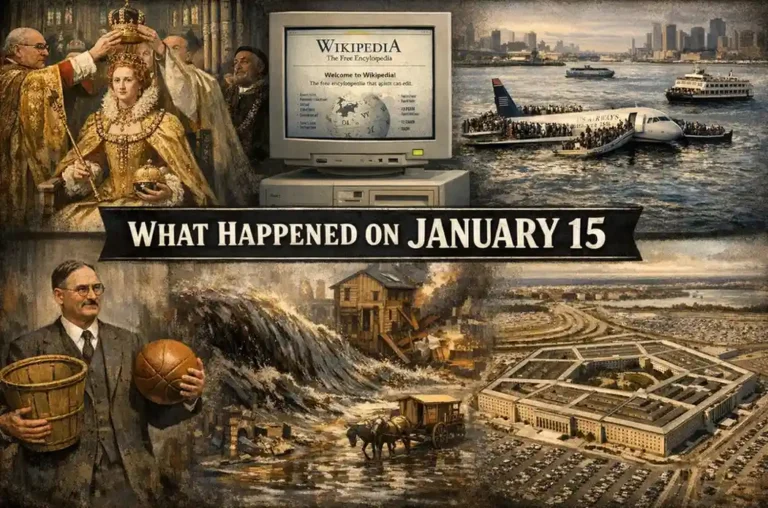
From the final victory of Henry V in Normandy to the digital shutdown of a file-sharing giant, this date reflects the collapse of old regimes and the birth of new political orders. Today, we investigate what happened on this day in history January 19, tracing the path from the Roman elevation of Theodosius to the historic lunar landing that solidified Japan’s place in the modern space race.
Important Events That Happened On January 19 In History
379: Theodosius Elevated to Augustus
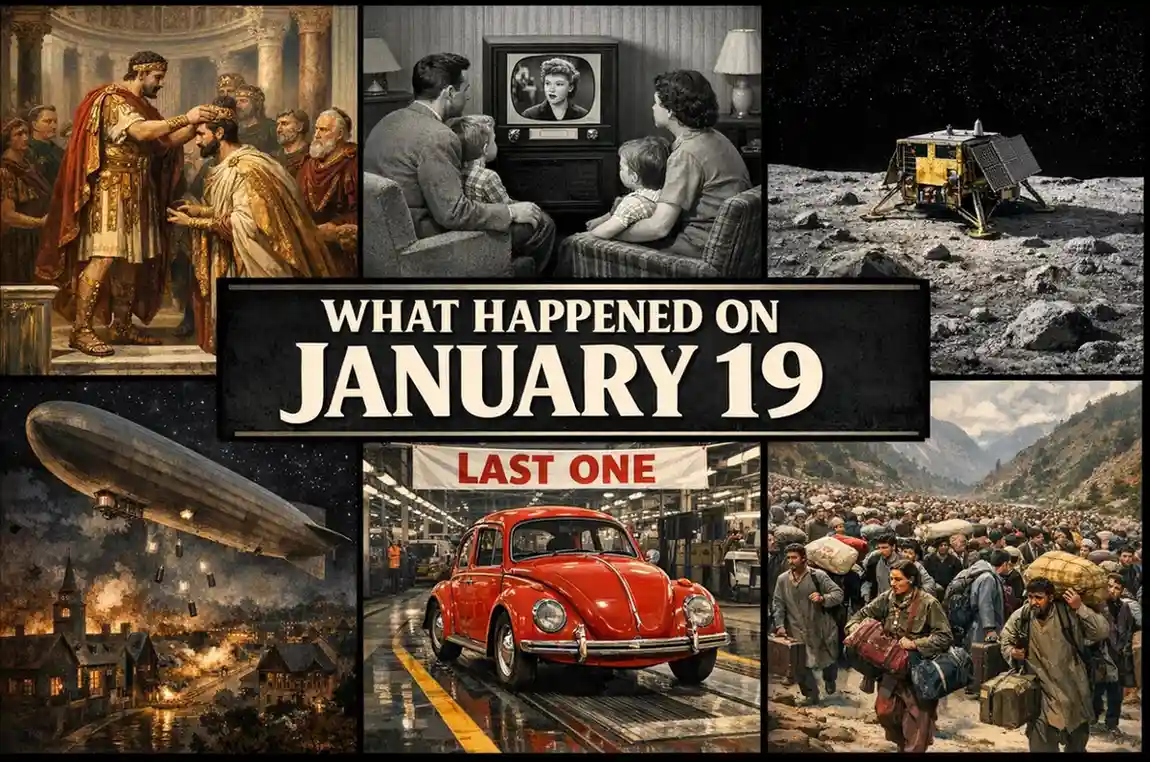
In the city of Sirmium, Emperor Gratian officially elevated Flavius Theodosius to the rank of Augustus. This appointment gave Theodosius authority over all eastern provinces of the Roman Empire, tasking him with stabilizing a region reeling from the disastrous defeat at Adrianople. His reign would eventually see him become the last emperor to rule over both the Eastern and Western halves of the Roman Empire.
649: Conquest of Kucha
Following a grueling forty-day siege, the forces of the Kingdom of Kucha surrendered to the Tang dynasty general Ashina She’er. This victory was a decisive moment for the Tang Empire, as it established firm Chinese control over the northern Tarim Basin in Xinjiang. The expansion secured vital trade routes along the Silk Road and extended Tang influence deep into Central Asia.
1419: Rouen Surrenders to Henry V
The city of Rouen fell to King Henry V of England during the Hundred Years’ War, marking the end of a brutal seven-month siege. The surrender of the Norman capital completed Henry’s systematic reconquest of Normandy, bringing the entire duchy under English control. This victory severely weakened the French crown and paved the way for the Treaty of Troyes.
1421: Coronation of John VIII Palaiologos
John VIII Palaiologos married Sophia of Montferrat and was subsequently crowned as Byzantine co-emperor alongside his father, Manuel II Palaiologos. This joint rule was intended to ensure a stable succession for the embattled empire as it faced increasing pressure from the Ottoman Turks. John VIII would spend much of his later reign desperately seeking Western aid to save Constantinople.
1511: Duchy of Mirandola Surrenders
During the War of the League of Cambrai, the Italian Duchy of Mirandola was forced to surrender to the forces of Pope Julius II. The “Warrior Pope” himself famously participated in the siege, reportedly donning armor and climbing through a breach in the walls. The fall of Mirandola was a strategic victory for the Papal States in their effort to drive French influence out of northern Italy.
1520: Mortally Wounded Regent Sten Sture
Sten Sture the Younger, the Regent of Sweden, was mortally wounded while leading his troops against Danish forces at the Battle of Bogesund. Hit by a cannonball while on the ice of Lake Åsunden, his injury threw the Swedish resistance into chaos. His subsequent death in February allowed the Danish King Christian II to briefly reclaim the Swedish throne, leading to the infamous Stockholm Bloodbath.
1607: Completion of San Agustin Church
The San Agustin Church in Manila was officially completed, standing today as the oldest stone church in the Philippines. Built during the Spanish colonial period, its baroque architecture was designed to withstand the frequent earthquakes of the region. It remains a UNESCO World Heritage site and a symbol of the enduring influence of the Augustinian Order in Southeast Asia.
1639: City Privileges for Hämeenlinna
The settlement of Hämeenlinna (known in Swedish as Tavastehus) was officially granted city privileges after separating from the Vanaja parish. Located in the Tavastia region of Finland, the city grew around the medieval Häme Castle. This administrative independence allowed the town to develop its own markets and local government, fostering its growth as a regional hub.
1764: John Wilkes Expelled from Commons
The British House of Commons voted to expel John Wilkes, a radical journalist and politician, for seditious libel. The charges stemmed from his publication of The North Briton, which contained sharp criticisms of King George III and his ministers. Wilkes became a symbol of the fight for freedom of the press and the rights of the electorate, famously sparking the cry “Wilkes and Liberty!”
1764: The World’s First Mail Bomb
Danish official Bolle Willum Luxdorph recorded in his diary a terrifying event: a mail bomb had severely injured Colonel Poulsen at Børglum Abbey. This is widely considered the first recorded instance of a bomb being sent through the postal service. The device was concealed in a box that exploded when opened, marking a dark milestone in the history of targeted violence.
1788: First Fleet Reinforcements
The second group of ships belonging to the First Fleet arrived at Botany Bay, joining the initial vessels that had landed the day prior. These ships brought more convicts and essential supplies needed to establish the first European penal colony in Australia. Finding the bay’s conditions unfavorable, the leadership soon decided to move the entire operation to the more sheltered waters of Port Jackson.
1795: Proclamation of the Batavian Republic
In the wake of the French Revolutionary Wars, the Batavian Republic was proclaimed in the Netherlands, effectively replacing the old Dutch Republic. This new state was a sister republic to revolutionary France and represented a major shift toward more centralized and democratic ideals in the region. The move ended the rule of the House of Orange, who fled to England in exile.
1817: Crossing of the Andes
General José de San Martín began his monumental crossing of the Andes Mountains with an army of over 5,000 soldiers. The treacherous journey from Argentina was a daring strategic move to surprise Spanish royalist forces in Chile. This military feat is regarded as one of the most significant events in the South American wars of independence, leading to the liberation of Chile and Peru.
1829: Premiere of Faust: Part One
Johann Wolfgang von Goethe’s masterpiece, Faust: The First Part of the Tragedy, received its premiere performance in Braunschweig, Germany. Although Goethe had published the text earlier, the stage production brought the legendary tale of the scholar’s pact with Mephistopheles to life. It remains one of the most influential works of world literature, exploring themes of morality, knowledge, and damnation.
1839: British Capture of Aden
Forces from the British East India Company successfully captured the port city of Aden on the Arabian Peninsula. The British sought the location as a strategic coaling station for their steamships traveling between India and Europe. Aden remained a vital link in the British imperial network for over a century, particularly after the opening of the Suez Canal.
1853: Premiere of Il trovatore
Giuseppe Verdi’s opera Il trovatore premiered at the Teatro Apollo in Rome to overwhelming success. The opera, known for its dramatic intensity and famous “Anvil Chorus,” quickly became a staple of the international repertoire. It solidified Verdi’s status as the leading Italian composer of his time and remains one of the most popular operas ever written.
1861: Georgia Secedes from the Union
Continuing the wave of Southern rebellion leading up to the American Civil War, Georgia officially voted to secede from the United States. It joined South Carolina, Florida, Mississippi, and Alabama in forming the Confederate States. The decision was driven by the state’s reliance on slavery and its opposition to the election of Abraham Lincoln.
1862: Battle of Mill Springs
In the early stages of the American Civil War, the Confederacy suffered its first significant defeat at the Battle of Mill Springs in Kentucky. Union forces commanded by George Henry Thomas repelled a Confederate attack, resulting in the death of Confederate General Felix Zollicoffer. The victory broke the Confederate defensive line in eastern Kentucky and boosted Northern morale.
1871: The Battle of St. Quentin
During the final stages of the Franco-Prussian War, Prussian forces achieved a decisive victory over the French Army of the North at the Battle of St. Quentin. The defeat shattered French hopes of relieving the ongoing Siege of Paris from the outside. The following day, a desperate French sortie from within Paris at the Battle of Buzenval also failed, leading directly to the French surrender.
1883: Edison’s Overhead Wire Lighting
The first electric lighting system using overhead wires, designed and built by Thomas Edison, began service in Roselle, New Jersey. This was a major advancement over earlier underground systems, as it was cheaper and easier to install in residential areas. The success of the Roselle system proved the viability of large-scale public electrification for entire neighborhoods.
1899: Formation of Anglo-Egyptian Sudan
An agreement between the United Kingdom and Egypt established the Anglo-Egyptian Sudan as a condominium, or a territory ruled jointly by two powers. This followed the British-led defeat of the Mahdist state in the preceding years. While nominally a joint venture, Britain held the true administrative power over the region until Sudanese independence in 1956.
1901: Queen Victoria Falls Ill
Queen Victoria, who had ruled the United Kingdom for over 63 years, was stricken with paralysis at Osborne House on the Isle of Wight. The news of her failing health sent the nation into a state of mourning and apprehension. She would pass away three days later, ending the Victorian Era and ushering in the reign of her son, Edward VII.
1915: Patent for the Neon Tube
Inventor Georges Claude received a patent for the neon discharge tube, a breakthrough that would transform the world of advertising and urban nightlife. By passing an electric current through neon gas in a sealed glass tube, Claude created a brilliant, steady light. The first commercial neon signs appeared shortly after, giving birth to the iconic “neon look” of modern cities.
1915: First Major Aerial Bombardment
In the first major aerial bombardment of a civilian target in history, German Zeppelins dropped bombs on the English towns of Great Yarmouth and King’s Lynn. The attack killed at least 20 people and caused significant property damage. This event signaled a terrifying new era of warfare where the reach of the front lines extended far behind the traditional battlefield.
1917: The Silvertown Explosion
A massive explosion occurred at a munitions factory in the Silvertown district of London, where TNT was being purified for use in World War I. The blast killed 73 people and injured more than 400, while the resulting fire destroyed dozens of nearby homes. The shockwave was felt as far away as Norfolk, marking it as one of the largest explosions in London’s history.
1920: U.S. Rejects the League of Nations
The United States Senate voted for a second time against joining the League of Nations, the international organization championed by President Woodrow Wilson. Opponents, led by Henry Cabot Lodge, feared that membership would draw the U.S. into unnecessary foreign conflicts. This decision effectively committed the United States to a period of isolationism in the interwar years.
1920: Founding of the ACLU
The American Civil Liberties Union (ACLU) was founded in response to the “Palmer Raids,” in which the U.S. government arrested and deported thousands of suspected radicals without due process. The organization was established to protect the constitutional rights of all Americans, particularly freedom of speech and assembly. It has since become a central player in American legal and social history.
1937: Howard Hughes Sets Air Record
Millionaire aviator and filmmaker Howard Hughes set a new transcontinental speed record, flying from Los Angeles to New York City in just 7 hours and 28 minutes. Flying a modified H-1 Racer, Hughes averaged over 320 miles per hour. This achievement showcased his engineering prowess and the rapid advancement of aviation technology in the late 1930s.
1941: Sinking of the Neghelli
During World War II, the British destroyer HMS Greyhound and other convoy escorts detected and attacked the Italian submarine Neghelli northeast of Falkonera. The submarine had successfully torpedoed a freighter earlier that day but was sunk with all hands following a depth charge attack. This engagement was part of the ongoing struggle for naval supremacy in the Mediterranean.
1942: Japanese Conquest of Burma Begins
Japanese forces launched their invasion of British-controlled Burma, crossing the border from Thailand. The campaign aimed to seize the vital “Burma Road” supply route to China and to threaten British India from the east. The subsequent fighting would last for years and involve some of the most difficult jungle warfare of the entire global conflict.
1945: Liberation of the Łódź Ghetto
Soviet Red Army forces entered and liberated the Łódź Ghetto in occupied Poland. Once a thriving community of over 200,000 people, the ghetto had been systematically emptied by the Nazis through starvation and deportations to extermination camps. When the Soviets arrived, fewer than 900 survivors remained, hiding in the ruins of the once-crowded district.
1946: International Military Tribunal for the Far East
General Douglas MacArthur, acting as Supreme Commander for the Allied Powers, issued a proclamation establishing the International Military Tribunal for the Far East in Tokyo. The tribunal was created to try Japanese leaders for “crimes against peace,” “war crimes,” and “crimes against humanity” committed during World War II. It was the Pacific equivalent of the Nuremberg Trials in Europe.
1953: Lucy Gives Birth on Television
In a landmark moment for American television, an estimated 72 percent of all TV sets in the country were tuned to I Love Lucy to watch the character Lucy Ricardo give birth to “Little Ricky.” The episode aired on the same day that actress Lucille Ball gave birth to her real-life son, Desi Arnaz Jr. The massive audience for the show famously surpassed that of the inauguration of President Eisenhower the following day.
1960: US–Japan Mutual Security Treaty
The United States and Japan signed a revised Mutual Security Treaty in Washington D.C., which established a formal military alliance between the two nations. The treaty allowed the U.S. to maintain military bases on Japanese soil in exchange for a commitment to defend Japan if attacked. The signing sparked massive “Anpo” protests in Japan among those who feared it would draw the country into U.S. Cold War conflicts.
1960: SAS Flight 871 Crash
A Scandinavian Airlines System (SAS) Caravelle crashed while on approach to Ankara Esenboğa Airport in Turkey. All 42 passengers and crew on board were killed when the aircraft struck a hill during a period of low visibility. This was the first fatal accident involving the Sud Aviation Caravelle, leading to a review of cockpit procedures and altimeter settings.
1966: Indira Gandhi Becomes Prime Minister
Indira Gandhi, the daughter of Jawaharlal Nehru, was elected as the leader of the Indian National Congress and became India’s first female Prime Minister. She stepped into power during a time of significant economic and social challenge for the young democracy. Her long and controversial tenure would redefine Indian politics and the country’s role on the global stage.
1969: Death of Jan Palach
Jan Palach, a Czech student who had set himself on fire three days earlier in Prague, died from his injuries. His self-immolation was a desperate protest against the Soviet-led invasion of Czechoslovakia and the subsequent rollback of “Prague Spring” reforms. His funeral became a massive demonstration of national grief and silent resistance against the occupying forces.
1977: Pardon of “Tokyo Rose”
On his last full day in office, President Gerald Ford granted a full pardon to Iva Toguri D’Aquino, better known as “Tokyo Rose.” During World War II, she had been forced to broadcast Japanese propaganda to Allied troops, leading to a post-war conviction for treason. Later investigations revealed that the evidence against her was coerced and unreliable, leading to the presidential pardon.
1978: Last German-made Beetle
The final Volkswagen Beetle to be manufactured in Germany rolled off the assembly line at the VW plant in Emden. While production of the iconic car continued in Latin America, particularly Mexico and Brazil, until 2003, this marked the end of an era for the German automotive industry. The Beetle had become a symbol of West Germany’s post-war economic miracle.
1981: Algiers Accords Signed
Officials from the United States and Iran signed the Algiers Accords, an agreement to release the 52 American hostages held in Tehran for 14 months. In exchange for the hostages’ freedom, the U.S. agreed to unfreeze billions of dollars in Iranian assets and committed to non-intervention in Iranian internal affairs. The hostages were officially released the following day, just as Ronald Reagan was inaugurated.
1988: Trans-Colorado Flight 2286 Crash
A Fairchild Metro III commuter plane operated by Trans-Colorado Airlines crashed into the ground near Bayfield, Colorado, while on approach to Durango. Nine people, including both pilots, were killed in the accident. The NTSB investigation concluded that the captain’s use of cocaine prior to the flight and the crew’s failure to follow standard approach procedures were primary factors in the crash.
1990: Exodus of Kashmiri Pandits
A mass exodus of Kashmiri Pandits, the Hindu minority in the Kashmir Valley, began as a result of escalating militant violence and threats. Thousands of families fled their homes overnight to seek safety in camps in Jammu and other parts of India. This displacement remains one of the most painful and contested chapters in the modern history of the Kashmir conflict.
1991: Second Scud Attack on Israel
During the Gulf War, Iraq fired a second Scud missile into Israel, striking the city of Tel Aviv. The attack resulted in 15 injuries and significant damage to residential areas. Iraq hoped these attacks would provoke Israel into joining the war, which would have threatened the unity of the U.S.-led Arab-Western coalition. Despite the pressure, Israel refrained from retaliating.
1993: Czech Republic and Slovakia Join UN
Following the peaceful dissolution of Czechoslovakia on January 1, the newly formed sovereign states of the Czech Republic and the Slovak Republic were officially admitted as members of the United Nations. This recognized their status as independent entities within the international community. Both nations moved quickly to establish their own diplomatic presence and pursue integration with European institutions.
1995: Bristow Helicopters Ditching
A Bristow Helicopters Super Puma, carrying workers to an oil platform, was struck by lightning over the North Sea and suffered a total tail rotor failure. The pilots successfully performed a controlled ditching in heavy seas, and all 18 people on board were later rescued by nearby vessels. The incident led to improved lightning protection and emergency training for offshore helicopter operations.
1996: North Cape Oil Spill
The barge North Cape ran aground on Moonstone Beach in Rhode Island after an engine fire forced the tugboat Scandia to cut it loose during a storm. The resulting spill of over 800,000 gallons of home heating oil devastated the local lobster and bird populations. It remains the largest oil spill in Rhode Island’s history, leading to stricter regulations for double-hulled barges.
1997: Arafat Returns to Hebron
Palestinian leader Yasser Arafat returned to the city of Hebron for the first time in over 30 years, joining thousands of Palestinians in celebrating the handover of the city from Israeli control. The withdrawal was part of the Hebron Agreement, leaving only a small enclave of Jewish settlers under Israeli guard. The event was seen as a major milestone in the implementation of the Oslo Accords.
1999: Formation of BAE Systems
British Aerospace reached an agreement to acquire the defense subsidiary of the General Electric Company, Marconi Electronic Systems. This massive merger created BAE Systems, which officially formed later that year as one of the world’s largest aerospace and defense companies. The deal consolidated much of the UK’s defense industry into a single, globally competitive entity.
2006: Slovak Air Force Crash
A Slovak Air Force Antonov An-24 carrying peacekeepers home from Kosovo crashed into a forested mountainside near the village of Hejce in Hungary. Of the 43 people on board, only one soldier survived the high-impact crash. It remains the deadliest aviation accident in Slovak history, and the crash site is now home to a memorial for the fallen soldiers.
2007: Assassination of Hrant Dink
Hrant Dink, a prominent Turkish-Armenian journalist and advocate for reconciliation, was shot and killed outside the offices of his newspaper, Agos, in Istanbul. The assassin was a 17-year-old ultra-nationalist who targeted Dink for his views on the Armenian Genocide. The murder sparked massive protests across Turkey and drew international attention to the plight of minorities and free speech in the country.
2007: First Unassisted Antarctic Trek
A four-man team named N2i reached the Antarctic “pole of inaccessibility”—the point furthest from any ocean—using only skis and kites. They were the first people to reach the remote location without the help of mechanical vehicles since a Soviet expedition in 1965. The team also became the first ever to complete the trek entirely without engine-powered assistance, setting a new standard for polar exploration.
2012: FBI Shuts Down Megaupload
In a major strike against online copyright infringement, the FBI shut down the Hong Kong-based file-sharing website Megaupload. The site’s founder, Kim Dotcom, was arrested in New Zealand as part of an international operation. The shutdown sparked intense debates over internet freedom and the methods used by law enforcement to target digital service providers.
2014: Bannu Army Convoy Attack
A powerful bomb targeted a military convoy in the city of Bannu, Pakistan, killing at least 26 soldiers and injuring dozens more. The attack, claimed by the Pakistani Taliban, was carried out using an explosive-laden vehicle. It was one of the deadliest strikes against the Pakistani military in years, leading to increased security operations in the country’s restive northwestern regions.
2024: Japan Lands on the Moon
The Japan Aerospace Exploration Agency (JAXA) successfully landed its SLIM (Smart Lander for Investigating Moon) probe on the lunar surface. Despite some issues with the lander’s solar panels upon arrival, the mission made Japan only the fifth nation in history to achieve a “soft landing” on the moon. The mission aimed to demonstrate high-precision landing technology for future lunar exploration.
2025: TikTok and Bytedance Banned
The United States government officially implemented a nationwide ban on the social media app TikTok and its parent company, Bytedance. The ban was enacted following the passage of legislation citing concerns over national security and data privacy. This move forced millions of American users to seek alternative platforms and triggered a significant legal and diplomatic standoff between the U.S. and China.
See what happened on January 18
Famous People Born On January 19
| Name | Role / Description | Birth – Death |
|---|---|---|
| Cindy Sherman | American photographer | January 19, 1954 – |
| Julian Barnes | British author | January 19, 1946 – |
| Larry Clark | American photographer/filmmaker | January 19, 1943 – |
| Henry Bessemer | English inventor | January 19, 1813 – March 15, 1898 |
| Dōgen | Japanese Buddhist monk | January 19, 1200 – September 22, 1253 |
| David Starr Jordan | American educator/naturalist | January 19, 1851 – September 19, 1931 |
| Pulcheria | Roman empress | January 19, 399 – 453 |
| Alexander Woollcott | American author/critic | January 19, 1887 – January 23, 1943 |
| John H. Johnson | American publisher | January 19, 1918 – August 8, 2005 |
| Thom Mayne | American architect | January 19, 1944 – |
| Edwidge Danticat | Haitian American author | January 19, 1969 – |
| Leslie A. White | American anthropologist | January 19, 1900 – March 31, 1975 |
| Johann Elert Bode | German astronomer | January 19, 1747 – November 23, 1826 |
| Sarah Helen Whitman | American poet/writer | January 19, 1803 – June 27, 1878 |
| William Williams Keen | American brain surgeon | January 19, 1837 – June 7, 1932 |
| Jacques-Henri Bernardin de Saint-Pierre | French writer | January 19, 1737 – January 21, 1814 |
| Pierre Chouteau, Jr. | American entrepreneur | January 19, 1789 – September 6, 1865 |
| Boris Blacher | German composer | January 19, 1903 – January 30, 1975 |
| Augustine Birrell | British politician/writer | January 19, 1850 – November 20, 1933 |
| Martin-Michel-Charles Gaudin | French finance minister | January 19, 1756 – November 5, 1841 |
Famous People Died On January 19
| Name | Role / Description | Birth – Death |
|---|---|---|
| Carl Perkins | American musician/songwriter | April 9, 1932 – January 19, 1998 |
| Wilson Pickett | American singer/songwriter | March 18, 1941 – January 19, 2006 |
| Anna Harriette Leonowens | British writer/governess | November 6, 1831 – January 19, 1915 |
| Pierre-Joseph Proudhon | French philosopher | January 15, 1809 – January 19, 1865 |
| William O. Douglas | U.S. Supreme Court justice | October 16, 1898 – January 19, 1980 |
| ʿAbbās I | Shah of Persia | January 27, 1571 – January 19, 1629 |
| William Congreve | English dramatist | January 24, 1670 – January 19, 1729 |
| Thomas Hart Benton | American painter | April 15, 1889 – January 19, 1975 |
| James Dickey | American poet/novelist | February 2, 1923 – January 19, 1997 |
| Carlota | Archduchess of Austria | June 7, 1840 – January 19, 1927 |
| Dagobert I | Merovingian king | 605 – January 19, 639 |
| Bettino Craxi | Italian politician | February 24, 1934 – January 19, 2000 |
| Arthur J. Goldberg | U.S. Supreme Court justice | August 8, 1908 – January 19, 1990 |
| William E. Borah | U.S. senator | June 29, 1865 – January 19, 1940 |
| Eric Voegelin | Political scientist | January 3, 1901 – January 19, 1985 |
| José Torres | Puerto Rican boxer | May 3, 1936 – January 19, 2009 |
| Hans Sachs | German poet/composer | November 5, 1494 – January 19, 1576 |
| Tony Garnier | French architect | August 13, 1869 – January 19, 1948 |
| Somdet Chao Phraya Si Suriyawong | Thai minister | December 23, 1808 – January 19, 1883 |
| Heinrich Anton de Bary | German botanist | January 26, 1831 – January 19, 1888 |
Observances & Institutional Dates
- Husband’s Day (Iceland): A traditional celebration where women honor the men in their lives with gifts and special meals.
- Confederate Heroes Day (USA): Observed in several southern states to commemorate those who fought for the Confederacy during the Civil War.
- Kokborok Day (India): A day celebrating the language and culture of the Tripuri people in the state of Tripura.
Frequently Asked Questions
Which American President pardoned “Tokyo Rose” on January 19, 1977?
President Gerald Ford granted a full pardon to Iva Toguri D’Aquino on his final full day in office.
What major medical and cultural event happened on TV on this day in 1953?
Lucille Ball’s character, Lucy Ricardo, gave birth on the show I Love Lucy, an event watched by nearly 72% of American households.
Which nation became the 5th to land on the moon on January 19, 2024?
Japan achieved this milestone with the successful landing of the SLIM probe by JAXA.