January 20 has become synonymous with the peaceful transfer of power in the West, yet its deeper history is marked by the birth of representative parliaments, the darkest meetings of the 20th century, and the struggle for national sovereignty across the globe. Today, we examine what happened on this day in history January 20, reflecting on the ceremonies that define modern democracy and the somber events that continue to haunt collective memory.
Important Events That Happened On January 20 In History
250: Martyrdom of Pope Fabian
During the Decian persecution, a period of intense state-sponsored violence against Christians in the Roman Empire, Pope Fabian was martyred. He had served as Bishop of Rome for 14 years, famously organizing the city into seven districts to better manage the church’s growth. His death made him a saint and a symbol of early Christian endurance against Imperial Roman decree.
1156: The Death of Bishop Henry
According to Finnish legend, an English clergyman named Henry, who was the Bishop of Turku, was killed on the frozen ice of Lake Köyliö. The assailant was a peasant named Lalli, who reportedly struck the Bishop down with an axe following a dispute. This event is a foundational part of Finnish folklore and Catholic history in the region, leading to Henry’s veneration as the patron saint of Finland.
1265: De Montfort’s Parliament Meets
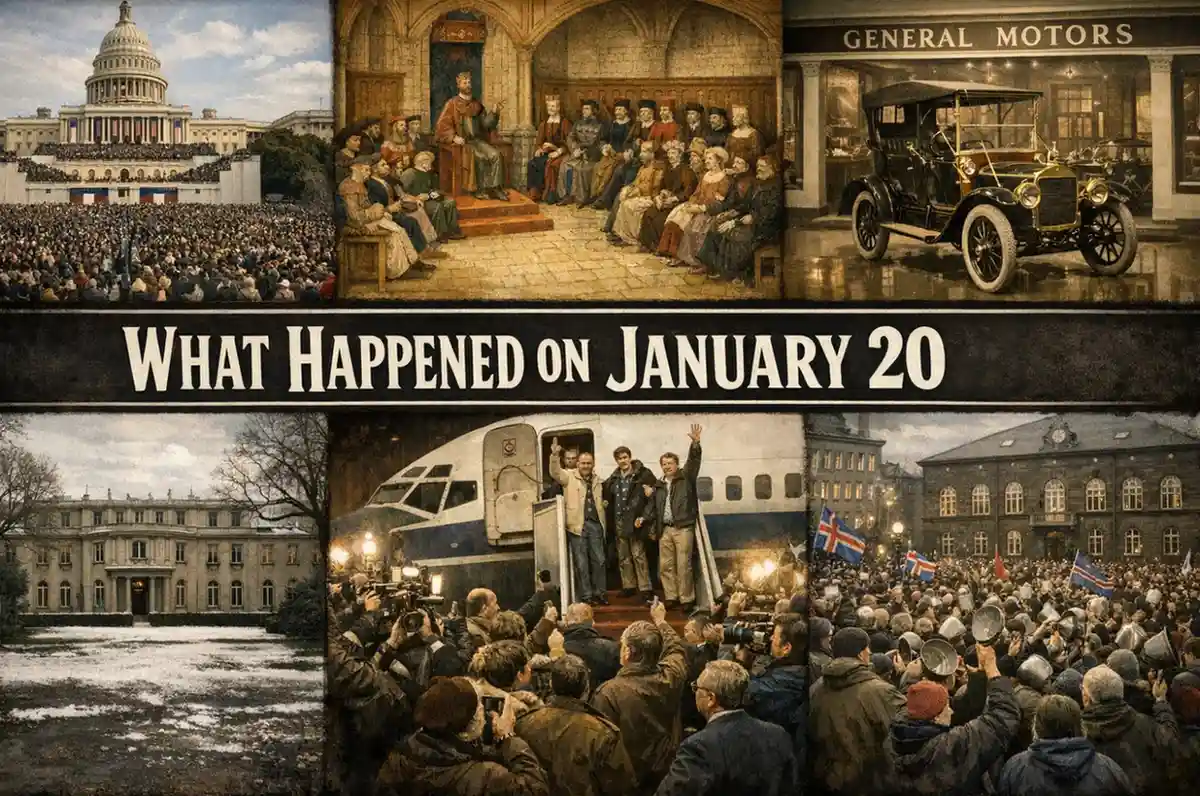
The first English parliament to include not only the high-ranking Lords but also elected representatives from the major towns (burgesses) held its first meeting at the Palace of Westminster. Organized by Simon de Montfort during a rebellion against King Henry III, this assembly is widely regarded as the ancestor of the modern House of Commons, establishing the principle of representative government.
1320: Wladyslaw Lokietek Becomes King
Wladyslaw I, known as “the Elbow-high” due to his short stature, was crowned King of Poland in Wawel Cathedral. His coronation ended the long period of fragmentation in the Polish lands and marked the reunification of the kingdom. He successfully navigated decades of civil war and foreign invasion to restore the Polish monarchy to a position of strength.
1356: Edward Balliol Surrenders Claim
Edward Balliol, a claimant to the Scottish throne supported by the English, officially surrendered his claim to King Edward III of England. In exchange for giving up his royal title, Balliol was granted a comfortable English pension. This surrender effectively ended the “Second War of Scottish Independence,” leaving the Bruce dynasty in control of Scotland.
1401: Europe’s First Public Bank
The Taula de canvi (Table of Change) began operations in Barcelona’s Llotja de Mar. It is described as the first-ever public bank in Europe, established by the city’s municipal government to manage public funds and facilitate trade. This institution laid the groundwork for modern public finance and the banking systems that would eventually dominate European commerce.
1523: Abdication of Christian II
King Christian II was forced to abdicate his throne as the King of Denmark and Norway. His reign had been marked by extreme violence—most notably the Stockholm Bloodbath—and heavy taxation, which led to a widespread rebellion by the nobility. His downfall led to the rise of the House of Oldenburg and a significant shift in Scandinavian power dynamics.
1567: Battle of Rio de Janeiro
Portuguese forces under Estácio de Sá achieved a final, decisive victory over French settlers in the Battle of Rio de Janeiro. The French had attempted to establish a colony known as “Antarctic France,” but the Portuguese successfully drove them out of the Guanabara Bay. This victory ensured Portuguese control over the region and led to the formal establishment of the city of Rio de Janeiro.
1576: Founding of León, Mexico
By order of Viceroy Don Martín Enríquez de Almanza, the city of León was officially founded in the Mexican state of Guanajuato. Originally intended as a defensive garrison against Chichimeca attacks, the city evolved into a major center for agriculture and industry. Today, León is known globally as the “Shoe Capital of the World” for its massive leather and footwear production.
1649: Trial of King Charles I Begins
The High Court of Justice began its proceedings for the trial of King Charles I of England on charges of high treason. This was an unprecedented event in European history, as a reigning monarch was brought before a court by his own subjects. Charles refused to recognize the authority of the court, arguing that “a king cannot be tried by any superior jurisdiction on earth.”
1726: Premiere of Bach’s Cantata BWV 13
Johann Sebastian Bach led the first performance of his cantata Meine Seufzer, meine Tränen (My sighs, my tears) in Leipzig. Composed for the second Sunday after Epiphany, the piece is noted for its somber and melancholic tone, reflecting the themes of human suffering and divine comfort. It remains a celebrated part of Bach’s massive body of liturgical music.
1783: Preliminary Peace Articles Signed
The Kingdom of Great Britain signed preliminary articles of peace with the Kingdom of France and the Kingdom of Spain. These agreements were essential precursors to the Treaty of Paris, setting the stage for the formal end of the American Revolutionary War. The articles recognized the independence of the United States and redistributed colonial territories among the European powers.
1785: Battle of Rạch Gầm-Xoài Mút
Invading Siamese (Thai) forces attempted to intervene in the political chaos of Vietnam but were ambushed and annihilated by the Tây Sơn army at the Mekong River. Led by Nguyễn Huệ, the Vietnamese forces used the river’s geography to trap and destroy the Siamese fleet. This victory is celebrated in Vietnam as one of the greatest military feats in the country’s history.
1788: First Fleet Reaches Botany Bay
The final and largest part of the British “First Fleet” arrived at Botany Bay, marking the beginning of the British colonization of Australia. Upon arrival, Governor Arthur Phillip determined that Botany Bay lacked sufficient fresh water and fertile soil. He decided to move the settlement north to Port Jackson, the site where the city of Sydney would be founded days later.
1839: Battle of Yungay
In a decisive military engagement, Chilean forces defeated the combined army of the Peru-Bolivian Confederation at the Battle of Yungay. This victory led to the dissolution of the Confederation and the restoration of independence for Peru and Bolivia as separate states. The battle solidified Chile’s status as the dominant military power on the Pacific coast of South America.
1841: British Occupy Hong Kong Island
During the First Opium War, British naval forces officially occupied Hong Kong Island. The occupation was formalized shortly after in the Convention of Chuenpi, though the treaty was never ratified by the Chinese or British governments. This event began 156 years of British rule over the territory, which transformed from a small fishing village into a global financial hub.
1874: Treaty of Pangkor
The Treaty of Pangkor was signed between British officials and Sultan Abdullah of Perak. The agreement allowed for British intervention in the internal affairs of the Malay states through the appointment of a British Resident. This treaty was a turning point in the colonization of the Malay Peninsula, paving the way for the eventual formation of British Malaya.
1877: End of the Constantinople Conference
The final day of the Constantinople Conference saw the major European powers agree on a series of political reforms for the Balkans, aimed at protecting Christian minorities within the Ottoman Empire. However, the Ottoman government ultimately rejected the proposals, considering them an infringement on their sovereignty. This diplomatic failure led directly to the Russo-Turkish War.
1887: Pearl Harbor Leased to the Navy
The United States Senate approved an amendment to a treaty with the Kingdom of Hawaii, allowing the U.S. Navy to lease Pearl Harbor as a naval base. This strategic move gave the United States a permanent military presence in the central Pacific. The base would later play a central role in 20th-century history, most notably during the attack that drew the U.S. into World War II.
1909: GM Acquires Oakland (Pontiac)
General Motors (GM) expanded its growing automotive empire by purchasing a stake in the Oakland Motor Car Company. Under GM’s management, the Oakland brand would eventually evolve into the Pontiac division. Pontiac became one of GM’s most successful and recognizable brands, particularly known for its performance-oriented “muscle cars” in the 1960s.
1921: Sinking of HMS K5
The British K-class submarine HMS K5 sank during a mock battle in the English Channel. All 56 crew members on board were lost when the vessel failed to resurface after a dive. The disaster highlighted the dangerous design flaws of the K-class submarines, which were steam-powered and notorious for mechanical failures, earning them the nickname “Katastrophe class.”
1921: First Constitution of Turkey
The Grand National Assembly of Turkey adopted the country’s first constitution, known as the Law of Fundamental Organization. This document marked a radical shift in sovereignty, moving it from the Ottoman Sultan to the Turkish nation. It established the framework for a new, secular republican state and served as the legal basis for the Turkish War of Independence.
1937: First January 20 Inauguration
Franklin D. Roosevelt was sworn in for his second term as President, marking the first time a U.S. inauguration took place on January 20. Previously, inaugurations were held on March 4. The change was mandated by the 20th Amendment, known as the “Lame Duck Amendment,” which was designed to shorten the transition period between administrations.
1941: Iron Guard Rebellion in Bucharest
A German officer’s assassination in Bucharest sparked a violent rebellion and pogrom by the Romanian Iron Guard, a fascist paramilitary group. During the three-day riot, 125 Jewish civilians were brutally murdered, and 30 soldiers were killed in clashes with the rebels. The event led to the consolidation of power by General Ion Antonescu, who suppressed the Iron Guard with German support.
1942: The Wannsee Conference
Senior Nazi officials met at a villa in the Berlin suburb of Wannsee to discuss and coordinate the implementation of the “Final Solution to the Jewish question.” Led by Reinhard Heydrich, the meeting ensured the cooperation of various government departments in the systematic genocide of Europe’s Jewish population. The minutes of the meeting serve as a chilling administrative record of the Holocaust’s planning.
1945: Hungarian Armistice
The provisional government of Hungary, led by Béla Miklós, signed an armistice with the Allied powers in Moscow. This agreement officially ended Hungary’s participation in the war on the side of Nazi Germany. The armistice required Hungary to declare war on Germany and provide troops to support the Soviet advance, signaling the collapse of the Axis alliance in Eastern Europe.
1945: Evacuation of East Prussia
Facing the rapid advance of the Soviet Red Army, Nazi Germany began the massive evacuation of approximately 1.8 million civilians and military personnel from East Prussia. Known as Operation Hannibal, the evacuation took nearly two months and involved a desperate flight across the Baltic Sea. Thousands of people died from the extreme cold, shipwrecks, and Soviet attacks during the retreat.
1953: Inauguration of Dwight D. Eisenhower
Dwight D. Eisenhower was inaugurated as the 34th President of the United States. A former Supreme Allied Commander during World War II, his presidency was marked by the end of the Korean War and the beginning of the Interstate Highway System. He was the first Republican to hold the office in 20 years, signaling a shift in American political leadership during the early Cold War.
1954: National Negro Network Established
In a significant milestone for Black media, the National Negro Network was established with 40 charter member radio stations across the United States. This was the first nationwide radio network owned and operated specifically for African American audiences. The network provided a platform for Black voices, news, and entertainment during the early years of the Civil Rights Movement.
1961: Inauguration of John F. Kennedy
John F. Kennedy was inaugurated as the 35th President of the United States, becoming the youngest man ever elected to the office and the first Roman Catholic. His inaugural address featured the famous line, “Ask not what your country can do for you—ask what you can do for your country.” His presidency would be defined by the Space Race, the Cuban Missile Crisis, and the Civil Rights Movement.
1972: Pakistan Launches Nuclear Program
Weeks after its defeat in the 1971 war with India and the independence of Bangladesh, Pakistan officially launched its nuclear weapons program. President Zulfikar Ali Bhutto convened a meeting of top scientists to initiate the development of a “nuclear deterrent.” This decision fundamentally altered the security landscape of South Asia and led to a decades-long nuclear arms race with India.
1973: Assassination of Amílcar Cabral
Amílcar Cabral, the charismatic leader of the independence movements in Guinea-Bissau and Cape Verde, was assassinated in Conakry, Guinea. Cabral was a brilliant revolutionary theorist and a central figure in the fight against Portuguese colonial rule in Africa. His death was a major blow to the movement, but his legacy continued to inspire liberation struggles across the continent.
1974: Battle of the Paracel Islands
Chinese naval forces seized full control over the Paracel Islands in the South China Sea following a brief but intense military engagement with the South Vietnamese Navy. The battle resulted in the sinking of a South Vietnamese warship and dozens of casualties. This victory solidified China’s territorial claims in the region, which remain a source of significant international tension today.
1981: Release of the American Hostages
Just 20 minutes after Ronald Reagan was inaugurated as the 40th President of the United States, Iran officially released the 52 American hostages. The hostages had been held in Tehran for 444 days following the 1979 seizure of the U.S. Embassy. The timing of the release was seen by many as a final insult to the outgoing President Jimmy Carter.
1986: First Federal MLK Day
Martin Luther King Jr. Day was observed as a federal holiday in the United States for the first time. The holiday was established to honor the life and legacy of the civil rights leader and his commitment to nonviolent social change. While the legislation was signed into law in 1983, it took several years for the first official observance to take place nationwide.
1986: Coup in Lesotho
Leabua Jonathan, the long-serving Prime Minister of Lesotho, was ousted from power in a bloodless military coup led by General Justin Lekhanya. The coup followed a blockade of the country by South Africa, which accused Jonathan’s government of harboring anti-apartheid rebels. The military government that followed maintained closer ties with the South African regime.
1990: “Black January” in Azerbaijan
Soviet troops entered the city of Baku to suppress a growing pro-independence protest movement in Azerbaijan. The military intervention, which became known as “Black January,” resulted in the deaths of over 140 civilians. This violent crackdown failed to stop the collapse of Soviet authority and is now commemorated in Azerbaijan as a National Day of Mourning.
1991: Islamic Law Imposed in Sudan
The government of Sudan officially imposed Sharia (Islamic law) nationwide, a move that significantly worsened the ongoing civil war. The decision was fiercely resisted by the predominantly Christian and animist population in the southern part of the country. This religious and cultural division would eventually lead to the independence of South Sudan in 2011.
1992: Air Inter Flight 148 Crash
An Air Inter Airbus A320 crashed into a mountain in the Vosges range near Strasbourg, France, while on approach to the airport. Of the 96 people on board, 87 were killed. The investigation revealed that the pilots had accidentally programmed the aircraft into a steep descent mode. This tragedy led to significant changes in cockpit interface design and pilot training for automated flight systems.
2001: Ousting of Joseph Estrada
Philippine President Joseph Estrada was forced to resign following a massive four-day nonviolent protest movement known as “People Power II.” The protests were sparked by allegations of massive corruption and the suspension of his impeachment trial. Estrada was succeeded by his Vice President, Gloria Macapagal Arroyo, marking a major turning point in Philippine democracy.
2009: Inauguration of Barack Obama
Barack Obama was inaugurated as the 44th President of the United States, becoming the first African American to hold the office. His inauguration drew a record-breaking crowd of nearly two million people to the National Mall in Washington D.C. His presidency was marked by the passage of the Affordable Care Act and the recovery from the 2008 global financial crisis.
2009: “Pots and Pans Revolution” in Iceland
A wave of protests in Iceland, sparked by the 2008 financial collapse, culminated in the “Pots and Pans Revolution.” Thousands of citizens gathered outside the parliament building, banging kitchenware to demand the resignation of the government and the central bank leadership. The protests successfully led to the collapse of the government and the drafting of a new constitution.
2017: Inauguration of Donald Trump
Donald Trump was inaugurated as the 45th President of the United States. A businessman and media personality, his presidency was characterized by a “populist” approach to government, major tax cuts, and significant shifts in American foreign and trade policy. His inauguration sparked both widespread celebration among his supporters and massive protests in major cities worldwide.
2018: Kabul Hotel Attack
Gunmen from the Taliban-affiliated Haqqani network attacked the Inter-Continental Hotel in Kabul, Afghanistan, sparking a 12-hour siege. The attackers targeted foreign guests and Afghan government officials, resulting in 40 deaths. This brutal attack highlighted the ongoing security challenges in Kabul and the persistence of extremist violence in the region.
2018: Afrin Offensive Begins
The Turkish government announced the start of “Operation Olive Branch,” a major military offensive against Syrian Democratic Forces (SDF) in the Afrin region of northern Syria. Turkey aimed to clear the area of Kurdish-led militias, which it viewed as a national security threat. The operation led to a significant escalation in the Syrian Civil War and the displacement of thousands of civilians.
2021: Inauguration of Joe Biden
Joe Biden was inaugurated as the 46th President of the United States, becoming the oldest person ever inaugurated at the time. Kamala Harris was sworn in as the first female, first Black, and first South Asian Vice President. The ceremony took place under tight security following the January 6 attack on the Capitol and amidst the ongoing COVID-19 pandemic.
2025: Second Inauguration of Donald Trump
Donald Trump was inaugurated for a second, non-consecutive term as the 47th President of the United States. Following his victory in the 2024 election, he became the oldest person ever inaugurated, surpassing the previous record held by Joe Biden. This historic return to office was a central event in American political history, marking only the second time a president served non-consecutive terms.
Read Here What Happened On This Day In History January 19: Powerful Tales
Famous People Born On January 20
| Name | Role / Description | Dates |
|---|---|---|
| Sophie, Duchess of Edinburgh | British royal, consort of Prince Edward | January 20, 1965 – |
| Nucky Johnson | American politician, Atlantic City | January 20, 1883 – December 9, 1968 |
| Charles III | King of Spain | January 20, 1716 – December 14, 1788 |
| André-Marie Ampère | French physicist, electromagnetism | January 20, 1775 – June 10, 1836 |
| Richard Henry Lee | US statesman | January 20, 1732 – June 19, 1794 |
| Göran Persson | Swedish prime minister | January 20, 1949 – |
| Ozzie Guillen | Baseball player & manager | January 20, 1964 – |
| Irving Kristol | American essayist, publisher | January 20, 1920 – September 18, 2009 |
| Anatoly Shcharansky | Soviet-Israeli human-rights activist | January 20, 1948 – |
| Joy Adamson | Conservationist | January 20, 1910 – January 3, 1980 |
| Ruth St. Denis | American dancer | January 20, 1879 – July 21, 1968 |
| Charles-Alexandre de Calonne | French statesman | January 20, 1734 – October 29, 1802 |
| Sebastian | King of Portugal | January 20, 1554 – August 4, 1578 |
| Johannes V. Jensen | Danish author | January 20, 1873 – November 25, 1950 |
| Harriot Eaton Stanton Blatch | American suffragist | January 20, 1856 – November 20, 1940 |
| Euclides da Cunha | Brazilian author | January 20, 1866 – August 15, 1909 |
| Johann Hermann Schein | German composer | January 20, 1586 – November 19, 1630 |
| Edward Albert Feigenbaum | AI pioneer | January 20, 1936 – |
| John Naber | Olympic swimmer | January 20, 1956 – |
| Walter Piston | American composer | January 20, 1894 – November 12, 1976 |
| Keith Castellain Douglas | British poet | January 20, 1920 – June 9, 1944 |
| Paul Cambon | French diplomat | January 20, 1843 – May 29, 1924 |
| Anne Jemima Clough | British educator | January 20, 1820 – February 27, 1892 |
| Okada Keisuke | Japanese admiral & PM | January 20, 1868 – October 17, 1952 |
| Jean-Jacques Barthélemy | French archaeologist | January 20, 1716 – April 30, 1795 |
| Sir William Fox | PM of New Zealand | January 20, 1812 – June 23, 1893 |
| Heberto Padilla | Cuban poet | January 20, 1932 – September 25, 2000 |
| Sebastian Münster | German scholar & cartographer | January 20, 1488 – May 23, 1552 |
| Bertram Home Ramsay | British naval officer | January 20, 1883 – January 2, 1945 |
| Josef Casimir Hofmann | Pianist & composer | January 20, 1876 – February 16, 1957 |
Famous People Died On January 20
| Name | Role / Description | Dates |
|---|---|---|
| Abdul Ghaffar Khan | Pashtun leader, activist | 1890 – January 20, 1988 |
| Anne of Austria | Queen of France | September 22, 1601 – January 20, 1666 |
| Norman Jewison | Canadian director | July 21, 1926 – January 20, 2024 |
| Sir Matthew Busby | British football manager | May 26, 1909 – January 20, 1994 |
| Mustafa I | Ottoman sultan | 1591 – January 20, 1639 |
| Garrincha | Brazilian footballer | October 28, 1933 – January 20, 1983 |
| Jean-François Millet | French painter | October 4, 1814 – January 20, 1875 |
| Paul Bocuse | French chef | February 11, 1926 – January 20, 2018 |
| Gerry Mulligan | American musician | April 6, 1927 – January 20, 1996 |
| Claudio Abbado | Italian conductor | June 26, 1933 – January 20, 2014 |
| Christian VIII | King of Denmark | September 18, 1786 – January 20, 1848 |
| Josh Gibson | American baseball player | December 21, 1911 – January 20, 1947 |
| Abū ʿAbd Allāh al-Shāfiʿī | Muslim jurist | 767 – January 20, 820 |
| Al Hirschfeld | American caricaturist | June 21, 1903 – January 20, 2003 |
| Curt Flood | American baseball player | January 18, 1938 – January 20, 1997 |
| Charles VII | Holy Roman Emperor | August 6, 1697 – January 20, 1745 |
| José Guadalupe Posada | Mexican printmaker | February 2, 1851 – January 20, 1913 |
| David Garrick | English actor & producer | February 19, 1717 – January 20, 1779 |
| Sir John Soane | British architect | September 10, 1753 – January 20, 1837 |
| Mehdi Bazargan | Prime minister of Iran | September 1907? – January 20, 1995 |
| Red Jacket | Seneca chief | 1758? – January 20, 1830 |
| Beatrice Lillie | Actress & comedienne | May 29, 1894 – January 20, 1989 |
| Higashikuni Naruhiko | PM of Japan | February 3, 1887 – January 20, 1990 |
| John Howard | British philanthropist | September 2, 1726 – January 20, 1790 |
| James McKeen Cattell | American psychologist | May 25, 1860 – January 20, 1944 |
| Camille Jordan | French mathematician | January 5, 1838 – January 20, 1922 |
| Bettina von Arnim | German writer | April 4, 1785 – January 20, 1859 |
| Jacques Roux | French priest & revolutionary | – January 20, 1794 |
| Piggy Lambert | US basketball coach | May 28, 1888 – January 20, 1958 |
| Charles Montagu Doughty | British traveler & writer | August 19, 1843 – January 20, 1926 |
Observances & Institutional Dates
- Presidential Inauguration Day (USA): Held every four years on January 20 following a presidential election.
- Armed Forces Day (Mali): A day of national pride and military parades honoring the soldiers of Mali.
- Martyrs’ Day (Azerbaijan): A somber day of remembrance for the victims of the “Black January” crackdown in 1990.
Frequently Asked Questions
Why is January 20 the date for U.S. Presidential Inaugurations?
The date was established by the 20th Amendment in 1933 to shorten the “lame duck” period between a November election and the start of a new term.
Which U.S. President was inaugurated twice on January 20?
Donald Trump was inaugurated as the 45th President on January 20, 2017, and as the 47th President on January 20, 2025.
What was the Wannsee Conference?
Held on January 20, 1942, it was a meeting where high-ranking Nazi officials coordinated the implementation of the Holocaust.