Exploring the past reveals a complex tapestry of human achievement and tragedy. In our look at what happened on this day in history January 21, we travel from the fall of French royalty to the heights of space exploration. Every year, this date marks significant shifts in global politics, science, and social movements.
Important Events That Happened On January 21 In History
763 – The End of the Alid Rebellion
Following the intense Battle of Bakhamra between the Alids and the Abbasids near Kufa, a major political era came to a close. The Alid rebellion officially ended with the death of Ibrahim, who was the brother of Isa ibn Musa. This defeat solidified Abbasid power and halted the immediate threat to their caliphate’s stability.
1525 – Foundation of the Swiss Anabaptist Movement
The Swiss Anabaptist Movement was born in a radical act of faith within the home of Felix Manz’s mother in Zürich. Conrad Grebel, Felix Manz, George Blaurock, and about a dozen others chose to baptize each other, defying local laws. This event was revolutionary because it broke a thousand-year tradition of the union between church and state.
1535 – The Anti-Protestant Procession in Paris
In the wake of the “Affair of the Placards,” where anti-Catholic posters were distributed throughout the city, the French King took a public stand. He personally led a massive anti-Protestant procession through the streets of Paris to show strength. This event signaled an escalation in the religious tensions and persecution that would plague France for years.
1720 – Sweden and Prussia Sign the Treaty of Stockholm
Diplomatic history was made when Sweden and Prussia officially signed the Treaty of Stockholm. This agreement was a crucial part of the negotiations to end the Great Northern War. By signing this treaty, the two nations settled territorial disputes and helped reshape the power dynamics of Northern Europe.
1749 – Destruction of the Teatro Filarmonico
The prestigious Teatro Filarmonico in Verona was tragically destroyed by a fire that could have been easily prevented. The blaze started because a torch was accidentally left behind in the box of a nobleman after a theatrical performance. While the loss was a blow to the arts, the community eventually rebuilt the structure in 1754.
1774 – Abdul Hamid I Becomes Sultan
A new era began for the Ottoman Empire as Abdul Hamid I officially became the Sultan and the Caliph of Islam. He succeeded Mustafa III during a period where the empire was struggling with significant military and economic challenges. His reign would be defined by his efforts to reform the military and navigate complex international relations.
1789 – America’s First Novel is Printed
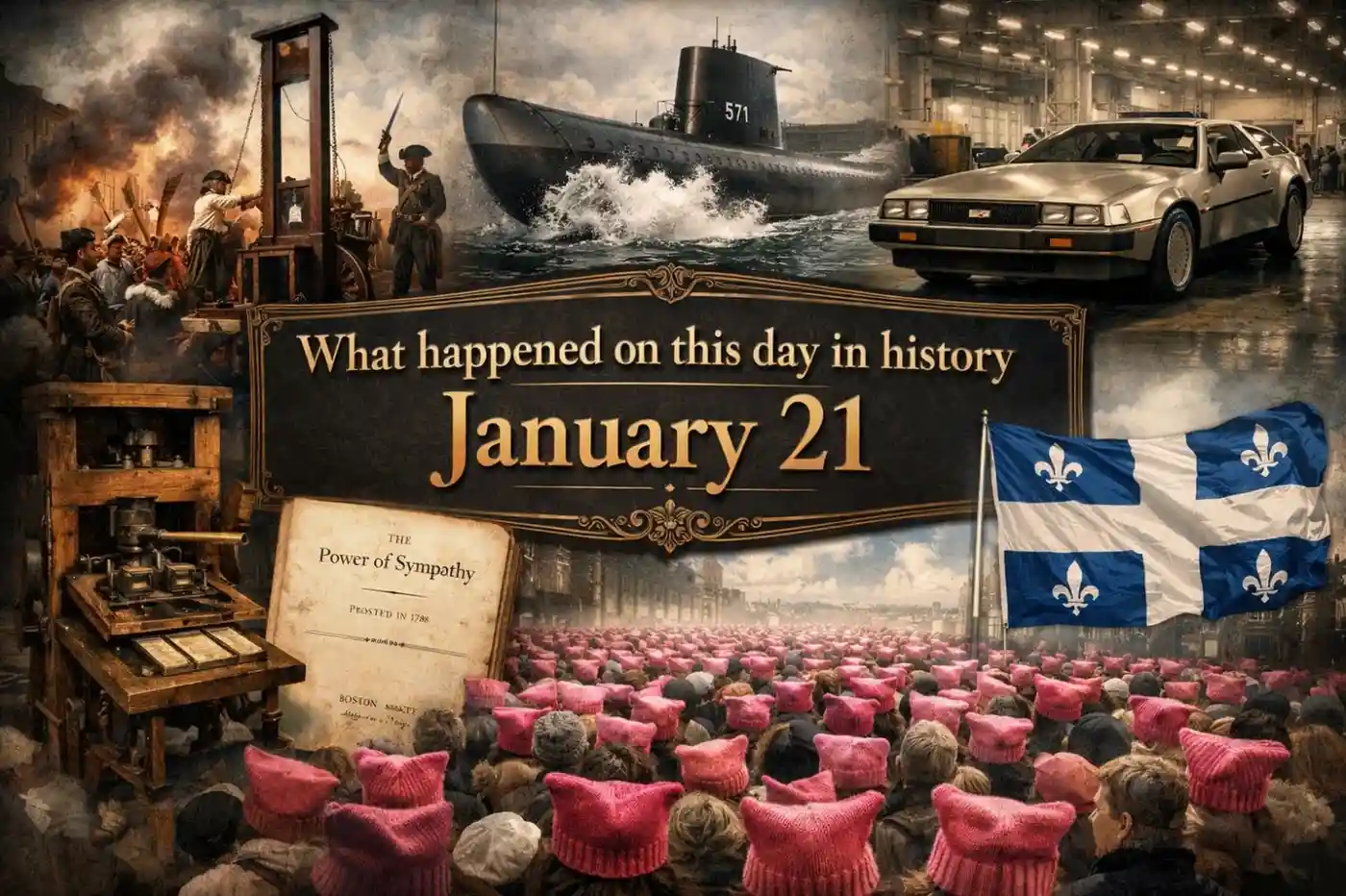
Literary history was written in Boston with the printing of The Power of Sympathy or the Triumph of Nature Founded in Truth. Written by William Hill Brown, this work is widely considered the very first American novel. It used a series of letters to tell its story, setting a precedent for American fiction and moral storytelling.
1793 – The Execution of King Louis XVI
After being found guilty of treason by the French National Convention, Louis XVI of France met his end at the guillotine. The execution took place in the Place de la Révolution in Paris amidst the fervor of the French Revolution. This event sent shockwaves through the monarchies of Europe and marked the definitive end of the Bourbon monarchy’s absolute power.
1824 – British Defeat in the First Anglo-Ashanti War
The Ashanti Empire demonstrated its military strength by defeating British forces in the Gold Coast. This battle was a major engagement in the First Anglo-Ashanti War and served as a reminder of the power of local resistance. The British loss highlighted the difficulties colonial powers faced when trying to expand into the interior of West Africa.
1854 – The Sinking of the RMS Tayleur
The RMS Tayleur met a tragic end off Lambay Island during its maiden voyage from Liverpool to Australia. The ship, which was highly anticipated for its modern design, succumbed to the sea with a great loss of life among the passengers and crew. Investigations into the wreck later revealed issues with the ship’s compasses and crew training.
1893 – Annexation of Tati Concessions Land
The Tati Concessions Land, which was formerly recognized as a part of Matabeleland, was formally annexed to the Bechuanaland Protectorate. This region is known today as part of the modern nation of Botswana. The move was a strategic administrative shift that occurred during the height of the “Scramble for Africa” by colonial powers.
1908 – New York’s Public Smoking Ban for Women
In a controversial move, New York City passed the Sullivan Ordinance, which made it illegal for women to smoke in public. The law was rooted in the social biases of the time, but it did not last long in the city’s books. The measure was eventually vetoed by the mayor, who recognized the legal and social inconsistencies of such a ban.
1911 – The First Monte Carlo Rally
The inaugural Monte Carlo Rally was held, marking the beginning of one of the most famous events in motorsports history. Participants started from various points across Europe with the goal of reaching Monte Carlo. It was designed to test the reliability of early automobiles and the endurance of drivers during the winter months.
1915 – Kiwanis International is Founded
In Detroit, Michigan, the service organization Kiwanis International was officially established by a group of businessmen. Originally intended to focus on professional networking, the organization soon shifted its primary mission to community service. Today, it is a global entity dedicated to improving the lives of children through various local initiatives.
1919 – Declaration of the Irish Republic
A revolutionary Irish parliament, the First Dáil, met to formally declare the independence of the Irish Republic from British rule. This bold political move coincided with the Soloheadbeg ambush, which is considered one of the first engagements of the Irish War of Independence. It was a turning point that led to years of conflict and the eventual creation of the Irish Free State.
1925 – Albania Declares Itself a Republic
Transitioning from a period of political instability, Albania officially declared itself a republic on this day. This change in governance aimed to centralize power and modernize the country’s political framework. Ahmed Zogu, who would later become King Zog I, played a central role in this shift as the republic’s first president.
1931 – Sir Isaac Isaacs Sworn in as Governor-General
History was made in Australia when Sir Isaac Isaacs was sworn in as the Governor-General of the nation. He was the first Australian-born person to ever hold this high office, which represented the British monarch. His appointment was a significant milestone in Australia’s journey toward greater national identity and independence from British administrative traditions.
1932 – Finland and the Soviet Union Non-Aggression Treaty
In an attempt to secure their borders, Finland and the Soviet Union signed a formal non-aggression treaty. The pact was intended to prevent military conflict between the two neighbors for a period of several years. Despite this diplomatic effort, the treaty would eventually fail to prevent the outbreak of the Winter War later in the decade.
1941 – The Iron Guard Rebellion and Pogrom
Triggered by the murder of a German officer in Bucharest the day before, members of the Iron Guard launched a violent rebellion in Romania. During the chaos, they engaged in a horrific pogrom, brutally killing 125 Jewish people. This event remains one of the darkest chapters of the Holocaust in Romania, characterized by extreme cruelty and lawlessness.
1942 – Establishment of the Fareynikte Partizaner Organizatsye
In the Vilna Ghetto, a vital Jewish resistance organization known as the Fareynikte Partizaner Organizatsye (FPO) was established. This group was formed with the intent of organizing an armed uprising against the Nazi occupiers. It was one of the first resistance groups in the ghettos to recognize that the only hope for dignity was through active combat.
1945 – Trade Union Council of Transcarpathian Ukraine
As the geopolitical landscape of Eastern Europe shifted near the end of World War II, a new labor body was formed. The Trade Union Council of Transcarpathian Ukraine was officially founded in the city of Mukachevo. This move was part of the broader administrative and social reorganization taking place as the region moved toward Soviet integration.
1948 – The Flag of Quebec is Adopted
The Flag of Quebec, known as the Fleurdelisé, was adopted and flown for the first time over the National Assembly of Quebec. It replaced the British Union Jack, symbolizing a distinct identity for the province. The day is still celebrated annually as Québec Flag Day to honor the history and culture of the Québécois people.
1950 – Conviction of Alger Hiss
Alger Hiss, a prominent American lawyer and government official, was convicted of perjury after a highly publicized trial. The case involved allegations of Soviet espionage, though Hiss was specifically charged for lying about his involvement with Whittaker Chambers. This trial became a landmark event during the early years of the Cold War and the “Red Scare” in America.
1951 – Eruption of Mount Lamington
The catastrophic eruption of Mount Lamington in Papua New Guinea took the lives of 2,942 people. The eruption was particularly devastating because the volcano was previously thought to be extinct or dormant, leaving locals unprepared. The blast produced a massive pyroclastic flow that destroyed everything in its path within minutes.
1954 – Launch of the USS Nautilus
The first nuclear-powered submarine in history, the USS Nautilus, was launched in Groton, Connecticut. First Lady Mamie Eisenhower had the honor of christening the vessel as it entered the water. This launch marked a massive technological leap in naval warfare, allowing submarines to remain submerged for much longer periods than conventional ships.
1960 – Miss Sam’s Journey on Little Joe 1B
NASA launched the Little Joe 1B Mercury spacecraft from Wallops Island, Virginia, with a unique passenger on board. Miss Sam, a female rhesus monkey, was sent into space to test the escape systems and biological effects of flight. The mission was a success, and Miss Sam was safely recovered after the flight reached an altitude of several miles.
1960 – The Crash of Avianca Flight 671
A tragedy occurred at the airport in Montego Bay, Jamaica, when Avianca Flight 671 crashed during landing. The accident resulted in the deaths of 37 people on board the aircraft. Investigations pointed toward a heavy landing that caused the plane to catch fire, making it one of the deadliest aviation accidents in Jamaican history at the time.
1960 – Coal Mine Collapse in Holly Country
In a devastating industrial disaster, a coal mine collapsed at Holly Country in South Africa. The accident trapped and killed 435 miners, making it one of the worst mining tragedies in the country’s history. The scale of the loss brought international attention to the dangerous working conditions in South African mines during that era.
1963 – End of the Chicago North Shore and Milwaukee Railroad
The Chicago North Shore and Milwaukee Railroad officially ended its operations after decades of service. Known for its high-speed electric trains, the line had been a staple of transportation between Chicago and Milwaukee. Its closure marked the decline of interurban electric railways in the United States as the automobile became the dominant mode of travel.
1968 – The Battle of Khe Sanh Begins
During the Vietnam War, one of the most publicized and controversial battles began at the Khe Sanh combat base. North Vietnamese forces launched a massive artillery bombardment against the U.S. Marines stationed there. The siege lasted for months and became a focal point of American media coverage and military strategy during the conflict.
1968 – B-52 Bomber Crash at Thule Air Base
A B-52 bomber carrying a nuclear payload crashed near Thule Air Base in Greenland after a cabin fire broke out. The impact caused the conventional explosives in the bombs to detonate, rupturing the nuclear weapons and contaminating the area with radioactive material. Despite an extensive cleanup operation, one of the four bombs reportedly remained unaccounted for.
1971 – Emley Moor Transmitting Station Goes Live
The current Emley Moor transmitting station began its UHF broadcasts, standing as the tallest free-standing structure in the United Kingdom. It was built to replace a previous mast that had collapsed during a winter storm years prior. The tower remains a vital part of the UK’s telecommunications infrastructure, reaching heights that dominate the Yorkshire landscape.
1976 – Commercial Concorde Service Begins
Supersonic air travel became a reality for the public as the Concorde began its first commercial flights. British Airways launched a route from London to Bahrain, while Air France began service between Paris and Rio de Janeiro. This milestone allowed passengers to travel at twice the speed of sound, redefining luxury and speed in the aviation industry.
1980 – Iran Air Flight 291 Crash
Iran Air Flight 291 crashed in the Alborz Mountains while it was on its final approach to Mehrabad International Airport in Tehran. All 128 people on board were killed when the Boeing 727 struck the rugged terrain in poor weather conditions. The disaster was attributed to a failure of the ground-based navigation equipment and pilot error.
1981 – DeLorean Sports Car Production Begins
Production of the iconic DeLorean sports car officially started in Dunmurry, Northern Ireland. Known for its distinct brushed stainless-steel body and gull-wing doors, the car would later achieve legendary status through the Back to the Future films. The factory’s opening was seen as a major economic boost for the region during a time of high unemployment.
1985 – Galaxy Airlines Flight 203 Crash
Galaxy Airlines Flight 203 crashed shortly after takeoff from the Reno–Tahoe International Airport in Nevada. The disaster claimed the lives of 70 people, leaving only one survivor from the wreckage. An investigation later determined that the crash was caused by a vibrations-induced pilot error after a ground crew failed to properly close an access door.
1986 – Attack on Dartmouth Anti-Apartheid Shanty Town
A group of conservative student protesters at Dartmouth College attacked and destroyed a mock shanty town on the campus Green. The shanty town had been built by other students as a protest against the South African apartheid system. This incident sparked a national debate about free speech, divestment, and the intensity of political divisions on American campuses.
1997 – Reprimand of Speaker Newt Gingrich
In a historic move, the U.S. House of Representatives voted 395–28 to formally reprimand Speaker Newt Gingrich for ethics violations. This marked the first time in American history that a Speaker of the House was disciplined in such a manner. The reprimand was accompanied by a significant fine, following a lengthy investigation into his use of tax-exempt funds.
1999 – Record Cocaine Bust by the Coast Guard
The United States Coast Guard executed one of the largest drug busts in American history when they intercepted a suspicious vessel. Upon searching the ship, they discovered over 4,300 kilograms (9,500 lbs) of cocaine on board. This massive seizure was a major victory in the ongoing “War on Drugs” and highlighted the scale of international smuggling operations.
2000 – Political Coup in Ecuador
After the Ecuadorian Congress was seized by indigenous organizations, a group consisting of Col. Lucio Gutiérrez and others deposed President Jamil Mahuad. The situation was fluid, with Gutiérrez eventually being replaced by military leadership. Ultimately, Vice-President Gustavo Noboa was allowed to succeed Mahuad to restore a sense of constitutional order.
2003 – Magnitude 7.6 Earthquake in Colima
A powerful 7.6 magnitude earthquake struck the Mexican state of Colima, causing widespread destruction. The quake resulted in the deaths of 29 people and left approximately 10,000 residents homeless due to collapsed buildings. Extensive relief efforts were required to provide food, shelter, and medical care to the affected communities in the following months.
2004 – Spirit Rover Loses Communication
NASA’s Mars Rover, Spirit, caused a scare at mission control when it suddenly ceased communication from the red planet. Scientists discovered that the problem was related to the management of the rover’s flash memory. They were eventually able to fix the software issue remotely from Earth, allowing Spirit to resume its mission on February 6.
2005 – Riots Erupt in Belmopan, Belize
In the capital city of Belmopan, public anger over the government’s introduction of new taxes turned into violent riots. Protesters took to the streets to voice their frustration with the economic situation, leading to clashes with law enforcement. The unrest highlighted the deep-seated tension between the administration and the citizens regarding fiscal policy.
2009 – Israel Withdraws from Gaza
Israel completed its withdrawal of troops from the Gaza Strip, marking the official end of a three-week war against Hamas. While the withdrawal was a step toward de-escalation, it did not lead to immediate peace. Intermittent fire from both sides continued to occur in the weeks that followed, keeping the region in a state of high tension.
2011 – Deadly Demonstrations in Tirana
Anti-government demonstrations in Tirana, Albania, turned fatal when four protesters died from gunshot wounds. The shots were allegedly fired by armed police who were protecting the Prime Minister’s office from the crowd. These deaths sparked further political outcry and international concern regarding the use of force and the state of democracy in Albania.
2014 – Jazira Canton Declares Autonomy
During the ongoing Rojava conflict, the Jazira Canton officially declared its autonomy from the Syrian Arab Republic. This move was part of a broader effort by Kurdish-led forces to establish self-governing regions in Northern Syria. The declaration aimed to create a decentralized system of governance amidst the chaos of the Syrian Civil War.
2017 – Global Women’s March
On Donald Trump’s first full day as President, a large-scale women’s march took place in over 400 American cities and 160 countries. Millions of people participated in what became one of the largest single-day protests in history. The marchers focused on a wide range of issues, including women’s rights, immigration reform, and healthcare.
2023 – Monterey Park Mass Shooting
A 72-year-old gunman opened fire inside a dance studio in Monterey Park, California, during Lunar New Year celebrations. The attack killed eleven people and injured nine others before the shooter committed suicide. It was a tragic event that stood as the worst mass shooting in Los Angeles County since the Covina massacre in 2008.
2025 – Grand Kartal Hotel Fire
A devastating fire broke out at the Grand Kartal Hotel, located within the Kartalkaya ski resort in Turkey’s Bolu Province. The blaze spread rapidly through the structure, resulting in 78 deaths and leaving 51 others injured. Rescue teams faced difficult conditions due to the resort’s location and the intensity of the flames during the peak of the winter season.
Read Also: What Happened On This Day In History January 20
Famous People Born On January 21
| Name | Role / Description | Birth – Death |
|---|---|---|
| Eric Holder | American lawyer; U.S. attorney general | January 21, 1951 – |
| Jeff Koons | American contemporary artist | January 21, 1955 – |
| John C. Frémont | American explorer & politician | January 21, 1813 – July 13, 1890 |
| Steve Reeves | American actor & bodybuilder | January 21, 1926 – May 1, 2000 |
| Ethan Allen | American Revolutionary War leader | January 21, 1738 – February 12, 1789 |
| John C. Breckinridge | 14th U.S. vice president | January 21, 1821 – May 17, 1875 |
| Oscar II | King of Sweden and Norway | January 21, 1829 – December 8, 1907 |
| Paul Scofield | British stage and film actor | January 21, 1922 – March 19, 2008 |
| Mathilde, Queen of the Belgians | Queen consort of Belgium | January 21, 1973 – |
| Ashton Eaton | American Olympic decathlete | January 21, 1988 – |
| Duncan Grant | British painter & designer | January 21, 1885 – May 8, 1978 |
| Maxime Weygand | French general | January 21, 1867 – January 28, 1965 |
| Wolfgang Köhler | German psychologist (Gestalt theory) | January 21, 1887 – June 11, 1967 |
| Elaine Showalter | American literary critic | January 21, 1941 – |
| Ernest Chausson | French composer | January 21, 1855 – June 10, 1899 |
| Pitirim Sorokin | American sociologist | January 21, 1889 – February 10, 1968 |
| Roger Nash Baldwin | American civil rights activist (ACLU) | January 21, 1884 – August 26, 1981 |
| John Fitch | American inventor (steamboat pioneer) | January 21, 1743 – July 2, 1798 |
| Pavel Florensky | Russian theologian & philosopher | January 21, 1882 – December 15, 1943 |
| Moses Hess | German philosopher & Zionist | January 21, 1812 – April 6, 1875 |
| Umberto Nobile | Italian Arctic explorer | January 21, 1885 – July 30, 1978 |
| Károly Takács | Hungarian Olympic marksman | January 21, 1910 – January 5, 1976 |
| Horace Wells | American dentist; anesthesia pioneer | January 21, 1815 – January 24, 1848 |
| James Murray | British governor of Quebec | January 21, 1721/22 – June 18, 1794 |
| Henri Duparc | French composer | January 21, 1848 – February 12, 1933 |
| Konrad E. Bloch | American biochemist, Nobel laureate | January 21, 1912 – October 15, 2000 |
| Igor Moiseyev | Russian choreographer | January 21, 1906 – November 2, 2007 |
| Eliza Roxey Snow Smith | American Mormon leader & poet | January 21, 1804 – December 5, 1887 |
| Moritz von Schwind | German Romantic painter | January 21, 1804 – February 8, 1871 |
| Joseph-Achille Le Bel | French chemist (stereochemistry) | January 21, 1847 – August 6, 1930 |
Famous People Died On January 21
| Name | Role / Description | Birth – Death |
|---|---|---|
| Elisha Gray | American inventor | August 2, 1835 – January 21, 1901 |
| John Dowland | English composer & lutenist | 1562/63 – January 21, 1626 |
| Lytton Strachey | British biographer & critic | March 1, 1880 – January 21, 1932 |
| Joseph Schildkraut | Austrian-American actor | March 22, 1895 – January 21, 1964 |
| Aleksandr Herzen | Russian writer & thinker | April 6, 1812 – January 21, 1870 |
| James Stewart, Earl of Moray | Scottish regent | c.1531 – January 21, 1570 |
| Mustafa III | Ottoman sultan | January 28, 1717 – January 21, 1774 |
| George Moore | Irish novelist | February 24, 1852 – January 21, 1933 |
| Yemelyan Pugachev | Russian rebel leader | c.1742 – January 21, 1775 |
| Russell Baker | American journalist & humorist | August 14, 1925 – January 21, 2019 |
| Blaise Cendrars | Swiss-French writer | September 1, 1887 – January 21, 1961 |
| Paschal II | Pope | c.1050 – January 21, 1118 |
| Bernard de Mandeville | British philosopher & writer | November 1670 – January 21, 1733 |
| John Couch Adams | British astronomer | June 5, 1819 – January 21, 1892 |
| Ermanno Wolf-Ferrari | Italian composer | January 12, 1876 – January 21, 1948 |
| Donald A. Smith, Lord Strathcona | Canadian statesman & financier | August 6, 1820 – January 21, 1914 |
| George Washington Goethals | American engineer (Panama Canal) | June 29, 1858 – January 21, 1928 |
| Mauricio Funes | President of El Salvador | October 18, 1959 – January 21, 2025 |
| Franz Grillparzer | Austrian dramatist | January 15, 1791 – January 21, 1872 |
| Claude Duval | French-born highwayman | 1643 – January 21, 1670 |
| Joseph Justus Scaliger | Dutch scholar & historian | August 5, 1540 – January 21, 1609 |
| Achim von Arnim | German Romantic writer | January 26, 1781 – January 21, 1831 |
| Athanaric | Visigoth chieftain | – January 21, 381 |
| Katsu Kaishū | Japanese naval reformer | March 12, 1823 – January 21, 1899 |
| Michael Cerularius | Patriarch of Constantinople | c.1000 – January 21, 1059 |
| Juan de Grijalba | Spanish explorer | c.1480 – January 21, 1527 |
| Matthias Claudius | German poet | August 15, 1740 – January 21, 1815 |
| Albert Lortzing | German opera composer | October 23, 1801 – January 21, 1851 |
| Peggy Lee | American singer & songwriter | May 26, 1920 – January 21, 2002 |
| Colonel Tom Parker | Manager of Elvis Presley | June 26, 1909 – January 21, 1997 |
Observances & Institutional Dates
- Errol Barrow Day (Barbados): A public holiday celebrating the birthday of the country’s first Prime Minister.
- Flag Day (Quebec): An annual day of recognition for the official flag of the province, adopted in 1948.
- Grandmother’s Day (Poland): A sweet tradition where grandchildren visit and give gifts to their grandmothers.
- Babinden (Bulgaria, Serbia): A day historically dedicated to midwives and the health of mothers and children.
- Lincoln Alexander Day (Canada): Honoring the first Black Member of Parliament and Lieutenant Governor of Ontario.
- National Hugging Day (United States): A day encouraged to promote the benefits of a simple hug.
- Lady of Altagracia Day (Dominican Republic): A religious feast day honoring the patroness of the nation.
- Squirrel Appreciation Day: A quirky day dedicated to learning about and being kind to our bushy-tailed neighbors.
Frequently Asked Questions
- Who was executed on January 21?
- King Louis XVI of France was executed by guillotine in 1793 for treason.
- What was the first American novel published on this day?
The Power of Sympathy by William Hill Brown was printed in 1789. - What milestone in naval history occurred on this day?
The first nuclear-powered submarine, the USS Nautilus, was launched in 1954. - Which modern protest took place on January 21, 2017?
The global Women’s March, involving millions of people across hundreds of cities.