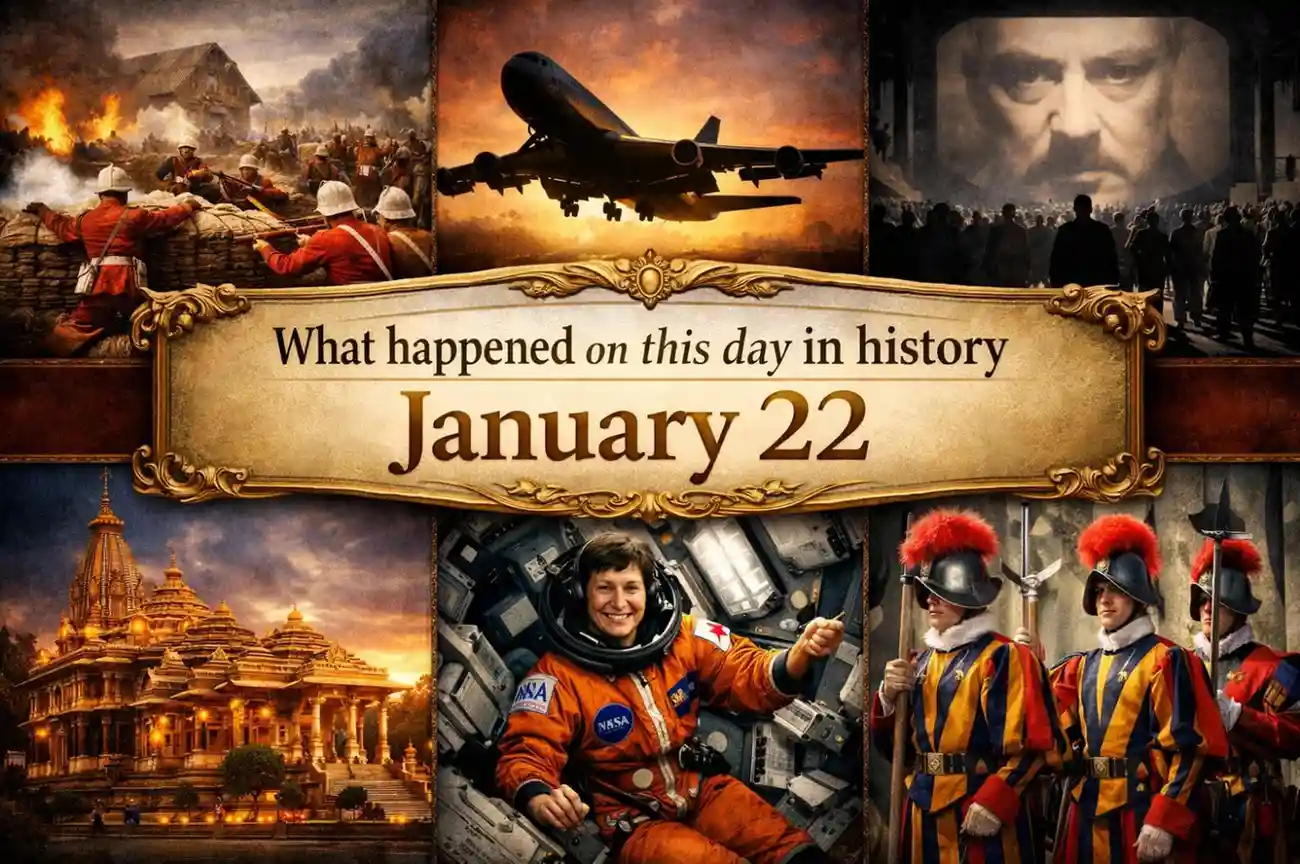
History is a relay race of power, where crowns change heads and boundaries are redrawn in a single day. In our deep dive into what happened on this day in history January 22, we witness the birth of modern aviation, the rise of iconic political leaders, and the shifting tides of empires. It is a day that consistently proves how the decisions of the past echo through centuries.
Important Events That Happened On January 22 In History
613 – The Coronation of Heraclius Constantine
In the majestic city of Constantinople, the Byzantine political landscape shifted as the eight-month-old Heraclius Constantine was crowned co-emperor. His father, the senior Emperor Heraclius, bestowed the title of Caesar upon the infant to secure the family dynasty. This early coronation was a strategic move intended to ensure a peaceful succession within the empire.
871 – The Battle of Basing
The fierce conflict between the West Saxons and the Danelaw Vikings reached a boiling point at the Battle of Basing. King Æthelred I led his Saxon forces into the fray, but they were ultimately defeated by the Viking invaders. This loss was a significant blow to the Saxon defense of England during a period of relentless Viking expansion.
1506 – Arrival of the Swiss Guards
The history of the Vatican changed forever as the first contingent of 150 Swiss Guards marched into the city. Recruited for their legendary reputation for loyalty and combat prowess, they were tasked with the personal protection of the Pope. Over five centuries later, this elite force continues to serve as the world’s oldest standing military unit.
1517 – The Battle of Ridaniya
The Ottoman Empire achieved a monumental victory under the leadership of Selim I by defeating the Mamluk Sultanate. The Battle of Ridaniya effectively brought an end to Mamluk rule and led to the Ottoman capture of Egypt. This victory significantly expanded Ottoman territory and established them as the dominant power in the Islamic world.
1555 – Fall of the Ava Kingdom
In the region now known as Myanmar, the Ava Kingdom finally succumbed to the rising power of the Taungoo Dynasty. The fall of Ava marked a major step in the unification of the country under a single powerful ruling line. This conquest helped shape the ethnic and political boundaries of the region for generations to come.
1689 – The Convention Parliament Convenes
Following the flight of James II and VII to France, the Convention Parliament met to address the vacancy of the English and Irish thrones. Since James II was the last Roman Catholic monarch of the region, the parliament had to determine if his departure constituted a formal abdication. This gathering laid the groundwork for the Glorious Revolution and the shift toward parliamentary sovereignty.
1808 – The Portuguese Royalty Arrives in Brazil
Fleeing the advancing French armies of Napoleon, the Portuguese royal family safely reached the shores of Brazil. This move was unprecedented, as it marked the first time a European monarch governed their empire from a colonial territory. The arrival of the court transformed Rio de Janeiro into a major political and economic hub almost overnight.
1849 – The Siege of Multan Ends
The nine-month-long Siege of Multan reached its conclusion during the Second Anglo-Sikh War. The last remaining Sikh defenders in Multan, Punjab, were forced to surrender to British and East India Company forces. This victory was a decisive moment that facilitated the eventual British annexation of the Punjab region.
1863 – The January Uprising Begins
A massive national movement broke out in Poland, Lithuania, and Belarus against the Russian occupation. Known as the January Uprising, the goal was to restore the Polish–Lithuanian–Ruthenian Commonwealth. Although the insurgency faced overwhelming Russian military might, it remains a powerful symbol of national identity and resistance.
1879 – A Zulu Victory at Isandlwana
In one of the most stunning defeats in British colonial history, Zulu forces overwhelmed a British army at the Battle of Isandlwana. Despite having inferior technology, the Zulu warriors used superior numbers and brilliant tactics to wipe out the British column. It remains a legendary example of indigenous resistance against European imperial expansion.
1879 – The Defense of Rorke’s Drift
Just hours after the disaster at Isandlwana, a tiny British garrison successfully defended a mission station against thousands of Zulu warriors. Known as the Battle of Rorke’s Drift, only 150 British soldiers held their ground against a massive force. The victory was heavily publicized in Britain to mitigate the shock of the earlier defeat at Isandlwana.
1890 – United Mine Workers of America Founded
Labor history was made in Columbus, Ohio, with the formation of the United Mine Workers of America (UMWA). The organization sought to improve the dangerous working conditions and low wages prevalent in the mining industry. By unifying miners across the country, the UMWA became a powerful force for workers’ rights in the United States.
1901 – Proclamation of King Edward VII
Following the death of his mother, the long-reigning Queen Victoria, Edward VII was officially proclaimed King of the United Kingdom. His accession marked the end of the Victorian Era and the beginning of the Edwardian Era. The transition brought a shift in social and political styles as the monarchy entered the 20th century.
1905 – Bloody Sunday in Saint Petersburg
A peaceful protest by Russian workers led by Father Gapon turned into a massacre when Imperial Guards opened fire on the crowd. Known as “Bloody Sunday,” the event left hundreds dead and sparked the 1905 Russian Revolution. This tragedy destroyed the people’s faith in the Tsar and set the stage for later revolutionary movements.
1906 – The Wreck of the SS Valencia
The SS Valencia ran aground on the treacherous rocks of Vancouver Island, British Columbia, during a heavy storm. Due to the difficult terrain and freezing waters, rescue efforts were largely unsuccessful, resulting in the deaths of over 130 people. The disaster led to major improvements in maritime safety and the construction of the West Coast Trail for shipwreck survivors.
1915 – Train Disaster in Guadalajara
In one of the worst rail accidents in history, over 600 people were killed in Guadalajara, Mexico. A train lost control and plunged off the tracks into a deep canyon during the chaos of the Mexican Revolution. The victims were largely families of soldiers, and the tragedy remains a somber footnote in the nation’s revolutionary history.
1917 – Wilson’s “Peace Without Victory”
While the United States remained neutral during World War I, President Woodrow Wilson gave a historic address to the Senate. He called for a “peace without victory” in Europe, arguing that a lasting peace could only be achieved if neither side felt humiliated. His idealistic vision would eventually influence the creation of the League of Nations.
1919 – Signing of Act Zluky
In a historic moment for Eastern Europe, Act Zluky was signed to unify the Ukrainian People’s Republic and the West Ukrainian National Republic. This symbolic unification aimed to create a single, independent Ukrainian state. Although the union was short-lived due to foreign invasions, it remains a cornerstone of modern Ukrainian national unity.
1924 – First Labour Prime Minister in the UK
Ramsay MacDonald broke political ground by becoming the first member of the Labour Party to serve as Prime Minister of the United Kingdom. His appointment signaled a massive shift in British politics, moving away from the traditional dominance of the Liberals and Conservatives. His government focused on social reform and improving international relations after the Great War.
1927 – First Live Football Radio Commentary
Sports broadcasting reached a new milestone when Teddy Wakelam provided the first live radio commentary of a football match. The game was played between Arsenal F.C. and Sheffield United at the Highbury stadium. This innovation allowed fans across the country to experience the excitement of the pitch from their own homes for the first time.
1941 – Capture of Tobruk
During World War II’s Operation Compass, British and Commonwealth troops successfully captured the strategic port of Tobruk from Italian forces. The victory provided the Allies with a vital deep-water port and thousands of prisoners. Tobruk would go on to be a key site of contention and a symbol of endurance throughout the North African campaign.
1943 – Victory at Buna–Gona
In the Pacific Theater of World War II, Australian and American forces finally defeated Japanese units in the Battle of Buna–Gona. The fighting was some of the most brutal and difficult of the war, characterized by jungle terrain and disease. The victory effectively ended Japanese offensive operations in Papua New Guinea.
1944 – Operation Shingle Begins
Allied forces launched Operation Shingle, an amphibious assault on Anzio and Nettuno, Italy. The goal was to bypass the German defenses of the Winter Line and clear the way for the capture of Rome. While the initial landing was successful, the Allies soon found themselves pinned down in a grueling stalemate by rapid German reinforcements.
1946 – Republic of Mahabad Declared
In the Kurdish city of Mahabad, Iran, Qazi Muhammad officially declared the birth of the independent Republic of Mahabad. He was named president, with Haji Baba Sheikh serving as the prime minister of the fledgling state. Although the republic only lasted for a year, it remains a significant symbol of Kurdish aspirations for self-determination.
1946 – Creation of the Central Intelligence Group
The United States took a major step in reorganizing its intelligence capabilities by creating the Central Intelligence Group (CIG). This organization was the direct forerunner to the modern Central Intelligence Agency (CIA). It was designed to coordinate government-wide intelligence efforts following the dissolution of the Office of Strategic Services (OSS) after the war.
1947 – KTLA Begins Operation
KTLA made history as the first commercial television station to operate west of the Mississippi River. Based in Hollywood, the station helped pioneer the television industry in the Western United States. Its launch marked the beginning of a new era of entertainment and news broadcasting for the Los Angeles area.
1957 – Israel Withdraws from Sinai
Following the Suez Crisis and intense international pressure, Israeli forces completed their withdrawal from the Sinai Peninsula. The territory was handed back to Egyptian control as part of a diplomatic agreement to end the conflict. This withdrawal was monitored by the United Nations to ensure stability in the region.
1963 – The Élysée Treaty
Charles de Gaulle of France and Konrad Adenauer of West Germany signed the Élysée Treaty to solidify a new era of cooperation. The treaty was designed to end centuries of rivalry and conflict between the two nations through regular consultation and joint projects. It remains the foundation of the modern Franco-German partnership within Europe.
1967 – Massacre in Managua
Nicaraguan National Guardsmen opened fire on a massive crowd of anti-Somocista demonstrators in the capital city of Managua. Reports on the death toll varied widely, ranging from dozens to hundreds of peaceful protesters killed. The massacre became a catalyst for growing resistance against the Somoza family’s dictatorship.
1968 – Apollo 5 and the First Lunar Module
NASA achieved a critical milestone in the Apollo Program with the launch of Apollo 5. The mission carried the very first Lunar Module (LM) into space for unmanned testing in Earth’s orbit. The successful performance of the module’s engines proved that the craft was capable of landing on and taking off from the Moon’s surface.
1968 – Operation Igloo White
The United States military began the installation of Operation Igloo White, a sophisticated electronic surveillance system in Southeast Asia. Using acoustic and seismic sensors, the system was designed to detect and track communist infiltration along the Ho Chi Minh Trail. It represented one of the most high-tech attempts to use electronic warfare during the Vietnam War.
1970 – Maiden Flight of the Boeing 747
The Boeing 747, famously known as the “Jumbo Jet,” entered commercial service with its first flight for Pan American Airways. The journey took passengers from New York’s JFK International Airport to London Heathrow. Its massive size and long-range capabilities revolutionized international travel, making it more accessible to the general public.
1971 – The Singapore Declaration
Leaders of the Commonwealth of Nations issued the Singapore Declaration, a key document outlining the group’s core principles. It emphasized values like world peace, liberty, and the fight against racial discrimination. This declaration remains one of the most important constitutional documents for the Commonwealth.
1973 – Roe v. Wade Decision
The Supreme Court of the United States delivered its landmark ruling in the case of Roe v. Wade. The decision legalized elective abortion across all fifty states, citing a woman’s right to privacy under the Constitution. This ruling remains one of the most influential and debated legal decisions in American history.
1973 – Apollo 17 Crew Addresses Congress
Following the final Moon landing mission, the crew of Apollo 17—Eugene Cernan, Ronald Evans, and Harrison Schmitt—addressed a joint session of Congress. They shared their experiences and the scientific importance of their journey to the lunar surface. Their speech marked the symbolic conclusion of the Apollo era of lunar exploration.
1973 – Kano Airport Disaster
A chartered Boeing 707 carrying pilgrims returning from Mecca exploded in flames upon landing at Kano Airport in Nigeria. The horrific accident resulted in the deaths of 176 people on board. It remains one of the deadliest aviation disasters in Nigerian history and led to calls for improved airport safety standards.
1973 – George Foreman Defeats Joe Frazier
In a historic heavyweight title bout in Jamaica, George Foreman shocked the world by defeating champion Joe Frazier. Foreman knocked Frazier down six times in just the first two rounds of the fight. The referee stopped the match, crowning Foreman as the new undisputed heavyweight champion of the world.
1984 – Apple’s Ominous “1984” Commercial
During Super Bowl XVIII, Apple aired a revolutionary 60-second commercial directed by Ridley Scott. Drawing inspiration from George Orwell’s novel Nineteen Eighty-Four, the ad depicted a dystopian future broken by the arrival of a new computer. It was a bold marketing move that introduced the Macintosh and changed the landscape of advertising forever.
1987 – Mendiola Massacre in Manila
Security forces in the Philippines opened fire on a crowd of thousands of demonstrators near Malacañang Palace. The protesters were demanding land reform and better treatment for farmers. Thirteen people were killed in the incident, which became known as the Mendiola Massacre and remains a significant event in the country’s struggle for social justice.
1992 – Rebel Occupation in Zaire
Rebel forces in Kinshasa seized control of Zaire’s national radio station to broadcast their demands. They called for the immediate resignation of the government under Mobutu Sese Seko. Although the occupation was temporary, it highlighted the growing instability and opposition to the long-standing regime.
1992 – Dr. Roberta Bondar Enters Space
The Space Shuttle Discovery launched on mission STS-42, carrying Dr. Roberta Bondar into orbit. She made history as the first Canadian woman and the first neurologist to travel into space. During the mission, she conducted various experiments focused on the human body’s reaction to weightlessness.
1995 – Beit Lid Suicide Bombing
In central Israel, two suicide bombers from Gaza detonated explosives at a military transit point near Netanya. The attack killed 19 Israeli soldiers and one civilian, leaving dozens more wounded. This event significantly impacted the ongoing Israeli-Palestinian peace process and led to increased security measures.
1998 – Endeavour Docks with Mir
The Space Shuttle Endeavour launched on mission STS-89, heading for a rendezvous with the Russian space station Mir. This mission was part of the ongoing Phase 1 of the International Space Station program. It focused on the transfer of crew members and logistical supplies between the Shuttle and the aging Russian station.
1999 – Tragedy of Graham Staines in India
Australian missionary Graham Staines and his two young sons were killed in Eastern India when radical Hindus set fire to their car while they were sleeping inside. The brutal attack sparked international outrage and a conversation about religious tolerance in India. Staines had spent decades in the region working with leprosy patients.
2006 – Inauguration of Evo Morales
Evo Morales was inaugurated as the President of Bolivia, making history as the country’s first indigenous leader. His rise to power represented a major shift in Bolivian politics toward the rights of the indigenous majority and the nationalization of resources. His presidency would bring about significant social and economic changes in the nation.
2007 – Baghdad Market Bombings
Two powerful car bombs exploded in the Bab Al-Sharqi market in central Baghdad, Iraq. The attack targeted a busy shopping area, resulting in the deaths of at least 88 people. It was one of the many devastating bombings that characterized the period of intense sectarian violence in Iraq following the 2003 invasion.
2009 – Executive Order to Close Guantanamo
U.S. President Barack Obama signed an executive order intended to close the detention camp at Guantanamo Bay within one year. The decision was aimed at addressing international concerns regarding the legal status and treatment of detainees. However, fierce congressional opposition ultimately prevented the full implementation of the closure.
2024 – Inauguration of Ram Mandir
Indian Prime Minister Narendra Modi officially inaugurated the Ram Mandir in Ayodhya, Uttar Pradesh. The event followed five centuries of religious and legal disputes over the site. Thousands of guests attended the “Pran Pratishtha” ceremony, marking a historic and highly significant moment for millions of Hindus worldwide.
Take a Look At January 21 Stories:
Famous People Born On January 22
| Name | Role / Description | Birth – Death |
|---|---|---|
| Malcolm McLaren | British impresario & musician | January 22, 1946 – April 8, 2010 |
| Sergei Eisenstein | Soviet film director | January 22, 1898 – February 11, 1948 |
| George Balanchine | Russian-American choreographer | January 22, 1904 – April 30, 1983 |
| August Strindberg | Swedish dramatist | January 22, 1849 – May 14, 1912 |
| Ivan III | Grand Prince of Moscow | January 22, 1440 – October 27, 1505 |
| Lev Davidovich Landau | Russian physicist, Nobel laureate | January 22, 1908 – April 1, 1968 |
| U Thant | UN Secretary-General | January 22, 1909 – November 25, 1974 |
| Gotthold Ephraim Lessing | German author & critic | January 22, 1729 – February 15, 1781 |
| Blind Willie Johnson | American blues musician | January 22, 1897 – c.1947 |
| Francis Picabia | French avant-garde artist | January 22, 1879 – November 30, 1953 |
| Beatrice Webb | British economist & reformer | January 22, 1858 – April 30, 1943 |
| Henri Dutilleux | French composer | January 22, 1916 – May 22, 2013 |
| Fred M. Vinson | U.S. Chief Justice | January 22, 1890 – September 8, 1953 |
| Pierre Gassendi | French philosopher & scientist | January 22, 1592 – October 24, 1655 |
| Marcel Dassault | French industrialist | January 22, 1892 – April 18, 1986 |
| Bruno Kreisky | Chancellor of Austria | January 22, 1911 – July 29, 1990 |
| Alan J. Heeger | American chemist, Nobel laureate | January 22, 1936 – |
| Rosa Ponselle | American opera singer | January 22, 1897 – May 25, 1981 |
| Paul Vidal de La Blache | French geographer | January 22, 1845 – April 5, 1918 |
| Richard Upjohn | American architect | January 22, 1802 – August 17, 1878 |
| Frigyes Riesz | Hungarian mathematician | January 22, 1880 – February 28, 1956 |
| Ernst Busch | German actor & singer | January 22, 1900 – June 8, 1980 |
| Edén Pastora | Nicaraguan revolutionary | January 22, 1937 – June 16, 2020 |
| Joseph Hume | British politician | January 22, 1777 – February 20, 1855 |
| Howard Moss | American poet & editor | January 22, 1922 – September 16, 1987 |
| François-Antoine Habeneck | French conductor | January 22, 1781 – February 8, 1849 |
| Henry Bauchau | Belgian author | January 22, 1913 – September 21, 2012 |
| Galina Zybina | Soviet Olympic athlete | January 22, 1931 – August 10, 2024 |
| Wincenty Witos | Polish statesman | January 22, 1874 – October 30, 1945 |
| Sir Robert Bruce Cotton | English antiquarian | January 22, 1571 – May 6, 1631 |
Famous People Died On January 22
| Name | Role / Description | Birth – Death |
|---|---|---|
| Jean Simmons | British-American actress | January 31, 1929 – January 22, 2010 |
| Benedict XV | Pope | November 21, 1854 – January 22, 1922 |
| Edward Seymour, 1st Duke of Somerset | Protector of England | c.1500 – January 22, 1552 |
| Arno Penzias | American astrophysicist, Nobel laureate | April 26, 1933 – January 22, 2024 |
| Walter Richard Sickert | British artist | May 31, 1860 – January 22, 1942 |
| Johann Friedrich Blumenbach | German anthropologist | May 11, 1752 – January 22, 1840 |
| Mike Hawthorn | British Formula One champion | April 10, 1929 – January 22, 1959 |
| Bill Mauldin | American cartoonist | October 29, 1921 – January 22, 2003 |
| Abe Kōbō | Japanese author | March 7, 1924 – January 22, 1993 |
| James Bryce, Viscount Bryce | British statesman | May 10, 1838 – January 22, 1922 |
| Sir Joseph Whitworth | British engineer | December 21, 1803 – January 22, 1887 |
| Marc Blitzstein | American composer | March 2, 1905 – January 22, 1964 |
| Else Lasker-Schüler | German poet | February 11, 1869 – January 22, 1945 |
| Jean-Louis Barrault | French actor & director | September 8, 1910 – January 22, 1994 |
| Harald Bohr | Danish mathematician | April 22, 1887 – January 22, 1951 |
| Anne Hébert | Canadian author | August 1, 1916 – January 22, 2000 |
| Horace-Bénédict de Saussure | Swiss scientist | February 17, 1740 – January 22, 1799 |
| Stanley Marcus | American businessman | April 20, 1905 – January 22, 2002 |
| Arthur Symons | English poet | February 28, 1865 – January 22, 1945 |
| Charles Kean | British actor | January 18, 1811 – January 22, 1868 |
| Charles Reznikoff | American poet | August 31, 1894 – January 22, 1976 |
| Fredrik Bajer | Danish Nobel Peace laureate | April 21, 1837 – January 22, 1922 |
| Joseph P. Bradley | U.S. Supreme Court justice | March 14, 1813 – January 22, 1892 |
| Edmund Brisco Ford | British geneticist | April 23, 1901 – January 22, 1988 |
| Ralph Barton Perry | American philosopher | July 3, 1876 – January 22, 1957 |
| Max Berg | German architect | April 17, 1870 – January 22, 1947 |
| George Steevens | Shakespearean scholar | May 10, 1736 – January 22, 1800 |
| Jack Shea | Olympic speed skater | September 10, 1910 – January 22, 2002 |
| Mariano Rumor | Italian statesman | June 16, 1915 – January 22, 1990 |
| Luís Romano | Cape Verdean writer | June 10, 1922 – January 22, 2010 |
Observances & Institutional Dates
- Grandfather’s Day (Poland): A day dedicated to honoring and celebrating the contributions of grandfathers in Polish families.
- Day of Unity of Ukraine (Ukraine): An annual commemoration of the 1919 Act Zluky, symbolizing the unification of eastern and western Ukrainian lands.
Frequently Asked Questions
- What major Supreme Court decision happened on January 22?
- The court ruled on Roe v. Wade in 1973, legalizing elective abortion across the United States.
- Who was the first Canadian woman in space?
- Dr. Roberta Bondar became the first Canadian woman in space on January 22, 1992.
- What iconic commercial aired on this day in 1984?
Apple aired its famous “1984” Macintosh commercial during the Super Bowl. - What was the “Jumbo Jet’s” first commercial flight?
- The Boeing 747 flew its first commercial route from New York to London on January 22, 1970.