
History is often shaped by the arrival of new fleets and the silent departure of legends. As we analyze what happened on this day in history January 26, we witness the birth of modern nations in Australia and India and the tragic loss of cultural figures like Kobe Bryant. From the discovery of the world’s largest diamond to the first flickering images of a television screen, this date marks a series of monumental shifts in the human story.
Important Events That Happened On January 26 In History
661 – End of the Rashidun Caliphate
The Rashidun Caliphate effectively came to an end following the assassination of Ali, the fourth and final caliph. Ali was attacked by a Kharijite extremist while praying at the Great Mosque of Kufa, dying from his wounds two days later. His death paved the way for the establishment of the Umayyad Dynasty and marked a permanent transition in Islamic governance and the beginning of the great schism between Sunni and Shia traditions.
1531 – The Great Lisbon Earthquake
A massive earthquake, estimated between 6.4 and 7.1 on the moment magnitude scale, struck the city of Lisbon, Portugal. The disaster was catastrophic, claiming the lives of approximately thirty thousand people and destroying a vast portion of the city’s infrastructure. In addition to the seismic shocks, a subsequent tsunami swept through the Tagus estuary, further devastating the coastal community.
1564 – Distinction of Roman Catholicism and Protestantism
The Council of Trent officially established a clear distinction between Roman Catholicism and Protestantism through its final decrees. This series of ecumenical meetings aimed to address the challenges of the Protestant Reformation by clarifying Church doctrines on scripture, the sacraments, and salvation. The council’s decisions formed the foundation of the Counter-Reformation and defined the character of modern Catholicism for centuries.
1564 – Battle of Ula
During the Livonian War, the Grand Duchy of Lithuania achieved a significant military victory over the Tsardom of Russia at the Battle of Ula. Lithuanian forces utilized a surprise attack against the larger Russian army, causing total disarray and halting the Russian advance toward the heart of the Grand Duchy. The victory was a major boost for Lithuanian morale and a setback for Ivan the Terrible’s expansionist ambitions.
1641 – Battle of Montjuïc
In a decisive engagement of the Reapers’ War, a Catalan army supported by French forces defeated the Spanish royalist army near Barcelona. The victory at the fortress of Montjuïc prevented the Spanish from reclaiming the city and solidified Catalonia’s alliance with France. The battle is a celebrated moment in Catalan history, symbolizing resistance against centralized Spanish authority.
1699 – The Treaty of Karlowitz
For the first time in history, the Ottoman Empire was forced to permanently cede vast territories to Christian powers following its defeat in the Great Turkish War. The signing of the Treaty of Karlowitz saw the Ottomans transfer control of much of Central Europe to the Habsburg Monarchy. This event signaled the end of Ottoman expansion into Europe and the beginning of the empire’s long period of territorial decline.
1700 – The Cascadia Earthquake
A massive earthquake with a magnitude between 8.7 and 9.2 occurred off the west coast of North America along the Cascadia subduction zone. While no written records exist from the local indigenous populations of the time, the event is precisely dated thanks to Japanese records of an “orphan tsunami” that struck their coast. The disaster reshaped the Pacific Northwest coastline and remains one of the largest seismic events in recorded history.
1765 – Naming of Port Egmont
A British naval expedition arrived at the Falkland Islands and gave the name Port Egmont to a natural harbor on Saunders Island. The crew began the process of establishing a settlement, which was officially founded eight days later, marking Britain’s first formal claim to the archipelago. This move set the stage for long-standing territorial disputes over the islands between Britain and Spain (and later Argentina).
1788 – The Arrival of the First Fleet
The British First Fleet, commanded by Arthur Phillip, sailed into Port Jackson to establish Sydney, the first permanent European settlement in Australia. This date is now commemorated as Australia Day, marking the beginning of the modern Australian nation. While it represents the birth of a new country for some, for many Indigenous Australians, it marks the beginning of a period of dispossession and cultural upheaval.
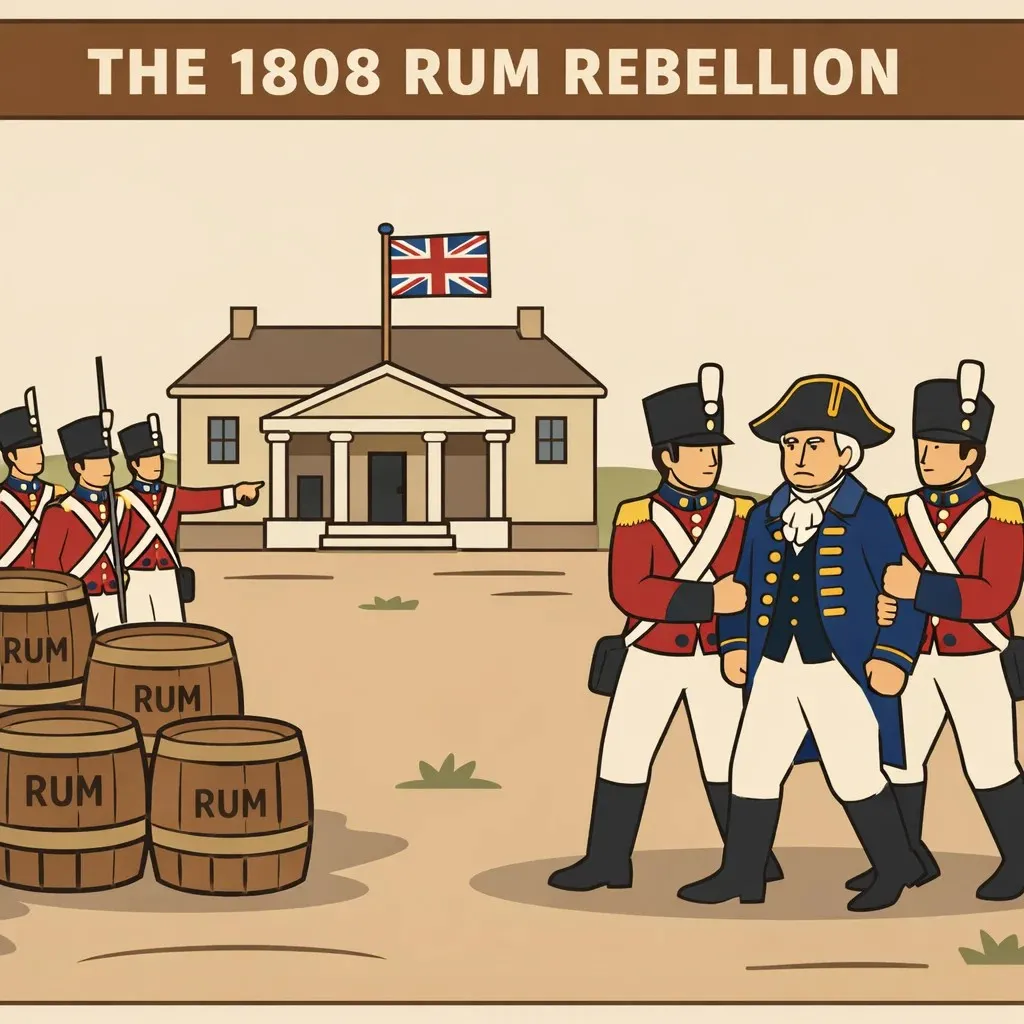
1808 – The Rum Rebellion
In the only successful armed takeover of a government in Australian history, the New South Wales Corps deposed Governor William Bligh. The conflict, known as the Rum Rebellion, stemmed from Bligh’s attempts to break the corps’ lucrative monopoly on the trade of spirits. Though the military ruled for two years, the British government eventually restored order and recalled the rebellious officers.
1837 – Michigan Joins the Union
Michigan was officially admitted as the 26th state of the United States after a long delay caused by a border dispute with Ohio known as the Toledo War. As part of the compromise to gain statehood, Michigan relinquished its claim to the Toledo Strip in exchange for the vast, resource-rich territory of the Upper Peninsula. This admission helped balance the political landscape of the growing American republic.
1841 – British Possession of Hong Kong
Commodore Gordon Bremer took formal possession of Hong Kong Island at Possession Point, marking the beginning of British colonial rule. The occupation was a result of the First Opium War between Britain and the Qing Dynasty of China. Hong Kong would remain under British administration for 156 years, evolving from a small fishing community into a global financial powerhouse.
1855 – Point No Point Treaty
In Washington Territory, leaders of several Native American tribes, including the S’Klallam and Chimakum, signed the Point No Point Treaty with the U.S. government. The treaty forced the tribes to cede their ancestral lands in exchange for reservations and small payments. This agreement was part of a larger effort by Governor Isaac Stevens to clear the path for white settlement in the Pacific Northwest.
1856 – First Battle of Seattle
Native American warriors launched an attack on the fledgling settlement of Seattle, leading to an all-day engagement with settlers and local militia. Marines from the USS Decatur, stationed in the harbor, used their cannons to drive off the attackers and prevent the town from being overrun. The battle was a pivotal moment in the Puget Sound War and solidified the US presence in the region.
1861 – Louisiana Secedes from the Union
Following the election of Abraham Lincoln, the state of Louisiana officially voted to secede from the United States, becoming the sixth state to join the Confederacy. The decision was driven by the state’s deep economic and social reliance on the institution of slavery. This move further accelerated the nation’s descent into the American Civil War, leading to years of devastating internal conflict.
1863 – General Burnside Relieved of Command
Following the catastrophic Union defeat at the Battle of Fredericksburg, President Abraham Lincoln relieved General Ambrose Burnside of his command of the Army of the Potomac. Burnside was replaced by General Joseph “Fighting Joe” Hooker, who was tasked with rebuilding the morale and effectiveness of the Union’s main eastern army. The change reflected Lincoln’s frustration with the slow progress and high casualties of the war effort.
1863 – African American Militia Authorized
The Governor of Massachusetts, John Albion Andrew, received official permission from the Secretary of War to raise a military organization for men of African descent. This led to the formation of the famous 54th Massachusetts Volunteer Infantry, one of the first official black units in the U.S. armed forces. Their service proved the courage and capability of Black soldiers and was a milestone in the fight for civil rights.
1870 – Virginia Readmitted to the Union
In a significant step during the Reconstruction Era, the state of Virginia was officially readmitted to the United States. To regain representation in Congress, the state was required to ratify the 14th and 15th Amendments, which granted citizenship and voting rights to former slaves. This readmission marked the end of military rule in the state and its formal return to the federal system.
1885 – The Fall of Khartoum
Troops loyal to the religious leader known as The Mahdi successfully stormed the city of Khartoum, bringing an end to a long and brutal siege. During the final assault, the Governor-General, Charles George Gordon, was killed on the steps of his palace. The fall of Khartoum signaled a major defeat for British and Egyptian interests in the Sudan and sparked public outrage in London.
1905 – Discovery of the Cullinan Diamond
The world’s largest gem-quality diamond, the Cullinan, was discovered at the Premier Mine in South Africa. Weighing a staggering 3,106 carats, the diamond was found by Frederick Wells, the mine’s surface manager. It was eventually presented to King Edward VII and cut into several large stones, including the “Great Star of Africa,” which remains part of the British Crown Jewels.
1915 – Rocky Mountain National Park Established
The United States Congress passed an act to establish Rocky Mountain National Park in Colorado, protecting over 265,000 acres of pristine mountain wilderness. The park was created to preserve the spectacular peaks, alpine tundra, and diverse wildlife of the region for future generations. Today, it remains one of the most visited national parks in the country, known for its dramatic Trail Ridge Road.
1918 – Start of the Finnish Civil War
In a symbolic act to signal the start of a revolution, a group of Red Guards hung a red lantern atop the tower of the Helsinki Workers’ Hall. This event marked the beginning of the Finnish Civil War between the “Reds” (socialists) and the “Whites” (conservatives). The conflict was a brutal struggle for the soul of the newly independent nation, leaving deep scars on Finnish society for decades.
1926 – First Demonstration of Television
John Logie Baird gave the world’s first public demonstration of a working television system to a group of scientists in London. Using a mechanical system of rotating discs, he successfully transmitted a recognizable moving image of a human face. While the quality was crude by modern standards, Baird’s breakthrough laid the technological foundation for the most influential medium of the 20th century.
1930 – India’s Declaration of Independence
The Indian National Congress, under the leadership of Mahatma Gandhi and Jawaharlal Nehru, officially declared January 26 as Independence Day. They called for “Poorna Swaraj,” or complete independence from British rule, through non-violent civil disobedience. While actual independence would not be achieved for another 17 years, this date remained a vital symbol of national pride and resistance.
1934 – The Apollo Theater Reopens
The historic Apollo Theater in Harlem, New York City, reopened its doors under new management, focusing on variety shows and live music for Black audiences. It quickly became a premier venue for African American performers, launching the careers of legends like Ella Fitzgerald and James Brown. The Apollo played a central role in the development of jazz, swing, and soul music in America.
1934 – German–Polish Non-Aggression Pact
In an early diplomatic move of the Nazi era, Germany and Poland signed a ten-year declaration of non-aggression. The treaty was intended to stabilize relations between the two nations and ease Polish fears of German expansion. However, the pact was merely a tactical move by Adolf Hitler, who would eventually break it to launch the invasion of Poland in 1939.
1939 – Nationalists Capture Barcelona
During the final stages of the Spanish Civil War, troops loyal to General Francisco Franco, supported by Italian forces, captured the city of Barcelona. The fall of this Republican stronghold signaled the inevitable victory of the Nationalist forces and the end of the democratic Spanish Republic. Thousands of refugees fled across the border to France as the city was subjected to a new military order.
1942 – US Troops Arrive in Europe
The first contingents of United States ground forces arrived in Europe, landing at a port in Northern Ireland to begin preparations for the fight against Nazi Germany. Their arrival marked the formal beginning of the massive US military buildup in the European Theater of World War II. These “GIs” were welcomed by local crowds as a sign that the tide of the war was beginning to turn.
1945 – Audie Murphy’s Valor in France
During a fierce engagement in the Colmar Pocket in France, American soldier Audie Murphy single-handedly held off an entire company of German infantry and six tanks. For over an hour, he stayed at his post, directing artillery fire and using a machine gun from a burning tank destroyer to repel the attack. This extraordinary display of bravery earned him the Medal of Honor and made him the most decorated US soldier of the war.
1949 – First Light for the Hale Telescope
The 200-inch Hale Telescope at Palomar Observatory achieved “first light” under the direction of the famed astronomer Edwin Hubble. At the time of its completion, it was the largest aperture optical telescope in the world, capable of peering deeper into space than ever before. The telescope allowed astronomers to study distant galaxies and expand our understanding of the scale and origin of the universe.
1950 – India Becomes a Republic
The Constitution of India officially came into force, completing the nation’s transition to a sovereign democratic republic. Rajendra Prasad was sworn in as the first President of India, and the country celebrated its first Republic Day with a massive parade in Delhi. This event marked the final break from the British monarchy and established the legal framework for the world’s largest democracy.
1952 – Black Saturday in Egypt
Violent rioting broke out in Cairo, an event that became known as “Black Saturday” or the Cairo Fire. Angry crowds targeted businesses and institutions associated with the British presence and the upper-class Egyptian elite, burning down hundreds of buildings in the central business district. The chaos was a precursor to the Egyptian Revolution later that year, which would eventually overthrow the monarchy.
1956 – Soviet Union Returns Porkkala
In a significant diplomatic gesture during the Cold War, the Soviet Union officially returned the Porkkala naval base to Finland. The Soviets had leased the territory following World War II, but the return of the base signaled a period of improved relations and reaffirmed Finnish neutrality. The event was a major moment of national celebration for the Finnish people.
1959 – Chain Island Listed for Sale
The California State Lands Commission officially listed the 41-acre Chain Island for sale to the public with a surprisingly low minimum bid of just $5,226. Located in the Sacramento-San Joaquin River Delta, the island was mostly marshland and uninhabited. This obscure land listing remains a curious footnote in California’s administrative history regarding the disposal of public state lands.
1962 – Launch of Ranger 3
NASA launched the Ranger 3 space probe with the ambitious goal of capturing close-up images of the Moon and landing an instrument capsule on the lunar surface. However, due to a series of technical malfunctions, the probe exceeded its intended velocity and missed the Moon by 22,000 miles. Despite the failure, the mission provided valuable flight data that contributed to the success of later lunar programs.
1966 – Disappearance of the Beaumont Children
Three siblings—Jane, Arnna, and Grant Beaumont—disappeared after going to a beach in Glenelg, South Australia. Despite one of the largest and most intensive police investigations in Australian history, no trace of the children was ever found. The case remains a haunting cold case that fundamentally changed how Australian parents viewed the safety of their children in public.
1972 – JAT Flight 367 Bombing
A JAT Yugoslav Airlines DC-9 exploded in mid-air over Czechoslovakia due to a terrorist bomb placed in the luggage compartment. Of the 28 people on board, the only survivor was flight attendant Vesna Vulović, who fell over 33,000 feet without a parachute inside a piece of the fuselage. Her survival is recorded in the Guinness World Records as the highest fall without a parachute survived by a human.
1974 – Turkish Airlines Flight 301 Crash
A Turkish Airlines Fokker F28 crashed immediately after takeoff from Izmir Cumaovası Airport, killing 66 of the 73 people on board. The investigators determined that the crash was caused by atmospheric icing on the wings, which prevented the aircraft from gaining sufficient lift. The tragedy led to renewed emphasis on de-icing procedures and safety training for pilots operating in winter conditions.
1986 – National Resistance Army Takes Uganda
After a prolonged bush war, the National Resistance Army led by Yoweri Museveni successfully overthrew the government of Tito Okello and captured Kampala. Museveni’s victory brought an end to years of violent instability and human rights abuses that had plagued Uganda since the era of Idi Amin. He was sworn in as president shortly after, beginning a long period of leadership that would reshape the nation.
1991 – Removal of Mohamed Siad Barre
The long-standing regime of Somali President Mohamed Siad Barre was overthrown by rebel forces, forcing him to flee the capital, Mogadishu. His removal marked the collapse of centralized government in Somalia and the beginning of a devastating period of clan-based civil war and humanitarian crisis. Ali Mahdi Muhammad was named as his successor, but the country remained deeply divided.
1998 – President Clinton’s Denial
In a televised address to the American public, U.S. President Bill Clinton forcefully denied having had “sexual relations” with former White House intern Monica Lewinsky. This moment became one of the most famous and scrutinized statements in political history as the investigation into the scandal deepened. The eventual revelation of the truth led to Clinton’s impeachment by the House of Representatives later that year.
2001 – The Gujarat Earthquake
A massive 7.7 magnitude earthquake struck the western Indian state of Gujarat on the morning of Republic Day. The disaster killed between 13,000 and 20,000 people and injured over 160,000 others, with the city of Bhuj suffering the most severe damage. The catastrophe triggered a massive international relief effort and a complete rebuilding of the affected region’s infrastructure.
2001 – The Diane Whipple Case
In a tragic and highly publicized incident in San Francisco, lacrosse coach Diane Whipple was killed by two large dogs in the hallway of her apartment building. The subsequent trial of the dogs’ owners resulted in a landmark conviction for second-degree murder. The case clarified the legal definition of “implied malice” in California, where a person can be held liable for murder if they act with conscious disregard for human life.
2009 – Madagascar Political Crisis
Violent rioting broke out in Antananarivo, Madagascar, as supporters of opposition leader Andry Rajoelina clashed with government forces. The protests were fueled by allegations of corruption and authoritarianism against President Marc Ravalomanana. This unrest sparked a major political crisis that eventually led to a military-backed change of government and Rajoelina taking power as the transitional leader.
2009 – Birth of the Suleman Octuplets
In Bellflower, California, Nadya Suleman gave birth to the world’s first surviving set of octuplets. The births gained massive international media attention, earning her the nickname “Octomom.” While the event sparked intense debate regarding the ethics of fertility treatments, all eight children reached their first birthday and beyond, setting a new medical milestone for multiple births.
2015 – Los Llanos Air Base Crash
A Greek F-16 fighter jet crashed into several other aircraft shortly after takeoff during a NATO training exercise at Los Llanos Air Base in Spain. The accident resulted in the deaths of 11 people and injured 21 others, many of whom were personnel on the ground. The crash was one of the deadliest incidents in the history of NATO’s Tactical Leadership Programme.
2015 – YPG Recaptures Kobanî
Kurdish People’s Protection Units (YPG) forces, supported by US-led coalition airstrikes, successfully drove Islamic State (ISIL) fighters out of the Syrian city of Kobanî. The victory ended a brutal four-month siege and was a major strategic and symbolic defeat for ISIL. The recapture of Kobanî was seen as a turning point in the international effort to degrade and defeat the extremist group in the region.
2020 – The Death of Kobe Bryant
A Sikorsky S-76 helicopter crashed into a hillside in Calabasas, California, killing all nine people on board. Among the victims were NBA legend Kobe Bryant and his 13-year-old daughter, Gianna. The news of the five-time champion’s death sent shockwaves around the world, leading to a massive outpouring of grief and memorials from millions of fans, athletes, and world leaders.
2021 – Red Fort Protest in Delhi
In a dramatic escalation of the ongoing farmers’ protests in India, thousands of farmers on tractors broke through police barricades and stormed the historic Red Fort in Delhi. The protesters clashed with police, resulting in over 80 injuries and the death of one farmer. The event occurred on Republic Day, drawing global attention to the intense standoff between the Indian government and the agricultural sector.
Take a Look At January 25 Stories
Famous People Born On January 26
| Name | Role / Description | Birth – Death |
|---|---|---|
| Lucinda Williams | American singer-songwriter | January 26, 1953 – |
| Anita Baker | American soul & R&B singer | January 26, 1958 – |
| Bessie Coleman | American aviator, aviation pioneer | January 26, 1892 – April 30, 1926 |
| Gene Siskel | American film critic & journalist | January 26, 1946 – February 20, 1999 |
| Morita Akio | Japanese businessman, Sony co-founder | January 26, 1921 – October 3, 1999 |
| Edward Sapir | American linguist & anthropologist | January 26, 1884 – February 4, 1939 |
| Jörg Haider | Austrian politician | January 26, 1950 – October 11, 2008 |
| Hans Selye | Endocrinologist, stress theory pioneer | January 26, 1907 – October 16, 1982 |
| Barbara Kruger | American conceptual artist | January 26, 1945 – |
| Roy Chapman Andrews | American explorer & naturalist | January 26, 1884 – March 11, 1960 |
| Jules Feiffer | American cartoonist & writer | January 26, 1929 – January 17, 2025 |
| Seán MacBride | Irish statesman, Nobel laureate | January 26, 1904 – January 15, 1988 |
| Salvador Sánchez | Mexican boxing champion | January 26, 1958 – August 12, 1982 |
| Claude-Adrien Helvétius | French Enlightenment philosopher | January 26, 1715 – December 26, 1771 |
| Polykarp Kusch | Physicist, Nobel laureate | January 26, 1911 – March 20, 1993 |
| Huey “Piano” Smith | American rock & roll musician | January 26, 1934 – February 13, 2023 |
| Achim von Arnim | German Romantic writer | January 26, 1781 – January 21, 1831 |
| John Bates Clark | American economist | January 26, 1847 – March 21, 1938 |
| Elisabet Ney | American sculptor | January 26, 1833 – June 29, 1907 |
| Guillaume Budé | French classical scholar | January 26, 1467 – August 20, 1540 |
| François Coppée | French poet & dramatist | January 26, 1842 – May 23, 1908 |
| Jimmy Van Heusen | American songwriter | January 26, 1913 – February 7, 1990 |
| Kees van Dongen | Dutch-French Fauvist painter | January 26, 1877 – May 28, 1968 |
| George Sackville-Germain | British statesman & soldier | January 26, 1716 – August 26, 1785 |
| Eugène Sue | French novelist | January 26, 1804 – August 3, 1857 |
| Mary Mapes Dodge | American children’s author | January 26, 1831 – August 21, 1905 |
| Jean-Baptiste Pigalle | French sculptor | January 26, 1714 – August 21, 1785 |
| Samuel Hopkins Adams | American journalist & author | January 26, 1871 – November 15, 1958 |
| Walter Krueger | U.S. Army general | January 26, 1881 – August 20, 1967 |
| Morita Akio | Sony co-founder & CEO | January 26, 1921 – October 3, 1999 |
Famous People Died On January 26
| Name | Role / Description | Birth – Death |
|---|---|---|
| Abner Doubleday | U.S. Army officer | June 26, 1819 – January 26, 1893 |
| Julia Margaret Cameron | British portrait photographer | June 11, 1815 – January 26, 1879 |
| Lewis Mumford | American historian & critic | October 19, 1895 – January 26, 1990 |
| Hugh Trevor-Roper | British historian | January 15, 1914 – January 26, 2003 |
| Nikolaus Otto | Inventor of four-stroke engine | June 10, 1832 – January 26, 1891 |
| A. E. van Vogt | Science fiction author | April 26, 1912 – January 26, 2000 |
| Arthur Cayley | British mathematician | August 16, 1821 – January 26, 1895 |
| Don Budge | American tennis champion | June 13, 1915 – January 26, 2000 |
| Gérard de Nerval | French Romantic poet | May 22, 1808 – January 26, 1855 |
| Louis Nirenberg | Mathematician, Abel Prize winner | February 25, 1925 – January 26, 2020 |
| George Ḥabash | Palestinian political leader | 1925/26 – January 26, 2008 |
| Alva Belmont | American women’s rights activist | January 17, 1853 – January 26, 1933 |
| Grace Moore | American opera singer | December 5, 1898 – January 26, 1947 |
| Henry Briggs | English mathematician | February 1561 – January 26, 1630 |
| Thomas J. Pendergast | American political boss | July 22, 1872 – January 26, 1945 |
| Johann Christoph Friedrich Bach | German composer | June 21, 1732 – January 26, 1795 |
| Francis Jeffrey | Scottish literary critic | October 23, 1773 – January 26, 1850 |
| Edward Davy | British inventor | June 16, 1806 – January 26, 1885 |
| José Emilio Pacheco | Mexican writer & poet | June 30, 1939 – January 26, 2014 |
| Valery Brumel | Soviet high-jump champion | May 14, 1942 – January 26, 2003 |
| Jean-François de Troy | French Rococo painter | January 27, 1679 – January 26, 1752 |
| Sir James Mackenzie | Scottish cardiologist | April 12, 1853 – January 26, 1925 |
| Louis Auchincloss | American novelist | September 27, 1917 – January 26, 2010 |
| Harold Brodkey | American author | October 25, 1930 – January 26, 1996 |
| Ignacy Friedman | Polish pianist | February 14, 1882 – January 26, 1948 |
| George Ticknor | American historian | August 1, 1791 – January 26, 1871 |
| Pierre-Daniel Huet | French philosopher & bishop | February 8, 1630 – January 26, 1721 |
| Gary Gabelich | American race-car driver | August 29, 1940 – January 26, 1984 |
| Martinus Nijhoff | Dutch poet | April 20, 1894 – January 26, 1953 |
| Thomas Lovell Beddoes | English poet | June 30, 1803 – January 26, 1849 |
Observances & Institutional Dates
- Australia Day: Commemorating the 1788 arrival of the First Fleet in Port Jackson.
- Republic Day (India): Celebrating the date the Constitution of India came into effect in 1950.
- Anniversary of the 1930 Poorna Swaraj Declaration: Honoring the early call for complete Indian independence.
Frequently Asked Questions
- Why is January 26 celebrated in Australia?
It marks the arrival of the British First Fleet at Port Jackson in 1788 and the founding of the first European settlement. - What is the significance of Republic Day in India?
- It honors the date in 1950 when India officially adopted its Constitution and became a sovereign republic.
- What was the world’s largest diamond found on this day?
- The Cullinan Diamond, weighing over 3,000 carats, was discovered in South Africa in 1905.
- Who survived a fall from 33,000 feet on this day in 1972?
- Flight attendant Vesna Vulović survived the mid-air explosion of JAT Flight 367 without a parachute.