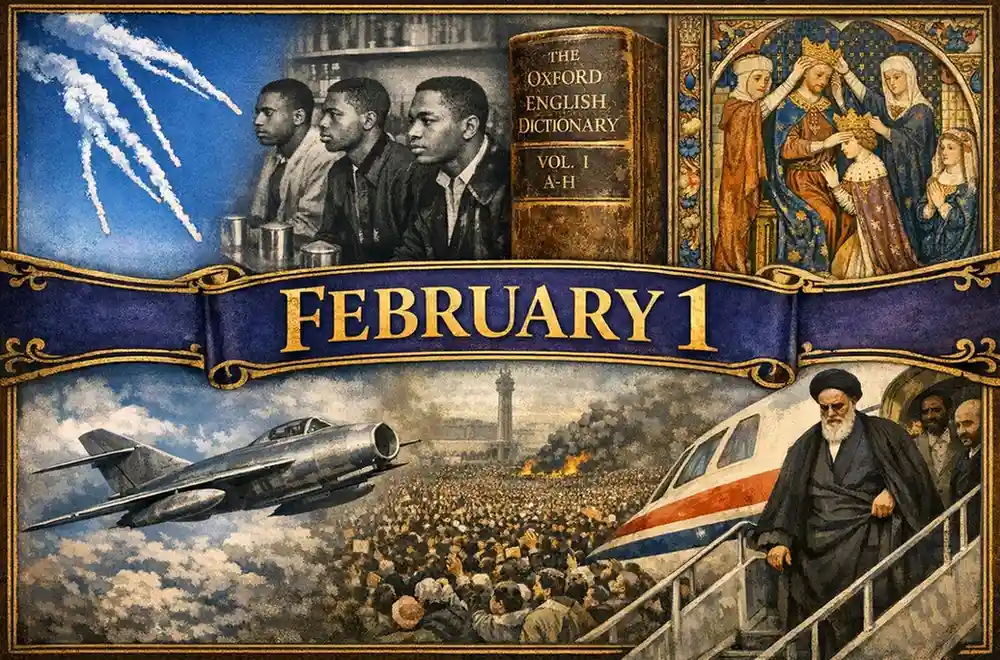
As the calendar turns to a new month, we find a date rich with the echoes of shifting power and human resilience. When exploring what happened on this day in history February 1, we encounter a timeline that stretches from the medieval coronation of a teenage king to the tragic disintegration of a space shuttle over American skies. This is a day that witnessed the birth of the Oxford English Dictionary, the first sit-ins of the Civil Rights Movement, and the return of an exiled Ayatollah to Iran. Whether through the lens of political revolution or scientific discovery, February 1 has consistently served as a gateway to major historical transformations.
Important Events That Happened On February 1 In History
1327 – Coronation of Edward III
At just fourteen years old, Edward III was crowned King of England. Despite the crown being on his head, the actual power resided with his mother, Queen Isabella, and her lover, Roger Mortimer. This period of regency was marked by political intrigue following the deposition of Edward II, though the young king would eventually assert his own authority to become one of England’s most formidable medieval monarchs.
1411 – First Peace of Thorn
The Monastic State of the Teutonic Knights and the Kingdom of Poland, along with the Grand Duchy of Lithuania, signed the First Peace of Thorn. This treaty ended the Polish–Lithuanian–Teutonic War, which had reached its climax at the Battle of Grunwald. The peace stabilized the region and forced the Teutonic Knights to pay a massive indemnity, signaling the beginning of their decline in Prussia.
1662 – Koxinga Seizes Taiwan
After a grueling nine-month siege, the Chinese general Koxinga (Zheng Chenggong) successfully ousted the Dutch East India Company from the island of Taiwan. His victory ended 38 years of Dutch colonial rule and established the Kingdom of Tungning. Koxinga is still revered today as a hero who restored Taiwan to Chinese control.
1713 – The Kalabalik at Bender
In a bizarre skirmish known as the “Kalabalik” (Turkish for “crowd” or “turmoil”), Ottoman Sultan Ahmed III ordered the seizure of his guest, King Charles XII of Sweden. Charles had been living in exile in the Ottoman Empire following his defeat at Poltava. The confrontation at Bender involved a fierce defense by the King and a small group of Swedes against thousands of Ottoman troops before he was finally captured.
1790 – First Session of the U.S. Supreme Court
The Supreme Court of the United States held its very first session at the Royal Exchange Building in New York City. Presided over by Chief Justice John Jay, the court began the monumental task of interpreting the laws of a young nation. At its inception, the court consisted of only six justices, and this initial meeting was largely organizational.
1793 – France Declares War on UK and Netherlands
Continuing the upheaval of the French Revolutionary Wars, the French National Convention declared war on Great Britain and the Dutch Republic. This escalated the conflict into a broader European struggle, as the revolutionary government sought to export its ideals while defending its borders against the monarchies of Europe.
1796 – Capital of Upper Canada Moves to York
The capital of Upper Canada was officially moved from Newark (now Niagara-on-the-Lake) to York. Governor John Graves Simcoe initiated the move because York—which we know today as Toronto—was considered more defensible against potential American attacks following the American Revolutionary War.
1814 – Devastating Eruption of Mount Mayon
The Mayon volcano in the Philippines experienced its most destructive eruption on record. Thick layers of volcanic ash and pyroclastic flows buried the town of Cagsawa, including its stone church. Approximately 1,200 people were killed in the catastrophe, leaving behind the iconic Cagsawa Ruins as a permanent memorial.
1835 – Abolition of Slavery in Mauritius
In a landmark moment for human rights in the Indian Ocean, slavery was officially abolished in the British colony of Mauritius. This followed the British Slavery Abolition Act of 1833. The transition led to the “Great Experiment,” where the British began importing large numbers of indentured laborers, primarily from India, to work on sugar plantations.
1861 – Texas Secedes from the Union
During the lead-up to the American Civil War, Texas became the seventh state to secede from the United States. Following a state convention vote, Texas officially joined the Confederate States of America one week later. The decision was driven by the state’s reliance on slavery and its opposition to the election of Abraham Lincoln.
1864 – Outbreak of the Second Schleswig War
The Second Schleswig War began as Prussian and Austrian forces crossed the border into the Duchy of Schleswig. The conflict was a contest between the German Confederation and the Kingdom of Denmark over the “Schleswig-Holstein Question.” The war eventually resulted in a decisive German victory and the loss of the duchies by the Danish crown.
1865 – Lincoln Signs the Thirteenth Amendment
Just one day after its passage by Congress, President Abraham Lincoln signed the joint resolution for the Thirteenth Amendment to the U.S. Constitution. By adding his signature, he formally sent the amendment—which abolished slavery and involuntary servitude—to the states for ratification, cementing his legacy as the “Great Emancipator.”
1884 – Publication of the First OED Volume
The first volume of the Oxford English Dictionary (OED), covering words from “A” to “Ant,” was published. Under the editorship of James Murray, this ambitious project aimed to document every word in the English language and its historical evolution. It took decades to complete, eventually becoming the definitive record of the English tongue.
1893 – Construction of “Black Maria” Studio
Thomas Edison completed the construction of the “Black Maria” in West Orange, New Jersey, recognized as the world’s first motion picture studio. The building was covered in black tar paper and featured a retractable roof to allow in natural sunlight. It was built on a pivot so it could be rotated to follow the sun throughout the day.
1895 – Fountains Valley Proclaimed
President Paul Kruger proclaimed Fountains Valley in Pretoria as a nature reserve, making it the oldest nature reserve in Africa. The area was protected to ensure a clean water supply for the city and to preserve the local flora and fauna, marking an early milestone in the African conservation movement.
1896 – Premiere of La bohème
Giacomo Puccini’s opera La bohème premiered at the Teatro Regio in Turin, Italy. The performance was conducted by a young Arturo Toscanini. While initial critical reception was mixed, the story of struggling bohemians in Paris quickly became one of the most beloved and frequently performed operas in the world.
1897 – Opening of Shinhan Bank
Shinhan Bank, originally established as Hanseong Bank, opened its doors in Seoul. It is recognized as the oldest bank in South Korea. The institution played a central role in the modernization of the Korean financial system and has survived through the country’s various political transitions and economic expansions.
1900 – Lord Roberts Takes Command in South Africa
Following a series of embarrassing British defeats during “Black Week” in the Second Boer War, the British government appointed Lord Roberts as the supreme commander of British forces in South Africa. Lord Kitchener was appointed as his chief of staff. Their arrival marked a turning point in the conflict as the British began a massive counter-offensive.
1908 – The Lisbon Regicide
A shocking assassination took place in Lisbon as King Carlos I of Portugal and his heir, Infante Luis Filipe, were shot dead while traveling in an open carriage. The attackers were members of the Carbonária, a revolutionary group. The event severely destabilized the Portuguese monarchy, which would be completely overthrown just two years later.
1924 – UK-Russia Relations Restored
More than six years after the Russian Revolution and the rise of the Bolsheviks, the United Kingdom and the Soviet Union officially restored diplomatic relations. The UK became one of the first major Western powers to recognize the Soviet government, seeking to stabilize trade and political communication in the post-war era.
1942 – Vidkun Quisling Appointed Minister President
In German-occupied Norway, Reichskommissar Josef Terboven appointed Vidkun Quisling as the Minister President of the “National Government.” Quisling was a Nazi collaborator, and his name has since become a global synonym for “traitor.” His puppet regime remained in power under German oversight until the end of World War II.
1942 – Marshalls–Gilberts Raids
The U.S. Navy launched the Marshalls–Gilberts raids, marking the first offensive action by the United States against Japanese forces in the Pacific. Conducted by carrier task forces, the raids targeted Japanese garrisons on several islands. While the tactical damage was modest, the operation provided a significant morale boost to the American public after Pearl Harbor.
1942 – First Broadcast of Voice of America
The Voice of America (VOA) began its official external broadcasting service. Its first programs were aimed at the German-speaking populations in Axis-controlled Europe, introduced with the promise: “The news may be good or bad for us – We will always tell you the truth.” It became a vital tool for providing uncensored information during the war.
1942 – Yan’an Rectification Movement Begins
Mao Zedong delivered a speech titled “Reform in Learning, the Party and Literature,” which launched the Yan’an Rectification Movement. This was the first major ideological campaign within the Communist Party of China. It aimed to consolidate Mao’s leadership and ensure that all party members adhered to his specific interpretation of Marxist-Leninist theory.
1946 – Trygve Lie Chosen as UN Secretary-General
Trygve Lie of Norway was selected to serve as the first-ever Secretary-General of the United Nations. As a former foreign minister, Lie was tasked with building the UN infrastructure from the ground up during the early, tense years of the Cold War. He played a key role in the organization’s response to the Korean War.
1946 – Hungary Becomes a Republic
The Parliament of Hungary officially abolished the Hungarian monarchy, which had existed for nine centuries. In its place, they proclaimed the Hungarian Republic. This transition took place under the shadow of Soviet occupation and marked the beginning of Hungary’s shift toward a communist-dominated political system.
1950 – First Flight of the MiG-17
The prototype of the Mikoyan-Gurevich MiG-17, a high-subsonic fighter aircraft, made its maiden flight. An evolution of the successful MiG-15, the MiG-17 featured improved wing design and stability. It would go on to become one of the most widely used and recognizable fighter jets of the Cold War era.
1957 – Northeast Airlines Flight 823 Crash
Shortly after taking off from LaGuardia Airport, Northeast Airlines Flight 823 crashed into Rikers Island during a snowstorm. The Douglas DC-6 was bound for Miami. The accident resulted in the deaths of 20 people and injured 78 others. Many of the survivors were helped by inmates and staff from the nearby Rikers Island prison.
1960 – The Greensboro Sit-ins Begin
Four Black students from North Carolina A&T State University—Ezell Blair Jr., Franklin McCain, Joseph McNeil, and David Richmond—staged a sit-in at a “whites-only” lunch counter at Woolworth’s in Greensboro. Their non-violent protest against segregation sparked a massive movement across the South, becoming a defining chapter of the Civil Rights Movement.
1964 – The Beatles’ First U.S. Number One
The “British Invasion” reached a fever pitch as The Beatles achieved their first number one hit on the Billboard Hot 100 with “I Want to Hold Your Hand.” The song’s success paved the way for the band’s legendary appearance on The Ed Sullivan Show later that month and fundamentally changed the landscape of American popular music.
1968 – Execution of Nguyễn Văn Lém
In a haunting moment of the Vietnam War, South Vietnamese National Police Chief Nguyễn Ngọc Loan was filmed and photographed executing Viet Cong officer Nguyễn Văn Lém on a street in Saigon. The graphic image, captured by Eddie Adams, won a Pulitzer Prize and played a significant role in turning American public opinion against the war.
1968 – Unification of the Canadian Forces
Canada’s three distinct military branches—the Royal Canadian Navy, the Canadian Army, and the Royal Canadian Air Force—were officially unified into a single service known as the Canadian Forces. This reorganization was aimed at increasing efficiency and creating a more cohesive national defense structure.
1968 – Formation of Penn Central
Two of the most storied names in American railroading, the New York Central Railroad and the Pennsylvania Railroad, merged to form Penn Central Transportation. At the time, it was the largest corporate merger in U.S. history. However, the company struggled with debt and operational issues, leading to a massive bankruptcy just two years later.
1972 – Kuala Lumpur Granted City Status
By a royal charter granted by the Yang di-Pertuan Agong of Malaysia, Kuala Lumpur was officially designated as a city. This recognized its growth and importance as the nation’s capital. To commemorate the event, Federal Territory Day is now observed annually in the city.
1974 – The Joelma Building Fire
A catastrophic fire broke out in the 25-story Joelma Building in São Paulo, Brazil. The blaze was caused by a short circuit in an air conditioner. Because the building lacked emergency exits and fire alarms, 189 people were killed and 293 injured. The tragedy led to a total overhaul of fire safety regulations in Brazil.
1979 – Ayatollah Khomeini Returns to Iran
Following the departure of the Shah, Ayatollah Ruhollah Khomeini returned to Tehran after nearly 15 years in exile in Iraq and France. Millions of people lined the streets to welcome him. His return marked the final stages of the Iranian Revolution and the beginning of the establishment of the Islamic Republic.
1981 – The Underarm Bowling Incident
In a controversial finish to a cricket match between Australia and New Zealand at the MCG, Australian captain Greg Chappell ordered his brother Trevor to bowl the final delivery underarm. This ensured that the New Zealander batsman could not hit the six required for a tie. While legal at the time, the act was condemned as “cowardly” and contrary to the spirit of the game.
1991 – Los Angeles Runway Collision
A tragic accident occurred at LAX when USAir Flight 1493, a Boeing 737, was cleared to land on a runway where a SkyWest Metroliner was already waiting for takeoff. The resulting collision and fire killed 34 people. The investigation blamed air traffic control errors, leading to major improvements in ground safety technology and procedures.
1991 – Hindu Kush Earthquake
A magnitude 6.8 earthquake struck the Hindu Kush mountain range. The tremors were felt across South and Central Asia, resulting in at least 848 deaths across Afghanistan, Pakistan, and present-day Tajikistan. The rugged terrain made rescue efforts extremely difficult for the affected remote communities.
1992 – Warren Anderson Declared a Fugitive
A Chief Judicial Magistrate in Bhopal, India, declared Warren Anderson, the former CEO of Union Carbide, a fugitive from justice. The ruling came after Anderson failed to appear in court to face charges related to the 1984 Bhopal gas tragedy. The move highlighted the long and difficult legal struggle for accountability following the industrial disaster.
1996 – Communications Decency Act Passed
The U.S. Congress passed the Communications Decency Act (CDA) as part of the Telecommunications Act of 1996. It was the first major attempt by the government to regulate pornographic material on the internet. However, major portions of the act were later struck down by the Supreme Court as unconstitutional violations of free speech.
1998 – First African American Female Rear Admiral
Lillian E. Fishburne made history in the U.S. Navy when she was promoted to the rank of rear admiral (lower half). She became the first African American woman to achieve flag rank in the Navy. Her career was distinguished by her expertise in telecommunications and her leadership in naval operations.
2002 – Murder of Daniel Pearl
The world was horrified by the news that Daniel Pearl, the South Asia Bureau Chief for The Wall Street Journal, had been murdered by his captors in Pakistan. Pearl had been kidnapped on January 23. His beheading and the release of a propaganda video sparked international outrage and underscored the dangers faced by journalists in conflict zones.
2003 – Space Shuttle Columbia Disaster
During its reentry into Earth’s atmosphere at the conclusion of mission STS-107, the Space Shuttle Columbia disintegrated over Texas and Louisiana. All seven astronauts on board were killed. The disaster was caused by damage to the shuttle’s left wing during launch, which allowed superheated gases to penetrate the wing structure during the heat of reentry.
2004 – Hajj Stampede in Saudi Arabia
During the “Stoning of the Devil” ritual of the Hajj pilgrimage in Mina, Saudi Arabia, a massive stampede occurred. In the chaos, 251 pilgrims were trampled to death and 244 others were injured. The tragedy prompted the Saudi government to significantly redesign the Jamarat Bridge and implement stricter crowd control measures.
2004 – Erbil Suicide Attacks
Double suicide bombings targeted the offices of the Kurdistan Democratic Party and the Patriotic Union of Kurdistan in Erbil, Iraq. The attacks, carried out by members of Jama’at al-Tawhid wal-Jihad, killed over 100 people. The bombings were a brutal attempt to destabilize the Kurdish region during the post-Saddam transition.
2005 – Royal Coup in Nepal
King Gyanendra of Nepal dismissed the entire government and declared a state of emergency, assuming absolute power as the Chairman of the Councils of Ministers. He claimed the move was necessary to crush the Maoist insurgency. The coup sparked widespread domestic protests and international condemnation, eventually leading to the abolition of the monarchy in 2008.
2007 – Switch to Enhanced Fujita Scale
The National Weather Service officially replaced the original Fujita scale with the Enhanced Fujita (EF) scale for rating the intensity of tornadoes in the United States. The new scale provided more precise wind speed estimates and accounted for different types of structures, leading to more accurate damage assessments.
2009 – Jóhanna Sigurðardóttir Becomes PM
Following the collapse of the previous government due to the financial crisis, Jóhanna Sigurðardóttir was sworn in as the Prime Minister of Iceland. Her appointment was historic: she was Iceland’s first female prime minister and the world’s first openly gay head of government. She led the country through a period of significant economic restructuring.
2012 – Port Said Stadium Riot
Following a football match between Al Masry and Al Ahly in Port Said, Egypt, thousands of fans stormed the pitch. The resulting clashes and stampede killed 74 people and injured over 500. The event was one of the deadliest in sports history and led to a two-year ban on domestic league football in Egypt.
2013 – Opening of The Shard Viewing Gallery
The Shard in London, the sixth-tallest building in Europe, officially opened its “View from The Shard” gallery to the public. Offering 360-degree views of the city from its 72nd floor, the skyscraper became an instant landmark and a symbol of London’s modern skyline.
2021 – Military Coup in Myanmar
The military of Myanmar (the Tatmadaw) seized power in a coup d’état, detaining State Counsellor Aung San Suu Kyi and other democratically elected leaders. The military claimed the previous year’s election was fraudulent. The coup ended a decade of partial democratic transition and sparked nationwide protests and a brutal military crackdown.
2022 – Death of Rayan Aourram
In a story that captured global attention, five-year-old Rayan Aourram fell into a 32-meter deep well in Morocco. For four days, rescue workers dug a parallel shaft in a race against time. Sadly, although rescuers eventually reached him, the boy had passed away shortly before he was brought to the surface.
Famous People Born On February 1
| Name | Role / Description | Birth – Death |
|---|---|---|
| Vivian Maier | American photographer | February 1, 1926 – April 20, 2009 |
| Thomas Cole | American painter, Hudson River School | February 1, 1801 – February 11, 1848 |
| Sir Edward Coke | English jurist | February 1, 1552 – September 3, 1634 |
| Muriel Spark | British novelist | February 1, 1918 – April 13, 2006 |
| G. Stanley Hall | American psychologist | February 1, 1844 – April 24, 1924 |
| Louis St. Laurent | Prime minister of Canada | February 1, 1882 – July 25, 1973 |
| Anastasio Somoza | President of Nicaragua | February 1, 1896 – September 29, 1956 |
| Yevgeny Zamyatin | Russian author | February 1, 1884 – March 10, 1937 |
| Hugo von Hofmannsthal | Austrian writer | February 1, 1874 – July 15, 1929 |
| Renata Tebaldi | Italian opera singer | February 1, 1922 – December 19, 2004 |
| George Pal | Film director & animator | February 1, 1908 – May 2, 1980 |
| Victor Herbert | Composer | February 1, 1859 – May 26, 1924 |
| James P. Johnson | Jazz composer & pianist | February 1, 1894 – November 17, 1955 |
| Roger Y. Tsien | Nobel Prize–winning chemist | February 1, 1952 – August 24, 2016 |
| S. J. Perelman | American humorist | February 1, 1904 – October 17, 1979 |
| Mike Enzi | U.S. senator | February 1, 1944 – July 26, 2021 |
| Auguste Blanqui | French socialist revolutionary | February 1, 1805 – January 1, 1881 |
| Meyer Guggenheim | Industrialist & philanthropist | February 1, 1828 – March 15, 1905 |
| Conn Smythe | Ice hockey pioneer | February 1, 1895 – November 18, 1980 |
| David Porter | U.S. naval officer | February 1, 1780 – March 3, 1843 |
| Galway Kinnell | American poet | February 1, 1927 – October 28, 2014 |
| David Antin | Poet & critic | February 1, 1932 – October 11, 2016 |
| Joseph Keppler | Political cartoonist | February 1, 1838 – February 19, 1894 |
| Dame Clara Butt | British singer | February 1, 1872 – January 23, 1936 |
| Richard Whately | English theologian | February 1, 1787 – October 8, 1863 |
| Reynolds Price | American novelist | February 1, 1933 – January 20, 2011 |
| Iajuddin Ahmed | President of Bangladesh | February 1, 1931 – December 10, 2012 |
| Paul-Émile Littré | French lexicographer | February 1, 1801 – June 2, 1881 |
| Wataya Risa | Japanese novelist | February 1, 1984 – |
Famous People Died On February 1
| Name | Role / Description | Birth – Death |
|---|---|---|
| Ed Koch | Mayor of New York City | December 12, 1924 – February 1, 2013 |
| Friedrich Paulus | German field marshal | September 23, 1890 – February 1, 1957 |
| Johan Huizinga | Dutch historian | December 7, 1872 – February 1, 1945 |
| Don Cornelius | TV host, Soul Train | September 27, 1936 – February 1, 2012 |
| Augustus II | King of Poland | May 12, 1670 – February 1, 1733 |
| Charles IV | King of France | 1294 – February 1, 1328 |
| Wisława Szymborska | Nobel Prize–winning poet | July 2, 1923 – February 1, 2012 |
| Gian Carlo Menotti | Italian composer | July 7, 1911 – February 1, 2007 |
| King Carlos I | King of Portugal | September 28, 1863 – February 1, 1908 |
| Horst Köhler | President of Germany | February 22, 1943 – February 1, 2025 |
| Angelo Dundee | Boxing trainer | August 30, 1921 – February 1, 2012 |
| Sir George G. Stokes | Physicist & mathematician | August 13, 1819 – February 1, 1903 |
| Matthew Fontaine Maury | Oceanography pioneer | January 14, 1806 – February 1, 1873 |
| Raoul Hausmann | Dada artist | July 12, 1886 – February 1, 1971 |
| Yamagata Aritomo | Prime minister of Japan | August 3, 1838 – February 1, 1922 |
| William G. McAdoo | U.S. Treasury secretary | October 31, 1863 – February 1, 1941 |
| Alexander VIII | Pope | April 22, 1610 – February 1, 1691 |
| Alva Myrdal | Nobel Peace laureate | January 31, 1902 – February 1, 1986 |
| Lukas Foss | Composer | August 15, 1922 – February 1, 2009 |
| Elaine de Kooning | Abstract expressionist artist | March 12, 1920 – February 1, 1989 |
| Donald Douglas | Aircraft designer | April 6, 1892 – February 1, 1981 |
| Clinton J. Davisson | Nobel physicist | October 22, 1881 – February 1, 1958 |
| Pierre-F.-X. de Charlevoix | French historian | October 29, 1682 – February 1, 1761 |
| John By | Engineer, Rideau Canal | 1781 – February 1, 1836 |
| Oswald Achenbach | German painter | February 2, 1827 – February 1, 1905 |
| Gertrudis G. de Avellaneda | Romantic poet | March 23, 1814 – February 1, 1873 |
| George H. Whipple | Nobel pathologist | August 28, 1878 – February 1, 1976 |
| Étienne Tshisekedi | Congolese statesman | December 14, 1932 – February 1, 2017 |
| Ishihara Shintarō | Japanese writer & politician | September 30, 1932 – February 1, 2022 |
| Willie Hoppe | Billiards champion | October 11, 1887 – February 1, 1959 |
Observances & Institutional Dates
- Start of Black History Month (US & Canada): A month-long observance dedicated to the history and achievements of Black individuals.
- Federal Territory Day (Malaysia): Celebrating the establishment of Kuala Lumpur and other federal territories.
- World Hijab Day: An annual event to encourage women of all religions to experience wearing the hijab and promote religious tolerance.
- National Freedom Day (US): Commemorating the date President Lincoln signed the 13th Amendment in 1865.
Frequently Asked Questions
- What happened to the Space Shuttle Columbia?
- It disintegrated during reentry on February 1, 2003, due to wing damage, killing all seven astronauts.
- Why are the Greensboro sit-ins famous?
- They began on this day in 1960 as a non-violent protest against racial segregation at lunch counters.
- Who was the first female African American Rear Admiral?
- Lillian E. Fishburne, who was promoted to the rank on February 1, 1998.
- When did The Beatles get their first #1 hit in the US?
- They hit the top spot with “I Want to Hold Your Hand” on February 1, 1964.