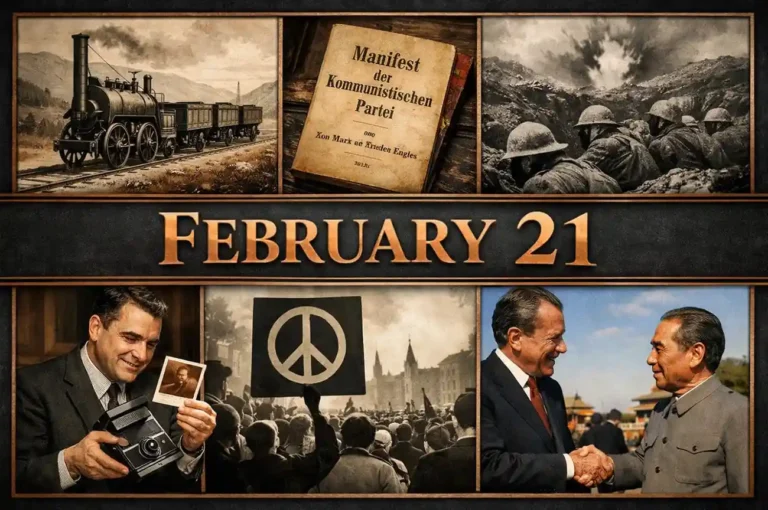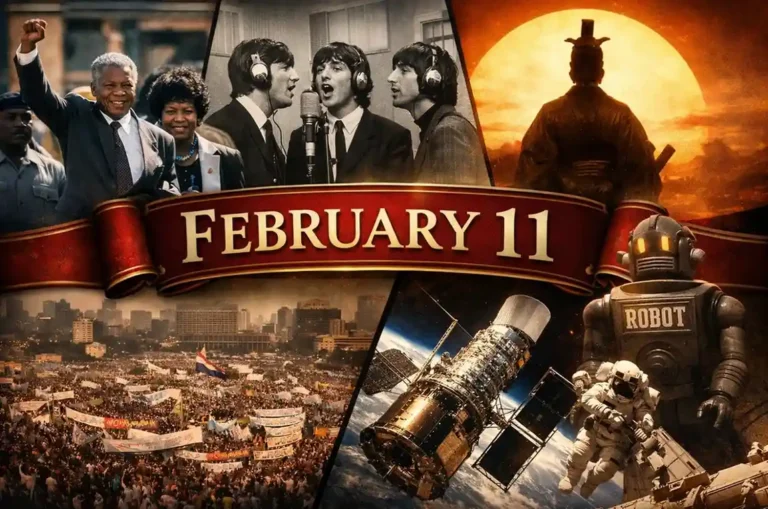
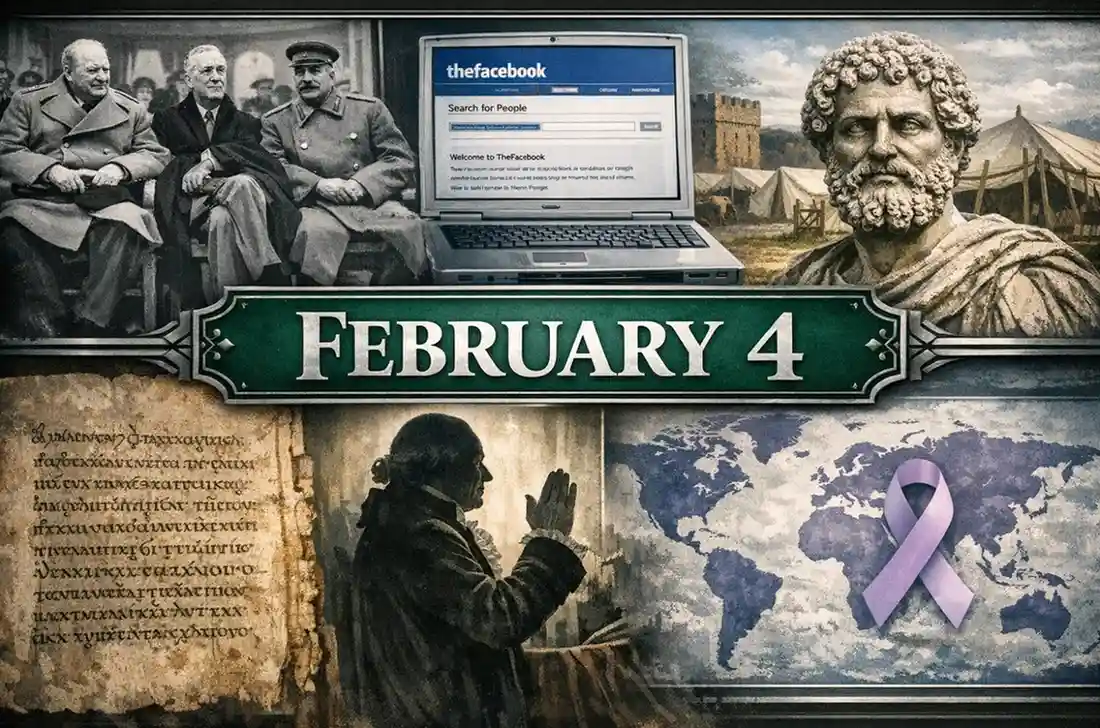
The fourth day of February stands as a remarkable crossroads in the human story, where the fall of ancient empires meets the birth of the modern digital age. When we examine what happened on this day in history February 4, we find a date defined by the unanimous election of a founding father, the liberation of war-torn camps, and the founding of a social network that would redefine global communication. It is a day of immense tragedy—seen in devastating earthquakes and martyr’s fires. From the halls of the Yalta Conference to the quiet discovery of ancient biblical codices, February 4 serves as a testament to the enduring complexity of our shared heritage.
Important Events That Happened On February 4 In History
211 – Death of Septimius Severus
Roman Emperor Septimius Severus died at Eboracum (modern-day York, England) while preparing for a campaign against the Caledonians. Upon his death, the Roman Empire was left to his two sons, Caracalla and Geta. Despite their father’s final advice to “be harmonious, enrich the soldiers, and scorn all others,” the brothers’ intense rivalry would soon lead to a bloody civil struggle.
960 – Founding of the Song Dynasty
Zhao Kuangyin, a leading general of the Later Zhou, declared himself Emperor Taizu of Song. This act successfully ended the period of the Five Dynasties and Ten Kingdoms, initiating the Song dynasty. This era would become a golden age for Chinese economy, technology, and culture, lasting for over three centuries.
1169 – Sicily Earthquake
A massive earthquake struck the Ionian coast of Sicily. The disaster caused tens of thousands of injuries and deaths, with the city of Catania suffering the most significant destruction. The event remains one of the most catastrophic natural disasters in the medieval history of the Mediterranean.
1454 – Outbreak of the Thirteen Years’ War
The Secret Council of the Prussian Confederation sent a formal act of disobedience to the Grand Master of the Teutonic Knights. This defiant move sparked the Thirteen Years’ War, a conflict between the Prussian Confederation (allied with Poland) and the Teutonic Order, which eventually led to the decline of the Knights’ power in the region.
1555 – Martyrdom of John Rogers
John Rogers was burned at the stake at Smithfield, becoming the first English Protestant martyr under the reign of Mary I (known as “Bloody Mary”). Rogers was a clergyman and a significant contributor to the “Matthew Bible.” His execution marked the beginning of a period of intense religious persecution in England.
1703 – Seppuku of the Forty-Seven Rōnin
In Edo (modern Tokyo), 46 of the 47 Rōnin committed seppuku (ritual suicide). This was their court-ordered recompense for avenging their master’s death by killing the court official Kira Yoshinaka. Their act of loyalty became a foundational legend in Japanese culture, epitomizing the samurai code of bushido.
1758 – Founding of Macapá
Sebastião Veiga Cabral founded the city of Macapá in northern Brazil. Located on the northern bank of the Amazon River and sitting directly on the equator, Macapá would grow into a vital strategic and economic hub for the state of Amapá.
1789 – George Washington Elected President
In a historic first for the United States, George Washington was unanimously elected as President by the U.S. Electoral College. He remains the only president to receive 100% of the electoral votes, a testament to his singular status as a unifying figure for the newly formed nation.
1794 – France Abolishes Slavery
The French National Convention passed a law abolishing slavery throughout all territories of the French First Republic. While this was a landmark moment for human rights, the victory was temporary; Napoleon Bonaparte would later reestablish slavery in the French West Indies in 1802.
1797 – Riobamba Earthquake
An earthquake struck Riobamba, Ecuador, causing catastrophic damage and up to 40,000 casualties. The city was almost entirely leveled, leading to its relocation to a new site nearby. It remains one of the deadliest earthquakes in South American history.
1801 – John Marshall Becomes Chief Justice
John Marshall was sworn in as the fourth Chief Justice of the United States. During his 34-year tenure, Marshall would transform the Supreme Court into a co-equal branch of government, most notably through the establishment of judicial review in Marbury v. Madison.
1810 – Britain Seizes Guadeloupe
During the Napoleonic Wars, British forces successfully seized the Caribbean island of Guadeloupe from the French. The occupation lasted until 1814, when the island was returned to France under the Treaty of Paris.
1820 – Capture of Valdivia
Under the command of Lord Cochrane, the Chilean Navy completed the two-day Capture of Valdivia. With only two ships and 300 men, Cochrane successfully took one of the most heavily fortified Spanish strongholds in South America, a major victory for Chilean independence.
1825 – Authorization of Ohio Canals
The Ohio Legislature authorized the construction of the Ohio and Erie Canal and the Miami and Erie Canal. These massive engineering projects were designed to connect the Ohio River with Lake Erie, fundamentally altering the state’s economy by opening up trade routes to the East Coast.
1846 – Mormon Exodus from Nauvoo
The first company of Mormon pioneers began their exodus from Nauvoo, Illinois. Under the leadership of Brigham Young, they headed westward across the frozen Mississippi River in search of a new home where they could practice their faith without persecution, eventually settling in the Salt Lake Valley.
1859 – Discovery of Codex Sinaiticus
German biblical scholar Constantin von Tischendorf discovered the Codex Sinaiticus at Saint Catherine’s Monastery in Egypt. This 4th-century manuscript is one of the most important surviving texts of the Greek Bible and remains a cornerstone for modern biblical scholarship.
1861 – Formation of the Confederacy
Delegates from six breakaway Southern states met in Montgomery, Alabama. This meeting initiated the formal process that would lead to the establishment of the Confederate States of America on February 8, setting the stage for the American Civil War.
1899 – Outbreak of the Philippine–American War
The Philippine–American War began when four Filipino soldiers entered the “American Zone” in Manila, leading to an exchange of fire that ignited the Battle of Manila. The conflict followed the U.S. decision to annex the Philippines rather than recognize the newly declared Philippine Republic.
1932 – Japan Occupies Harbin
During the Second Sino-Japanese War, the city of Harbin in Manchuria fell to Japanese forces. The occupation was part of Japan’s aggressive expansion into mainland China, which eventually led to the establishment of the puppet state of Manchukuo.
1938 – Hitler Takes Command of the Wehrmacht
Adolf Hitler appointed himself as the head of the Armed Forces High Command (Oberkommando der Wehrmacht). This move followed the forced resignations of top generals and allowed Hitler to exert direct personal control over the German military.
1941 – Creation of the USO
The United Service Organization (USO) was established as a private, nonprofit corporation to provide morale and recreational services to members of the U.S. military. The USO became famous for its celebrity-led “Camp Shows” that entertained troops stationed around the world.
1945 – Liberation of Santo Tomas
The Santo Tomas Internment Camp in Manila was liberated by the U.S. Army’s 1st Cavalry Division. Thousands of Allied civilians, who had been held in brutal conditions by Japanese forces for over three years, were finally freed.
1945 – The Yalta Conference Opens
The “Big Three”—Winston Churchill, Franklin D. Roosevelt, and Joseph Stalin—met at the Livadia Palace in Crimea. The Yalta Conference was held to plan the final defeat of Nazi Germany and discuss the post-war reorganization of Europe, which would eventually shape the Cold War era.
1945 – Battle of Pokoku and Irrawaddy River
The British Indian Army and the Imperial Japanese Army began a series of intense engagements known as the Battle of Pokoku and Irrawaddy River operations. These battles were crucial to the Allied effort to liberate Burma from Japanese occupation.
1948 – Independence of Ceylon
The British colony of Ceylon achieved independence as a dominion within the British Commonwealth. In 1972, the nation would officially change its name to Sri Lanka and become a republic.
1961 – Angolan War of Independence Begins
Nationalists launched an attack on a police station and prison in Luanda, marking the beginning of the Angolan War of Independence. This conflict was part of the larger Portuguese Colonial War, as various African colonies fought to end centuries of Portuguese rule.
1966 – All Nippon Airways Flight 60 Crash
A Boeing 727 operating as All Nippon Airways Flight 60 plunged into Tokyo Bay during its final approach to Haneda Airport. All 133 people on board were killed in what was, at the time, the deadliest single-plane accident in history.
1967 – Launch of Lunar Orbiter 3
NASA launched Lunar Orbiter 3 from Cape Canaveral. Its primary mission was to photograph the lunar surface to identify safe landing sites for the upcoming Surveyor and Apollo missions, contributing vital data to the eventual moon landings.
1974 – Kidnapping of Patty Hearst
The Symbionese Liberation Army (SLA), a radical left-wing group, kidnapped Patty Hearst, the granddaughter of publishing tycoon William Randolph Hearst, from her apartment in Berkeley, California. The case became a media sensation, especially after Hearst later appeared to join her captors.
1974 – M62 Coach Bombing
A bomb planted by the Provisional IRA exploded on a bus traveling on the M62 motorway in Yorkshire, England. The bus was carrying off-duty British military personnel and their families. Twelve people—nine soldiers and three civilians—were killed in the attack.
1975 – Haicheng Earthquake
A magnitude 7.3 earthquake struck Haicheng, Liaoning, China. This event is historically significant because it was the first earthquake in history to be successfully predicted by seismologists, allowing for an evacuation that saved thousands of lives despite the extensive damage.
1976 – Guatemala and Honduras Earthquake
A powerful earthquake struck Guatemala and Honduras, claiming the lives of more than 22,000 people. The quake caused widespread destruction of homes and infrastructure, leaving over a million people homeless in the Central American region.
1977 – Chicago “L” Train Derailment
A Chicago Transit Authority elevated train rear-ended another train and derailed at a sharp curve in the “Loop.” Eleven people were killed and 180 injured in the deadliest accident in the history of Chicago’s rapid transit system.
1992 – Hugo Chávez Leads Coup Attempt
Lieutenant Colonel Hugo Chávez led a failed coup d’état against Venezuelan President Carlos Andrés Pérez. Although the coup was unsuccessful and Chávez was imprisoned, the event catapulted him to national fame and set the stage for his eventual democratic election as president in 1998.
1997 – Israeli Helicopter Collision
Two Israeli Sikorsky CH-53 troop-transport helicopters collided in mid-air over northern Galilee while en route to Lebanon. All 73 military personnel on board were killed, leading to a period of national mourning in Israel and an intense debate over the country’s presence in southern Lebanon.
1997 – Bojnurd Earthquake
A magnitude 6.5 earthquake struck the Bojnurd region of northeastern Iran. The quake destroyed or damaged 173 villages and killed at least 88 people. The region’s traditional mud-brick architecture contributed to the high level of structural damage.
1998 – Afghanistan Earthquake
A magnitude 5.9 earthquake shook the Takhar Province in northern Afghanistan. The disaster resulted in 2,323 deaths and hundreds of injuries. Because the region was remote and affected by ongoing conflict, international aid efforts were significantly hampered.
1999 – Shooting of Amadou Diallo
Amadou Diallo, an unarmed West African immigrant, was shot 41 times by four plainclothes NYPD officers who mistook him for a rape suspect. The killing sparked massive protests and a national debate over police brutality and racial profiling in New York City.
2000 – World Summit Against Cancer
The World Summit Against Cancer for the New Millennium was held in Paris. President Jacques Chirac and UNESCO Director General Koichiro Matsuura signed the Charter of Paris, which officially established February 4 as World Cancer Day to raise global awareness and encourage prevention.
2003 – Yugoslavia Becomes Serbia and Montenegro
The Federal Republic of Yugoslavia adopted a new constitution, officially transforming the nation into a loose confederacy known as Serbia and Montenegro. This transition was part of a managed effort to maintain a union while granting both republics significant autonomy.
2004 – Founding of Facebook
Mark Zuckerberg and his co-founders launched “TheFacebook” from a Harvard University dorm room. Originally intended for Harvard students, the site quickly expanded to other universities and eventually the general public, becoming the world’s largest social network and a dominant force in modern culture.
2008 – “A Million Voices Against the FARC”
Millions of people took to the streets in Colombia and around the world in a massive mobilization against the FARC (Revolutionary Armed Forces of Colombia). The protests were organized via social media to demand an end to the group’s kidnappings and violence.
2015 – TransAsia Airways Flight 235 Crash
TransAsia Airways Flight 235 crashed into the Keelung River shortly after takeoff from Taipei. The accident was captured on several dashboard cameras, showing the plane clipping a bridge. Forty-three people were killed; the investigation later revealed the pilot had accidentally shut down the plane’s only working engine.
2020 – Macau Closes Casinos
Due to the rapid spread of the COVID-19 pandemic, the government of Macau ordered all casinos to close for 15 days. This unprecedented move highlighted the severity of the global health crisis, as Macau is the world’s most lucrative gambling hub.
2025 – Örebro Mass Shooting
Ten people were killed and 23 others injured in a mass shooting at an adult education centre in Örebro, Sweden. The attack, which took place during daytime classes, shocked the nation and led to an immediate review of security protocols at educational institutions across Scandinavia.
Read Here February 3: Unforgettable Moments
Famous People Born On February 4
| Name | Role / Description | Birth – Death |
|---|---|---|
| Oscar De La Hoya | American boxing champion | February 4, 1973 – |
| Tadeusz Kościuszko | Polish general; American Revolution hero | February 4, 1746 – October 15, 1817 |
| Ken Thompson | Computer scientist; UNIX co-creator | February 4, 1943 – |
| Friedrich Ebert | First president of Weimar Germany | February 4, 1871 – February 28, 1925 |
| Clyde Tombaugh | Astronomer; discoverer of Pluto | February 4, 1906 – January 17, 1997 |
| Birju Maharaj | Indian classical Kathak dancer | February 4, 1938 – January 16, 2022 |
| Fernand Léger | French modernist painter | February 4, 1881 – August 17, 1955 |
| Albert Venn Dicey | British constitutional jurist | February 4, 1835 – April 7, 1922 |
| Jennifer Shipley | First female PM of New Zealand | February 4, 1952 – |
| Ludwig Prandtl | Physicist; father of aerodynamics | February 4, 1875 – August 15, 1953 |
| Jacques Prévert | French poet and screenwriter | February 4, 1900 – April 11, 1977 |
| Byron Nelson | American golf legend | February 4, 1912 – September 26, 2006 |
| Wolfgang Beltracchi | German art forger | February 4, 1951 – |
| Taryn Simon | American conceptual photographer | February 4, 1975 – |
| Clément Ader | Aviation pioneer | February 4, 1841 – March 5, 1926 |
| Russell Hoban | American novelist | February 4, 1925 – December 13, 2011 |
| Thomas Earnshaw | English watchmaker | February 4, 1749 – March 1, 1829 |
| Deng Yingchao | Chinese revolutionary politician | February 4, 1904 – July 11, 1992 |
| Henry Knowles Beecher | Medical ethicist, anesthesiologist | February 4, 1904 – July 25, 1976 |
| George Lillo | English dramatist | February 4, 1693 – September 3, 1739 |
| Pierre Marivaux | French playwright | February 4, 1688 – February 12, 1763 |
| Carl Michael Bellman | Swedish poet-musician | February 4, 1740 – February 11, 1795 |
| Raymond A. Dart | Anthropologist; Taung Child discoverer | February 4, 1893 – November 22, 1988 |
| James Gillespie Birney | Abolitionist politician | February 4, 1792 – November 25, 1857 |
| Jacques Copeau | Theatre director and reformer | February 4, 1879 – October 20, 1949 |
| Alessandro Magnasco | Italian Baroque painter | February 4, 1667 – March 12, 1749 |
| João Baptista de Almeida Garrett | Portuguese writer and statesman | February 4, 1799 – December 9, 1854 |
| MacKinlay Kantor | Pulitzer Prize–winning author | February 4, 1904 – October 11, 1977 |
| Manuel Álvarez Bravo | Mexican photographer | February 4, 1902 – October 19, 2002 |
| Jean Richepin | French poet and novelist | February 4, 1849 – December 12, 1926 |
Famous People Died On February 4
| Name | Role / Description | Birth – Death |
|---|---|---|
| Ossie Davis | Actor, playwright, activist | December 18, 1917 – February 4, 2005 |
| Louis Jordan | R&B and rock pioneer | July 8, 1908 – February 4, 1975 |
| Hendrik Antoon Lorentz | Nobel Prize–winning physicist | July 18, 1853 – February 4, 1928 |
| Florence Green | Last surviving WWI veteran | February 19, 1901 – February 4, 2012 |
| Iannis Xenakis | Composer and architect | May 29, 1922 – February 4, 2001 |
| Edward Sapir | Linguist and anthropologist | January 26, 1884 – February 4, 1939 |
| Donald Byrd | Jazz trumpeter | December 9, 1932 – February 4, 2013 |
| Carl Albert | U.S. Speaker of the House | May 10, 1908 – February 4, 2000 |
| Kamau Brathwaite | Caribbean poet | May 11, 1930 – February 4, 2020 |
| Pompeo Batoni | Italian painter | January 25, 1708 – February 4, 1787 |
| Louise Bogan | Poet and critic | August 11, 1897 – February 4, 1970 |
| Alan Baker | Fields Medal mathematician | August 19, 1939 – February 4, 2018 |
| Miguel Covarrubias | Artist and anthropologist | 1904 – February 4, 1957 |
| Rabanus Maurus | Medieval scholar | c. 780 – February 4, 856 |
| Pankaj Roy | Indian cricket opener | May 31, 1928 – February 4, 2001 |
| Robert Koldewey | Archaeologist of Babylon | September 10, 1855 – February 4, 1925 |
| Mary Elizabeth Braddon | Victorian novelist | October 4, 1837 – February 4, 1915 |
| Antonio del Pollaiuolo | Renaissance artist | January 17, 1432 – February 4, 1498 |
| John Rogers | Protestant martyr | c. 1500 – February 4, 1555 |
| Lewanika | King of the Lozi people | c. 1842 – February 4, 1916 |
| Yvette Guilbert | French singer and actress | January 20, 1867 – February 4, 1944 |
| Charles-Marie de La Condamine | Explorer of the Amazon | January 28, 1701 – February 4, 1774 |
| Giambattista della Porta | Renaissance philosopher | 1535? – February 4, 1615 |
| Sisinnius | Pope of the Catholic Church | – February 4, 708 |
| Hayashi Senjūrō | Prime minister of Japan | February 23, 1876 – February 4, 1943 |
| Conradus Celtis | German humanist scholar | February 1, 1459 – February 4, 1508 |
| Louise Bogan | Poet and critic | August 11, 1897 – February 4, 1970 |
| Robert Blair | Scottish poet | 1699 – February 4, 1746 |
| Philip Wharton | English political reformer | April 18, 1613 – February 4, 1696 |
| Saint Gilbert of Sempringham | Religious founder | c. 1083 – February 4, 1189 |
Observances & Institutional Dates
- World Cancer Day: A global awareness day led by the Union for International Cancer Control (UICC).
- Independence Day (Sri Lanka): Commemorating the nation’s independence from British rule in 1948.
- Rosa Parks Day (California and Missouri): Honoring the civil rights leader on her birthday.
- International Day of Human Fraternity: A UN-recognized day to promote dialogue and understanding between different cultures and religions.
Frequently Asked Questions
- What major social network was founded on February 4?
- Facebook was launched by Mark Zuckerberg on this day in 2004.
- Which US President was elected on this day in 1789?
- George Washington was unanimously elected by the Electoral College.
- What happened at the Yalta Conference?
- Churchill, Roosevelt, and Stalin met in 1945 to plan the post-war reorganization of Europe.
- Why is February 4 World Cancer Day?
- It was established in 2000 by the Charter of Paris to raise global awareness of the disease.