History is rarely a quiet affair, and the seventh day of February proves that the world can shift beneath our feet in a single afternoon. When we consider what happened on this day in history February 7, we encounter a timeline that spans from the coronation of Roman emperors to the arrival of four mop-topped musicians from Liverpool who would change global culture forever. This is a day where human ambition reached into the stars with the first untethered spacewalk and where nations were born or reborn through the signing of the Maastricht Treaty.
Important Events That Happened On February 7 In History
457 – Leo I Becomes Emperor
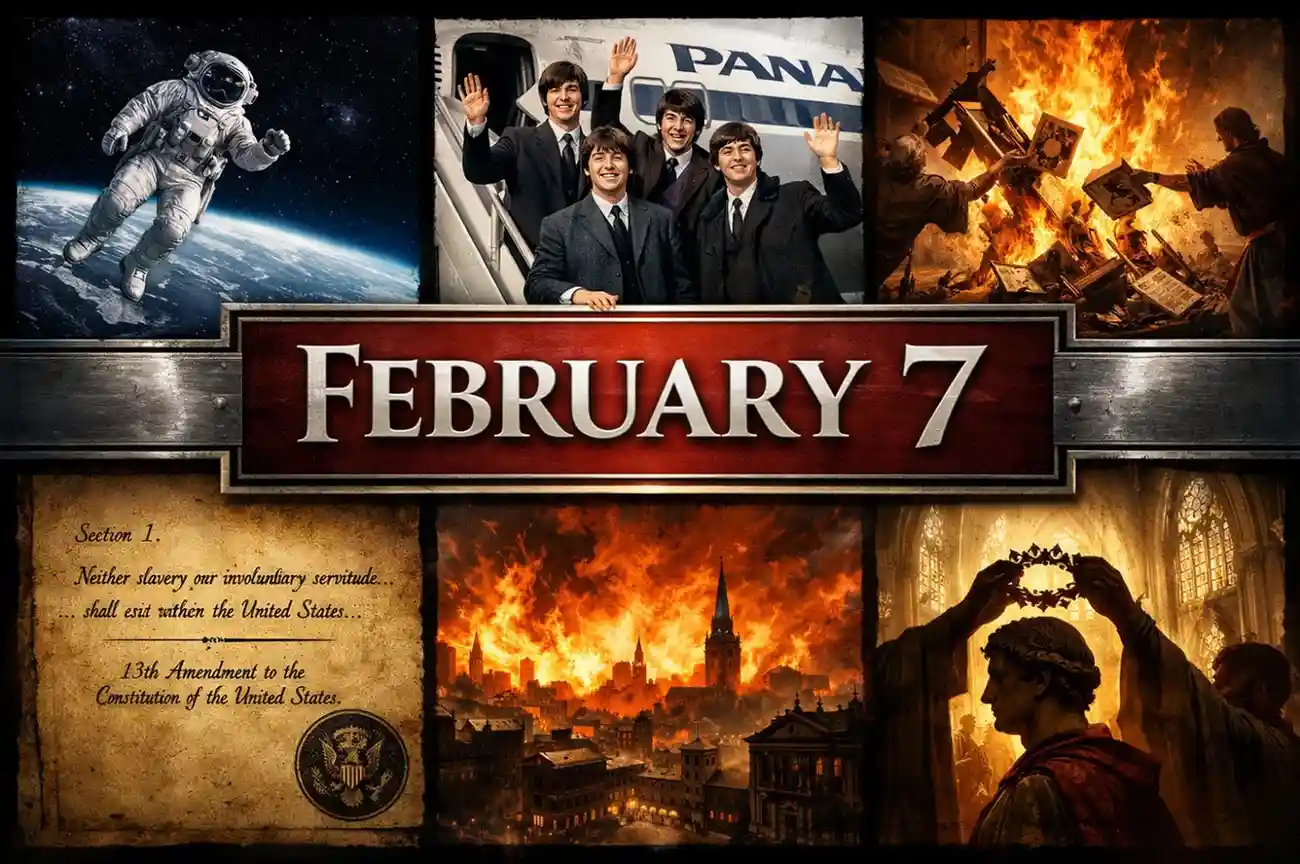
Leo I was crowned the Eastern Roman Emperor. His reign was significant for being the first coronation to be performed by the Patriarch of Constantinople, beginning a tradition that would last for a millennium and emphasizing the divine right of the Byzantine rulers.
987 – Byzantine Rebellion Begins
Byzantine generals Bardas Phokas the Younger and Bardas Skleros launched a massive rebellion against Emperor Basil II. Representing the military elite, their uprising posed a significant threat to the central authority of the empire, eventually leading to a dramatic showdown.
1301 – First English Prince of Wales
Edward of Caernarvon, who would later rule as King Edward II, was granted the title of Prince of Wales. This established the tradition of the English (and later British) monarch’s eldest son holding this specific title.
1313 – Founding of the Pinya Kingdom
King Thihathu founded the Pinya Kingdom in central Myanmar. It was established as the de jure successor state to the fallen Pagan Kingdom, maintaining the cultural and political continuity of the region.
1365 – City Rights for Ulvila
King Albert of Sweden (Albert III of Mecklenburg) granted city rights to Ulvila. This made it one of the oldest cities in Finland, serving as an important medieval trading hub.
1497 – The Bonfire of the Vanities
In Florence, followers of the Dominican friar Girolamo Savonarola burned thousands of objects deemed to be “sinful,” including cosmetics, mirrors, musical instruments, and irreplaceable books and artworks. It remains one of the most famous examples of religious zealotry destroying cultural heritage.
1756 – Death of Sepé Tiaraju
During the Guaraní War, the rebel leader Sepé Tiaraju was killed in a skirmish with Spanish and Portuguese forces. He fought against the colonial displacement of indigenous people in the Jesuit missions, later becoming a folk hero in Brazil.
1783 – Lifting of the Siege of Gibraltar
Combined French and Spanish forces finally lifted the Great Siege of Gibraltar during the American Revolutionary War. Despite over three years of bombardment, the British garrison held the strategic rock, a major blow to Spanish and French naval ambitions.
1795 – Ratification of the 11th Amendment
The 11th Amendment to the United States Constitution was ratified. This amendment dealt with the sovereign immunity of states, preventing federal courts from hearing lawsuits against a state by a citizen of another state or country.
1807 – Battle of Eylau
Napoleon Bonaparte’s French army engaged Russian forces under Bennigsen at the Battle of Eylau. The first day of the battle ended with the French taking the town after brutal fighting, though the main engagement would conclude as a bloody, indecisive stalemate the following day.
1812 – Great New Madrid Earthquake
The strongest in a series of massive earthquakes struck New Madrid, Missouri. The tremors were so powerful they reportedly caused the Mississippi River to flow backward and were felt as far away as the East Coast.
1813 – Action of 7 February 1813
The French frigate Aréthuse and the British frigate Amelia engaged in a fierce naval duel near the Îles de Los. Both ships battered each other into near-wrecks, but neither was able to force a surrender, resulting in a draw.
1819 – Raffles Departs Singapore
Just days after securing the island for the British East India Company, Sir Thomas Stamford Raffles left Singapore. He placed the settlement under the command of William Farquhar, who was tasked with building the foundation of the modern city-state.
1842 – Battle of Debre Tabor
Ras Ali Alula, the Regent of the Emperor of Ethiopia, defeated the powerful warlord Wube Haile Maryam. The victory helped consolidate the power of the central regency against regional rivals during the “Era of the Princes.”
1854 – Founding of ETH Zurich
A law was approved to establish the Swiss Federal Institute of Technology (now ETH Zurich). The school would open its doors in 1855 and go on to become one of the most prestigious science and technology universities in the world.
1863 – Sinking of HMS Orpheus
The Royal Navy corvette HMS Orpheus ran aground and sank off the coast of Auckland, New Zealand. 189 people died in the disaster, which remains the deadliest maritime accident in New Zealand waters.
1894 – Cripple Creek Miners’ Strike
Led by the Western Federation of Miners, workers in Cripple Creek, Colorado, began a major strike for higher wages and an eight-hour workday. It became one of the few labor strikes in U.S. history to be supported by a state militia.
1898 – Trial of Émile Zola
The French author Émile Zola was brought to trial for libel after publishing his open letter, J’Accuse…!. The letter accused the French government of anti-Semitism and the wrongful imprisonment of Alfred Dreyfus, igniting a national scandal.
1900 – Third Attempt at Ladysmith Fails
During the Second Boer War, British forces failed for a third time to break the Boer siege of Ladysmith. The failure highlighted the military challenges the British faced against the highly mobile Boer commandos.
1900 – Bubonic Plague in San Francisco
A Chinese immigrant in San Francisco fell ill with the bubonic plague, marking the start of the first plague epidemic in the continental United States. The outbreak led to a period of intense discrimination and quarantine in the city’s Chinatown.
1904 – The Great Baltimore Fire
A fire broke out in Baltimore, Maryland, and raged for 30 hours. It destroyed over 1,500 buildings and scorched much of the downtown area. The disaster led to the standardization of fire hose couplings across the United States.
1940 – Premiere of Pinocchio
Walt Disney’s second full-length animated feature, Pinocchio, premiered in New York City. While initially a box office disappointment due to World War II, it eventually became a beloved classic and a milestone in animation history.
1943 – Evacuation of Guadalcanal
Imperial Japanese Navy forces completed Operation Ke, successfully evacuating troops from Guadalcanal. This ended the grueling six-month Guadalcanal campaign and marked a decisive shift in the Pacific Theater toward the Allies.
1944 – German Counteroffensive at Anzio
During the Allied Operation Shingle, German forces launched a major counteroffensive against the beachhead at Anzio, Italy. The fighting was some of the most intense of the Italian campaign, resulting in a prolonged stalemate.
1951 – Sancheong–Hamyang Massacre
During the Korean War, South Korean forces massacred more than 700 civilians suspected of being communist sympathizers. The event remains a dark chapter in the history of the conflict.
1962 – US Embargo on Cuba
The United States government announced a total ban on all imports and exports to and from Cuba. This move significantly escalated the Cold War tensions between the two nations and remains a central part of their diplomatic history.
1964 – The Beatles Arrive in America
“Beatlemania” officially hit the United States as John, Paul, George, and Ringo landed at John F. Kennedy International Airport for the first time. Thousands of screaming fans greeted them, signaling the start of the “British Invasion” in pop culture.
1966 – The Great Fire of Iloilo
A lumber yard fire in Iloilo City, Philippines, spread to destroy nearly three-quarters of the city proper. The blaze burned for 12 hours and caused Php 50 million in damage, reshaping the city’s urban landscape.
1974 – Independence of Grenada
Grenada officially gained its independence from the United Kingdom. Eric Gairy became the nation’s first Prime Minister, though the transition was marked by internal political tension.
1979 – Pluto Enters Neptune’s Orbit
For the first time since its discovery, the orbit of Pluto brought it closer to the Sun than Neptune. Because of its highly elliptical orbit, Pluto spent the next 20 years as the “eighth” planet before moving back outside Neptune’s path.
1981 – Pushkin Airport Crash
A Soviet Tu-104 airliner crashed shortly after takeoff from Pushkin Airport near Leningrad. All 50 people on board died, including 16 high-ranking admirals and officers of the Soviet Pacific Fleet, a massive blow to the Soviet Navy.
1984 – First Untethered Spacewalk
During the STS-41-B mission, astronauts Bruce McCandless II and Robert L. Stewart used the Manned Maneuvering Unit (MMU) to perform the first untethered spacewalk. McCandless famously floated 320 feet away from the Space Shuttle Challenger.
1986 – Duvalier Flees Haiti
President Jean-Claude “Baby Doc” Duvalier fled Haiti for France, ending 28 years of his family’s authoritarian rule. His departure followed months of popular protests and international pressure.
1990 – Soviet Communist Party Abandons Monopoly
The Central Committee of the Communist Party of the Soviet Union agreed to give up its constitutional monopoly on political power. This was a critical moment in the dissolution of the USSR, allowing for the rise of a multi-party system.
1991 – Jean-Bertrand Aristide Sworn In
Jean-Bertrand Aristide was sworn in as the first democratically elected president of Haiti. His inauguration represented a major hope for democratic reform in the nation after decades of dictatorship.
1991 – Mortar Attack on 10 Downing Street
During a cabinet meeting, the Provisional IRA launched three mortar shells at 10 Downing Street, the home of the British Prime Minister. While one shell exploded in the garden, Prime Minister John Major and his staff escaped uninjured.
1992 – Signing of the Maastricht Treaty
Members of the European Community signed the Maastricht Treaty in the Netherlands. The treaty established the European Union, paved the way for the Euro currency, and introduced the concept of European citizenship.
1995 – Arrest of Ramzi Yousef
Ramzi Yousef, the mastermind behind the 1993 World Trade Center bombing, was arrested by Pakistani and U.S. agents in Islamabad. His capture was a major victory in the early global fight against terrorism.
1999 – King Abdullah Ascends the Throne
Following the death of his father, King Hussein, Crown Prince Abdullah became the King of Jordan. He inherited the leadership of a key Middle Eastern nation during a period of regional transition.
2001 – Launch of Destiny Lab
Space Shuttle Atlantis launched on mission STS-98, carrying the Destiny laboratory module to the International Space Station. Destiny became the primary research facility for U.S. payloads aboard the station.
2009 – Black Saturday Bushfires
Victoria, Australia, was devastated by the “Black Saturday” bushfires. The extreme heat and wind led to the deaths of 173 people, making it the deadliest natural disaster in Australian history.
2012 – Resignation of Mohamed Nasheed
President Mohamed Nasheed of the Maldives resigned following weeks of protests and a police mutiny. Nasheed claimed he was forced to resign at gunpoint, an event that led to significant political unrest in the island nation.
2013 – Mississippi Certifies 13th Amendment
Mississippi officially certified the 13th Amendment, becoming the last state to formally approve the abolition of slavery. While the state had ratified it in 1995, the paperwork had never been filed with the federal government.
2014 – Happisburgh Footprints Announced
Scientists announced the discovery of hominid footprints in Happisburgh, England, dating back over 800,000 years. They are the oldest footprints ever found outside of Africa and provided new evidence of early human migration.
2016 – North Korea Satellite Launch
North Korea launched the Kwangmyŏngsŏng-4 satellite into orbit. The launch was widely condemned by the international community as a disguised test of long-range ballistic missile technology, violating several UN treaties.
2021 – Uttarakhand Flood Begins
A glacial lake outburst led to a massive flood in the Uttarakhand region of India. The deluge swept away dams and bridges and left over 200 people dead or missing in the Himalayan valley.
2024 – Bombings in Pakistan
Twin bombings targeted election offices in Pakistan’s Balochistan province, killing at least 24 people just one day before the general elections. The attacks were an attempt to disrupt the democratic process in the region.
Read Also: This Day In History February 6: Unbelievable Twists
Famous People Born On February 7
| Name | Short Description | Dates |
|---|---|---|
| Thomas Andrews | Irish ship designer | February 7, 1873 – April 15, 1912 |
| Anna Ivanovna | Empress of Russia | February 7, 1693 – October 28, 1740 |
| G H Hardy | English mathematician | February 7, 1877 – December 1, 1947 |
| Henry Fuseli | Romantic painter | February 7, 1741 – April 16, 1825 |
| Buster Crabbe | Olympic swimmer and actor | February 7, 1908 – April 23, 1983 |
| John Deere | Agricultural inventor | February 7, 1804 – May 17, 1886 |
| John Hickenlooper | U.S. senator | February 7, 1952 – |
| Tawakkol Karman | Nobel Peace Prize activist | February 7, 1979 – |
| Harry Nyquist | Communications engineer | February 7, 1889 – April 4, 1976 |
| An Wang | Computer industry pioneer | February 7, 1920 – March 24, 1990 |
| Eubie Blake | Ragtime composer | February 7, 1887 – February 12, 1983 |
| Eric Temple Bell | Mathematician and writer | February 7, 1883 – December 21, 1960 |
| Maskawa Toshihide | Nobel physicist | February 7, 1940 – July 23, 2021 |
| Witi Ihimaera | Māori novelist | February 7, 1944 – |
| Bernard Maybeck | American architect | February 7, 1862 – October 3, 1957 |
| Hector Babenco | Film director | February 7, 1946 – July 13, 2016 |
| Ricardo Palma | Peruvian writer | February 7, 1833 – October 6, 1919 |
| Thomas Killigrew | English dramatist | February 7, 1612 – March 19, 1683 |
| Kristin Otto | Olympic swimmer | February 7, 1966 – |
| Ossip Gabrilowitsch | Concert pianist | February 7, 1878 – September 14, 1936 |
| William Huggins | Astronomical pioneer | February 7, 1824 – May 12, 1910 |
| Hannah Whitall Smith | Religious reformer | February 7, 1832 – May 1, 1911 |
| Konstantin Feoktistov | Soviet cosmonaut | February 7, 1926 – November 21, 2009 |
| Jean Charlot | Muralist and painter | February 7, 1898 – March 20, 1979 |
| Shiga Kiyoshi | Bacteriologist | February 7, 1871 – January 25, 1957 |
| Vladimir Kuts | Olympic runner | February 7, 1927 – August 16, 1975 |
| João de Castro | Portuguese navigator | February 7, 1500 – June 6, 1548 |
| Emma Nevada | Opera soprano | February 7, 1859 – June 20, 1940 |
| Roger Angel | Telescope innovator | February 7, 1941 – |
| David Ignatow | American poet | February 7, 1914 – November 17, 1997 |
Famous People Died On February 7
| Name | Short Description | Dates |
|---|---|---|
| Adolphe Sax | Inventor of saxophone | November 6, 1814 – February 7, 1894 |
| Frank Robinson | Baseball legend | August 31, 1935 – February 7, 2018 |
| Dean Smith | Basketball coach | February 28, 1931 – February 7, 2015 |
| Aleksandr Kolchak | Russian admiral | November 16, 1874 – February 7, 1920 |
| Anne Morrow Lindbergh | Writer and aviator | June 22, 1906 – February 7, 2001 |
| Sheridan Le Fanu | Gothic novelist | August 28, 1814 – February 7, 1873 |
| Elihu Root | Nobel statesman | February 15, 1845 – February 7, 1937 |
| Ann Radcliffe | Gothic fiction pioneer | July 9, 1764 – February 7, 1823 |
| Jimmy Van Heusen | Songwriter | January 26, 1913 – February 7, 1990 |
| John Perry Barlow | Digital rights activist | October 3, 1947 – February 7, 2018 |
| Witold Lutosławski | Modern composer | January 25, 1913 – February 7, 1994 |
| Daniel F Malan | South African leader | May 22, 1874 – February 7, 1959 |
| Igor Kurchatov | Nuclear physicist | January 12, 1903 – February 7, 1960 |
| Alan Jay Perlis | Turing Award winner | April 1, 1922 – February 7, 1990 |
| Robert E Park | Sociologist | February 14, 1864 – February 7, 1944 |
| Iwasaki Yatarō | Mitsubishi founder | January 9, 1835 – February 7, 1885 |
| Nap Lajoie | Baseball Hall of Famer | September 5, 1874 – February 7, 1959 |
| Orazio Gentileschi | Baroque painter | 1562 – February 7, 1639 |
| Galileo Ferraris | Induction motor pioneer | October 31, 1847 – February 7, 1897 |
| William Boyce | English composer | September 11, 1711 – February 7, 1779 |
| Alan G MacDiarmid | Nobel chemist | April 14, 1927 – February 7, 2007 |
| Pelagius II | Pope of Rome | – February 7, 590 |
| Albert Finney | British actor | May 9, 1936 – February 7, 2019 |
| Richard Hatch | Sci-fi television star | May 21, 1945 – February 7, 2017 |
| Hans Rosling | Data educator | July 27, 1948 – February 7, 2017 |
| Billy Casper | Golf champion | June 24, 1931 – February 7, 2015 |
| Daniel Chodowiecki | Enlightenment artist | October 16, 1726 – February 7, 1801 |
| Baccio Bandinelli | Renaissance sculptor | November 12, 1493 – February 7, 1560 |
| James Stewart | Scottish noble | – February 7, 1592 |
| André Cardinal Destouches | French composer | April 6, 1672 – February 7, 1749 |
Observances & Institutional Dates
- Independence Day (Grenada): Marking the nation’s 1974 separation from British rule.
- National Black HIV/AIDS Awareness Day (US): Focused on education and testing within the Black community.
Frequently Asked Questions
- What happened to the Beatles on February 7, 1964?
- They landed in New York for their first U.S. visit, sparking the British Invasion.
- Who was the first untethered spacewalker?
- Astronaut Bruce McCandless II on this day in 1984.
- What did the Maastricht Treaty create?
- Signed in 1992, it led to the official formation of the European Union.
- When did Mississippi finally certify the 13th Amendment?
- It officially completed the process on February 7, 2013.