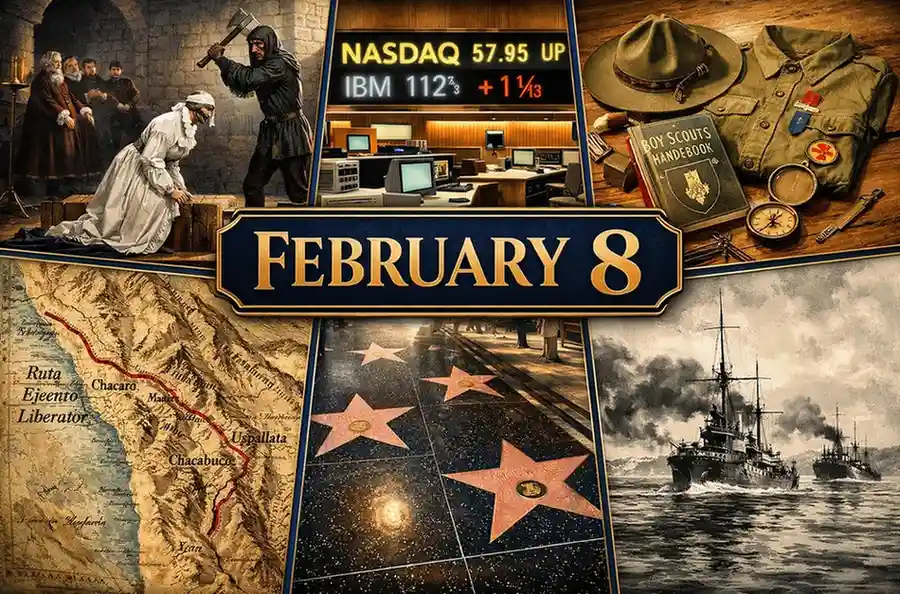
History is often written in the ink of drastic transitions and sudden maneuvers. When we look at what happened on this day in history February 8, we find a date defined by the brutal execution of a queen, the founding of world-renowned institutions, and the beginning of conflicts that reshaped entire continents. It is a day where the first electronic stock market flickered to life and where explorers returned from the silent isolation of space. From the high-stakes politics of the Roman Empire to the modern struggle for civil rights, this date serves as a witness to the relentless, often turbulent, evolution of human society across nearly two millennia.
Important Events That Happened On February 8 In History
421 – Constantius III Becomes Co-Emperor
Constantius III was elevated to the position of co-emperor of the Western Roman Empire alongside Honorius. Though his reign was brief—lasting only seven months before his death—his rise represented a final attempt to stabilize the western provinces during a period of intense external pressure.
1238 – Mongols Burn Vladimir
During the Mongol invasion of Kievan Rus’, the forces of the Golden Horde captured and burned the city of Vladimir. The destruction of this major political and cultural center was a devastating blow to the Russian principalities and solidified Mongol dominance over the region.
1250 – Battle of Al Mansurah
In a key engagement of the Seventh Crusade, French crusaders led by Louis IX battled Ayyubid forces at Al Mansurah. Despite initial crusader progress, the battle turned into a disaster for the European forces, eventually leading to the capture of the French king himself.
1347 – End of the Byzantine Civil War
The Byzantine civil war of 1341–47 concluded with a power-sharing agreement between John VI Kantakouzenos and John V Palaiologos. The conflict had severely drained the empire’s resources, leaving it vulnerable to the rising Ottoman threat.
1587 – Execution of Mary, Queen of Scots
After 19 years of imprisonment, Mary, Queen of Scots, was beheaded at Fotheringhay Castle. She was executed on the orders of her cousin, Queen Elizabeth I, following her alleged involvement in the Babington Plot to assassinate the English monarch.
1601 – Essex Rebellion
Robert Devereux, 2nd Earl of Essex and a former favorite of Queen Elizabeth I, led an unsuccessful rebellion in London against the crown. The coup failed to gain popular support, and Essex was subsequently arrested and executed for treason.
1693 – Charter for William & Mary
King William III and Queen Mary II granted a royal charter for the College of William & Mary in Virginia. It is the second-oldest institution of higher education in the United States and remains a prestigious center for academic research.
1807 – Victory at the Battle of Eylau
Napoleon Bonaparte claimed victory at the Battle of Eylau after two days of horrific fighting in a snowstorm. While the Russian and Prussian forces withdrew, the casualties on both sides were so immense that the battle is remembered as one of the most grueling of the Napoleonic Wars.
1817 – Crossing of the Andes
An army led by Grand Marshal Las Heras began its crossing of the Andes mountains. This movement was part of José de San Martín’s daring campaign to liberate Chile from Spanish colonial rule, a feat often compared to Hannibal’s crossing of the Alps.
1837 – Election of Richard Johnson
Richard Johnson became the first and only Vice President of the United States to be chosen by the Senate. Because no candidate received a majority of the electoral vote, the decision was moved to the Senate under the terms of the 12th Amendment.
1865 – Delaware Rejects 13th Amendment
Delaware formally refused to ratify the Thirteenth Amendment to the U.S. Constitution, which sought to criminalize slavery. While the amendment became national law later that year, Delaware did not symbolically ratify it until 1901.
1879 – Universal Standard Time Proposed
Sir Sandford Fleming first proposed the adoption of Universal Standard Time during a meeting of the Royal Canadian Institute. His vision of dividing the world into 24 time zones eventually revolutionized global travel and communication.
1879 – Sydney Cricket Riot
A match between an English touring team and a New South Wales XI ended in a riot after a controversial umpiring decision. Spectators stormed the field and attacked the English captain, Lord Harris, in one of the earliest instances of unrest in international cricket.
1885 – Japanese Immigrants Reach Hawaii
The first group of Japanese immigrants arrived in Hawaii to work on the sugar plantations. This marked the beginning of a significant wave of Japanese migration that would profoundly shape the cultural and social fabric of the islands.
1887 – The Dawes Act Enacted
The United States Congress passed the Dawes Act, authorizing the federal government to break up tribal lands into individual allotments. The policy resulted in the loss of millions of acres of Native American land and aimed to force the assimilation of indigenous peoples.
1904 – Attack on Port Arthur
Japanese forces launched a surprise night attack on the Russian fleet at Port Arthur, Manchuria. The strike began the Russo-Japanese War, marking the first time in modern history an Asian power challenged a major European empire.
1904 – Northern Sumatra Campaign
General G.C.E. van Daalen led a brutal military campaign in the Dutch East Indies. The operation in Northern Sumatra resulted in the deaths of thousands of civilians as the Dutch Colonial Army sought to consolidate control over the region.
1910 – Boy Scouts of America Incorporated
Entrepreneur William D. Boyce incorporated the Boy Scouts of America in Washington, D.C. The organization was modeled after the British movement and grew to become one of the largest youth organizations in American history.
1915 – The Birth of a Nation Premieres
D.W. Griffith’s The Birth of a Nation premiered in Los Angeles. While celebrated for its technical innovations in filmmaking, the movie was—and remains—notorious for its racist portrayals and its glorification of the Ku Klux Klan.
1924 – First Execution by Gas Chamber
Nevada became the first state in the U.S. to use a gas chamber for a state execution. The condemned was Gee Jon, a member of a Chinese organized crime group; the method was intended to be a more “humane” alternative to hanging.
1937 – Republican Council in Cantabria
During the Spanish Civil War, Republican forces established the Interprovincial Council of Santander, Palencia, and Burgos. The council was formed to coordinate the defense and administration of the northern Republican-held territories.
1942 – Invasion of Singapore
Imperial Japanese forces began their invasion of Singapore, then a British stronghold known as the “Gibraltar of the East.” The landing marked the start of a swift campaign that would lead to the largest surrender in British military history.
1945 – Operation Veritable Begins
British and Canadian forces launched Operation Veritable, a massive offensive aimed at clearing German forces from the land between the Maas and Rhine rivers. The operation was a crucial step in the final Allied push into the German heartland.
1945 – Escape from Peenemünde
Mikhail Devyataev and nine other Soviet POWs executed a daring escape from a Nazi concentration camp at Peenemünde. They hijacked a German bomber and flew it back to Soviet-held territory, providing intelligence on the V-2 rocket program.
1946 – Provisional People’s Committee of North Korea
The People’s Republic of Korea was dissolved in the northern part of the peninsula and replaced by the communist-controlled Provisional People’s Committee. This move signaled the formalization of the division of Korea.
1950 – Establishment of the Stasi
The German Democratic Republic (East Germany) established the Ministry for State Security, known as the Stasi. It would become one of the most pervasive and repressive secret police agencies in the world until its dissolution in 1990.
1960 – Order-in-Council for Mountbatten-Windsor
Queen Elizabeth II issued an Order-in-Council declaring that her descendants, other than those with the style of Royal Highness or the title of Prince/Princess, would carry the surname Mountbatten-Windsor.
1960 – Hollywood Walk of Fame Founded
The first stars were laid on the Hollywood Walk of Fame, creating a permanent monument to achievement in the entertainment industry. The project transformed Hollywood Boulevard into a global tourist destination.
1962 – Charonne Station Massacre
During a protest in Paris against the Algerian War, nine people were killed by French police at the Charonne metro station. The police were under the command of Maurice Papon, an official later convicted for crimes against humanity.
1963 – Ba’athist Coup in Iraq
The regime of Iraqi Prime Minister Abd al-Karim Qasim was overthrown in a violent coup by the Ba’ath Party. Qasim was executed shortly after, and the coup brought the Ba’athists to power for the first time.
1965 – Crash of Eastern Air Lines Flight 663
Shortly after taking off from New York’s JFK Airport, Eastern Air Lines Flight 663 crashed into the Atlantic Ocean. All 84 people on board were killed; the crash was attributed to the pilot’s spatial disorientation during an evasive maneuver.
1968 – Orangeburg Massacre
During a protest against racial segregation at a bowling alley in Orangeburg, South Carolina, highway patrol officers opened fire on Black students from South Carolina State University. Three students were killed and 28 were injured.
1971 – NASDAQ Debuts
The NASDAQ (National Association of Securities Dealers Automated Quotations) began operations as the world’s first electronic stock market. It revolutionized trading by allowing for the electronic quotation of stocks.
1971 – Operation Lam Son 719
South Vietnamese ground troops launched an incursion into Laos. The objective was to disrupt the Ho Chi Minh trail and stop communist infiltration, but the operation eventually ended in a chaotic retreat.
1974 – Return of Skylab 4
The crew of Skylab 4 returned to Earth after 84 days in orbit, concluding the final mission to the first American space station. Their mission set new records for human endurance in space at the time.
1983 – Melbourne Dust Storm
A massive dust storm swept through Melbourne, Australia, as a result of the worst drought on record. The city was plunged into darkness during the day as millions of tonnes of topsoil were blown across the region.
1983 – Theft of Shergar
The legendary Irish racehorse Shergar was stolen from the Ballymany Stud by armed gunmen. It is widely believed the Provisional IRA carried out the theft for ransom, but the horse was never recovered and was allegedly killed shortly after.
1986 – Hinton Train Collision
A VIA Rail passenger train and a Canadian National freight train collided head-on near Hinton, Alberta. Twenty-three people were killed in the crash, which remains one of the deadliest rail disasters in Canadian history.
1989 – Independent Air Flight 1851 Crash
A Boeing 707 operated by Independent Air struck Pico Alto mountain in the Azores while on approach. All 144 people on board were killed. The crash was blamed on pilot error and a failure to follow correct altitude procedures.
1993 – Qods Mid-air Collision
An Iran Air Tours Tupolev Tu-154 and an Iranian Air Force Sukhoi Su-24 collided in mid-air near Qods, Iran. The accident killed all 133 people on board both aircraft.
2010 – Salang Avalanches
A series of massive avalanches triggered by a storm in the Hindu Kush mountains buried over two miles of road in Afghanistan. At least 172 people were killed and thousands more were trapped in their vehicles.
2013 – Northeast Blizzard
A major category 3 blizzard struck the northeastern United States and Canada. The storm left hundreds of thousands without power and was responsible for at least 18 deaths across the region.
2014 – Medina Hotel Fire
A fire broke out at a hotel in Medina, Saudi Arabia, killing 15 Egyptian pilgrims who were in the city for the Umrah pilgrimage. Another 130 people were injured in the blaze.
2020 – Nakhon Ratchasima Shooting
A Thai soldier went on a shooting rampage at a military camp and a shopping center in Nakhon Ratchasima. He killed 29 people b efore being shot dead by security forces. It remains the deadliest mass shooting by a single perpetrator in Thai history.
2023 – Laval Daycare Bus Crash
A transit bus crashed into a daycare center in Laval, Quebec, killing two children and injuring six others. The driver was arrested at the scene and charged with first-degree murder and attempted murder.
Famous People Born On February 8
| Name | Short Description | Dates |
|---|---|---|
| Joseph Schumpeter | Economist of capitalism theory | February 8, 1883 – January 8, 1950 |
| Alonzo Mourning | NBA basketball champion | February 8, 1970 – |
| Daniel Bernoulli | Swiss mathematician | February 8, 1700 – March 17, 1782 |
| Kate Chopin | American novelist | February 8, 1850 – August 22, 1904 |
| Franz Marc | German expressionist painter | February 8, 1880 – March 4, 1916 |
| Martin Buber | Jewish religious philosopher | February 8, 1878 – June 13, 1965 |
| Sebastião Salgado | Brazilian photojournalist | February 8, 1944 – May 23, 2025 |
| Elizabeth Bishop | American poet | February 8, 1911 – October 6, 1979 |
| William Avery Bishop | WWI Canadian fighter ace | February 8, 1894 – September 11, 1956 |
| King Vidor | Hollywood film director | February 8, 1894 – November 1, 1982 |
| Lionel Walter Rothschild | British zoologist | February 8, 1868 – August 27, 1937 |
| Dame Edith Evans | British stage actress | February 8, 1888 – October 14, 1976 |
| Paula Modersohn-Becker | German painter | February 8, 1876 – November 30, 1907 |
| Il Guercino | Italian Baroque painter | February 8, 1591 – December 22, 1666 |
| Chester F. Carlson | Inventor of xerography | February 8, 1906 – September 19, 1968 |
| Robert Burton | Author of Anatomy of Melancholy | February 8, 1577 – January 25, 1640 |
| Afonso IV | King of Portugal | February 8, 1291 – May 28, 1357 |
| Francis Ysidro Edgeworth | Economist and statistician | February 8, 1845 – February 13, 1926 |
| H. W. Bates | Natural selection explorer | February 8, 1825 – February 16, 1892 |
| Claro Mayo Recto | Filipino nationalist leader | February 8, 1890 – October 2, 1960 |
| Arthur Greenwood | British Labour politician | February 8, 1880 – June 9, 1954 |
| Ba Maw | Prime minister of Myanmar | February 8, 1893 – May 29, 1977 |
| Antonio Cánovas del Castillo | Spanish prime minister | February 8, 1828 – August 8, 1897 |
| Lisel Mueller | Pulitzer Prize poet | February 8, 1924 – February 21, 2020 |
| Rudolf Dreikurs | Psychiatrist and educator | February 8, 1897 – May 25, 1972 |
| Lonnie Johnson | Blues and jazz guitarist | February 8, 1889 – June 16, 1970 |
| Christiaan Snouck Hurgronje | Islamic studies scholar | February 8, 1857 – June 26, 1936 |
| Henry Roth | Author of Call It Sleep | February 8, 1906 – October 13, 1995 |
| Maxime Du Camp | French writer-photographer | February 8, 1822 – February 9, 1894 |
| Harry Hongda Wu | Chinese human rights activist | February 8, 1937 – April 26, 2016 |
| Karl Theodor von Dalberg | German statesman | February 8, 1744 – February 10, 1817 |
| Théodore-Agrippa d’Aubigné | French poet and soldier | February 8, 1552 – April 29, 1630 |
| Iwan Baan | Architectural photographer | February 8, 1975 – |
| Jean-Joseph-Marie Amiot | Jesuit missionary in China | February 8, 1718 – October 9, 1793 |
| Friedlieb Ferdinand Runge | Paper chromatography pioneer | February 8, 1795 – March 25, 1867 |
| Bernard Courtois | Discoverer of iodine | February 8, 1777 – September 27, 1838 |
| Shobha Gurtu | Queen of thumri singing | February 8, 1925 – September 27, 2004 |
| Richard Lemon Lander | African explorer | February 8, 1804 – February 6, 1834 |
| Moses Gomberg | Free radical chemist | February 8, 1866 – February 12, 1947 |
| Ulrich of Württemberg | Reformation-era duke | February 8, 1487 – November 6, 1550 |
| Floyd Dixon | R&B jump blues artist | February 8, 1929 – July 26, 2006 |
| Pierre-Daniel Huet | Philosopher and bishop | February 8, 1630 – January 26, 1721 |
| Jean André Deluc | Geologist and meteorologist | February 8, 1727 – November 7, 1817 |
| Jean-François Regnard | French comic dramatist | February 8, 1655 – September 4, 1709 |
| Samuel A. Barnett | Social reform clergyman | February 8, 1844 – June 17, 1913 |
| Barthélemy Enfantin | Social philosopher | February 8, 1796 – September 1, 1864 |
Famous People Died On February 8
| Name | Short Description | Dates |
|---|---|---|
| Del Shannon | Rock singer of Runaway | December 30, 1934 – February 8, 1990 |
| Iris Murdoch | Philosopher-novelist | July 15, 1919 – February 8, 1999 |
| Hülegü | Founder of Ilkhanate | c.1217 – February 8, 1265 |
| Alexis of Russia | Romanov tsar | March 19, 1629 – February 8, 1676 |
| William J. Donovan | OSS intelligence chief | January 1, 1883 – February 8, 1959 |
| Connie Mack | Baseball legend | December 22, 1862 – February 8, 1956 |
| Fritz Zwicky | Dark matter astronomer | February 14, 1898 – February 8, 1974 |
| Ivan V | Russian co-tsar | September 6, 1666 – February 8, 1696 |
| Dennis Gabor | Inventor of holography | June 5, 1900 – February 8, 1979 |
| Halldór Laxness | Nobel novelist | April 23, 1902 – February 8, 1998 |
| Cetshwayo | Zulu king | c.1826 – February 8, 1884 |
| Max Liebermann | German Impressionist | July 20, 1847 – February 8, 1935 |
| Sir Giles Gilbert Scott | British architect | November 9, 1880 – February 8, 1960 |
| France Prešeren | Slovene national poet | December 3, 1800 – February 8, 1849 |
| Robert Ryman | Minimalist painter | May 30, 1930 – February 8, 2019 |
| Sam Nujoma | First president of Namibia | May 12, 1929 – February 8, 2025 |
| Walther Bothe | Nobel physicist | January 8, 1891 – February 8, 1957 |
| Margaret Forster | British novelist | May 25, 1938 – February 8, 2016 |
| Sir Robert Robinson | Nobel chemist | September 13, 1886 – February 8, 1975 |
| Walter Munk | Oceanography pioneer | October 19, 1917 – February 8, 2019 |
| Sir Peter Mansfield | MRI Nobel laureate | October 9, 1933 – February 8, 2017 |
| Nancy Holt | Land Art pioneer | April 5, 1938 – February 8, 2014 |
| Berthold Auerbach | German novelist | February 28, 1812 – February 8, 1882 |
| R. M. Ballantyne | Adventure novelist | April 24, 1825 – February 8, 1894 |
| Violette Verdy | Ballet star | December 1, 1933 – February 8, 2016 |
| May Miller | Harlem Renaissance writer | January 26, 1899 – February 8, 1995 |
Observances & Institutional Dates
- Military Foundation Day (North Korea): Commemorating the establishment of the Korean People’s Army.
- Prešeren Day (Slovenia): A major cultural holiday marking the anniversary of the death of poet France Prešeren.
- Propose Day (India): The second day of Valentine’s week.
- Parinirvana Day: Observed by some Mahayana Buddhists to mark the death of the Buddha.
Frequently Asked Questions
- Why was Mary, Queen of Scots executed?
- She was beheaded on February 8, 1587, for her alleged role in a plot to kill Queen Elizabeth I.
- What is the significance of the NASDAQ debut?
- On this day in 1971, it became the world’s first electronic stock exchange.
- Who founded the Boy Scouts of America?
- William D. Boyce incorporated the organization on February 8, 1910.
- What was the “Welcome Stranger” equivalent of 1983?
- It was the theft of the famous racehorse Shergar, which was never seen again.