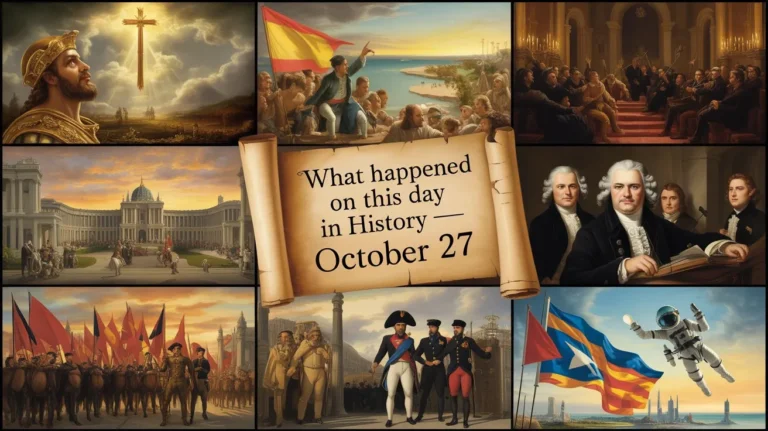
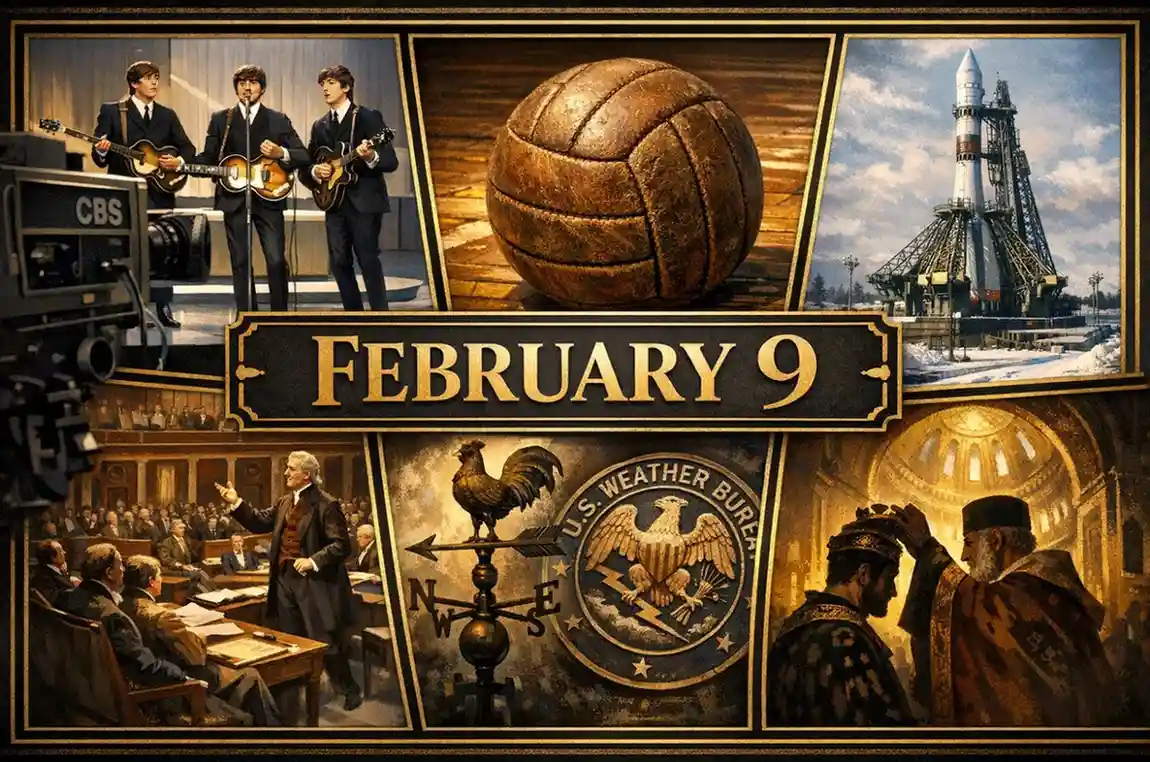
The movement of history is often dictated by moments of sudden realization and high-stakes decisions. When we look at what happened on this day in history February 9, we encounter a date that spans from the coronation of Byzantine co-emperors to the digital age’s political trials. It is a day where the sound of the “British Invasion” first saturated American airwaves and where the grim realities of warfare were met by the quiet return of lunar explorers.
Important Events That Happened On February 9 In History
474 – Zeno Crowned Co-Emperor
Zeno was elevated to the rank of co-emperor of the Eastern Roman Empire. He served alongside his young son, Leo II, beginning a reign characterized by complex religious disputes and significant shifts in the administrative structure of the Byzantine state.
1003 – Restoration of Boleslaus III
Boleslaus III was restored to authority in Bohemia. His return to power was made possible through the armed support of Bolesław I the Brave of Poland, demonstrating the interconnected and often militarized nature of medieval European leadership.
1098 – Battle of Antioch Victory
During the First Crusade, an army led by Bohemond of Taranto secured a major victory against the Seljuq emir Ridwan of Aleppo. This engagement occurred during the grueling Siege of Antioch and was vital in preventing a relief force from breaking the crusader lines.
1539 – First Race at Chester
The first recorded horse race took place at the Chester Racecourse, known as the Roodee. This event established Chester as the site of the oldest active racecourse in England, a tradition that continues to this day.
1555 – Martyrdom of John Hooper
John Hooper, the Bishop of Gloucester, was burned at the stake for his Protestant beliefs under the reign of Queen Mary I. He was one of the most prominent figures executed during the Marian Persecutions.
1621 – Election of Pope Gregory XV
Gregory XV became the Pope of the Catholic Church. He holds the distinction of being the last Pope to be elected by acclamation, a method where the cardinals unanimously proclaim a candidate without a formal ballot.
1654 – Capture of Fort Rocher
During the Anglo-Spanish War, English forces successfully completed the Capture of Fort Rocher on the island of Tortuga. The fort had been a strategic stronghold in the Caribbean, and its capture shifted the balance of power in the region.
1775 – Massachusetts Declared in Rebellion
The British Parliament officially declared the colony of Massachusetts to be in a state of rebellion. This declaration followed years of rising tensions and effectively authorized the British military to use force against the colonists.
1778 – Rhode Island Ratifies Articles
Rhode Island became the fourth state to ratify the Articles of Confederation. This was a critical step in the formation of the first federal government of the United States following the Declaration of Independence.
1822 – Haiti Attacks Dominican Republic
Forces from Haiti launched an attack on the newly established Dominican Republic on the eastern side of the island of Hispaniola. This invasion led to a 22-year period of Haitian occupation of the entire island.
1825 – House Elects John Quincy Adams
Following the deadlocked election of 1824, where no candidate won an electoral majority, the U.S. House of Representatives elected John Quincy Adams as the sixth President. This “contingent election” was famously denounced by opponent Andrew Jackson as a “corrupt bargain.”
1849 – New Roman Republic Declared
Revolutionaries in Rome declared the establishment of the Roman Republic, briefly ending the temporal power of the Pope. The republic sought to implement democratic reforms before it was eventually suppressed by French intervention.
1861 – Jefferson Davis Elected CSA President
In Montgomery, Alabama, the Provisional Confederate Congress elected Jefferson Davis as the Provisional President of the Confederate States of America. This move solidified the political structure of the seceding Southern states.
1870 – Founding of the U.S. Weather Bureau
President Ulysses S. Grant signed a joint resolution of Congress that established the U.S. Weather Bureau (now the National Weather Service). This agency was tasked with providing meteorological observations for the safety of shipping and commerce.
1889 – USDA Elevated to Cabinet Level
President Grover Cleveland signed a bill that elevated the United States Department of Agriculture (USDA) to a Cabinet-level agency. This move recognized the vital importance of agriculture to the American economy and policy.
1893 – Premiere of Falstaff
Giuseppe Verdi’s final opera, Falstaff, premiered at La Scala in Milan. The work was Verdi’s second comedy and served as a triumphant conclusion to the career of one of history’s greatest operatic composers.
1895 – Invention of Volleyball
William G. Morgan, a physical education director in Holyoke, Massachusetts, created a new indoor game called “Mintonette.” Designed as a less strenuous alternative to basketball, the game was soon renamed volleyball.
1900 – Davis Cup Established
The International Lawn Tennis Challenge, now known as the Davis Cup, was officially established. Created by Dwight F. Davis, it has grown into the premier international team event in men’s tennis.
1904 – Conclusion of the Battle of Port Arthur
The opening engagement of the Russo-Japanese War, the Battle of Port Arthur, concluded. The surprise Japanese naval attack significantly damaged the Russian Pacific Fleet and set the tone for the rest of the conflict.
1907 – The Mud March
The National Union of Women’s Suffrage Societies (NUWSS) organized the “Mud March” in London. It was the first large-scale public procession for women’s suffrage, named for the terrible weather conditions during the event.
1913 – The Great Meteor Procession
A rare group of meteors was visible across the eastern seaboard of the Americas. Astronomers later concluded that the source was a small, short-lived natural satellite of the Earth that had decayed from its orbit.
1920 – Svalbard Treaty Signed
International diplomacy formally recognized Norwegian sovereignty over the Arctic archipelago of Svalbard. The treaty designated the region as demilitarized and granted specific economic rights to all signatory nations.
1922 – Brazil Joins Berne Convention
Brazil became a member of the Berne Convention for the Protection of Literary and Artistic Works. This was a major step in the international recognition of copyright law within South America.
1929 – Assassination of Bazin
Members of the Việt Nam Quốc Dân Đảng (Vietnamese Nationalist Party) assassinated the French labor recruiter Bazin in Hanoi. The act prompted a massive crackdown on nationalist activists by French colonial authorities.
1932 – Finland Repeals Prohibition
Following a national referendum in which 70% of the population voted for repeal, Finland officially abolished its prohibition laws. The new legislation allowed for the legal sale and consumption of alcohol.
1934 – Formation of the Balkan Entente
Greece, Romania, Yugoslavia, and Turkey signed the Balkan Entente. The pact was a defensive alliance intended to maintain the geopolitical status quo in the region and deter Bulgarian and Italian territorial ambitions.
1941 – Bombing of Genoa Cathedral
During a British naval bombardment of Genoa, Italy, a bomb struck the Cathedral of San Lorenzo. Miraculously, the device failed to detonate, sparing the historic structure and the people sheltered inside.
1942 – Reinstatement of “War Time”
The United States reinstated year-round Daylight Saving Time, referred to as “War Time,” as a measure to conserve energy resources for the war effort. The measure remained in place until the end of World War II.
1943 – Guadalcanal Declared Secure
Allied authorities officially declared Guadalcanal secure after Imperial Japanese forces evacuated the island. This ended one of the most significant and grueling campaigns of the Pacific War with a decisive Allied victory.
1945 – HMS Venturer Sinks U-864
In a rare and historic instance of submarine-to-submarine combat while both were submerged, the British HMS Venturer sank the German U-864 off the coast of Fedje, Norway.
1945 – Attack at Førdefjorden
A force of Allied aircraft launched an unsuccessful attack against a German destroyer in Førdefjorden, Norway. The engagement resulted in heavy losses for the Allied air crews involved.
1950 – McCarthy’s Anti-Communist Accusations
U.S. Senator Joseph McCarthy delivered a speech in Wheeling, West Virginia, claiming he had a list of 205 Communists working within the Department of State. This sparked the “Second Red Scare” and the era of McCarthyism.
1951 – Geochang Massacre Begins
During the Korean War, a battalion of the South Korean Army’s 11th Division began a two-day massacre in Geochang. They killed 719 unarmed citizens, including women and children, on suspicion of supporting communist guerrillas.
1959 – R-7 Semyorka Becomes Operational
The Soviet Union’s R-7 Semyorka became the world’s first operational intercontinental ballistic missile (ICBM). Stationed at Plesetsk, it represented a major escalation in the nuclear arms race of the Cold War.
1961 – The Beatles Play the Cavern Club
After returning to Liverpool from their residency in Hamburg, the Beatles performed at the Cavern Club for the first time under their now-famous name during a lunchtime session.
1964 – The Beatles on The Ed Sullivan Show
The Beatles made their historic first appearance on The Ed Sullivan Show. An estimated 73 million viewers tuned in, marking a cultural milestone that launched the British Invasion of the American music scene.
1965 – First Combat Troops in Vietnam
The United States Marine Corps sent a MIM-23 Hawk missile battalion to South Vietnam. These were the first American troops to enter the country without an official advisory or training mission, signaling a major escalation of the war.
1971 – Sylmar Earthquake
A magnitude 6.5–6.7 earthquake struck the Greater Los Angeles Area. Known as the Sylmar earthquake, it caused extreme damage, killing 64 people and injuring over 2,000, leading to significant changes in seismic safety building codes.
1971 – Satchel Paige Voted into Hall of Fame
Legendary pitcher Satchel Paige became the first player from the Negro Leagues to be voted into the National Baseball Hall of Fame. This recognition was a pivotal moment in acknowledging the greatness of players barred from the Major Leagues due to segregation.
1971 – Apollo 14 Returns to Earth
The Apollo 14 mission, featuring Alan Shepard and Edgar Mitchell, successfully splashed down in the Pacific Ocean. It was the third human landing on the Moon and included the famous collection of lunar samples.
1975 – Soyuz 17 Splashdown
The Soviet Soyuz 17 spacecraft returned to Earth after a successful 29-day mission to the Salyut 4 space station. The mission set a new Soviet record for endurance in space at the time.
1976 – Aeroflot Flight 3739 Crash
A Tupolev Tu-104 crashed during takeoff from Irkutsk Airport in the Soviet Union. The disaster resulted in the deaths of 24 people on board.
1978 – Unveiling of the SPV-2000
The Budd Company unveiled its first SPV-2000 self-propelled railcar in Philadelphia. The vehicle was designed to provide a more efficient and modern option for commuter and regional rail services.
1982 – Japan Air Lines Flight 350 Crash
A JAL McDonnell Douglas DC-8 crashed near Haneda Airport. The captain, suffering from a mental health crisis, intentionally engaged the engine’s thrust reversers during landing. Twenty-four people died in the incident.
1886 – Last Appearance of Halley’s Comet
Halley’s Comet made its most recent appearance in the inner Solar System. This was the first time the comet was observed by spacecraft, providing unprecedented data on its composition and structure.
1987 – Unrest in Palestine
Civil unrest broke out across Palestine, marking the start of a period of significant protests and clashes. The events were a precursor to the first Intifada, which began later that year.
1991 – Lithuania Votes for Independence
In a national referendum, voters in Lithuania overwhelmingly chose independence from the Soviet Union. This was a major step in the collapse of Soviet control over the Baltic states.
1996 – Canary Wharf Bombing
The Provisional IRA ended its 18-month ceasefire by detonating a massive bomb at Canary Wharf in London. The blast killed two people and caused over £100 million in damage, marking a return to active conflict.
1996 – Discovery of Copernicium
A team of scientists led by Sigurd Hofmann at the GSI Helmholtz Centre for Heavy Ion Research discovered the element Copernicium (element 112). It was later named in honor of the astronomer Nicolaus Copernicus.
2001 – Ehime Maru and USS Greeneville Collision
The American submarine USS Greeneville surfaced directly underneath the Japanese training ship Ehime Maru near Hawaii. Nine people on the Japanese ship, including four students, were killed in the disaster.
2016 – Bad Aibling Train Collision
Two passenger trains collided on a single-track line in Bavaria, Germany. The accident, caused by human error on the part of a dispatcher, killed 12 people and injured 85 others.
2018 – Pyeongchang Winter Olympics Begin
The opening ceremony for the 2018 Winter Olympics took place in Pyeongchang, South Korea. The games were notable for the participation of athletes from both North and South Korea under a unified flag.
2020 – Salvadoran Political Crisis
President Nayib Bukele sent armed soldiers into the Legislative Assembly to demand the approval of a security loan. The move caused a brief but intense political crisis and drew international condemnation.
2021 – Second Impeachment of Donald Trump
The second impeachment trial of Donald Trump began in the U.S. Senate. He was charged with incitement of insurrection following the January 6 attack on the Capitol, making him the only president to be impeached twice.
2025 – Baltic Power Synchronization
The Baltic states—Estonia, Latvia, and Lithuania—successfully synchronized their power grids with the Continental Europe Synchronous Area (CESA). This achievement marked their final disconnection from the Russian-controlled IPS/UPS system, ensuring energy independence.
Famous People Born On February 9
| Name | Short Description | Dates |
|---|---|---|
| Carmen Miranda | Portuguese-born singer & actress | February 9, 1909 – August 5, 1955 |
| Brian Greene | American physicist | February 9, 1963 – |
| John Walker Lindh | Taliban fighter | February 9, 1981 – |
| Georgina Hope Rinehart | Australian business executive | February 9, 1954 – |
| Ronald Colman | British-American actor | February 9, 1891 – May 19, 1958 |
| Glenn McGrath | Australian cricketer | February 9, 1970 – |
| Brendan Behan | Irish author | February 9, 1923 – March 20, 1964 |
| Dean Rusk | U.S. Secretary of State | February 9, 1909 – December 20, 1994 |
| Natsume Sōseki | Japanese novelist | February 9, 1867 – December 9, 1916 |
| Thomas Bernhard | Austrian writer | February 9, 1931 – February 12, 1989 |
| Ernest Tubb | American musician | February 9, 1914 – September 6, 1984 |
| Samuel J. Tilden | American politician | February 9, 1814 – August 4, 1886 |
| Rinus Michels | Dutch football coach | February 9, 1928 – March 3, 2005 |
| Vsevolod Meyerhold | Russian theatre director | February 9, 1874 – February 2, 1940 |
| Wilhelm Maybach | German engineer | February 9, 1846 – December 29, 1929 |
| Robert Morris | American sculptor | February 9, 1931 – November 28, 2018 |
| Edward Henry Carson | Anglo-Irish politician | February 9, 1854 – October 22, 1935 |
| John A. Logan | U.S. general & politician | February 9, 1826 – December 26, 1886 |
| Irina Slutskaya | Russian figure skater | February 9, 1979 – |
| Bill Veeck | American baseball executive | February 9, 1914 – January 2, 1986 |
| Sir Charles Edward Kingsford Smith | Australian pilot | February 9, 1897 – November 8, 1935 |
| Kamehameha IV | King of Hawaii | February 9, 1834 – November 30, 1863 |
| Jacobus Johannes Pieter Oud | Dutch architect | February 9, 1890 – April 5, 1963 |
| Walter Page | American musician | February 9, 1900 – December 20, 1957 |
| Erich Dagobert von Drygalski | German geographer | February 9, 1865 – January 10, 1949 |
| Pietro Nenni | Italian journalist & politician | February 9, 1891 – January 1, 1980 |
| William Dwight Whitney | American linguist | February 9, 1827 – June 7, 1894 |
| Robert Hope-Jones | British-American organ maker | February 9, 1859 – September 13, 1914 |
| Ludwig Forrer | Swiss statesman | February 9, 1845 – September 28, 1921 |
| Frans Mikael Franzén | Finnish-Swedish poet | February 9, 1772 – August 14, 1847 |
| Gasparo Angiolini | Italian choreographer & composer | February 9, 1731 – February 6, 1803 |
| Fritz A. Breuhaus | German architect | February 9, 1883 – December 2, 1960 |
| A.V. Williams Jackson | American scholar | February 9, 1862 – August 8, 1937 |
| Giovambattista Andreini | Italian actor & author | February 9, 1579 – June 7, 1654 |
| Anthony Hope | English author | February 9, 1863 – July 8, 1933 |
| H.S.M. Coxeter | British mathematician | February 9, 1907 – March 31, 2003 |
| James Stephens | Irish writer | February 9, 1880 – December 26, 1950 |
Famous People Died On February 9
| Name | Short Description | Dates |
|---|---|---|
| Herbert A. Simon | American social scientist | June 15, 1916 – February 9, 2001 |
| Bill Haley | American musician | July 6, 1925 – February 9, 1981 |
| Tom Robbins | American author | July 22, 1932 – February 9, 2025 |
| Winfield Scott Hancock | U.S. military officer | February 14, 1824 – February 9, 1886 |
| Sophie Tucker | American singer | January 13, 1884 – February 9, 1966 |
| Adolf von Menzel | German painter | December 8, 1815 – February 9, 1905 |
| Frederick III | King of Denmark & Norway | March 18, 1609 – February 9, 1670 |
| Agnès Sorel | French courtesan | c.1422 – February 9, 1450 |
| Paul Laurence Dunbar | American writer | June 27, 1872 – February 9, 1906 |
| J. William Fulbright | U.S. senator | April 9, 1905 – February 9, 1995 |
| Ernst von Dohnányi | Hungarian composer | July 27, 1877 – February 9, 1960 |
| Nevil Maskelyne | British astronomer | October 6, 1732 – February 9, 1811 |
| Alexandre Benois | Russian artist | May 4, 1870 – February 9, 1960 |
| Howard Martin Temin | American virologist | December 10, 1934 – February 9, 1994 |
| Peter Lalor | Australian politician | February 5, 1827 – February 9, 1889 |
| T. Balasaraswati | Indian dancer & singer | May 13, 1918 – February 9, 1984 |
| Norman Douglas | British author | December 8, 1868 – February 9, 1952 |
| Fred Harvey | American restaurateur | 1835 – February 9, 1901 |
| M.C. Chagla | Indian statesman | September 30, 1900 – February 9, 1981 |
| Sergey Vladimirovich Ilyushin | Soviet aircraft designer | March 30, 1894 – February 9, 1977 |
| Maxime Du Camp | French writer & photographer | February 8, 1822 – February 9, 1894 |
| Sir Charles Gavan Duffy | Irish politician | April 12, 1816 – February 9, 1903 |
| Álvaro de Bazán, Marqués de Santa Cruz | Spanish naval commander | December 12, 1526 – February 9, 1588 |
| Johan Barthold Jongkind | Dutch artist | June 3, 1819 – February 9, 1891 |
| Louis-Nicolas Ménard | French author | October 19, 1822 – February 9, 1901 |
| Betty Davis | American funk singer | July 26, 1944 – February 9, 2022 |
| Chick Corea | American musician | June 12, 1941 – February 9, 2021 |
| Anne Ayres | American nun | January 3, 1816 – February 9, 1896 |
| James Melville Gilliss | American astronomer | September 6, 1811 – February 9, 1865 |
| Blessed Anna Katharina Emmerick | German nun | September 8, 1774 – February 9, 1824 |
| Douglas Freshfield | British explorer | April 27, 1845 – February 9, 1934 |
| William E. Dodge | American industrialist | September 4, 1805 – February 9, 1883 |
| Jacques Bainville | French historian | February 9, 1879 – February 9, 1936 |
| Kurt Herbert Adler | Austrian-American conductor | April 2, 1905 – February 9, 1988 |
| Danshaku Katō Hiroyuki | Japanese political theorist | August 5, 1836 – February 9, 1916 |
| Christian, count von Haugwitz | Prussian minister & diplomat | June 11, 1752 – February 9, 1832 |
| William Lescaze | American architect | March 27, 1896 – February 9, 1969 |
Observances & Institutional Dates
- Feast of Alto of Altomünster: Honoring the 8th-century Irish missionary and abbot.
- Blessed Anne Catherine Emmerich: Commemorating the German mystic and nun.
- St. Ansbert of Rouen: Honoring the 7th-century bishop and chancellor.
Frequently Asked Questions
- What happened on The Ed Sullivan Show on February 9, 1964?
- The Beatles made their American television debut to a record-breaking 73 million viewers.
- Who invented volleyball and when?
- William G. Morgan created the game, originally called Mintonette, on this day in 1895.
- Why did the U.S. House of Representatives elect John Quincy Adams?
- Because no candidate won a majority of the electoral votes in the 1824 election.
- What was the Sylmar earthquake?
- A massive magnitude 6.5-6.7 quake that hit Los Angeles in 1971, causing extreme damage.