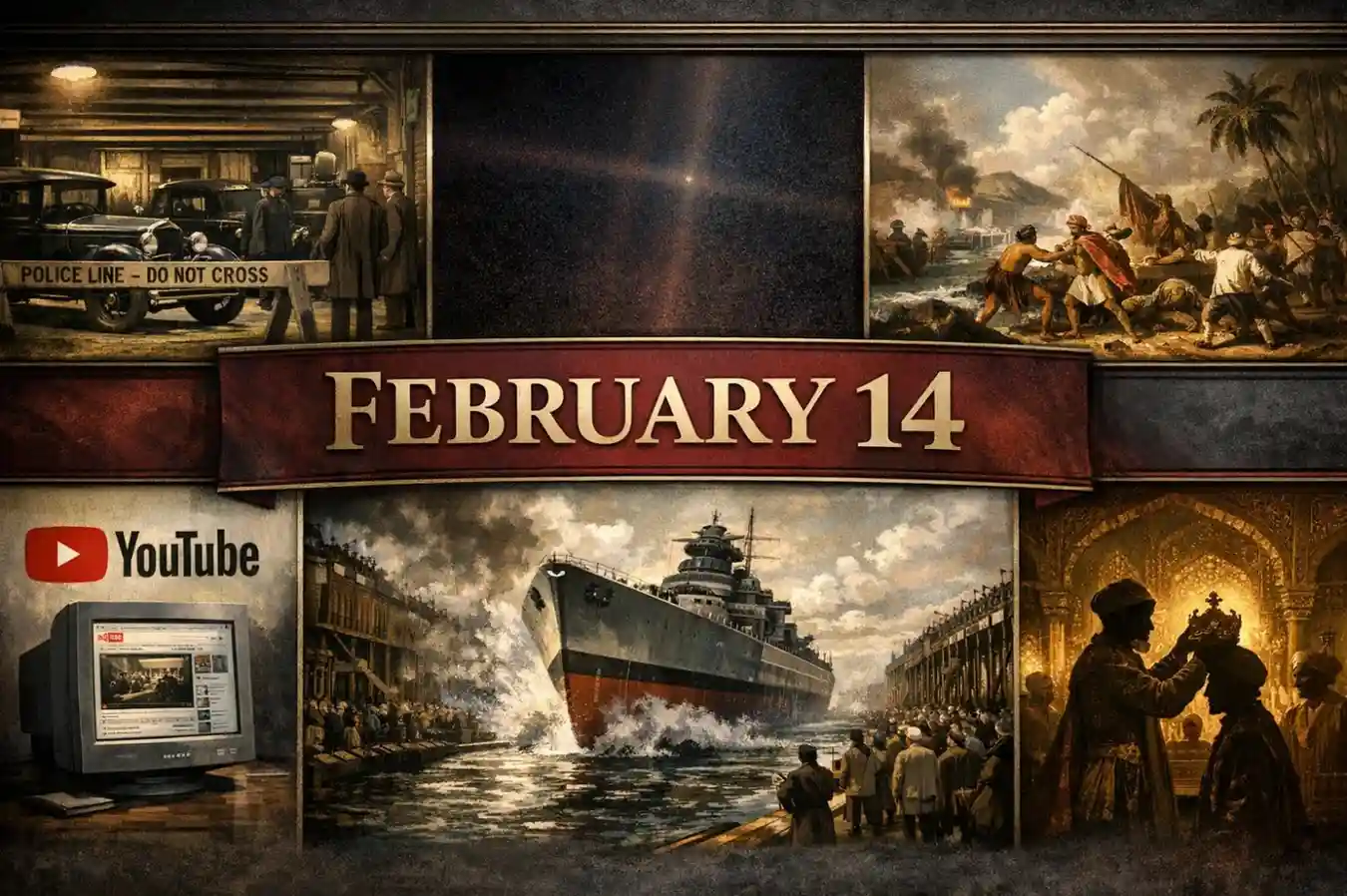
While many know this date for romantic gestures, history tells a much more turbulent and diverse story. When we look at what happened on this day in history February 14, we find ourselves standing at the crossroads of brutal massacres, the birth of empires, and the launch of technologies that redefined how we see the world. It is the day James Cook’s voyages ended in violence on a Hawaiian beach, yet also the day a class of students launched YouTube, forever changing the digital landscape.
From the chilling “Pale Blue Dot” photograph taken by a lonely spacecraft to the tragic school shootings that sparked global movements, this date serves as a powerful reminder of our capacity for both profound cruelty and awe-inspiring curiosity.
Important Events That Happened On February 14 In History
748 – Consolidation of the Abbasid Revolt
Hashimi rebels under Abu Muslim Khorasani successfully took Merv, the capital of the Umayyad province of Khorasan. This victory marked a critical turning point in the Abbasid Revolution, leading to the eventually overthrow of the Umayyad Caliphate.
842 – The Oaths of Strasbourg
Charles the Bald and Louis the German swore the Oaths of Strasbourg. Notably, the oaths were recorded in Early Romance (the precursor to French) and Old High German, making them some of the earliest written evidence of these languages.
1014 – Crowning of Henry of Bavaria
Pope Benedict VIII crowned Henry of Bavaria, King of Germany and Italy, as the Holy Roman Emperor. His reign was characterized by efforts to reform the church and stabilize the imperial borders.
1130 – 1130 Papal Election Crisis
A deeply troubled election within the Catholic Church exposed a massive rift within the College of Cardinals, leading to the simultaneous election of Pope Innocent II and Antipope Anacletus II.
1349 – Strasbourg Massacre
In a horrific display of antisemitism fueled by Black Death hysteria, several thousand Jews were burned to death by mobs in Strasbourg. Those who survived the fire were forcibly removed from the city.
1530 – Overthrow of the Tarascan State
Spanish conquistadores led by Nuño de Guzmán executed Tangaxuan II, the last independent monarch of the Tarascan state. This act solidified Spanish control over central Mexico.
1556 – Defrocking of Thomas Cranmer
Archbishop of Canterbury Thomas Cranmer was publicly defrocked at Christ Church Cathedral. Having been declared a heretic, he was eventually burned at the stake, becoming a primary martyr of the English Reformation.
1556 – Coronation of Akbar the Great
Akbar was crowned as the ruler of the Mughal Empire at the age of thirteen. He would go on to become one of the most powerful and influential emperors in Indian history, known for his religious tolerance and administrative reforms.
1613 – Wedding of the “Winter Queen.”
Princess Elizabeth, daughter of James I, married Frederick V of the Palatinate at Whitehall Palace. Their union had significant political ramifications for the Protestant cause in Europe.
1655 – Mapuche Uprising in Chile
The Mapuches launched a series of coordinated attacks against Spanish settlers in Chile. This marked the beginning of a major uprising against colonial labor practices and territorial expansion.
1778 – First Foreign Salute to the U.S. Flag
The American flag received its first formal recognition by a foreign naval vessel. French Admiral Toussaint-Guillaume Picquet de la Motte rendered a nine-gun salute to the USS Ranger, commanded by John Paul Jones.
1779 – Battle of Kettle Creek
During the American Revolutionary War, Patriot forces defeated a Loyalist militia in Georgia. The victory provided a much-needed morale boost and disrupted British efforts to recruit Loyalists in the southern colonies.
1779 – Death of Captain James Cook
Famed explorer Captain James Cook was killed during a skirmish with Native Hawaiians at Kealakekua Bay. The conflict arose following an attempt by Cook to kidnap the island’s high chief to recover a stolen boat.
1797 – Battle of Cape St. Vincent
British naval commanders John Jervis and Horatio Nelson led the Royal Navy to a significant victory over a larger Spanish fleet near Gibraltar, preventing a French and Spanish naval junction.
1804 – First Serbian Uprising
Karađorđe led the First Serbian Uprising against the Ottoman Empire. This started a decade-long struggle for Serbian independence and the rebirth of the Serbian state.
1831 – Battle of Debre Abbay
Ras Marye of Yejju marched into Tigray and defeated Dejazmach Sabagadis. The death of Sabagadis in the battle led to a period of instability in Northern Ethiopia.
1835 – Quorum of the Twelve Apostles Formed
In Kirtland, Ohio, the original Quorum of the Twelve Apostles of the Latter Day Saint movement was organized, establishing a key leadership structure for the growing church.
1849 – First Photograph of a Sitting President
In New York City, James Knox Polk became the first serving U.S. President to have his photograph taken. The daguerreotype was captured by Matthew Brady.
1852 – Opening of Great Ormond St Hospital
The Hospital for Sick Children was founded in London by Dr. Charles West. it was the first hospital in England to provide in-patient beds specifically dedicated to children.
1855 – Texas Linked by Telegraph
The state of Texas was officially linked to the rest of the United States via telegraph with the completion of the line between New Orleans and Marshall, Texas.
1859 – Oregon Becomes a State
Oregon was admitted to the Union as the 33rd U.S. state. It entered as a “free state,” though its original constitution contained exclusionary laws regarding Black residents.
1876 – Telephone Patent Race
Both Alexander Graham Bell and Elisha Gray applied for patents for the telephone on the same day. The resulting legal battle eventually awarded the rights to Bell.
1879 – Start of the War of the Pacific
The Chilean Army occupied the Bolivian port city of Antofagasta. This action triggered the War of the Pacific, a conflict between Chile and the allied forces of Bolivia and Peru over mineral rights.
1899 – Voting Machines Approved
The U.S. Congress approved the use of voting machines for federal elections, aiming to modernize the electoral process and reduce fraud.
1900 – Battle of the Tugela Heights
The British Army began a series of military operations during the Second Boer War to lift the Siege of Ladysmith in South Africa.
1903 – Department of Commerce and Labor Established
U.S. President Theodore Roosevelt signed the act creating the Department of Commerce and Labor to monitor the activities of large corporations and labor unions.
1912 – Arizona Statehood
Arizona was admitted to the Union as the 48th state. It was the last of the contiguous (connected) United States to be admitted.
1912 – First Diesel Submarines
The U.S. Navy commissioned the E-1, its first class of diesel-powered submarines, marking a significant leap in underwater endurance and safety.
1918 – Russia Adopts the Gregorian Calendar
Soviet Russia officially transitioned from the Julian calendar to the Gregorian calendar. Because of the switch, the day following January 31 became February 14.
1919 – Start of the Polish–Soviet War
The Polish–Soviet War began as forces from the Second Polish Republic clashed with the Soviet Russian Red Army over territorial control in Eastern Europe.
1920 – League of Women Voters Founded
Following the push for the 19th Amendment, the League of Women Voters was established in Chicago to help women exercise their newly won right to vote.
1924 – IBM is Born
The Computing-Tabulating-Recording Company officially changed its name to the International Business Machines Corporation (IBM), signaling its global ambitions.
1929 – Saint Valentine’s Day Massacre
In one of the most notorious gangland killings in history, seven members and associates of George “Bugs” Moran’s gang were gunned down in a Chicago garage by rivals linked to Al Capone.
1939 – Launch of the Bismarck
The German battleship Bismarck, one of the largest and most powerful warships ever built by Germany, was launched in Hamburg.
1942 – Battle of Pasir Panjang
In a desperate defense of Singapore, the Malay Regiment fought a heroic but losing battle against Japanese forces at Pasir Panjang. The hill’s fall led directly to the British surrender.
1943 – Liberation of Rostov-on-Don
Soviet forces liberated the city of Rostov-on-Don from German occupation, marking a significant victory on the Eastern Front.
1943 – Fifth Panzer Army Counter-attack
In Tunisia, German General Hans-Jürgen von Arnim launched a massive counter-offensive against Allied positions, leading to the Battle of Sid Bou Zid.
1944 – Submarine Action in Malacca Strait
A Royal Navy submarine, the HMS Tally-Ho, successfully sank the German-controlled Italian submarine UIT-23 in the Strait of Malacca.
1945 – Bombing of Dresden Begins
The British RAF and U.S. Army Air Forces began a massive fire-bombing campaign against the German city of Dresden. The resulting firestorm killed tens of thousands of civilians and destroyed the historic city center.
1945 – Accidental Bombing of Prague
Due to a navigational error in bad weather, a squadron of American B-17 bombers mistakenly dropped their payloads on Prague instead of Dresden, resulting in hundreds of civilian deaths.
1945 – Liberation of Mostar
Yugoslav Partisans liberated the city of Mostar from Nazi German and Croatian Ustaše forces.
1945 – Roosevelt and King Ibn Saud Meet
President Franklin D. Roosevelt met King Abdulaziz of Saudi Arabia aboard the USS Quincy. This meeting established the modern diplomatic and energy partnership between the two nations.
1946 – Nationalization of the Bank of England
The Bank of England was formally nationalized, moving it from private ownership to a public institution under the control of the UK government.
1947 – Abolition of Noble Ranks in Hungary
A new law came into force in Hungary that officially abolished all noble ranks, titles, and related styles of address.
1949 – First Session of the Knesset
The Knesset, the parliament of the newly established State of Israel, convened for the first time in Jerusalem.
1949 – Start of the Asbestos Strike
A major strike began in Quebec’s asbestos mines. The conflict became a pivotal moment in Canadian labor history and is seen as the start of the “Quiet Revolution.”
1954 – Siege of Đắk Đoa
During the First Indochina War, a small French garrison at Đắk Đoa was overrun by Viet Minh forces after a week-long siege.
1961 – Synthesis of Lawrencium
Scientists at the University of California, Berkeley, successfully synthesized element 103. It was named Lawrencium in honor of cyclotron inventor Ernest Lawrence.
1979 – Kidnapping of Adolph Dubs
In Kabul, militants kidnapped the American ambassador to Afghanistan, Adolph Dubs. He was killed during a botched rescue attempt by Afghan police, leading to a breakdown in U.S.-Afghan relations.
1983 – Collapse of United American Bank
The United American Bank of Knoxville collapsed in one of the largest bank failures in U.S. history at the time. Its president, Jake Butcher, was later convicted of massive fraud.
1989 – Bhopal Disaster Settlement
Union Carbide agreed to pay $470 million to the Indian government in compensation for the 1984 gas leak in Bhopal that killed thousands and injured hundreds of thousands.
1989 – Fatwa Against Salman Rushdie
Ayatollah Ruhollah Khomeini of Iran issued a fatwa calling for the death of Salman Rushdie, author of The Satanic Verses, claiming the book was blasphemous.
1990 – Indian Airlines Flight 605 Crash
An Airbus A320 crashed during its final approach to Bangalore, India, resulting in 92 fatalities.
1990 – The Pale Blue Dot
At the request of Carl Sagan, the Voyager 1 spacecraft turned its camera back toward Earth one last time. From 6 billion kilometers away, it captured a photograph showing Earth as a tiny, fragile speck of light.
1998 – Yaoundé Train Explosion
A collision between an oil tanker and a freight train in Cameroon led to a massive fuel spill. When locals attempted to scavenge the oil, an explosion occurred, killing 120 people.
2000 – First Asteroid Orbit
The NEAR Shoemaker spacecraft successfully entered orbit around the asteroid 433 Eros. It was the first time any human-made object had orbited an asteroid.
2003 – Hans Blix Report on Iraq
UNMOVIC Chairman Hans Blix reported to the UN Security Council that inspectors had found no evidence of weapons of mass destruction in Iraq, contradicting U.S. intelligence claims used to justify the impending invasion.
2004 – Transvaal Water Park Collapse
The glass roof of the Transvaal water park in Moscow collapsed under the weight of snow, killing 28 people and injuring nearly 200 others.
2005 – Assassination of Rafic Hariri
A massive bomb blast in Beirut killed former Lebanese Prime Minister Rafic Hariri and 22 others. The assassination triggered the Cedar Revolution and the withdrawal of Syrian troops from Lebanon.
2005 – Philippine Bombings
A series of coordinated bombings by militants linked to al-Qaeda struck three cities in the Philippines, killing seven and wounding over 150.
2005 – Launch of YouTube
Three former PayPal employees—Chad Hurley, Steve Chen, and Jawed Karim—activated the domain name “YouTube.com,” starting the journey toward becoming the world’s most popular video-sharing platform.
2008 – Northern Illinois University Shooting
A gunman opened fire in a geology lecture hall at NIU, killing five students before taking his own life.
2011 – Bahraini Day of Rage
As part of the wider Arab Spring, protesters in Bahrain held a “Day of Rage” to demand political reform and social justice, sparking a period of significant civil unrest.
2018 – Resignation of Jacob Zuma
Facing a vote of no confidence and pressure from his own party, Jacob Zuma resigned as the President of South Africa.
2018 – Parkland School Shooting
A former student opened fire at Marjory Stoneman Douglas High School in Florida. Seventeen people were killed in one of the deadliest school shootings in American history.
2019 – Pulwama Attack
A suicide bomber attacked a convoy of Indian security personnel in Jammu and Kashmir. The blast killed 40 members of the Central Reserve Police Force, leading to a major escalation in tensions with Pakistan.
2020 – Village Attack in Cameroon
Armed men attacked the village of Ngarbuh in Northwest Cameroon, killing at least 22 people, including many children.
You can read here the February 13 Facts
Famous People Born On February 14
| Name | Role / Description | Birth – Death |
|---|---|---|
| Sushma Swaraj | Indian politician | 14 February 1952 – 6 August 2019 |
| Hans Adam II | Prince of Liechtenstein | 14 February 1945 – |
| Leon Battista Alberti | Italian Renaissance architect | 14 February 1404 – 25 April 1472 |
| Renée Fleming | American soprano | 14 February 1959 – |
| Eugene F. Fama | American economist, Nobel laureate | 14 February 1939 – |
| Christopher Latham Sholes | Inventor of the typewriter | 14 February 1819 – 17 February 1890 |
| Winfield Scott Hancock | Union general, Civil War | 14 February 1824 – 9 February 1886 |
| Max Horkheimer | German philosopher | 14 February 1895 – 7 July 1973 |
| Fritz Zwicky | Swiss astronomer | 14 February 1898 – 8 February 1974 |
| Donna Shalala | American public official | 14 February 1941 – |
| Victor Moreau | French Revolutionary general | 14 February 1763 – 2 September 1813 |
| Frank Harris | Irish-American journalist | 14 February 1856 – 26 August 1931 |
| Israel Zangwill | British author & Zionist | 14 February 1864 – 1 August 1926 |
| Richard Allen | Founder of AME Church | 14 February 1760 – 26 March 1831 |
| Domingo F. Sarmiento | President of Argentina | 14 February 1811 – 11 September 1888 |
| Mel Allen | American sportscaster | 14 February 1913 – 16 June 1996 |
| Francesco Cavalli | Italian Baroque composer | 14 February 1602 – 14 January 1676 |
| Anna Howard Shaw | American suffragist | 14 February 1847 – 2 July 1919 |
| C.T.R. Wilson | British physicist, Nobel laureate | 14 February 1869 – 15 November 1959 |
| Vladimir Drinfeld | Mathematician, Fields Medalist | 14 February 1954 – |
| Phạm Tuân | First Vietnamese astronaut | 14 February 1947 – |
| Valentín Gómez Farías | President of Mexico | 14 February 1781 – 5 July 1858 |
| Mickey Wright | American golfer | 14 February 1935 – 17 February 2020 |
| Herbert A. Hauptman | Chemist, Nobel laureate | 14 February 1917 – 23 October 2011 |
| Frederick III | Elector Palatine | 14 February 1515 – 26 October 1576 |
| Okakura Kakuzō | Japanese art critic | 14 February 1863 – 2 September 1913 |
| Aleksandr Dargomyzhsky | Russian composer | 14 February 1813 – 17 January 1869 |
| Sir Goldsworthy Gurney | British inventor | 14 February 1793 – 28 February 1875 |
| Joseph Thomson | Scottish explorer | 14 February 1858 – 2 August 1895 |
| Danai Gurira | Zimbabwean-American actress | 14 February 1978 – |
Famous People Died On February 14
| Name | Role / Description | Birth – Death |
|---|---|---|
| David Hilbert | German mathematician | 23 January 1862 – 14 February 1943 |
| P.G. Wodehouse | British comic novelist | 15 October 1881 – 14 February 1975 |
| Sir William Blackstone | English jurist | 10 July 1723 – 14 February 1780 |
| Rafic al-Hariri | Prime Minister of Lebanon | 1 November 1944 – 14 February 2005 |
| Sir Julian Huxley | British biologist | 22 June 1887 – 14 February 1975 |
| John Dickinson | American statesman | 8 November 1732 – 14 February 1808 |
| Dick Francis | British author | 31 October 1920 – 14 February 2010 |
| Vicente Guerrero | Mexican independence leader | 10 August 1782 – 14 February 1831 |
| Morgan Tsvangirai | Prime Minister of Zimbabwe | 10 March 1952 – 14 February 2018 |
| U Nu | Prime Minister of Myanmar | 25 May 1907 – 14 February 1995 |
| Frederick Loewe | American composer | 10 June 1901 – 14 February 1988 |
| Karl Jansky | Radio astronomy pioneer | 22 October 1905 – 14 February 1950 |
| Dmitry Kabalevsky | Russian composer | 30 December 1904 – 14 February 1987 |
| Philip Levine | American poet | 10 January 1928 – 14 February 2015 |
| Charles-Ferdinand de Berry | French prince | 24 January 1778 – 14 February 1820 |
| Pietro Belluschi | Italian-American architect | 18 August 1899 – 14 February 1994 |
| Victor Gruen | Architect, shopping mall pioneer | 18 July 1903 – 14 February 1980 |
| Henry Maudslay | British engineer | 22 August 1771 – 14 February 1831 |
| Il Sodoma | Italian Renaissance painter | 1477 – 14 February 1549 |
| Baby Dodds | Jazz drummer | 24 December 1898 – 14 February 1959 |
| Gioseffo Zarlino | Italian music theorist | 22 March 1517 – 14 February 1590 |
| Myra Bradwell | American lawyer | 12 February 1831 – 14 February 1894 |
| Carl Erich Correns | German geneticist | 19 September 1864 – 14 February 1933 |
| Abraham Bosse | French engraver | 1604 – 14 February 1676 |
| William Dyce | Scottish painter | 19 September 1806 – 14 February 1864 |
| John Hadley | British mathematician | 16 April 1682 – 14 February 1744 |
| Walter H. Zinn | Nuclear physicist | 10 December 1906 – 14 February 2000 |
| Carlos Menem | President of Argentina | 2 July 1930 – 14 February 2021 |
| Andrei Chikatilo | Soviet serial killer | 16 October 1936 – 14 February 1994 |
| Jean Dauberval | French choreographer | 19 August 1742 – 14 February 1806 |
Observances & Institutional Dates
- Oregon Statehood Day: Celebrating Oregon’s admission to the Union in 1859.
- Arizona Statehood Day: Commemorating Arizona becoming the 48th state in 1912.
- Presentation of Jesus at the Temple: An important feast day in the Armenian Apostolic Church.
- Parents’ Worship Day: A modern observance in some parts of India focusing on family respect and values.
Frequently Asked Questions
- How did Captain James Cook die?
- He was killed in a skirmish with Native Hawaiians in 1779 over a stolen boat and an attempted kidnapping of a chief.
- What was the St. Valentine’s Day Massacre?
- A 1929 gangland hit in Chicago where Al Capone’s rivals were gunned down in a garage.
- What is the “Pale Blue Dot”?
- A famous 1990 photo of Earth taken by Voyager 1 from 6 billion km away, showing our planet as a tiny speck.
- When was YouTube created?
- The domain was activated and the company was founded on February 14, 2005.