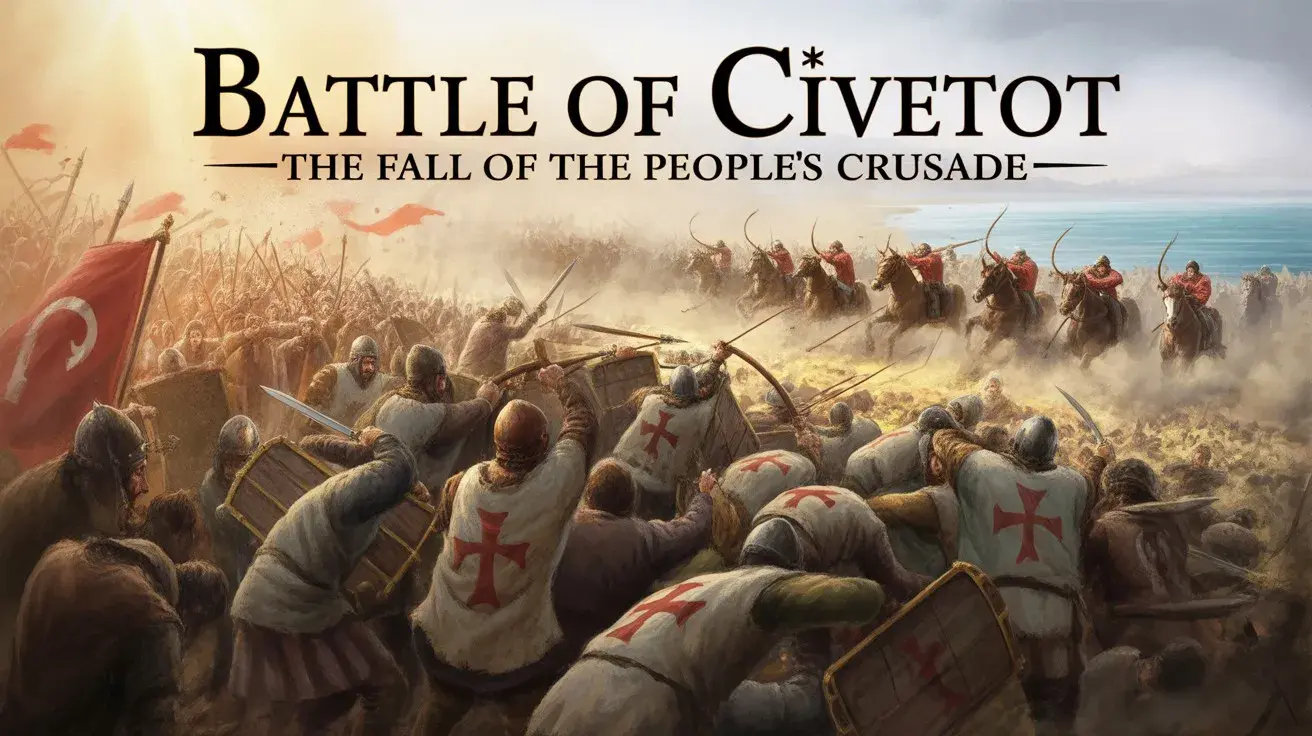
To truly grasp the magnitude of the disaster at Civetot, we must first step back into the fervent atmosphere of 11th-century Europe. The Battle of Civetot ended the ill-fated People’s Crusade on 21 October 1096, turning a tide of popular fervor into a cautionary tale about the limits of zeal without leadership. It is the story of the People’s Crusade, a movement born of pure zeal, and its bloody, abrupt end on a forgotten shore in Anatolia.
Of all the dramatic chapters of the Crusades—the sieges of mighty cities, the clashing of knightly charges, the intricate politics of kings and emperors—the Battle of Civetot is a story often relegated to the footnotes. It lacks the cinematic glory of Jerusalem’s capture or the legendary status of Richard the Lionheart.
Quick snapshot
- Date: 21 October 1096.
- Place: Civetot (near modern Altınova / Hersek, Yalova province, Turkey).
- Combatants: Seljuk Turks of Anatolia vs. the People’s Crusade (largely peasants and poorly-armed volunteers).
- Commanders: Kilij Arslan I (Seljuk sultan) vs. leaders of the People’s Crusade such as Walter Sans-Avoir and Geoffrey Burel (Peter the Hermit had led the movement but was not present at the final rout).
- Result: Decisive Seljuk victory; the People’s Crusade was effectively destroyed, with only a few thousand survivors escaping.
The Spark: Understanding the People’s Crusade
In 1095, Pope Urban II, at the Council of Clermont, issued a call to arms that would echo through history: reclaim the Holy Land from Muslim rule. This appeal was strategically aimed at the warrior class—the knights and nobles of Christendom.
However, the message was hijacked by something far more volatile and unpredictable: popular passion. Charismatic preachers, most notably the ascetic Peter the Hermit, took this call and amplified it for the masses. Peter, riding a donkey and dressed in simple robes, preached a message of divine urgency and guaranteed salvation to anyone who would take up the cross.
His audience was not the armored elite; it was the common people—peasants, artisans, minor knights with little to lose, women, children, and the elderly. They were driven by a potent mix of genuine piety, the promise of spiritual reward, and a desperate hope for economic relief from the grinding poverty of feudal life.
This was the People’s Crusade, or the “Crusade of the Poor.” It was a migratory horde, not a disciplined army. They marched east with more faith than supplies, more passion than strategy, and more heart than military experience. By the summer of 1096, this tumultuous wave of humanity, fraught with internal divisions and already stained by violent pogroms against Jewish communities in the Rhineland, had surged towards its first major destination: the magnificent capital of the Byzantine Empire, Constantinople.
Read Also: The Battle of Andernach: The Two Days That Decided Medieval Europe’s Future
A Clash of Worlds: The Crusaders in Constantinople
The arrival of the People’s Crusade at the gates of Constantinople was a scene of mutual culture shock. For the crusaders, the city was a vision of unimaginable wealth and splendor, a glimpse of heaven on earth. For the Byzantine Emperor, Alexios I Komnenos, it was a nightmare.
Alexios was a shrewd and pragmatic ruler. He had requested a contingent of well-trained mercenaries from the West to help him reconquer lost territories in Anatolia from the Seljuk Turks. What he received was a restless, hungry, and undisciplined mob that saw his Orthodox Christian subjects as little better than heretics. The crusaders, for their part, did not understand the complex political landscape of the region. To them, Alexios was a fellow Christian who should provide them with unlimited support, and his territory was simply the land they had to cross to reach the “infidel.”
Alarmed, Alexios acted quickly to defuse the situation. He provided some supplies and, most critically, arranged to ferry the entire unruly mass across the Bosphorus Strait into Anatolia in August 1096. His strategy was likely twofold: get them out of his capital and let them serve as a distracting vanguard, softening up the Seljuks before the proper crusader armies arrived.
The Calm Before the Storm: The Camp at Civetot
On the Asian shore, the crusaders established a makeshift but sprawling camp near the small port of Civetot (in modern-day Turkey). It was here that the fragile discipline of the People’s Crusade began to unravel completely. The promised land of milk and honey was, in reality, a hostile frontier.
Food was scarce. Restlessness and hunger fueled indiscipline. Different bands, led by various minor nobles and zealots like Walter Sans-Avoir (Walter the Penniless) and the pugnacious French knight Geoffrey Burel, began to operate independently. They started raiding the surrounding countryside, pillaging not only Turkish villages but also Christian Byzantine settlements, alienating the very population they were supposedly there to liberate.
This period was marked by minor successes and escalating tensions. A group of German and Italian crusaders, seeking glory, managed to capture the abandoned fortress of Xerigordos, about a day’s march from the Seljuk capital of Nicaea. This act, a mere pinprick to the Seljuks, was the final straw. It forced the Seljuk Sultan, Kilij Arslan, a capable and battle-hardened leader who had been preoccupied with conflicts in the East, to turn his full attention to this nuisance festering on his doorstep.
The Fatal Miscalculation & Day of Battle
Back at Civetot, the crusaders were growing increasingly desperate and overconfident. They received intelligence—or, more likely, a combination of rumor and misinformation—that the garrison at Nicaea was weak and ready to surrender. They believed the main Turkish army was still far away. Against the wiser counsel of some, the hot-headed Geoffrey Burel argued passionately for a full-scale, pre-emptive assault on Nicaea itself. It was a fatal gamble.
On the morning of October 21, 1096, nearly the entire crusading force at Civetot—a column of perhaps 20,000 to 25,000 people, including a significant number of non-combatants who followed the army—marched out of the camp, leaving behind only the sick, the elderly, and a small guard. They moved in a disorganized, sprawling mass, their spirits high with the prospect of an easy victory and the plunder of a major city.
They were walking directly into a trap. Kilij Arslan was not absent; he had assembled his professional army—a force centered on the swift and deadly horse archers that were the backbone of Seljuk military power—and was waiting for them. He chose his ground perfectly: a narrow, wooded valley near the fortress of Dracon, where the crusaders’ numerical advantage would be nullified and his cavalry could dominate.
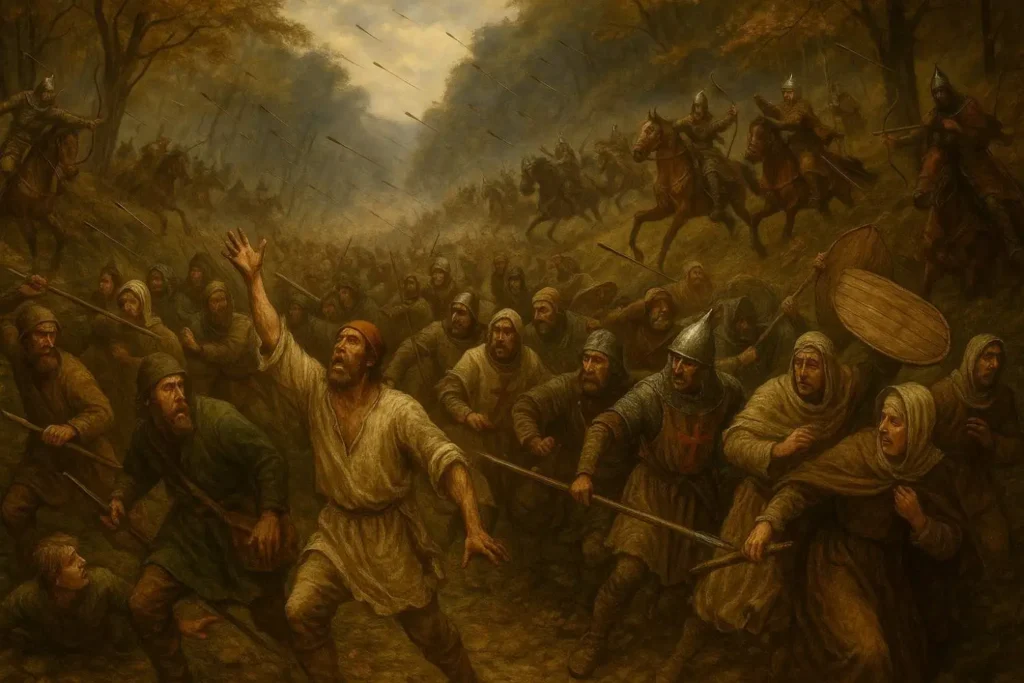
As the crusader vanguard entered the valley, the silence was shattered. The sky darkened not with clouds, but with a hail of Turkish arrows.
What followed was not a battle in the traditional sense; it was a systematic slaughter.
The Archery Storm: The Seljuk horse archers, masters of hit-and-run tactics, swept down from the wooded slopes. They unleashed volley after volley of arrows into the densely packed, slow-moving column. The crusaders, mostly foot soldiers with little to no armor, had no defense against this. They could not close to melee range, and they had few archers of their own to respond.
Encircled and Panicked: The Turks used their superior mobility to encircle the crusaders, cutting off any line of retreat. The initial zeal of the crusaders turned to terror and then to utter panic. The chaotic column began to collapse in on itself.
The Rout and the Pursuit: The collapse was total. What remained of the army broke and ran in a desperate, frantic flight back towards the perceived safety of Civetot. The Turkish cavalry pursued them relentlessly, cutting down the fleeing soldiers like wheat. The six-mile road back to the coast became a gauntlet of death.
The Massacre at the Camp
The horror did not end in the valley. The survivors who reached Civetot, believing they had found refuge, had only moments to try and organize a defense before the main Turkish force descended upon the camp. The small guard was swiftly overwhelmed.
What happened next was the final, gut-wrenching act of the tragedy. The Turks stormed the camp, showing little mercy. Those who were not killed on the spot—the non-combatants, the women, the children—were captured to be sold into slavery. Contemporary sources, though likely exaggerated, suggest a catastrophic loss of life, with estimates that 90% of the People’s Crusade was wiped out in a single day.
A few managed to escape, either by hiding in the surrounding woods or by fortifying themselves in a ruined castle by the shore until Byzantine ships could rescue them. Among the fortunate few was Peter the Hermit, who had been in Constantinople during the battle, pleading with Emperor Alexios for more aid. He returned to the West a broken man, his great movement extinguished in a river of blood.
Leaders and personalities
Peter the Hermit is the most famous name associated with the People’s Crusade; his charisma helped gather thousands, but he was not present at the final rout and survived the catastrophe, remaining later at Constantinople with small followers. The local leadership at Civetot included Walter Sans-Avoir and Geoffrey Burel—figures who led bands of the popular movement in the field and paid with their lives or defeat when confronted by Kilij Arslan’s forces. Kilij Arslan I, for his part, had the advantage of experience against mounted Europeans and the tactical flexibility of Seljuk horse-archery and ambush techniques.
Casualties, survivors, and immediate aftermath
Medieval sources present wildly differing numbers—some claims are inflated and others incomplete—but all point to massive losses among the crusaders. Contemporary chroniclers suggest large death tolls; modern summaries and encyclopedic entries commonly report that only a small fraction of the People’s Crusade survived to return to Byzantine protection or to join later princely expeditions.
The rout at Civetot sent shockwaves: it revealed to Western audiences the cost of improvisation, and it forced Byzantine authorities and later crusader leaders to rethink how to coordinate and secure large movements across hostile terrain.
The Echoes of Civetot: Why This Battle Matters
The Battle of Civetot was more than just a military defeat; it was a seismic event that shaped the entire First Crusade.
A Brutal, But Necessary, Lesson:
For the main Crusader armies of princes and nobles that arrived months later, Civetot served as a grim, real-world tutorial. The story of the massacre circulated widely, teaching the professional knights a vital lesson about the tactical prowess of the Seljuk Turks. They learned the critical importance of discipline, scouting, and adapting to a style of warfare dominated by fast-moving horse archers. In a dark sense, the sacrifice of the People’s Crusade paved the way for the more methodical, and ultimately successful, campaigns that followed.
The End of an Idea:
Civetot marked the definitive end of the concept of a “people’s” crusade. The dream of a holy war led by the common man, fueled by faith alone, died on the shores of Anatolia. Henceforth, the Crusades would be firmly in the hands of the military aristocracy, a organized and state-sanctioned endeavor.
A Timeless Human Tragedy:
Beyond the strategy and the politics, Civetot remains a profoundly human story. It is a cautionary tale about the immense gap between passionate belief and practical capability, about the dangers of hubris and the vulnerability of naivety. It is a reminder that history is not only made by the powerful in their halls of stone, but also by the countless, nameless individuals who march into the unknown, armed with little more than hope, and are consumed by it.
The silence that fell over the camp at Civetot was a grim prelude. The First Crusade had truly begun, and its first chapter was written not in glory, but in the ashes of a failed dream and the blood of the faithful.
Place, name, and archaeology:
The medieval toponym Civetot (also rendered Civitot, Cibotos, Kibotos/Kibatos in some sources) is commonly associated with a coastal zone on the northern shore of the Gulf of Izmit near modern Hersek and Altınova in Turkey. Recent archaeological and underwater research has identified Byzantine-era remains—most notably the so-called Kibatos Castle—submerged in the Marmara Sea and exposed in surveys dating from 2019 onward.
These discoveries support the medieval narratives that place an important Byzantine anchor point in the region and help bind the literary record to a specific geography. While archaeology cannot recover every detail of the battle, these finds underline that Civetot’s landscape was strategically meaningful in the late 11th century.
Visualizing Civetot: how to picture the moment
When you imagine Civetot, think less of a perfectly ordered battlefield and more of scattered tents, foraging bands, overturned carts, and frantic figures running toward a narrow shoreline. In the distance, mobile horse-archers sweep in—composed, coordinated, and practiced in skirmish warfare—while the disordered pilgrims stumble or are cut down. Contemporary imagery and later artist renderings emphasize panic and confusion rather than formal lines; that visual helps explain why the Seljuk response was so effective.
Frequently asked questions
Was Peter the Hermit killed at Civetot?
No. Peter survived and remained at Constantinople with some followers; the troops who suffered most were the foraging and camp-following groups.
How many people died at Civetot?
Estimates vary. Medieval chroniclers offer large (often contradictory) figures; modern summaries put losses in the thousands, but exact counts are uncertain.
Did the People’s Crusade end the First Crusade?
No. Civetot destroyed the People’s Crusade, but organized princely expeditions continued and ultimately succeeded in taking Jerusalem in 1099. Civetot, however, changed the tactical and diplomatic approach of later crusading contingents.
Who won the Battle of Civetot?
The Seljuk Turks, led by Sultan Kilij Arslan I, decisively won the Battle of Civetot in October 1096. The poorly armed and untrained People’s Crusade was completely annihilated, with tens of thousands killed or enslaved.
Who won the People’s Crusade?
The Seljuk Turks were the clear victors. The People’s Crusade, made up mostly of peasants and untrained volunteers, was destroyed before the official First Crusade even began. Only a handful of survivors managed to return to Constantinople.
What are some interesting facts about the Battle of Civetot?
The battle took place near Civetot (modern-day Koyunlu, Turkey) on October 21, 1096.
It marked the end of the People’s Crusade, the first, ill-fated wave of the First Crusade.
The crusaders were led by Peter the Hermit and Walter Sans-Avoir, though Peter was in Constantinople during the battle.
Around 90% of the crusaders were killed or captured in a single day.
The defeat served as a lesson in discipline and strategy for the later, more organized crusader armies that followed.