
Introduction
The life of Joan of Arc reads like a story ripped from legend — a peasant girl who rose to lead armies, faced a politicized church trial, and was executed at twenty-one.
This Joan of Arc biography covers her upbringing, visions, military campaigns, trial and execution, later rehabilitation, canonization, and the long shadow she casts over culture and history.
Quick summary / Key facts
- Who: Joan of Arc (Jeanne d’Arc), a peasant girl from Domrémy who claimed divine guidance and led French forces against the English during the Hundred Years’ War.
- Born: c. 1412 in Domrémy (exact date unknown).
- Major feats: Lifted the Siege of Orléans (1429), helped secure Charles VII’s coronation at Reims.
- Captured: May 1430 at Compiègne by Burgundian forces; sold to the English.
- Trial & death: Tried by an ecclesiastical court in Rouen for heresy; executed by burning on 30 May 1431.
- Rehabilitation: Verdict nullified in 1456 (posthumous retrial).
- Canonized: Declared a saint of the Roman Catholic Church on 16 May 1920 (Pope Benedict XV).
Historical context: The Hundred Years’ War and France in the early 15th century
By the opening decades of the 1400s, France had endured more than a century of intermittent war with England. The conflict known today as the Hundred Years’ War (1337–1453) devastated regions, disrupted trade and agriculture, and left political authority fractured. King Charles VI’s recurring mental illness and rival claims to the French crown deepened a crisis of legitimacy.
Northern and central France were contested ground: English armies, with Burgundian allies, controlled important towns and fortresses, while the Dauphin (the future Charles VII) struggled to cement his rule. In this atmosphere—marked by famine, occupation, and frequent raids—the sudden appearance of a young peasant woman who claimed divine guidance and promised victory struck a powerful chord across social and political lines.
Early life
Joan was born around 1412 in Domrémy, a small farming village in the duchy of Bar (now in the modern département of Vosges). Her family was rural peasants who tilled fields, raised livestock, and observed a devout form of local Catholicism. Contemporary sources describe her as a humble, hardworking girl who spent her youth doing household and farm tasks.
Domrémy’s position near the borderlands exposed villagers to periodic Burgundian raids and the violence of war; those realities likely shaped Joan’s early worldview and her intense concern for her country.
Her parents, Jacques d’Arc and Isabelle Romée, were smallholders of modest means; the household expected every child to pitch in with chores, mend clothing, and help tend animals and garden plots. Joan received little formal schooling — like most peasant girls, she could read only a little, if at all — but she learned the Psalms, the saints’ lives, and the rhythms of the Church by heart through daily prayer and participation in village devotions and feast days.
The local parish and the strong popular cults of saints in Lorraine shaped a worldview where the sacred and the everyday were closely intertwined, making religious experience a normal part of life rather than an extraordinary claim. Neighbors later remembered Joan as unusually devout, frank in speech, and quietly stubborn — qualities that made her both respected in Domrémy and, eventually, ready to stand out when larger events swept across France.
Visions, voices, and spiritual calling
From roughly age 13 Joan reported a series of visions and auditory experiences. She consistently named Saint Michael, Saint Catherine, and Saint Margaret as the primary figures who spoke to her and instructed her to support the Dauphin and drive the English from France. Joan’s own testimony framed these experiences as explicit divine commands rather than ambiguous spiritual impressions.
In later interrogations, she spoke calmly and repeatedly about the voices’ instructions, their timing, and the behavior they demanded of her. For Joan and those who found her convincing, the voices were the moral and practical basis of her mission.
Leaving Domrémy and reaching the court
Joan’s move from private devotion to public action required both courage and a chain of local approvals. She first persuaded local officials and a small number of villagers that her mission was genuine.
With the backing of a sympathetic local garrison leader and some clerical endorsements, she made the risky journey to the Loire court to meet the Dauphin. The trip to Chinon and the court’s decision to test her claims were pivotal: they transformed a local visionary into someone with the potential to affect national politics.
Meeting Charles VII and royal recognition
At Chinon, Joan met Charles (not yet crowned) and his inner circle. Court accounts vary on the precise sequence of events, but the essential fact is that skeptical advisers subjected Joan to tests — both private interviews and theological questioning — to determine whether she was a fraud, a witch, or something else.
Her manner—plain, direct, and resolute—along with a demonstration of religious knowledge and an insistence that she acted only under God’s command, persuaded enough influential figures to grant her a limited, highly visible role. The Dauphin’s eventual acceptance of Joan gave her symbolic authority: she was now an instrument the monarchy could employ to rally support and change momentum.
Military role and campaigns (Orléans, Loire, Reims)
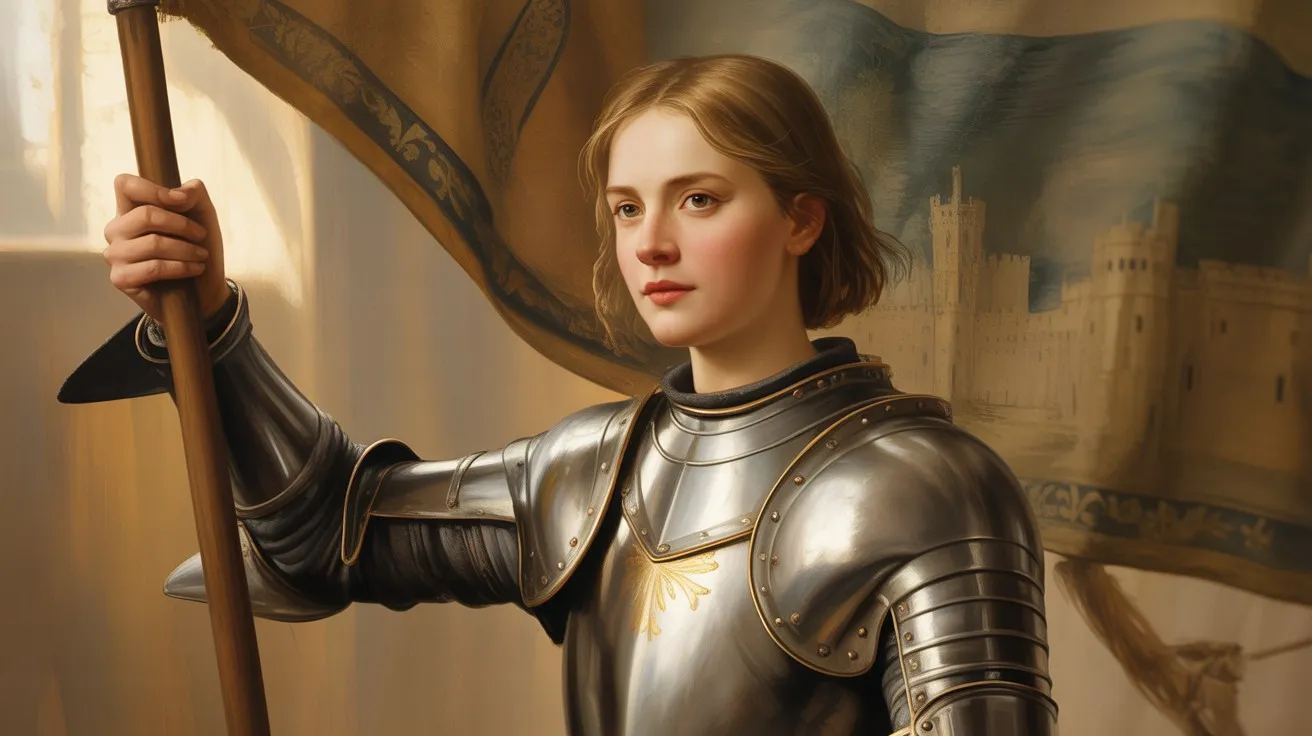
Joan’s military career, though brief, is concentrated around a few dramatic months in 1429. She arrived at Orléans in April 1429 while the city remained under English siege. Joan rode in armor, carried a banner rather than a sword in combat, and refused offers to be treated as a conventional noble commander.
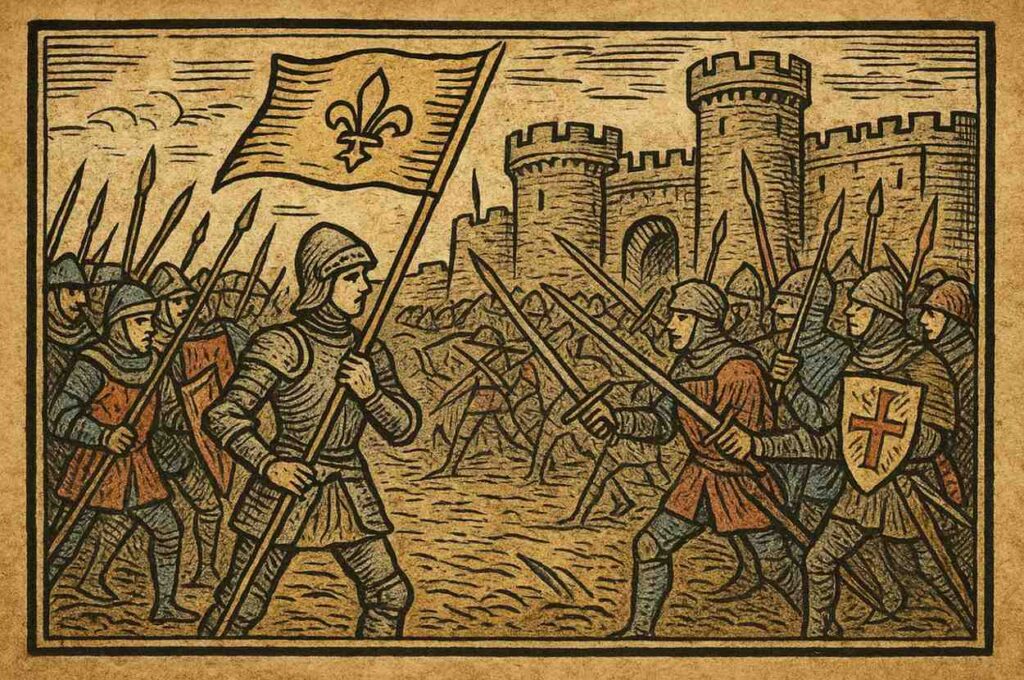
Her presence had a galvanizing effect; within days, French forces pressed local attacks that lifted the siege. In the following weeks, she joined offensives along the Loire valley that recaptured several strategic towns and opened a route for the Dauphin.
The climax came when Joan escorted the Dauphin to Reims, the traditional site of French coronations. On 17 July 1429, Charles VII was crowned at Reims—a symbolic restoration of legitimate rule that shifted perceptions throughout France and abroad. The coronation severed some of the moral ground the English had claimed and gave the French cause renewed momentum.
Leadership style and battlefield impact
Joan was not a professional commander in the modern sense. Her leadership depended less on formal military training and more on moral authority, personal example, and the psychological effect she produced among troops and townspeople. She often stood where danger was greatest, prayed openly, and insisted on religious ritual before actions.
Her banner, composed of the fleurs-de-lis and religious imagery, functioned as both a talisman and a rallying point. While some contemporary captains criticized her lack of tactical experience, many historians credit her presence with unifying fragmented forces and inspiring a morale-driven offensive that produced rapid political gains.
Capture: circumstances, who captured her, and why
On 23 May 1430 (in accounts around that date), Joan was captured during a military action near Compiègne. Burgundian cavalry—political allies of the English—took her prisoner during a sortie. Sources attribute her capture to a combination of misfortune, an exposed position during the sortie, and possibly insufficient protection. Once in Burgundian hands, her value as a political and symbolic prize was obvious: selling her to the English removed a powerful motivator for French resistance and offered propaganda advantages.
Imprisonment and conditions in Rouen
After being sold to the English, Joan was transferred to Rouen, the administrative and legal center of English authority in occupied Normandy. She was confined in a castle prison and later moved into ecclesiastical custody for trial.
Conditions were grim: she endured isolation, frequent interrogations, restricted contact with allies, and the psychological strain of knowing that her fate rested on a legal process shaped by her enemies. Contemporary accounts emphasize both her physical hardships and the court’s persistent effort to frame her story within theological terms that would justify a conviction.
The ecclesiastical trial: charges, key figures, and procedures
In January–May 1431 an ecclesiastical court sat in Rouen to examine charges of heresy and related offenses. The trial was presided over by Bishop Pierre Cauchon of Beauvais, a churchman closely aligned with the English cause. The prosecution emphasized two themes: first, that Joan’s claims of hearing divine voices threatened ecclesiastical authority and orthodox practice; second, that her repeated wearing of male clothing violated biblical injunctions and ecclesiastical law.
The court assembled a team of theologians and notaries to interrogate Joan’s beliefs and conduct. Many later observers and modern historians argue the trial was politicized and procedurally flawed: Joan lacked consistent counsel of her choosing, interrogations relied on leading questions, and political motives influenced evidentiary choices.
Legal arguments and Joan’s defense
Joan’s defense throughout the proceedings was intellectually simple yet morally powerful: she insisted her visions came from God and that she had acted only under divine command. When probed about doctrinal matters, she deferred to scripture and expressed an unassuming humility that both frustrated and impressed clerics. The prosecution attempted to demonstrate inconsistency, to show that her claimed revelations could be demonic or fraudulent, and to treat her clothing as evidence of moral disorder.
Under intense pressure, Joan signed a formal abjuration in late May 1431; that document acknowledged errors in her conduct as judged by the court. Within days, however, she declared that her signature had been obtained under duress and publicly repudiated parts of the confession—an act the court interpreted as a relapse, which legally justified a harsher sentence.
The nuances here are important: whether Joan truly intended to renounce her claims, the conditions under which she signed, and the way the court used the signing all remain central to historic assessments of the trial’s fairness.
Execution: the burning at the stake — timeline and eyewitness accounts
On 30 May 1431, Joan was led to the marketplace in Rouen and executed by burning. Eyewitness accounts describe a tense, ritualized public event. She was bound to a stake and burned; some accounts indicate that she briefly wore female garments in her final moments, while others emphasize her steadfast prayer and the clarity of her final statements.
For many witnesses, the spectacle had a paradoxical effect: intended to humiliate, it also showcased Joan’s composure and resolve. News of the execution spread quickly and provoked strong reactions in France.
Immediate aftermath and reaction
Rather than extinguishing the force of Joan’s persona, the execution contributed to her martyrdom in the popular imagination. Reports of miracles, testimonies about her courage, and indignation at procedural irregularities circulated among the French. Politically, Joan’s death became a rallying symbol for anti-English sentiment in some regions and a moral grievance that outlived immediate military calculations.
Rehabilitation trial (1456) and overturned verdict
In the 1450s, with the political landscape shifted and Charles VII securely on the throne, a formal review of the Rouen proceedings took place. The rehabilitation (or nullification) trial—held in 1456 under papal authority—examined the earlier trial’s procedures and found that Joan had been denied fair treatment and that several canonical norms had been violated.
The court declared her innocent of heresy and nullified the judgment against her. This legal reversal restored Joan’s name in the eyes of the Church and provided a foundation for later veneration.
Canonization (1920) and sainthood
Devotion to Joan persisted through centuries. Stories of her courage, the symbolism of her life, and the rehabilitation verdict helped foster a growing cult of memory. The formal cause for canonization gathered momentum in the 19th and early 20th centuries, driven by popular devotion and scholarly interest.
In 1920, Pope Benedict XV canonized Joan of Arc, recognizing her as a martyr and saint. Canonization affirmed both the spiritual significance many believed she embodied and the long cultural importance of her story for France and for Catholics worldwide.
Patronages, feast day, and religious significance
Joan is honoured as a patron saint of France and is commonly invoked for causes tied to courage, national identity, and the protection of soldiers and captives. The Church marks her feast day on May 30, the anniversary of her death.
Over time, Joan’s religious image has been woven into national memory, used by political and cultural movements for different ends, but also inspiring countless believers who see in her a model of faith under trial.
Legacy in art, literature, film, and popular culture
Joan of Arc’s story has been retold in virtually every artistic medium. Medieval chronicles presented her as miraculous and providential; Renaissance and later writers explored her psychological and moral dimensions; Romantic artists idealized her as a tragic national heroine; modern filmmakers and playwrights have continually reimagined her life to probe questions of gender, faith, and politics.
Statues and stained-glass windows, operas and novels, and dozens of films testify to her adaptability as a symbol—one that can mean different things in different eras while retaining an unmistakable core story.
Controversies, alternate theories, and myths
Because Joan’s life is so extraordinary, speculation has flourished. Over the centuries, theories have questioned her identity, suggested survival under an assumed name, or tried to use her story for partisan narratives. Most such claims lack strong documentary support. Serious historical inquiry leans on trial transcripts, contemporary letters, and administrative records to separate credible claims from later legend.
Debate continues about interpretation—about the precise role she played in military decisions, about the sincerity or nature of her visions, and about how subsequent generations transformed her image.
Mental health and the visions
Modern readers sometimes propose psychiatric explanations for Joan’s visions. Retrospective diagnosis is fraught and often anachronistic: in Joan’s time, visionary experiences fit within accepted religious frameworks and could be treated as signs of sanctity rather than pathology.
A balanced approach acknowledges that unusual experiences have many possible causes—psychological, cultural, or spiritual—while also respecting the period’s context and the testimony of contemporaries who found Joan persuasive.
Cross-dressing and clothing (why she wore male clothing)
One of the trial’s most contentious accusations focused on Joan’s wearing of male clothing. Her explanation was practical: male dress protected her while she rode with soldiers and reduced the risk of sexual harassment in prison. For the judges, the act was rhetorically useful—framed as a moral transgression that supported theological condemnation.
Modern readers tend to accept the pragmatic reasons Joan gave and note how the clothing issue was used politically during the trial.
Conclusion: Why Joan of Arc still matters
Joan of Arc endures because her life compresses many themes that speak to human beings across centuries: conviction, courage, youthful audacity, the collision of private faith and public politics, and the frailty of human institutions.
Her story matters because it resists easy categorization. Seen as a saint, Joan is a model of spiritual devotion and moral courage; seen as a soldier, she is a reminder that individuals can alter the course of events when timing, charisma, and circumstance align; seen as a symbol, she becomes a mirror on which later generations project their hopes, fears, and political needs.
That slipperiness is part of her power: different groups — clerics, monarchs, nationalists, feminists, artists — have all drawn on Joan to press very different arguments about authority, virtue, and identity.
There is also a practical lesson in her life for how institutions handle dissent and difference. Her trial exposes how legal and ecclesiastical systems can be bent by politics, how rhetoric can substitute for evidence, and how reputations can be destroyed or restored by later inquiry.
The 1456 rehabilitation and the eventual canonization show that historical judgments can be revisited, that legal and cultural redress is possible — but often slow and contested.
Finally, Joan remains relevant because she asks contemporary readers a question that never grows old: what are the limits of conviction? Her example compels us to weigh the virtues and dangers of uncompromising belief, the ethics of leadership, and the human cost of symbolic politics.
Whether as a subject for art, a case study in law and gender, or a personal exemplar of bravery, Joan’s life continues to prompt reflection on courage, responsibility, and the stories nations tell about themselves.
FAQs — Joan of Arc
Who was Joan of Arc?
A peasant girl from Domrémy (northeastern France) who claimed divine visions, led French forces during key moments of the Hundred Years’ War, helped secure Charles VII’s coronation, was captured and executed in 1431, and was later rehabilitated and canonized.
What is Joan of Arc famous for?
She’s best known for lifting the siege of Orléans (1429), rallying French forces, escorting Charles VII to his coronation at Reims, and becoming both a martyr and a lasting national and religious symbol.
What is the true story of Joan of Arc?
The core facts supported by contemporary records: born c.1412 in Domrémy, reported visions from about age 13, persuaded Charles’s court to let her help relieve Orléans in 1429, played a visible role in several campaigns, was captured by Burgundians in 1430, tried for heresy in Rouen, executed by burning on 30 May 1431, rehabilitated legally in 1456, and canonized in 1920.
When and where was Joan of Arc born?
Around 1412 in Domrémy (then in the Duchy of Bar), a small farming village in northeastern France.
What did Joan of Arc do?
She claimed divine guidance, joined the Dauphin’s cause, inspired and accompanied French attacks in 1429 (notably at Orléans), and helped secure Charles VII’s symbolic coronation—then was captured, tried, and executed.
How did Joan of Arc die?
She was executed by burning at the stake in Rouen on 30 May 1431 after being convicted of heresy by an ecclesiastical court operating under pro-English authorities.
How old was Joan of Arc when she died?
She was about 19 years old (born c.1412, executed 1431).
What was Joan of Arc found guilty of?
The Rouen court convicted her of heresy—charges hinged especially on her claims of divine voices and on wearing male clothing; the court also treated a later repudiation of her abjuration as a “relapse,” which supported the death sentence.
Was Joan of Arc found innocent?
Yes — in 1456 a church-led retrial (the rehabilitation) reviewed the proceedings at Rouen, found procedural abuses and coercion, and declared her innocent of heresy.
Was Joan of Arc real?
Yes — Joan is very well documented in contemporary records: letters, trial transcripts, eyewitness testimony, and administrative documents attest to her life and actions.
Was Joan of Arc a saint?
Yes — she was canonized by Pope Benedict XV in 1920 and is venerated as Saint Joan of Arc.
Why was Joan of Arc made a saint / why is she a saint?
Her canonization recognized her martyrdom, enduring popular devotion, and the church’s earlier legal rehabilitation; she was seen as a model of Christian faith and courage.
When was Joan of Arc canonized?
In 1920.
How was Joan of Arc captured by her enemies?
She was captured by Burgundian forces during fighting near Compiègne (May 1430); the Burgundians later sold her to the English.
What happened at Joan of Arc’s trial?
A pro-English ecclesiastical court in Rouen interrogated her (Jan–May 1431) on charges of heresy and related offences; the procedures were irregular by many contemporary and modern standards, and political motives strongly influenced the trial.
Why did Joan of Arc wear male clothing / pants?
Joan said she dressed in male clothes for practical protection in military life and to avoid sexual harassment or danger in prison; during the trial her clothing was used as evidence against her.
Why did Joan of Arc have short hair / cut her hair?
She cut her hair for practical reasons — to fit a helmet, wear armor, and protect herself while traveling and fighting; short hair also made it easier to adopt male dress for safety.
What did Joan of Arc begin to hear at age 13?
She reported auditory and visionary experiences — saints (especially St. Michael, St. Catherine, and St. Margaret) who instructed her to support the Dauphin and save France from English control.
What did God (or the voices) say to Joan of Arc?
According to Joan’s testimony, the voices instructed her to help the Dauphin reclaim his kingdom, urged piety and repentance, and directed certain practical steps (like seeking an audience with Charles). She consistently presented them as divine commands.
What was the arrow wound on Joan of Arc?
Contemporary accounts record that Joan was wounded in action (she was struck by projectiles at times). These injuries were not fatal and did not prevent her continued participation in campaigns; specifics vary by source.
What did Joan ask to see at her execution?
Eyewitnesses report she asked for a cross (a crucifix) and for a priest to hear her confession and give absolution before she died.
What were Joan of Arc’s last words? / What was the last word she screamed as she died?
Witnesses report that Joan repeatedly invoked the name of Jesus at the stake; many accounts give her final cry as “Jesus” (often rendered in medieval spellings).
Did Joan of Arc have schizophrenia / What mental condition did Joan have?
Modern psychiatric labels can’t reliably be applied to a 15th-century religious experience. Scholars generally treat her visions as part of a medieval religious framework; retrospective diagnoses (like schizophrenia) are speculative and widely debated.
What miracle did Joan of Arc do / What miracles did she perform?
There are no widely accepted accounts of major public miracles during her lifetime in the way later saints sometimes reported them. Miracles associated with Joan are mainly posthumous: cures and answered prayers reported by devotees and used as part of the evidence for canonization.
Is Joan non-binary? / Is Joan of Arc a feminist? / Is Joan of Arc “emo”?
These are modern categories that don’t map neatly onto 15th-century identities. Joan adopted male dress for practical and safety reasons and acted within a religious-military mission; scholars debate whether she can be described as a proto-feminist. Labels like “non-binary” or “emo” are anachronistic and not supported by historical records.
Did Joan of Arc have a flag?
Yes — Joan carried a banner (standard) rather than a battle flag in the modern sense; her banner displayed religious imagery and fleurs-de-lis and served as a visible rallying symbol.
What is St. Joan of Arc the patron saint of?
She is a patron saint of France and is commonly invoked for courage, soldiers, captives, and situations involving national or spiritual struggle.
Why is Joan of Arc remembered today?
Because her life combines dramatic action, religious conviction, political consequence, and martyrdom — qualities that made her a powerful symbol for successive generations in religion, art, national memory, and popular culture.
How did Joan of Arc look in real life? / Did Joan have black or blonde hair?
No authentic painted portrait from her lifetime survives. Contemporary descriptions emphasize an ordinary peasant appearance, short hair, and plain dress; exact hair color and detailed facial features are not reliably recorded.
Where was Joan of Arc buried and what happened to her remains?
She was burned at the stake and her ashes were disposed of (contemporary accounts say her ashes were thrown into the Seine). There is no preserved grave or body.
Was Joan accused of witchcraft?
Enemies sometimes framed female visionaries as witches, but the formal charges at Rouen were theological (heresy) and focused on visions and cross-dressing; “witchcraft” was not the primary legal label used in her official trial.
Did Joan of Arc have a temper?
Contemporary witnesses describe Joan as resolute and forceful when needed; she could be stern and impatient with commanders who failed to act, but accounts emphasize her piety and self-control as much as any temper.
What did Joan of Arc do when she was 17?
Around 1429, at about 17, Joan traveled to court, gained audiences with Charles’s circle, and took a central role in the Orléans campaign and the campaign that led to Charles’s coronation at Reims.
Sources & Further Reading:
Orléans Siege Background – National Archives of France
Joan of Arc – Encyclopaedia Britannica
Trial transcript editions and university PDFs (collections)
