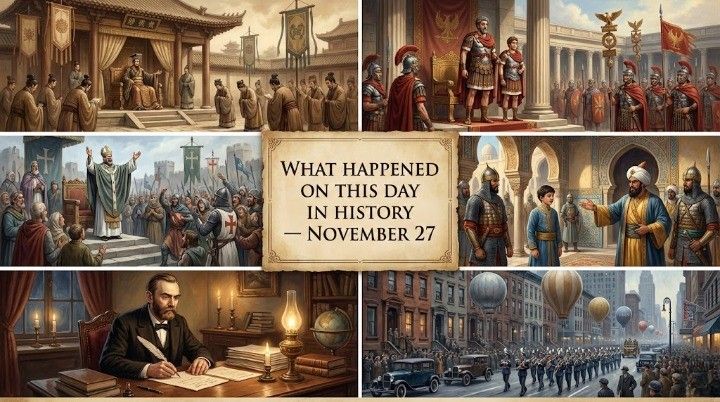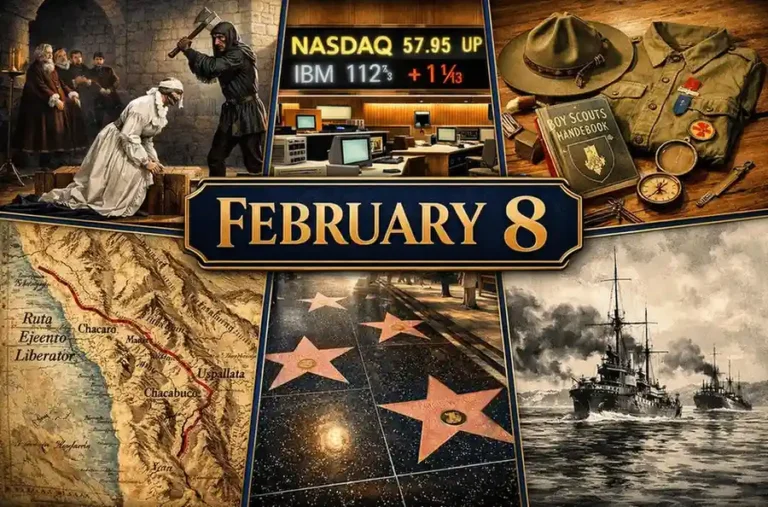
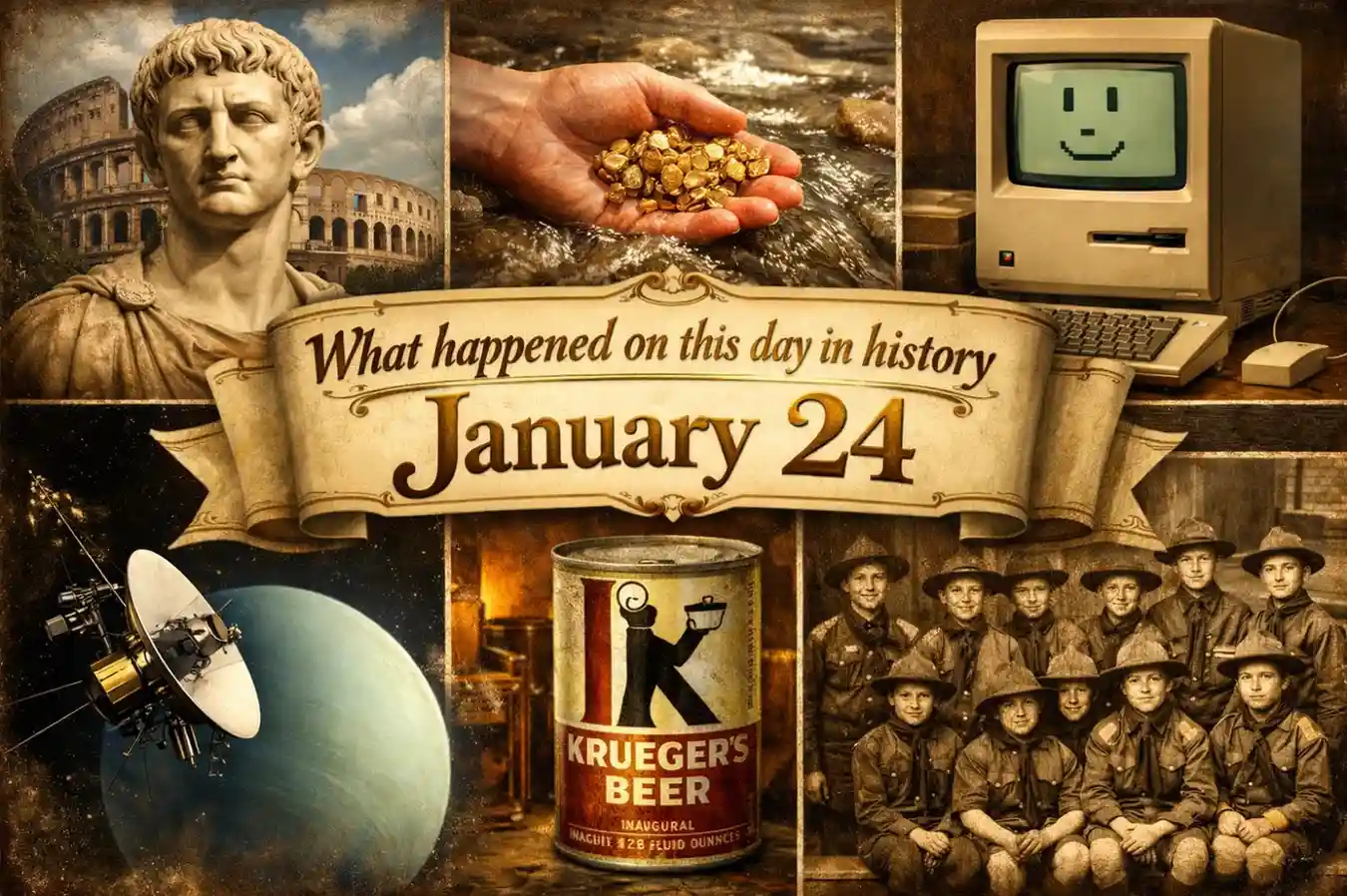
The flow of time often turns on a single moment of chance or a calculated act of rebellion. In this account of what happened on this day in history January 24, we witness the chaotic rise of Roman leaders and the accidental discovery that sparked the California Gold Rush. From the execution of notorious figures to the launch of revolutionary technology, this date stands as a crossroads of human progress and peril.
Important Events That Happened On January 24 In History
41 – Claudius Proclaimed Roman Emperor
Following the brutal assassination of the controversial Emperor Caligula by his own guards, the Praetorian Guard discovered his uncle, Claudius, hiding behind a curtain. In a sudden shift of power, they proclaimed him the new Roman Emperor, bypassing the Senate’s initial hopes to restore the Republic. Despite his physical infirmities and the chaotic nature of his rise, Claudius went on to become an efficient and successful administrator of the empire.
914 – First Fatimid Invasion of Egypt
The powerful Fatimid Caliphate launched its first major military campaign to seize control of Egypt from the Abbasid Caliphate. This invasion marked the beginning of a long and complex struggle for dominance over the wealthy and strategic Nile region. Although this initial attempt was not immediately successful in securing a permanent conquest, it set the stage for the eventual Fatimid takeover of the region decades later.
1438 – Council of Basel Suspends Pope Eugene IV
In a dramatic clash of religious and political authority, the Council of Basel officially voted to suspend Pope Eugene IV from his duties. The council members accused the Pope of being rebellious against the authority of the Church councils and sought to limit his supreme power. This move exacerbated the Great Schism and led to a period of intense ecclesiastical conflict that divided European loyalties.
1458 – Matthias Corvinus Elected King of Hungary
Matthias Corvinus was elected as the King of Hungary, beginning a reign that would become known as a golden age for the nation. Often called “Matthias the Just,” he was a patron of the arts and a brilliant military strategist who established the famous Black Army. His leadership turned Hungary into one of the most powerful and culturally advanced kingdoms in Central Europe during the Renaissance.
1536 – Henry VIII’s Jousting Accident
During a tournament at Greenwich Palace, King Henry VIII was thrown from his horse while jousting and the armored animal fell on top of him. He remained unconscious for two hours, suffering a severe brain injury that historians now believe permanently altered his personality. This trauma is often cited as the turning point that led to his increasingly erratic behavior, legendary temper, and health struggles in his later years.
1651 – The Parliament of Boroa
During the long-running Arauco War, Spanish authorities and the indigenous Mapuche people met at the Parliament of Boroa to negotiate terms of peace. This meeting was an attempt to renew the fragile diplomatic agreements established in previous decades to end the bloodshed in Chile. While the peace was often interrupted by further conflict, these parliaments represented a rare effort at formal treaty-making between colonial and native powers.
1679 – Dissolution of the Cavalier Parliament
King Charles II of England officially dissolved the Cavalier Parliament, which had been in session for an unprecedented eighteen years since the Restoration. The King made this move to protect his brother, the Duke of York, from the growing political pressure of the Exclusion Crisis. This dissolution ended a long era of royalist legislative dominance and led to a period of intense partisan electioneering.
1742 – Charles VII Albert Becomes Emperor
Charles VII Albert, the Elector of Bavaria, was crowned Holy Roman Emperor, marking a brief interruption in the centuries-long Habsburg dominance of the title. His election took place during the chaotic War of the Austrian Succession, as various European powers challenged the rights of Maria Theresa. However, his reign was troubled by military losses and he struggled to maintain authority over his own ancestral lands.
1758 – Königsberg Submits to Russia
During the height of the Seven Years’ War, the prominent citizens and leading burghers of Königsberg formally submitted to the forces of Empress Elizabeth of Russia. This surrender led to the formation of “Russian Prussia,” an administrative period that lasted until 1763. For five years, the residents of the East Prussian capital were officially subjects of the Russian Empire before the territory was eventually returned.
1817 – Action of Picheuta
As part of the monumental Crossing of the Andes, a detachment of soldiers led by Juan Gregorio de las Heras engaged in a skirmish at Picheuta. Many of the revolutionary soldiers were captured by Spanish royalist forces during this engagement. Despite this setback, the crossing continued as a vital part of the campaign to liberate Chile and Argentina from Spanish colonial rule.
1835 – The Malê Revolt in Brazil
In the city of Salvador da Bahia, enslaved people, many of whom were literate Muslims of African descent, staged a significant uprising known as the Malê Revolt. Although the rebellion was suppressed by the authorities, it sent shockwaves through the Brazilian slave-holding society. The bravery of the participants served as a long-term catalyst that helped bring an end to slavery in the region fifty years later.
1848 – Gold Found at Sutter’s Mill
While overseeing the construction of a sawmill for John Sutter near Sacramento, James W. Marshall spotted shiny flakes of metal in the river tailrace. His discovery of gold at Sutter’s Mill acted as the spark for the world-famous California Gold Rush. This event triggered a massive global migration, transformed the American West, and led to California’s rapid transition into statehood.

1857 – University of Calcutta Founded
The University of Calcutta was formally established, making it the first fully-fledged, multidisciplinary university in South Asia. Founded on the model of the University of London, it became a cornerstone of modern higher education in the region. It played a pivotal role in the intellectual and nationalist movements of India, producing many of the country’s most famous scholars and leaders.
1859 – Formation of the United Principalities
The United Principalities of Moldavia and Wallachia were formed through a personal union under the rule of Domnitor Alexandru Ioan Cuza. This political unification served as the foundation for the modern nation of Romania. By choosing a single ruler for both regions, the people defied the Great Powers of Europe and moved a step closer to full national sovereignty.
1900 – The Battle of Spion Kop Ends
During the Second Boer War, British forces were forced to retreat after a bloody and unsuccessful attempt to break the Siege of Ladysmith. The Battle of Spion Kop resulted in heavy casualties as the Boers utilized superior positioning and artillery against the British troops on the exposed hilltop. The defeat highlighted significant flaws in British military leadership and tactical planning during the conflict.
1908 – The First Boy Scout Troop Organized
Robert Baden-Powell officially organized the first Boy Scout troop in England, launching what would become a massive international youth movement. Following the success of his book Scouting for Boys, groups of young people began forming their own patrols across the country. The movement focused on outdoor skills, character development, and citizenship, eventually spreading to almost every nation on Earth.
1915 – The Battle of Dogger Bank
A major naval engagement of World War I took place in the North Sea as the British Grand Fleet intercepted a German raiding squadron. Led by Vice-Admiral Sir David Beatty, the British battle cruisers heavily damaged the German fleet and sank the armored cruiser Blücher. The victory reinforced British naval supremacy and forced the German Navy to become more cautious with its surface fleet.
1916 – Federal Income Tax Declared Constitutional
In the landmark case of Brushaber v. Union Pacific Railroad Co., the Supreme Court of the United States upheld the legality of the federal income tax. The court ruled that the tax was constitutional under the recently ratified 16th Amendment. This decision solidified the government’s power to collect taxes on personal and corporate income, fundamentally changing American fiscal policy.
1918 – Russia Introduces the Gregorian Calendar
By decree of the Council of People’s Commissars, Russia officially began the transition from the Julian calendar to the more widely used Gregorian calendar. To align with the rest of Europe, the decree stated that the day following January 31 would become February 14. This shift helped modernize Russian administrative systems and synchronized the country with international standards.
1933 – Ratification of the 20th Amendment
The 20th Amendment to the United States Constitution was officially ratified, significantly shortening the “Lame Duck” period between elections and inaugurations. The amendment moved the start of the President’s term from March 4 to January 20 and the start of Congressional terms to January 3. This change was designed to allow newly elected officials to take power more quickly during times of national crisis.
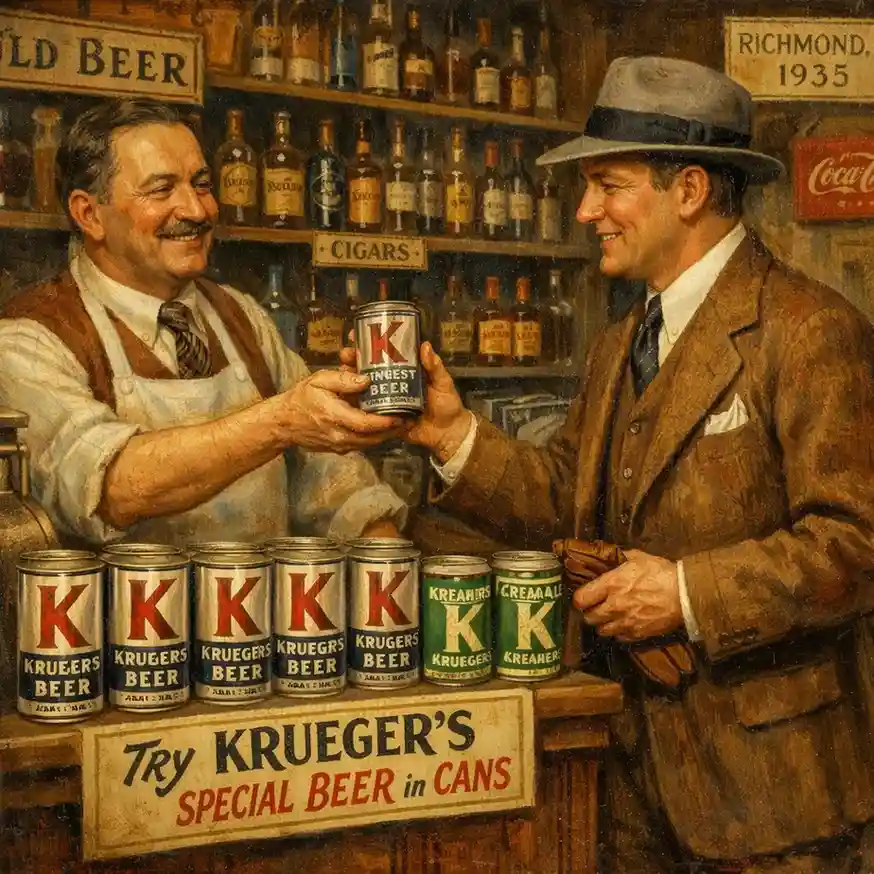
1935 – The First Canned Beer Goes on Sale
The Gottfried Krueger Brewing Company made history in Richmond, Virginia, by selling the very first cans of beer to the public. This innovation was made possible by the development of a special lining that prevented the beer from reacting with the metal. Canned beer quickly became a massive success due to its portability and ease of storage, forever changing the beverage industry.
1939 – The Deadliest Chilean Earthquake
A catastrophic earthquake struck the city of Chillán and surrounding areas, becoming the deadliest seismic event in the history of Chile. With an estimated magnitude of 8.3, the quake destroyed thousands of buildings and claimed the lives of approximately 28,000 people. The disaster led to the creation of new seismic building codes and a national disaster response agency in Chile.
1942 – Allies Bombard Bangkok
During World War II, Allied aircraft conducted a bombing raid on Bangkok, which was then under the control of a pro-Japanese Thai government. In response to the attack and the ongoing Japanese occupation, Thailand officially declared war against the United States and the United Kingdom. This moved the Southeast Asian nation fully into the Axis camp for the remainder of the conflict.
1943 – Conclusion of the Casablanca Conference
President Franklin D. Roosevelt and Prime Minister Winston Churchill concluded a high-level secret meeting in Casablanca, Morocco. During the conference, the two leaders coordinated their military strategy for the next phase of World War II and famously announced that they would accept nothing less than the “unconditional surrender” of the Axis powers. This declaration set the tone for the final years of the global conflict.
1946 – First United Nations Resolution
The United Nations General Assembly passed its very first resolution during its inaugural session in London. The resolution established the United Nations Atomic Energy Commission, tasked with dealing with the problems raised by the discovery of atomic energy. It reflected the urgent global concern regarding nuclear weapons in the immediate aftermath of World War II.
1960 – “Barricades Week” in Algiers
In response to rumors that French President Charles de Gaulle intended to grant independence to Algeria, European volunteer units in Algiers launched an insurrection. They seized government buildings and erected barricades in the streets, leading to violent clashes with the local police. This week-long crisis highlighted the deep divisions and civil unrest caused by the Algerian War of Independence.
1961 – Goldsboro B-52 Crash
A B-52 bomber carrying two powerful Mark 39 hydrogen bombs broke up in mid-air over Goldsboro, North Carolina. While one bomb’s parachute deployed safely, the second weapon fell at high speed and partially disintegrated upon impact. To this day, the uranium-enriched core of that second bomb remains buried deep in a swampy field, as it was never recovered.
1966 – Air India Flight 101 Crash
An Air India Boeing 707, named the “Kanchenjunga,” crashed into the glacier-covered slopes of Mont Blanc in the French Alps. All 117 people on board were killed, including Homi J. Bhabha, the chairman of the Indian Atomic Energy Commission. The accident was attributed to a pilot error regarding the aircraft’s position relative to the mountain peaks.
1968 – Operation Coburg Begins
During the Vietnam War, the 1st Australian Task Force launched Operation Coburg in the provinces around Long Bình and Biên Hòa. The mission was designed to intercept North Vietnamese Army and Viet Cong units before they could launch attacks on major bases. The operation was a significant Australian engagement that coincided with the lead-up to the massive Tet Offensive.
1972 – Shoichi Yokoi Found on Guam
Two local hunters on the island of Guam discovered Shoichi Yokoi, a Japanese sergeant who had been hiding in the jungle since the end of World War II. Yokoi had survived for 28 years in a cave, unaware that the war had ended in 1945. His return to Japan was a sensation, symbolizing the extreme devotion and resilience of Japanese soldiers from that era.
1977 – The Atocha Massacre
In a dark moment during the Spanish transition to democracy, a group of far-right extremists attacked a labor law office in Madrid. Five people, including four lawyers and a clerk, were murdered in what became known as the Atocha Massacre. The tragedy sparked a massive public outcry and paradoxically helped accelerate the legalization of the Communist Party and the democratic process.
1978 – Soviet Satellite Kosmos 954 Burns Up
A nuclear-powered Soviet satellite, Kosmos 954, malfunctioned and re-entered Earth’s atmosphere, scattering radioactive debris over Canada’s Northwest Territories. The incident triggered a massive cleanup operation known as Operation Morning Light. Only about 1% of the radioactive material was eventually recovered, causing significant environmental and diplomatic concerns.
1984 – Macintosh Personal Computer Goes on Sale
Following its famous “1984” Super Bowl commercial, Apple Computer officially placed the Macintosh on sale in the United States. It was the first mass-market personal computer to feature a graphical user interface and a mouse, making computing accessible to non-technical users. The “Mac” forever changed the way people interacted with technology and defined the future of the industry.
1986 – Voyager 2 Reaches Uranus
The Voyager 2 space probe made its historic closest approach to Uranus, passing within 50,600 miles of the planet’s cloud tops. It provided the first close-up images and scientific data of the ice giant, its rings, and its moons. To this day, Voyager 2 remains the only spacecraft to have visited the seventh planet from the Sun.
1987 – Civil Rights Protest in Forsyth County
Approximately 20,000 people gathered in Forsyth County, Georgia, for one of the largest civil rights demonstrations since the 1960s. The march was a response to racial intimidation that had occurred during a smaller walk the previous week. Leaders like Coretta Scott King and Jesse Jackson participated, drawing national attention to ongoing racial tensions in the American South.
1989 – Execution of Ted Bundy
Notorious serial killer Ted Bundy was executed in the electric chair at the Florida State Prison. After years of denials and legal delays, Bundy had finally confessed to the murders of over 30 young women across several states. His case remains one of the most infamous in criminal history due to his charm, his escapes from custody, and the sheer brutality of his crimes.
1990 – Japan Launches Hiten Lunar Probe
Japan successfully launched Hiten, its first robotic lunar probe, marking the country’s entry into deep space exploration. This mission made Japan only the third nation, after the Soviet Union and the United States, to send a probe to the Moon. Hiten was used to test swing-by maneuvers and orbital technologies that paved the way for future Japanese space missions.
2003 – Department of Homeland Security Begins Operation
The United States Department of Homeland Security (DHS) officially opened its doors, merging 22 different federal agencies into a single cabinet-level department. Created in response to the September 11 terrorist attacks, its primary mission was to coordinate national efforts to protect the country from various threats. It represented the largest reorganization of the U.S. federal government in over half a century.
2004 – Opportunity Rover Lands on Mars
The six-wheeled robotic rover Opportunity successfully touched down on the surface of Mars, joining its twin, Spirit. Landing in the Meridiani Planum region, Opportunity began a mission to analyze Martian rocks and soil for evidence of past water. While its mission was initially planned for 90 days, the rover continued to operate and relay data for nearly 15 years.
2009 – Cyclone Klaus Hits France
A powerful extratropical cyclone named Klaus made landfall near Bordeaux, France, bringing hurricane-force winds to the region. The storm caused 26 deaths across Southern Europe and left millions without power or public transport. It was one of the most damaging storms to hit the area in decades, resulting in extensive forest and property destruction.
2011 – Domodedovo Airport Bombing
A suicide bomber detonated an explosive device in the international arrivals hall of Moscow’s Domodedovo Airport. The blast killed at least 35 people and injured 180 others. The attack, which was later claimed by Islamist militants from the North Caucasus, led to a massive overhaul of security protocols at Russian transportation hubs.
2018 – Sentencing of Larry Nassar
Former sports doctor Larry Nassar was sentenced to up to 175 years in prison after more than 150 women and girls gave powerful victim impact statements in court. Nassar was found guilty of using his position at USA Gymnastics and Michigan State University to sexually abuse female athletes under the guise of medical treatment. The case sparked a national reckoning over institutional failure and athlete safety.
See What Happened On January 23:
Famous People Born On January 24
| Name | Role / Description | Birth – Death |
|---|---|---|
| Edith Wharton | American novelist | January 24, 1862 – August 11, 1937 |
| E. T. A. Hoffmann | German writer & composer | January 24, 1776 – June 25, 1822 |
| Mary Lou Retton | American Olympic gymnast | January 24, 1968 – |
| William Congreve | English dramatist | January 24, 1670 – January 19, 1729 |
| Hermann Ebbinghaus | German psychologist | January 24, 1850 – February 26, 1909 |
| Farinelli | Italian opera singer | January 24, 1705 – July 15, 1782 |
| Maria Tallchief | American ballerina | January 24, 1925 – April 11, 2013 |
| Charles James Fox | British statesman | January 24, 1749 – September 13, 1806 |
| Pierre-Augustin Caron de Beaumarchais | French playwright | January 24, 1732 – May 18, 1799 |
| Christian Wolff | German Enlightenment philosopher | January 24, 1679 – April 9, 1754 |
| Robert Motherwell | American abstract expressionist | January 24, 1915 – July 16, 1991 |
| Benjamin Lincoln | American Revolutionary War general | January 24, 1733 – May 9, 1810 |
| Sir Edwin Chadwick | British social reformer | January 24, 1800 – July 6, 1890 |
| Daniel Shechtman | Israeli chemist, Nobel laureate | January 24, 1941 – |
| Giorgio Chinaglia | Italian footballer | January 24, 1947 – April 1, 2012 |
| Henry Jarvis Raymond | Founder of The New York Times | January 24, 1820 – June 18, 1869 |
| Viktor Shklovsky | Russian literary theorist | January 24, 1893 – December 8, 1984 |
| Vasily Surikov | Russian painter | January 24, 1848 – March 19, 1916 |
| Oskar Morgenstern | Economist, game theory pioneer | January 24, 1902 – July 26, 1977 |
| Ernst Heinkel | German aircraft designer | January 24, 1888 – January 30, 1958 |
| Radomir Putnik | Serbian military commander | January 24, 1847 – May 17, 1917 |
| Ferdinand Cohn | German botanist | January 24, 1828 – June 25, 1898 |
| Vicki Baum | Austrian-American novelist | January 24, 1888 – August 29, 1960 |
| Ruth Asawa | American sculptor | January 24, 1926 – August 6, 2013 |
| Lars Hörmander | Swedish mathematician, Fields Medal | January 24, 1931 – November 25, 2012 |
| Norman Dello Joio | American composer | January 24, 1913 – July 24, 2008 |
| Paul Natorp | German philosopher | January 24, 1854 – August 17, 1924 |
| Henry Barnard | American education reformer | January 24, 1811 – July 5, 1900 |
| Karl von Staudt | German mathematician | January 24, 1798 – June 1, 1867 |
| Jaune Quick-to-See Smith | Native American artist | January 24, 1940 – January 24, 2025 |
Famous People Died On January 24
| Name | Role / Description | Birth – Death |
|---|---|---|
| Marvin Minsky | AI pioneer & scientist | August 9, 1927 – January 24, 2016 |
| George Cukor | American film director | July 7, 1899 – January 24, 1983 |
| Giovanni Agnelli | Italian industrialist (Fiat) | March 12, 1921 – January 24, 2003 |
| Martin Delany | Abolitionist & physician | May 6, 1812 – January 24, 1885 |
| Carl Andre | American minimalist sculptor | September 16, 1935 – January 24, 2024 |
| Joe Franklin | American TV & radio host | March 9, 1926 – January 24, 2015 |
| N. Scott Momaday | Native American author | February 27, 1934 – January 24, 2024 |
| Stephen III | Pope of the Catholic Church | c.720 – January 24, 772 |
| Horace Wells | Pioneer of anesthesia | January 21, 1815 – January 24, 1848 |
| Paul Walden | Latvian chemist | July 26, 1863 – January 24, 1957 |
| Stephen IV | Pope of the Catholic Church | – January 24, 817 |
| François-Thomas Germain | French silversmith | 1726 – January 24, 1791 |
| Gaspare Spontini | Italian opera composer | November 14, 1774 – January 24, 1851 |
| Alfonso IV | King of Aragon | 1299 – January 24, 1336 |
| Étienne-Maurice Falconet | French sculptor | December 1, 1716 – January 24, 1791 |
| Constance Fenimore Woolson | American novelist | March 5, 1840 – January 24, 1894 |
| Felix Timmermans | Belgian novelist | July 5, 1886 – January 24, 1947 |
| Jean Berain the Elder | French designer | October 28, 1637 – January 24, 1711 |
| Saint John Ervine | British dramatist | December 28, 1883 – January 24, 1971 |
| Richard G. Stern | American novelist | February 25, 1928 – January 24, 2013 |
| Sir David Gill | Scottish astronomer | June 12, 1843 – January 24, 1914 |
| Pinhas Lavon | Israeli politician | July 12, 1904 – January 24, 1976 |
| Kōtoku Shūsui | Japanese socialist leader | November 4, 1871 – January 24, 1911 |
| Dámaso Alonso | Spanish poet | October 22, 1898 – January 24, 1990 |
| Friedrich Trendelenburg | German philosopher | November 30, 1802 – January 24, 1872 |
| William Sellers | American engineer | September 19, 1824 – January 24, 1905 |
| Ján Kollár | Slovak poet | July 29, 1793 – January 24, 1852 |
| Arthur von Auwers | German astronomer | September 12, 1838 – January 24, 1915 |
| Balkrishna Doshi | Indian architect | August 26, 1927 – January 24, 2023 |
| Bhimsen Joshi | Indian classical vocalist | February 4, 1922 – January 24, 2011 |
Observances & Institutional Dates
- Day of the Unification of the Romanian Principalities (Romania): Celebrating the 1859 union of Moldavia and Wallachia.
- Feast of Our Lady of Peace (Roman Catholic Church): A religious observance dedicated to the Virgin Mary as the bringer of peace.
- National Girl Child Day (India): An annual day to raise awareness about the rights of girls and the importance of their education and health.
Frequently Asked Questions
- What major computer was released on January 24?
- The original Apple Macintosh went on sale for the first time on January 24, 1984.
- Which notorious serial killer was executed on this day?
- Ted Bundy was executed at Florida State Prison on January 24, 1989.
- What started the California Gold Rush on this day?
- James W. Marshall found gold at Sutter’s Mill on January 24, 1848.
- Who was proclaimed Emperor after Caligula’s death?
- Claudius was named Roman Emperor by the Praetorian Guard on January 24, 41 AD.