
Introduction:
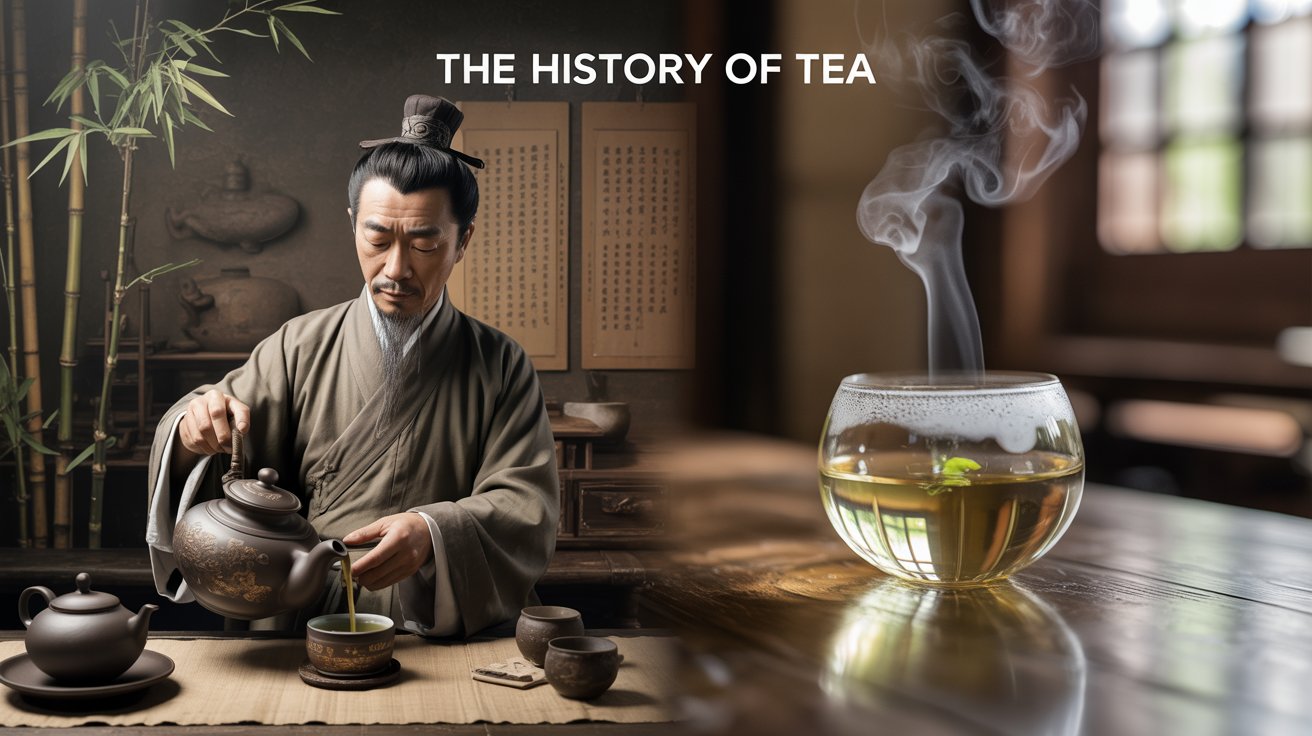
Every second, across the globe, humans sip thousands of cups of tea. The history of tea is a fascinating tale that weaves together myth, medicine, and empires across thousands of years. From the bustling chai stalls of Mumbai to the tranquil tea ceremonies of Kyoto, and from the sturdy mugs of British workers to the iced sweet tea of the American South.
This humble leaf has touched every corner of human life. Tea has shaped economies, influenced traditions, and become an enduring symbol of comfort and connection.
“But what is the true history of tea? How did a simple plant from ancient China travel the world to become a global phenomenon? This remarkable story begins with ancient legends and journeys through dynasties, empires, and innovations that shaped the modern world. Let’s steep ourselves in this fascinating history.”
The Legendary Origins of Tea: Myths of Emperors and Monks
Before history books, there were stories. The origin of tea is steeped in delightful legends that reveal its deep cultural significance long before it became a global commodity.
The Accidental Discovery: Emperor Shen Nong (2737 BCE)
The most famous legend credits the mythical Emperor Shen Nong, a revered figure known as the “Divine Healer” and father of Chinese agriculture and medicine. As the story goes, around 2737 BCE, Shen Nong was boiling water in the shade of a wild tea tree when a gust of wind blew a few leaves into his pot. Intrigued by the pleasant aroma of the resulting infusion, he took a sip.
He found the brew refreshing and invigorating, and noted its detoxifying properties. This accidental discovery marked the mythical birth of tea, aligning with Shen Nong’s philosophy of exploring nature’s pharmacy.
The Pious Act: Bodhidharma and the Eyelids
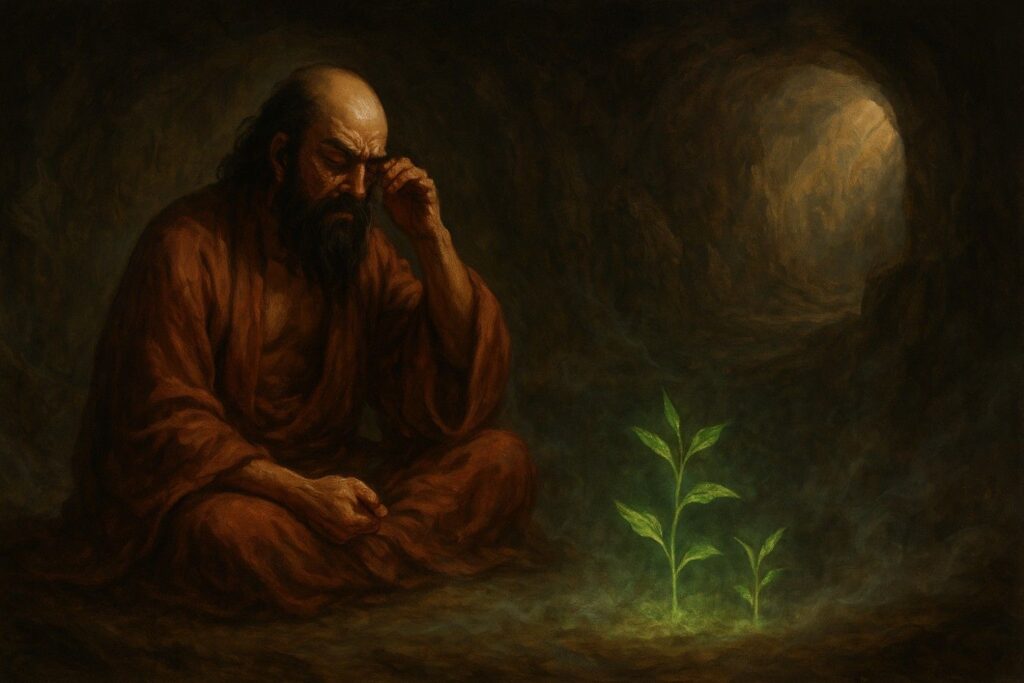
Another captivating legend comes from the world of Buddhism. It is said that around the 5th or 6th century CE, the monk Bodhidharma, the founder of Zen Buddhism, vowed to meditate for nine years without sleep. Toward the end of his marathon meditation, overwhelmed by fatigue, he tore off his own eyelids in frustration.
Where they fell, the first tea plants grew. The leaves of this plant, when brewed, offered alertness and focus—a gift to future monks to aid their meditation. While biologically fanciful, this story powerfully links tea to spiritual practice and mental clarity.
These legends, whether fact or folklore, set the stage for tea’s journey from a medicinal herb to a beloved beverage.
Tea’s Documented History: From Medicine to Art in Ancient China
While the legends are enchanting, the documented history of tea is equally compelling. Its evolution from a medicinal concoction to a cultural cornerstone is a testament to its enduring appeal.
Early Medicinal Use (Shang & Zhou Dynasties)
The earliest credible records suggest that by the Shang Dynasty (1600-1046 BCE), tea was being consumed in the Yunnan province, not as a pleasant drink, but as a medicinal vegetable relish or a bitter tonic. It was often chewed or boiled with other herbs.
The Tang Dynasty: Tea Becomes an Art Form
The true turning point for tea came during the Tang Dynasty (618-907 CE). This was the era when tea shed its purely medicinal skin and became a popular daily beverage and a subject of art and literature. The catalyst for this transformation was a man named Lu Yu.
In 780 CE, Lu Yu penned The Classic of Tea (Chájīng), the first definitive work on the subject. This seminal text covered everything from the cultivation and processing of tea leaves to the proper methods of brewing and drinking it, even detailing the ideal water and utensils.
Lu Yu elevated tea drinking to a spiritual and social discipline. Because of his work, he is revered in China as the “Sage of Tea.” During this period, tea was compressed into bricks for easy transport and trade.
The Silk Road: Tea’s First Steps West
Tea’s first journey out of East Asia was via the Silk Road. Camels carried compressed tea bricks to the nomadic tribes of Central Asia, who prized it for its nutritional value. This trade route was slow and arduous, making tea an expensive luxury in the distant West for centuries.
Tea in Japan
Tea first reached Japan in the early 9th century, when Buddhist monks such as Saichō returned from their studies in China carrying tea seeds and knowledge of its preparation. These seeds were planted at temples and monasteries—especially on Mount Hiei—where tea was consumed mainly for its stimulating effects during long periods of meditation.
For several centuries, tea remained a drink of monks and the imperial elite rather than the public.
A major shift came in the late 12th and early 13th centuries with the monk Eisai, who brought back a fresh supply of seeds and promoted powdered green tea (matcha). His book Kissa Yōjōki (“Drinking Tea for Health”) linked tea to wellness and spiritual practice, sparking a wider appreciation among samurai and aristocratic circles.
From these beginnings, Japan’s distinctive tea culture—including the tea ceremony—slowly developed, blending spiritual discipline with refined aesthetics.
Tea Spreads to the World
The 16th and 17th centuries marked the beginning of tea’s global conquest, driven by European exploration and trade.
European Traders Enter the Scene
The first Europeans to encounter tea were the Portuguese, who reached China in the 1500s. They established a trade route and introduced the concept to Europe. However, it was the Dutch East India Company that commercialized it in the early 1600s, making it a fashionable drink among the wealthy aristocracy in Holland and then in England.
The British Obsession and the East India Company
Tea arrived in England in the mid-1600s, and its popularity skyrocketed after King Charles II married the Portuguese princess Catherine of Braganza, a known tea enthusiast. It quickly became the national drink. The British East India Company grew to dominate the trade, but there was a problem: China held a monopoly.
To balance trade (and fund their tea habit), the British began illegally exporting opium from India to China. This led to the Opium Wars. Simultaneously, they sought to break China’s monopoly by establishing their own tea production.
The Birth of an Industry: India and Ceylon
In the 1820s, the British discovered native tea plants (Camellia sinensis var. assamica) growing in the Assam region of India. This was a game-changer. They established vast plantations in Assam and later in Darjeeling, using techniques developed in China.
Another pivotal moment was the coffee blight in Ceylon (modern-day Sri Lanka) in the 1860s. Scottish planter James Taylor experimented with tea as a replacement crop. His success was phenomenal, and Ceylon quickly became one of the world’s leading tea producers. The era of mass-produced, affordable tea for the masses had begun.
Tea in the Modern Era: The Invention of the Tea Bag and Global Traditions
The 20th and 21st centuries have seen tea adapt to modern life while its traditional roots remain strong.
Convenience and Innovation: The Tea Bag
In a classic tale of accidental invention, the tea bag was born in the early 1900s when New York tea merchant Thomas Sullivan sent samples of his tea in small silk bags. Customers, misunderstanding the purpose, began steeping the entire bag. They found it convenient, and the modern tea bag was born, revolutionizing how the Western world consumes tea.
Understanding the Types: It’s All About Oxidation
All “true” tea (green, black, white, oolong, pu-erh) comes from the same plant, Camellia sinensis. The difference lies in processing, specifically oxidation.
Green Tea: Unoxidized. Leaves are heated soon after picking to preserve their green color and fresh, grassy flavor.
Black Tea: Fully oxidized. The leaves are withered, rolled, and allowed to oxidize completely, resulting in a robust, malty flavor.
Oolong Tea: Partially oxidized. This category offers a vast spectrum of flavors, between green and black tea.
White Tea: The least processed. Made from young buds, it is simply withered and dried, yielding a delicate and subtle cup.
A Tapestry of Tea Cultures
Tea is no longer just a drink; it’s a reflection of culture.
British Afternoon Tea: A ritual of elegance with finger sandwiches, scones, and, of course, a pot of strong black tea with milk.
Moroccan Mint Tea: A symbol of hospitality, this sweet green tea infused with fresh spearmint is poured from a height to create a frothy head.
Indian Chai Culture: “Chai” simply means tea in Hindi, but “masala chai”—black tea brewed with milk, sugar, and a blend of spices like cardamom, ginger, and cinnamon—is a ubiquitous street beverage and a daily ritual for millions.
Japanese tea ceremony: A formal, aesthetic practice focused on powdered matcha and precise ritual.
Russian & Central Asian cultures: Strong black teas served from samovars, sometimes with preserves or sweets.
Conclusion:
From a legendary leaf falling into an emperor’s pot to the clipper ships racing across oceans, and from the tranquil Japanese tea ceremony to the bustling chai wallahs of Mumbai, the history of tea is a mirror reflecting human history itself. It has sparked wars, fueled economies, and fostered peace. It is a medicine, a ritual, a comfort, and a connector.
So, the next time you cradle a warm mug in your hands, take a moment to appreciate the incredible journey contained within. You’re not just drinking a beverage; you’re sipping on over 5,000 years of history.
Tea Origins & Legends
What is the real history of tea?
Tea originated in ancient China, with legendary discovery credited to Shen Nong around 2737 BCE. It started as a medicinal drink and evolved into a cultural and social beverage. By the Tang Dynasty (618–907 CE), tea culture was formalized, and later it spread to Japan, Korea, Europe, and the rest of the world.
What is the full form of tea?
Tea does not have a full form; it is simply derived from the Chinese word for the plant: “te” (Min Chinese dialect) or “cha” (Mandarin). Some people make acronyms for fun, but scientifically or historically, tea is just tea.
What is the real name of tea?
The plant’s botanical name is Camellia sinensis. In Chinese, it’s called cha (Mandarin) or te (Min dialect).
What was tea first called?
In China, tea was originally called “cha”. In some regions, it was also referred to as a medicinal herb with local names.
Who is the father of tea in the world?
Lu Yu, a Chinese scholar of the Tang Dynasty (618–907 CE), is often called the “Father of Tea” because he wrote The Classic of Tea (Cha Jing), systematizing cultivation, brewing, and appreciation.
Who invented tea in Islam?
Tea was not “invented” in Islam. It was introduced to the Islamic world (Middle East) via Ottoman traders and Sufi travelers in the 16th–17th centuries.
What is a brief history of tea?
Tea began in ancient China as a medicinal herb, became a cultural drink by the Tang Dynasty, spread to Japan, Korea, and later Europe via trade, and was cultivated globally in colonies like India and Sri Lanka. Modern tea culture includes green, black, oolong, white tea, and chai traditions worldwide.
Why is tea famous?
Tea is famous because it is flavorful, stimulating (contains caffeine), versatile, and culturally significant. Its association with social rituals, medicine, and global trade also boosted its fame.
Tea Types & Chemistry
What is tea chemistry?
Tea contains a mix of polyphenols (catechins), caffeine, amino acids (L-theanine), flavonoids, and essential oils, which contribute to its flavor, aroma, and health benefits.
What are the 5 names of tea?
Five popular types of tea based on processing are:
Pu-erh / Dark tea, Green tea, Black tea, Oolong tea, White tea.
What is the chemical name of tea?
Tea itself is a plant (Camellia sinensis). Its major chemical compounds include caffeine (C8H10N4O2), catechins, and theanine (C7H14N2O3). There is no single chemical “name” for tea itself.
What are the 4 main types of tea?
Green tea – unoxidized
Black tea – fully oxidized
Oolong tea – partially oxidized
White tea – minimally processed
What is the most famous tea?
Black tea (like Assam, Darjeeling, Earl Grey) and green tea (like Chinese Longjing or Japanese Sencha) are globally famous.
What is basic tea called?
The simplest form is plain tea — just brewed leaves of Camellia sinensis without milk, sugar, or spices.
What makes tea organic?
Tea is considered organic if it is grown without synthetic pesticides, herbicides, or chemical fertilizers and meets certified organic farming standards.
Global Production & Records
Which country is first in tea?
China is the first country where tea was discovered and first widely consumed.
Which country drinks the most tea?
China and India have the largest total tea consumption, but Turkey consumes the most per capita.
Who is the king of tea?
The title “King of Tea” is usually given to Pu-erh tea or Darjeeling tea, depending on the region and context, as they are highly prized worldwide. There is no single person known as the “king of tea.”
Which country is no. 1 in tea?
China leads in total production and historical significance; India is also a top producer. Per capita consumption: Turkey ranks first.
What is the oldest known tea?
The oldest known tea is wild tea in Yunnan, China, used around 2737 BCE according to legend. Archaeological evidence confirms tea use in the Han Dynasty (206 BCE – 220 CE).
Tea in South Asia (India & Pakistan)
What is the history of tea in Pakistan?
Tea came to the Indian subcontinent during the British colonial period. British traders and planters introduced large-scale tea cultivation in areas like Assam, Darjeeling, and Sri Lanka (Ceylon). After 1947, Pakistan inherited the tea-drinking culture and now imports most of its tea from Kenya, Sri Lanka, and India.
What is the history of tea in the India?
Tea in India grew naturally in Assam, but large-scale cultivation began under British rule in the 19th century. Plantations in Assam, Darjeeling, and Nilgiri made India a major tea producer. Today, tea is an integral part of Indian culture, from masala chai to commercial teas.
Tea in the UK & Europe
What is the history of tea in the UK?
Tea arrived in England in the mid-17th century, brought by Dutch and Portuguese traders. It became fashionable among the elite after being served at royal courts. By the 18th century, tea was popular across all social classes, aided by the British East India Company, which imported vast quantities from China and later India. The British developed their own tea traditions, including afternoon tea and tea breaks.
Why is tea so popular in the UK?
Tea became popular due to its association with sophistication, comfort, and routine. It was an affordable luxury, a social ritual (afternoon tea), and later a daily habit among workers and households. British colonial trade ensured supply, making it widely accessible.
What is the oldest tea in the UK?
The oldest commercially recognized teas in the UK are Chinese black teas like Keemun and Congou, imported in the 17th–18th centuries. There is no native “oldest tea” in the UK since tea is imported from Asia or later from India and Sri Lanka.
How old is tea in England?
Tea has been consumed in England for about 400 years. It became a fashionable drink in the 1650s and became widespread by the 18th century.
Tea in the USA & Australia
What is the history of tea in the USA?
Tea came to North America in the 17th century via British colonists. It was a common drink in colonial households. Tea played a political role in events like the Boston Tea Party (1773), where American colonists protested British taxation. After independence, coffee became more common, but tea remained a cultural staple.
Is tea made in the USA?
Yes, but production is limited. Southern states like South Carolina grow some tea commercially (mostly green and specialty teas), such as at the Charleston Tea Garden, America’s largest tea plantation.
What is the history of tea in Australia?
Tea was introduced to Australia by British settlers in the late 18th century. Initially a colonial import, it became a daily staple, influenced by British traditions. Over time, Australian culture developed its own tea-drinking habits, blending local and global practices.
When did tea come to Australia?
Tea arrived in Australia in the late 1700s, shortly after the First Fleet landed in 1788, as part of British colonial imports.
What is tea in Australia?
In Australia, tea generally refers to black tea (like English Breakfast or Earl Grey) served with milk and sugar, often in the morning or afternoon. Herbal infusions are also common. “Tea” can sometimes mean the evening meal, depending on regional slang.
What tea is Australia known for?
Australia is not historically known for tea production, but the Charleston Tea Garden produces some specialty green and black teas. Most Australian tea consumption relies on imports from China, India, and Sri Lanka.
How popular is tea in Australia?
Tea is very popular in Australia, ranking as one of the top daily beverages after coffee. Black teas dominate, though herbal and green teas have gained popularity in recent decades. Afternoon tea is a common social ritual, though coffee culture is slightly more dominant in urban areas.