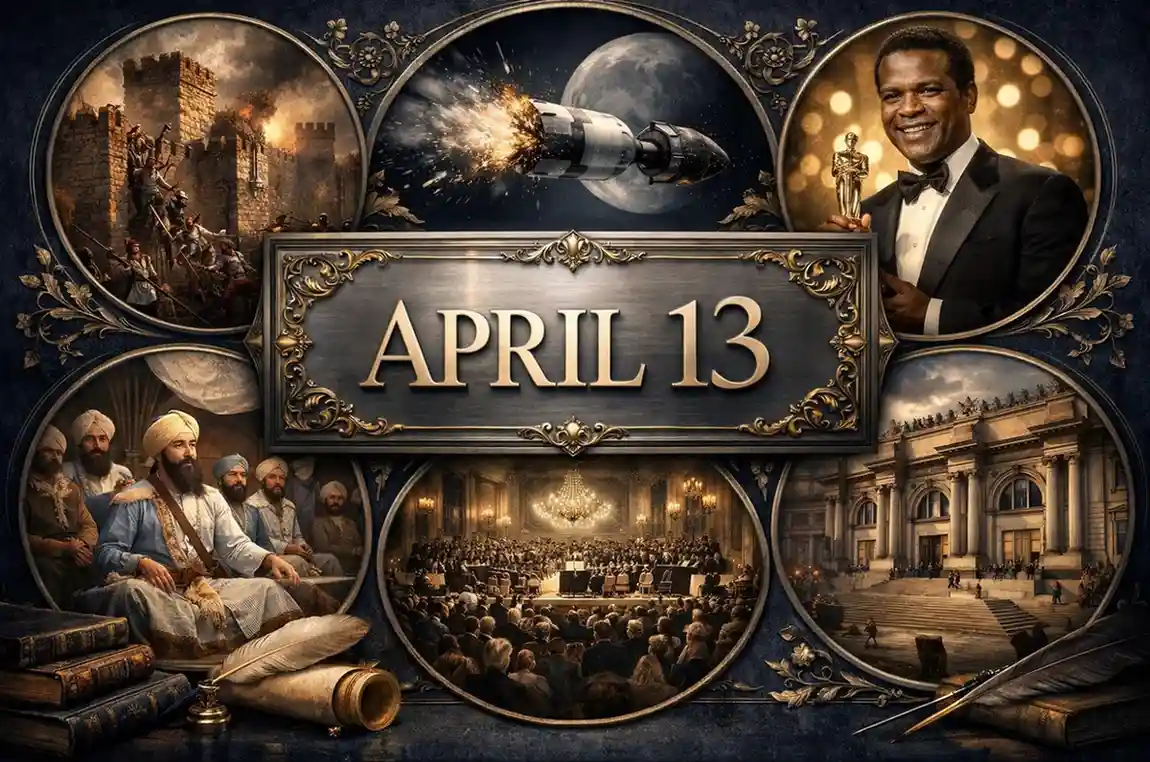
A review of what happened on this day in history April 13 reveals a date defined by the collapse of ancient powers and the birth of modern movements. From the final fall of Constantinople in 1204 to the world premiere of Handel’s Messiah in 1742, this day spans the heights of artistic achievement and the depths of military defeat. These events highlight the cyclical nature of history, where the end of one era frequently provides the foundation for the next.
Important Events That Happened On April 13 In History
989 – Death of Bardas Phokas
The death of the powerful general Bardas Phokas the Younger during the Battle of Abydos ended his second major revolt against the state. His sudden passing while facing the forces of Byzantine Emperor Basil II led to the immediate collapse of the rebel movement. This victory allowed the emperor to consolidate his authority and secure the internal stability of the Byzantine administration for years to come. It marked a critical turning point in the reign of one of the empire’s most influential and long-serving medieval rulers.
1055 – Election of Pope Victor II
Following the death of Pope Leo IX in the previous year, Victor II was officially elected as the new leader of the Catholic Church. As a close associate of the Holy Roman Emperor, his appointment served to strengthen the political and religious ties between the papacy and the empire. During his brief tenure, he continued the reform efforts of his predecessor and worked to resolve various ecclesiastical disputes within Europe. His papacy is remembered as a period of significant cooperation between the German crown and the spiritual leadership in Rome.
1111 – Coronation of Henry V
King Henry V of Germany was officially crowned as the Holy Roman Emperor by Pope Paschal II during a ceremony held in the city of Rome. The coronation followed a period of intense conflict and negotiation regarding the rights of the monarch to appoint high-ranking church officials. Although the event aimed to settle the investiture controversy, tensions between the secular and religious authorities remained high throughout his reign. This crowning represented a major consolidation of power for the Salian dynasty within the complex landscape of medieval European politics.
1175 – Battle of the Horns of Hama
Saladin achieved a decisive military victory over his Muslim rivals, the Zengids, at the Battle of the Horns of Hama. This success allowed him to unify significant portions of the region and solidify his personal control over the territory of Syria. Following the clash, only the city of Aleppo remained outside of his immediate influence as he sought to build a centralized Islamic state. The battle was a fundamental step in his rise to power and his eventual confrontation with the Crusader states in the Levant.
1204 – Fall of Constantinople
The city of Constantinople fell to the soldiers of the Fourth Crusade, bringing a temporary end to the long-standing Byzantine Empire. This event followed a successful breach of the city’s defenses and led to an intense period of looting and the destruction of priceless cultural artifacts. The victors established the Latin Empire in the region, which lasted for several decades before the Byzantine remnants could reclaim their capital. This collapse significantly altered the political and religious balance of power between the Eastern and Western worlds for centuries.
1612 – Duel at Funajima Island
The legendary samurai Miyamoto Musashi defeated his formidable rival Sasaki Kojirō in a famous duel on the shores of Funajima Island. Musashi famously arrived late and used a wooden sword carved from an oar to secure his victory over the master of the “Tsubame Gaeshi” technique. This encounter became one of the most celebrated moments in Japanese martial arts history and cemented Musashi’s reputation as an unbeatable swordsman. The duel has since been immortalized in countless works of literature, theater, and film as a symbol of tactical brilliance.
1613 – Capture of Pocahontas
Samuel Argall set off for the settlement of Jamestown with Pocahontas as his prisoner after capturing her in the village of Passapatanzy, Virginia. His primary goal was to use her as a high-value bargaining chip to secure the release of English prisoners held by her father, Chief Powhatan. This event led to a prolonged period of captivity for the young woman, during which she was introduced to English customs and the Christian faith. The capture ultimately played a major role in the diplomatic relations and the eventual temporary peace between the colonists and the local tribes.
1699 – Formalization of the Khalsa
The Sikh religion was formally established as the Khalsa, or the brotherhood of Warrior-Saints, by Guru Gobind Singh in northern India. This historic event took place during the festival of Vaisakhi and introduced the unique identity and code of conduct for the Sikh community. The Guru initiated the first five members, known as the Panj Pyare, and established a system that emphasized spiritual devotion alongside military readiness. This formalization transformed the Sikh faith into a disciplined and resilient force dedicated to social justice and the defense of the oppressed.
1742 – Premiere of Handel’s Messiah
George Frideric Handel’s famous oratorio, Messiah, made its highly anticipated world premiere during a benefit concert held in Dublin, Ireland. The performance was a massive success, with the audience responding enthusiastically to the powerful choral arrangements and the moving scriptural text. The work eventually became one of the most frequently performed and beloved pieces in the entire history of Western classical music. Today, it remains a staple of the holiday season and a testament to Handel’s enduring influence on the musical world.
1777 – Battle of Bound Brook
British and Hessian forces launched a successful surprise attack on an American garrison during the Battle of Bound Brook in New Jersey. The American troops, led by Benjamin Lincoln, were quickly overwhelmed by the superior numbers and tactical positioning of the royal military. While the British managed to capture equipment and prisoners, they were unable to secure a long-term strategic advantage and eventually withdrew from the area. This clash served as a harsh reminder of the constant dangers of ambush and the fluid nature of the American Revolutionary War.
1829 – Roman Catholic Relief Act
The Roman Catholic Relief Act was officially passed in the United Kingdom, granting Catholics the right to vote and the ability to sit in Parliament. This landmark legislation followed decades of political struggle and social tension regarding the civil rights of religious minorities in the country. The act effectively removed most of the remaining legal barriers that had prevented Catholics from participating fully in the national political process. It represented a major victory for the cause of religious toleration and the modernization of the British legislative system.
1849 – Hungarian Declaration of Independence
Lajos Kossuth formally presented the Hungarian Declaration of Independence during a closed session of the National Assembly at the Great Protestant Church in Debrecen. This bold document declared Hungary’s total separation from the Habsburg Monarchy and the establishment of a sovereign state. The move was a centerpiece of the Hungarian Revolution and sought to secure national rights and democratic reforms for the population. While the independence was short-lived due to military intervention, it became a foundational moment for Hungarian national pride and political identity.
1861 – Surrender of Fort Sumter
Major Robert Anderson and his Union troops officially surrendered Fort Sumter to Confederate forces following a relentless thirty-four-hour artillery bombardment. This event marked the successful capture of the federal stronghold in Charleston Harbor and the first major victory for the newly formed Confederacy. The surrender finalized the start of the American Civil War and led to a rapid escalation of hostilities across the divided nation. It remains a somber historical marker for the beginning of the deadliest conflict in the history of the United States.
1865 – Occupation of Raleigh
Union forces under the command of General William T. Sherman reached and occupied the city of Raleigh, North Carolina, during the final weeks of the Civil War. The state capital was taken without significant resistance as the Confederate military continued its retreat toward the west. This occupation effectively cut off vital supply lines and signaled the total collapse of Confederate authority in the central part of the state. The presence of federal troops brought an end to the local war effort and began the complex process of military administration.
1870 – Founding of the MET
The Metropolitan Museum of Art was formally established in New York City with the goal of bringing art and education to the American public. A group of civic leaders and artists came together to create an institution that would rival the great museums of Europe. The museum began its journey in a small temporary building before eventually moving to its iconic location on Fifth Avenue. Today, it stands as one of the largest and most visited art museums in the world, housing millions of works spanning thousands of years.
1873 – The Colfax Massacre
A violent mob consisting of former Confederate soldiers and members of the Ku Klux Klan murdered over 60 to 150 black men in Colfax, Louisiana. The tragedy occurred after a group of African Americans attempted to defend the local courthouse following a disputed gubernatorial election. The victims were killed even after they had surrendered, making it one of the most brutal acts of racial violence during the Reconstruction era. This event highlighted the extreme resistance to civil rights and the failure of the federal government to protect its citizens.
1919 – Jallianwala Bagh Massacre
British Indian Army troops under the command of Reginald Dyer opened fire on a large crowd of unarmed demonstrators in Amritsar, India. The massacre resulted in hundreds of deaths and over a thousand injuries among the men, women, and children who had gathered for a peaceful meeting. This act of state-sponsored violence took place within a confined space, leaving the victims with no way to escape the gunfire. The event became a defining catalyst for the Indian independence movement and a lasting symbol of the brutality of colonial rule.
1941 – Soviet-Japanese Neutrality Pact
The Soviet Union and the Empire of Japan signed a formal pact of neutrality to ensure that neither nation would attack the other during the ongoing world conflict. This diplomatic agreement allowed the USSR to focus its military resources on its western border as tensions with Germany reached a breaking point. For Japan, the treaty secured its northern flank while it pursued its territorial goals in Southeast Asia and the Pacific region. The pact remained in effect for most of World War II until the Soviet government declared war on Japan in 1945.
1943 – Katyn Forest Graves Announced
The German government officially announced the discovery of mass graves containing the remains of thousands of Polish prisoners of war in the Katyn Forest. Investigations revealed that the victims had been executed by Soviet forces in 1940, leading to a major diplomatic crisis between the Polish government-in-exile and Moscow. The Soviet Union denied any responsibility for the crime, a stance it maintained for several decades before finally admitting the truth. This event remains a tragic symbol of the war’s complexity and the hidden atrocities committed by the warring powers.
1943 – Dedication of the Jefferson Memorial
President Franklin D. Roosevelt officially dedicated the Jefferson Memorial in Washington, D.C., on the 200th anniversary of Thomas Jefferson’s birth. The neoclassical structure was built to honor the third American President and the primary author of the Declaration of Independence. Its design features a bronze statue of Jefferson and inscriptions of his most famous writings regarding liberty and the rights of man. The memorial has since become one of the most visited and iconic landmarks in the nation’s capital, symbolizing the foundational ideals of the country.
1945 – Capture of Vienna
Soviet and Bulgarian military forces completed the successful capture of Vienna from German troops during the final stages of the war in Europe. The battle for the Austrian capital was intense and resulted in significant damage to many of the city’s historic landmarks and infrastructure. The fall of Vienna represented a major strategic loss for the Nazi regime and opened the way for the Allied advance into the heart of Germany. Following the victory, the city was divided into four occupation zones managed by the victorious Allied powers.
1948 – Hadassah Medical Convoy Massacre
An armored medical convoy carrying Jewish doctors, nurses, and students was ambushed by Arab forces in the Sheikh Jarrah neighborhood of Jerusalem. The attack resulted in the deaths of 78 medical professionals and one British soldier who were attempting to reach the Hadassah Hospital. This tragedy occurred during the intense period of conflict that preceded the official establishment of the State of Israel. It remains a somber and controversial event in regional history, highlighting the extreme dangers faced by non-combatants during the sectarian struggle.
1953 – Launch of Project MKUltra
Director Allen Dulles officially authorized the launch of Project MKUltra, a secret CIA program dedicated to researching various methods of mind control and behavioral modification. The project involved a wide range of experiments on human subjects, often conducted without their knowledge or informed consent. These studies investigated the use of chemical substances, hypnosis, and psychological isolation to influence the human mind for intelligence purposes. The program’s existence and its unethical practices were eventually exposed to the public during congressional investigations decades later.
1960 – Transit 1-B Satellite Launch
The United States successfully launched Transit 1-B, which became the world’s first operational satellite navigation system. The technology was originally developed for the U.S. Navy to provide accurate location data for submarines and surface vessels at sea. This achievement laid the essential groundwork for the modern Global Positioning System (GPS) that is used worldwide today for countless civilian and military applications. The launch marked a significant milestone in the history of aerospace engineering and the practical use of satellites in orbit.
1964 – Sidney Poitier Wins Oscar
Sidney Poitier made history at the Academy Awards by becoming the first African-American man to win the Oscar for Best Actor. He received the prestigious award for his powerful performance as Homer Smith in the 1963 film Lilies of the Field. This milestone represented a major breakthrough for representation in the film industry and a significant moment in the broader civil rights era. Poitier’s success helped to pave the way for future generations of actors of color and solidified his status as a legendary cultural figure.
1970 – Apollo 13 Oxygen Tank Explosion
An oxygen tank aboard the Apollo 13 Service Module exploded while the spacecraft was en route to the Moon, putting the crew in immediate peril. The blast caused major damage to the command module, Odyssey, and forced the astronauts to use the lunar module as a “lifeboat” for the journey home. Ground control and the crew worked tirelessly to develop emergency procedures to conserve power, water, and air for the three men on board. This event remains one of the most famous examples of human resilience and problem-solving in the history of space exploration.
1972 – PRC Recognized by UPU
The Universal Postal Union officially voted to recognize the People’s Republic of China as the only legitimate representative of China within the organization. This decision effectively expelled the representatives of the Republic of China, which continued to administer the island of Taiwan. The move followed a broader trend within international organizations to shift recognition toward the mainland government in Beijing. This administrative change reflected the shifting geopolitical realities of the 1970s and the ongoing diplomatic struggle over Chinese sovereignty.
1972 – Battle of An Lộc Begins
North Vietnamese forces launched a major offensive against the provincial capital of An Lộc, marking the start of a pivotal battle during the Vietnam War. The city was a strategic prize due to its proximity to Saigon, and its defense became a critical test for the South Vietnamese military. For several weeks, the city was subjected to intense shelling and ground assaults, resulting in a brutal and prolonged siege. The successful defense of the city, supported by American airpower, ultimately prevented a total collapse of the southern front during the Easter Offensive.
1975 – Start of Lebanese Civil War
An attack by Phalangist resistance members on a bus carrying Palestinian militia members in Beirut ignited the beginning of the Lebanese Civil War. This act of violence was the culmination of long-standing tensions between various religious and political factions within the country. The conflict would last for fifteen years, resulting in the deaths of over 100,000 people and the massive displacement of the civilian population. This day serves as a tragic reminder of how localized violence can spiral into a devastating national and regional crisis.
1976 – Reintroduction of the Two-Dollar Bill
The United States Treasury Department officially reintroduced the two-dollar bill as a Federal Reserve Note on the 233rd anniversary of Thomas Jefferson’s birth. The move was part of the national Bicentennial celebration and featured a new design showcasing the signing of the Declaration of Independence. While the bill was intended to encourage the use of lower-denomination currency, it remained relatively unpopular with the public and became a collector’s item. Despite its limited circulation, the note continues to be printed as part of the country’s currency system.
1997 – Tiger Woods Wins the Masters
Tiger Woods secured a historic victory at the Masters Tournament, becoming the youngest person and the first golfer of color to win the prestigious event. He finished with a record-breaking twelve-stroke lead, a dominant performance that signaled a new era for the sport of golf. His win at Augusta National captured the attention of a global audience and brought a significant increase in popularity and diversity to the game. This achievement marked the beginning of his rise to become one of the most successful athletes in history.
2024 – Sydney Stabbing Attack
A tragic mass stabbing occurred at the Westfield Bondi Junction shopping center in Sydney, Australia, resulting in the deaths of six innocent people. The perpetrator was eventually neutralized by a responding police officer after causing numerous injuries during the violent rampage. This event shocked the nation and led to a massive outpouring of grief and a public debate regarding community safety and mental health support. The bravery of the first responders and the resilience of the local community were widely praised in the aftermath of the tragedy.
2025 – Rory McIlroy Completes Grand Slam
Rory McIlroy achieved a historic milestone by winning the Masters Tournament at Augusta National, securing the final piece of his career Grand Slam. He became only the sixth golfer in the history of the sport to win all four modern major championships during his career. This victory followed years of close finishes and high expectations, making the moment particularly meaningful for his fans and the golfing world. His achievement places him among the greatest legends of the game and solidifies his place in sports history.
Famous People Born on April 13
| Name | Description | Date |
|---|---|---|
| Thomas Jefferson | 3rd U.S. President and author of the Declaration of Independence | April 13, 1743 – July 4, 1826 |
| Samuel Beckett | Irish novelist, playwright, and Nobel Prize winner | April 13, 1906 – December 22, 1989 |
| Seamus Heaney | Irish poet and Nobel Prize laureate | April 13, 1939 – August 30, 2013 |
| Frederick North, Lord North | Prime Minister of Great Britain during the American Revolution | April 13, 1732 – August 5, 1792 |
| Richard Trevithick | English engineer; inventor of the first steam locomotive | April 13, 1771 – April 22, 1833 |
| Catherine de’ Medici | Queen consort of Henry II of France and powerful regent | April 13, 1519 – January 5, 1589 |
| Stanley Donen | American film director and choreographer (Singin’ in the Rain) | April 13, 1924 – February 21, 2019 |
| Stanislaw Ulam | Mathematician; key figure in the development of the hydrogen bomb | April 13, 1909 – May 13, 1984 |
| Eudora Welty | American short-story writer and novelist | April 13, 1909 – July 23, 2001 |
| Garry Kasparov | Russian chess grandmaster and former World Champion | April 13, 1963 – Present |
| John Hanson | American Revolutionary leader and Continental Congress president | April 13, 1721 – November 22, 1783 |
| Butch Cassidy | Notorious American train and bank robber | April 13, 1866 – November 7, 1908 |
| Amy Goodman | American journalist and host of Democracy Now! | April 13, 1957 – Present |
| James, Baron Ensor | Belgian painter and printmaker known for bizarre fantasy | April 13, 1860 – November 19, 1949 |
| Michael Halliday | British linguist and proponent of neo-Firthian theory | April 13, 1925 – April 15, 2018 |
| Eli Terry | Father of the American mass-production clock industry | April 13, 1772 – February 26, 1852 |
| Sir Robert Watson-Watt | Scottish physicist credited with the development of radar | April 13, 1892 – December 5, 1973 |
| Edna Lewis | African American chef and champion of Southern cuisine | April 13, 1916 – February 13, 2006 |
| Thomas Percy | British scholar and bishop; collector of traditional ballads | April 13, 1729 – September 30, 1811 |
| Bud Freeman | American jazz musician and pioneer of the tenor saxophone | April 13, 1906 – March 15, 1991 |
| John Hays Hammond, Jr. | Inventor; developed radio remote control for missile systems | April 13, 1888 – February 12, 1965 |
| Dany Laferrière | Haitian-born Canadian author and academician | April 13, 1953 – Present |
| Sir Arthur Travers Harris | British Air Marshal; directed WWII saturation bombing | April 13, 1892 – April 5, 1984 |
| Najma Heptulla | Indian politician and former Governor of Manipur | April 13, 1940 – Present |
| Charles Burnett | American filmmaker known for realistic portrayals of Black life | April 13, 1944 – Present |
| Lanford Wilson | American playwright; pioneer of Off-Off-Broadway | April 13, 1937 – March 24, 2011 |
| René Pleven | Two-time Premier of France and sponsor of the Pleven Plan | April 13, 1901 – January 13, 1993 |
| Jean-Marie G. Le Clézio | French author and Nobel Prize laureate | April 13, 1940 – Present |
| Alfred Schutz | Sociologist and philosopher of social phenomenology | April 13, 1899 – May 20, 1959 |
| Peter Faber | French Jesuit theologian and cofounder of the Society of Jesus | April 13, 1506 – August 1, 1546 |
Famous People Died on April 13
| Name | Description | Date |
|---|---|---|
| Günter Grass | German novelist (The Tin Drum) and Nobel Prize winner | October 16, 1927 – April 13, 2015 |
| Jean de La Fontaine | French poet famous for his Fables | July 8, 1621 – April 13, 1695 |
| John Archibald Wheeler | American physicist; popularized the term “black hole” | July 9, 1911 – April 13, 2008 |
| Mary Quant | British fashion designer; popularized the miniskirt | February 11, 1930 – April 13, 2023 |
| Muriel Spark | British satirist and novelist (The Prime of Miss Jean Brodie) | February 1, 1918 – April 13, 2006 |
| Faith Ringgold | American artist known for narrative “story quilts” | October 8, 1930 – April 13, 2024 |
| Henry Darger | American outsider artist and reclusive writer | April 12, 1892 – April 13, 1973 |
| Tewodros II | Emperor of Ethiopia; known as a modernizing ruler | c. 1818 – April 13, 1868 |
| Krum | Khan of the Bulgars who expanded Bulgarian territory | unknown – April 13, 814 |
| Wallace Stegner | American author of the West; Pulitzer Prize winner | February 18, 1909 – April 13, 1993 |
| Ernst Cassirer | German philosopher of cultural values and symbolism | July 28, 1874 – April 13, 1945 |
| Paul Greengard | American neurobiologist and Nobel Prize winner | December 11, 1925 – April 13, 2019 |
| Giorgio Bassani | Italian author noted for examining Jewish heritage | March 4, 1916 – April 13, 2000 |
| Alaungpaya | King who unified Myanmar and founded the Konbaung dynasty | 1714 – April 13, 1760 |
| Pierre Marie | French neurologist; discovered link between pituitary and growth | September 9, 1853 – April 13, 1940 |
| St. Hermenegild | Visigothic prince and martyr | unknown – April 13, 585 |
| Lavr Kornilov | Russian general known for the “Kornilov Affair” | August 30, 1870 – April 13, 1918 |
| Stepan Makarov | Russian naval commander in the Russo-Japanese War | January 8, 1849 – April 13, 1904 |
| Vasily Vereshchagin | Russian painter famous for realistic war scenes | October 26, 1842 – April 13, 1904 |
| Max Gluckman | South African anthropologist specializing in legal systems | January 26, 1911 – April 13, 1975 |
| David Dudley Field | American lawyer; architect of law codification | February 13, 1805 – April 13, 1894 |
| James Bogardus | Inventor; pioneer of cast-iron building construction | March 14, 1800 – April 13, 1874 |
| Hugh Clapperton | Scottish explorer of West Africa and northern Nigeria | May 18, 1788 – April 13, 1827 |
| Carlo Carrà | Influential Italian Futurist and Metaphysical painter | February 11, 1881 – April 13, 1966 |
| Georges Duhamel | French author of several major novel cycles | June 30, 1884 – April 13, 1966 |
| ʿAbd al-Salām ʿĀrif | President of Iraq from 1963 to 1966 | 1921 – April 13, 1966 |
| John Humphrey Noyes | Founder of the utopian socialist Oneida Community | September 3, 1811 – April 13, 1886 |
| Robert Fortune | Scottish botanist who introduced tea plants to India | September 16, 1813 – April 13, 1880 |
| Ralph Kirkpatrick | Renowned American musicologist and harpsichordist | June 10, 1911 – April 13, 1984 |
| Sébastien Chamfort | French playwright and wit of the French Revolution | 1741 – April 13, 1794 |
Observances & Institutional Dates
- Songkran (Thailand): The traditional Thai New Year festival celebrated with water festivals and religious ceremonies to mark the solar calendar shift.
- Vaisakhi: A significant historical and religious festival in Sikhism that commemorates the formation of the Khalsa in 1699.
- Water-Sprinkling Festival: A traditional celebration observed by the Dai people and other communities in Southeast Asia to usher in the new year.
- Anniversary of the MET: Celebrating the 1870 founding of New York City’s premier art museum as a global center for culture and education.
Frequently Asked Questions
- When did Constantinople fall to the Crusaders? The city was successfully breached and occupied by the forces of the Fourth Crusade on April 13, 1204.
- Who was the first black man to win an Oscar for Best Actor? Sidney Poitier won the award on April 13, 1964, for his role in the film Lilies of the Field.
- What happened to Apollo 13 on this day? In 1970, an oxygen tank exploded on the spacecraft, starting a famous emergency rescue mission while en route to the Moon.
- Why is Vaisakhi celebrated on April 13? It commemorates the 1699 formalization of the Khalsa by Guru Gobind Singh in northern India.