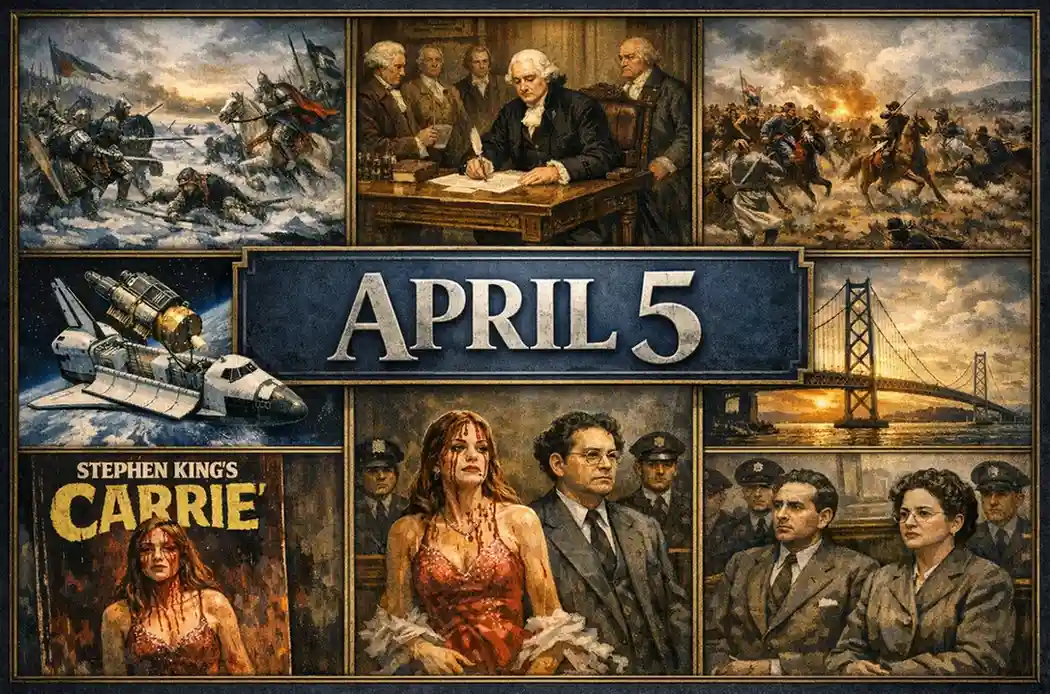
In analyzing what happened on this day in history April 5, we find a date defined by the exercise of new powers and the clash of empires. From the 1792 first use of the presidential veto by George Washington to the 1992 dissolution of the Peruvian Congress by military force, this day captures the tension between democratic governance and authoritarian shifts. It is also a day of monumental engineering and cultural debuts, featuring the return of the Mayflower in 1621 and the publication of Stephen King’s first novel in 1974.
Important Events That Happened On April 5 In History
823 – Coronation of Lothair I
Lothair I was crowned King of Italy by Pope Paschal I. This event solidified his position within the Carolingian Empire, marking a significant moment in the medieval struggle for authority between the Papacy and the Frankish monarchy.
919 – Second Fatimid Invasion of Egypt
The Fatimid heir-apparent, al-Qa’im bi-Amr Allah, set out from Raqqada at the head of his army, marking the start of the second Fatimid invasion of Egypt. This campaign was a major step in the Fatimid Caliphate’s long-term goal to expand eastward and seize control of the Nile Delta.
1242 – Battle on the Ice
During the Battle on the Ice of Lake Peipus, Russian forces led by Alexander Nevsky successfully rebuffed an invasion attempt by the Teutonic Knights. The victory prevented the expansion of the Northern Crusades into Russian territory and became a legendary symbol of national defense.
1536 – Charles V’s Royal Entry into Rome
Holy Roman Emperor Charles V made a grand Royal Entry into Rome. To re-enact a classical Roman triumph, he ordered the demolition of a swath of the city’s buildings to create a processional path, asserting his dominance over the Italian peninsula.
1566 – Petition of Compromise
Two hundred Dutch noblemen, led by Hendrick van Brederode, presented the Petition of Compromise to Margaret of Parma. The document denounced the Spanish Inquisition in the Seventeen Provinces, acting as a precursor to the Dutch Revolt against Spanish rule.
1614 – Marriage of Pocahontas and John Rolfe
In the Virginia Colony, Pocahontas, the daughter of Powhatan, married English colonist John Rolfe. The union led to a period of relative peace between the Jamestown settlers and the local Native American tribes, known as the “Peace of Pocahontas.”
1614 – Opening of the “Addled Parliament”
The second English Parliament of King James I, later nicknamed the “Addled Parliament,” opened. It lasted only two months and failed to pass any legislation or grant the King any taxes due to persistent conflicts over royal impositions.
1621 – The Mayflower Returns to England
After a winter spent at Plymouth, Massachusetts, the Mayflower set sail for its return voyage to England. While the crew departed, the surviving Pilgrims remained behind to establish their permanent colony in the New World.
1792 – First Presidential Veto
United States President George Washington exercised his constitutional authority to veto a bill for the first time in U.S. history. The bill concerned the apportionment of representatives, and Washington’s action set the precedent for the executive branch’s check on legislative power.
1795 – Peace of Basel
The Peace of Basel was concluded between France and Prussia. This treaty represented a significant shift in the French Revolutionary Wars, as Prussia recognized French control of the left bank of the Rhine and withdrew from the First Coalition.
1818 – Battle of Maipú
In a decisive engagement of the Chilean War of Independence, patriotic forces led by Bernardo O’Higgins and José de San Martín defeated the Spanish army. The victory at Maipú effectively ended major Spanish control over central Chile.
1862 – Battle of Yorktown Begins
The Battle of Yorktown commenced as part of the Peninsula Campaign during the American Civil War. Union General George B. McClellan began a siege of the Confederate lines, delaying his advance toward the capital of Richmond.
1879 – Outbreak of the War of the Pacific
Bolivia declared war on Chile, and Chile subsequently declared war on Peru, marking the formal beginning of the War of the Pacific. The conflict was largely driven by disputes over valuable mineral deposits in the Atacama Desert.
1902 – Ibrox Park Disaster
A stand box collapsed at Ibrox Park in Glasgow during an international football match between Scotland and England. The tragedy resulted in 25 deaths and more than 500 injuries, leading to major changes in stadium safety and design.
1910 – Transandine Railway Inauguration
The Transandine Railway, a massive engineering feat connecting Chile and Argentina through the Andes mountains, was officially inaugurated. The rail link provided a vital transport route across the continent until its partial closure in later decades.
1922 – Incorporation of the American Birth Control League
The American Birth Control League, the forerunner to Planned Parenthood, was officially incorporated. Founded by Margaret Sanger, the organization aimed to provide education and access to contraception in the United States.
1932 – Newfoundland Riot
In the Dominion of Newfoundland, ten thousand rioters seized the Colonial Building in St. John’s. The unrest, sparked by economic hardship and allegations of corruption, eventually led to the suspension of self-government.
1933 – FDR’s Executive Orders 6101 and 6102
U.S. President Franklin D. Roosevelt signed two major executive orders: 6101 established the Civilian Conservation Corps (CCC), and 6102 forbade the hoarding of gold coin and bullion by U.S. citizens, effectively taking the country further off the gold standard.
1933 – Andorran Revolution
During the Andorran Revolution, a group known as the Young Andorrans occupied the Casa de la Vall. They successfully forced the government to hold democratic elections with universal male suffrage, modernizing the nation’s political system.
1936 – Tupelo Tornado
A massive F5 tornado struck Tupelo, Mississippi, as part of a larger outbreak. The storm killed 233 people, making it one of the deadliest single tornadoes in United States history.
1938 – Abolition of the Generalitat
During the Spanish Civil War, dictator Francisco Franco decreed the abolition of the Generalitat, the autonomous government of Catalonia. The decree also removed the official status of the Catalan language as the Nationalist forces consolidated power.
1942 – Fuhrer Directive No. 41
Adolf Hitler issued Fuhrer Directive No. 41, outlining the strategy for “Case Blue.” This plan detailed the German summer offensive toward the Caucasus oil fields and included the fateful assault on the city of Stalingrad.
1942 – Attack on Colombo
The Imperial Japanese Navy launched a carrier-based air raid on Colombo, Ceylon (now Sri Lanka). The attack caused significant damage to port facilities and resulted in the sinking of the Royal Navy cruisers HMS Cornwall and HMS Dorsetshire.
1943 – Mortsel Bombing Tragedy
During World War II, U.S. Army Air Forces accidentally dropped bombs on the Belgian town of Mortsel while targeting a nearby factory. The error resulted in more than 900 civilian deaths, including 209 children at a local school.
1945 – Tito-Soviet Agreement
Yugoslav leader Josip Broz Tito signed an agreement allowing the temporary entry of Soviet troops into Yugoslav territory. This cooperation was crucial for the final expulsion of German forces from the region.
1946 – End of Bornholm Occupation
Soviet troops ended their year-long occupation of the Danish island of Bornholm. The island had remained under Soviet control following the end of the war in Europe until this negotiated withdrawal.
1946 – Rabat Aircraft Crash
A Vickers Wellington aircraft crashed into a residential area in Rabat, Malta, during a training exercise. The disaster killed all four crew members and 16 civilians on the ground.
1949 – St. Anthony’s Hospital Fire
A devastating fire at a hospital in Effingham, Illinois, claimed 77 lives. The tragedy shocked the nation and led to sweeping improvements in fire safety codes for hospitals across the United States.
1951 – Sentencing of the Rosenbergs
In a high-profile Cold War trial, Ethel and Julius Rosenberg were sentenced to death. They were convicted of conspiracy to commit espionage by passing secrets regarding the atomic bomb to the Soviet Union.
1956 – Castro Declares War on Batista
Fidel Castro officially declared himself at war with the government of Cuban President Fulgencio Batista. This proclamation intensified the military phase of the Cuban Revolution.
1958 – Ripple Rock Explosion
Ripple Rock, a major underwater hazard in Canada’s Seymour Narrows, was destroyed in a massive controlled explosion. It was one of the largest non-nuclear explosions ever recorded and made the waterway safe for navigation.
1965 – My Fair Lady Wins Best Picture
The film adaptation of the musical My Fair Lady won Best Picture at the 37th Academy Awards. The film, starring Audrey Hepburn and Rex Harrison, dominated the ceremony with a total of eight Oscars.
1966 – Buddhist Uprising in Đà Nẵng
During the Buddhist Uprising in South Vietnam, Prime Minister Nguyễn Cao Kỳ personally attempted to lead a military force to capture the city of Đà Nẵng. He eventually backed down to avoid a larger civil confrontation.
1971 – JVP Revolt in Sri Lanka
The Janatha Vimukthi Peramuna (JVP) launched an armed revolt against the United Front government of Sirimavo Bandaranaike. The uprising marked the beginning of a period of significant political violence in Sri Lanka.
1974 – Publication of Carrie
Stephen King’s first novel, Carrie, was published by Doubleday with an initial print run of 30,000 copies. The book’s success launched King’s career as one of the world’s most famous authors of horror and supernatural fiction.
1976 – Tiananmen Incident
In China, the April Fifth Movement led to a mass gathering in Tiananmen Square to mourn the death of Zhou Enlai. The peaceful protest turned into a violent clash with authorities, resulting in the “Tiananmen Incident.”
1977 – Rosebud Sioux Tribe v. Kneip
The U.S. Supreme Court ruled that congressional legislation had diminished the size of the Sioux reservation. The decision effectively destroyed the tribe’s jurisdictional authority over the affected land.
1983 – Founding of the People’s Armed Police
The People’s Armed Police (PAP) was officially founded in China. The paramilitary force was established to handle internal security, riot control, and border protection.
1991 – ASA Flight 2311 Crash
An Atlantic Southeast Airlines (ASA) flight crashed in Brunswick, Georgia, killing all 23 people on board. Among the victims were former U.S. Senator John Tower and NASA astronaut Sonny Carter.
1991 – Launch of STS-37
Space Shuttle Atlantis launched on mission STS-37. The primary objective was the deployment of the Compton Gamma Ray Observatory, a critical tool for studying high-energy physics in the universe.
1992 – Fujimori’s “Self-Coup”
President Alberto Fujimori of Peru dissolved the Peruvian Congress and suspended the judiciary using military force. This “self-coup” (autogolpe) allowed him to consolidate power and rewrite the nation’s constitution.
1992 – First Casualties of the Bosnian War
Peace protesters Suada Dilberovic and Olga Sučić were killed by snipers on the Vrbanja Bridge in Sarajevo. They are widely considered the first casualties of the Bosnian War, which followed the city’s declaration of independence.
1998 – Opening of the Akashi Kaikyō Bridge
The Akashi Kaikyō Bridge in Japan opened to traffic, connecting the city of Kobe to Awaji Island. At the time of its opening, it held the record for the longest central span of any suspension bridge in the world.
1999 – Lockerbie Suspects Handed Over
Two Libyan men suspected of the 1988 bombing of Pan Am Flight 103 were handed over to UN officials for trial. The proceedings took place at a special Scottish court convened in the Netherlands.
2007 – Sinking of MS Sea Diamond
The cruise ship MS Sea Diamond struck a volcanic reef near the Greek island of Santorini. While most passengers were evacuated, the ship sank the following day, and two passengers remained missing and presumed dead.
2009 – North Korean Satellite Launch
North Korea launched the Kwangmyŏngsŏng-2 satellite, which passed over mainland Japan. The launch prompted immediate condemnation from the UN Security Council and heightened regional tensions.
2010 – Attacks in Khyber Pakhtunkhwa
In Pakistan, twin suicide bombings targeted an Awami National Party rally in Timergara and the U.S. Consulate in Peshawar. Approximately 50 people were killed and 100 injured in the coordinated militant attacks.
2010 – Upper Big Branch Mine Disaster
An explosion at the Upper Big Branch coal mine in West Virginia killed 29 miners. It was the worst mining disaster in the United States in 40 years and led to intense scrutiny of safety regulations in the industry.
2010 – Launch of STS-131
Space Shuttle Discovery launched on mission STS-131. The crew successfully delivered equipment and supplies to the International Space Station during the 15-day mission.
2018 – Tennessee Slaughterhouse Raid
U.S. Immigration and Customs Enforcement agents raided a slaughterhouse in Bean Station, Tennessee. Nearly 100 undocumented Hispanic workers were detained in one of the largest workplace immigration raids in U.S. history.
2025 – Impeachment of Yoon Suk Yeol Upheld
The Constitutional Court of South Korea unanimously upheld the impeachment of President Yoon Suk Yeol. The ruling followed his 2024 declaration of martial law, officially terminating his presidency and triggering new elections.
Take A Look At April 4 Moments
Famous People Born on April 5
| Name | Description | Date |
|---|---|---|
| Herbert von Karajan | Austrian conductor, leading international conductor of mid-20th century | April 5, 1908 – July 16, 1989 |
| Jean-Honoré Fragonard | French Rococo painter (The Swing) | April 5, 1732 – August 22, 1806 |
| Algernon Charles Swinburne | English poet and critic | April 5, 1837 – April 10, 1909 |
| Nadar | French photographer, pioneering portraitist | April 5, 1820 – March 21, 1910 |
| Jules Ferry | French statesman, prime minister, colonial expansionist | April 5, 1832 – March 17, 1893 |
| Nigel Hawthorne | British actor (Yes, Minister, The Madness of King George) | April 5, 1929 – December 26, 2001 |
| Elihu Yale | English merchant and philanthropist, benefactor of Yale University | April 5, 1649 – July 8, 1721 |
| Nguyen Van Thieu | President of South Vietnam (1967–1975) | April 5, 1923 – September 29, 2001 |
| Alfred Blalock | American surgeon, co-developer of “blue baby” surgery | April 5, 1899 – September 15, 1964 |
| Herbert Bayer | Austrian-American artist, Bauhaus master | April 5, 1900 – September 30, 1985 |
| Franklin Chang-Díaz | Costa Rican-born American physicist and astronaut | April 5, 1950 – Present |
| Jagjivan Ram | Indian politician, Dalit leader | April 5, 1908 – July 6, 1986 |
| Louis Spohr | German violinist, composer, and conductor | April 5, 1784 – October 22, 1859 |
| Mistinguett | French comedienne and singer | April 5, 1875 – January 5, 1956 |
| Roman Herzog | President of Germany (1994–1999) | April 5, 1934 – January 10, 2017 |
| Albert Roussel | French composer | April 5, 1869 – August 23, 1937 |
| Charles IV Leopold | Duke of Lorraine and Bar, Austrian field marshal | April 5, 1643 – April 18, 1690 |
| Sir Thomas Masterman Hardy, Baronet | British naval officer, captain of HMS Victory under Nelson | April 5, 1769 – September 20, 1839 |
| Sir Henry Havelock | British soldier, hero of the Indian Rebellion of 1857 | April 5, 1795 – November 24, 1857 |
| Alexander I | First prince of modern autonomous Bulgaria (1879–1886) | April 5, 1857 – November 17, 1893 |
| Richard Eberhart | American poet, Pulitzer Prize winner | April 5, 1904 – June 9, 2005 |
| Frank Stockton | American novelist and short-story writer (The Lady, or the Tiger?) | April 5, 1834 – April 20, 1902 |
| Jesse H. Jones | American banker and government official, RFC chairman | April 5, 1874 – June 1, 1956 |
| Hugo Claus | Belgian poet, novelist, and playwright | April 5, 1929 – March 19, 2008 |
| Samuel Freeman Miller | Associate justice of the U.S. Supreme Court (1862–1890) | April 5, 1816 – October 13, 1890 |
| Fighting Harada | Japanese boxer, world flyweight and bantamweight champion | April 5, 1943 – Present |
| Chester Bowles | American politician, governor of Connecticut, ambassador to India | April 5, 1901 – May 25, 1986 |
| Sébastien Érard | French piano and harp maker, developed modern piano action | April 5, 1752 – August 5, 1831 |
| Vincenzo Gioberti | Italian philosopher and statesman | April 5, 1801 – November 26, 1852 |
| Nancy Holt | American land artist | April 5, 1938 – February 8, 2014 |
Famous People Died on April 5
| Name | Description | Date |
|---|---|---|
| Georges Danton | French Revolutionary leader, orator, and statesman | October 26, 1759 – April 5, 1794 |
| Cecil Taylor | American jazz pianist and composer, free jazz pioneer | March 15, 1929 – April 5, 2018 |
| Gene Pitney | American singer-songwriter | February 17, 1941 – April 5, 2006 |
| Hermann Joseph Muller | American geneticist, Nobel Prize winner (X-ray mutations) | December 21, 1890 – April 5, 1967 |
| Camille Desmoulins | French journalist and revolutionary | March 2, 1760 – April 5, 1794 |
| Pierre Samuel du Pont | American industrialist, founder of Du Pont | January 15, 1870 – April 5, 1954 |
| Edward Young | English poet and dramatist (Night Thoughts) | July 3, 1683 – April 5, 1765 |
| A.Y. Jackson | Canadian landscape painter, Group of Seven member | October 3, 1882 – April 5, 1974 |
| Allan Kaprow | American performance artist, inventor of “Happenings” | August 23, 1927 – April 5, 2006 |
| Sidney Altman | Canadian-American molecular biologist, Nobel Prize winner (catalytic RNA) | May 7, 1939 – April 5, 2022 |
| Earl Derr Biggers | American novelist, creator of Charlie Chan | August 26, 1884 – April 5, 1933 |
| Karl Otto Koch | German Nazi concentration camp commandant | August 2, 1897 – April 5, 1945 |
| Margaret Burbidge | English-born American astronomer, first woman director of Royal Greenwich Observatory | August 12, 1919 – April 5, 2020 |
| Anne-Marie-Louise d’Orléans, duchess de Montpensier | French princess, “La Grande Mademoiselle” | May 29, 1627 – April 5, 1693 |
| Vincent Youmans | American songwriter (No, No, Nanette) | September 27, 1898 – April 5, 1946 |
| Lee Petty | American stock-car driver, NASCAR pioneer | March 14, 1914 – April 5, 2000 |
| Thomas Hodgkin | English physician, described Hodgkin’s lymphoma | August 17, 1798 – April 5, 1866 |
| Baruch S. Blumberg | American physician, Nobel Prize winner (hepatitis B vaccine) | July 28, 1925 – April 5, 2011 |
| Mischa Elman | Russian-born American violin virtuoso | January 20, 1891 – April 5, 1967 |
| Charles Freer Andrews | English missionary, friend of Gandhi | 1871 – April 5, 1940 |
| Alfred Henry Sturtevant | American geneticist, developed gene mapping technique | November 21, 1891 – April 5, 1970 |
| Carlos Prío Socarrás | President of Cuba (1948–1952) | July 14, 1903 – April 5, 1977 |
| Marie-Jean Hérault de Séchelles | French revolutionary, member of Committee of Public Safety | September 20, 1759 – April 5, 1794 |
| Charles Pichegru | French general during Revolutionary Wars | February 16, 1761 – April 5, 1804 |
| Frédéric Le Play | French sociologist and mining engineer | April 11, 1806 – April 5, 1882 |
| Jacobus Johannes Pieter Oud | Dutch architect, pioneer of modern architecture | February 9, 1890 – April 5, 1963 |
| Johann Bernhard Fischer von Erlach | Austrian Baroque architect | July 20, 1656 – April 5, 1723 |
| Robert Raikes | British philanthropist, pioneer of the Sunday school movement | September 14, 1735 – April 5, 1811 |
| George Savile, 1st marquess of Halifax | English statesman, “The Trimmer” | November 11, 1633 – April 5, 1695 |
| Sir Arthur Travers Harris, 1st Baronet | British air officer, head of RAF Bomber Command in WWII | April 13, 1892 – April 5, 1984 |
Observances & Institutional Dates
- First Contact Day: An unofficial international observance celebrating the fictional future date when humans and Vulcans first met in the Star Trek universe.
- National Maritime Day (India): Commemorating the 1919 maiden voyage of the first Indian-owned ship, the SS Loyalty.
- Sikmogil (South Korea): Arbor Day, a national holiday dedicated to tree planting and forest conservation.
- International Day of Conscience: A UN-recognized day to promote a culture of peace with love and conscience.
Frequently Asked Questions
- When did the first U.S. presidential veto occur? George Washington issued the first presidential veto on April 5, 1792.
- What is the significance of the Battle of Maipú? Fought on April 5, 1818, it was the decisive victory that secured Chile’s independence from Spain.
- Who were the first casualties of the Bosnian War? Protesters Suada Dilberovic and Olga Sučić were killed on April 5, 1992, in Sarajevo.
- When was the Akashi Kaikyō Bridge opened? This record-breaking suspension bridge in Japan opened to traffic on April 5, 1998.