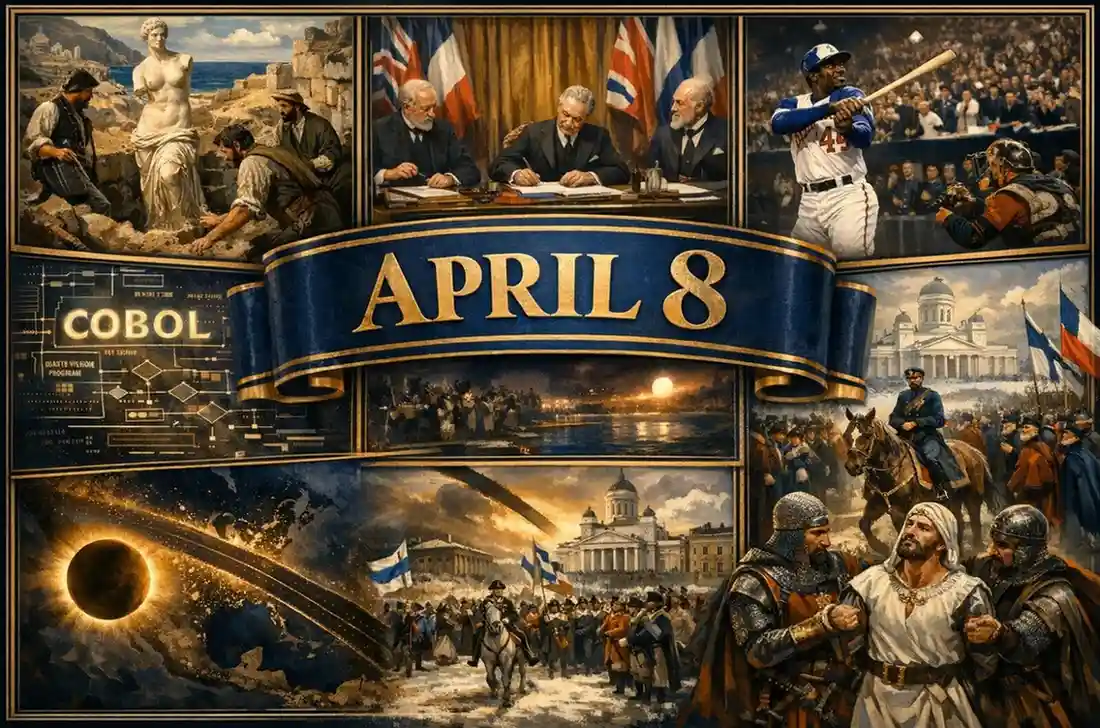
In our review of what happened on this day in history April 8, we encounter a date defined by the shifting of capitals and the signing of transformative global pacts. From the 1820 discovery of the Venus de Milo to the 1904 birth of the Entente Cordiale, this day captures the tension between cultural preservation and political maneuvering.
Important Events That Happened On April 8 In History
217 – Assassination of Emperor Caracalla
The Roman Emperor Caracalla was murdered while traveling in Mesopotamia, ending a reign marked by both cruelty and the extension of Roman citizenship. His death was orchestrated by the Praetorian Guard prefect, Marcus Opellius Macrinus, who immediately moved to secure the imperial throne. This transition highlighted the immense power held by the military elite in determining the leadership of the Roman Empire during the third century. Macrinus became the first emperor who was not of the senatorial rank, signifying a major shift in the traditional Roman social hierarchy.
876 – The Battle of Dayr al-‘Aqul
The Abbasid Caliphate secured a vital victory against the Saffarid forces at the Battle of Dayr al-‘Aqul, effectively halting an invasion of Iraq. By defeating the Saffarid ruler Ya’qub ibn al-Layth al-Saffar, the Caliphate successfully preserved the safety and sovereignty of its capital, Baghdad. The clash remains a significant historical marker for the survival of the Abbasid central authority against rising regional powers in the east. This military success prevented a total collapse of the caliphal administration and delayed the fragmentation of the Islamic empire for several decades.
1139 – Excommunication of Roger II
Pope Innocent II issued a formal decree of excommunication against Roger II of Sicily despite the king’s public recognition of the Pope’s legitimacy. The tension stemmed from Roger’s seven-year support of the rival claimant, Anacletus II, during a period of deep schism within the Catholic Church. This ecclesiastical punishment reflected the ongoing power struggle between the Papacy and the Norman rulers for territorial control in Southern Italy. The conflict eventually resolved through the Treaty of Mignano, where the Pope was forced to recognize Roger’s royal title after being captured in battle.
1143 – Accession of Manuel I Komnenos
Manuel I Komnenos officially succeeded his father, John II, as the Byzantine Emperor, beginning a reign noted for its ambitious foreign policy. His leadership was defined by a deep fascination with Western European culture and a desire to restore the empire’s influence over Italy and the Levant. Under his rule, the Byzantine Empire experienced a cultural and military renaissance, though his high-cost campaigns eventually strained the state’s resources. Manuel’s era is often viewed as the final flourishing of the Komnenian restoration before the empire faced renewed decline in the late 12th century.
1232 – Mongol Siege of Kaifeng Begins
The Mongol Empire launched a massive military investment of Kaifeng, the strategic capital of the Jin dynasty, during the Mongol–Jin War. This siege was a critical step in the Mongol conquest of Northern China, utilizing advanced weaponry and psychological warfare to break the city’s defenses. The fall of Kaifeng eventually forced the Jin court to flee, leading to the ultimate collapse of the dynasty a few years later in 1234. This campaign demonstrated the relentless expansionist policy of the Mongols and their ability to conquer highly fortified urban centers through sustained pressure.
1250 – Capture of King Louis IX
During the Seventh Crusade, the Ayyubid forces of Egypt captured King Louis IX of France following the disastrous Battle of Fariskur. The French monarch was taken into custody along with a significant portion of his army, effectively ending his first military expedition to the Holy Land. His release was only secured after the payment of a massive ransom and the surrender of the strategic port city of Damietta to the Egyptians. Despite this military failure, Louis IX’s conduct during his captivity contributed to his reputation for piety and his eventual canonization as a saint.
1271 – Conquest of Krak des Chevaliers
The Mamluk Sultan Baibars successfully conquered the Krak des Chevaliers, one of the most formidable crusader fortresses in modern-day Syria. By capturing this “impenetrable” stronghold, Baibars eliminated a major defensive hub of the Knights Hospitaller and further weakened the Crusader States. The fall of the castle was achieved through a combination of heavy bombardment and a forged letter that convinced the defenders to surrender. This victory marked a significant turning point in the Mamluk campaign to expel Western military orders from the Middle East permanently.
1605 – Founding of Oulu
Charles IX of Sweden issued the formal order to found the city of Oulu at the mouth of the Oulujoki river in Finland. The city was established to serve as a vital commercial hub and defensive outpost for the Swedish Empire in the northern Baltic region. Its strategic location allowed Oulu to grow into an important center for the international trade of tar, which was essential for shipbuilding. Today, Oulu remains a major urban center in Finland, having transitioned from a trading port to a global leader in technology and innovation.
1730 – Dedication of Shearith Israel
The congregation Shearith Israel dedicated its first synagogue building in New York City, marking a milestone for Jewish life in North America. This structure was the first synagogue built in continental North America, serving a community of Sephardic Jews who had sought refuge in the colonies. The dedication reflected the growing religious diversity of the American colonies and the emergence of institutional Jewish life in the New World. Commonly known as the Spanish and Portuguese Synagogue, it remains a testament to the long-standing history of the Jewish faith in the United States.
1812 – Helsinki Becomes the Capital of Finland
Czar Alexander I officially decreed that the capital of the Grand Duchy of Finland be moved from the city of Turku to Helsinki. The decision was influenced by Helsinki’s closer proximity to Saint Petersburg and its strong defensive position near the sea fortress of Suomenlinna. Following the decree, the city underwent a massive reconstruction in the Neoclassical style, giving it the grand architectural character it retains today. This shift permanently altered the political and cultural center of Finland, establishing Helsinki as the modern heart of the nation’s administration.
1820 – Discovery of the Venus de Milo
A peasant and a French naval officer found the ancient Greek statue known as the Venus de Milo on the island of Milos in the Aegean. The sculpture, widely believed to represent the goddess Aphrodite, was soon acquired by France and placed in the Louvre Museum in Paris. Dating back to the Hellenistic period, the statue’s missing arms and graceful form sparked intense global fascination with classical antiquity. It remains one of the most celebrated works of Western art, symbolizing the enduring beauty and mystery of ancient Greek craftsmanship.
1832 – U.S. Troops Depart for the Black Hawk War
Approximately 300 soldiers from the United States 6th Infantry departed from St. Louis to confront Sauk and Fox tribes led by Chief Black Hawk. The movement of these troops marked the escalation of the Black Hawk War, a conflict centered on disputed land treaties in the Illinois territory. The campaign sought to forcibly remove Native American populations who had returned to their ancestral lands to plant corn and seek refuge. This military action contributed to the broader pattern of displacement and conflict that characterized the American expansion into the Midwest.
1866 – Secret Alliance Against Austria
Italy and Prussia signed a covert military agreement aimed at challenging the dominance of the Austrian Empire in Central Europe and the Mediterranean. The alliance was a strategic masterstroke by Otto von Bismarck, ensuring that Austria would have to fight a war on two fronts simultaneously. Italy’s goal was the liberation of Venetia, while Prussia sought to establish its leadership over a unified German state without Austrian interference. This diplomatic pact set the stage for the Austro-Prussian War, which would fundamentally redraw the political boundaries of the European continent.
1886 – First Irish Home Rule Bill
William Ewart Gladstone introduced the first Irish Home Rule Bill to the British House of Commons, seeking to grant Ireland a degree of self-government. The proposal sparked a massive political controversy, splitting the Liberal Party and igniting fierce opposition from Unionists in both Britain and Ireland. Gladstone argued that granting a domestic parliament to Dublin was the only way to ensure long-term peace and stability within the United Kingdom. Although the bill was ultimately defeated, it placed the “Irish Question” at the forefront of British politics for the next several decades.
1895 – Pollock v. Farmers’ Loan & Trust Co.
The Supreme Court of the United States issued a landmark ruling declaring unapportioned federal income tax to be unconstitutional. The court argued that taxes on income from property were direct taxes and thus had to be apportioned among the states based on their population. This decision effectively nullified the income tax provisions of the Wilson–Gorman Tariff Act of 1894, protecting wealthy landowners from federal levies. The ruling was so controversial that it eventually led to the ratification of the 16th Amendment in 1913, which granted Congress the power to tax income.
1904 – The Entente Cordiale
The United Kingdom and the French Third Republic signed the Entente Cordiale, a series of agreements that resolved long-standing colonial disputes. This diplomatic rapprochement ended centuries of intermittent conflict between the two nations, particularly regarding their interests in Africa and Asia. While not a formal military alliance, the pact significantly improved Anglo-French relations and acted as a counterweight to German expansion in Europe. The Entente Cordiale paved the way for the later Triple Entente, which would become a defining alliance during the First World War.
1940 – Election of Yumjaagiin Tsedenbal
The Mongolian People’s Revolutionary Party elected Yumjaagiin Tsedenbal as General Secretary, initiating his 44-year reign as the leader of Mongolia. His long tenure was characterized by close alignment with the Soviet Union and the extensive modernization of the Mongolian economy and infrastructure. Tsedenbal became the de facto ruler of the country, navigating the complexities of the Cold War while maintaining a tight grip on domestic political power. His departure from office in 1984 marked the end of the longest leadership period in the history of the modern Mongolian state.
1954 – Mid-Air Collision Over Moose Jaw
A Royal Canadian Air Force trainer plane collided with a Trans-Canada Airlines passenger aircraft over the city of Moose Jaw, Saskatchewan. The catastrophic accident resulted in the deaths of 37 people and sent wreckage falling into a residential neighborhood below. The tragedy prompted a national debate regarding aviation safety and the separation of military and civilian flight paths over urban areas. It remains one of the deadliest aviation disasters in Canadian history and a somber reminder of the risks associated with increasing air traffic.
1954 – Crash of SAA Flight 201
A South African Airways de Havilland Comet 1 crashed into the Mediterranean Sea during a night flight, killing all 21 people on board. This was the second mysterious crash involving a Comet aircraft in just a few months, leading to the temporary grounding of the entire fleet. Subsequent investigations revealed that the world’s first commercial jetliner suffered from catastrophic metal fatigue caused by repeated cabin pressurization. These findings revolutionized aircraft design and safety testing, leading to the development of much stronger and safer airframes for future jet travel.
1959 – Birth of the COBOL Language
A committee of computer experts, led by the pioneering Grace Hopper, met to begin the development of a new programming language called COBOL. The language was designed to be “common” and “business-oriented,” allowing for data processing tasks to be performed across different types of computers. COBOL utilized English-like syntax, making it more accessible to business professionals who were not trained in complex mathematical coding. Decades later, COBOL remains the backbone of many global financial systems, proving the incredible longevity and utility of the committee’s original vision.
1959 – Creation of the Inter-American Development Bank
The Organization of American States drafted the formal agreement to establish the Inter-American Development Bank (IDB) to support regional growth. The bank was created to provide financial and technical assistance for economic and social development projects across Latin America and the Caribbean. By offering low-interest loans and grants, the IDB sought to reduce poverty and improve infrastructure in developing nations within the Western Hemisphere. It has since grown into the largest source of development financing for the region, playing a critical role in its modern economic history.
1960 – West German–Dutch Land Agreement
The Netherlands and West Germany signed a treaty to resolve territorial disputes arising from the Dutch annexation of German land after World War II. Under the agreement, the Netherlands returned most of the occupied border territories to West Germany in exchange for a payment of 280 million marks. The payment was classified as “Wiedergutmachung” or reparations, intended to compensate for the damages suffered by the Dutch during the war. This diplomatic resolution helped normalize relations between the two neighbors and integrated West Germany more fully into the European community.
1968 – Posthumous George Cross for Barbara Jane Harrison
Flight attendant Barbara Jane Harrison was awarded the George Cross posthumously for her heroic actions during the fire on BOAC Flight 712. After the aircraft caught fire shortly after takeoff from London, Harrison stayed on board to help passengers escape the burning cabin. Her selfless courage saved several lives, but she unfortunately perished in the flames while trying to reach an elderly passenger. She remains the only woman to be awarded the George Cross for an act of bravery performed during peacetime in British history.
1970 – Bahr El-Baqar School Bombing
Israeli bombers struck a primary school in the Egyptian village of Bahr El-Baqar during the ongoing War of Attrition between the two nations. The air raid resulted in the deaths of 46 children and left many others wounded, sparking a wave of international condemnation. Israel claimed the school was part of a military installation, while Egypt maintained it was a purely civilian target used for education. The tragedy remains a deeply painful memory in Egyptian history and a significant incident in the long-standing Arab-Israeli conflict.
1974 – Hank Aaron Hits Home Run 715
Hank Aaron surpassed Babe Ruth’s legendary record for career home runs by hitting his 715th homer at Atlanta-Fulton County Stadium. The historic moment occurred off a pitch from Al Downing, as a massive crowd cheered Aaron’s defiance of intense racial pressure and threats. Aaron’s achievement was a triumph of skill and perseverance, cementing his place as one of the greatest athletes in the history of baseball. The “Home Run King” held the record for over three decades, symbolizing a major breakthrough for Black athletes in professional sports.
1975 – Establishment of Voyageurs National Park
The United States Congress officially established Voyageurs National Park in northern Minnesota to protect its unique water-based wilderness. The park was named after the French-Canadian fur traders, or “voyageurs,” who frequently traveled the region’s interconnected lakes and rivers. It preserved over 200,000 acres of boreal forest and aquatic ecosystems, offering a sanctuary for wildlife such as bald eagles, wolves, and moose. The creation of the park ensured that the historic trade routes and natural beauty of the border region would be protected for future generations.
1990 – Victory for New Democracy in Greece
The conservative New Democracy party, led by Constantine Mitsotakis, won the Greek parliamentary election, ending a period of political instability. The victory allowed Mitsotakis to form a government after two previous indecisive elections had left the country without a clear majority. The new administration focused on implementing free-market reforms and stabilizing the Greek economy during a time of significant European transition. This election marked a shift away from the populist policies of the previous decade and sought to strengthen Greece’s ties with the European Union.
1993 – Launch of STS-56
The Space Shuttle Discovery launched from the Kennedy Space Center on mission STS-56 to conduct atmospheric research. The primary goal of the mission was to deploy the ATLAS-2 laboratory, which studied the relationship between the sun’s energy and the Earth’s atmosphere. The crew also conducted various experiments related to the ozone layer and solar radiation, providing critical data for climate science. This mission highlighted NASA’s ongoing commitment to using space technology to better understand and protect our home planet’s environment.
2002 – Launch of STS-110 and Jerry Ross’s Record
The Space Shuttle Atlantis launched on mission STS-110, carrying the critical S0 truss segment to the International Space Station. The mission was a major construction milestone, as the truss served as the structural backbone for the station’s solar arrays and cooling systems. During the flight, astronaut Jerry L. Ross became the first person in history to fly on seven distinct space missions. His record-breaking career exemplified the dedication and experience of the NASA astronaut corps during the peak of the Space Shuttle era.
2005 – Hybrid Solar Eclipse
A rare hybrid solar eclipse occurred, transitioning between a total and annular eclipse as it traveled across the Pacific Ocean. The celestial event was visible over parts of Central and South America, including Costa Rica, Panama, Colombia, and Venezuela. Skywatchers in these regions observed the moon partially or fully obscuring the sun, creating a dramatic “ring of fire” or a total blackout. Such eclipses provide scientists with valuable opportunities to study the sun’s corona and the dynamics of the Earth’s atmosphere.
2010 – Signing of the New START Treaty
U.S. President Barack Obama and Russian President Dmitry Medvedev signed the New START Treaty in Prague to reduce their nuclear arsenals. The agreement committed both nations to significant cuts in the number of deployed strategic nuclear warheads and delivery systems. It also established a rigorous inspection regime to ensure transparency and mutual trust between the world’s two largest nuclear powers. The treaty was a major achievement in the “reset” of U.S.–Russia relations and a significant step toward global nuclear disarmament.
2014 – End of Life for Windows XP
Microsoft officially ended support for the Windows XP operating system, marking the final “End of Life” for the iconic software. The move meant that computers running Windows XP would no longer receive security updates, leaving them vulnerable to new viruses and malware. Released in 2001, Windows XP had been one of the most popular and long-lived operating systems in the history of personal computing. Its retirement forced millions of users and businesses worldwide to upgrade to newer, more secure versions of the Windows platform.
2020 – Bernie Sanders Ends Presidential Campaign
Senator Bernie Sanders officially suspended his 2020 presidential campaign, clearing the path for Joe Biden to become the Democratic nominee. Sanders’ departure followed a series of primary losses and occurred as the COVID-19 pandemic significantly disrupted the political process. His campaign had focused on “progressive” issues like Medicare for All and wealth inequality, significantly influencing the Democratic Party’s platform. By ending his bid, Sanders aimed to unify the party and focus all resources on the upcoming general election against Donald Trump.
2024 – Total Solar Eclipse Over North America
A total solar eclipse took place across North America, with the path of totality stretching from Mexico through the United States and into Canada. Millions of people gathered to witness the moon completely block the sun, turning day into night for several minutes in many major cities. The event was a major scientific and cultural phenomenon, driving significant tourism and providing a wealth of data for solar researchers. It was the first total solar eclipse visible in the contiguous United States since 2017 and won’t happen again in the region for decades.
Famous People Born on April 8
| Name | Description | Date |
|---|---|---|
| Kofi Annan | Ghanaian secretary-general of the United Nations (1997–2006), Nobel Peace Prize winner | April 8, 1938 – August 18, 2018 |
| Christian IX | King of Denmark (1863–1906), “father-in-law of Europe” | April 8, 1818 – January 29, 1906 |
| Edmund Husserl | German philosopher, founder of phenomenology | April 8, 1859 – April 27, 1938 |
| Philip IV | King of Spain (1621–1665) and Portugal (1621–1640) | April 8, 1605 – September 17, 1665 |
| Albert I | King of Belgium (1909–1934), led Belgian army in World War I | April 8, 1875 – February 17, 1934 |
| John Havlicek | American basketball player, Boston Celtics legend | April 8, 1940 – April 25, 2019 |
| Ian Smith | Prime minister of Rhodesia (1964–1979) | April 8, 1919 – November 20, 2007 |
| Mary Pickford | Canadian-born American silent film actress, co-founder of United Artists | April 8, 1892 – May 29, 1979 |
| Sonja Henie | Norwegian-American figure skater, three-time Olympic gold medalist | April 8, 1912 – October 12, 1969 |
| Betty Ford | American first lady (1974–1977), founder of Betty Ford Center | April 8, 1918 – July 8, 2011 |
| Barbara Kingsolver | American author and activist | April 8, 1955 – Present |
| Vivienne Westwood | British fashion designer, punk fashion pioneer | April 8, 1941 – December 29, 2022 |
| Jacques Brel | Belgian singer and songwriter | April 8, 1929 – October 9, 1978 |
| Richard Joseph Neutra | Austrian-American architect, International Style pioneer | April 8, 1892 – April 16, 1970 |
| Melvin Calvin | American biochemist, Nobel Prize winner (photosynthesis) | April 8, 1911 – January 8, 1997 |
| Carmen McRae | American jazz vocalist and pianist | April 8, 1920 – November 10, 1994 |
| Harvey Williams Cushing | American neurosurgeon, “father of modern neurosurgery” | April 8, 1869 – October 7, 1939 |
| John Fante | American writer | April 8, 1909 – May 8, 1983 |
| Giuseppe Tartini | Italian violinist and composer | April 8, 1692 – February 26, 1770 |
| Sir John R. Hicks | English economist, Nobel Prize winner | April 8, 1904 – May 20, 1989 |
| Catfish Hunter | American baseball pitcher, Hall of Famer | April 8, 1946 – September 9, 1999 |
| Hou Hsiao-hsien | Taiwanese film director | April 8, 1947 – Present |
| Tom DeLay | American politician, U.S. House Majority Leader (2003–2006) | April 8, 1947 – Present |
| William Henry Welch | American pathologist, founder of Johns Hopkins medical school | April 8, 1850 – April 30, 1934 |
| Peter I | King of Portugal (1357–1367) | April 8, 1320 – January 18, 1367 |
| Charles-Édouard Brown-Séquard | French physiologist and neurologist | April 8, 1817 – April 1, 1894 |
| Sir Adrian Cedric Boult | English conductor | April 8, 1889 – February 23, 1983 |
| Dhionísios, Count Solomós | Greek poet, national poet of Greece | April 8, 1798 – November 21, 1857 |
| David Rittenhouse | American astronomer and inventor | April 8, 1732 – June 26, 1796 |
| August Wilhelm von Hofmann | German chemist, aniline dye pioneer | April 8, 1818 – May 2, 1892 |
Famous People Died on April 8
| Name | Description | Date |
|---|---|---|
| Pablo Picasso | Spanish artist, one of the greatest and most influential artists of the 20th century | October 25, 1881 – April 8, 1973 |
| Margaret Thatcher | Prime minister of the United Kingdom (1979–1990), “Iron Lady” | October 13, 1925 – April 8, 2013 |
| Peter Higgs | British physicist, Nobel Prize winner (Higgs boson) | May 29, 1929 – April 8, 2024 |
| Gaetano Donizetti | Italian opera composer | November 29, 1797 – April 8, 1848 |
| Vaslav Nijinsky | Russian ballet dancer, legendary performer | 1889/1890 – April 8, 1950 |
| Sol LeWitt | American artist, pioneer of Minimalism and conceptual art | September 9, 1928 – April 8, 2007 |
| Marian Anderson | American contralto, civil rights icon | February 27, 1897 – April 8, 1993 |
| Omar Bradley | United States general, first chairman of the Joint Chiefs of Staff | February 12, 1893 – April 8, 1981 |
| Caracalla | Roman emperor (198–217) | April 4, 188 – April 8, 217 |
| John II | King of France (1350–1364) | April 16, 1319 – April 8, 1364 |
| Pyotr Leonidovich Kapitsa | Soviet physicist, Nobel Prize winner (superfluidity) | July 8, 1894 – April 8, 1984 |
| Wilhelm von Humboldt | German language scholar, philosopher, and diplomat | June 22, 1767 – April 8, 1835 |
| King Oliver | American jazz cornetist, mentor to Louis Armstrong | May 11, 1885 – April 8, 1938 |
| John II Comnenus | Byzantine emperor (1118–1143) | September 13, 1087 – April 8, 1143 |
| Taishi Shōtoku | Japanese regent, author of Japan’s first constitution | 574 – April 8, 622 |
| Adolph Simon Ochs | American newspaper publisher, owner of The New York Times | March 12, 1858 – April 8, 1935 |
| Ferenc Rákóczi II | Prince of Transylvania, leader of Hungarian uprising against Habsburgs | March 27, 1676 – April 8, 1735 |
| Mangal Pandey | Indian soldier, key figure in the Indian Rebellion of 1857 | July 19, 1827 – April 8, 1857 |
| Elisha Otis | American inventor of the safety elevator | August 3, 1811 – April 8, 1861 |
| István, Count Széchenyi | Hungarian political reformer and writer | September 21, 1791 – April 8, 1860 |
| Bankim Chandra Chatterjee | Indian author, composer of Vande Mataram | June 26, 1838 – April 8, 1894 |
| Richard Olney | U.S. secretary of state (1895–1897) | September 15, 1835 – April 8, 1917 |
| Juan Belmonte | Spanish bullfighter, revolutionary torero | April 14, 1892 – April 8, 1962 |
| Abel Tendekayi Muzorewa | Prime minister of Zimbabwe Rhodesia (1979) | April 14, 1925 – April 8, 2010 |
| Antony Flew | English philosopher, prominent atheist turned deist | February 11, 1923 – April 8, 2010 |
| Ryan White | American AIDS activist and symbol of AIDS crisis | December 6, 1971 – April 8, 1990 |
| Daniel Bovet | Italian pharmacologist, Nobel Prize winner | March 23, 1907 – April 8, 1992 |
| Erik Axel Karlfeldt | Swedish poet, Nobel Prize in Literature (posthumous) | July 20, 1864 – April 8, 1931 |
| Ford Frick | American baseball executive, commissioner of baseball (1951–1965) | December 19, 1894 – April 8, 1978 |
| Malcolm McLaren | British impresario, manager of the Sex Pistols | January 22, 1946 – April 8, 2010 |
Observances & Institutional Dates
- International Romani Day: A day to celebrate Romani culture and raise awareness of the challenges facing the Romani people globally.
- Buddha’s Birthday (Hana Matsuri): Known as the “Flower Festival” in Japan, this holiday commemorates the birth of the historical Buddha.
Frequently Asked Questions
- Why was the Entente Cordiale important? It was a series of 1904 agreements that ended centuries of rivalry between Britain and France, shaping WWI alliances.
- When did Hank Aaron break Babe Ruth’s record? Hank Aaron hit his 715th home run to break the record on April 8, 1974.
- What is COBOL? COBOL is a business-oriented programming language first discussed by a committee led by Grace Hopper on April 8, 1959.
- When did Windows XP support end? Microsoft officially ended all standard support for Windows XP on April 8, 2014.