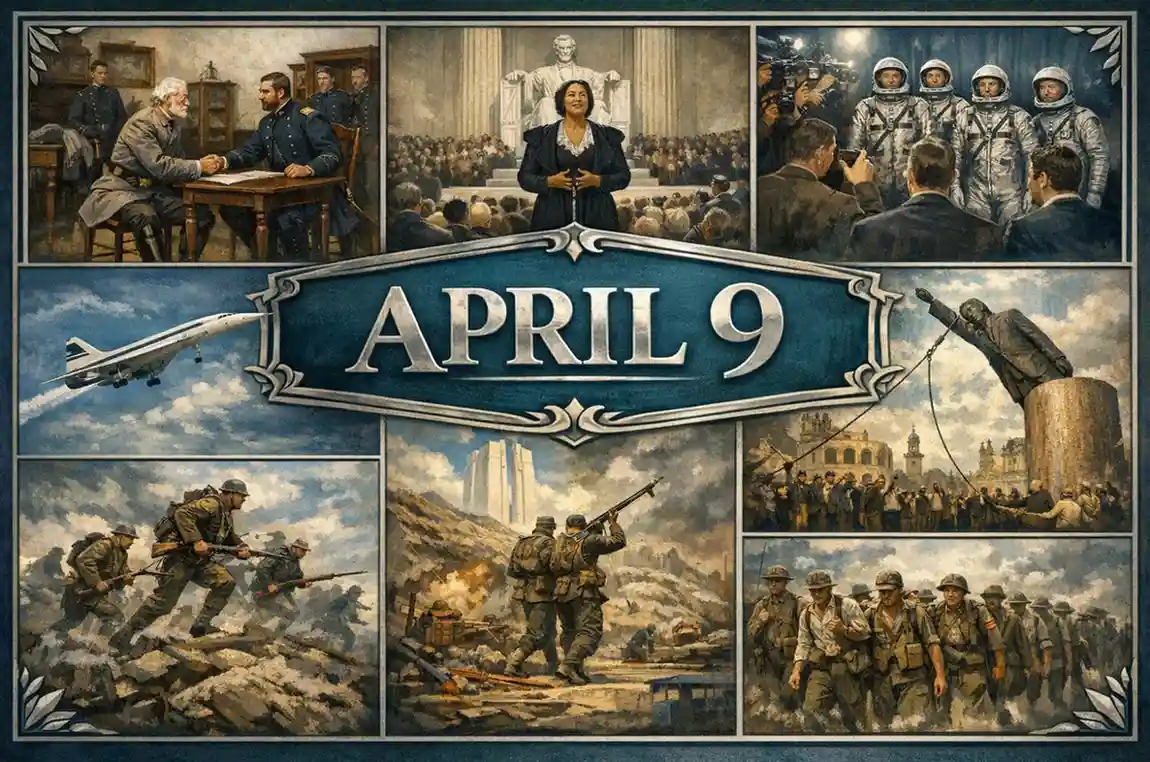
From the 1865 surrender at Appomattox Court House to the 2003 fall of Baghdad, historic endings have frequently paved the way for new beginnings. Across the timeline of this day in history April 9, we also witness a surge in human ingenuity, marked by the 1959 debut of the Mercury Seven astronauts and the inaugural flights of the Boeing 737 and Concorde. These events transformed the nature of global conflict and accelerated our journey into the supersonic age.
Important Events That Happened On April 9 In History
193 – Proclamation of Septimius Severus
The Roman army stationed in Illyricum declared the battle-hardened Septimius Severus as their new leader and emperor. His ascent followed the chaotic period of the Year of the Five Emperors, marking the beginning of the Severan dynasty. The move consolidated military support behind a single commander, eventually allowing him to stabilize the empire through force.
475 – Circular Letter of Basiliscus
Byzantine Emperor Basiliscus issued the Enkyklikon, a formal circular letter addressed to the high-ranking bishops of the Christian world. The document expressed imperial backing for the Monophysite theological position, sparking significant religious debate across the empire. By taking a firm stance on the nature of Christ, the emperor attempted to unify the fractured church under a single doctrine.
537 – Reinforcements for Belisarius
The Byzantine general Belisarius received a vital surge of 1,600 expert cavalrymen during the grueling Siege of Rome. These archers, predominantly of Hunnic and Slavic descent, provided the mobility needed to launch daring raids against the Gothic camps. Despite the arrival of these fresh troops, the conflict remained a tense stalemate as resources within the city dwindled.
1241 – Battle of Liegnitz
Mongol forces achieved a devastating victory over the combined armies of Poland and Germany in a clash that shook European nobility. The superior tactics and speed of the Mongol riders overcame the heavy armor and traditional formations of the Western knights. This defeat created a wave of panic throughout the continent, revealing the immense threat posed by the expanding Mongol Empire.
1288 – Battle of Bach Dang
Trần forces in northern Vietnam successfully repelled a massive naval invasion led by the Yuan dynasty of the Mongols. The Vietnamese used a clever strategy of planting iron-tipped stakes in the riverbed to trap and destroy the retreating Mongol fleet. This victory effectively ended the Mongol attempts to conquer the region, securing the independence of the Trần state.
1387 – Surrender of Thessalonike
The Byzantine city of Thessalonike officially surrendered to the Ottoman Empire after enduring a prolonged and difficult siege. This loss represented a significant blow to the shrinking Byzantine territory, further isolating the capital of Constantinople. Imperial rule briefly returned to the city following the Battle of Ankara years later, though its long-term fate remained tied to the Ottomans.
1388 – Victory at the Battle of Näfels
Forces of the Old Swiss Confederacy secured a stunning win against the Archduchy of Austria despite being outnumbered sixteen to one. Utilizing the rugged mountainous terrain, the Swiss infantry launched a surprise attack that threw the heavily armored Austrian cavalry into chaos. This triumph solidified the independence of Glarus and strengthened the growing Swiss alliance against the Habsburg dynasty.
1438 – Opening of the Council of Ferrara
The Council of Ferrara began its first official session, presided over by Pope Eugene IV and attended by the Patriarch of Constantinople. The gathering brought together representatives from the major Eastern Sees to discuss the reunification of the Catholic and Orthodox churches. These negotiations were driven by the desperate need for Western military aid as the Byzantine Empire faced imminent Ottoman threats.
1454 – Signing of the Treaty of Lodi
The Treaty of Lodi established a diplomatic balance of power among the major northern Italian city-states for nearly half a century. The pact ended years of warfare between Venice and Milan, creating a peaceful environment that allowed the Renaissance to flourish. By recognizing existing borders, the treaty prevented any single state from dominating the entire Italian peninsula.
1511 – Outbreak of the Şahkulu Rebellion
Shiite Muslims rose up against the Ottoman Empire in a large-scale revolt led by the charismatic figure Şahkulu. The rebellion was fueled by religious tension and dissatisfaction with the administration of Sultan Bayezid II. At its peak, the movement posed a significant threat to Ottoman control in Anatolia and disrupted internal military stability.
1609 – Treaty of Antwerp
Spain and the Dutch Republic signed the Treaty of Antwerp, initiating a twelve-year truce during the Eighty Years’ War. The agreement provided a much-needed reprieve for both nations, allowing the Dutch to focus on their growing global trade empire. Spain’s recognition of the Northern Provinces’ autonomy, even temporarily, was a major diplomatic victory for the Dutch people.
1609 – Expulsion of the Moriscos
King Philip III of Spain issued a harsh decree ordering the total expulsion of the Moriscos from Spanish territory. The Moriscos were descendants of Spain’s Muslim population who had been forcibly converted to Christianity but were viewed with suspicion. Hundreds of thousands of people were forced to leave their homes, causing a massive demographic and economic shift in the region.
1682 – La Salle Reaches the Mississippi Mouth
Robert Cavelier de La Salle reached the mouth of the Mississippi River, claiming the vast surrounding territory for the French Crown. He named the expansive region Louisiana in honor of King Louis XIV, laying the foundation for a massive French colonial empire. This journey connected the Great Lakes to the Gulf of Mexico, opening a vital strategic waterway for trade and exploration.
1784 – Ratification of the Treaty of Paris
King George III of Great Britain officially ratified the Treaty of Paris, bringing a legal end to the American Revolutionary War. The ratification followed the earlier approval by the U.S. Congress, confirming the independence of the thirteen American colonies. This document formally recognized the United States as a sovereign nation and established the boundaries of the new country.
1860 – First Audible Voice Recording
Édouard-Léon Scott de Martinville utilized his phonautograph machine to create the first known recording of a human voice. The device etched visual representations of sound waves onto soot-covered paper, though it was not initially designed for playback. Modern technology later allowed these “phonautograms” to be converted back into sound, revealing a haunting snippet of a French folk song.
1865 – Surrender at Appomattox
General Robert E. Lee surrendered the Army of Northern Virginia to General Ulysses S. Grant at the Appomattox Court House. The peaceful meeting between the two commanders effectively signaled the end of the American Civil War after four years of bloodshed. Grant offered generous terms to the Confederate troops, allowing them to return home with their horses to resume their lives as citizens.
1909 – Payne–Aldrich Tariff Act
The U.S. Congress passed the Payne–Aldrich Tariff Act, which sought to adjust the nation’s import duties on various goods. The legislation caused a major rift within the Republican Party, as many felt it failed to lower tariffs as promised by President Taft. Progressive members of government viewed the act as a win for large corporations at the expense of the average consumer.
1917 – Assault on Vimy Ridge
The Canadian Corps launched a massive and meticulously planned assault on Vimy Ridge during the first day of the Battle of Arras. Through innovative creeping barrage tactics and intense training, the Canadians successfully captured the high ground from German forces. This achievement was the first time all four Canadian divisions fought together, creating a powerful sense of national identity.
1918 – Battle of the Lys
German forces crushed the Portuguese Expeditionary Corps during a massive offensive in the Belgian region of Flanders. The attack was part of the wider Spring Offensive, intended to break the Allied lines before American reinforcements could fully arrive. The Portuguese troops, exhausted and outnumbered, suffered heavy losses as the German army made significant territorial gains.
1937 – Flight of the Kamikaze
A Japanese-built aircraft named the Kamikaze arrived at London’s Croydon Airport, completing a record-breaking journey from Tokyo. It was the first Japanese aircraft to fly to Europe, showcasing the rapid advancement of Japan’s aviation industry to the world. The flight was a major feat of endurance and navigation, capturing the attention of the international press and public.
1939 – Marian Anderson’s Lincoln Memorial Concert
Renowned singer Marian Anderson performed a historic concert at the Lincoln Memorial before an integrated crowd of 75,000 people. She was invited to the site after being barred from performing at Constitution Hall due to her race. Her performance of “My Country, ‘Tis of Thee” became a powerful anthem for the early civil rights movement in America.
1940 – Invasion of Denmark and Norway
Nazi Germany launched Operation Weserübung, a simultaneous military invasion of Denmark and Norway during World War II. Denmark surrendered within hours to avoid total destruction, while Norway put up a fierce resistance that lasted for several weeks. The invasion was designed to secure iron ore supplies from Sweden and provide naval bases for the German fleet in the North Sea.
1940 – Vidkun Quisling Seizes Power
As German troops moved into Norway, the fascist politician Vidkun Quisling declared himself the new leader of the country in a radio broadcast. His attempt to seize power during the chaos made his name a permanent synonym for “traitor” in many world languages. While the Norwegian people and their king refused to recognize his authority, he eventually led a collaborationist government under German control.
1942 – End of the Battle of Bataan
The Battle of Bataan concluded with the surrender of approximately 75,000 Filipino and American troops to the Imperial Japanese Army. This was the largest surrender in American military history, leaving the Philippines almost entirely under Japanese occupation. Immediately following the surrender, the captives were forced into the brutal Bataan Death March toward prison camps.
1942 – Japanese Raid on HMS Hermes
Japan’s 1st Air Fleet launched a carrier-based air attack in the Indian Ocean, sinking the British aircraft carrier HMS Hermes. The raid also resulted in the loss of the Australian destroyer HMAS Vampire as the Japanese navy asserted its dominance in the region. The loss of the Hermes was a significant blow to the Royal Navy’s presence in the East, leaving British interests vulnerable.
1945 – Execution of Dietrich Bonhoeffer
The Nazi regime executed Dietrich Bonhoeffer, a Lutheran pastor and prominent anti-Nazi dissident, at the Flossenbürg concentration camp. Bonhoeffer had been a vocal opponent of the regime’s policies and was involved in the underground resistance movement. He was killed just weeks before the end of the war, leaving behind a profound legacy of theological and ethical courage.
1945 – Sinking of the Admiral Scheer
Royal Air Force bombers successfully sank the German heavy cruiser Admiral Scheer during an air raid on the port of Kiel. The ship was hit multiple times and capsized in its dock, ending its career as a major surface raider for the German navy. The sinking was part of a larger campaign to destroy the remains of the German fleet in the final weeks of World War II.
1945 – End of the Battle of Königsberg
The Battle of Königsberg in East Prussia came to a close as Soviet forces captured the heavily fortified German city. After days of intense urban combat and heavy artillery shelling, the German garrison finally surrendered to the Red Army. The city’s fall marked a major milestone in the Soviet advance toward Berlin and resulted in the total displacement of its local population.
1945 – Formation of the AEC
The United States established the Atomic Energy Commission (AEC) to manage the development and regulation of nuclear technology. This agency took over the work of the Manhattan Project, shifting control of atomic energy from military to civilian hands. The AEC was tasked with promoting the peaceful use of nuclear power while maintaining the nation’s nuclear weapons stockpile.
1946 – Tel Aviv Postal Strike
Approximately 500 postal workers in the cities of Tel Aviv and Jaffa went on a strike to demand better wages and working conditions. The labor action disrupted communications across the region during a period of significant political transition in Mandatory Palestine. The strike highlighted the growing organizational power of the local workforce and their willingness to challenge the British administration.
1947 – Glazier–Higgins–Woodward Tornadoes
A massive tornado system struck parts of Texas, Oklahoma, and Kansas, resulting in 181 deaths and widespread destruction. The most devastating storm obliterated the town of Glazier and caused catastrophic damage in Higgins and Woodward. This remains one of the deadliest tornado outbreaks in American history, leading to significant changes in weather monitoring.
1947 – Start of the Journey of Reconciliation
The Journey of Reconciliation began as the first interracial “Freedom Ride” through the upper American South. Riders sought to challenge Jim Crow laws by practicing nonviolent integrated travel on interstate buses. The initiative was a direct response to a Supreme Court ruling that banned racial segregation in interstate travel.
1947 – UN Security Council Resolution 22
The United Nations Security Council adopted Resolution 22 regarding the Corfu Channel incident between the UK and Albania. The resolution recommended that the two nations take their dispute to the International Court of Justice for a legal resolution. The case involved the mining of British ships in Albanian waters, posing an early test for international maritime law.
1948 – Assassination of Jorge Eliécer Gaitán
The assassination of popular political leader Jorge Eliécer Gaitán sparked a massive and violent riot in Bogotá known as the Bogotazo. His death plunged Colombia into a decade-long period of extreme civil strife and political violence known as La Violencia. Gaitán had been a voice for the poor and marginalized, and his murder left a deep void in the nation’s political landscape.
1948 – Attack on Deir Yassin
Fighters from Zionist paramilitary groups attacked the Palestinian village of Deir Yassin near Jerusalem. The assault resulted in the deaths of over 100 villagers and became a turning point in the conflict leading up to the 1948 war. The events at Deir Yassin triggered a wave of fear and displacement among the Palestinian population throughout the region.
1952 – Bolivian National Revolution
The government of Hugo Ballivián was overthrown by the Bolivian National Revolution, ushering in a period of radical social change. The new leadership implemented universal suffrage, major agrarian reforms, and the nationalization of the country’s vital tin mines. This movement aimed to empower the indigenous population and reduce the influence of the wealthy landowning elite.
1952 – Japan Air Lines Flight 301 Crash
A Japan Air Lines aircraft crashed into Mount Mihara on the island of Izu Ōshima, resulting in the deaths of all 37 people on board. The accident occurred during a domestic flight from Tokyo to Fukuoka, shocking the nation during its post-war aviation recovery. Investigators struggled to determine the exact cause of the crash due to limited technology at the time.
1957 – Suez Canal Reopens
The Suez Canal was officially cleared and reopened to international shipping following the resolution of the Suez Crisis. The canal had been blocked for months by sunken ships and debris during the conflict between Egypt and a coalition of Western powers. Its reopening restored a vital maritime trade route between Europe and Asia, stabilizing global oil supplies.
1959 – Selection of the Mercury Seven
NASA announced the selection of the first seven American astronauts, who were quickly named the “Mercury Seven” by the press. Chosen from hundreds of military test pilots, these men became the faces of the United States’ ambitious “Race for Space.” Their mission was to be the first Americans to orbit the Earth and prove that humans could survive in the vacuum of space.
1960 – Attempted Assassination of Hendrik Verwoerd
The architect of South African apartheid, Prime Minister Hendrik Verwoerd, survived an assassination attempt in Johannesburg. A white farmer named David Pratt shot the Prime Minister at close range during an agricultural show, causing serious injuries. Verwoerd recovered and continued his policies of racial segregation, further entrenching the apartheid system in the country.
1967 – First Flight of the Boeing 737
The first Boeing 737-100 made its maiden flight, marking the beginning of the most successful commercial jet family in history. Designed as a short-to-medium range airliner, the 737 featured a “twin-jet” configuration that proved to be incredibly efficient. The aircraft’s versatility allowed it to operate from smaller airports, bringing jet service to a much wider range of cities.
1969 – Maiden Flight of the British Concorde
The first British-built Concorde 002 successfully completed its maiden flight from Filton to RAF Fairford. Piloted by Brian Trubshaw, the supersonic aircraft showcased the cutting-edge aerospace engineering of the Anglo-French partnership. The flight was a major milestone in the quest for commercial supersonic travel, capable of crossing the Atlantic in half the time of standard jets.
1980 – Execution of Muhammad Baqir al-Sadr
The Iraqi regime of Saddam Hussein executed the prominent philosopher and religious leader Muhammad Baqir al-Sadr and his sister. Their deaths followed days of intense torture and were part of a wider crackdown on political and religious dissent in Iraq. Al-Sadr was a highly influential thinker whose work addressed the intersection of Islamic law and modern economic theory.
1981 – USS George Washington Collision
The American nuclear submarine USS George Washington accidentally collided with the Japanese cargo ship Nissho Maru. The cargo ship sank within minutes, resulting in the deaths of two Japanese sailors and causing a major diplomatic incident. The U.S. Navy was criticized for failing to immediately assist the survivors and for the delay in reporting the accident.
1989 – Tbilisi Massacre
The Soviet Army used violent force to disperse a peaceful anti-government demonstration in the Georgian capital of Tbilisi. The protest, which included a hunger strike for national independence, resulted in 20 deaths and hundreds of injuries. The tragedy further fueled the desire for Georgian sovereignty and deepened the distrust of the central Soviet administration.
1990 – IRA Bombing in County Down
A bomb planted by the IRA exploded in County Down, Northern Ireland, targeting a patrol of the Ulster Defence Regiment (UDR). The attack killed three members of the regiment and was part of the wider conflict known as “The Troubles.” This bombing highlighted the persistent violence that plagued Northern Ireland during the late 20th century.
1990 – Sahtu Dene and Metis Land Claim
The Sahtu Dene and Metis Comprehensive Land Claim Agreement was officially signed in the western Arctic. The landmark deal covered 180,000 square kilometers of land in the Mackenzie Valley, granting the Indigenous groups significant ownership rights. The agreement provided a framework for self-government and the management of natural resources within the traditional territory.
1990 – Mid-Air Collision Over Alabama
A commercial Embraer EMB 120 Brasilia collided in mid-air with a small Cessna 172 over the city of Gadsden, Alabama. The two occupants of the Cessna were killed in the crash, while the larger airliner managed to land safely with no injuries to its passengers. The accident was attributed to a failure of air traffic control and the pilots’ inability to see and avoid each other in busy airspace.
1991 – Georgia Declares Independence
Georgia officially declared its independence from the Soviet Union, asserting its status as a sovereign and democratic state. The declaration followed a popular referendum and was driven by years of growing national sentiment for self-rule. This move was a significant part of the wider collapse of the Soviet Union as various republics sought to break away from Moscow.
1992 – Conviction of Manuel Noriega
A U.S. Federal Court found the former Panamanian dictator Manuel Noriega guilty on multiple counts of drug trafficking and racketeering. Noriega had been captured following the 1989 U.S. invasion of Panama and was brought to the United States for trial. He was sentenced to 40 years in prison (later reduced to 30), marking a rare case of a foreign head of state being tried in a U.S. court.
1994 – Launch of STS-59
The Space Shuttle Endeavour launched from the Kennedy Space Center on the STS-59 mission to map the Earth’s surface. The primary payload was the Spaceborne Imaging Radar-C, which utilized advanced radar technology to create detailed 3D maps of the planet. This data allowed scientists to better understand global changes in vegetation, sea levels, and the Earth’s crustal movements.
2003 – Fall of Baghdad
United States forces captured the city of Baghdad, signaling the effective end of Saddam Hussein’s long and repressive rule over Iraq. The iconic image of the statue of Saddam Hussein being pulled down in Firdos Square became a global symbol of the regime’s collapse. While the fall of the capital was a major military achievement, it was followed by years of internal instability and sectarian violence.
2009 – Protests in Tbilisi
Up to 60,000 people gathered in Tbilisi, Georgia, to protest against the government of President Mikheil Saakashvili. The demonstrators demanded the president’s resignation, citing concerns over authoritarianism and the handling of the 2008 war with Russia. The massive turnout reflected the deep political polarization within the country and the public’s desire for democratic reforms.
2011 – Alphen aan den Rijn Mall Shooting
A gunman opened fire at a shopping mall in the Dutch town of Alphen aan den Rijn, killing six people and wounding seventeen others. The perpetrator took his own life at the scene, leaving the quiet community in a state of shock and mourning. It was the deadliest mass shooting in the modern history of the Netherlands, prompting a national debate over gun control laws.
2013 – Iran Earthquake
A 6.1-magnitude earthquake struck southern Iran near the city of Bushehr, killing 32 people and injuring hundreds of others. The quake caused significant damage to several villages and homes, though the nearby nuclear power plant was reported to be unharmed. Rescue workers faced difficult conditions as they searched through the rubble for survivors in the remote mountainous region.
2013 – Velika Ivanča Shooting
A man went on a violent shooting spree in the Serbian village of Velika Ivanča, killing thirteen people including members of his own family. The motive for the attack remained unclear, leaving the small rural community devastated by the sudden and extreme violence. It was the deadliest mass shooting in Serbia since the end of the Balkan wars, causing a period of national mourning.
2014 – Franklin Regional High School Stabbings
A student armed with two knives attacked his classmates at Franklin Regional High School in Murrysville, Pennsylvania. Twenty people were injured in the spree before the suspect was eventually subdued by a school official and a fellow student. The event shocked the community and added to the national conversation regarding school safety and adolescent mental health.
2017 – Palm Sunday Church Bombings
Twin suicide bombings targeted Coptic Christian churches in the Egyptian cities of Tanta and Alexandria on Palm Sunday. The attacks killed 45 people and wounded dozens of others, marking a horrific assault on the country’s religious minority. The bombings were claimed by the Islamic State, seeking to incite sectarian tension and challenge the Egyptian government’s authority.
2017 – Removal of David Dao
A passenger named Dr. David Dao was forcibly and violently dragged off a United Express flight after refusing to give up his seat. The incident, captured on video by fellow passengers, showed Dao being injured as he was removed from the overbooked aircraft. The footage went viral, sparking massive global criticism of United Airlines and the aviation industry’s treatment of customers.
2021 – Bago Massacre in Myanmar
Burmese military and security forces killed at least 82 civilians during a brutal crackdown in the city of Bago. The massacre was part of the military’s violent suppression of protests following the February 2021 coup. Security forces used heavy weaponry against peaceful demonstrators and blocked medical personnel from reaching the wounded.
Take A Look At April 8 Moments
Famous People Born on April 9
| Name | Description | Date |
|---|---|---|
| Léon Blum | Premier of France (1936–1937), first Socialist and Jewish premier | April 9, 1872 – March 30, 1950 |
| J. William Fulbright | United States senator, founder of Fulbright scholarships | April 9, 1905 – February 9, 1995 |
| Victor Vasarely | Hungarian-born French painter, father of Op art | April 9, 1908 – March 15, 1997 |
| Curly Lambeau | American football coach, founder of the Green Bay Packers | April 9, 1898 – June 1, 1965 |
| Jørn Utzon | Danish architect, designer of the Sydney Opera House | April 9, 1918 – November 29, 2008 |
| Carl Perkins | American musician, “Blue Suede Shoes” singer | April 9, 1932 – January 19, 1998 |
| James Scott, duke of Monmouth | English noble, claimant to the throne | April 9, 1649 – July 15, 1685 |
| Charles Proteus Steinmetz | German-born American electrical engineer | April 9, 1865 – October 26, 1923 |
| Élie-Joseph Cartan | French mathematician, pioneer of Lie group theory | April 9, 1869 – May 6, 1951 |
| Hugh Gaitskell | British Labour Party leader (1955–1963) | April 9, 1906 – January 18, 1963 |
| Viktor Stepanovich Chernomyrdin | Prime minister of Russia (1992–1998) | April 9, 1938 – November 3, 2010 |
| J. Presper Eckert | American engineer, co-inventor of the first general-purpose electronic computer | April 9, 1919 – June 3, 1995 |
| Elias Lönnrot | Finnish folklorist, compiler of the Kalevala | April 9, 1802 – March 19, 1884 |
| Gregory Pincus | American endocrinologist, co-developer of the birth-control pill | April 9, 1903 – August 22, 1967 |
| John Christian Watson | First Labour prime minister of Australia (1904) | April 9, 1867 – November 18, 1941 |
| Antal Dorati | Hungarian-born American conductor | April 9, 1906 – November 13, 1988 |
| Theobald Boehm | German flutist and flute maker, revolutionized flute design | April 9, 1794 – November 25, 1881 |
| Charles Burchfield | American painter | April 9, 1893 – January 10, 1967 |
| Hironaka Heisuke | Japanese mathematician, Fields Medal winner | April 9, 1931 – Present |
| Sir Robert Helpmann | Australian ballet dancer, choreographer, and actor | April 9, 1909 – September 28, 1986 |
| Emily Hobhouse | English social reformer and humanitarian | April 9, 1860 – June 8, 1926 |
| Sol Hurok | American impresario | April 9, 1888 – March 5, 1974 |
| Thomas Johann Seebeck | German physicist (Seebeck effect) | April 9, 1770 – December 10, 1831 |
| Lord David Cecil | English biographer and literary critic | April 9, 1902 – January 1, 1986 |
| Paule Marshall | American novelist | April 9, 1929 – August 12, 2019 |
| Fisher Ames | American essayist and Federalist politician | April 9, 1758 – July 4, 1808 |
| Sebastian Ziani de Ferranti | British electrical engineer | April 9, 1864 – January 13, 1930 |
| Johannes Crüger | German composer and music theorist | April 9, 1598 – February 23, 1662 |
| Paul de Lamerie | English silversmith | April 9, 1688 – August 1, 1751 |
| Frank King | American comic-strip artist (Gasoline Alley) | April 9, 1883 – June 24, 1969 |
Famous People Died on April 9
| Name | Description | Date |
|---|---|---|
| Philip, duke of Edinburgh | British prince, husband of Queen Elizabeth II | June 10, 1921 – April 9, 2021 |
| François Rabelais | French writer, author of Gargantua and Pantagruel | c.1494 – April 9, 1553 |
| Paolo Veronese | Italian Renaissance painter | 1528 – April 9, 1588 |
| Zeno | Eastern Roman emperor (474–491) | unknown – April 9, 491 |
| James F. Byrnes | Associate justice of U.S. Supreme Court, secretary of state | May 2, 1879 – April 9, 1972 |
| Jacques Necker | French financier and statesman, finance minister under Louis XVI | September 30, 1732 – April 9, 1804 |
| Phil Ochs | American folk singer and protest songwriter | December 19, 1940 – April 9, 1976 |
| Christian, baron von Wolff | German philosopher, leading figure of the Enlightenment | January 24, 1679 – April 9, 1754 |
| Sidney Lumet | American film director (12 Angry Men, Network) | June 25, 1924 – April 9, 2011 |
| Willie Stargell | American baseball player, Hall of Fame outfielder | March 6, 1940 – April 9, 2001 |
| Edward Thomas | British poet and writer | March 3, 1878 – April 9, 1917 |
| Stephen J. Field | Associate justice of the U.S. Supreme Court (1863–1897) | November 4, 1816 – April 9, 1899 |
| Jorge Eliécer Gaitán | Colombian political leader, assassinated presidential candidate | January 26, 1902 – April 9, 1948 |
| Ferdinand Tönnies | German sociologist, founder of Gemeinschaft and Gesellschaft theory | July 26, 1855 – April 9, 1936 |
| William V | Prince of Orange and Nassau, stadtholder of the Dutch Republic | March 8, 1748 – April 9, 1806 |
| Hans Reichenbach | German philosopher of science, logical positivist | September 26, 1891 – April 9, 1953 |
| Paolo Soleri | Italian-born American architect, utopian city planner | June 21, 1919 – April 9, 2013 |
| Mrs. Patrick Campbell | English actress | February 9, 1865 – April 9, 1940 |
| Simon Fraser, 11th Lord Lovat | Scottish Jacobite, chief of clan Fraser | c.1667 – April 9, 1747 |
| William X | Duke of Aquitaine (1127–1137) | 1099 – April 9, 1137 |
| Sherman Minton | Associate justice of the U.S. Supreme Court (1949–1956) | October 20, 1890 – April 9, 1965 |
| Ramsey Clark | U.S. attorney general (1967–1969), human rights lawyer | December 18, 1927 – April 9, 2021 |
| Kammu | Emperor of Japan (781–806) | 737 – April 9, 806 |
| Charles Spencer, 3rd earl of Sunderland | British Whig statesman | 1674 – April 9, 1722 |
| Benedict VIII | Pope (1012–1024) | unknown – April 9, 1024 |
| Constantine | Pope (708–715) | unknown – April 9, 715 |
| William Law | English author on Christian ethics and mysticism | 1686 – April 9, 1761 |
| Sir Patrick Manson | Scottish parasitologist, founder of tropical medicine | October 3, 1844 – April 9, 1922 |
| Sarah Fielding | English author, pioneering novelist | November 8, 1710 – April 9, 1768 |
| Vilhelm Bjerknes | Norwegian meteorologist, founder of modern weather forecasting | March 14, 1862 – April 9, 1951 |
Observances & Institutional Dates
- Araw ng Kagitingan (Day of Valor): A national holiday in the Philippines honoring the soldiers who fought at Bataan during World War II.
- Vimy Ridge Day: A day of remembrance in Canada for the soldiers who fought and died during the 1917 battle.
- Day of National Unity (Georgia): Commemorating the 1989 Tbilisi massacre and the nation’s pursuit of independence.
- Day of the Finnish Language: Celebrating the cultural importance of the Finnish language and the birthday of Mikael Agricola.
- National Former Prisoner of War Recognition Day (United States): Honoring the service and sacrifice of American military personnel held as POWs.
Frequently Asked Questions
- What happened at Appomattox on April 9? General Robert E. Lee surrendered to General Ulysses S. Grant, effectively ending the American Civil War.
- When did the first American astronauts start their journey? The “Mercury Seven” were officially announced by NASA on April 9, 1959.
- What is the significance of the 1909 voice recording? It is the first time a human voice was ever captured in an audible format, using a phonautograph.
- Why is April 9 important to Georgia? It marks both the tragic 1989 Tbilisi massacre and the nation’s 1991 declaration of independence from the Soviet Union.