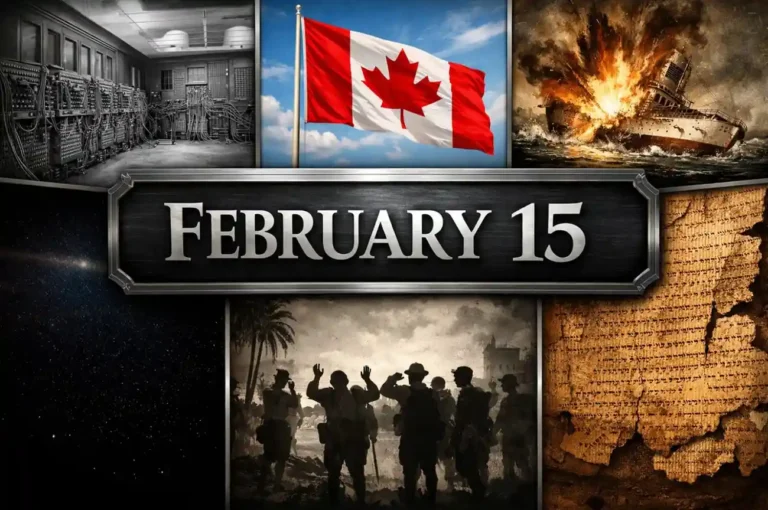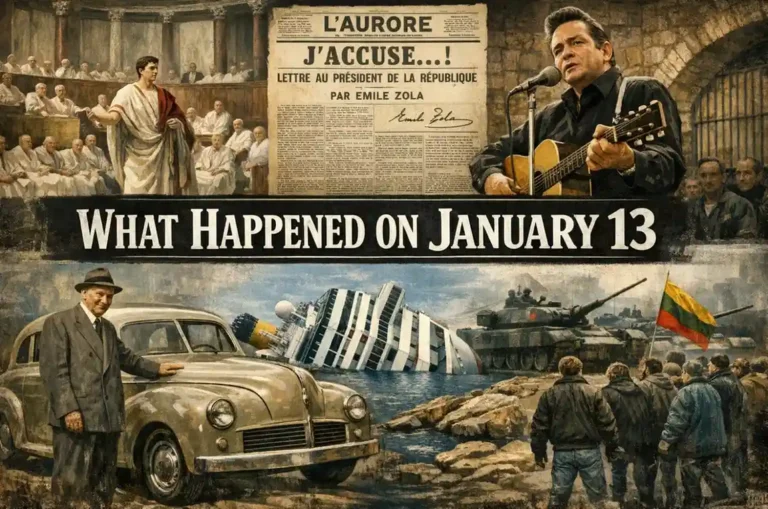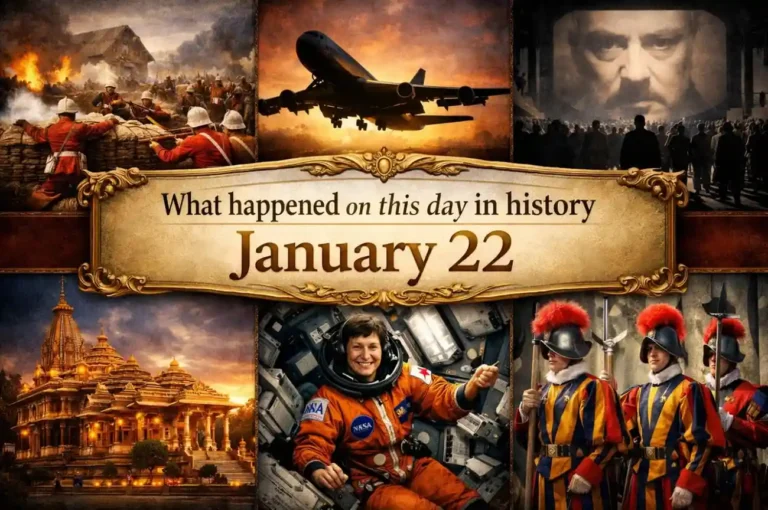
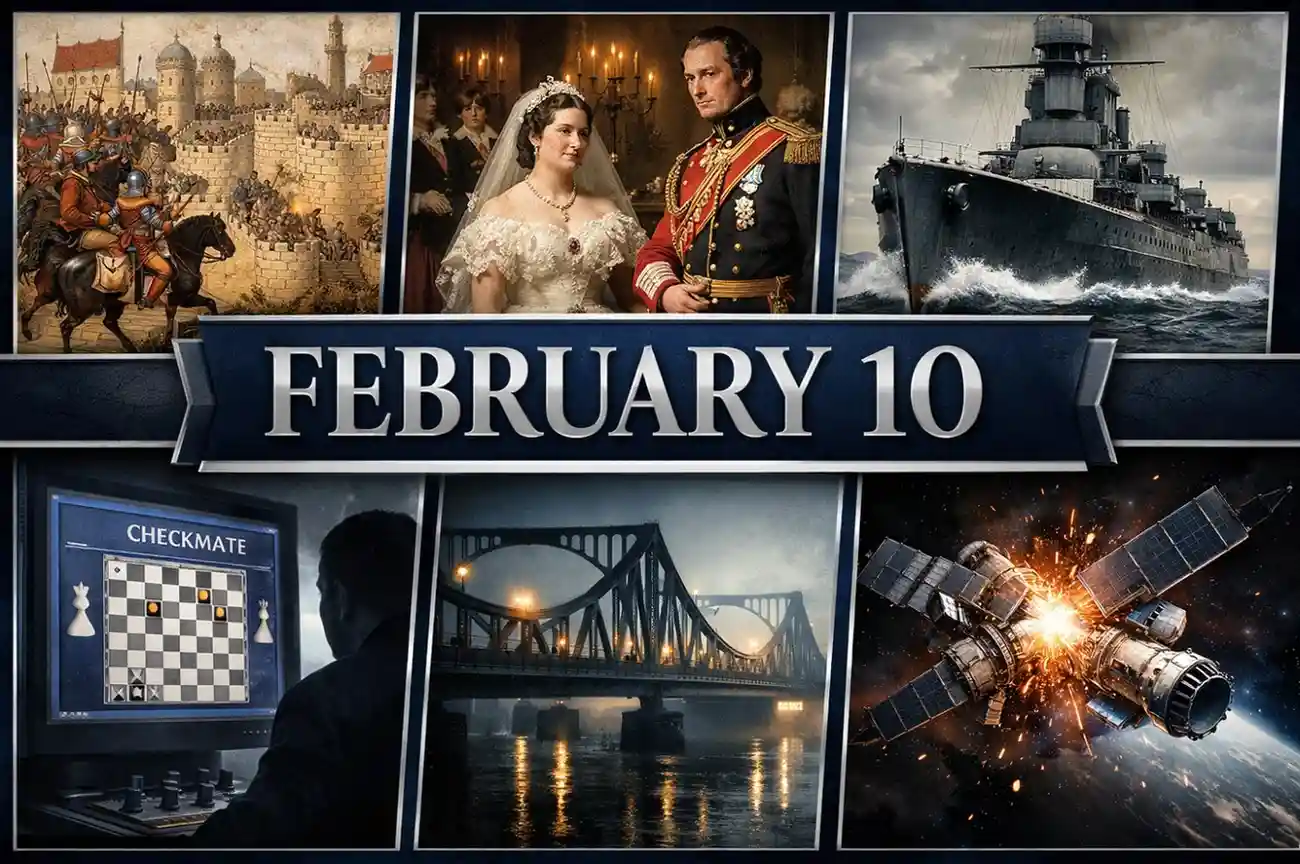
The passage of time often reveals that the most permanent changes are born from moments of intense friction and sudden decision. When we look at what happened on this day in history February 10, we find a date defined by the fall of ancient caliphates, the birth of modern naval warfare, and the personal unions of monarchs that shaped entire empires. It is a day where cold-blooded assassinations sparked national revolutions and where the world’s first supercomputer proved that human intuition had a digital rival.
From the bloody streets of medieval Oxford to the silent, high-speed collisions of satellites in Earth’s orbit, this date serves as a stark catalog of the humanity’s capacity for both monumental progress and devastating error.
Important Events That Happened On February 10 In History
1258 – The Fall of Baghdad
The Siege of Baghdad ended with the surrender of Al-Musta’sim, the last Abbasid caliph, to Hulegu Khan of the Mongol Empire. The subsequent sacking of the city resulted in the destruction of the Grand Library of Baghdad and marked the end of the Islamic Golden Age.
1306 – Murder of John Comyn
In a moment that forever changed Scottish history, Robert the Bruce murdered his rival John Comyn in front of the high altar of Greyfriars Church in Dumfries. The act forced Bruce to claim the crown and sparked the revolution in the Wars of Scottish Independence.
1355 – St Scholastica Day Riot
A dispute over the quality of wine at a tavern in Oxford, England, escalated into a massive riot between townspeople and students. By the end of the two-day conflict, 63 scholars and approximately 30 locals were killed.
1392 – Imperial Byzantine Marriage
Byzantine Emperor Manuel II Palaiologos married Helena Dragaš, the daughter of Serbian Prince Constantine Dragaš. Helena was crowned empress the following day and went on to serve as a powerful figure in the twilight years of the empire.
1502 – Vasco da Gama’s Second Voyage
Famed explorer Vasco da Gama set sail from Lisbon, Portugal, embarking on his second expedition to India. This voyage was heavily militarized, aimed at establishing Portuguese dominance in the Indian Ocean trade.
1567 – Assassination of Lord Darnley
Lord Darnley, the second husband of Mary, Queen of Scots, was found dead in Edinburgh. His house at Kirk o’ Field was destroyed by an explosion, but Darnley himself appeared to have been strangled, leading to a massive scandal and suspicions of a targeted assassination.
1712 – Huilliche Rebellion
In the Chiloé Archipelago, the indigenous Huilliche people rose in rebellion against the Spanish encomenderos. The uprising was a response to the brutal labor conditions and abuses suffered under the colonial system.
1763 – The Treaty of Paris
The Treaty of Paris was signed, officially ending the French and Indian War (the North American theater of the Seven Years’ War). Under the terms, France ceded Canada (Quebec) to Great Britain, fundamentally reshaping the colonial map of North America.
1814 – Battle of Champaubert
Napoleon Bonaparte achieved a significant tactical victory over Russian and Prussian forces at the Battle of Champaubert. It was the opening engagement of the Six Days’ Campaign, widely considered one of Napoleon’s most brilliant displays of military maneuvering.
1840 – Wedding of Victoria and Albert
Queen Victoria of the United Kingdom married her cousin, Prince Albert of Saxe-Coburg-Gotha, at the Chapel Royal in St. James’s Palace. Their partnership would profoundly influence British culture, science, and the monarchy for decades.
1846 – Battle of Sobraon
British forces defeated the Sikh Empire in the Battle of Sobraon, the final engagement of the First Anglo-Sikh War. The victory led to the Treaty of Lahore and the eventual annexation of the Punjab region.
1861 – Jefferson Davis Notified
Jefferson Davis received a telegram informing him that he had been chosen as the provisional President of the Confederate States of America. He was tending his garden in Mississippi when the news arrived, signaling the start of his leadership during the American Civil War.
1862 – Battle of Elizabeth City
During the American Civil War, a Union naval flotilla engaged and destroyed the majority of the Confederate “Mosquito Fleet” on the Pasquotank River. The victory allowed Union forces to secure control of the North Carolina sounds.
1906 – Christening of HMS Dreadnought
The Royal Navy christened HMS Dreadnought, a battleship so advanced it made all previous warships obsolete. Its “all-big-gun” design and steam turbine propulsion triggered a global naval arms race.
1920 – Poland’s Wedding to the Sea
General Józef Haller performed a symbolic ceremony in Puck, throwing a platinum ring into the Baltic Sea. The act celebrated the restitution of Polish access to the open sea following the Treaty of Versailles.
1920 – Schleswig Plebiscite
In the first of the Schleswig plebiscites, approximately 75% of the population in Zone I (Northern Schleswig) voted to join Denmark rather than remain with Germany, redrawing the border between the two nations.
1923 – Founding of Texas Tech
Texas Tech University was officially founded as Texas Technological College in Lubbock. The institution was created to provide higher education in technology and agriculture to the West Texas region.
1930 – Yên Bái Mutiny
The Việt Nam Quốc Dân Đảng (Vietnamese Nationalist Party) launched an armed uprising among Vietnamese soldiers in the French colonial army. The mutiny failed to overthrow the French protectorate but became a symbol of resistance.
1933 – Death of Ernie Schaaf
In a heavyweight boxing match at Madison Square Garden, Primo Carnera knocked out Ernie Schaaf in the 13th round. Schaaf lapsed into a coma and died four days later, leading to intense scrutiny of the sport’s safety.
1936 – Battle of Amba Aradam
Italian forces launched a major offensive against Ethiopian defenders at Amba Aradam. The battle was characterized by the Italians’ use of superior heavy artillery and chemical weapons (mustard gas) against the Ethiopian army.
1939 – Conquest of Catalonia
Nationalist forces under Francisco Franco completed their conquest of Catalonia during the Spanish Civil War. The victory allowed the Nationalists to seal the border with France, effectively ending major Republican resistance in the north.
1940 – Mass Deportations from Poland
The Soviet Union began the first of four waves of mass deportations of Polish citizens from occupied eastern Poland. Hundreds of thousands of people were forcibly sent to labor camps and settlements in Siberia and Central Asia.
1943 – Battle of Krasny Bor
As part of Operation Polyarnaya Zvezda, the Soviet Red Army launched a massive assault against German forces and Spanish volunteers (the Blue Division) at Krasny Bor. The goal was to fully lift the Siege of Leningrad.
1947 – Paris Peace Treaties Signed
The Allies of World War II signed peace treaties with Italy, Romania, Hungary, Bulgaria, and Finland. The treaties settled territorial disputes, established reparations, and allowed these nations to eventually join the United Nations.
1954 – Eisenhower’s Vietnam Warning
U.S. President Dwight D. Eisenhower held a press conference where he warned against unilateral United States military intervention in Vietnam, cautioning that it could lead to an impossible commitment of resources.
1962 – Powers-Abel Spy Exchange
In a famous Cold War moment, captured American U2 pilot Gary Powers was exchanged for Soviet spy Rudolf Abel on the Glienicke Bridge between West Berlin and Potsdam.
1964 – Melbourne–Voyager Collision
The Australian aircraft carrier HMAS Melbourne collided with the destroyer HMAS Voyager during night maneuvers off New South Wales. The Voyager was sliced in half and sank, resulting in the deaths of 82 sailors.
1967 – 25th Amendment Ratified
The 25th Amendment to the United States Constitution was officially ratified. It clarified the process of presidential succession and established procedures for dealing with presidential disabilities and vacancies in the office of the Vice President.
1972 – Ras Al Khaimah Joins UAE
Ras Al Khaimah officially joined the United Arab Emirates, becoming the seventh and final emirate to join the federation established the previous year.
1984 – Wagalla Massacre
In the Wajir District of Kenya, soldiers rounded up and killed an estimated 5,000 ethnic Somali Kenyans at the Wagalla Airstrip. It remains one of the worst human rights abuses in Kenya’s modern history.
1989 – Election of Ron Brown
Ron Brown was elected chairman of the Democratic National Committee. He was the first African American to lead a major American political party, later serving as U.S. Secretary of Commerce.
1996 – Deep Blue Defeats Kasparov
In the first game of a six-game match, the IBM supercomputer Deep Blue defeated world chess champion Garry Kasparov. It was the first time a computer had beaten a reigning world champion in a game under regular time controls.
2003 – NATO Split over Turkey
France and Belgium broke the NATO “silent approval” procedure by objecting to the timing of military aid to Turkey. The disagreement stemmed from fears that such measures would signal an inevitable path to war with Iraq.
2004 – Kish Air Flight 7170 Crash
A Fokker 50 operated by Kish Air crashed while on final approach to Sharjah International Airport in the UAE. Forty-three of the 46 people on board were killed.
2009 – Satellite Collision
The first-ever major collision between two intact spacecraft in orbit occurred when the American Iridium 33 and the Russian Kosmos 2251 satellites struck each other at a speed of 26,000 mph, creating thousands of pieces of space debris.
2013 – Allahabad Stampede
During the Hindu festival of Kumbh Mela, a massive stampede broke out at the Allahabad railway station in India. Thirty-six pilgrims were killed and dozens more were injured.
2016 – Closure of Kaesong Industrial Complex
South Korea announced the total suspension of operations at the Kaesong joint industrial complex. The move was a direct response to North Korea’s long-range rocket launch and nuclear tests.
2018 – Tai Po Bus Accident
A double-decker bus on route 872 overturned in Tai Po, Hong Kong. Nineteen people were killed and 66 injured in what was one of the deadliest traffic accidents in the city’s history.
2021 – Rio Carnival Canceled
For the first time in its long history, the traditional Carnival in Rio de Janeiro was canceled. The decision was made due to the ongoing COVID-19 pandemic and the risks associated with massive public gatherings.
2021 – Texas Power Crisis Begins
A severe winter storm triggered the worst energy infrastructure failure in Texas history. Power outages affected millions of residents for days, leading to hundreds of deaths and billions of dollars in damage.
2026 – Tumbler Ridge Shootings
A series of shootings occurred at a private residence and a school in Tumbler Ridge, British Columbia. The violence left nine people dead and 27 others injured, shocking the local community.
Famous People Born On February 10
| Name | Short Description | Dates |
|---|---|---|
| John Calipari | American basketball coach | February 10, 1959 – |
| Boris Pasternak | Russian novelist and poet | February 10, 1890 – May 30, 1960 |
| Leontyne Price | American opera soprano | February 10, 1927 – |
| Dame Judith Anderson | Australian actress | February 10, 1898 – January 3, 1992 |
| Chick Webb | American jazz drummer | February 10, 1905? – June 16, 1939 |
| Charles Lamb | English essayist and critic | February 10, 1775 – December 27, 1834 |
| Adrienne Clarkson | Canadian governor-general | February 10, 1939 – |
| John Farrow | Australian-born film director | February 10, 1904 – January 27, 1963 |
| Bill Tilden | American tennis champion | February 10, 1893 – June 5, 1953 |
| Lawrence Weiner | American conceptual artist | February 10, 1942 – December 2, 2021 |
| Louise Arbour | Canadian judge and prosecutor | February 10, 1947 – |
| Walter H. Brattain | American physicist, Nobel laureate | February 10, 1902 – October 13, 1987 |
| Alex Comfort | British author and gerontologist | February 10, 1920 – March 26, 2000 |
| Dominique Pire | Belgian priest, Nobel Peace laureate | February 10, 1910 – January 30, 1969 |
| Larry Adler | American harmonica virtuoso | February 10, 1914 – August 7, 2001 |
| William Allen White | American journalist | February 10, 1868 – January 29, 1944 |
| Alexandre Millerand | President of France | February 10, 1859 – April 7, 1943 |
| Giuseppe Ungaretti | Italian modernist poet | February 10, 1888 – June 1, 1970 |
| André-Ernest-Modeste Grétry | Belgian-French composer | February 10, 1741 – September 24, 1813 |
| John Franklin Enders | American microbiologist | February 10, 1897 – September 8, 1985 |
| Charles W. de la Poer Beresford | British admiral | February 10, 1846 – September 6, 1919 |
| Samuel Plimsoll | British social reformer | February 10, 1824 – June 3, 1898 |
| John Harding, Baron Harding | British military officer | February 10, 1896 – January 20, 1989 |
| Mary Rand | British Olympic athlete | February 10, 1940 – |
| Fleur Adcock | New Zealand poet | February 10, 1934 – October 10, 2024 |
| Richard Dagobert Brauer | German-American mathematician | February 10, 1901 – April 17, 1977 |
| Harrison Gray Otis | American newspaper publisher | February 10, 1837 – July 30, 1917 |
| James Mooney | American anthropologist | February 10, 1861 – December 22, 1921 |
| Ira Remsen | American chemist | February 10, 1846 – March 4, 1927 |
| Howard Spring | Welsh novelist | February 10, 1889 – May 3, 1965 |
| J. Edgar Thomson | American railroad executive | February 10, 1808 – May 27, 1874 |
| Michael Anthony | Trinidadian author | February 10, 1932 – |
| Hardy Cross | American structural engineer | February 10, 1885 – February 11, 1959 |
| Per Teodor Cleve | Swedish chemist | February 10, 1840 – June 18, 1905 |
| Honoré d’Urfé | French pastoral novelist | February 10, 1567 – June 1, 1625 |
| Aaron Hill | English dramatist | February 10, 1685 – February 8, 1750 |
| Miklós Barabás | Hungarian painter | February 10, 1810 – February 12, 1898 |
| Charles De Geer | Swedish entomologist | February 10, 1720 – March 8, 1778 |
| William Pember Reeves | New Zealand statesman | February 10, 1857 – May 16, 1932 |
| Sir Walter Parratt | British organist | February 10, 1841 – March 27, 1924 |
| Viktor Hensen | German physiologist | February 10, 1835 – April 5, 1924 |
| Sir James Allen | New Zealand politician | February 10, 1855 – July 28, 1942 |
| Thomas Platter | Swiss humanist writer | February 10, 1499 – January 26, 1582 |
| Avraham Trahtman | Israeli mathematician | February 10, 1944 – |
| Frank Moore Colby | American editor and writer | February 10, 1865 – March 3, 1925 |
| Thomas Blackburn | British poet | February 10, 1916 – August 13, 1977 |
| Victor Mordechai Goldschmidt | German crystallographer | February 10, 1853 – May 8, 1933 |
Famous People Died On February 10
| Name | Short Description | Dates |
|---|---|---|
| Bartholomew Roberts | Welsh pirate | 1682? – February 10, 1722 |
| Pius XI | Pope (1922–1939) | May 31, 1857 – February 10, 1939 |
| David Thompson | English explorer | April 30, 1770 – February 10, 1857 |
| Marcel Mauss | French sociologist | May 10, 1872 – February 10, 1950 |
| Sir David Brewster | Scottish physicist | December 11, 1781 – February 10, 1868 |
| Sofya Kovalevskaya | Russian mathematician | January 15, 1850 – February 10, 1891 |
| Edgar Wallace | British crime novelist | April 1, 1875 – February 10, 1932 |
| Carlos Saura | Spanish film director | January 4, 1932 – February 10, 2023 |
| Leo XII | Pope (1823–1829) | August 22, 1760 – February 10, 1829 |
| J.F.C. Fuller | British military theorist | September 1, 1878 – February 10, 1966 |
| Billy Rose | American songwriter | September 6, 1899 – February 10, 1966 |
| Jonathan Cape | British publisher | November 15, 1879 – February 10, 1960 |
| Edvard Kardelj | Yugoslav revolutionary | January 27, 1910 – February 10, 1979 |
| Pitirim Sorokin | Russian-American sociologist | January 21, 1889 – February 10, 1968 |
| William IX of Aquitaine | Medieval troubadour duke | October 22, 1071 – February 10, 1127 |
| Baldwin III | King of Jerusalem | 1129 – February 10, 1163 |
| Norman E. Shumway | American heart surgeon | February 9, 1923 – February 10, 2006 |
| Paul Monette | American writer | October 16, 1945 – February 10, 1995 |
| Ernesto Teodoro Moneta | Italian Nobel laureate | September 20, 1833 – February 10, 1918 |
| Archibald Lampman | Canadian poet | November 17, 1861 – February 10, 1899 |
| Mrs. Henry Wood | British novelist | January 17, 1814 – February 10, 1887 |
| Robert Mallet-Stevens | French architect | March 24, 1886 – February 10, 1945 |
| Karl Theodor von Dalberg | German archbishop | February 8, 1744 – February 10, 1817 |
| Sir William Dugdale | English antiquary | September 12, 1605 – February 10, 1686 |
| Adolphe Crémieux | French political leader | April 30, 1796 – February 10, 1880 |
| John Henry Taylor | English golf champion | March 19, 1871 – February 10, 1963 |
| Wilhelm Schmidt | German anthropologist | February 16, 1868 – February 10, 1954 |
| Richard Carlile | English radical journalist | December 8, 1790 – February 10, 1843 |
| I.J. Singer | Yiddish novelist | November 30, 1893 – February 10, 1944 |
| Muṣṭafā Kāmil | Egyptian nationalist leader | August 14, 1874 – February 10, 1908 |
| Lawrence J. Henderson | American biochemist | June 3, 1878 – February 10, 1942 |
| Sir William F.P. Napier | British general & historian | December 17, 1785 – February 10, 1860 |
| Paul Gervais | French paleontologist | September 26, 1816 – February 10, 1879 |
| Jean Cayrol | French novelist | June 6, 1911 – February 10, 2005 |
| Francis A. Pratt | American inventor | February 15, 1827 – February 10, 1902 |
| Carl Meinhof | German linguist | July 23, 1857 – February 10, 1944 |
| Nikolay Mikhaylovsky | Russian literary critic | November 27, 1842 – February 10, 1904 |
| Alice Hegan Rice | American novelist | January 11, 1870 – February 10, 1942 |
| Henry Jones | English games authority | November 2, 1831 – February 10, 1899 |
| Charles Chauncy | American clergyman | January 1, 1705 – February 10, 1787 |
| Étienne de Gerlache | Belgian statesman | December 26, 1785 – February 10, 1871 |
| Władysław Broniewski | Polish poet | December 17, 1897 – February 10, 1962 |
| Abe Isoo | Japanese socialist leader | March 1, 1865 – February 10, 1949 |
| Vittorio Sereni | Italian poet | July 27, 1913 – February 10, 1983 |
| John Jeremiah Bigsby | British geologist | August 14, 1792 – February 10, 1881 |
| Wolter van Hoëvell | Dutch reformist statesman | July 15, 1812 – February 10, 1879 |
| Sir Hubert Shirley-Smith | British civil engineer | October 13, 1901 – February 10, 1981 |
Observances & Institutional Dates
- Feast of St. Paul’s Shipwreck (Malta): A public holiday celebrating the traditional date of St. Paul’s arrival on the island in 60 AD.
- National Memorial Day of the Exiles and Foibe (Italy): Commemorating the victims of the Foibe massacres and the Istrian-Dalmatian exodus.
- Fenkil Day (Eritrea): Marking the 1990 liberation of the port of Massawa.
- Arabian Leopard Day: Dedicated to the conservation of the endangered Arabian leopard.
Frequently Asked Questions
- What happened to the Abbasid Caliphate on February 10?
- It officially ended in 1258 with the Mongol conquest of Baghdad.
- Who did Queen Victoria marry?
- She married Prince Albert of Saxe-Coburg-Gotha on this day in 1840.
- What was the first computer to beat a chess champion?
- IBM’s Deep Blue defeated Garry Kasparov in a single game on February 10, 1996.
- Why is February 10 significant for the US Constitution?
- The 25th Amendment, regarding presidential succession, was ratified on this day in 1967.