History has a way of packing the most massive changes into a single day, and February 11 is a perfect example of that. When we look at what happened on this day in history February 11, we see the traditional birth of a global powerhouse like Japan and the hard-won freedom of a hero like Nelson Mandela.
This is a day where science fiction became a reality on television screens, and the world of pop music was forever changed in a single marathon recording session by four lads from Liverpool.
Important Events That Happened On February 11 In History
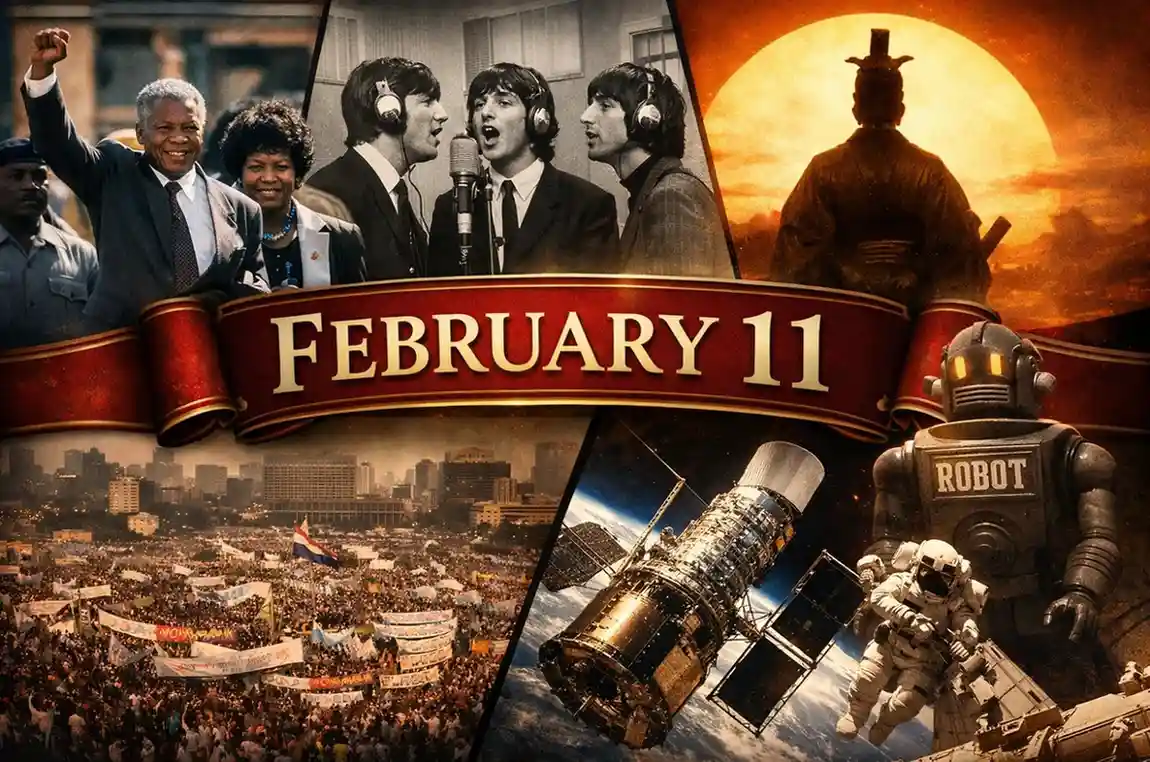
660 BCE – Foundation of Japan
According to tradition, Emperor Jimmu founded Japan on this day. While the date is legendary, it serves as the cultural cornerstone for the nation, celebrated annually as National Foundation Day.
55 – Death of Britannicus
Tiberius Claudius Caesar Britannicus, the heir to the Roman Empire, died under mysterious circumstances just before his coming of age. His sudden death removed the final obstacle for Nero to consolidate his power as Emperor.
951 – Rise of the Later Zhou
In a swift military coup, court official Guo Wei declared himself emperor. This marked the beginning of the Later Zhou dynasty, a short-lived but vital era in the transition toward the Song Dynasty.
1144 – Birth of Western Alchemy
Robert of Chester finished his translation of the Liber de compositione alchemiae from Arabic to Latin. This work introduced the secrets of alchemy to the Western world, sparking centuries of scientific and mystical exploration.
1534 – Henry VIII Styled Supreme Head
The Catholic bishops of the Province of Canterbury agreed to recognize King Henry VIII as the supreme head of the English church. This acknowledgment, qualified by the phrase “so far as the law of Christ allows,” was a massive step toward the English Reformation.
1584 – Founding of Nombre de Jesús
Explorer Pedro Sarmiento de Gamboa established Nombre de Jesús in the Strait of Magellan. It was the first of two ill-fated Spanish settlements intended to control the strategic passage between the Atlantic and Pacific.
1586 – Francis Drake Captures Cartagena
English privateer Sir Francis Drake and his fleet captured the Spanish colonial port of Cartagena de Indias. They occupied the city for two months, departing only after receiving a significant ransom and a hoard of booty.
1659 – Assault on Copenhagen
During the Second Northern War, Swedish forces launched a major assault on Copenhagen. The Danish defenders successfully beat back the attack, inflicting heavy losses on the Swedish army.
1794 – U.S. Senate Opens to Public
For the first time since the government’s inception, the United States Senate opened its sessions to the public. Previously, the Senate had met in private, unlike the House of Representatives.
1808 – First Anthracite Experiment
In Wilkes-Barre, Pennsylvania, Jesse Fell successfully burned anthracite coal on an open grate. This experiment proved that coal could be used as a viable fuel for heating homes, revolutionizing the energy industry.
1812 – Gerrymandering Coined
Massachusetts Governor Elbridge Gerry was accused of “gerrymandering” for the first time. The term was created to describe the oddly shaped, salamander-like district he drew to benefit his political party.
1823 – Carnival Tragedy in Malta
A horrific human crush occurred at the Convent of the Minori Osservanti in Valletta during Carnival celebrations. About 110 boys were killed in the panic, making it one of the darkest days in Maltese history.
1826 – Founding of University College London
UCL was established under the name “University of London.” It was the first university institution in London and the first in England to be entirely secular and admit students regardless of their religion.
1840 – Premiere of La fille du régiment
Gaetano Donizetti’s beloved opera, La fille du régiment (The Daughter of the Regiment), received its first performance at the Opéra-Comique in Paris.
1843 – Premiere of I Lombardi
Giuseppe Verdi’s fourth opera, I Lombardi alla prima crociata, premiered in Milan. The work was a major success and helped cement Verdi’s reputation as Italy’s leading operatic composer.
1855 – Crowning of Tewodros II
Kassa Hailu was crowned Tewodros II, Emperor of Ethiopia. His reign was significant for his efforts to modernize and centralize the Ethiopian state.
1856 – Annexation of Awadh
The British East India Company officially annexed the Kingdom of Awadh, deposing King Wajid Ali Shah. This aggressive move was a major factor in the growing resentment that led to the Indian Rebellion of 1857.
1858 – First Vision at Lourdes
Fourteen-year-old Bernadette Soubirous experienced her first vision of the Blessed Virgin Mary in a grotto at Lourdes, France. The site has since become one of the most visited pilgrimage destinations in the world.
1861 – Slavery Noninterference Resolution
As the Civil War loomed, the U.S. House of Representatives unanimously passed a resolution guaranteeing that the federal government would not interfere with slavery in any state where it already existed.
1873 – Abdication of King Amadeo I
King Amadeo I of Spain abdicated the throne, citing the ungovernability of the Spanish people. His departure immediately led to the proclamation of the First Spanish Republic.
1889 – Adoption of Meiji Constitution
Japan formally adopted the Meiji Constitution, which established a constitutional monarchy. It was a pivotal moment in Japan’s rapid modernization and Westernization during the late 19th century.
1903 – Bruckner’s 9th Symphony
Anton Bruckner’s monumental 9th Symphony received its posthumous premiere in Vienna. Though unfinished, it remains one of the most influential works in the late Romantic repertoire.
1906 – Vehementer Nos Published
Pope Pius X issued the encyclical Vehementer Nos, which denounced the French law on the Separation of the Churches and the State, condemning the secularization of the French government.
1919 – Friedrich Ebert Elected President
Friedrich Ebert was elected as the first President of Germany under the new Weimar Republic. He faced the monumental task of stabilizing the country following the chaos of World War I.
1929 – Signing of the Lateran Treaty
The Kingdom of Italy and the Holy See signed the Lateran Treaty. The agreement recognized the Vatican City as an independent state and settled the long-standing “Roman Question” regarding the Pope’s temporal power.
1933 – LAPD Red Squad Raid
The Los Angeles Police Department’s “Red Squad” raided an art show at the John Reed Club. The police destroyed a dozen political artworks, part of a broader crackdown on socialist and communist organizations in the U.S.
1937 – Flint Sit-Down Strike Ends
One of the most important strikes in American history ended when General Motors recognized the United Auto Workers (UAW). The victory proved the effectiveness of the sit-down strike and bolstered the labor movement.
1938 – First Science Fiction TV Program
The BBC produced the world’s first science fiction television broadcast. It was an adaptation of Karel Čapek’s play R.U.R. (Rossum’s Universal Robots), the work that originally coined the word “robot.”
1942 – Battle of Bukit Timah
During the Japanese invasion of Singapore, the second day of the intense Battle of Bukit Timah was fought. The fall of this strategic height made the British surrender of Singapore nearly inevitable.
1946 – Revised Standard Version Published
The New Testament of the Revised Standard Version (RSV) of the Bible was published. It was the first serious scholarly challenge to the dominance of the King James Version in the English-speaking world.
1953 – Rosenberg Clemency Denied
President Dwight D. Eisenhower denied all appeals for clemency for Julius and Ethel Rosenberg, who were convicted of conspiracy to commit espionage. They were executed later that year.
1953 – Israeli-Soviet Relations Severed
Diplomatic relations between Israel and the Soviet Union were officially broken off. This followed the “Doctors’ Plot” in the USSR and a bomb attack on the Soviet embassy in Tel Aviv.
1959 – Federation of Arab Emirates of the South
The United Kingdom established the Federation of Arab Emirates of the South as a protectorate. This entity was a predecessor to the Federation of South Arabia in what is now Yemen.
1963 – The Beatles Record Please Please Me
In a single 585-minute marathon recording session at Abbey Road Studios, The Beatles recorded ten songs for their debut album, Please Please Me.
1970 – Japan Launches Ohsumi
With the successful launch of the Ohsumi satellite, Japan became the fourth nation—after the USSR, the USA, and France—to put an object into orbit using its own rocket technology.
1971 – Seabed Arms Control Treaty
The Seabed Arms Control Treaty was opened for signature. The international agreement banned the placement of nuclear weapons and other weapons of mass destruction on the ocean floor.
1978 – Pacific Western Flight 314 Crash
A Boeing 737 crashed at Cranbrook Airport in British Columbia while attempting to avoid a snowplow on the runway. The disaster killed 42 people on board.
1979 – Victory of the Iranian Revolution
The Iranian Revolution culminated in the establishment of an Islamic theocracy. Ayatollah Ruhollah Khomeini took leadership as the country moved away from the monarchy of the Shah.
1990 – Release of Nelson Mandela
After 27 years of imprisonment, anti-apartheid leader Nelson Mandela was released from Victor Verster Prison. His walk to freedom signaled the beginning of the end for apartheid in South Africa.
1990 – Buster Douglas Knocks Out Mike Tyson
In one of the biggest upsets in sports history, 42:1 underdog Buster Douglas knocked out the “undefeated” Mike Tyson in the tenth round in Tokyo to become the undisputed Heavyweight Champion.
1997 – Hubble Servicing Mission
Space Shuttle Discovery launched on mission STS-82. The crew’s objective was to perform maintenance and install new instruments on the Hubble Space Telescope to extend its scientific life.
1999 – Pluto Crosses Neptune’s Orbit
Pluto crossed Neptune’s orbit, moving further away from the Sun than Neptune. Because of its irregular orbit, Pluto had been closer to the Sun than Neptune since 1979.
2000 – Shuttle Radar Topography Mission
Space Shuttle Endeavour launched on mission STS-99. The mission used specialized radar to generate the most high-resolution digital topographic database of Earth ever created at the time.
2001 – Anna Kournikova Virus
A Dutch programmer released a computer worm disguised as a photo of tennis star Anna Kournikova. The virus infected millions of computers globally, highlighting the growing threat of social engineering in cyber warfare.
2008 – Attack on José Ramos-Horta
Rebel soldiers in East Timor seriously wounded President José Ramos-Horta in an assassination attempt. The rebel leader, Alfredo Reinado, was killed by security forces during the attack.
2011 – Resignation of Hosni Mubarak
After 17 days of massive protests during the Arab Spring, Egyptian President Hosni Mubarak resigned. He transferred power to the military, ending his 30-year rule.
2013 – Pope Benedict XVI Announces Resignation
The Vatican confirmed that Pope Benedict XVI would resign due to his advanced age and declining health. He was the first Pope to step down voluntarily since Gregory XII in 1415.
2013 – Invasion of Lahad Datu
Militants from the Sulu Archipelago invaded the Lahad Datu District in Sabah, Malaysia. This sparked a month-long standoff as they sought to reclaim the territory for the Sultanate of Sulu.
2014 – Algerian Military Plane Crash
A C-130 Hercules military transport plane crashed into a mountain in eastern Algeria during bad weather. Seventy-seven people were killed, with only one survivor.
2015 – Murder of Özgecan Aslan
The brutal murder of university student Özgecan Aslan as she resisted an attempted rape sparked nationwide protests in Turkey. The tragedy led to a massive public outcry against violence and harassment toward women.
2015 – Launch of the IXV
The European Space Agency successfully launched its Intermediate eXperimental Vehicle (IXV). The suborbital flight tested reentry technologies for future reusable spacecraft.
2016 – Jizan Education Center Shooting
A gunman opened fire at an education center in Saudi Arabia’s Jizan Province, killing seven employees. The attacker was arrested shortly after the incident.
2017 – North Korean Missile Test
North Korea test-fired a Pukguksong-2 ballistic missile across the Sea of Japan. The test occurred during a meeting between U.S. President Donald Trump and Japanese Prime Minister Shinzo Abe, escalating regional tensions.
2018 – Saratov Airlines Flight 703 Crash
An An-148 regional jet crashed shortly after takeoff from Moscow’s Domodedovo Airport. All 71 people on board were killed; the crash was later attributed to iced-over speed sensors.
2020 – WHO Names COVID-19
The World Health Organization officially gave the name “COVID-19” to the disease caused by the novel coronavirus outbreak. The virus itself was designated as SARS-CoV-2.
2024 – Alexander Stubb Elected in Finland
In the second round of the Finnish presidential election, Alexander Stubb was elected as the 13th President of Finland. He took office during a period of significant geopolitical change for the nation.
Take A look at February 10 tales:
Famous People Born On February 11
| Name | Role / Description | Born – Died |
|---|---|---|
| Farouk I | King of Egypt | February 11, 1920 – March 18, 1965 |
| Kelly Slater | American surfer | February 11, 1972 – |
| Gene Vincent | American rockabilly singer | February 11, 1935 – October 12, 1971 |
| Joseph L. Mankiewicz | American filmmaker | February 11, 1909 – February 5, 1993 |
| Paul Bocuse | French chef | February 11, 1926 – January 20, 2018 |
| Antony Flew | English philosopher | February 11, 1923 – April 8, 2010 |
| Alexander H. Stephens | Confederate VP | February 11, 1812 – March 4, 1883 |
| William Henry Fox Talbot | British photographer | February 11, 1800 – September 17, 1877 |
| Lloyd Bentsen | American politician | February 11, 1921 – May 23, 2006 |
| Mary Quant | British fashion designer | February 11, 1930 – April 13, 2023 |
| J. Willard Gibbs | American scientist | February 11, 1839 – April 28, 1903 |
| Hans-Georg Gadamer | German philosopher | February 11, 1900 – March 13, 2002 |
| Leo Szilard | American physicist | February 11, 1898 – May 30, 1964 |
| Ioánnis Antónios Kapodístrias | Greek statesman | February 11, 1776 – October 9, 1831 |
| Gregory XIV | Pope | February 11, 1535 – October 16, 1591 |
| Bernard Le Bovier Fontenelle | French author & scientist | February 11, 1657 – January 9, 1757 |
| Gian Francesco Poggio Bracciolini | Italian scholar | February 11, 1380 – October 30, 1459 |
| Ahmed Tevfik Paşa | Ottoman vizier | February 11, 1845 – 1936 |
| Carlo Carrà | Italian painter | February 11, 1881 – April 13, 1966 |
| Ladislas | King of Naples | February 11, 1377 – August 6, 1414 |
| William Carstares | Scottish minister | February 11, 1649 – December 28, 1715 |
| Joseph Slepian | American engineer & mathematician | February 11, 1891 – December 1, 1969 |
| Roy Fuller | British author | February 11, 1912 – September 27, 1991 |
| Hans Järta | Swedish politician | February 11, 1774 – April 6, 1847 |
| Thomas Hitchcock, Jr. | American polo player | February 11, 1900 – April 19, 1944 |
| Louis-Tullius-Joachim Visconti | French architect | February 11, 1791 – December 23, 1853 |
| James Cowles Prichard | British physician & ethnologist | February 11, 1786 – December 23, 1848 |
| Vivian Fuchs | British explorer | February 11, 1908 – November 11, 1999 |
| Aléxandros Mavrokordátos | Greek statesman | February 11, 1791 – August 18, 1865 |
| Auguste Mariette | French archaeologist | February 11, 1821 – January 19, 1881 |
Famous People Died On February 11
| Name | Role / Description | Born – Died |
|---|---|---|
| Eleanor Powell | American dancer & actress | November 21, 1912 – February 11, 1982 |
| Sergei Eisenstein | Soviet film director | January 22, 1898 – February 11, 1948 |
| Thomas Cole | American painter | February 1, 1801 – February 11, 1848 |
| Honoré Daumier | French artist | February 20 or 26, 1808 – February 11, 1879 |
| DeWitt Clinton | American politician | March 2, 1769 – February 11, 1828 |
| John Buchan, 1st Baron Tweedsmuir | British statesman & author | August 26, 1875 – February 11, 1940 |
| Sir Charles Algernon Parsons | British engineer | June 13, 1854 – February 11, 1931 |
| Milan IV | King of Serbia | August 22, 1854 – February 11, 1901 |
| Aleksandr Sergeyevich Griboyedov | Russian dramatist | January 15, 1795 – February 11, 1829 |
| Axel M. F. Munthe | Swedish author & physician | October 31, 1857 – February 11, 1949 |
| Carl Michael Bellman | Swedish poet & musician | February 4, 1740 – February 11, 1795 |
| Saint Paschal I | Pope | – February 11, 824 |
| Isadore Singer | American mathematician | May 3, 1924 – February 11, 2021 |
| Whitney Houston | American singer & actress | August 9, 1963 – February 11, 2012 |
| Mary Jackson | American mathematician & engineer | April 9, 1921 – February 11, 2005 |
| Sir Vincent Wigglesworth | British entomologist | April 17, 1899 – February 11, 1994 |
| Leon Festinger | American psychologist | May 8, 1919 – February 11, 1989 |
| Frank Herbert | American author | October 8, 1920 – February 11, 1986 |
| Henry Hathaway | American director | March 13, 1898 – February 11, 1985 |
| Paavo Yrjölä | Finnish athlete | June 18, 1902 – February 11, 1980 |
| Fakhruddin Ali Ahmed | President of India | May 13, 1905 – February 11, 1977 |
| Robert William Holley | American biochemist | January 28, 1922 – February 11, 1993 |
| George N. T. Grenville, 1st Marquess of Buckingham | British statesman | June 17, 1753 – February 11, 1813 |
| William Kelly | American inventor | August 21, 1811 – February 11, 1888 |
| T.E.B. Clarke | British writer | June 7, 1907 – February 11, 1989 |
| Henry Willis | British organ maker | April 27, 1821 – February 11, 1901 |
| Hardy Cross | American engineer | February 10, 1885 – February 11, 1959 |
| Aleksey M. Kaledin | Russian military officer | October 24, 1861 – February 11, 1918 |
| William Shenstone | English poet & gardener | November 18, 1714 – February 11, 1763 |
| Jean-François de La Harpe | French critic | November 20, 1739 – February 11, 1803 |
Observances & Institutional Dates
- National Foundation Day (Japan): Commemorating the traditional founding of the nation in 660 BCE.
- International Day of Women and Girls in Science: A UN-sponsored day to promote full and equal access to science for women and girls.
- Inventors’ Day (United States): Celebrated on the birthday of Thomas Edison.
- Youth Day (Cameroon): A national holiday focused on the importance of the country’s youth.
Frequently Asked Questions
- When was Nelson Mandela released from prison?
- He was released on February 11, 1990, after 27 years in captivity.
- Who was the underdog who beat Mike Tyson?
- Buster Douglas defeated Mike Tyson in a massive upset on this day in 1990.
- Why did Pope Benedict XVI resign?
- He announced his resignation on February 11, 2013, citing his advanced age and health.
- What is the significance of 660 BCE in Japanese history?
- It is the traditional date of the founding of Japan by its first emperor, Jimmu.