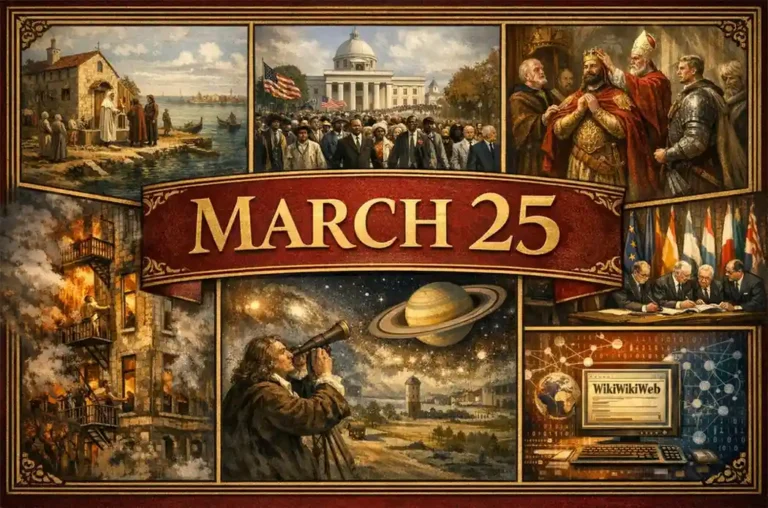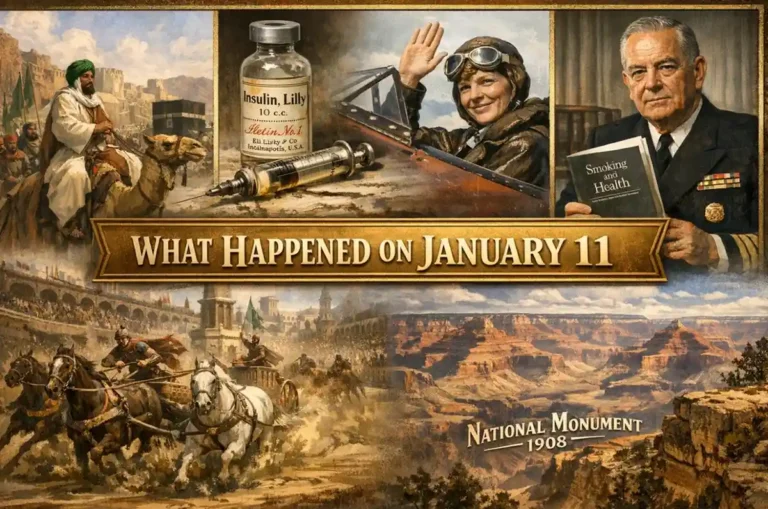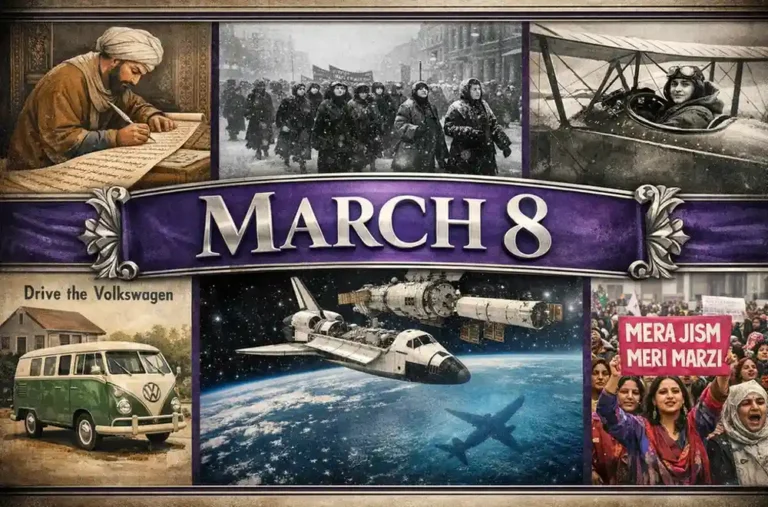
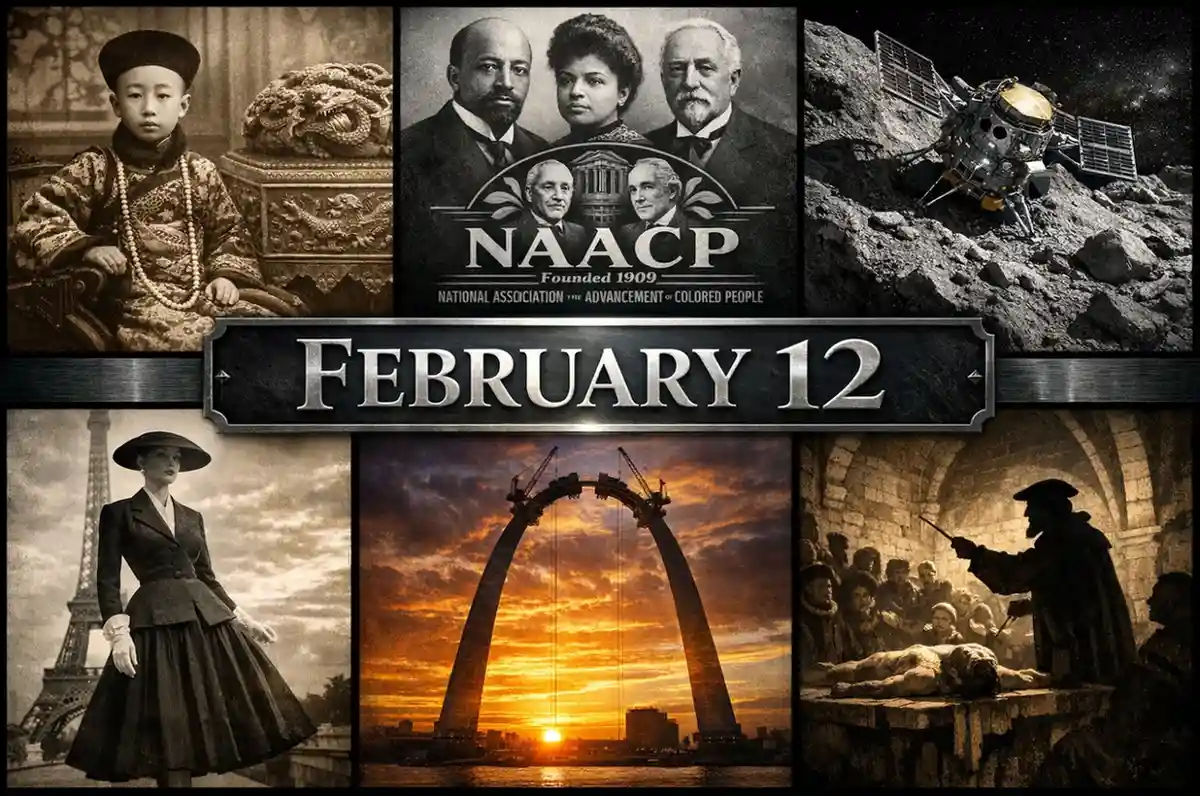
History often finds its rhythm in the tension between the old world and the new, and February 12 is a testament to that struggle. When we look at what happened on this day in history February 12, we see the end of a multi-thousand-year imperial tradition in China and the birth of a pivotal civil rights organization in America. This is a day where art was stolen, asteroids were touched by human ingenuity, and women in Lahore stood defiant against a military dictator to reclaim their rights.
From the freezing heights of the Andes to the fashion runways of Paris, these events remind us that whether through a vote, a protest, or a scientific breakthrough, the world is constantly being remade by those who dare to act.
Important Events That Happened On February 12 In History
1059 – Election of Pope Leo IX
Upon reaching Rome, Bruno of Toul was elected as Pope Leo IX. His papacy was landmark for initiating the Gregorian Reforms, which sought to address clerical issues and reassert papal authority across Europe.
1096 – Foundation of La Roë Abbey
Pope Urban II officially confirmed the foundation of the abbey of La Roë under Robert of Arbrissel. It was established as a community of canons regular, marking a significant moment in medieval monastic history.
1404 – First Teaching Autopsy
In Vienna, Galeazzo di Santa Sofia performed the first post-mortem autopsy for the specific purposes of teaching and demonstration. This event at the Heiligen–Geist Spital was a massive leap forward for medical education and the study of human anatomy.
1429 – Battle of the Herrings
During the Siege of Orléans, English forces led by Sir John Fastolf successfully defended a supply convoy against a French attack. The battle earned its unusual name because the convoy was primarily carrying barrels of herrings for the Lenten season.
1502 – Islam Outlawed in Castile
Queen Isabella I issued a repressive edict outlawing Islam in the Crown of Castile. This forced virtually all Muslim subjects to convert to Christianity or face exile, marking a definitive end to religious pluralism in the region.
1502 – Vasco da Gama’s Second Voyage
Vasco da Gama departed Lisbon with 15 ships and 800 men. This second voyage to India was designed to consolidate Portuguese trade interests and use military force to secure the spice routes.
1541 – Founding of Santiago
Spanish conquistador Pedro de Valdivia founded the city of Santiago, Chile. He established the settlement at the foot of Santa Lucia Hill, laying the foundation for what would become the nation’s capital.
1593 – Siege of Haengju
In a remarkable military feat during the Japanese invasion of Korea, 3,000 Joseon defenders led by General Kwŏn Yul repelled an army of over 30,000 Japanese invaders. The victory at the mountain fortress remains a proud symbol of Korean resistance.
1689 – Abdication of James II
The Convention Parliament formally declared that King James II’s flight to France in 1688 constituted an abdication of the throne. This paved the way for the joint rule of William III and Mary II.
1733 – Founding of Georgia
Englishman James Oglethorpe landed at Savannah, founding the colony of Georgia. As the 13th of the original Thirteen Colonies, it was intended to serve as a refuge for the “worthy poor” and a buffer against Spanish Florida.
1771 – Gustav III Becomes King
Gustav III ascended to the throne of Sweden. His reign was noted for its cultural revival and a self-coup that restored absolute power to the monarchy, ending the “Age of Liberty.”
1817 – Battle of Chacabuco
After a legendary crossing of the Andes, a patriotic army led by José de San Martín and Bernardo O’Higgins defeated Spanish loyalists. The victory was a decisive moment in the Chilean War of Independence.
1818 – Chilean Independence Approved
Bernardo O’Higgins formally approved the Chilean Declaration of Independence near Concepción. This act officially signaled Chile’s break from Spanish colonial rule.
1825 – Treaty of Indian Springs
The Creek people were forced to cede the last of their lands in Georgia to the U.S. government. Under the terms of the treaty, they were required to migrate west, leading to the displacement of their community.
1832 – Ecuador Annexes Galápagos
Ecuador officially took possession of the Galápagos Islands. Previously largely uninhabited by humans, the islands would later become world-famous as the site of Charles Darwin’s evolutionary research.
1889 – Premiere of Jakobín
Antonín Dvořák’s opera Jakobín premiered at the National Theater in Prague. The work, celebrated for its folk-inspired melodies, remains a staple of the Czech operatic repertoire.
1894 – Café Terminus Bombing
Anarchist Émile Henry detonated a bomb at the Café Terminus in Paris. This attack, occurring during a wave of anarchist violence known as the Ère des attentats, is often cited by historians as one of the first acts of modern terrorism.
1909 – Founding of the NAACP
The National Association for the Advancement of Colored People (NAACP) was founded in New York City by a diverse group of activists, including W.E.B. Du Bois. It was created to fight for civil rights and against the lynching of Black Americans.
1909 – Sinking of the SS Penguin
New Zealand’s worst maritime disaster of the century occurred when the ferry SS Penguin struck rocks and sank at the entrance to Wellington Harbour. The ship exploded shortly after, and 75 people lost their lives.
1912 – Abdication of the Last Emperor
The Xuantong Emperor, better known as Puyi, formally abdicated the throne. His resignation ended the Qing Dynasty and marked the conclusion of over 2,000 years of imperial rule in China.
1919 – Regional Congress at Huliaipole
The Makhnovshchina (Revolutionary Insurgent Army of Ukraine) held the Second Regional Congress of Peasants, Workers, and Insurgents. The meeting aimed to coordinate the defense and administration of the “Free Territory” during the Russian Civil War.
1921 – Revolt in Georgia
Bolshevik forces launched a planned revolt in Georgia. This served as a pretext for the subsequent invasion by the Red Army, leading to the Sovietization of the Democratic Republic of Georgia.
1935 – Crash of USS Macon
The USS Macon, a massive helium-filled airship, crashed into the Pacific Ocean off the coast of California during a storm. The disaster ended the U.S. Navy’s program for large, rigid airships.
1945 – Mississippi and Alabama Tornadoes
A devastating tornado outbreak swept through Mississippi and Alabama, killing 45 people. The storms caused immense destruction and left hundreds injured in their path.
1946 – Operation Deadlight Ends
The Royal Navy concluded Operation Deadlight, the scuttling of the surrendered German U-boat fleet. Of the 154 captured submarines, 121 were sent to the bottom of the Atlantic.
1946 – Beating of Isaac Woodard
Isaac Woodard, a Black U.S. Army veteran, was brutally beaten by a South Carolina police officer just hours after being honorably discharged. The attack left him permanently blind and became a major catalyst for the early civil rights movement.
1947 – Sikhote-Alin Meteorite
One of the largest iron meteorites in recorded history struck the Sikhote-Alin Mountains in the Soviet Union. The impact created a series of craters and was visible for hundreds of miles.
1947 – Dior’s “New Look”
Fashion designer Christian Dior unveiled his first collection in Paris, introducing the “New Look.” Characterized by voluminous skirts and narrow waists, it revitalized the French fashion industry after World War II.
1961 – Launch of Venera 1
The Soviet Union launched Venera 1, the first spacecraft designed to fly past Venus. Although communications were lost before it reached the planet, it was a pioneering mission in interplanetary exploration.
1963 – Construction of the Gateway Arch
Work began on the Gateway Arch in St. Louis, Missouri. Designed by Eero Saarinen, the stainless steel monument was built as a memorial to the westward expansion of the United States.
1963 – Flight 705 Crash
Northwest Orient Airlines Flight 705 crashed into the Florida Everglades shortly after takeoff from Miami. All 45 people on board were killed when the Boeing 720 broke up in severe turbulence.
1965 – Malcolm X Visits Smethwick
Civil rights leader Malcolm X visited Smethwick in England to support those fighting racial segregation. His visit followed a notorious election campaign dominated by racial rhetoric.
1966 – Shooting of Rabbi Morris Adler
Rabbi Morris Adler was fatally shot by a disgruntled congregant during a service in Southfield, Michigan. The tragic event deeply affected the Jewish community in the United States.
1968 – Phong Nhị and Phong Nhất Massacre
During the Vietnam War, civilians in the villages of Phong Nhị and Phong Nhất were killed in a massacre. Investigations later alleged that the atrocity was carried out by South Korean troops serving alongside U.S. forces.
1974 – Exile of Aleksandr Solzhenitsyn
Nobel laureate Aleksandr Solzhenitsyn was arrested and forcibly exiled from the Soviet Union. His expulsion followed the publication of The Gulag Archipelago, which exposed the horrors of the Soviet labor camp system.
1983 – Women’s Protest in Lahore
In a historic act of defiance against General Zia-ul-Haq’s military regime, 100 women protested in Lahore against the discriminatory Law of Evidence. Despite being tear-gassed and arrested, their persistence led to the repeal of the law.
1988 – Black Sea Bumping Incident
During a Cold War naval standoff, the Soviet frigate Bezzavetnyy intentionally rammed the U.S. missile cruiser USS Yorktown in the Black Sea. The incident occurred as the U.S. ship claimed “innocent passage” through Soviet waters.
1990 – Australia’s First Female Premier
Carmen Lawrence made history by becoming the Premier of Western Australia. She was the first woman to lead a state government in Australian history.
1992 – Mongolian Constitution
The current Constitution of Mongolia came into effect. The document completed the nation’s transition from a socialist state to a multi-party democracy with a market economy.
1993 – Abduction of James Bulger
Two-year-old James Bulger was abducted from a shopping center in England by two ten-year-old boys. The subsequent murder of the toddler by children shocked the world and led to a national debate on youth and justice.
1994 – Theft of The Scream
Thieves broke into the National Gallery in Oslo and stole Edvard Munch’s famous painting The Scream. They left a note thanking the museum for the poor security; the painting was recovered months later.
1999 – Acquittal of Bill Clinton
The United States Senate acquitted President Bill Clinton on two articles of impeachment. The trial followed an investigation into his relationship with Monica Lewinsky and charges of perjury and obstruction of justice.
2001 – First Asteroid Landing
The NEAR Shoemaker spacecraft successfully touched down on the surface of the asteroid 433 Eros. It was the first time a human-made object had landed on an asteroid, providing invaluable scientific data.
2002 – Trial of Slobodan Milošević
The trial of former Yugoslav President Slobodan Milošević began at The Hague. He was the first former head of state to be tried for war crimes, though he died in his cell before the trial could conclude.
2002 – Khorramabad Air Crash
An Iran Airtour Tupolev Tu-154 crashed into the mountains near Khorramabad, Iran. All 119 people on board were killed as the aircraft descended for landing in poor visibility.
2004 – Same-Sex Marriage in San Francisco
Responding to a directive from Mayor Gavin Newsom, the city of San Francisco began issuing marriage licenses to same-sex couples. This bold move was a major early milestone in the fight for marriage equality in the U.S.
2009 – Colgan Air Flight 3407 Crash
A Bombardier Dash 8 crashed into a house in Clarence Center, New York, during its approach to Buffalo. All 49 people on board and one person on the ground were killed; the crash was attributed to pilot error in icing conditions.
2016 – Meeting of Pope and Patriarch
Pope Francis and Patriarch Kirill met in Havana, Cuba, for the first meeting between the leaders of the Catholic and Russian Orthodox Churches since the Great Schism of 1054. They signed an Ecumenical Declaration calling for Christian unity.
2019 – North Macedonia Renamed
The Republic of Macedonia officially changed its name to the Republic of North Macedonia. The change was the result of the Prespa agreement, settling a decades-old dispute with Greece and clearing the way for NATO membership.
2026 – Bangladesh General Election
In the first election since the July Revolution, the Bangladesh Nationalist Party (BNP), led by Tarique Rahman, won a landslide victory. The party returned to power after 19 years, and a concurrent referendum was also approved by voters.
Want to read About Feb 11? Click here
Famous People Born On February 12
| Name | Role/Description | Birth – Death |
|---|---|---|
| Anna Pavlova | Russian ballerina | 12 Feb 1881 – 23 Jan 1931 |
| Arlen Specter | American politician | 12 Feb 1930 – 14 Oct 2012 |
| Louis Buchalter | American crime boss | 12 Feb 1897 – 4 Mar 1944 |
| Vasily Chuikov | Soviet general | 12 Feb 1900 – 18 Mar 1982 |
| Costa-Gavras | French director | 12 Feb 1933 – |
| Max Beckmann | German painter | 12 Feb 1884 – 27 Dec 1950 |
| Louisa Adams | American first lady | 12 Feb 1775 – 15 May 1852 |
| Julian Schwinger | American physicist | 12 Feb 1918 – 16 Jul 1994 |
| Eugène Atget | French photographer | 12 Feb 1857 – 4 Aug 1927 |
| Peter Cooper | American inventor | 12 Feb 1791 – 4 Apr 1883 |
| John L. Lewis | American labor leader | 12 Feb 1880 – 11 Jun 1969 |
| Joan Mitchell | American painter | 12 Feb 1926 – 30 Oct 1992 |
| Marie Lloyd | British actress | 12 Feb 1870 – 7 Oct 1922 |
| Étienne-Louis Boullée | French architect | 12 Feb 1728 – 6 Feb 1799 |
| Thomas Campion | English poet & musician | 12 Feb 1567 – 1 Mar 1620 |
| Friedrich de la Motte Fouqué | German writer | 12 Feb 1777 – 23 Jan 1843 |
| Roy Harris | American composer | 12 Feb 1898 – 1 Oct 1979 |
| William Morris Davis | American geographer | 12 Feb 1850 – 5 Feb 1934 |
| James D. Dana | American geologist | 12 Feb 1813 – 14 Apr 1895 |
| Fang Lizhi | Chinese astrophysicist | 12 Feb 1936 – 6 Apr 2012 |
| Hussein Onn | Malaysian PM | 12 Feb 1922 – 28 May 1990 |
| George Meredith | English novelist | 12 Feb 1828 – 18 May 1909 |
| Sir Walter Nash | New Zealand PM | 12 Feb 1882 – 4 Jun 1968 |
| Conrad | King of the Germans | 12 Feb 1074 – 27 Jul 1101 |
| Johan Laidoner | Estonian soldier | 12 Feb 1884 – 13 Mar 1953 |
| John Graham Chambers | British sportsman | 12 Feb 1843 – 4 Mar 1883 |
| Myra Bradwell | American lawyer | 12 Feb 1831 – 14 Feb 1894 |
| William Wetmore Story | American sculptor | 12 Feb 1819 – 7 Oct 1895 |
| Edward Forbes | British naturalist | 12 Feb 1815 – 18 Nov 1854 |
| William Whitehead | British poet | 12 Feb 1715 – 14 Apr 1785 |
| Caspar Bartholin | Danish physician | 12 Feb 1585 – 13 Jul 1629 |
Famous People Died On February 12
| Name | Role/Description | Birth – Death |
|---|---|---|
| Tom Landry | American football coach | 11 Sep 1924 – 12 Feb 2000 |
| Ethan Allen | American soldier | 21 Jan 1738 – 12 Feb 1789 |
| Kurt Lewin | German-American psychologist | 9 Sep 1890 – 12 Feb 1947 |
| Sid Caesar | American comedian | 8 Sep 1922 – 12 Feb 2014 |
| Grant Wood | American painter | 13 Feb 1891 – 12 Feb 1942 |
| Jean Renoir | French director | 15 Sep 1894 – 12 Feb 1979 |
| Auguste Escoffier | French chef | 28 Oct 1846 – 12 Feb 1935 |
| Lillie Langtry | British actress | 13 Oct 1853 – 12 Feb 1929 |
| Julio Cortázar | Argentine author | 26 Aug 1914 – 12 Feb 1984 |
| Donald Judd | American artist | 3 Jun 1928 – 12 Feb 1994 |
| Stanisław II August Poniatowski | King of Poland | 17 Jan 1732 – 12 Feb 1798 |
| Fanny Crosby | American hymn writer | 24 Mar 1820 – 12 Feb 1915 |
| Thomas Bernhard | Austrian writer | 9/10 Feb 1931 – 12 Feb 1989 |
| Robert F. Wagner | NYC mayor | 20 Apr 1910 – 12 Feb 1991 |
| Imad Mughniyeh | Lebanese terrorist | 1962 – 12 Feb 2008 |
| J.C. Penney | American businessman | 16 Sep 1875 – 12 Feb 1971 |
| Charles Le Brun | French painter | 24 Feb 1619 – 12 Feb 1690 |
| Richard Dedekind | German mathematician | 6 Oct 1831 – 12 Feb 1916 |
| George Antheil | American composer | 8 Jul 1900 – 12 Feb 1959 |
| Eubie Blake | American musician | 7 Feb 1887 – 12 Feb 1983 |
| Hans von Bülow | German conductor | 8 Jan 1830 – 12 Feb 1894 |
| Emil Waldteufel | French composer | 9 Dec 1837 – 12 Feb 1915 |
| Ray Dandridge | American baseball player | 31 Aug 1913 – 12 Feb 1994 |
| Ambroise Thomas | French composer | 5 Aug 1811 – 12 Feb 1896 |
| Bruce Austin Fraser | British admiral | 5 Feb 1888 – 12 Feb 1981 |
| Agostino Steffani | Italian composer | 25 Jul 1654 – 12 Feb 1728 |
| Douglas R. Hartree | English physicist | 27 Mar 1897 – 12 Feb 1958 |
| Minamoto Yoshitomo | Japanese warrior | 1123 – 12 Feb 1160 |
| Sir Nicholas Throckmorton | English diplomat | 1515 – 12 Feb 1571 |
| William Alexander, 1st earl of Stirling | British statesman | c.1576 – 12 Feb 1640 |
Observances & Institutional Dates
- Georgia Day (U.S.): Commemorating the founding of the colony by James Oglethorpe.
- Red Hand Day (UN): An international awareness day against the use of child soldiers.
- Lincoln’s Birthday (U.S.): Honoring the birth of the 16th President of the United States.
- Union Day (Myanmar): Celebrating the Panglong Agreement and the unity of the nation.
Frequently Asked Questions
- What ended on February 12, 1912?
- The 2,000-year-old imperial rule of China ended with the abdication of Emperor Puyi.
- When was the NAACP founded?
- It was founded on February 12, 1909, to combat racial injustice.
- What was the “New Look” in 1947?
- It was Christian Dior’s revolutionary fashion collection that redefined post-war style.
- Which asteroid did a spacecraft first land on?
- NEAR Shoemaker landed on 433 Eros on this day in 2001.