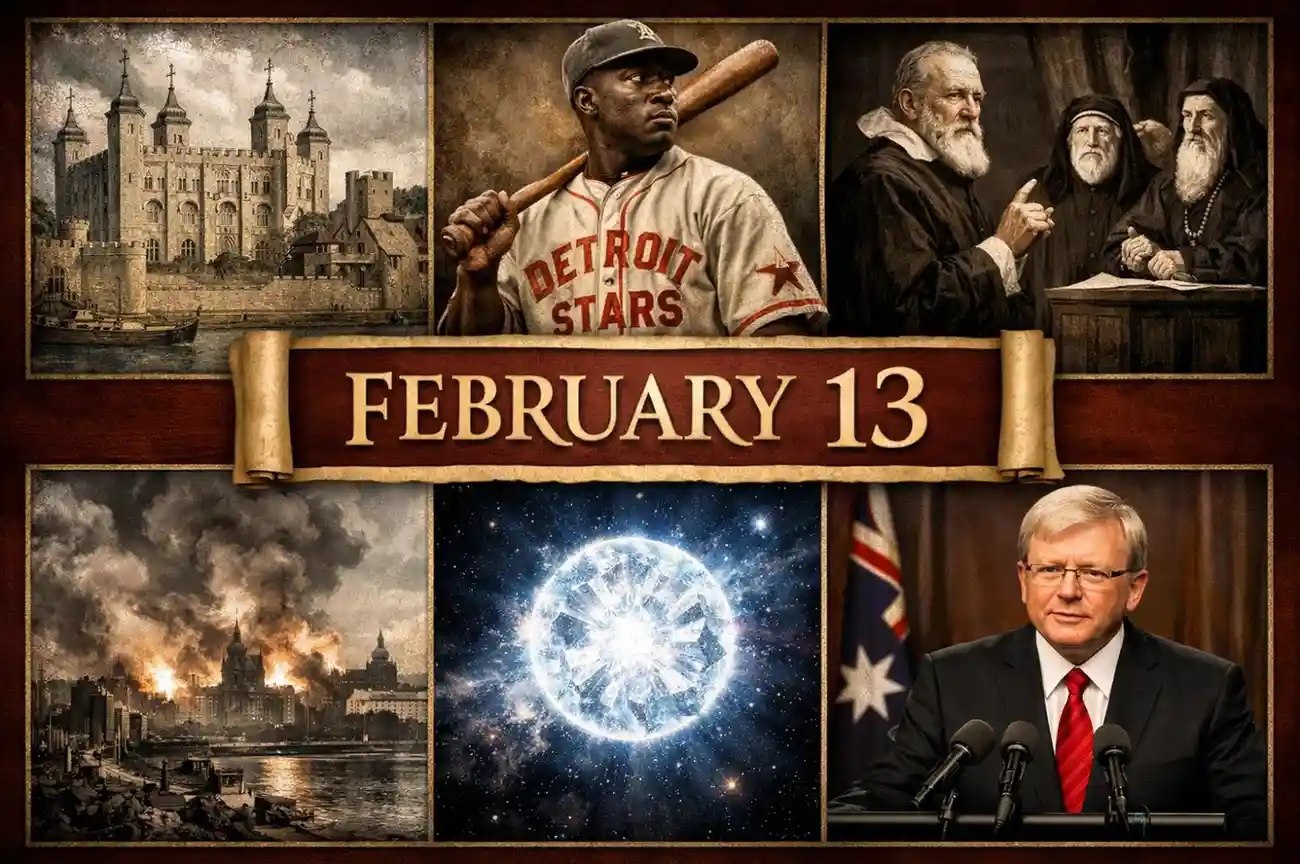
History has a peculiar way of balancing the scales, often on the very same calendar day. When we look at what happened on this day in history February 13, we find a narrative arc that moves from the tragic execution of a young queen to the triumphant discovery of a star-sized diamond in the far reaches of space. This is a day where Galileo stood before the Inquisition to defend the truth of the stars, and where, centuries later, the first Negro National League was formed to claim a rightful place in the American sun.
Important Events That Happened On February 13 In History
962 – The Diploma Ottonianum
Emperor Otto I and Pope John XII co-signed the Diploma Ottonianum. This document confirmed John as the ruler of Rome and the Papal States, but it also established the Emperor’s right to ratify papal elections, a move that would define church-state tensions for years to age.
1258 – The Sacking of Baghdad
Following the city’s capture, Hulegu Khan ordered his Mongol army to sack and plunder Baghdad. The destruction was immense, effectively ending the city’s status as the intellectual and cultural capital of the Islamic world.
1322 – Collapse of the Ely Tower
On the night of February 12th–13th, the central tower of Ely Cathedral collapsed. The disaster led to the construction of the unique and world-famous Octagon tower, a masterpiece of medieval engineering.
1352 – Battle of the Bosporus
During the War of the Straits, a fierce naval battle was fought in stormy seas near Constantinople. Fleets from Genoa, Venice, Aragon, and the Byzantine Empire clashed in a brutal night engagement for control over vital trade routes.
1462 – Treaty of Westminster
Edward IV of England finalized a treaty with the Scottish Lord of the Isles. The agreement was a strategic move by the English crown to exert influence over Scotland by supporting internal rivals to the Scottish king.
1503 – Challenge of Barletta
A famous tournament known as the Disfida di Barletta took place between 13 Italian and 13 French knights. The Italians won the contest, which became a significant moment of national pride and a legendary tale of chivalry.
1542 – Execution of Catherine Howard
Catherine Howard, the fifth wife of King Henry VIII, was beheaded at the Tower of London. She was executed for adultery and treason, having been married to the king for less than two years.
1633 – Galileo Arrives in Rome
The famed astronomer Galileo Galilei arrived in Rome to face trial before the Inquisition. He was accused of heresy for supporting the Copernican view that the Earth revolves around the Sun.
1642 – The Clergy Act
The Clergy Act became law in England, officially excluding bishops of the Church of England from serving in the House of Lords. This move reflected the growing Puritan influence and the widening rift between the monarchy and Parliament.
1660 – Accession of Charles XI
Upon the accession of the young King Charles XI of Sweden, his regents began the difficult negotiations to end the Second Northern War, seeking to stabilize the Swedish Empire’s borders.
1689 – William and Mary Proclaimed
Following the Glorious Revolution, William III and Mary II were officially proclaimed co-rulers of England. This transition established the supremacy of Parliament and led to the signing of the Bill of Rights.
1692 – Massacre of Glencoe
In the early morning, government troops killed nearly 80 members of the Macdonald clan at Glencoe, Scotland. The massacre was ordered because the clan chief had been late in pledging allegiance to the new king, William of Orange.
1726 – Parliament of Negrete
The Parliament of Negrete brought an end to the Mapuche uprising that had begun in 1723. The agreement between Spanish authorities and Mapuche leaders established a fragile peace in colonial Chile.
1755 – Treaty of Giyanti
The Treaty of Giyanti was signed, effectively dividing the Javanese kingdom of Mataram into two separate entities: the Sunanate of Surakarta and the Sultanate of Yogyakarta.
1849 – General Petition of Romanians
A delegation led by Metropolitan bishop Andrei Șaguna presented a petition to Austrian Emperor Franz Joseph I. They demanded that the Romanian nation in Transylvania, Banat, and Bukovina be formally recognized.
1861 – Capitulation of Gaeta
The Siege of Gaeta ended as the defending fortress surrendered to Piedmontese forces. This event effectively marked the end of the Kingdom of the Two Sicilies and was a massive step toward Italian unification.
1867 – Burying the Senne
Work began on covering the Senne river in Brussels. The project buried the city’s primary waterway underground, allowing for the creation of the modern central boulevards seen today.
1880 – Edison’s Thermionic Emission
Thomas Edison observed the phenomenon of thermionic emission, the release of electrons from a heated filament. This discovery, later known as the “Edison Effect,” became the foundation for the vacuum tube and electronics.
1913 – Tibetan Independence
The 13th Dalai Lama proclaimed Tibetan independence following the collapse of the Manchu Qing dynasty. This began a period of nearly forty years during which Tibet functioned as a de facto independent state.
1914 – Establishment of ASCAP
The American Society of Composers, Authors and Publishers (ASCAP) was founded in New York City. The organization was created to protect the copyrighted works of musical creators and ensure they were compensated for public performances.
1920 – Negro National League Formed
Rube Foster established the Negro National League in Kansas City. It was the first successful and stable professional baseball league for Black players in the United States during the era of segregation.
1931 – New Delhi Becomes Capital
The British Raj officially completed the transfer of the capital of India from Calcutta to New Delhi, a city purpose-built to serve as the seat of imperial power.
1935 – Lindbergh Kidnapping Verdict
In a trial dubbed the “Trial of the Century,” a jury found Bruno Richard Hauptmann guilty of the kidnapping and murder of the infant son of Charles Lindbergh. Hauptmann was sentenced to death.
1945 – Siege of Budapest Ends
The long and bloody siege of Budapest concluded with the unconditional surrender of German and Hungarian forces to the Soviet Red Army, marking a major Allied advance in the final months of World War II.
1945 – Bombing of Dresden Begins
The Royal Air Force launched a massive aerial bombardment of Dresden, Germany. The attack created a firestorm that destroyed much of the city center and resulted in heavy civilian casualties.
1951 – Battle of Chipyong-ni
The Battle of Chipyong-ni began during the Korean War. It is remembered as a turning point that halted the Chinese incursion into South Korea and stabilized the UN front lines.
1954 – Frank Selvy’s 100-Point Game
Furman University’s Frank Selvy made history by scoring 100 points in a single basketball game against Newberry College. He remains the only NCAA Division I player to achieve this feat.
1955 – Dead Sea Scrolls Acquired
The state of Israel announced it had obtained four of the seven original Dead Sea Scrolls. These ancient religious manuscripts are among the most significant archaeological finds of the 20th century.
1955 – Sabena Flight 503 Crash
A Sabena Airlines DC-6 crashed into Monte Terminillo in Italy during a flight from Brussels to Rome. All 29 people on board were killed in the high-altitude impact.
1960 – First French Nuclear Test
France successfully detonated its first atomic bomb, codenamed “Gerboise Bleue,” in the Algerian desert. This made France the fourth country in the world to possess nuclear weapons.
1960 – Nashville Sit-ins
Black college students in Nashville began a series of sit-ins at segregated lunch counters. This nonviolent protest was a landmark event in the American civil rights movement.
1961 – The Coso Artifact
An object that appeared to be a spark plug encased in 500,000-year-old rock was discovered near Olancha, California. While some claimed it was an “out-of-place artifact,” researchers later identified it as a 1920s Champion spark plug encased in a natural concretion.
1967 – Madrid Codices Discovered
Researchers at the National Library of Spain rediscovered two forgotten notebooks by Leonardo da Vinci, known as the Madrid Codices. They contain invaluable sketches and notes on mechanics and engineering.
1975 – World Trade Center Fire
A major fire broke out on the 11th floor of the North Tower of the World Trade Center in New York. The fire burned for three hours but did not cause structural failure, though it led to significant interior damage.
1978 – Sydney Hilton Bombing
A bomb exploded in a garbage truck outside the Hilton Hotel in Sydney during a meeting of Commonwealth heads of state. The blast killed two workers and a police officer.
1979 – Hood Canal Bridge Sinks
An intense windstorm with gusts over 100 mph struck western Washington, causing a half-mile section of the Hood Canal floating bridge to sink into the water.
1981 – Louisville Sewer Explosions
A series of massive explosions, caused by the ignition of hexane vapors in the sewer system, destroyed over two miles of streets in Louisville, Kentucky. Remarkably, there were no fatalities.
1983 – Cinema Statuto Fire
A fire at the Cinema Statuto in Turin, Italy, killed 64 people. The tragedy, caused by an electrical short circuit, led to a major overhaul of fire safety regulations in Italian public buildings.
1984 – Konstantin Chernenko Takes Power
Following the death of Yuri Andropov, Konstantin Chernenko was chosen as the General Secretary of the Communist Party of the Soviet Union. His brief leadership was marked by his failing health.
1991 – Amiriyah Shelter Bombing
During the Gulf War, U.S. “smart bombs” destroyed the Amiriyah air-raid shelter in Baghdad. While the military claimed it was a command center, the strike killed over 400 Iraqi civilians who were using it for protection.
1996 – Nepalese Civil War Initiated
The Communist Party of Nepal (Maoist) launched a “People’s War” against the Nepalese monarchy. The conflict would last for a decade and fundamentally transform the country’s political landscape.
2001 – El Salvador Earthquake
A magnitude 6.6 earthquake struck El Salvador just one month after a previous major quake. The disaster killed at least 315 people and triggered massive landslides.
2004 – Discovery of “Lucy” Star
Astronomers announced the discovery of BPM 37093, a white dwarf star that is essentially a 10-billion-trillion-trillion-carat diamond. It was nicknamed “Lucy” in honor of the Beatles song.
2007 – Resignation of Ma Ying-jeou
Taiwanese opposition leader Ma Ying-jeou resigned as chairman of the Kuomintang (GMD) after being indicted for embezzlement. He simultaneously announced his run for the presidency, which he later won.
2008 – National Apology in Australia
Prime Minister Kevin Rudd delivered a historic formal apology to Indigenous Australians and the “Stolen Generations” for the past government policies of forced child removal and assimilation.
2010 – Pune Bakery Bombing
A bomb exploded at the German Bakery in Pune, India, a popular spot for tourists and students. The attack killed 17 people and was attributed to the militant group Indian Mujahideen.
2011 – Umatilla Bison Hunt
For the first time in over a century, members of the Umatilla tribe were able to hunt a bison outside Yellowstone National Park, reclaiming a traditional right guaranteed by an 1855 treaty.
2012 – Maiden Flight of Vega
The European Space Agency successfully launched its new Vega rocket for the first time. The launch took place from the Guiana Space Centre, providing Europe with a new capability for placing small satellites into orbit.
2017 – Assassination of Kim Jong-nam
Kim Jong-nam, the estranged half-brother of North Korean leader Kim Jong-un, was murdered at Kuala Lumpur International Airport. He was attacked with VX nerve agent by two women in a highly publicized assassination.
2021 – Second Acquittal of Donald Trump
The United States Senate acquitted President Donald Trump in his second impeachment trial. The trial had centered on the charge of “incitement of insurrection” related to the January 6 Capitol attack.
2021 – Texas Winter Storm Crisis
A massive winter storm caused catastrophic power grid failures in Texas and northern Mexico. The extreme cold and resulting blackouts led to at least 82 deaths and left millions without heat or water.
Famous People Born On February 13
| Name | Role/Description | Birth – Death |
|---|---|---|
| Grant Wood | American painter | 13 Feb 1891 – 12 Feb 1942 |
| Richard Blumenthal | U.S. senator | 13 Feb 1946 – |
| Tennessee Ernie Ford | Singer | 13 Feb 1919 – 17 Oct 1991 |
| Robert H. Jackson | U.S. Supreme Court justice | 13 Feb 1892 – 9 Oct 1954 |
| Georges Simenon | Belgian-French author | 13 Feb 1903 – 4 Sep 1989 |
| Bess Truman | First Lady of the U.S. | 13 Feb 1885 – 18 Oct 1982 |
| Sir Joseph Banks | British naturalist | 13 Feb 1743 – 19 Jun 1820 |
| Mary of Burgundy | Duchess of Burgundy | 13 Feb 1457 – 27 Mar 1482 |
| Omar Torrijos | Panamanian leader | 13 Feb 1929 – 31 Jul 1981 |
| Peter Gustav Lejeune Dirichlet | Mathematician | 13 Feb 1805 – 5 May 1859 |
| Feodor Chaliapin | Russian singer | 13 Feb 1873 – 12 Apr 1938 |
| Sigmar Polke | German artist | 13 Feb 1941 – 10 Jun 2010 |
| Alexander VII | Pope | 13 Feb 1599 – 22 May 1667 |
| Elaine Pagels | Scholar | 13 Feb 1943 – |
| Paul Felix Lazarsfeld | Sociologist | 13 Feb 1901 – 30 Aug 1976 |
| Eddie Robinson | Football coach | 13 Feb 1919 – 3 Apr 2007 |
| Lewis Grassic Gibbon | Scottish author | 13 Feb 1901 – 7 Feb 1935 |
| Eleanor Farjeon | Writer | 13 Feb 1881 – 5 Jun 1965 |
| Leopold Godowsky | Pianist & composer | 13 Feb 1870 – 21 Nov 1938 |
| Georgios Papandreou | Greek PM | 13 Feb 1888 – 1 Nov 1968 |
| Ivan Andreyevich Krylov | Russian author | 13 Feb 1768/1769 – 21 Nov 1844 |
| Paul Deschanel | French president | 13 Feb 1855 – 28 Apr 1922 |
| Achille Bazaine | French marshal | 13 Feb 1811 – 28 Sep 1888 |
| Eileen Farrell | Singer | 13 Feb 1920 – 23 Mar 2002 |
| Sir Roy Harrod | Economist | 13 Feb 1900 – 9 Mar 1978 |
| Kate Roberts | Welsh writer | 13 Feb 1891 – 4 Apr 1985 |
| Jean-Jacques Servan-Schreiber | Journalist | 13 Feb 1924 – 7 Nov 2006 |
| Claude-Étienne Minié | Military officer | 13 Feb 1804 – 14 Dec 1879 |
| David Dudley Field | Lawyer | 13 Feb 1805 – 13 Apr 1894 |
| Charles-Irénée Castel, abbé de Saint-Pierre | Author | 13 Feb 1658 – 29 Apr 1743 |
Famous People Died On February 13
| Name | Role/Description | Birth – Death |
|---|---|---|
| George Rogers Clark | Military leader | 19 Nov 1752 – 13 Feb 1818 |
| Benvenuto Cellini | Italian artist | 1 Nov 1500 – 13 Feb 1571 |
| Lucia dos Santos | Portuguese nun | 22 Mar 1907 – 13 Feb 2005 |
| Sir Peter Strawson | Philosopher | 23 Nov 1919 – 13 Feb 2006 |
| Agnes Campbell Macphail | Politician | 24 Mar 1890 – 13 Feb 1954 |
| Alphonse Bertillon | French official | 23 Apr 1853 – 13 Feb 1914 |
| David Dixon Porter | Naval officer | 8 Jun 1813 – 13 Feb 1891 |
| Alberto Burri | Italian painter | 12 Mar 1915 – 13 Feb 1995 |
| Ruggero Giuseppe Boscovich | Astronomer & mathematician | 18 May 1711 – 13 Feb 1787 |
| Johann Joseph Fux | Composer | c.1660 – 13 Feb 1741 |
| Georges Rouault | French artist | 27 May 1871 – 13 Feb 1958 |
| Ichikawa Kon | Japanese director | 20 Nov 1915 – 13 Feb 2008 |
| Lily Pons | Singer | 12 Apr 1898 – 13 Feb 1976 |
| Charles Gravier, count de Vergennes | French minister | 28 Dec 1719 – 13 Feb 1787 |
| Huey Smith | Musician | 26 Jan 1934 – 13 Feb 2023 |
| Lucille Clifton | Poet | 27 Jun 1936 – 13 Feb 2010 |
| Francis Ysidro Edgeworth | Economist | 8 Feb 1845 – 13 Feb 1926 |
| Dick Weber | Bowler | 23 Dec 1929 – 13 Feb 2005 |
| Béla II | King of Hungary | c.1109 – 13 Feb 1141 |
| Jacopo Bassano | Painter | c.1517 – 13 Feb 1592 |
| Henry Highland Garnet | Abolitionist | 1815 – 13 Feb 1882 |
| Henrietta Szold | Zionist leader | 21 Dec 1860 – 13 Feb 1945 |
| Mariano José de Larra | Writer | 24 Mar 1809 – 13 Feb 1837 |
| Pauline Trigère | Couturiere | 4 Nov 1908 – 13 Feb 2002 |
| Arthur William Upfield | Writer | 1 Sep 1888 – 13 Feb 1964 |
| Kid Gavilan | Boxer | 6 Jan 1926 – 13 Feb 2003 |
| Vernon Lee | Essayist | 14 Oct 1856 – 13 Feb 1935 |
| Isaac Hull | Naval officer | 9 Mar 1773 – 13 Feb 1843 |
| Edna Lewis | Author & chef | 13 Apr 1916 – 13 Feb 2006 |
| Alfred Einstein | Musicologist | 30 Dec 1880 – 13 Feb 1952 |
Observances & Institutional Dates
- World Radio Day: A UNESCO-declared day to celebrate the importance of radio as a medium for information and entertainment.
- Children’s Day (Myanmar): Celebrating the birthday of General Aung San, the father of modern Myanmar.
- Black Love Day (United States): An African American holiday focused on peace, stop-the-violence, and racial healing.
Frequently Asked Questions
- What happened to Catherine Howard on this day?
- She was executed for adultery by King Henry VIII in 1542.
- Why is February 13 significant for the Lindbergh baby case?
- It was the day the jury found Bruno Hauptmann guilty of the kidnapping and murder in 1935.
- What is the “Lucy” star?
- It is a white dwarf star discovered in 2004 that is actually a massive diamond.
- When did the 13th Dalai Lama declare Tibet’s independence?
- He proclaimed it on February 13, 1913.