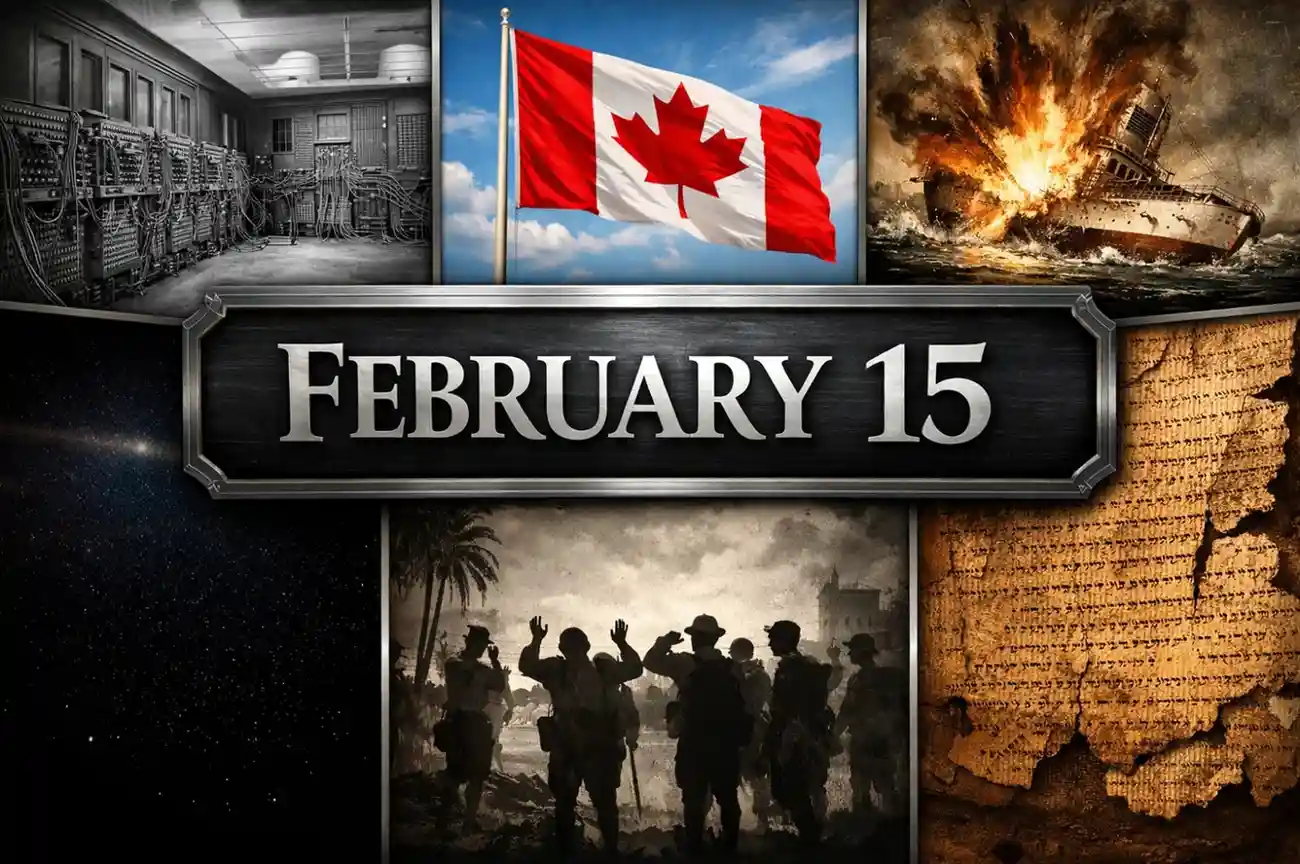
Throughout the centuries, today has acted as a bridge between the old world and the new, often through the force of law or the tragedy of conflict. When we look at what happened on this day in history February 15, we see the foundation of legal systems that governed empires and the sudden fall of military strongholds that changed the course of world wars. This is a day when an iron battleship exploded in a quiet harbor, sparking a war, and where, decades later, the first electronic computer hummed to life, sparking a digital revolution.
From the vast steppes of Afghanistan to the frozen reaches of the Arctic, the events of February 15 remind us that our world is shaped by a constant push for order, even amidst the chaos of human struggle.
Important Events That Happened On February 15 In History
438 – Publication of the Codex Theodosianus
Roman Emperor Theodosius II officially published the Codex Theodosianus, a massive compilation of Roman laws issued since 312 CE. This legal code was designed to streamline the complex legal system of the Empire and provide a unified standard for justice. Its influence was immense, as it served as a primary legal reference for the Eastern Roman Empire and significantly impacted the development of medieval European law.
590 – Crowning of Khosrau II
Khosrau II was crowned the King of Persia, ascending to the throne during a period of intense internal and external turmoil. His reign was characterized by ambitious military campaigns against the Byzantine Empire and a lavish court culture that represented the peak of Sasanian art. Though he initially found success, his long rule eventually led to the exhaustion of the Persian state, paving the way for future conquests.
706 – Public Executions in the Hippodrome
Byzantine Emperor Justinian II solidified his return to power by having his predecessors, Leontios and Tiberios III, publicly executed in the Hippodrome of Constantinople. This brutal display served as a warning to any who would challenge his authority and marked a dark chapter in the city’s political history. The executions were witnessed by massive crowds, illustrating the violent nature of succession within the Byzantine court.
1002 – Arduin of Ivrea Crowned King of Italy
At an assembly of Lombard nobles in Pavia, Arduin of Ivrea was restored to his domains and formally crowned as the King of Italy. He was chosen by local lords who were seeking independence from the influence of the Holy Roman Empire and the German kings. His coronation represented a brief but significant attempt to establish a purely Italian monarchy during the early medieval period.
1113 – Recognition of the Order of Hospitallers
Pope Paschal II issued the papal bull Pie Postulatio Voluntatis, which officially recognized the Order of the Hospital of Saint John of Jerusalem. This document granted the Order independence from local religious authorities and placed it directly under papal protection. It transformed the group from a simple infirmary for pilgrims into a powerful, international military and religious organization.
1214 – English Invasion of France
During the Anglo-French War, King John of England led an invasion force that landed at La Rochelle on the western coast of France. John’s goal was to reclaim lost ancestral lands in Normandy and Anjou that had been seized by King Philip II. This military campaign was part of a broader struggle for European dominance that would eventually culminate in the decisive Battle of Bouvines later that year.
1493 – Columbus Writes the New World Letter
While sailing home on board the Niña, Christopher Columbus wrote an open letter describing the lands, people, and resources he had encountered in the Caribbean. This letter was widely distributed upon his arrival in Portugal and Spain, serving as the first “press release” of the New World. It sparked immediate European interest in colonization and permanently altered the course of global history by bridging two hemispheres.
1637 – Ferdinand III Becomes Holy Roman Emperor
Ferdinand III was elected Holy Roman Emperor, succeeding his father during the height of the devastating Thirty Years’ War. Unlike his predecessor, Ferdinand III was more inclined toward seeking a peaceful resolution to the conflict that had ravaged Central Europe. His reign eventually saw the signing of the Peace of Westphalia, which fundamentally reshaped the political and religious map of the continent.
1690 – Secret Treaty of Sibiu
Constantin Cantemir, the Prince of Moldavia, signed a secret treaty with the Holy Roman Empire in the city of Sibiu. Under the terms of this agreement, Moldavia pledged to support the Habsburgs in their military actions against the Ottoman Empire. This high-stakes diplomatic move was a desperate attempt by the Moldavian leadership to secure independence from Ottoman suzerainty.
1764 – Establishment of St. Louis
The city of St. Louis was founded by French fur traders Pierre Laclède and Auguste Chouteau in a region that was then part of Spanish Louisiana. Positioned near the confluence of the Mississippi and Missouri Rivers, the settlement was designed to be a hub for the lucrative continental fur trade. It eventually became known as the “Gateway to the West,” playing a central role in American expansion.
1798 – Proclamation of the Roman Republic
Five days after Napoleon’s general Louis-Alexandre Berthier invaded the city, the Roman Republic was officially proclaimed. This new government replaced the temporal rule of the Pope and was established as a “sister republic” of revolutionary France. The event marked a period of radical secularization in Rome and the forced exile of Pope Pius VI, reflecting the spreading influence of Enlightenment ideals.
1835 – Serbia’s Sretenje Constitution
The Sretenje Constitution, the first modern constitution of Serbia, briefly came into effect following an assembly of national leaders. It was a remarkably liberal document for its time, advocating for the division of power and the protection of individual rights. However, due to pressure from the conservative absolute monarchies of Russia, Austria, and the Ottomans, the constitution was suspended shortly after its adoption.
1852 – Inauguration of Helsinki Cathedral
The Helsinki Cathedral, originally known as St. Nicholas’ Church, was officially inaugurated in the capital of the Grand Duchy of Finland. Designed by the architect Carl Ludvig Engel, its striking white dome and neoclassical design became the definitive landmark of the city’s skyline. The cathedral’s completion was a crowning achievement of the massive reconstruction effort that transformed Helsinki into a modern European capital.
1862 – Battle of Fort Donelson Attack
During the American Civil War, Confederate forces under General John B. Floyd launched an attack against Union troops led by Ulysses S. Grant, who were currently besieging Fort Donelson. The Confederates were attempting to break through the Union lines to allow for an escape to Nashville. When they failed to capitalize on their initial success and break the encirclement, the fort’s surrender became inevitable, handing Grant a major strategic victory.
1870 – Founding of Stevens Institute of Technology
The Stevens Institute of Technology was established in Hoboken, New Jersey, through a bequest from the family of inventors who pioneered American steam navigation. It was the first institution in the United States to offer a dedicated Bachelor of Engineering degree in mechanical engineering. This milestone in technical education helped provide the skilled workforce necessary for the rapid industrialization of the late 19th century.
1872 – First Issue of the Bulletin de la Fédération jurassienne
The first issue of the Bulletin de la Fédération jurassienne was published, serving as a primary voice for the anarchist movement in Switzerland and abroad. This newspaper played a crucial role in spreading the ideas of Mikhail Bakunin and other anti-authoritarian thinkers during the split in the International Workingmen’s Association. It remains a significant historical artifact in the study of early labor and anarchist political theory.
1879 – Female Attorneys and the Supreme Court
U.S. President Rutherford B. Hayes signed a landmark bill that allowed female attorneys to argue cases before the Supreme Court of the United States. This legislation was largely the result of persistent lobbying by Belva Ann Lockwood, who had previously been denied entry based solely on her gender. It was a major victory for the women’s rights movement, breaking down a significant barrier in the legal profession.
1898 – Explosion of the USS Maine
The American battleship USS Maine exploded and sank in the harbor of Havana, Cuba, resulting in the deaths of approximately 274 crew members. While the cause of the explosion was initially unclear and remains debated by historians, American newspapers blamed a Spanish mine. The disaster created a massive public outcry that pushed the United States into declaring war against Spain, beginning the Spanish-American War.
1899 – The February Manifesto in Finland
Tsar Nicholas II of Russia issued a declaration known as the February Manifesto, which significantly reduced the autonomous powers of the Grand Duchy of Finland. This decree meant that Russian imperial laws would take precedence over Finnish laws, effectively starting a period of cultural and political oppression. It galvanized Finnish resistance and marked the beginning of a long struggle for the preservation of their national identity.
1909 – Flores Theater Fire
A devastating fire broke out during a performance at the Flores Theater in Acapulco, Mexico, claiming the lives of roughly 250 people. The tragedy was compounded by the fact that the theater’s exits were locked or blocked, preventing a quick escape for the panicked audience. It remains one of the deadliest theater fires in world history and led to a temporary ban on public gatherings in the region as safety codes were questioned.
1923 – Greece Adopts the Gregorian Calendar
Greece became the final European country to officially transition to the Gregorian calendar for civil purposes. This change was intended to align the nation with the rest of the Western world for trade and diplomacy, though the Greek Orthodox Church continued to use the Julian calendar for religious observances. The transition required jumping forward several days, as the Julian system had fallen significantly out of sync with astronomical reality.
1925 – Second Delivery of Serum to Nome
The second delivery of life-saving diphtheria antitoxin arrived in Nome, Alaska, concluding a heroic effort known as the “Great Race of Mercy.” While the first delivery brought relief, this second batch ensured that the epidemic was fully contained. This feat, performed by teams of sled dogs and mushers across nearly 700 miles of frozen wilderness, captured the imagination of the world and celebrated human and animal endurance.
1933 – Attempted Assassination of FDR
While visiting Miami, Giuseppe Zangara attempted to assassinate U.S. President-elect Franklin D. Roosevelt during a public speech. Zangara missed Roosevelt but struck five other people, including Chicago Mayor Anton J. Cermak, who was standing nearby. Cermak eventually died from his wounds, and Zangara was quickly captured and executed, leaving the country to contemplate how close it had come to a political catastrophe.
1940 – Premiere of Paul Creston’s Saxophone Sonata
The Carnegie Chamber Hall in New York hosted the official premiere of Paul Creston’s Saxophone Sonata, performed by the composer and saxophonist Cecil Leeson. This work was a significant addition to the classical saxophone repertoire, showcasing the instrument’s lyrical and technical capabilities. It helped elevate the status of the saxophone, which was often relegated to jazz and military bands, within the world of formal concert music.
1942 – Fall of Singapore
In one of the most significant defeats in British military history, General Arthur Percival surrendered Singapore to Japanese forces. Approximately 80,000 soldiers from the UK, Australia, and India became prisoners of war following the week-long assault. Winston Churchill described the event as the “worst disaster” in British history, as it ended the myth of British invincibility in Southeast Asia and secured a vital strategic base for Japan.
1944 – Assault on Monte Cassino
Allied forces began a massive assault on the historic abbey of Monte Cassino in Italy, believing it was being used as an observation post by German troops. The attack involved intense aerial bombardment that reduced the ancient structure to rubble. Unfortunately, the destruction of the abbey actually provided the German paratroopers with better defensive positions in the ruins, leading to a prolonged and bloody struggle for the heights.
1944 – The Narva Offensive
The Soviet Red Army launched the Narva Offensive against German forces in Estonia, seeking to break through the “Panther Line” and reclaim the Baltic region. The battle was exceptionally brutal, fought in freezing conditions across marshy terrain and dense forests. It was part of the wider Soviet winter campaign aimed at pushing the German army back toward its own borders and liberating occupied territories in the north.
1945 – Third Day of Dresden Bombing
As the devastating aerial campaign against Dresden entered its third day, American and British bombers continued to strike the burning city. By this point, the historic center had been largely incinerated by firestorms, and the civilian death toll had reached catastrophic levels. The bombing remains one of the most controversial events of World War II, sparking debates about the military necessity of targeting civilian-populated urban centers.
1946 – Dedication of ENIAC
The University of Pennsylvania formally dedicated ENIAC, the world’s first electronic general-purpose computer. Occupying an entire room and using thousands of vacuum tubes, it was capable of performing thousands of additions per second, a feat that was previously impossible for human “calculators.” This machine laid the groundwork for the modern digital age, proving that electronic computation was the future of science and industry.
1949 – Excavations at Qumran Cave 1
Archaeologists Gerald Lankester Harding and Roland de Vaux began the first systematic excavations at Cave 1 of the Qumran Caves near the Dead Sea. Their work confirmed the authenticity of the ancient scrolls that had been found by Bedouin shepherds two years earlier. This discovery of the first seven Dead Sea Scrolls provided a revolutionary look at biblical texts and the religious life of the Second Temple period.
1952 – Burial of King George VI
The funeral of King George VI took place at St George’s Chapel in Windsor Castle, where he was laid to rest following his death earlier that month. The ceremony was attended by dignitaries from around the world and marked the end of a reign defined by the challenges of World War II. His daughter, Queen Elizabeth II, had already begun her own long reign, signaling a new era for the British monarchy and the Commonwealth.
1954 – Agreement on the DEW Line
Canada and the United States officially agreed to collaborate on the construction of the Distant Early Warning (DEW) Line. This was a system of radar stations stretching across the Arctic regions to detect incoming Soviet bombers during the Cold War. The project was a massive engineering undertaking that required the cooperation of both nations to protect North American airspace from the threat of a nuclear strike.
1961 – Sabena Flight 548 Crash
A Sabena Airlines Boeing 707 crashed in Belgium while on its approach to Brussels, resulting in the deaths of all 73 people on board. The tragedy was particularly felt in the sports world, as the entire United States figure skating team was on the plane traveling to the World Championships. The loss led to the cancellation of the 1961 championships and left a lasting impact on the global skating community.
1965 – Adoption of the Maple Leaf Flag
The maple leaf was officially adopted as the national flag of Canada, replacing the Canadian Red Ensign. The new design, featuring a single red maple leaf on a white square with red borders, was the result of a long and heated national debate. It was intended to provide Canada with a distinct symbol that was independent of British colonial imagery, representing the nation’s growing sense of sovereign identity.
1970 – Dominicana de Aviación Flight 603 Crash
Shortly after takeoff from Santo Domingo, a Dominicana de Aviación DC-9 crashed into the Caribbean Sea, killing all 102 people on board. Among the victims were members of the Puerto Rico women’s national volleyball team and former world boxing champion Carlos Cruz. The crash was one of the deadliest in the history of the Dominican Republic and was attributed to engine failure caused by contaminated fuel.
1971 – Decimal Day in the UK and Ireland
The United Kingdom and Ireland completed the process of decimalising their currencies, a historic shift known as “Decimal Day.” This move replaced the traditional system of pounds, shillings, and pence with a simpler system based on units of 100. It required a massive public education campaign to help citizens adapt to the new coins and calculations, bringing the two nations in line with global financial standards.
1972 – U.S. Federal Copyright for Sound Recordings
For the first time in American history, sound recordings were granted federal copyright protection. Previously, only the underlying musical composition was protected, leaving actual audio recordings vulnerable to unauthorized duplication. This change in law was a major win for the music industry, providing artists and record labels with the legal tools necessary to combat the growing problem of record piracy.
1972 – Overthrow of José María Velasco Ibarra
President José María Velasco Ibarra of Ecuador was overthrown by a military coup for the fourth time in his lengthy and turbulent political career. Velasco Ibarra had been serving his fifth term as president when the military seized power to prevent him from holding scheduled elections. This event illustrated the chronic political instability that characterized many South American governments during the mid-20th century.
1982 – Sinking of the Ocean Ranger
The Ocean Ranger, one of the world’s largest semi-submersible drilling rigs, sank during a severe storm off the coast of Newfoundland. All 84 crew members on board perished when the rig capsized after a wave broke through a window in the control room. The disaster led to major changes in the regulations governing offshore drilling safety and the design of lifeboats for use in the North Atlantic.
1989 – Soviet Withdrawal from Afghanistan
The Soviet Union officially announced that its last troops had crossed the border, marking the end of the nine-year Soviet–Afghan War. The conflict had resulted in a stalemate and heavy losses for the Soviet military, contributing to internal instability back in the USSR. For Afghanistan, the withdrawal left a power vacuum that led to a brutal civil war among various mujahideen factions.
1991 – Formation of the Visegrád Group
The leaders of Czechoslovakia, Hungary, and Poland signed the Visegrád Declaration, establishing a cooperative framework for their transition toward free-market economies and democratic systems. The group was named after the Hungarian town where the meeting took place, echoing a 14th-century summit of medieval kings. It was a strategic effort to coordinate their integration into Western European institutions like the EU and NATO.
1992 – Sentencing of Jeffrey Dahmer
In a Milwaukee courtroom, serial killer Jeffrey Dahmer was sentenced to 15 consecutive terms of life in prison for the murders of 15 young men and boys. The case had shocked the nation due to its gruesome nature and the systemic failures that allowed Dahmer to remain undetected for so long. Dahmer was later murdered in prison, but the trial remains a significant moment in the history of American criminal justice.
1992 – Air Transport International Flight 805 Crash
An ATI cargo flight crashed during a second landing attempt in Swanton, Ohio, resulting in the deaths of all four crew members on board. The Douglas DC-8 struck the ground near the Toledo Express Airport during a period of bad weather. Investigations into the crash highlighted the dangers of spatial disorientation and the importance of strict adherence to go-around procedures during low-visibility landings.
1996 – Long March 3B Rocket Crash
A Chinese Long March 3B rocket carrying a telecommunications satellite veered wildly off course immediately after liftoff and crashed into a nearby village. While official reports stated that only six people were killed, independent observers and journalists estimated the death toll to be much higher. The incident was a major setback for China’s commercial space program and raised serious questions about the safety of launch sites near populated areas.
1996 – Rocket Attack on U.S. Embassy in Athens
The U.S. Embassy in Athens was targeted by an anti-tank rocket launched by the far-left militant group known as the Revolutionary Organization 17 November. The rocket struck the embassy’s rear parking lot, causing property damage but no injuries. The attack was part of a long-running campaign by the group against Western interests and represented the persistent threat of political extremism in Greece at the time.
1996 – The Shawinigan Handshake
During a public event in Hull, Quebec, Canadian Prime Minister Jean Chrétien was confronted by a protester named Bill Clennett. Chrétien famously grabbed Clennett by the throat and shoved him aside, an incident that was quickly dubbed the “Shawinigan Handshake” by the media. Surprisingly, the Prime Minister’s aggressive response actually boosted his popularity among many voters who saw it as a sign of his tough, no-nonsense character.
2001 – First Draft of the Human Genome
The journal Nature published the first draft of the complete human genome, the result of a massive international effort known as the Human Genome Project. This scientific milestone provided a map of all the genes in the human body, opening new doors for medicine and the understanding of genetic diseases. It was hailed as one of the most significant achievements in the history of science, comparable to the moon landing.
2003 – Largest Peace Demonstration in History
In over 600 cities across the globe, millions of people took to the streets to protest the impending invasion of Iraq. Estimates of the total number of participants ranged from 8 million to 30 million, making it the largest coordinated anti-war protest in history. Despite the unprecedented scale of the demonstrations, the U.S.-led coalition proceeded with the invasion just one month later.
2003 – Last Launch of Ariane 4
The European Space Agency launched the final Ariane 4 rocket from the spaceport in French Guiana. Over its 15-year career, the Ariane 4 had become the “workhorse” of the European space industry, launching over 100 satellites into orbit. Its retirement paved the way for the larger and more powerful Ariane 5, representing the continued evolution of Europe’s independent access to space.
2010 – Halle Train Collision
Two commuter trains collided head-on during the morning rush hour in Halle, Belgium, resulting in 19 deaths and over 170 injuries. The impact was so severe that carriages were thrown into the air and crushed. The disaster sparked a national debate about the speed of implementing automatic braking systems across the Belgian rail network and led to significant investments in rail safety technology.
2012 – Comayagua Prison Fire
A horrific fire broke out at a prison in the city of Comayagua, Honduras, killing 360 inmates who were trapped in their cells. The fire was one of the deadliest prison disasters in history and highlighted the critical issues of overcrowding and lack of safety standards in Latin American correctional facilities. Relatives of the victims clashed with police outside the prison as they waited for news of their loved ones.
2013 – Chelyabinsk Meteor Explosion
A meteor exploded in the atmosphere over the Russian city of Chelyabinsk, releasing energy equivalent to nearly 30 Hiroshima bombs. The shock wave from the blast shattered windows for miles, injuring 1,500 people mostly due to flying glass. The event was a vivid reminder of the threat posed by near-Earth objects and occurred, by pure coincidence, just hours before an unrelated asteroid made a record-close pass by Earth.
2021 – Congo River Boat Disaster
A crowded boat carrying passengers and goods sank on the Congo River near the village of Longola Ekoti, leading to the drowning of at least 60 people. Hundreds of others were reported missing as rescue efforts were hampered by the remote location and lack of proper equipment. Such tragedies are frequent on the Congo River, where old, poorly maintained vessels are often the only means of transport for local communities.
After reading February 15 facts, read also the February 14 stories
Famous People Born On February 15
| Name | Role / Description | Birth – Death |
|---|---|---|
| Galileo Galilei | Italian astronomer & physicist | 15 February 1564 – 8 January 1642 |
| Susan B. Anthony | American women’s rights leader | 15 February 1820 – 13 March 1906 |
| Alfred North Whitehead | British mathematician & philosopher | 15 February 1861 – 30 December 1947 |
| John Adams | American composer & conductor | 15 February 1947 – |
| Art Spiegelman | American cartoonist (Maus) | 15 February 1948 – |
| Shepard Fairey | American street artist (“Hope” poster) | 15 February 1970 – |
| Graham Hill | British Formula One champion | 15 February 1929 – 29 November 1975 |
| Cyrus McCormick | American inventor (mechanical reaper) | 15 February 1809 – 13 May 1884 |
| Niklaus Wirth | Swiss computer scientist | 15 February 1934 – 1 January 2024 |
| Elihu Root | American statesman, Nobel laureate | 15 February 1845 – 7 February 1937 |
| Michael Praetorius | German composer & theorist | 15 February 1571 – 15 February 1621 |
| Emil Kraepelin | German psychiatrist | 15 February 1856 – 7 October 1926 |
| Halford Mackinder | British geographer | 15 February 1861 – 6 March 1947 |
| Roger B. Chaffee | American astronaut (Apollo 1) | 15 February 1935 – 27 January 1967 |
| Li Hongzhang | Chinese statesman | 15 February 1823 – 7 November 1901 |
| Pedro Menéndez de Avilés | Spanish conquistador | 15 February 1519 – 17 September 1574 |
| Charles Lewis Tiffany | American jeweler (Tiffany & Co.) | 15 February 1812 – 18 February 1902 |
| Desmond Haynes | West Indian cricketer | 15 February 1956 – |
| Henry Threadgill | American jazz musician | 15 February 1944 – |
| Sax Rohmer | British novelist (Fu Manchu) | 15 February 1883 – 1 June 1959 |
| Bill T. Jones | American choreographer | 15 February 1952 – |
| Georges Auric | French composer | 15 February 1899 – 23 July 1983 |
| George Johnstone Stoney | Irish physicist (coined “electron”) | 15 February 1826 – 5 July 1911 |
| Charles-François Daubigny | French painter | 15 February 1817 – 19 February 1878 |
| Abraham Clark | American Founding Father | 15 February 1726 – 15 September 1794 |
| Johann H.W. Tischbein | German painter | 15 February 1751 – 26 June 1829 |
| Hans von Euler-Chelpin | Swedish biochemist, Nobel laureate | 15 February 1873 – 7 November 1964 |
| Owen Jones | British architect & designer | 15 February 1809 – 19 April 1874 |
| Jean-François Lesueur | French composer | 15 February 1760 – 6 October 1837 |
| Vittoria Accoramboni | Italian noblewoman | 15 February 1557 – 22 December 1585 |
Famous People Died On February 15
| Name | Role / Description | Birth – Death |
|---|---|---|
| Ferdinand II | Holy Roman Emperor | 9 July 1578 – 15 February 1637 |
| H.H. Asquith | British Prime Minister | 12 September 1852 – 15 February 1928 |
| Lew Wallace | American author (Ben-Hur) | 10 April 1827 – 15 February 1905 |
| Gotthold Ephraim Lessing | German writer & critic | 22 January 1729 – 15 February 1781 |
| Little Walter | American blues musician | 1 May 1930 – 15 February 1968 |
| Mark Hanna | American political leader | 24 September 1837 – 15 February 1904 |
| Mikhail Glinka | Russian composer | 1 June 1804 – 15 February 1857 |
| Hugh Dowding | British air chief marshal | 24 April 1882 – 15 February 1970 |
| Giulio Douhet | Italian air power theorist | 30 May 1869 – 15 February 1930 |
| Conrad III | King of Germany | 1093 – 15 February 1152 |
| Paul Berg | American biochemist, Nobel laureate | 30 June 1926 – 15 February 2023 |
| Theodoros Kolokotronis | Greek revolutionary leader | April 1770 – 15 February 1843 |
| Henry Addington | British Prime Minister | 30 May 1757 – 15 February 1844 |
| Anthony A. Cooper | English philosopher | 26 February 1671 – 15 February 1713 |
| Edgar Snow | American journalist | 19 July 1905 – 15 February 1972 |
| William Schuman | American composer | 4 August 1910 – 15 February 1992 |
| William C. Bullitt | American diplomat | 25 January 1891 – 15 February 1967 |
| Owen W. Richardson | British physicist, Nobel laureate | 26 April 1879 – 15 February 1959 |
| Lucius II | Pope | – 15 February 1145 |
| Henry Way Kendall | American physicist, Nobel laureate | 9 December 1926 – 15 February 1999 |
| Jan Swammerdam | Dutch naturalist | 12 February 1637 – 15 February 1680 |
| José de Acosta | Spanish theologian | 1539 – 15 February 1600 |
| Otto von Kotzebue | Russian explorer | 30 December 1787 – 15 February 1846 |
| Oswiu | King of Northumbria | 612 – 15 February 670 |
| Nicholas Wiseman | English cardinal | 2 August 1802 – 15 February 1865 |
| Jean Le Bel | French chronicler | c. 1290 – 15 February 1370 |
| Thomas Bray | Anglican clergyman | 1656 – 15 February 1730 |
| Adam Wilhelm Moltke | Danish Prime Minister | 25 August 1785 – 15 February 1864 |
| Henry Hunt | British reformer | 6 November 1773 – 15 February 1835 |
| St. Claude La Colombière | French Jesuit priest | 2 February 1641 – 15 February 1682 |
Observances & Institutional Dates
- National Flag of Canada Day: Celebrating the anniversary of the 1965 adoption of the maple leaf flag.
- Susan B. Anthony Day: Observed in several U.S. states to honor the birth and legacy of the famed suffragette.
- ENIAC Day (Philadelphia): Commemorating the dedication of the world’s first electronic computer at the University of Pennsylvania.
- Liberation Day (Afghanistan): Marking the anniversary of the 1989 withdrawal of Soviet troops.
- Parinirvana Day: A Mahayana Buddhist festival marking the death of the Buddha and his entrance into Nirvana.
Frequently Asked Questions
- What was the “Pale Blue Dot” photo?
- While the photo was taken on Feb 14, it was widely celebrated today as a reminder of Earth’s fragility.
- When did Singapore fall to the Japanese?
- Singapore surrendered on February 15, 1942, in what was called the largest British surrender in history.
- What is the significance of ENIAC?
- Dedicated in 1946, it was the first electronic, general-purpose computer, starting the computer age.
- Why did the USS Maine explode?
- The 1898 explosion was blamed on a Spanish mine, though modern theories suggest an internal coal bunker fire.