The timeline of mid-February often reflects the human drive to reach further, whether across frozen oceans or into the depths of a hidden tomb. When we look at what happened on this day in history February 16, we find a day characterized by the unsealing of ancient mysteries and the signing of modern protocols. It is a date where nations claimed their independence twice over and where technology bridged gaps through the first computer bulletin boards.
Important Events That Happened On February 16 In History
1249 – Andrew of Longjumeau’s Diplomatic Mission
King Louis IX of France dispatched Andrew of Longjumeau as his official ambassador to the Khagan of the Mongol Empire. Louis hoped to form a strategic alliance with the Mongols against the Islamic powers of the Middle East during the Crusades. Andrew traveled vast distances across Central Asia, carrying letters and gifts, representing one of the earliest major diplomatic contacts between Western Europe and the Mongol court.
1270 – Battle of Karuse
The Grand Duchy of Lithuania achieved a significant military victory over the Livonian Order in the Battle of Karuse, fought on the frozen surface of the Baltic Sea. The Lithuanian forces, led by Grand Duke Traidenis, successfully ambushed the Crusader knights who were attempting to expand their influence in the region. This victory halted the Order’s northward advance for several years and solidified Lithuania’s status as a rising power in Eastern Europe.
1630 – Capture of Olinda
Dutch forces under the command of Hendrick Lonck successfully captured the city of Olinda in present-day Brazil. This victory was a centerpiece of the Dutch West India Company’s efforts to seize the lucrative sugar-producing regions from Portuguese control. The fall of Olinda marked the beginning of “Dutch Brazil,” a colonial venture that would significantly influence the Atlantic slave trade and the global sugar economy for several decades.
1646 – Battle of Torrington
The Battle of Torrington in Devon stands as the last major engagement of the First English Civil War. Parliamentarian forces led by Sir Thomas Fairfax delivered a crushing defeat to the Royalist army commanded by Lord Hopton. During the fighting, a massive explosion in the town’s church, which was being used as a gunpowder magazine, decimated much of the area. This victory effectively ended organized Royalist resistance in the West Country, leading to the eventual surrender of King Charles I.
1699 – First Leopoldine Diploma
Holy Roman Emperor Leopold I issued the First Leopoldine Diploma, a landmark decree regarding the status of the Greek Catholic clergy in Transylvania. This document officially recognized that Greek Catholic priests enjoyed the same legal privileges and exemptions as their Roman Catholic counterparts. The diploma was a strategic effort to integrate the Romanian population into the Habsburg Empire by offering religious and social parity within the Catholic framework.
1742 – Spencer Compton Becomes Prime Minister
Spencer Compton, the Earl of Wilmington, officially took office as the Prime Minister of Great Britain following the resignation of Robert Walpole. His tenure was largely overshadowed by the influence of other powerful politicians and the ongoing War of the Austrian Succession. Though his time in the highest office was relatively short, his appointment represented the shifting political alliances within the British Whig party during the mid-18th century.
1796 – British Capture of Colombo
The city of Colombo in Ceylon, known today as Sri Lanka, fell to British forces, marking the completion of their invasion of the island. The Dutch defenders surrendered the strategic port city with minimal resistance, ending nearly 150 years of Dutch colonial rule in the region. This conquest secured Britain’s control over the valuable cinnamon trade and established a vital naval base in the Indian Ocean for the British Empire.
1804 – Raid on the USS Philadelphia
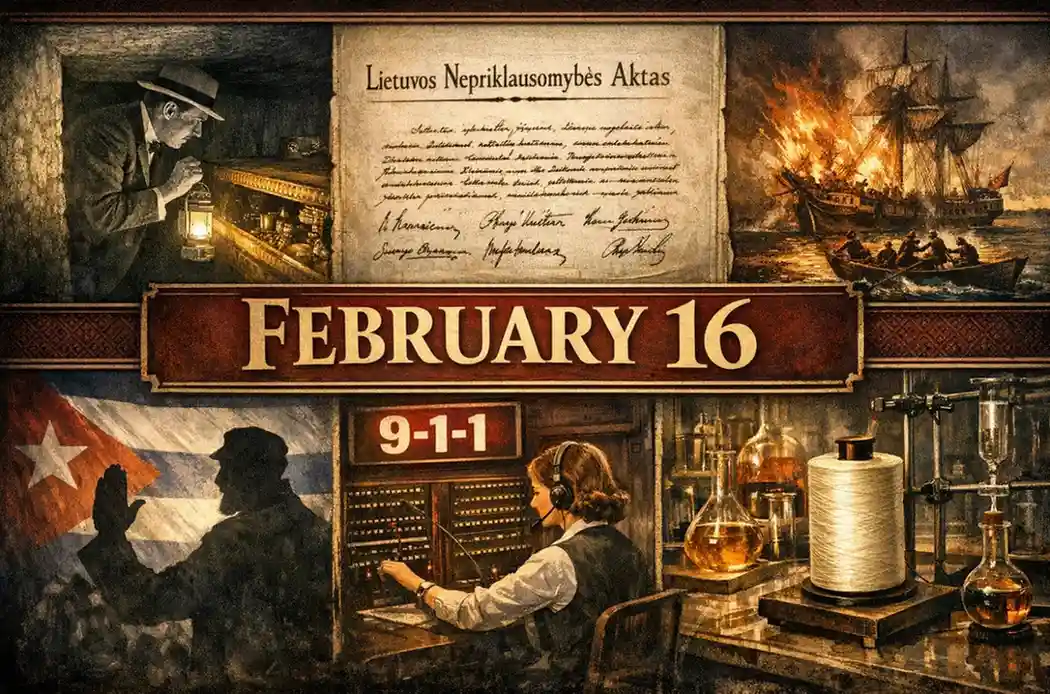
During the First Barbary War, Lieutenant Stephen Decatur led a daring night raid into Tripoli Harbor to burn the captured frigate USS Philadelphia. The ship had run aground and was being used by Tripolitan pirates as a gun battery against the American fleet. Decatur and his men successfully boarded the vessel, set it ablaze, and escaped without losing a single man, an action famously described by Admiral Horatio Nelson as “the most bold and daring act of the age.”
1862 – Capture of Fort Donelson
In a pivotal moment of the American Civil War, Union General Ulysses S. Grant successfully captured Fort Donelson in Tennessee. After the Confederate defenders asked for terms, Grant famously replied that “no terms except unconditional and immediate surrender can be accepted.” This victory opened up the Cumberland River as a highway for Union invasion and earned Grant the nickname “Unconditional Surrender” Grant, propelling him to national fame.
1866 – Marquess of Hartington Becomes Secretary of State for War
Spencer Compton Cavendish, the Marquess of Hartington, was appointed as the British Secretary of State for War. His appointment came during a period of necessary military reform following the lessons learned in the Crimean War. Hartington would go on to become one of the most prominent Liberal politicians of the Victorian era, eventually leading the party and serving in various high-ranking cabinet positions throughout his long career.
1881 – Incorporation of the Canadian Pacific Railway
The Canadian Pacific Railway (CPR) was officially incorporated by an Act of Parliament in Ottawa. This massive project was a condition of British Columbia’s entry into the Canadian Confederation, intended to physically link the Atlantic and Pacific coasts. The construction of the railway was an immense engineering feat that faced countless financial and geographical obstacles, eventually playing a crucial role in the settlement and development of Western Canada.
1899 – Founding of Iceland’s First Football Club
Knattspyrnufélag Reykjavíkur, known as KR, was founded on this day as the first football club in Iceland. The establishment of the club marked the formal introduction of organized sports to the island nation and laid the foundation for Iceland’s passionate football culture. KR has since become the most successful club in Icelandic history, winning numerous league titles and serving as a pioneer for the sport in the North Atlantic.
1900 – Borchgrevink’s Farthest South
The Southern Cross expedition, led by Carsten Borchgrevink, achieved a new “Farthest South” record by reaching 78° 50’S. This mission was the first to make a successful landing on the Great Ice Barrier (now known as the Ross Ice Shelf) and the first to overwinter on the Antarctic continent. Their findings and biological collections provided the scientific community with its first detailed look at the harsh conditions of the interior Antarctic.
1918 – Act of Independence of Lithuania
The Council of Lithuania unanimously adopted the Act of Independence, declaring the nation an independent state based on democratic principles. This historic document signaled the end of centuries of foreign rule by the Russian Empire and German occupation. Despite the ongoing chaos of World War I, the act successfully laid the groundwork for the modern Lithuanian state and is celebrated today as the nation’s primary national holiday.
1923 – Unsealing of Tutankhamun’s Burial Chamber
Archaeologist Howard Carter officially unsealed the burial chamber of the boy-king Pharaoh Tutankhamun in the Valley of the Kings. Inside, he discovered the magnificent golden shrines and the stone sarcophagus that had remained undisturbed for over 3,000 years. This discovery sparked a global wave of “Egyptomania” and remains one of the most famous and significant archaeological finds in history, providing unparalleled insight into ancient Egyptian royalty.
1930 – Romania Joins FIFA
The Romanian Football Federation officially became a member of FIFA, the international governing body for football. This move allowed Romania to participate in the very first World Cup held in Uruguay later that same year. Membership in FIFA helped professionalize the sport within Romania and integrated the nation into the burgeoning world of international sports diplomacy and competition.
1934 – End of the Austrian Civil War
The brief but violent Austrian Civil War ended with the total defeat of the Social Democrats and their paramilitary wing, the Republikanischer Schutzbund. The conflict broke out between the socialist movement and the Austrofascist government led by Engelbert Dollfuss. The government’s victory led to the banning of opposition parties and the establishment of a corporate state, a major step toward the eventual annexation of Austria by Nazi Germany.
1934 – Commission of Government in Newfoundland
In a unique historical event, the Commission of Government was officially sworn in for Newfoundland, ending 79 years of independent responsible government. Due to a crushing financial crisis caused by the Great Depression, the dominion voluntarily suspended its democratic rights in exchange for British financial aid. This non-elected body of seven officials governed Newfoundland until it eventually joined Canada as a province in 1949.
1936 – Popular Front Wins Spanish Election
The Popular Front, a coalition of left-wing parties including socialists and communists, won a narrow but decisive victory in the Spanish general election. This result deeply polarized the country and caused immediate alarm among conservative, military, and religious sectors of society. The political instability and social unrest that followed this election were the primary factors that led to the outbreak of the Spanish Civil War just months later.
1937 – Patent for Nylon
Wallace H. Carothers, a chemist at DuPont, received a United States patent for the synthetic polymer known as nylon. This invention revolutionized the textile industry, providing a durable and inexpensive alternative to silk that was quickly adopted for everything from stockings to parachutes. Carothers’ work laid the foundation for the modern plastics and synthetics industry, though he tragically did not live to see the full impact of his discovery.
1940 – The Altmark Incident
In a daring naval operation during World War II, sailors from the British destroyer HMS Cossack boarded the German tanker Altmark in neutral Norwegian waters. The Altmark was carrying 299 British merchant sailors who had been captured by the German pocket battleship Admiral Graf Spee. The rescue mission, carried out under the shout of “The Navy’s here!”, successfully freed the prisoners and was a major propaganda victory for Britain.
1942 – Establishment of the Greek People’s Liberation Army
In Nazi-occupied Athens, the Greek People’s Liberation Army (ELAS) was formally established as the military wing of the National Liberation Front (EAM). ELAS grew to become the largest and most effective resistance force in Greece during World War II, engaging in guerrilla warfare against Axis troops. Their efforts were crucial in liberating large parts of the Greek countryside, though they later became a central player in the post-war Greek Civil War.
1942 – Attack on Aruba
A German U-boat, U-156, surfaced off the coast of Aruba and shelled the Lago Oil Refinery, marking the first German shots fired at a land-based target in the Americas during World War II. The attack was part of Operation Neuland, a campaign to disrupt the vital oil supplies being shipped from the Caribbean to the Allied forces. While the physical damage to the refinery was relatively minor, the incident brought the reality of the war directly to the Western Hemisphere.
1943 – Red Army Re-enters Kharkov
In the early phases of the Third Battle of Kharkov, Soviet Red Army troops successfully pushed German forces out and re-entered the strategic city. The victory was short-lived, as a brilliant counter-offensive by German Field Marshal Erich von Manstein would soon retake the city for the Axis. This back-and-forth struggle highlighted the immense scale and brutal nature of the fighting on the Eastern Front during the middle years of the war.
1945 – Landing on Corregidor
American paratroopers and infantry launched a daring amphibious and aerial assault on Corregidor Island in the Philippines. Known as “The Rock,” the island was a heavily fortified bastion that controlled the entrance to Manila Bay. The battle to retake the island was intense and resulted in the near-total destruction of the Japanese garrison, marking a major step toward the final liberation of the Philippines from Japanese occupation.
1945 – Alaska Equal Rights Act
The Alaska Equal Rights Act of 1945 was signed into law, becoming the first anti-discrimination law in United States history. The bill was primarily driven by the advocacy of Elizabeth Peratrovich, an Indigenous Tlingit woman who gave a powerful speech to the territorial senate about the indignity of “No Natives Allowed” signs. The law banned discrimination in public accommodations, setting a precedent that would be echoed in the federal Civil Rights Act nearly two decades later.
1959 – Fidel Castro Becomes Premier
Fidel Castro was sworn in as the Premier of Cuba, just weeks after his revolutionary forces successfully overthrew the regime of dictator Fulgencio Batista. Castro initially promised a return to democracy, but he quickly moved to consolidate power and transform Cuba into a socialist state. His leadership would fundamentally reshape the Cold War landscape in the Western Hemisphere and lead to decades of tension with the United States.
1960 – Operation Sandblast Begins
The nuclear-powered submarine USS Triton set sail from Connecticut to begin Operation Sandblast, the first submerged circumnavigation of the globe. The mission was designed to test the endurance of both the crew and the nuclear propulsion system while remaining undetected beneath the waves. The Triton followed the route originally taken by Ferdinand Magellan, completing the 26,700-mile journey in 60 days without ever surfacing.
1961 – Launch of Explorer 9
As part of the Explorer program, the United States successfully launched Explorer 9 into orbit. This mission featured a 12-foot inflatable balloon made of aluminum foil and plastic, designed to measure the density of the Earth’s upper atmosphere by tracking its orbital decay. It was the first satellite to be launched from Wallops Island, Virginia, and provided valuable data on the atmospheric effects of solar radiation.
1962 – The Great Sheffield Gale
A powerful windstorm known as the Great Sheffield Gale struck the United Kingdom, with wind speeds reaching over 90 mph in some urban areas. The city of Sheffield was the hardest hit, with nine people losing their lives and an estimated 150,000 homes suffering damage. The disaster led to a major reassessment of building codes and urban planning in Britain to better protect residential areas from extreme weather events.
1962 – West Germany Coastal Flooding
A catastrophic North Sea flood struck the coastal regions of West Germany, resulting in the deaths of 315 people. A massive storm surge breached dikes and flooded large parts of Hamburg and other coastal cities, leaving 60,000 people homeless. The tragedy prompted the German government to launch a massive infrastructure project to reinforce sea defenses and modernize the nation’s emergency response systems.
1968 – First 9-1-1 Call in Haleyville
The first 9-1-1 emergency telephone system in the United States went into service in the small town of Haleyville, Alabama. Speaker of the Alabama House, Rankin Fite, made the inaugural call to U.S. Representative Tom Bevill at the local police station. This system was designed to provide a universal, easy-to-remember number for citizens to reach emergency services, a concept that quickly spread across the entire country.
1968 – Civil Air Transport Flight 010 Crash
A Boeing 727 operated by Civil Air Transport crashed into a tea plantation near Shongshan Airport in Taiwan while attempting to land in heavy fog. The disaster resulted in the deaths of 21 of the 63 people on board, along with one person on the ground. The crash was attributed to pilot error during the approach, and it eventually led to the dissolution of Civil Air Transport, which had been a major airline in East Asia.
1978 – Creation of the First Computer BBS
The first computer bulletin board system (CBBS) was launched in Chicago by Ward Christensen and Randy Suess. Created during a massive snowstorm, the system allowed users with modems to dial in, read messages, and post announcements. This was a pioneering moment in social networking and online communities, laying the technological and social groundwork for the modern internet forums and social media platforms we use today.
1983 – Ash Wednesday Bushfires
A series of devastating bushfires, known as the Ash Wednesday fires, swept across the Australian states of Victoria and South Australia. Fanned by extreme heat and gale-force winds, the fires killed 75 people and destroyed over 2,000 homes. It remains one of the deadliest and most destructive fire events in Australian history, leading to significant changes in land management and community fire safety education.
1984 – Operation Dawn 5
Iran launched Operation Dawn 5, a major offensive during the bloody Iran–Iraq War aimed at capturing the strategic highway connecting Basra and Baghdad. The battle involved massive waves of infantry and resulted in extremely heavy casualties on both sides as they fought over the marshy terrain of southern Iraq. While Iran gained some territory, the offensive eventually stalled into the same brutal war of attrition that characterized much of the conflict.
1985 – Founding of Hezbollah
The militant group Hezbollah was officially founded in Lebanon with the publication of its manifesto. Emerged during the Lebanese Civil War and following the 1982 Israeli invasion, the group was established as a Shia Islamist organization with significant support from Iran. Hezbollah has since become a major political and military force in the Middle East, involved in numerous conflicts and international controversies.
1986 – MS Mikhail Lermontov Grounding
The Soviet cruise liner MS Mikhail Lermontov ran aground and sank in the Marlborough Sounds of New Zealand after hitting a reef. While most of the 743 passengers and crew were successfully rescued, one crew member was lost in the disaster. The sinking caused significant environmental concern due to fuel oil leakage and led to a lengthy investigation into the navigational decisions made by the local pilot.
1986 – China Airlines Flight 2265 Crash
A China Airlines Boeing 737 crashed into the Pacific Ocean near Penghu Airport in Taiwan during a second landing attempt. All 13 people on board were killed in the accident. The crash was attributed to the pilot’s failure to maintain proper altitude and airspeed during a “go-around” maneuver in poor weather, highlighting the ongoing challenges of aviation safety in the region during the 1980s.
1991 – Assassination of Enrique Bermúdez
Enrique Bermúdez, the founder and top military commander of the Nicaraguan Contras, was assassinated in the parking lot of a hotel in Managua. Bermúdez had been a central figure in the decade-long civil war against the Sandinista government. His death occurred during a fragile period of national reconciliation and served as a stark reminder of the deep-seated political animosities that remained in post-war Nicaragua.
1996 – Silver Spring Train Collision
An Amtrak passenger train, the Capitol Limited, collided with a MARC commuter train in Silver Spring, Maryland, during a heavy snowstorm. The collision resulted in a massive fire that killed 11 people on the commuter train. The National Transportation Safety Board determined that the MARC train’s engineer had failed to obey a signal, leading to significant improvements in positive train control technology and emergency exit lighting on passenger cars.
1998 – China Airlines Flight 676 Crash
In one of Taiwan’s worst aviation disasters, an Airbus A300 operated by China Airlines crashed into a residential neighborhood near Chiang Kai-shek International Airport. All 196 people on board were killed, along with six people on the ground as the aircraft plowed through homes and a road. The crash was caused by the pilots inadvertently disconnecting the autopilot and failing to regain control during a botched landing attempt.
2000 – Emery Worldwide Flight 17 Crash
A Douglas DC-8 cargo plane operated by Emery Worldwide crashed shortly after takeoff from Sacramento Mather Airport in California. All three crew members on board were killed when the plane veered out of control and struck an auto salvage yard. The investigation revealed that a disconnected bolt in the elevator control system made the aircraft impossible to steer, leading to a grounding of the airline’s entire fleet.
2005 – Kyoto Protocol Comes into Force
The Kyoto Protocol, an international treaty aimed at reducing greenhouse gas emissions to combat global warming, officially came into force. The treaty’s activation was made possible by Russia’s ratification, which pushed the agreement over the required threshold of participating nations. While the protocol faced criticism for excluding developing nations and being rejected by the United States, it was a landmark step in global environmental diplomacy.
2005 – NHL Cancels Season
For the first time in the history of North American professional sports, an entire regular season and the playoffs were canceled due to a labor dispute. The National Hockey League (NHL) scrapped the 2004–05 season after the league and the players’ union failed to reach an agreement on a new collective bargaining unit. The lockout lasted 310 days and resulted in a fundamental restructuring of the league’s economic system, including the introduction of a salary cap.
2006 – Decommissioning of the Last MASH
The United States Army officially decommissioned the 212th MASH (Mobile Army Surgical Hospital), the last unit of its kind in the service. Popularized by the book, film, and television series MASH*, these units were designed to provide immediate surgical care close to the front lines. The Army transitioned to smaller, more modular “Combat Support Hospitals,” marking the end of an era in military medicine that had begun during the Korean War.
2013 – Hazara Town Bombing
A massive bomb hidden in a water tanker exploded at a busy market in Hazara Town, Quetta, Pakistan, killing more than 80 people and injuring nearly 200 others. The attack targeted the Shia Hazara minority and was claimed by the militant group Lashkar-e-Jhangvi. The tragedy sparked widespread protests across Pakistan, with the Hazara community demanding better protection from sectarian violence and justice for the victims.
2021 – Hirak Anniversary Protests in Kherrata
Approximately 5,000 people gathered in the Algerian town of Kherrata to mark the second anniversary of the Hirak protest movement. The demonstrations had been largely suspended for nearly a year due to the COVID-19 pandemic.
The protesters marched to demand a transition to a fully civilian government and an end to the influence of the military in politics, signaling a resurgence of the movement that had previously ousted President Bouteflika.
You Can Also Read February 15 Tales Here:
Famous People Born On February 16
| Name | Description | Date |
|---|---|---|
| Francis Galton | British scientist | February 16, 1822 – January 17, 1911 |
| Ernst Haeckel | German embryologist | February 16, 1834 – August 9, 1919 |
| George F. Kennan | American diplomat | February 16, 1904 – March 17, 2005 |
| Charles Taze Russell | American religious leader | February 16, 1852 – October 31, 1916 |
| Edgar Bergen | American entertainer | February 16, 1903 – September 30, 1978 |
| John Schlesinger | British film director | February 16, 1926 – July 25, 2003 |
| Cathy Freeman | Australian athlete | February 16, 1973 – |
| Henry Adams | American historian | February 16, 1838 – March 27, 1918 |
| Richard Ford | American writer | February 16, 1944 – |
| Niklas Zennström | Swedish entrepreneur | February 16, 1966 – |
| Michael Holding | West Indian cricketer | February 16, 1954 – |
| John Corigliano | American composer | February 16, 1938 – |
| Henry Wilson | U.S. vice president | February 16, 1812 – November 22, 1875 |
| Robert Flaherty | American filmmaker | February 16, 1884 – July 23, 1951 |
| Katharine Cornell | American actress | February 16, 1893 – June 9, 1974 |
| Phineas Quimby | American thinker | February 16, 1802 – January 16, 1866 |
| Orderic Vitalis | Medieval historian | February 16, 1075 – c.1142 |
| Gaspard II de Coligny | French admiral | February 16, 1519 – August 24, 1572 |
| Hugo de Vries | Dutch botanist | February 16, 1848 – May 21, 1935 |
| G. M. Trevelyan | British historian | February 16, 1876 – July 21, 1962 |
| Armand Guillaumin | French painter | February 16, 1841 – June 26, 1927 |
| Henry M. Leland | American engineer | February 16, 1843 – March 26, 1932 |
| Octave Mirbeau | French author | February 16, 1850 – February 16, 1917 |
| Nikolay Leskov | Russian writer | February 16, 1831 – March 5, 1895 |
| Martiros Saryan | Armenian painter | February 16, 1880 – May 5, 1972 |
| Paul Bailey | British author | February 16, 1937 – |
| Charles Pichegru | French general | February 16, 1761 – April 5, 1804 |
| Giambattista Bodoni | Italian printer | February 16, 1740 – November 29, 1813 |
| Coluccio Salutati | Florentine statesman | February 16, 1331 – May 4, 1406 |
| Aharon Appelfeld | Israeli author | February 16, 1932 – January 4, 2018 |
Famous People Died On February 16
| Name | Description | Date |
|---|---|---|
| William H. Masters | American physician | December 27, 1915 – February 16, 2001 |
| Angela Carter | British writer | May 7, 1940 – February 16, 1992 |
| Gary Carter | American baseball player | April 18, 1954 – February 16, 2012 |
| Meghnad Saha | Indian astrophysicist | October 6, 1893 – February 16, 1956 |
| Brownie McGhee | American musician | November 30, 1915 – February 16, 1996 |
| Mark Sykes | British diplomat | March 16, 1879 – February 16, 1919 |
| ʿAbbās al-Mūsawī | Lebanese leader | c.1952 – February 16, 1992 |
| John V Palaeologus | Byzantine emperor | June 18, 1332 – February 16, 1391 |
| Charles Theodore | German ruler | December 1, 1724 – February 16, 1799 |
| John C. Garand | American engineer | January 1, 1888 – February 16, 1974 |
| Afonso III | King of Portugal | May 5, 1210 – February 16, 1279 |
| Josef Hofmann | American pianist | January 20, 1876 – February 16, 1957 |
| Eddie Foy | American actor | March 9, 1856 – February 16, 1928 |
| H. W. Bates | British naturalist | February 8, 1825 – February 16, 1892 |
| Giosuè Carducci | Italian poet | July 27, 1835 – February 16, 1907 |
| Leslie Hore-Belisha | British politician | September 7, 1893 – February 16, 1957 |
| Martine Carol | French actress | May 16, 1922 – February 16, 1967 |
| François-Joseph Gossec | French composer | January 17, 1734 – February 16, 1829 |
| Jânio Quadros | Brazilian president | January 25, 1917 – February 16, 1992 |
| Peyton Rous | American scientist | October 5, 1879 – February 16, 1970 |
| Henry Bacon | American architect | November 28, 1866 – February 16, 1924 |
| James Harvey Robinson | American historian | June 29, 1863 – February 16, 1936 |
| Pierre-Paul Prud’hon | French painter | April 4, 1758 – February 16, 1823 |
| Senda Berenson | American educator | March 19, 1868 – February 16, 1954 |
| Gonzalo Jiménez de Quesada | Spanish explorer | c.1495 – February 16, 1579 |
| Elisha Kent Kane | American explorer | February 3, 1820 – February 16, 1857 |
| Ferdinand Buisson | French educator | December 20, 1841 – February 16, 1932 |
| Charles Cotton | English writer | April 28, 1630 – February 16, 1687 |
| Don Bragg | American athlete | May 15, 1935 – February 16, 2019 |
| Richard Mead | British physician | August 11, 1673 – February 16, 1754 |
Observances & Institutional Dates
- Restoration of Lithuania’s Statehood Day: Commemorating the 1918 declaration of independence from Russia and Germany.
- Elizabeth Peratrovich Day (Alaska): Honoring the Tlingit activist whose efforts led to the first anti-discrimination law in the U.S.
- Day of the Shining Star (North Korea): A major national holiday celebrating the birthday of the late leader Kim Jong Il.
- Total Defence Day (Singapore): Marking the anniversary of the 1942 British surrender to Japan, focusing on national resilience.
Frequently Asked Questions
- Who discovered King Tut’s tomb?
- Howard Carter unsealed the burial chamber on February 16, 1923, after years of searching.
- What was the first anti-discrimination law in the U.S.?
- It was the Alaska Equal Rights Act of 1945, signed into law on this day.
- What is the significance of the 9-1-1 call today?
- The very first 9-1-1 emergency system went into service in Haleyville, Alabama, in 1968.
- When did Fidel Castro take power?
- He was sworn in as the Premier of Cuba on February 16, 1959, following the Cuban Revolution.