The chronicles of mid-February often reveal the high price of conviction and the relentless pursuit of new frontiers. When we look at what happened on this day in history February 17, we encounter a day where voices were forcibly silenced and where entire nations found their footing for the first time. It is a date marked by the grim execution of philosophers who dared to look at the stars and the birth of organizations like the Red Cross that sought to heal the wounds of war.
Important Events That Happened On February 17 In History
1370 – Battle of Rudau
In a major engagement of the Northern Crusades, the Grand Duchy of Lithuania faced off against the Teutonic Knights near the village of Rudau. The battle was a significant part of the ongoing struggle between the pagan Lithuanians and the Christian military order seeking to expand their territory. While both sides suffered heavy losses, the Teutonic Knights managed to secure a victory, halting a Lithuanian incursion into Samland. This conflict underscored the deep religious and territorial tensions that defined the Baltic region for centuries.
1411 – Musa Çelebi Becomes Sultan
Following the chaotic civil wars known as the Ottoman Interregnum, Musa Çelebi was proclaimed Sultan of the Ottoman Empire. Musa, one of the sons of Bayezid I, secured his position with the strategic military support of Mircea I of Wallachia. His reign was brief and turbulent, reflecting the internal power struggles that nearly tore the empire apart following their defeat by Tamerlane. His rise to power highlighted the importance of Balkan alliances in determining the leadership of the Ottoman state during its formative years.
1500 – Battle of Hemmingstedt
Duke Frederick of Schleswig-Holstein and King John of Denmark led a professional army in an attempt to crush the independent peasantry of Dithmarschen. Despite having a much larger force of knights and mercenaries, the Danish nobles were disastrously defeated by the local farmers. The peasants used their knowledge of the marshy terrain to their advantage, opening dikes to flood the battlefield and trap the heavily armored invaders. This remains one of the most famous examples of a peasant militia defeating a professional feudal army.
1600 – Execution of Giordano Bruno
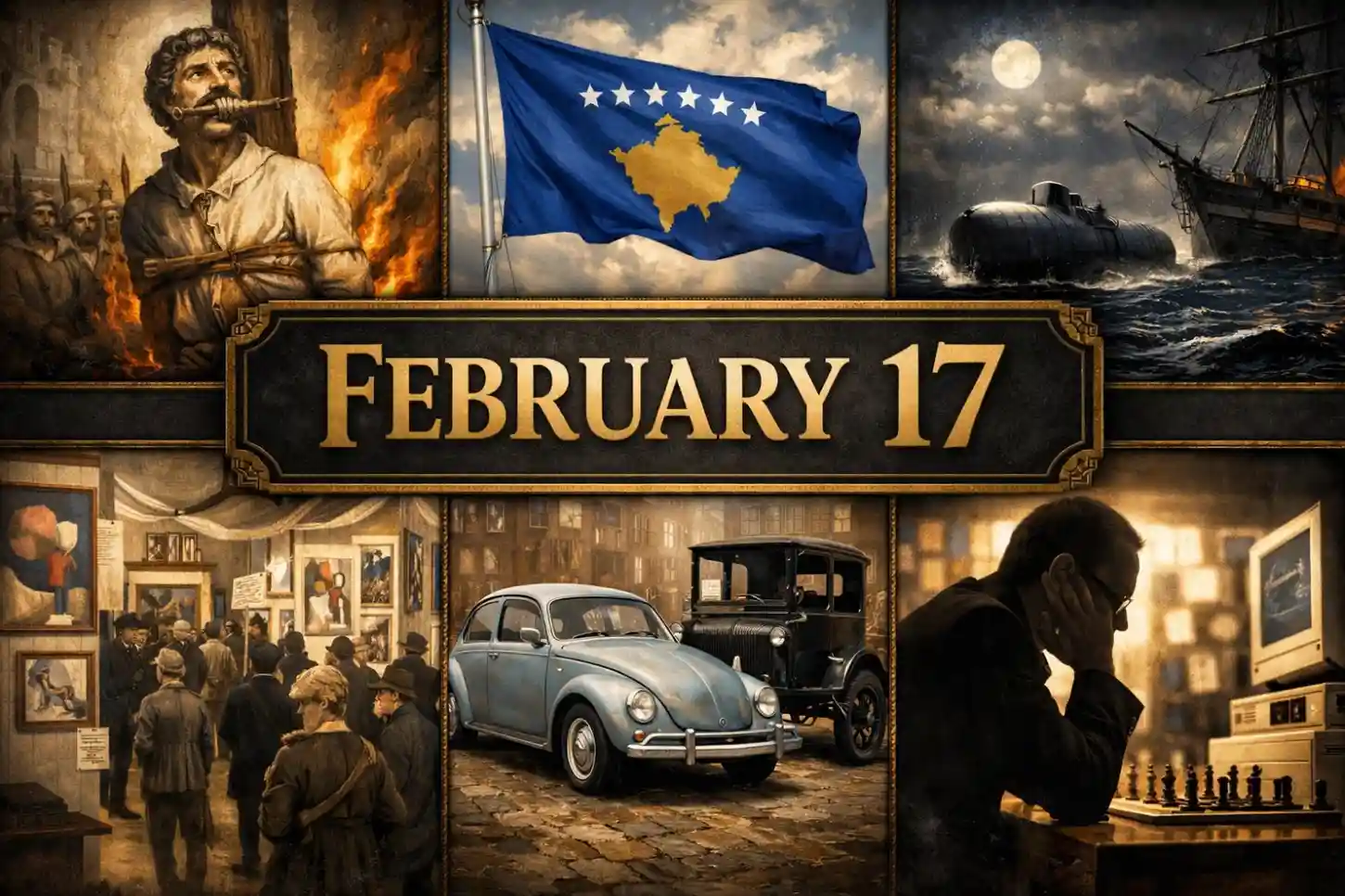
The philosopher and former friar Giordano Bruno was executed by burning at the stake for heresy at the Campo de’ Fiori in Rome. Bruno had championed the idea of an infinite universe and the possibility of other worlds, views that were seen as a direct threat to Catholic doctrine. To prevent him from addressing the crowd with his final words, the executioners placed a wooden vise on his tongue. His death became a powerful symbol of the historical conflict between free scientific inquiry and religious authority.
1616 – Nurhaci Proclaims the Later Jin
The Manchu leader Nurhaci declared himself Khan of the Later Jin Dynasty, establishing a power base that would eventually conquer all of China. Nurhaci successfully unified various Jurchen tribes and created the “Eight Banners” system, a highly effective military and social organization. His proclamation was a direct challenge to the waning Ming Dynasty and set the stage for the rise of the Qing Dynasty. This transition would result in the final imperial dynasty of China, lasting until the early 20th century.
1621 – Myles Standish Appointed Commander
The English Plymouth Colony in North America appointed Myles Standish as its first military commander to organize the settlement’s defenses. A professional soldier who had accompanied the Pilgrims on the Mayflower, Standish was tasked with navigating the complex and often tense relations with local Native American tribes. His leadership was crucial for the physical survival of the small, vulnerable colony during its first difficult years. Standish’s role defined the early intersection of military necessity and civilian governance in colonial New England.
1674 – Ambon Earthquake and Megatsunami
A massive earthquake struck the Indonesian island of Ambon, triggering a devastating megatsunami that reached heights of 100 meters. The wall of water swept across the coastline, drowning over 2,300 people and destroying numerous coastal villages. It remains one of the most powerful and deadly tsunami events ever recorded in the region’s history. The disaster was so profound that it was documented in detail by the naturalist Georg Eberhard Rumphius, who lost his own family in the tragedy.
1676 – Loss at Evangelistas Islets
During an ambitious Spanish expedition led by Pascual de Iriate to explore the southern reaches of South America, sixteen men were lost at the Evangelistas Islets. The islets, located at the western entrance of the Strait of Magellan, were notoriously difficult to navigate due to extreme weather and treacherous currents. This loss was a stark reminder of the immense dangers faced by explorers attempting to map the “End of the World.” The tragedy contributed to the growing reputation of the Strait as one of the most dangerous maritime passages on Earth.
1739 – Battle of Vasai
The Maratha Empire commenced a major invasion of Portuguese-occupied territory in India, leading to the Siege of Vasai. Led by Chimaji Appa, the brother of Peshwa Baji Rao I, the Maratha forces sought to expel the Europeans from their strategic coastal strongholds. The battle was characterized by heavy artillery duels and intense hand-to-hand combat as the Marathas pushed toward the Citadel. The eventual Maratha victory was a significant blow to Portuguese colonial ambitions in the Indian subcontinent.
1753 – Sweden Adopts the Gregorian Calendar
Sweden officially transitioned from the Julian calendar to the Gregorian calendar, a move that required a dramatic shift in dates. To correct the accumulated error in the calendar system, February 17 was immediately followed by March 1, effectively deleting eleven days from the year. While the change was intended to synchronize Sweden with the rest of Western Europe, it caused significant confusion among the public. This adjustment was part of a larger European movement to adopt a more scientifically accurate solar calendar.
1801 – Election of Thomas Jefferson
The United States House of Representatives finally resolved a deadlock in the Electoral College between Thomas Jefferson and Aaron Burr. Because the two candidates had received an equal number of votes, the decision was handed to the House, which underwent 36 ballots before Jefferson was elected President. This tense political crisis highlighted a major flaw in the original constitutional process for electing leaders. The ordeal led directly to the passage of the 12th Amendment, which required electors to cast separate ballots for President and Vice President.
1814 – Battle of Mormant
During the War of the Sixth Coalition, Napoleon Bonaparte led his French forces to a tactical victory over an Allied Russian and Austrian contingent at Mormant. Despite being outnumbered and facing a tightening encirclement by European powers, Napoleon demonstrated his continued mastery of rapid movement and battlefield tactics. The French cavalry played a decisive role in shattering the Allied lines and capturing thousands of prisoners. Although a victory, it was one of the final flashes of Napoleonic brilliance before his eventual abdication later that spring.
1819 – First Passage of the Missouri Compromise
The United States House of Representatives passed the Missouri Compromise for the first time, an attempt to settle the growing tensions over the expansion of slavery. The legislation allowed Missouri to enter the Union as a slave state while admitting Maine as a free state to maintain a balance of power in the Senate. It also established a geographic line across the Louisiana Territory, north of which slavery would be prohibited. This “compromise” only served to delay the inevitable conflict that would eventually erupt into the American Civil War.
1838 – Weenen Massacre
In the early morning hours, Zulu warriors attacked a series of Voortrekkers camps along the Blaukraans River in the Natal region of South Africa. The massacre resulted in the deaths of hundreds of men, women, and children who were part of the Great Trek moving into the interior. The Zulus were acting under the orders of their King, Dingane, who saw the encroaching settlers as a threat to his kingdom. This event fueled a cycle of violence and retribution that would define the region’s history for decades to come.
1854 – Independence of the Orange Free State
The United Kingdom officially recognized the independence of the Orange Free State through the signing of the Bloemfontein Convention. The British decided to withdraw from the territory, allowing the Boer settlers to establish their own self-governing republic. This move was part of a broader British policy to reduce the costs of colonial administration in southern Africa while maintaining influence through treaties. The Orange Free State would exist as an independent nation until it was eventually annexed during the Second Boer War.
1859 – Capture of the Citadel of Saigon
During the Cochinchina Campaign, the French Navy successfully captured the Citadel of Saigon, a massive fortress defended by 1,000 soldiers of the Nguyễn dynasty. The French used their superior naval artillery to breach the walls, marking a major turning point in their conquest of southern Vietnam. This victory provided France with a vital base of operations for their burgeoning colonial empire in Indochina. The fall of the citadel began nearly a century of French influence and rule over the region.
1863 – Founding of the Red Cross
A group of five citizens in Geneva, led by Henry Dunant, founded the International Committee for Relief to the Wounded. This organization was established to improve the care of soldiers on the battlefield, regardless of their nationality, and would later become the International Committee of the Red Cross. Dunant’s vision was inspired by the horrific suffering he witnessed at the Battle of Solferino. The group’s work led to the first Geneva Convention, establishing international standards for humanitarian treatment during wartime.
1864 – Sinking of the USS Housatonic
In a landmark event in naval history, the Confederate submarine H. L. Hunley became the first submarine to successfully sink an enemy warship. Using a spar torpedo, the small, hand-cranked vessel attacked the Union blockade ship USS Housatonic off the coast of South Carolina. While the Housatonic sank quickly, the Hunley also disappeared during its return trip, and its crew was lost. This event proved that underwater warfare was a viable, albeit incredibly dangerous, military reality.
1865 – Burning of Columbia
As Union forces under General William Tecumseh Sherman advanced into South Carolina, the capital city of Columbia was engulfed in flames. While Confederate forces fled the city, fires broke out that destroyed a large portion of the business district and many residential areas. Historians still debate whether the fires were set intentionally by Union troops, by retreating Confederates, or were simply a tragic accident of war. Regardless of the cause, the destruction of Columbia became a symbol of the “Total War” strategy employed in the South.
1905 – Assassination of Grand Duke Sergei Alexandrovich
During the Russian Revolution of 1905, Grand Duke Sergei Alexandrovich, a member of the Romanov royal family, was assassinated inside the Moscow Kremlin. The attack was carried out by Ivan Kalyayev, a member of the Socialist Revolutionary Party, who threw a bomb into the Grand Duke’s carriage. The assassination was a protest against the autocratic rule of the Tsar and the brutal suppression of workers’ strikes. It signaled a dangerous escalation of political violence that would eventually lead to the collapse of the monarchy.
1913 – The Armory Show Opens
The International Exhibition of Modern Art, popularly known as the Armory Show, opened in New York City, introducing Americans to radical new styles like Cubism and Fauvism. The show featured works by European masters like Marcel Duchamp and Henri Matisse, which shocked and confused the traditional art world. It is considered one of the most important events in the history of American art, as it permanently shifted the cultural landscape toward modernism. The exhibition challenged existing definitions of beauty and paved the way for the 20th-century avant-garde.
1919 – Ukrainian Republic Asks for Help
Facing an invasion by the Bolshevik Red Army, the Ukrainian People’s Republic issued a formal plea to the Entente powers and the United States for military and diplomatic assistance. The fledgling republic was struggling to maintain its newly declared independence amidst the chaos following World War I and the Russian Revolution. Unfortunately, the Western powers were hesitant to commit resources to the conflict, and the appeal went largely unanswered. This lack of support contributed to the eventual fall of the republic and its absorption into the Soviet Union.
1944 – Battle of Eniwetok Begins
American forces launched an amphibious invasion of Eniwetok Atoll in the Marshall Islands as part of their “island-hopping” campaign in the Pacific. The operation was designed to secure a vital airfield and naval anchorage closer to the Japanese home islands. The battle was characterized by intense fighting against a deeply entrenched Japanese garrison that refused to surrender. After five days of brutal combat, the U.S. successfully secured the atoll, marking another significant step toward the defeat of Japan.
1944 – Operation Hailstone
In support of the Eniwetok invasion, the United States Navy launched Operation Hailstone, a massive air and surface strike against the Japanese base at Truk Lagoon. Known as the “Gibraltar of the Pacific,” Truk was the primary forward base for the Japanese Imperial Navy. The American attack destroyed dozens of ships and hundreds of aircraft, effectively neutralizing Truk’s strategic importance for the remainder of the war. It was a devastating blow to Japanese naval power and logistical capabilities in the central Pacific.
1948 – Al-Waziri Coup in Yemen
A violent coup attempt briefly ousted the ruling Hamidaddin dynasty of Yemen, resulting in the assassination of Imam Yahya Muhammad Hamid ed-Din. The Al-Waziri family sought to modernize the country and establish a more constitutional form of government. However, the coup was quickly suppressed by the Imam’s son, Ahmad, who rallied loyalist tribes to retake control of the capital. The failure of the coup reinforced the traditionalist rule of the Imams in Yemen for another decade.
1949 – Chaim Weizmann Becomes President
Chaim Weizmann, a prominent Zionist leader and renowned chemist, was inaugurated as the first President of the State of Israel. His presidency was largely a ceremonial role, but he served as a powerful symbol of the new nation’s legitimacy and intellectual aspirations. Weizmann had spent decades lobbying international leaders for the creation of a Jewish homeland, most notably influencing the Balfour Declaration. His leadership during the early months of the state helped provide stability and a sense of continuity.
1959 – Launch of Vanguard 2
The United States successfully launched Vanguard 2, the world’s first weather satellite designed to measure cloud-cover distribution. The satellite carried two optical telescopes that scanned the Earth as it orbited, providing the first primitive “pictures” of the planet’s weather patterns from space. Although the satellite’s rotation became unstable, limiting the quality of the data, it proved the feasibility of monitoring global weather systems from orbit. This mission laid the foundation for the sophisticated meteorological satellites that we rely on today.
1959 – Gatwick Plane Crash
A Turkish Airlines Vickers Viscount crashed in heavy fog while attempting to land at Gatwick Airport in London. The disaster claimed the lives of 14 people, but Turkish Prime Minister Adnan Menderes was among the few who miraculously survived the wreck. Menderes was traveling to London for high-level negotiations regarding the future of Cyprus. The prime minister’s survival was seen as a symbol of resilience in Turkey, though his government would be overthrown in a military coup just a year later.
1964 – Wesberry v. Sanders Ruling
The United States Supreme Court issued a landmark ruling in the case of Wesberry v. Sanders, declaring that congressional districts must be approximately equal in population. This decision established the principle of “one person, one vote,” ensuring that every citizen’s vote carries equal weight regardless of where they live. Before this ruling, many rural districts were vastly over-represented compared to rapidly growing urban areas. The decision forced many states to redraw their political maps, fundamentally altering the landscape of American democracy.
1964 – Coup in Gabon
Gabonese President Léon M’ba was toppled in a military coup, and his political rival, Jean-Hilaire Aubame, was briefly installed as the new leader. The military officers behind the coup cited corruption and autocratic rule as their primary motivations for seizing power. However, the change was short-lived, as French paratroopers intervened the following day to restore M’ba to the presidency. This event highlighted the continued influence of France in the internal affairs of its former African colonies during the post-independence era.
1965 – Launch of Ranger 8
NASA launched the Ranger 8 probe on a mission to capture high-resolution photographs of the Moon’s surface before intentionally crashing into it. The primary target was the Mare Tranquillitatis region, an area of interest for the future Apollo lunar landings. The probe successfully transmitted over 7,000 images during its final minutes of flight, providing scientists with crucial data on the lunar terrain and soil composition. This mission was a key step in ensuring the safety and success of the eventual crewed missions to the Moon.
1966 – Aeroflot Flight 065 Crash
During takeoff from Sheremetyevo International Airport in Moscow, an Aeroflot Tu-114 crashed after a wingtip struck a snowbank on the runway. The disaster killed 21 of the people on board and injured several others. The investigation revealed that the pilots attempted to take off from a runway that had not been properly cleared of snow, leading to the loss of control. This accident highlighted the extreme challenges and safety risks associated with winter aviation operations in the Soviet Union.
1969 – Death of Berry L. Cannon
During an attempt to repair a leak in the SEALAB III underwater habitat, American aquanaut Berry L. Cannon died from carbon dioxide poisoning. The fatal accident occurred because of a missing CO2 scrubbing canister in his breathing apparatus, a tragic oversight in safety protocols. Cannon’s death led to the immediate suspension and eventual abandonment of the SEALAB project, which was designed to test the feasibility of long-term human habitation on the ocean floor. It was a significant setback for underwater exploration and research.
1970 – MacDonald Family Murders
The pregnant wife and two young daughters of Captain Jeffrey R. MacDonald were found brutally murdered in their home at Fort Bragg, North Carolina. MacDonald, a Green Beret surgeon, initially claimed that the murders were committed by a group of drug-crazed intruders. However, inconsistencies in his story and forensic evidence led investigators to suspect him of the crime. After a lengthy legal battle that spanned nearly a decade, MacDonald was eventually convicted of the murders and sentenced to life in prison.
1972 – Volkswagen Beetle Sets Sales Record
The cumulative sales of the Volkswagen Beetle officially exceeded those of the Ford Model T, making it the most produced car model in history at that time. With over 15 million units sold, the “Bug” became a global cultural icon, known for its simple design, reliability, and affordability. Originally developed in Germany during the 1930s, the Beetle’s success symbolized the post-war economic boom and the rise of mass-market consumerism. It remains one of the most recognizable and beloved vehicles ever created.
1974 – Helicopter Incident at the White House
Robert K. Preston, a disgruntled U.S. Army private who had washed out of flight school, stole a Bell UH-1 Huey helicopter and flew it to the White House. He buzzed the building and landed on the South Lawn, where he was fired upon and wounded by Secret Service agents. Preston’s motive appeared to be a desire to prove his flying skill and protest his military situation. The incident exposed a significant vulnerability in White House security and led to a major review of airspace protection in Washington, D.C.
1978 – La Mon Restaurant Bombing
The Provisional IRA detonated a massive incendiary bomb at the La Mon House restaurant near Belfast, resulting in the deaths of 12 people. The blast created a firestorm that trapped guests who were attending a social event, leaving 30 others with severe burns. The victims were all Protestant civilians, and the attack was one of the most horrific events of “The Troubles” in Northern Ireland. The IRA later issued an apology, claiming the warning they provided was inadequate, but the tragedy left a deep and lasting scar on the community.
1979 – Sino-Vietnamese War Begins
China launched a massive military invasion of northern Vietnam, sparking the brief but bloody Sino-Vietnamese War. The conflict was triggered by Vietnam’s invasion of Cambodia to oust the Chinese-backed Khmer Rouge and border disputes between the two communist nations. The fighting was characterized by brutal mountain warfare and heavy casualties on both sides. Although China withdrew its troops after just one month, both countries claimed victory, and tensions remained high for another decade.
1980 – First Winter Ascent of Everest
Polish climbers Krzysztof Wielicki and Leszek Cichy made history by completing the first-ever winter ascent of Mount Everest. Battling extreme cold, hurricane-force winds, and low oxygen levels, they reached the summit via the South Col route. This achievement proved that the world’s highest peak could be conquered during the harshest season, pushing the boundaries of high-altitude mountaineering. The success of the “Ice Warriors” brought international fame to the Polish climbing community and remains a legendary feat in the sport.
1981 – Ryan International Flight 590 Crash
A Ryan International Airlines cargo flight crashed during takeoff from Cleveland Hopkins International Airport, killing both pilots on board. The investigation determined that the crash was caused by the pilots’ failure to properly de-ice the aircraft’s wings before departure, leading to a loss of lift and an aerodynamic stall. This accident was one of several during that era that led to stricter federal regulations and improved industry standards for winter weather flight operations and pilot training.
1992 – Garadaghly Massacre
During the First Nagorno-Karabakh War, Armenian troops captured the Azerbaijani village of Garadaghly and reportedly killed over 20 civilians. The massacre occurred as part of a wider ethnic conflict between Armenia and Azerbaijan over the disputed territory. Survivors described a scene of systematic violence and forced displacement. This event is remembered in Azerbaijan as a tragic example of the human cost of the conflict, which resulted in thousands of deaths and millions of displaced people on both sides.
1995 – End of the Cenepa War
The Cenepa War, a brief border conflict between Peru and Ecuador over a disputed river valley in the Amazon, ended with a ceasefire brokered by the United Nations and other international guarantors. The fighting had involved air strikes and jungle warfare, resulting in dozens of casualties. The peace agreement, known as the Itamaraty Peace Declaration, established a demilitarized zone and led to the final demarcation of the border in 1998. It was the last significant territorial conflict between the two nations.
1996 – Kasparov vs. Deep Blue
In a historic chess match in Philadelphia, world champion Garry Kasparov defeated the IBM supercomputer Deep Blue. Although Kasparov won the overall match, Deep Blue’s victory in the first game marked the first time a computer had beaten a reigning world champion under tournament conditions. This event was a major milestone in the development of artificial intelligence, showcasing the increasing ability of machines to master complex human tasks. The rematch a year later would see Deep Blue eventually triumph over Kasparov.
1996 – Launch of NEAR Shoemaker
NASA’s NEAR (Near Earth Asteroid Rendezvous) Shoemaker spacecraft launched on a mission to study the asteroid 433 Eros. It was the first mission designed specifically to orbit and eventually land on an asteroid. The spacecraft provided unprecedented data on the composition, shape, and magnetic field of Eros during its year-long orbital mission. The mission concluded in 2001 with a successful soft landing on the asteroid’s surface, a feat that had never been accomplished before.
1996 – Biak Earthquake and Tsunami
A powerful 8.2 magnitude earthquake struck near the island of Biak in Indonesia’s Papua province, triggering a massive tsunami. The waves, reaching heights of up to 7 meters, devastated coastal villages and left at least 166 people dead or missing. The quake’s intense shaking was felt across a wide region and caused significant damage to infrastructure and housing. This disaster highlighted the extreme vulnerability of the Indonesian archipelago to seismic and tsunamigenic activity.
2006 – Southern Leyte Mudslide
Following weeks of unusually heavy rainfall, a massive mudslide buried the village of Guinsaugon in the southern Philippines. The disaster occurred in seconds, engulfing homes, a crowded elementary school, and over 1,000 residents under a layer of mud 10 meters deep. The official death toll was set at 1,126, making it one of the deadliest landslides in history. The tragedy sparked international aid efforts and a major discussion about the impacts of deforestation and climate change on landslide risks.
2008 – Kosovo Declares Independence
Kosovo formally declared its independence from Serbia, a move that was celebrated by its ethnic Albanian majority but rejected as illegal by the Serbian government. The declaration came after years of international administration following the 1999 Kosovo War. While the United States and many European nations quickly recognized Kosovo as a sovereign state, others, including Russia and China, did not. This event remains a central point of diplomatic tension in the Balkans and a complex issue in international law.
2011 – Start of Libyan Revolution
In response to the wider Arab Spring, major protests broke out across Libya against the 42-year rule of Muammar Gaddafi. The “Day of Rage” saw thousands of people taking to the streets in Benghazi and other cities, demanding political reform and civil liberties. The government’s violent crackdown on the demonstrators quickly escalated into a full-scale civil war. This movement eventually led to the fall of the Gaddafi regime later that year following international military intervention.
2011 – Bloody Thursday in Bahrain
During the early morning hours, Bahraini security forces launched a deadly raid on pro-democracy protesters who were camping at the Pearl Roundabout in Manama. The attack resulted in several deaths and hundreds of injuries, leading the day to be locally remembered as “Bloody Thursday.” The protesters were demanding constitutional reforms and greater political representation. The crackdown only served to further galvanize the opposition and drew widespread international condemnation for human rights abuses.
2015 – Haiti Mardi Gras Stampede
During a vibrant Mardi Gras parade in Port-au-Prince, a popular singer’s float struck an overhead power line, causing a panic that led to a massive stampede. The resulting chaos killed 18 people and injured nearly 80 others as the crowd surged to escape the electrical discharge. The tragedy prompted the government to cancel the remaining carnival festivities and declare a national period of mourning. It was a somber end to what is usually the country’s most joyous cultural celebration.
2016 – Ankara Barracks Explosion
A car bomb targeted a convoy of military vehicles waiting at a traffic light outside a Turkish Armed Forces barracks in the capital city of Ankara. The massive explosion killed at least 29 people, most of whom were military personnel, and injured over 60 others. The Turkish government blamed Kurdish militant groups for the attack, which occurred in a highly secured area of the city near the parliament. The bombing was part of a wave of terrorist attacks that plagued Turkey during that period.
Take a Look At Feb 16 Facts
Famous People Born On February 17
| Name | Description | Date |
|---|---|---|
| Ronald Aylmer Fisher | British geneticist & statistician | February 17, 1890 – July 29, 1962 |
| Gene Pitney | American singer-songwriter | February 17, 1941 – April 5, 2006 |
| Ruth Rendell | British crime novelist | February 17, 1930 – May 2, 2015 |
| Thomas J. Watson Sr. | American industrialist, IBM leader | February 17, 1874 – June 19, 1956 |
| Arcangelo Corelli | Italian violinist & composer | February 17, 1653 – January 8, 1713 |
| Arthur Kennedy | American film actor | February 17, 1914 – January 5, 1990 |
| Lola Montez | Irish dancer & adventurer | February 17, 1821 – January 17, 1861 |
| Hans Morgenthau | German-American political thinker | February 17, 1904 – July 19, 1980 |
| Andre Norton | American sci-fi author | February 17, 1912 – March 17, 2005 |
| Rene Laennec | Inventor of stethoscope | February 17, 1781 – August 13, 1826 |
| Chaim Potok | American rabbi & novelist | February 17, 1929 – July 23, 2002 |
| Gustavo Adolfo Becquer | Spanish Romantic poet | February 17, 1836 – December 22, 1870 |
| Otto Stern | German-American physicist | February 17, 1888 – August 17, 1969 |
| Henry Vieuxtemps | Belgian violinist & composer | February 17, 1820 – June 6, 1881 |
| Ronald Knox | English theologian & author | February 17, 1888 – August 24, 1957 |
| Red Barber | American sports commentator | February 17, 1908 – October 22, 1992 |
| Bernie Grant | British MP | February 17, 1944 – April 8, 2000 |
| Mori Ogai | Japanese literary figure | February 17, 1862 – July 9, 1922 |
| Dorothy Canfield Fisher | American writer & reformer | February 17, 1879 – November 9, 1958 |
| Mary Frances Berry | American professor & activist | February 17, 1938 – |
| Montgomery Ward | Mail-order business pioneer | February 17, 1844 – December 7, 1913 |
| Sir Edward German | English composer | February 17, 1862 – November 11, 1936 |
| Giovanni Pacini | Italian opera composer | February 17, 1796 – December 6, 1867 |
| Andre Maginot | French political leader | February 17, 1877 – January 7, 1932 |
| Wilhelm Gesenius | German biblical critic | February 17, 1786 – October 23, 1842 |
| Bess Streeter Aldrich | American novelist | February 17, 1881 – August 3, 1954 |
| Edgar Quinet | French historian & poet | February 17, 1803 – March 27, 1875 |
| Friedrich von Klinger | German dramatist | February 17, 1752 – March 9, 1831 |
| Horace de Saussure | Swiss physicist & explorer | February 17, 1740 – January 22, 1799 |
| John Sullivan | American Revolutionary leader | February 17, 1740 – January 23, 1795 |
Famous People Died On February 17
| Name | Description | Date |
|---|---|---|
| Heinrich Heine | German poet & writer | December 13, 1797 – February 17, 1856 |
| Wilfrid Laurier | Canadian prime minister | November 20, 1841 – February 17, 1919 |
| Albert I of Belgium | King of Belgium | April 8, 1875 – February 17, 1934 |
| Christopher Sholes | Inventor of typewriter | February 14, 1819 – February 17, 1890 |
| Johann Pestalozzi | Swiss education reformer | January 12, 1746 – February 17, 1827 |
| Alfred P Sloan Jr | GM business leader | May 23, 1875 – February 17, 1966 |
| Jovian | Roman emperor | c.331 – February 17, 364 |
| Florence Kelley | American reformer | September 12, 1859 – February 17, 1932 |
| Hans Hofmann | Modern art pioneer | March 21, 1880 – February 17, 1966 |
| Bruno Walter | Classical conductor | September 15, 1876 – February 17, 1962 |
| SY Agnon | Nobel Prize author | July 17, 1888 – February 17, 1970 |
| Jose Lopez Portillo | President of Mexico | June 16, 1920 – February 17, 2004 |
| Adolphe Quetelet | Statistician & sociologist | February 22, 1796 – February 17, 1874 |
| David Garnett | English novelist | March 9, 1892 – February 17, 1981 |
| Mesrop Mashtots | Creator of Armenian alphabet | c.360 – February 17, 440 |
| James Macpherson | Scottish literary figure | October 27, 1736 – February 17, 1796 |
| Henry Olcott | Co-founder of Theosophy | August 2, 1832 – February 17, 1907 |
| Graham Sutherland | British painter | August 24, 1903 – February 17, 1980 |
| Siegbert Tarrasch | German chess expert | March 5, 1862 – February 17, 1934 |
| Guy Laroche | French fashion designer | July 16, 1921 – February 17, 1989 |
| Michael Novak | Political philosopher | September 9, 1933 – February 17, 2017 |
| Maurice Quentin de La Tour | Portrait painter | September 5, 1704 – February 17, 1788 |
| Johan Sverdrup | Prime minister of Norway | July 30, 1816 – February 17, 1892 |
| Herve Bazin | French novelist | April 17, 1911 – February 17, 1996 |
| George Marshall | American director | December 29, 1891 – February 17, 1975 |
| Muhammad Heikal | Egyptian editor | September 23, 1923 – February 17, 2016 |
| Mickey Wright | Golf legend | February 14, 1935 – February 17, 2020 |
| Ciro Alegria | Peruvian novelist | November 4, 1909 – February 17, 1967 |
| Madeleine Bejart | French stage actress | January 8, 1618 – February 17, 1672 |
| Francisco Giner de los Rios | Spanish educator | October 10, 1839 – February 17, 1915 |
Observances & Institutional Dates
- Independence Day (Kosovo): Commemorating the 2008 declaration of independence from Serbia.
- Revolution Day (Libya): Marking the anniversary of the 2011 uprising against Muammar Gaddafi.
- Random Acts of Kindness Day: An unofficial but popular day encouraged in many countries to promote compassion and goodwill.
- National Cabbage Day: A whimsical food observance in the United States celebrating the versatile leafy green.
Frequently Asked Questions
- Who was Giordano Bruno?
- He was an Italian philosopher burned at the stake in 1600 for advocating an infinite universe and multiple worlds.
- What was the first submarine to sink a ship?
- The Confederate submarine H. L. Hunley achieved this feat on February 17, 1864, by sinking the USS Housatonic.
- When did Kosovo declare independence?
- Kosovo officially declared its independence from Serbia on February 17, 2008.
- What is the significance of the Armory Show?
- Opening in 1913, it was the first large-scale exhibition of modern art in America, introducing the public to avant-garde styles.