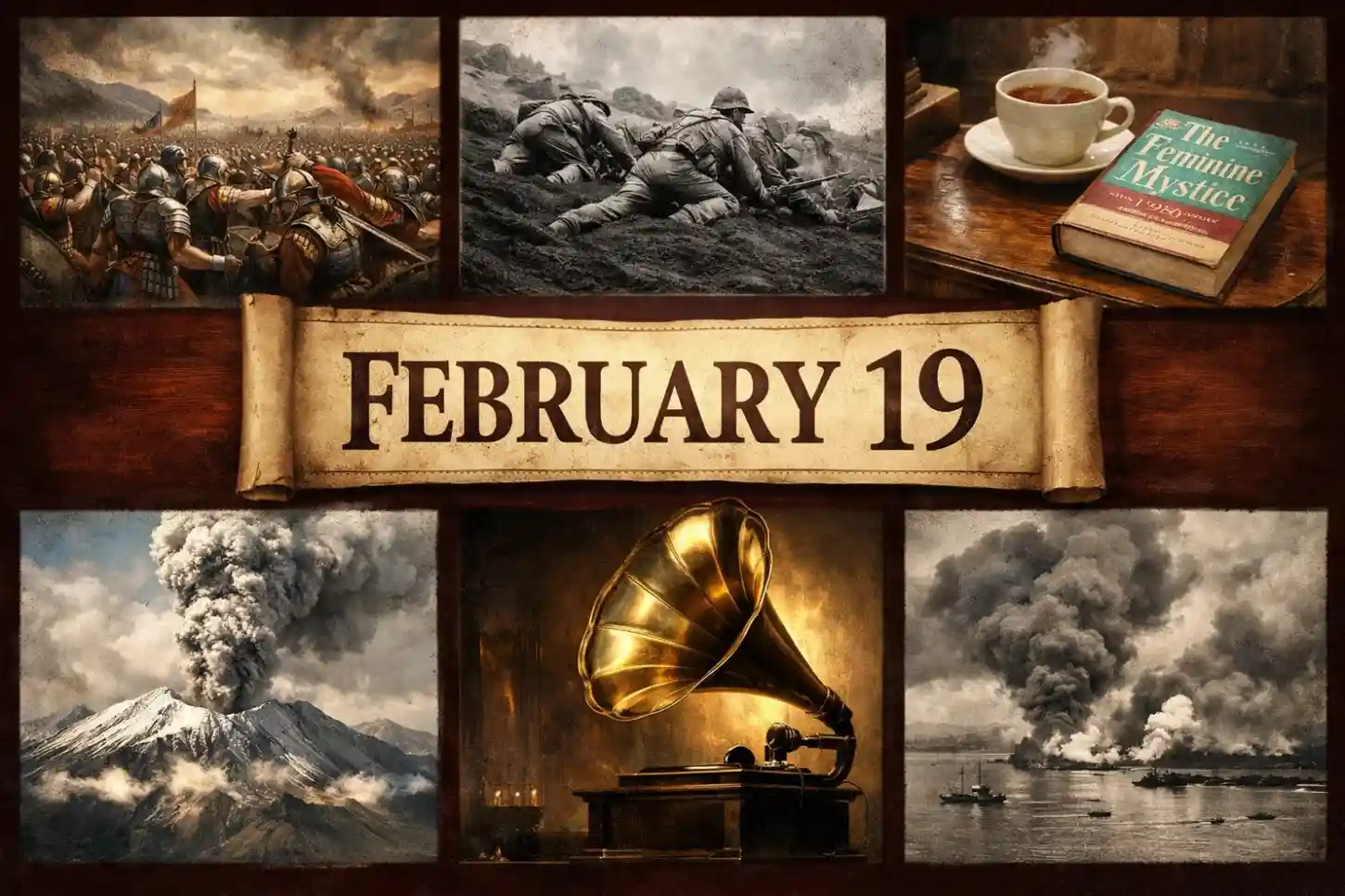
The passage of time often reveals how the grandest of imperial designs can be undone by a single signature or a sudden volcanic eruption. When we look at what happened on this day in history February 19, we find a calendar marked by the ends of colonial eras and the beginning of deep social awakenings. It is a day where Roman emperors fought the bloodiest of civil wars and where modern leaders took less than an hour to relinquish power.
Important Events That Happened On February 19 In History
197 – Battle of Lugdunum
In what is widely considered the largest and bloodiest battle ever fought between two Roman armies, Emperor Septimius Severus defeated the usurper Clodius Albinus. The clash took place at Lugdunum (modern-day Lyon, France) and involved roughly 150,000 soldiers on each side, representing nearly the entire military strength of the empire. Severus’s victory ended a period of civil instability, but the sheer scale of the slaughter decimated the veteran legions needed to defend the frontiers. Albinus took his own life following the defeat, leaving Severus as the undisputed master of the Roman world.
356 – Anti-Paganism Decree of Constantius II
Emperor Constantius II issued a formal decree that strictly forbade the worship of pagan idols and the performance of sacrifices throughout the Roman Empire. This policy was a significant escalation in the Christianization of the state, as it moved beyond mere favoritism toward Christianity to the active suppression of traditional Roman religion. Temples were ordered to be closed, and those found violating the edict faced the threat of capital punishment. This law marked a pivotal moment in the transition from the classical religious pluralism of Rome to a state-mandated Christian orthodoxy.
607 – Consecration of Pope Boniface III
After a vacancy of nearly a year following the death of his predecessor, Boniface III was officially consecrated as the Pope in Rome. His brief but impactful papacy was characterized by his close relationship with the Byzantine Emperor Phocas, from whom he obtained a decree recognizing the See of Rome as the head of all churches. This was a crucial diplomatic victory that helped solidify the primacy of the Roman Pontiff over the rival Patriarch of Constantinople. Boniface also introduced reforms regarding the election of popes to prevent the bribery and corruption that had plagued the process.
1594 – Coronation of Sigismund III as King of Sweden
Sigismund III of the House of Vasa, who had already been ruling as the King of Poland and Grand Duke of Lithuania, was crowned King of Sweden at Uppsala Cathedral. He inherited the Swedish throne from his father, John III, creating a short-lived personal union between the Polish-Lithuanian Commonwealth and the Kingdom of Sweden. However, Sigismund’s staunch Catholicism created immediate friction with the largely Lutheran Swedish nobility. This religious and political tension eventually led to his deposition in Sweden and decades of devastating warfare between the two northern powers.
1600 – Eruption of Huaynaputina
The stratovolcano Huaynaputina in southern Peru exploded in a cataclysmic eruption, the most violent in the recorded history of South America. The blast ejected massive amounts of ash and volcanic rock, burying nearby villages and causing a significant drop in global temperatures known as a “volcanic winter.” The resulting crop failures led to a devastating famine as far away as Russia, contributing to the “Time of Troubles.” In Peru, the landscape was permanently altered, and the local economy was shattered for decades by the destruction of vineyards and farmland.
1649 – Second Battle of Guararapes
The Second Battle of Guararapes took place in Pernambuco, marking the decisive engagement that effectively ended Dutch colonization efforts in Brazil. Luso-Brazilian forces, despite being outnumbered, used the rugged terrain to trap and defeat the Dutch West India Company’s army. This victory broke the Dutch hold on the sugar-producing regions of the northeast and forced them to eventually abandon their claims in South America. The battle is celebrated in Brazil as a foundational moment of national unity, as people of Portuguese, African, and Indigenous descent fought together.
1674 – Treaty of Westminster
England and the Netherlands signed the Treaty of Westminster, bringing a formal end to the Third Anglo-Dutch War. A key provision of this peace agreement was the permanent transfer of the Dutch colony of New Amsterdam to English control, which was then renamed New York. The treaty also restored Dutch control over Suriname, showcasing the complex territorial trades that defined 17th-century colonial diplomacy. This agreement signaled the beginning of the end of the Dutch Republic’s status as a top-tier maritime power compared to the rising British Empire.
1714 – Battle of Napue
The Battle of Napue was the final major field engagement of the Great Northern War fought between the Swedish Empire and the Tsardom of Russia. The Russian forces, led by Mikhail Golitsyn, achieved a decisive victory over the Swedish troops in Isokyrö, Finland. This defeat led to the “Great Wrath,” a period of brutal Russian military occupation in Finland that saw widespread destruction and the displacement of thousands. The battle confirmed Russia’s dominance in the Baltic region and effectively ended Sweden’s status as a great European power.
1726 – Supreme Privy Council Established in Russia
Following the death of Peter the Great, the Supreme Privy Council was established as a high-level advisory body to Empress Catherine I. The council was designed to manage the affairs of the state and was dominated by several powerful nobles and favorites of the court. While it was intended to provide stability during a time of uncertain succession, it quickly became a tool for aristocratic maneuvering. The council’s power lasted only until 1730, when Empress Anna Ioannovna abolished it to restore full autocratic rule to the monarchy.
1807 – Arrest of Aaron Burr
The former Vice President of the United States, Aaron Burr, was arrested for treason in Wakefield, Alabama, while attempting to flee toward Spanish territory. Burr was accused of leading a conspiracy to recruit an army and carve out an independent empire in the American West or Mexico. He was confined to Fort Stoddert before being sent to Richmond, Virginia, to stand trial in one of the most sensational legal cases in American history. Though he was eventually acquitted due to a lack of evidence of an “overt act,” his political career was permanently destroyed.
1819 – Discovery of the South Shetland Islands
British explorer William Smith, captain of the merchant ship Williams, discovered the South Shetland Islands off the coast of the Antarctic Peninsula. Smith had been blown off course while navigating around Cape Horn when he spotted the mountainous, ice-covered land. This was the first time any land south of 60° latitude had been sighted and documented by a reliable observer. The discovery sparked a massive influx of sealers to the region, leading to the rapid exploitation of the local seal populations over the following years.
1836 – South Australia Established
King William IV signed the Letters Patent that officially established the province of South Australia as a British colony. Unlike other Australian colonies that began as penal settlements, South Australia was designed as a “free” colony based on the principles of systematic colonization. This meant that land was sold to settlers, and the proceeds were used to fund the migration of laborers and families. This unique social experiment aimed to create a society of free settlers with religious freedom and a balanced economy from the very beginning.
1846 – Texas Power Transfer
In a ceremony in Austin, the government of the Republic of Texas officially transferred power to the newly formed State of Texas government. This followed the annexation of Texas by the United States, a move that ended nearly a decade of Texan independence but also helped trigger the Mexican-American War. President Anson Jones famously declared that “the Republic of Texas is no more” as the Lone Star flag was lowered and the American flag was raised. This transition marked a major milestone in the American policy of Manifest Destiny and westward expansion.
1847 – First Rescuers Reach the Donner Party
A small group of seven rescuers, known as the “First Relief,” finally reached the starving survivors of the Donner Party at Truckee Lake in the Sierra Nevada mountains. The emigrant group had been trapped by early and heavy snowfalls for months, forcing them to resort to desperate measures, including cannibalism, to survive. The rescuers were shocked by the emaciated and traumatized state of the families they found in the makeshift camps. This mission began a series of grueling rescue efforts that eventually saved about half of the original party members.
1878 – Patent for the Phonograph
Thomas Edison was granted a patent for the phonograph, a revolutionary device capable of both recording and reproducing sound. The invention worked by indenting sound waves onto a rotating cylinder covered in tinfoil using a vibrating needle. While Edison initially thought of the device as a tool for business dictation, it quickly evolved into a medium for entertainment and music. The phonograph was the first step in the birth of the global recording industry, forever changing how humans experience and preserve auditory information.
1884 – Enigma Outbreak of Tornadoes
More than sixty tornadoes struck the Southern United States in a massive event known as the “Enigma Outbreak,” one of the largest and deadliest in U.S. history. The storms tore through several states, including Alabama, Georgia, and North and South Carolina, causing hundreds of deaths and leaving thousands homeless. Because meteorological record-keeping was in its infancy, the exact death toll and number of tornadoes are still debated by historians. The devastation was so widespread that it remains a benchmark for extreme weather events in the American South.
1913 – The 45-Minute Presidency
Following the forced resignation of Francisco I. Madero during a military coup, Pedro Lascuráin became the President of Mexico for only about 45 minutes. As the foreign secretary, he was next in the line of succession and took the oath of office solely to appoint Victoriano Huerta as his interior secretary. Once the appointment was official, Lascuráin immediately resigned, allowing Huerta to become the next president according to the law. This remains the shortest presidential term in world history, a legalistic maneuver used to provide a veneer of legitimacy to a violent transition of power.
1915 – Naval Attack on the Dardanelles
A powerful Anglo-French naval task force began a massive bombardment of Ottoman artillery positions along the coast of the Gallipoli peninsula. This marked the start of the Dardanelles Campaign, an Allied attempt to force a passage through the straits to reach Constantinople and knock the Ottoman Empire out of World War I. The naval bombardment was initially seen as a way to avoid a costly land invasion, but the presence of hidden mines and mobile batteries frustrated the Allied ships. The failure of this naval phase eventually led to the disastrous Gallipoli land campaign.
1937 – Assassination Attempt on Rodolfo Graziani
During a public ceremony in Addis Ababa, two Ethiopian nationalists of Eritrean origin attempted to assassinate the Italian Viceroy, Rodolfo Graziani, using hand grenades. Graziani was wounded in the blast, but he survived the attack, which took place at the former imperial palace. In immediate and brutal retaliation, Italian forces launched a three-day massacre of Ethiopian civilians that became known as “Yekatit 12.” Thousands of innocent people were killed, and the event remains one of the darkest chapters of the Italian occupation of Ethiopia.
1942 – Bombing of Darwin
In the largest single attack ever mounted by a foreign power on Australian soil, nearly 250 Japanese warplanes struck the northern city of Darwin. The two-wave air raid targeted the harbor and the town’s airfield, sinking several ships and destroying vital military infrastructure. At least 243 people were killed, including many civilians, and the attack caused widespread panic across the Australian continent. This event brought the reality of World War II directly to the Australian mainland and forced a major reorganization of the country’s national defenses.
1942 – Executive Order 9066
United States President Franklin D. Roosevelt signed Executive Order 9066, which authorized the Secretary of War to designate “military areas” from which any or all persons could be excluded. While the order did not name a specific group, it was used primarily to force the relocation and internment of over 110,000 Japanese Americans living on the West Coast. Families were forced to abandon their homes and businesses and move to desolate camps in the interior of the country. This order is now widely regarded as one of the most significant violations of civil liberties in American history.
1943 – Battle of Kasserine Pass Begins
The Battle of Kasserine Pass began in Tunisia, marking the first major engagement between American and German forces during World War II. The battle was a disaster for the inexperienced American troops, who were outmaneuvered and overwhelmed by General Erwin Rommel’s veteran Panzer divisions. The U.S. suffered heavy casualties and lost massive amounts of equipment before the Axis advance was finally halted. This defeat served as a brutal wake-up call for the U.S. military, leading to sweeping changes in leadership, training, and tactical doctrine.
1945 – Landing on Iwo Jima
About 30,000 United States Marines began an amphibious landing on the volcanic island of Iwo Jima, launching one of the most intense battles of the Pacific War. The island was a strategic target because of its airfields, which could provide a base for fighter escorts during the bombing of the Japanese home islands. The Japanese defenders had prepared a sophisticated network of underground tunnels and bunkers, turning the island into a fortress. The battle would last for five weeks and result in nearly 7,000 American deaths and the near-total destruction of the Japanese garrison.
1948 – Calcutta Youth Conference
The Conference of Youth and Students of Southeast Asia Fighting for Freedom and Independence convened in Calcutta, India. The gathering brought together revolutionary students and activists from across the region to discuss strategies for ending European colonial rule. Many historians believe the conference served as a catalyst for several communist-led insurgencies that broke out in Southeast Asia shortly after, including those in Burma, Malaya, and the Philippines.
The event underscored the growing influence of Marxist-Leninist ideology on the decolonization movements of the mid-20th century.
1949 – Ezra Pound Awarded Bollingen Prize
The poet Ezra Pound was awarded the first Bollingen Prize in poetry for his work The Pisan Cantos, sparking a massive controversy in the literary and political worlds. At the time of the award, Pound was being held in a psychiatric hospital to avoid trial for treason after broadcasting fascist and anti-Semitic propaganda from Italy during World War II. Critics were divided over whether the artistic merit of the poetry could be separated from the hateful actions and views of the author. The debate led to a major reassessment of the relationship between art, politics, and social responsibility.
1954 – Transfer of Crimea
The Soviet Politburo officially ordered the transfer of the Crimean Oblast from the Russian Soviet Federative Socialist Republic to the Ukrainian Soviet Socialist Republic. This decision was presented as a “symbolic gesture” to mark the 300th anniversary of the union between Russia and Ukraine. At the time, the move was largely an internal administrative matter within the unified Soviet Union and had little practical impact on the lives of residents.
However, following the collapse of the USSR in 1991, this transfer became the basis for intense territorial disputes between the two independent nations.
1959 – Independence Granted to Cyprus
The United Kingdom officially granted independence to Cyprus following the signing of the London and Zurich Agreements between Britain, Greece, Turkey, and Cypriot leaders. This brought an end to years of armed struggle by Greek Cypriots seeking union with Greece and Turkish Cypriots seeking partition. The agreement established a complex power-sharing system intended to protect both ethnic communities. While independence was formally proclaimed the following August, this date marked the diplomatic resolution that allowed the island to emerge from colonial rule.
1960 – China Launches T-7 Rocket
China successfully launched the T-7, its first indigenous sounding rocket, from a site in Anhui Province. The rocket reached an altitude of about 8 kilometers, carrying basic scientific instruments to study the upper atmosphere. This launch was a modest but crucial first step in China’s burgeoning space program, which had been initiated under the leadership of scientist Qian Xuesen.
The success of the T-7 proved that China could develop rocket technology independently, laying the groundwork for its future status as a major spacefaring nation.
1963 – Publication of The Feminine Mystique
Betty Friedan’s groundbreaking book, The Feminine Mystique, was published, an event often credited with sparking the “second wave” of the feminist movement in the United States. Friedan’s work challenged the prevailing cultural assumption that women could only find fulfillment through domestic roles as wives and mothers. The book resonated with millions of women who felt a sense of unarticulated dissatisfaction with their lives, which Friedan called “the problem that has no name.” Its publication led to the formation of new women’s organizations and a national conversation about gender equality.
1965 – Coup Attempt in South Vietnam
Colonel Phạm Ngọc Thảo, along with Generals Lâm Văn Phát and Trần Thiện Khiêm, led a failed coup attempt against the military junta of General Nguyễn Khánh in South Vietnam. Thảo, who was later revealed to be a deep-cover communist spy for North Vietnam, used his position to sow chaos and instability within the Saigon government. While the coup did not succeed in seizing power, it did manage to force Khánh out of office, leading to further political upheaval. This instability severely hampered the South Vietnamese war effort during a critical period of the conflict.
1976 – Rescinding of Executive Order 9066
President Gerald Ford officially rescinded Executive Order 9066 through Proclamation 4417, exactly 34 years after it was originally signed. In his speech, Ford acknowledged that the internment of Japanese Americans was a “national mistake” and that such an action should never be repeated. This was a vital step in the long process of government recognition and redress for the survivors of the camps. The formal apology helped begin a period of healing and public education regarding the importance of protecting constitutional rights even during times of war.
1978 – Larnaca Airport Raid
Egyptian special forces launched a bold but unauthorized raid on Larnaca International Airport in Cyprus in an attempt to rescue hostages from a hijacked plane. The Egyptian commandos did not have permission from the Cypriot government to intervene, leading to a direct military confrontation with the Cypriot National Guard on the tarmac. In the ensuing firefight, 15 Egyptian commandos were killed, and an Egyptian C-130 transport plane was destroyed. The incident caused a severe diplomatic rift between Egypt and Cyprus and highlighted the dangers of unilateral military action in international incidents.
1985 – William Schroeder Leaves Hospital
William J. Schroeder became the first recipient of an artificial heart to be discharged from a hospital, marking a milestone in medical history. Schroeder had been implanted with the Jarvik-7 artificial heart at a hospital in Louisville, Kentucky, as a desperate measure to save his life from terminal heart disease. While he had to live in a specially designed apartment nearby and carry a large external power source, his discharge proved that patients with artificial hearts could achieve some level of independence. His survival for 620 days provided valuable data for the future development of cardiac assist devices.
1985 – Iberia Flight 610 Crash
A Boeing 727 operating as Iberia Flight 610 crashed into Mount Oiz in northern Spain while on approach to Bilbao Airport. All 148 people on board were killed when the aircraft’s wing struck a television antenna on the mountain peak amidst heavy fog. It remains the deadliest aviation accident in the history of Iberia Airlines and the most tragic to ever occur in the Basque Country. The investigation concluded that the pilots had misjudged their altitude and failed to follow the proper instrument approach procedures during poor visibility.
1985 – China Airlines Flight 006 Incident
A China Airlines Boeing 747 experienced a terrifying aircraft upset over the Pacific Ocean after an engine failed at high altitude. The pilots lost control of the plane, which entered a steep dive and rolled nearly 360 degrees, falling 30,000 feet in less than two minutes. Miraculously, the crew managed to regain control and land safely in San Francisco, though the aircraft suffered significant structural damage and 24 people were injured. The incident was later attributed to pilot fatigue and an over-reliance on the autopilot system during an emergency.
1886 – Akkaraipattu Massacre
During the Sri Lankan Civil War, members of the Sri Lankan Army reportedly massacred 80 Tamil farm workers in the eastern town of Akkaraipattu. The victims were rounded up while working in a paddy field and executed, an act that drew widespread condemnation from human rights organizations. This massacre was part of a cycle of ethnic violence and retaliation that characterized the conflict between the government and Tamil separatist groups. Such incidents fueled deep-seated resentment and made a peaceful resolution to the civil war increasingly difficult to achieve.
1988 – AVAir Flight 3378 Crash
A Fairchild Swearingen Metroliner operating as AVAir Flight 3378 crashed shortly after takeoff from Raleigh-Durham International Airport in North Carolina. All 12 people on board were killed when the aircraft struck a reservoir in low visibility and freezing rain. The National Transportation Safety Board determined that the pilots had become disoriented after entering the clouds and failed to maintain a proper climb rate. This accident led to improved training for pilots on small commuter aircraft regarding the dangers of spatial disorientation during instrument flight conditions.
1989 – Flying Tiger Line Flight 066 Crash
A Boeing 747 cargo plane operated by Flying Tiger Line crashed into a hill near Sultan Abdul Aziz Shah Airport in Malaysia. All four crew members on board were killed when the plane struck the terrain while attempting a landing in poor visibility. The investigation revealed that the pilots had misinterpreted the air traffic controller’s instructions and descended below the minimum safe altitude. The crash highlighted the need for clearer communication between controllers and international flight crews to prevent “controlled flight into terrain” accidents.
2002 – Mars Odyssey Begins Mapping
NASA’s Mars Odyssey space probe officially began its mission to map the surface of Mars using the Thermal Emission Imaging System (THEMIS). The probe’s primary goal was to study the chemical and mineralogical composition of the Martian surface and search for evidence of past or present water. THEMIS allowed scientists to create high-resolution maps of the planet’s temperature and topography, revealing details about its geological history. Mars Odyssey would eventually become the longest-operating spacecraft in Martian history, providing a vital communications link for future rovers.
2003 – Iran Military Aircraft Crash
An Ilyushin Il-76 military aircraft belonging to the Islamic Revolutionary Guard Corps crashed into the mountains near Kerman, Iran. All 275 people on board, mostly members of the Guard, were killed in the disaster, which occurred during a period of high winds and low visibility. It remains one of the deadliest aviation accidents in Iranian history and one of the worst involving a military transport aircraft worldwide. The crash dealt a significant blow to the elite military unit and raised concerns about the maintenance and safety standards of Iran’s aging aircraft fleet.
2006 – Pasta de Conchos Mine Explosion
A methane gas explosion occurred in a coal mine near Nueva Rosita, Mexico, trapping and killing 65 miners deep underground. The blast was so powerful that it collapsed large sections of the mine, making rescue efforts extremely difficult and dangerous. The tragedy sparked national outrage in Mexico over the poor safety conditions and lack of government oversight in the mining industry. Despite years of protests from the families of the victims, the bodies of most of the miners were never recovered, leaving a lingering sense of injustice in the community.
2011 – Belitung Shipwreck Exhibition
The debut exhibition of the Belitung shipwreck, a 9th-century Arab dhow discovered off the coast of Indonesia, opened at the ArtScience Museum in Singapore. The wreck contained over 60,000 artifacts, including the largest collection of Chinese Tang dynasty ceramics ever found in a single location. These treasures provided the first physical evidence of a maritime “Silk Road” that connected China with the Middle East over a millennium ago. The exhibition showcased the incredible craftsmanship of the era and the vast scale of ancient global trade networks.
2012 – Apodaca Prison Brawl
A violent riot and mass escape occurred at a prison in Apodaca, Nuevo León, Mexico, resulting in the deaths of 44 inmates. The brawl was a coordinated attack by members of the Los Zetas cartel against members of the rival Gulf Cartel who were also being held at the facility. During the chaos, 30 Zetas members managed to escape the prison, leading to accusations of corruption and complicity among the prison guards and officials. This event highlighted the extreme level of violence and control that organized crime groups exercised within Mexico’s overcrowded prison system.
2020 – Hanau Shootings
In a shocking act of domestic terrorism, a gunman killed nine people in two separate shootings at shisha bars in the German city of Hanau. The attacker, who was motivated by far-right, racist, and xenophobic ideologies, targeted members of the local migrant community. After the attacks, the gunman was found dead in his home along with his mother. The tragedy sparked a national debate in Germany about the rise of right-wing extremism and the need for better protection for minority groups against hate-motivated violence.
2021 – Death of Mya Thwe Thwe Khine
Mya Thwe Thwe Khine, a 19-year-old grocery store worker, died after being shot in the head by police during anti-coup protests in Myanmar. She had been taking part in a peaceful demonstration in the capital city of Naypyidaw when she was struck by live ammunition. Her death made her the first known martyr of the movement against the military junta that had seized power earlier that month. Images of her being shot went viral, galvanizing the resistance and drawing international condemnation of the military’s use of lethal force against its own citizens.
If You Want To Read Feb 18 Tales, Click Here
Famous People Born On February 19
| Name | Description | Date |
|---|---|---|
| Nicolaus Copernicus | Polish astronomer | February 19, 1473 – May 24, 1543 |
| David Garrick | English actor & playwright | February 19, 1717 – January 20, 1779 |
| Luigi Boccherini | Italian composer | February 19, 1743 – May 28, 1805 |
| William Fairbairn | Scottish engineer | February 19, 1789 – August 18, 1874 |
| Sir Roderick Impey Murchison | British geologist | February 19, 1792 – October 22, 1871 |
| Zygmunt Krasiński | Polish poet | February 19, 1812 – February 23, 1859 |
| William III | King of Netherlands | February 19, 1817 – November 23, 1890 |
| Francis Preston Blair Jr. | American politician | February 19, 1821 – July 9, 1875 |
| Élie Ducommun | Swiss Nobel laureate | February 19, 1833 – December 7, 1906 |
| Adelina Patti | Italian soprano | February 19, 1843 – September 27, 1919 |
| Charles Clermont-Ganneau | French archaeologist | February 19, 1846 – February 15, 1923 |
| Svante Arrhenius | Swedish chemist | February 19, 1859 – October 2, 1927 |
| Sven Hedin | Swedish explorer | February 19, 1865 – November 26, 1952 |
| Edward Garnett | British critic | February 19, 1868 – February 21, 1937 |
| Lugenia Burns Hope | Social reformer | February 19, 1871 – August 14, 1947 |
| Constantin Brâncuși | Modern sculptor | February 19, 1876 – March 16, 1957 |
| Carson McCullers | American writer | February 19, 1917 – September 29, 1967 |
| George Rose | Actor | February 19, 1920 – May 5, 1988 |
| Smokey Robinson | Singer-songwriter | February 19, 1940 – |
| David Gross | Physicist | February 19, 1941 – |
Famous People Died On February 19
| Name | Description | Date |
|---|---|---|
| Galileo Galilei | Italian scientist | February 15, 1564 – February 19, 1642 |
| Tokugawa Tsunayoshi | Japanese shogun | February 23, 1646 – February 19, 1709 |
| Antonello da Messina | Italian painter | c.1430 – February 19, 1479 |
| Georg Büchner | German dramatist | October 17, 1813 – February 19, 1837 |
| Giuseppe Maria Fieschi | French conspirator | December 13, 1790 – February 19, 1836 |
| Multatuli | Dutch writer | March 2, 1820 – February 19, 1887 |
| Albert Bierstadt | American painter | January 7, 1830 – February 19, 1902 |
| Karl Weierstrass | Mathematician | October 31, 1815 – February 19, 1897 |
Observances & Institutional Dates
- Army Day (Mexico): A national holiday celebrating the creation of the Mexican Army and its role in defending the country.
- Commemoration of Vasil Levski (Bulgaria): Marking the anniversary of the execution of the national hero and revolutionary.
- Brâncuși Day (Romania): A day dedicated to the legacy of Constantin Brâncuși, one of the most influential sculptors of the 20th century.
- Shivaji Jayanti (Maharashtra, India): Celebrating the birthday of the legendary Maratha warrior-king Chhatrapati Shivaji Maharaj.
Frequently Asked Questions
- What was the shortest presidency in history?
- Pedro Lascuráin served as the President of Mexico for only 45 minutes on February 19, 1913.
- What is Executive Order 9066?
- It was the 1942 order by FDR that led to the internment of Japanese Americans during World War II.
- Why is The Feminine Mystique important?
- Published in 1963, it helped launch the second wave of feminism by questioning traditional gender roles.
- What happened at the Battle of Iwo Jima?
- On this day in 1945, U.S. Marines began their landing on the island, starting one of the Pacific’s most famous battles.