History has a way of repeating itself, yet it often surprises us with moments of profound change. When we explore what happened on this day in history February 2, we uncover a date that connects ancient power, human endurance, and modern ambition—from the birth of empires and legendary rescues to the end of the Battle of Stalingrad and milestones that shaped the modern world.
Important Events That Happened On February 2 In History
506 – Promulgation of the Breviary of Alaric
Alaric II, the eighth king of the Visigoths, issued the Breviary of Alaric (Breviarium Alaricianum). This significant collection of Roman law was intended for the Roman subjects of the Visigothic Kingdom. By codifying these laws, Alaric II ensured the preservation of Roman legal traditions, which would later influence the development of law throughout Western Europe during the Middle Ages.
880 – Battle of Lüneburg Heath
In a major clash of the Viking Age, King Louis III of France suffered a defeat at the hands of the Norse Great Heathen Army. The battle took place at Lüneburg Heath in Saxony. This engagement was part of the wider Norse incursions into the Carolingian Empire, highlighting the persistent threat posed by Viking raiders to the stability of Frankish territories.
962 – Coronation of Otto I
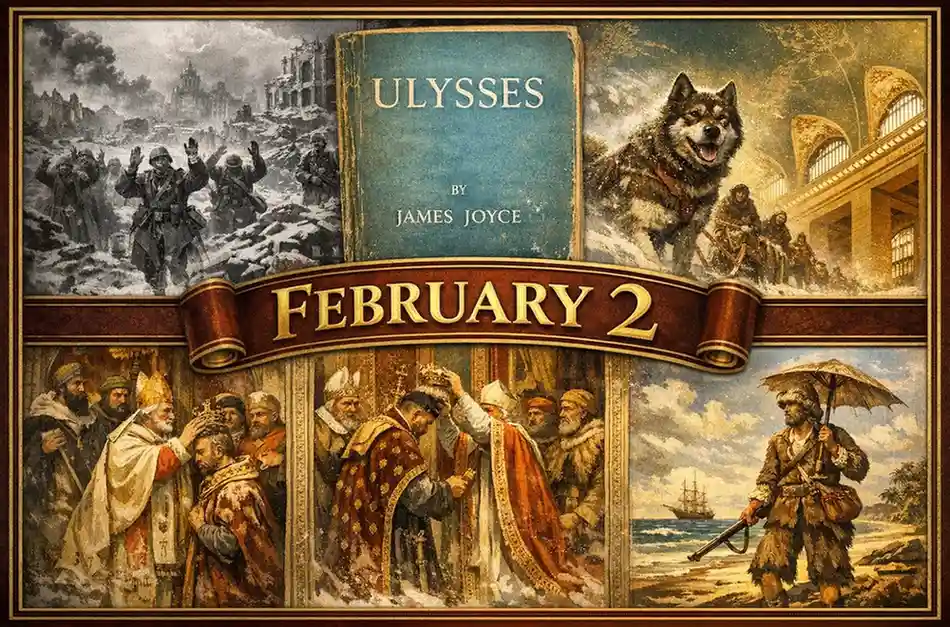
In a moment known as the Translatio imperii, Pope John XII crowned Otto I as Holy Roman Emperor. This was the first time a ruler had held the title in nearly 40 years. The event marked the official beginning of the Holy Roman Empire as a distinct entity, centralizing power in Germany and Italy and establishing a relationship between the papacy and the empire that would define European politics for centuries.
1032 – Conrad II Becomes King of Burgundy
Holy Roman Emperor Conrad II expanded his influence by becoming the King of Burgundy. His accession to the Burgundian throne further unified the diverse territories under the Holy Roman Empire’s control, strengthening the “Salian” dynasty and securing vital trade routes through the Alpine passes.
1141 – The Battle of Lincoln
During the chaotic period of English history known as The Anarchy, King Stephen was defeated and captured by the forces of Empress Matilda’s allies. The battle was a major turning point in the civil war, as the capture of the reigning monarch briefly gave Matilda the upper hand in her claim to the English throne.
1207 – Establishment of Terra Mariana
The principality of Terra Mariana (Land of Mary) was established, eventually encompassing much of present-day Latvia and Estonia. This territory was formed following the Livonian Crusade and was placed under the ultimate authority of the Holy See. It marked the expansion of Latin Christendom into the Baltic region.
1347 – End of the Byzantine Civil War
The Byzantine Civil War of 1341–1347 came to an end when conspirators allowed John VI Kantakouzenos into Constantinople. Earlier that day, Empress Anna had convened a synod to depose Patriarch Joseph XIV. The entry of Kantakouzenos led to a power-sharing agreement, though the internal conflict left the Byzantine Empire significantly weakened against external threats.
1428 – Catalonia Earthquake
An intense earthquake struck the Principality of Catalonia, with its epicenter located near Camprodon. The seismic event caused widespread destruction throughout the region, including the collapse of buildings and heavy casualties. It remains one of the most devastating natural disasters in the history of the Pyrenees region.
1438 – Execution of Transylvanian Rebels
Nine leaders of a significant peasant revolt in Transylvania were executed at Torda. The revolt had been a response to the harsh economic conditions and the suppression of rights by the nobility. The executions served as a brutal suppression of the uprising, reaffirming the control of the Hungarian and Transylvanian elite over the peasantry.
1461 – Battle of Mortimer’s Cross
In a key engagement of the Wars of the Roses, the Yorkist forces led by Edward, Earl of March (the future Edward IV), defeated a Lancastrian army. The battle is notable for the death of Owen Tudor, the grandfather of the future King Henry VII, who was executed following the Yorkist victory.
1536 – Founding of Buenos Aires
Spaniard Pedro de Mendoza founded the settlement of Ciudad de Nuestra Señora Santa María del Buen Ayre, known today as Buenos Aires. Although the initial settlement was eventually abandoned due to indigenous attacks and famine before being refounded years later, this date marks the formal beginning of the Argentine capital.
1645 – Battle of Inverlochy
As part of the Wars of the Three Kingdoms, the Royalist forces of James Graham, 1st Marquess of Montrose, achieved a decisive victory over the Covenanter forces of the Marquess of Argyll. The battle, fought in the Scottish Highlands, was a masterclass in mountain warfare and a significant blow to the Covenanter cause in Scotland.
1653 – Incorporation of New Amsterdam
The settlement of New Amsterdam was officially incorporated as a city. Under the administration of the Dutch West India Company, the city served as the capital of the New Netherland colony. Following the English takeover in 1664, the city was renamed New York City, now one of the world’s most influential metropolises.
1709 – Rescue of Alexander Selkirk
After four years and four months of living as a castaway on a deserted island in the South Pacific, Alexander Selkirk was rescued by a passing privateer. Selkirk’s incredible tale of survival and isolation became a national sensation in Britain and served as the direct inspiration for Daniel Defoe’s masterpiece, Robinson Crusoe.
1725 – Premiere of Bach’s Cantata BWV 125
In Leipzig, Johann Sebastian Bach led the first performance of his chorale cantata Mit Fried und Freud ich fahr dahin. The work was based on Martin Luther’s paraphrase of the Nunc dimittis (the Song of Simeon). It stands as a profound example of Bach’s liturgical music, composed for the Feast of the Purification.
1797 – Conclusion of the Siege of Mantua
The eight-month siege of the fortress of Mantua ended when Austrian Count Dagobert Sigmund von Wurmser surrendered to Napoleon Bonaparte. The fall of this strategic stronghold secured French control over Northern Italy and effectively ended the War of the First Coalition, catapulting Napoleon to international fame.
1814 – End of the River Thames Frost Fairs
The final “Frost Fair” on the River Thames came to a close as the ice began to thaw. For centuries, when the Thames froze over, Londoners would build booths, sell goods, and hold festivals on the ice. Due to changes in the river’s flow and a warming climate, the river would never again freeze solidly enough to support such an event.
1848 – Treaty of Guadalupe Hidalgo
The Mexican–American War officially ended with the signing of the Treaty of Guadalupe Hidalgo. Under the terms of the treaty, Mexico ceded 55 percent of its territory—including present-day California, Nevada, Utah, and parts of Arizona, Colorado, and New Mexico—to the United States in exchange for $15 million.
1850 – Battle at Fort Utah
Brigham Young, leader of the LDS Church and Governor of Utah Territory, officially declared war on the Timpanogos people. This led to the Battle at Fort Utah, a violent conflict that resulted in the displacement and death of many Timpanogos individuals as Mormon settlers expanded their territory into the Utah Valley.
1868 – Fall of Osaka Castle
During the Boshin War in Japan, pro-Imperial forces captured Osaka Castle from the Tokugawa shogunate. The castle, a symbol of shogunate power, was burned to the ground during the conflict. This event marked a major milestone in the Meiji Restoration, leading to the end of the samurai era and the modernization of Japan.
1870 – Publication of The Seven Brothers
Seitsemän veljestä (The Seven Brothers), the first and only novel by Aleksis Kivi, was published for the first time in thin booklets. As the first major novel written in the Finnish language, it is considered a cornerstone of Finnish literature and a vital element in the development of the Finnish national identity.
1876 – Formation of the National League
The National League of Professional Baseball Clubs was formed in New York City, replacing the National Association. Often called the “Senior Circuit,” it is the oldest surviving professional sports league in the United States and laid the organizational foundation for Major League Baseball.
1881 – Trial of the Warlocks of Chiloé
In Chile, sentences were handed down in the unusual trial of the “warlocks” of Chiloé. Members of a secret society known as La Recta Provincia were accused of practicing witchcraft and committing various crimes. The trial highlighted the tension between the modern Chilean state and the deep-seated folklore and indigenous traditions of the Chiloé Archipelago.
1887 – The First Groundhog Day
The residents of Punxsutawney, Pennsylvania, observed the first official Groundhog Day at Gobbler’s Knob. Based on a German weather lore tradition, the event centers on a groundhog named Phil. If he sees his shadow, there are supposedly six more weeks of winter; if not, spring is said to be on its way.
1899 – Selection of Canberra as Capital
The Australian Premiers’ Conference, meeting in Melbourne, reached a decision to locate the nation’s future capital city between the rival cities of Sydney and Melbourne. This led to the creation of the Australian Capital Territory and the eventual design and construction of Canberra.
1900 – Formation of the American League
Representatives from Boston, Detroit, Milwaukee, Baltimore, Chicago, and St. Louis met to form baseball’s American League. Originally a minor league, it declared itself a major league the following year, creating the “Junior Circuit” and the modern structure of professional baseball in America.
1901 – Funeral of Queen Victoria
A massive state funeral was held for Queen Victoria, who had died on January 22 after reigning for 63 years. Her funeral procession in London was one of the largest gatherings of European royalty in history, marking the symbolic end of the Victorian Era and the beginning of the Edwardian period.
1909 – Paris Film Congress Opens
European film producers opened the Paris Film Congress in an attempt to create a cartel similar to the Motion Picture Patents Company (MPPC) in the United States. While the effort to control the industry through a unified patent pool was ultimately unsuccessful, it reflected the early global struggle for dominance in the burgeoning cinema market.
1913 – Opening of Grand Central Terminal
New York City’s Grand Central Terminal officially opened to the public. Replacing the old Grand Central Station, the terminal was a marvel of Beaux-Arts architecture and engineering. It remains one of the world’s most visited tourist attractions and a central hub for the city’s commuter rail system.
1920 – Tartu Peace Treaty
The Tartu Peace Treaty was signed between the Republic of Estonia and the Russian Soviet Federative Socialist Republic. The treaty officially ended the Estonian War of Independence, with Russia recognizing Estonia’s sovereignty “in perpetuity.” It was the first international treaty to recognize a state that had broken away from the former Russian Empire.
1922 – Publication of Ulysses
On his 40th birthday, James Joyce saw the publication of his landmark modernist novel, Ulysses, in Paris. The book, which chronicles a single day in the life of Leopold Bloom in Dublin, revolutionized literature with its “stream of consciousness” technique. It was initially banned in many countries, including the US and UK, due to its explicit content.
1922 – The Pork Mutiny
In northern Finland, a group of armed Finnish Red Guards who had fled to Soviet Russia crossed the border back into Finland. They began an uprising known as the “Pork Mutiny” (Läskikapina), so named because the leaders recruited forest workers by providing them with food, including pork. The mutiny was short-lived and suppressed by Finnish border guards.
1925 – The Serum Run to Nome
A team of 20 mushers and about 150 sled dogs completed a “Great Race of Mercy” to deliver diphtheria antitoxin to Nome, Alaska. The final leg was completed by Balto and his musher Gunnar Kaasen. The 674-mile journey in sub-zero temperatures saved the town from an epidemic and inspired the modern Iditarod Trail Sled Dog Race.
1934 – Incorporation of the Export-Import Bank
The Export-Import Bank of the United States (EXIM) was incorporated by executive order of President Franklin D. Roosevelt. The bank was created to facilitate trade between the United States and other nations, providing financing and insurance to American exporters during the Great Depression.
1935 – First Admissible Polygraph Evidence
Leonarde Keeler administered polygraph tests to two murder suspects in Portage, Wisconsin. This marked the first time that evidence from a “lie detector” was admitted in a U.S. court of law. While the polygraph remains controversial in modern legal systems, this event was a milestone in the history of forensic science.
1942 – Anti-Nazi Resistance in Norway
The Osvald Group, a communist-led resistance organization, carried out the first active event of anti-Nazi sabotage in Norway. The group bombed several railway stations in Oslo to protest the inauguration of Vidkun Quisling as Minister President under the German occupation. It signaled the start of more aggressive internal resistance.
1943 – The German Surrender at Stalingrad
The Battle of Stalingrad, the bloodiest battle in human history, came to a definitive end as Soviet troops accepted the surrender of the remaining organized German forces in the city. The defeat of the German Sixth Army was a catastrophic blow to Nazi Germany and is widely regarded as the turning point of World War II in Europe.
1954 – First Outdoor NHL Game
The Detroit Red Wings played the first outdoor game in the history of the National Hockey League. It was an exhibition match against the Marquette Branch Prison Pirates, a team made up of inmates at a Michigan prison. The Red Wings won 18–0, playing on a makeshift rink in the prison yard.
1959 – The Dyatlov Pass Incident
Nine experienced ski hikers died under mysterious circumstances in the northern Ural Mountains of the Soviet Union. Their tent was found slashed from the inside, and their bodies were discovered scattered across the slope in varying states of undress. The “Dyatlov Pass Incident” has since spawned numerous theories ranging from avalanches to military tests.
1966 – Pakistan’s Six-Point Agenda
In the aftermath of the Indo-Pakistani War of 1965, Pakistan suggested a six-point agenda for future peace talks with India, centered on the disputed territory of Kashmir. The proposal aimed to address the long-standing grievances between the two nations, though a permanent resolution to the Kashmir conflict remained elusive.
1971 – Idi Amin Seizes Power
General Idi Amin led a military coup in Uganda, overthrowing President Milton Obote while the latter was attending a conference in Singapore. Amin’s subsequent eight-year rule was characterized by extreme human rights abuses, political repression, and economic decline, leaving a devastating impact on the nation.
1971 – Signing of the Ramsar Convention
The Convention on Wetlands of International Importance, known as the Ramsar Convention, was signed in the Iranian city of Ramsar. This international treaty provides a framework for the conservation and sustainable use of wetlands and their resources, recognizing the vital ecological role these habitats play.
1980 – The Abscam Operation Surfaces
News reports surfaced detailing an FBI sting operation known as Abscam. FBI agents posed as representatives of a fake Arab sheikh to offer bribes to various public officials. The operation led to the conviction of one senator and six members of the U.S. House of Representatives for bribery and conspiracy.
1982 – The Hama Massacre Begins
The Syrian government, under the orders of President Hafez al-Assad, began a brutal military assault on the town of Hama to suppress an uprising by the Muslim Brotherhood. The siege and subsequent massacre lasted for weeks, resulting in the deaths of thousands of civilians and the destruction of much of the historic city.
1987 – New Philippine Constitution Enacted
Following the People Power Revolution that toppled the Marcos dictatorship, the Philippines officially enacted a new constitution. The document restored democratic institutions, established term limits for the presidency, and strengthened civil liberties, serving as the foundation for the modern Philippine Republic.
1989 – Soviet Withdrawal from Kabul
The last armored column of the Soviet Army left the Afghan capital of Kabul, marking the final stages of the Soviet–Afghan War. The nine-year conflict had been a costly failure for the Soviet Union and left Afghanistan in a state of civil war that would continue for decades.
1990 – F. W. de Klerk Announces Reforms
In a landmark speech to the South African Parliament, President F. W. de Klerk announced the unbanning of the African National Congress (ANC) and other anti-apartheid organizations. He also promised the unconditional release of Nelson Mandela. These historic reforms signaled the beginning of the end of the apartheid system.
1998 – Cebu Pacific Flight 387 Crash
A Cebu Pacific Douglas DC-9 crashed into the slopes of Mount Sumagaya in the Philippines while on a domestic flight. All 104 people on board were killed in the accident. The crash was attributed to pilot error and poor weather conditions, making it one of the deadliest aviation disasters in Philippine history.
2000 – First Digital Cinema Projection in Europe
The first digital cinema projection in Europe took place in Paris. Realized by Philippe Binant, the screening used DLP CINEMA technology developed by Texas Instruments. This event marked the beginning of the transition from traditional 35mm film to digital distribution and projection in European theaters.
2004 – Roger Federer Becomes No. 1
Swiss tennis star Roger Federer reached the No. 1 spot in the ATP world rankings for the first time. He would go on to hold the position for a record-breaking 237 consecutive weeks, a period during which he dominated men’s tennis and cemented his status as one of the greatest athletes in history.
2005 – Introduction of the Civil Marriage Act
The Government of Canada introduced the Civil Marriage Act to the House of Commons. The legislation aimed to provide a gender-neutral definition of marriage. When it became law in July 2005, Canada became the fourth country in the world to legalize same-sex marriage nationwide.
2007 – The Sicily Derby Riot
During a Serie A football match between Catania and Palermo, a violent riot broke out between fans and police. Police officer Filippo Raciti was killed during the clashes. The tragedy shocked Italy and led to the immediate suspension of all football matches in the country and the implementation of much stricter stadium security regulations.
2012 – Sinking of the MV Rabaul Queen
The passenger ferry MV Rabaul Queen sank in heavy seas off the coast of Papua New Guinea. Over 100 survivors were rescued, but an estimated 146 to 165 people drowned in the disaster. The sinking was largely blamed on overcrowding and the captain’s decision to sail in unsafe weather conditions.
2021 – Myanmar’s State Administration Council
Following a military coup that deposed the democratically elected government of Aung San Suu Kyi, the Burmese military established the State Administration Council. This military junta assumed total control of the country, leading to widespread civil disobedience and a prolonged period of violent internal conflict.
Read Also About February 1: Powerful Moments
Famous People Born On February 2
| Name | Role / Description | Birth – Death |
|---|---|---|
| Max Schmeling | German heavyweight boxer | February 2, 1905 – February 2, 2005 |
| Stan Getz | American jazz saxophonist | February 2, 1927 – June 6, 1991 |
| Jascha Heifetz | Violinist, classical virtuoso | February 2, 1901 – December 10, 1987 |
| Barry Diller | American media executive | February 2, 1942 – |
| Havelock Ellis | British essayist & physician | February 2, 1859 – July 8, 1939 |
| Nell Gwyn | English actress, royal mistress | February 2, 1650 – November 14, 1687 |
| Albert Sidney Johnston | Confederate general (U.S. Civil War) | February 2, 1803 – April 6, 1862 |
| Fritz Kreisler | Violinist & composer | February 2, 1875 – January 29, 1962 |
| Abba Eban | Israeli diplomat & statesman | February 2, 1915 – November 17, 2002 |
| Than Shwe | Myanmar military ruler | February 2, 1933 – |
| Dambisa Moyo | Zambian economist & author | February 2, 1969 – |
| Jussi Björling | Swedish operatic tenor | February 2, 1911 – September 9, 1960 |
| James Dickey | American poet & novelist | February 2, 1923 – January 19, 1997 |
| Solomon Guggenheim | Art collector & philanthropist | February 2, 1861 – November 3, 1949 |
| José Guadalupe Posada | Mexican printmaker | February 2, 1851 – January 20, 1913 |
| James I of Aragon | King of Aragon | February 2, 1208 – July 27, 1276 |
| Jean de Lattre de Tassigny | French military leader | February 2, 1889 – January 11, 1952 |
| Mikhail Frunze | Soviet military theorist | February 2, 1885 – October 31, 1925 |
| Benedict XIII | Pope (1724–1730) | February 2, 1649 – February 21, 1730 |
| Sonny Stitt | Jazz saxophonist | February 2, 1924 – July 22, 1982 |
| Hannah More | English religious writer | February 2, 1745 – September 7, 1833 |
| Damdiny Sühbaatar | Mongolian revolutionary leader | February 2, 1893 – February 22, 1923 |
| John Henry Holland | Mathematician & systems theorist | February 2, 1929 – August 9, 2015 |
| Harold Rosenberg | American art critic | February 2, 1906 – July 11, 1978 |
| Dale T. Mortensen | Nobel Prize–winning economist | February 2, 1939 – January 9, 2014 |
| Frank Lloyd | Film director | February 2, 1888 – August 10, 1960 |
| Carolina Klüft | Swedish Olympic athlete | February 2, 1983 – |
| Antonio Segni | President of Italy | February 2, 1891 – December 1, 1972 |
| Fiona Wood | Australian plastic surgeon | February 2, 1958 – |
| Josephine Humphreys | American novelist | February 2, 1945 – |
Famous People Died On February 2
| Name | Role / Description | Birth – Death |
|---|---|---|
| Giovanni Pierluigi da Palestrina | Renaissance composer | c.1525 – February 2, 1594 |
| John L. Sullivan | Heavyweight boxing champion | October 15, 1858 – February 2, 1918 |
| Natalie Barney | Literary salon figure | October 31, 1879 – February 2, 1972 |
| Raymond B. Cattell | Psychologist & theorist | March 20, 1905 – February 2, 1998 |
| Yaroslav the Wise | Grand Prince of Kyiv | 980 – February 2, 1054 |
| Anthelme Brillat-Savarin | French gastronome & author | April 1, 1755 – February 2, 1826 |
| Vsevolod Meyerhold | Theatre director & innovator | February 9, 1874 – February 2, 1940 |
| Carl Goerdeler | German resistance leader | July 31, 1884 – February 2, 1945 |
| Aaron Douglas | Harlem Renaissance artist | May 26, 1899 – February 2, 1979 |
| Letizia Buonaparte | Mother of Napoleon Bonaparte | August 24, 1750 – February 2, 1836 |
| Clement XIII | Pope (1758–1769) | March 7, 1693 – February 2, 1769 |
| Wendell Phillips | Abolitionist orator | November 29, 1811 – February 2, 1884 |
| Joshua Lederberg | Nobel Prize–winning geneticist | May 23, 1925 – February 2, 2008 |
| Constantin Carathéodory | Mathematician | September 13, 1873 – February 2, 1950 |
| Mike Moore | Prime minister of New Zealand | January 28, 1949 – February 2, 2020 |
| St. Lawrence of Canterbury | Archbishop of Canterbury | – February 2, 619 |
| Govert Flinck | Dutch Baroque painter | January 25, 1615 – February 2, 1660 |
| Vladimir Sukhomlinov | Russian general & minister | August 16, 1848 – February 2, 1926 |
| Solomon | British concert pianist | August 9, 1902 – February 2, 1988 |
| Joan II of Naples | Queen of Naples | 1371 – February 2, 1435 |
| William H. Stein | Nobel Prize–winning biochemist | June 25, 1911 – February 2, 1980 |
| Claude Brown | American author | February 23, 1937 – February 2, 2002 |
| Adolf Stoecker | German political cleric | December 11, 1835 – February 2, 1909 |
| Robert McAlmon | Author & publisher | March 9, 1896 – February 2, 1956 |
| Jean Étienne de Boré | Sugar industry pioneer | December 27, 1741 – February 2, 1820 |
| George Henry Evans | Labor reform advocate | March 25, 1805 – February 2, 1856 |
| Patrick Ruthven | Royalist army commander | c.1573 – February 2, 1651 |
| Harry Mark Petrakis | American novelist | June 5, 1923 – February 2, 2021 |
| Léon Brunschvicg | French philosopher | November 10, 1869 – February 2, 1944 |
| Valery Larbaud | French writer & critic | August 29, 1881 – February 2, 1957 |
Observances & Institutional Dates
- Groundhog Day: A traditional weather-prediction festival observed in the United States and Canada.
- World Wetlands Day: Commemorating the signing of the Ramsar Convention on wetlands in 1971.
- Victory of the Battle of Stalingrad: A day of remembrance in Russia and former Soviet states for the 1943 victory.
Frequently Asked Questions
- What happened at the end of the Battle of Stalingrad on February 2, 1943?
- The last German forces in the city surrendered to the Soviet Union, marking a major turning point in WWII.
- Why is Alexander Selkirk’s rescue on this day famous?
- His 1709 rescue after being a castaway for over four years inspired the novel Robinson Crusoe.
- What major sports league was formed on this day in 1876?
- The National League of Professional Baseball Clubs (MLB) was founded.
- What was the “Serum Run to Nome” in 1925?
- A relay of sled dogs delivered life-saving diphtheria medicine to the isolated town of Nome, Alaska.