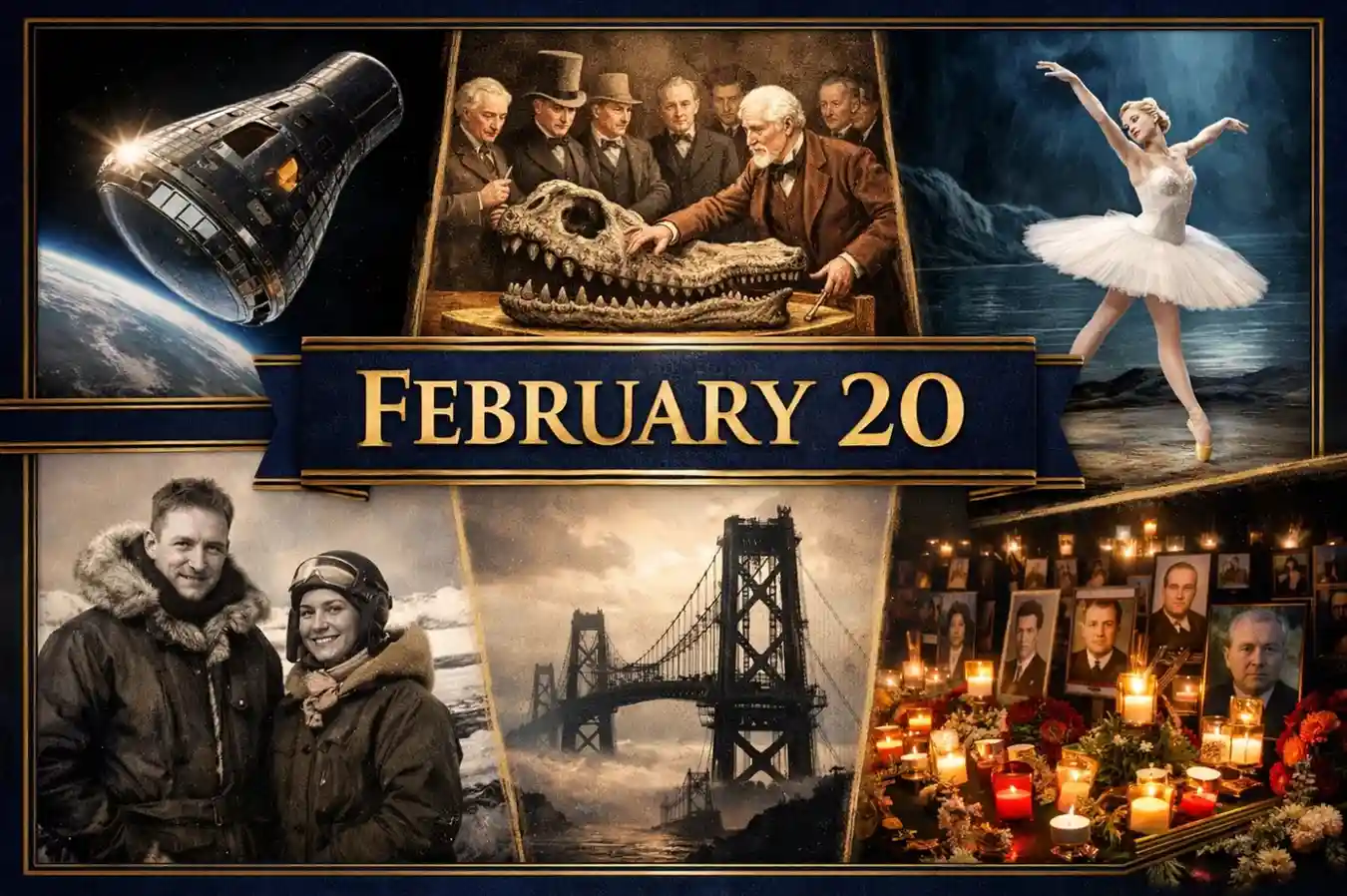
The passage of time often reveals how a single day can shift the boundaries of empires and the limits of human achievement. When we look at what happened on this day in history February 20, we witness the formalization of global communications, the discovery of ancient giants, and the first American footsteps into the orbit of our planet. It is a day where the delicate art of Tchaikovsky premiered alongside the violent birth of new political movements and the tragic loss of lives in unexpected disasters.
Important Events That Happened On February 20 In History
1339 – Battle of Parabiago
In a fierce struggle for the control of Milan, the regular Milanese army clashed with the St. George’s Mercenaries led by the pretender Lodrisio Visconti. The battle took place in the snow-covered fields of Parabiago and was characterized by brutal hand-to-hand combat between professional men-at-arms. Despite early successes by the mercenaries, the local Milanese forces managed to rally and decisively defeat Lodrisio’s army. This victory secured the rule of Azzone Visconti and remains a legendary chapter in the medieval military history of Northern Italy.
1472 – Orkney and Shetland Pawned to Scotland
In a peculiar diplomatic and financial maneuver, the islands of Orkney and Shetland were pawned by King Christian I of Norway and Denmark to the Kingdom of Scotland. The islands served as collateral for the unpaid dowry of his daughter, Margaret of Denmark, who was married to King James III of Scotland. Because the Danish crown was never able to raise the funds to redeem the debt, the islands eventually became a permanent part of Scotland. This event fundamentally altered the maritime borders and cultural trajectory of the northern Scottish archipelagos forever.
1521 – Ponce de León Departs for Florida
The Spanish conquistador Juan Ponce de León set sail from San Juan, Puerto Rico, leading an expedition of two ships and roughly 200 prospective colonists toward Florida. This was an ambitious attempt to establish a permanent Spanish settlement on the North American mainland following his earlier exploration of the coast. However, the mission met with disaster when the party was attacked by local Calusa warriors, and Ponce de León was mortally wounded by a poisoned arrow. His failure temporarily stalled Spanish efforts to colonize the southeastern region of what is now the United States.
1547 – Coronation of Edward VI
At just nine years of age, Edward VI was crowned King of England during a lavish ceremony at Westminster Abbey. As the son of Henry VIII and Jane Seymour, he was the first English monarch to be raised as a Protestant from birth. His short reign would see significant religious reforms that moved the Church of England further away from Catholic traditions and toward a more radical theology. Despite his youth, Edward’s coronation represented the continuity of the Tudor dynasty during a period of intense social and religious transition.
1553 – Birth of the Chaldean Catholic Church
Yohannan Sulaqa, an East Syrian monk, traveled to Rome to profess his Catholic faith and was subsequently ordained as a bishop, marking a historic schism. This act created a new ecclesiastical line that acknowledged the primacy of the Pope, leading to the formal establishment of the Chaldean Catholic Church. Sulaqa’s mission was a response to the hereditary succession practices within the Church of the East that many found objectionable. His legacy continues today as the Chaldean Church remains a vibrant part of the global Catholic community in the Middle East.
1685 – Establishment of Fort St. Louis
The French explorer René-Robert Cavelier, Sieur de La Salle, established Fort St. Louis at Matagorda Bay, providing the primary basis for France’s territorial claim to Texas. The colony was intended to be at the mouth of the Mississippi River, but navigational errors led the expedition hundreds of miles off course. The small settlement struggled against disease, lack of supplies, and hostile interactions with local Karankawa people, eventually ending in failure. Despite its short life, the fort’s existence forced Spain to increase its military and missionary presence in the region to counter French influence.
1792 – The Postal Service Act
United States President George Washington signed the Postal Service Act, officially establishing the United States Post Office Department as a permanent part of the federal government. This landmark legislation set low rates for newspapers to encourage the spread of information and protected the privacy of personal mail from government intrusion. It also authorized the creation of thousands of miles of “post roads” to connect the rapidly growing young nation. The act transformed the postal service into a vital engine for democracy, commerce, and national unity in the early American republic.
1798 – Pope Pius VI Removed from Power
French General Louis-Alexandre Berthier entered Rome and formally removed Pope Pius VI from his temporal power, declaring the city a republic under French influence. The Pope refused to renounce his authority and was subsequently taken prisoner and escorted across the Alps into France. This event was a direct consequence of the French Revolutionary Wars and the radical secularization policies of the French Directory. Pius VI would eventually die in captivity a year later, marking one of the lowest points in the history of the modern papacy.
1813 – Battle of Salta
During the Argentine War of Independence, General Manuel Belgrano led his revolutionary army to a decisive victory over the royalist forces of Pío de Tristán. The Battle of Salta was significant not only for its tactical success but also for Belgrano’s decision to offer a generous surrender to the defeated Spanish troops. This victory ensured that the northern provinces of Argentina remained free from royalist control and bolstered the morale of the independence movement. It remains a celebrated moment in South American history as a triumph of both military skill and humanitarian ideals.
1816 – Premiere of The Barber of Seville
Gioachino Rossini’s comic opera The Barber of Seville received its world premiere at the Teatro Argentina in Rome, though the opening night was famously a disaster. The performance was plagued by accidents, including a singer tripping and a cat wandering onto the stage, while fans of a rival composer hissed throughout. Despite this rocky start, the opera’s brilliant score and witty plot quickly won over audiences, becoming one of the most popular works in the repertoire. It remains a masterpiece of the “bel canto” style and a staple of opera houses around the world.
1824 – First Scientific Naming of a Dinosaur
The British geologist and clergyman William Buckland formally announced the name Megalosaurus during a meeting of the Geological Society of London. This was the first time a non-avian dinosaur species was scientifically and validly named, based on fossilized remains found in Oxfordshire. Buckland correctly identified the creature as a giant, extinct lizard, though his initial reconstruction looked much more like a modern crocodile than a dinosaur. This announcement predated the coining of the term “Dinosauria” and laid the scientific foundation for the field of vertebrate paleontology.
1835 – Concepción Earthquake
A massive earthquake struck the city of Concepción, Chile, nearly leveling the entire urban center and triggering a devastating tsunami along the coast. The disaster was witnessed and recorded by Charles Darwin, who was nearby during his voyage on the HMS Beagle. Darwin noted how the earthquake significantly raised the level of the land, providing him with early evidence for his theories on geological change. The total destruction of the city forced a massive rebuilding effort and remains one of the most powerful seismic events in Chilean history.
1846 – Kraków Uprising
Polish insurgents launched an armed uprising in the city of Kraków, aiming to incite a national fight for independence against the occupying powers of Austria, Prussia, and Russia. The rebellion sought to restore a sovereign Poland and was briefly successful in establishing a revolutionary government that promised social reforms. However, the movement lacked broad support among the peasantry and was quickly crushed by Austrian military intervention. The failure of the uprising led to the formal annexation of the Free City of Kraków by the Austrian Empire, further delaying Polish hopes for freedom.
1864 – Battle of Olustee
In the pine forests of northern Florida, Union and Confederate forces clashed in the Battle of Olustee, the largest engagement fought in the state during the American Civil War. The Union expedition, intended to disrupt Confederate supply lines and recruit Black soldiers, was met by a prepared and equal force of Southern defenders. The battle was a bloody defeat for the Union, which suffered nearly 40% casualties, including many soldiers from the famous 54th Massachusetts Infantry. The Confederate victory ensured that the interior of Florida remained under Southern control for the rest of the conflict.
1865 – End of the Uruguayan War
The Uruguayan War concluded with a formal peace agreement between President Tomás Villalba and the rebel leader Venancio Flores. The conflict had involved significant foreign intervention, with Brazil supporting the rebels and Paraguay siding with the established government. While the peace ended the immediate civil strife, it shifted the regional balance of power and deepened the tensions between Paraguay and its neighbors. This fallout set the stage for the catastrophic War of the Triple Alliance, the deadliest conflict in South American history.
1872 – Opening of the Metropolitan Museum of Art
The Metropolitan Museum of Art officially opened its doors to the public in New York City, originally housed in a small building on Fifth Avenue. Founded by a group of businessmen, artists, and thinkers, the museum was intended to bring art and art education to the American people. Its first acquisition was a Roman sarcophagus, and it has since grown into one of the largest and most influential art museums in the world. Today, “The Met” holds millions of works spanning 5,000 years of human history and is a cornerstone of global cultural life.
1877 – Premiere of Swan Lake
Pyotr Ilyich Tchaikovsky’s ballet Swan Lake received its world premiere at the Bolshoi Theatre in Moscow, featuring choreography by Julius Reisinger. Much like The Barber of Seville, its debut was met with criticism, with many contemporary viewers finding the music too complex and the dancing mediocre. It was only after Tchaikovsky’s death and a successful 1895 revival with new choreography that the ballet achieved its status as a timeless classic. It is now considered the quintessential classical ballet, beloved for its hauntingly beautiful score and its tale of love and transformation.
1894 – Bombings by Désiré Pauwels
During a period of intense anarchist activity in France known as the Ère des attentats, the Belgian anarchist Désiré Pauwels attempted to detonate bombs in Paris. One of the explosions occurred near the Rue de la Chaussée-d’Antin, while a later attempt resulted in Pauwels’ own death when his device exploded prematurely. These attacks were part of a wider wave of “propaganda by the deed,” intended to destabilize the state through terror. The bombings led to the passage of repressive laws and a significant crackdown on the anarchist movement throughout Europe.
1901 – First Hawaii Territory Legislature
The legislature of the Territory of Hawaii convened for the first time in Honolulu, marking a new chapter in the islands’ political history following their annexation by the United States. This inaugural session was tasked with establishing the legal and administrative framework for the new American territory. The legislature faced immediate challenges regarding land rights, labor, and the relationship between the native Hawaiian population and the American government. This meeting began the long and often contentious process of Hawaii’s integration into the United States, which culminated in statehood in 1959.
1905 – Jacobson v. Massachusetts Ruling
The United States Supreme Court issued a landmark ruling in Jacobson v. Massachusetts, upholding the constitutionality of a state’s mandatory smallpox vaccination program. The court ruled that an individual’s liberty is not absolute and can be restricted in the interest of public health and safety. This decision established the legal precedent for government-mandated vaccinations and other public health measures in the U.S. It remains a foundational case for modern public health law, balancing individual rights with the collective well-being of the community.
1909 – Publication of the Futurist Manifesto
The Italian poet Filippo Tommaso Marinetti published the Futurist Manifesto on the front page of the French journal Le Figaro. The manifesto aggressively rejected the art of the past and celebrated the speed, violence, and technology of the modern industrial world. It called for the destruction of museums and libraries, arguing that a racing car was more beautiful than the Victory of Samothrace. This radical document launched Futurism as an international art movement, profoundly influencing 20th-century painting, sculpture, architecture, and even politics.
1913 – Commencement of Work on Canberra
King O’Malley, the Australian Minister for Home Affairs, drove in the first survey peg to mark the official commencement of construction on the new national capital, Canberra. The site had been chosen as a compromise between the rival cities of Sydney and Melbourne, and the city was designed by American architect Walter Burley Griffin. The driving of the peg symbolized the physical birth of a city built from scratch to serve as the heart of Australian democracy. Today, Canberra stands as a unique example of a fully planned “garden city” and the administrative center of the nation.
1920 – Gori Earthquake
A powerful earthquake struck the country of Georgia, causing significant destruction and killing between 114 and 130 people. The town of Gori, the birthplace of Joseph Stalin, was particularly hard hit, with many of its historic buildings and residential areas reduced to rubble. The disaster occurred during a period of political upheaval as Georgia struggled for independence following the Russian Revolution. The rebuilding effort was slow and difficult, but the event remains a somber milestone in the geological and social history of the Caucasus region.
1931 – Approval of the Bay Bridge
The United States Congress officially approved the construction of the San Francisco–Oakland Bay Bridge by the state of California. This massive engineering project was intended to connect the two major cities across the San Francisco Bay, replacing the slow and congested ferry systems. The bridge was a marvel of the era, featuring a combination of suspension spans and a massive tunnel through Yerba Buena Island. Completed in 1936, it remains one of the busiest bridges in the world and a vital artery for the regional economy of the Bay Area.
1931 – Anarchist Uprising in Encarnación
A group of anarchist militants launched a brief but intense uprising in the city of Encarnación, Paraguay, attempting to establish a revolutionary commune. The rebels seized control of the city’s administrative buildings and declared a new social order based on anarchist principles of self-governance and the abolition of private property.
While the uprising was quickly suppressed by the Paraguayan military, it reflected the deep social unrest and the influence of radical European ideologies in South America during the early 20th century. The event is remembered as a rare example of an urban commune in the region’s history.
1933 – The Blaine Act and the Repeal of Prohibition
The U.S. Congress passed the Blaine Act, a crucial legislative step toward the repeal of federal Prohibition in the United States. The act submitted the proposed Twenty-first Amendment to the U.S. Constitution to state ratifying conventions, rather than state legislatures, to ensure a faster approval process. This move was a response to the widespread failure of the Eighteenth Amendment, which had led to a surge in organized crime and public defiance. The eventual ratification of the Twenty-first Amendment later that year marked the end of the “Noble Experiment.”
1933 – Hitler’s Secret Meeting with Industrialists
Adolf Hitler, who had recently been appointed Chancellor of Germany, held a secret meeting with a group of the country’s most powerful industrialists at the home of Hermann Göring. During the meeting, Hitler and Göring requested massive financial contributions to fund the Nazi Party’s campaign for the upcoming March elections. The industrialists, fearing the rise of communism and seeking political stability, pledged millions of Reichsmarks to the cause. This financial backing was essential for the Nazi propaganda machine as it moved to consolidate its total control over the German state.
1935 – First Woman to Step on Antarctica
Caroline Mikkelsen, a Danish-Norwegian explorer, became the first woman known to set foot on the continent of Antarctica. She was accompanied by her husband, Captain Klarius Mikkelsen, on a whaling expedition that landed at the Vestfold Hills. To mark the occasion, the party raised the Norwegian flag and built a small stone cairn. While the exact location of her landing was debated for decades, her achievement shattered a gender barrier in the male-dominated field of polar exploration and paved the way for future female scientists and explorers.
1939 – Madison Square Garden Nazi Rally
The German American Bund organized the largest pro-Nazi rally in United States history at Madison Square Garden in New York City. Approximately 20,000 members and sympathizers attended the event, which featured a giant portrait of George Washington flanked by swastikas. The rally was met by massive counter-protests outside, leading to violent clashes and hundreds of arrests. This event underscored the alarming presence of fascist ideologies in America on the eve of World War II and the intense domestic tensions over the country’s role in the global conflict.
1942 – Edward O’Hare Becomes an Ace
During a single air battle over the Pacific, U.S. Navy pilot Lieutenant Edward “Butch” O’Hare became America’s first World War II flying ace. Flying a Grumman F4F Wildcat, O’Hare single-handedly attacked a formation of nine Japanese bombers that were approaching his aircraft carrier, the USS Lexington. In just minutes, he shot down five of the bombers and damaged a sixth, potentially saving his ship from destruction. For this extraordinary act of courage and skill, he was awarded the Medal of Honor and later had Chicago’s O’Hare International Airport named in his honor.
1943 – Hollywood Censorship Agreement
Fearing the impact of film content on public morale and international relations, major American movie studio executives agreed to allow the Office of War Information (OWI) to censor and review movies. This voluntary agreement ensured that films would align with the government’s propaganda goals and avoid portraying the U.S. war effort in a negative light. The OWI provided “suggestions” on scripts and could block the export of films that did not meet their standards. This partnership between Washington and Hollywood was a key part of the total mobilization of American culture during World War II.
1943 – Publication of the Four Freedoms
The Saturday Evening Post began publishing a series of four paintings by Norman Rockwell titled the Four Freedoms, starting with “Freedom of Speech.” The paintings were inspired by President Franklin D. Roosevelt’s 1941 State of the Union address, in which he outlined the essential human rights worth fighting for: Freedom of Speech, Freedom of Worship, Freedom from Want, and Freedom from Fear. Rockwell’s relatable and evocative images became immensely popular, helping to sell millions of dollars in war bonds. They remain iconic symbols of American democratic values and the domestic home front experience.
1944 – Start of “Big Week”
The United States Army Air Forces launched “Operation Argument,” popularly known as “Big Week,” a massive and sustained aerial offensive against the German aircraft industry. For six days, American bombers and their fighter escorts conducted daylight raids on manufacturing centers across Germany to lure the Luftwaffe into a decisive battle. While the physical damage to the factories was significant, the primary goal was to destroy the German fighter force in the air. By the end of the week, the Luftwaffe had lost hundreds of veteran pilots, giving the Allies air superiority over Western Europe.
1944 – Capture of Eniwetok Atoll
Following a week of intense naval bombardment and amphibious landings, United States forces successfully captured Eniwetok Atoll in the Marshall Islands. The battle was a strategic victory that provided the U.S. with a vital forward base and a large deep-water anchorage for the next phases of the Pacific campaign. The Japanese garrison defended the atoll with fanatical resolve, leading to high casualties on both sides and the near-total destruction of the island’s vegetation. The fall of Eniwetok signaled that the Japanese outer defense perimeter was rapidly collapsing under American pressure.
1952 – Emmett Ashford Becomes First Black Umpire
In a significant step for the integration of professional baseball, Emmett Ashford was authorized to serve as a substitute umpire in the Southwestern International League. This made him the first African-American umpire in organized baseball, breaking a long-standing racial barrier in the sport’s officiating ranks. Ashford was known for his flamboyant style, high energy, and impeccable professionalism on the field. He would spend many years in the minor leagues before finally becoming the first Black umpire in Major League Baseball in 1966, forever changing the face of the game.
1956 – USMMA Becomes a Permanent Service Academy
The United States Merchant Marine Academy (USMMA) at Kings Point, New York, was officially established as a permanent federal Service Academy by an act of Congress. Known as the “Fourth Arm of Defense,” the academy was created to train officers for the U.S. Merchant Marine, which plays a critical role in both international trade and national security. It joined the ranks of West Point, Annapolis, and the Coast Guard Academy as an elite institution of higher learning. The academy’s motto, Acta Non Verba (“Deeds Not Words”), reflects its commitment to practical leadership and service to the nation.
1959 – Cancellation of the Avro Arrow
The Canadian government under Prime Minister John Diefenbaker abruptly cancelled the Avro Arrow program, a project to design and build an advanced supersonic interceptor jet. The decision followed years of mounting costs and the shifting strategic focus from manned bombers to intercontinental ballistic missiles. The cancellation resulted in the immediate loss of thousands of jobs and sparked an intense political debate that continues to this day. Many Canadians saw the end of the Arrow as a blow to the nation’s technological sovereignty and a major setback for its aerospace industry.
1962 – John Glenn Orbits the Earth
Aboard the Friendship 7 spacecraft, Lieutenant Colonel John Glenn became the first American to successfully orbit the Earth. During his mission, which lasted nearly five hours, he completed three orbits and conducted experiments on the effects of weightlessness on the human body. Glenn’s flight was a much-needed victory for NASA’s Mercury program, which was trailing behind the Soviet Union’s space achievements. He returned to Earth as a national hero, proving that American technology and pilots were capable of competing in the high-stakes Space Race.
1965 – Ranger 8 Crashes into the Moon
NASA’s Ranger 8 probe successfully completed its mission by crashing into the Moon’s Sea of Tranquility after transmitting over 7,000 high-resolution photographs. The images provided scientists with unprecedented detail of the lunar surface, helping to identify potential landing sites for the upcoming crewed Apollo missions. This was the second successful flight in the Ranger series, which was designed to gather essential data before a human landing. The precision of the crash proved that NASA had mastered the complex navigation required to reach and strike specific targets on the lunar surface.
1968 – China Academy of Space Technology Established
The China Academy of Space Technology (CAST) was established in Beijing, serving as the nation’s primary organization for the research and development of space satellites. Founded under the leadership of rocket scientist Qian Xuesen, the academy was tasked with making China a major player in the global space arena. CAST would eventually design and build China’s first satellite, Dong Fang Hong I, which launched in 1970. Today, it remains at the heart of China’s ambitious space program, including its lunar exploration and space station projects.
1971 – Emergency Broadcast System False Alarm
In a bizarre and terrifying incident, the United States Emergency Broadcast System (EBS) was accidentally activated in an erroneous national alert. A teletype operator at the National Emergency Warning Center mistakenly used the “live” alert tape instead of the “test” tape, sending a real emergency message to thousands of radio and TV stations. While some stations ignored the alert due to its unusual nature, others went off the air or began broadcasting warnings of an impending attack. The mistake caused widespread confusion and highlighted significant flaws in the nation’s emergency communication protocols.
1979 – Sinila Crater Gas Release
An earthquake on the Dieng Plateau in Indonesia cracked open the Sinila volcanic crater, releasing a massive cloud of poisonous hydrogen sulfide gas. The gas, which is invisible and heavier than air, flowed down the mountain slopes and trapped villagers in their sleep. A total of 149 people were killed, and thousands more had to be evacuated from the surrounding area. The tragedy was a reminder of the hidden dangers of volcanic regions, where silent gas releases can be just as deadly as explosive eruptions.
1986 – Launch of the Mir Space Station
The Soviet Union successfully launched the core module of the Mir space station, beginning a new era of long-term human habitation in orbit. Mir was the first modular space station, allowing for various scientific and docking modules to be added over time. It remained in orbit for 15 years and was occupied for ten of those years by a succession of international crews, including American astronauts during the Shuttle-Mir program. Mir served as a vital laboratory for studying the long-term effects of spaceflight and paved the way for the International Space Station.
1988 – Nagorno-Karabakh Secession Vote
The parliament of the Nagorno-Karabakh Autonomous Oblast voted to secede from the Azerbaijan Soviet Socialist Republic and join the Armenian Soviet Socialist Republic. This historic vote was a response to decades of ethnic tensions and a desire for self-determination by the region’s ethnic Armenian majority. The decision sparked immediate and violent clashes between Armenians and Azerbaijanis, leading to the First Nagorno-Karabakh War. This conflict remains one of the most persistent and unresolved territorial disputes in the post-Soviet space, continuing to impact regional stability today.
1991 – Toppling of Enver Hoxha’s Statue
In the Albanian capital of Tirana, an angry mob of tens of thousands of protesters toppled a 30-foot-tall bronze statue of the country’s longtime communist dictator, Enver Hoxha. This dramatic event occurred during a period of massive pro-democracy demonstrations that were sweeping across Albania, the last of the Eastern European nations to undergo a democratic transition. The falling of the statue was a powerful symbolic end to four decades of isolationist and repressive rule. It signaled the irreversible collapse of the communist regime and the beginning of Albania’s journey toward a multi-party system.
1998 – Tara Lipinski’s Olympic Gold
At the 1998 Winter Olympics in Nagano, Japan, American figure skater Tara Lipinski won the gold medal in the ladies’ singles event. At just 15 years and 255 days old, she became the youngest individual gold medalist in the history of the Winter Games, a record she still holds. Her performance featured a signature triple loop-triple loop combination that showcased her incredible technical skill and youthful energy. Lipinski’s victory over teammate Michelle Kwan remains one of the most famous and debated moments in the history of Olympic figure skating.
2002 – El Ayyat Train Fire
A catastrophic fire broke out on an Egyptian National Railways train in El Ayyat after a cooking gas cylinder exploded in one of the passenger cars. The fire spread rapidly through the overcrowded and poorly ventilated third-class carriages while the train was still moving at high speed. Because the emergency brakes were not applied immediately, the flames engulfed the entire train, killing over 370 people. It remains the deadliest rail disaster in Egyptian history and led to a major outcry regarding the safety and maintenance of the country’s public transportation network.
2003 – The Station Nightclub Fire
During a concert by the rock band Great White in West Warwick, Rhode Island, a pyrotechnics display ignited flammable soundproofing foam behind the stage. The fire spread with terrifying speed, filling the nightclub with thick, toxic smoke and creating a crush at the main exit. A total of 100 people were killed and over 200 others were injured in the disaster. The tragedy led to significant changes in fire safety regulations for entertainment venues nationwide, including stricter requirements for sprinklers and fire-resistant materials in clubs and theaters.
2005 – Spanish EU Constitution Referendum
Spain became the first country to hold a national referendum on the ratification of the proposed Constitution of the European Union. The “Yes” vote passed by a substantial margin of over 76%, reflecting strong public support for European integration and Spain’s role within the Union. However, the turnout was historically low at around 42%, raising questions about public engagement with complex EU political issues. While Spain approved the document, the constitution was ultimately rejected in France and the Netherlands, leading to its eventual abandonment in favor of the Lisbon Treaty.
2009 – Tamil Tiger Kamikaze Attack
In a desperate final act of the Sri Lankan Civil War, two aircraft operated by the Tamil Tigers (LTTE) attempted a kamikaze-style attack on the national air force headquarters in Colombo. The planes were packed with C4 explosives and piloted by LTTE members, but they were detected and shot down by the Sri Lankan military before reaching their primary target. One plane crashed into a government building, causing several deaths and injuries, while the other was downed near the airport. This attack was the last significant air operation by the separatist group before their final defeat a few months later.
2010 – Madeira Floods and Mudslides
The island of Madeira, Portugal, was struck by exceptionally heavy rainfall that triggered devastating flash floods and mudslides across the archipelago. The capital city of Funchal was particularly hard hit, as torrents of water and debris swept through the streets, destroying bridges, homes, and infrastructure. At least 43 people were killed and hundreds were left homeless in what was described as the worst natural disaster in the history of the island. The event highlighted the vulnerability of mountainous island regions to extreme weather events and sparked a massive recovery and prevention effort.
2014 – “Heavenly Hundred” Deaths in Kyiv
The Euromaidan protests in Ukraine’s capital city, Kyiv, reached a tragic and violent peak as dozens of anti-government demonstrators were killed. Many of the victims were reportedly shot by snipers in and around Independence Square during a brutal crackdown by security forces. These fallen protesters became known as the “Heavenly Hundred,” and their deaths galvanized the opposition and led to the collapse of President Viktor Yanukovych’s government. This day remains a somber anniversary in Ukraine, honoring those who sacrificed their lives for the country’s democratic future.
2015 – Rafz Train Collision
Two passenger trains collided in the Swiss town of Rafz after one train reportedly passed a stop signal and struck the side of another. The impact derailed several carriages and left as many as 49 people injured, some of them seriously. The accident caused major disruption to the Swiss Federal Railways network, with many services between Zurich and Stuttgart being cancelled or diverted. While Swiss rail is known for its exceptional safety record, this incident led to a thorough investigation and a review of signaling and safety protocols on the regional lines.
2016 – Kalamazoo Shooting Spree
A series of random shooting incidents occurred across Kalamazoo County, Michigan, resulting in the deaths of six people and injuries to two others. The attacks took place at three different locations over several hours, including an apartment complex, a car dealership, and a restaurant.
The suspect, an Uber driver who was picking up passengers between the shootings, was eventually apprehended by police without further incident. The tragedy sparked a national discussion about the challenges of identifying “lone wolf” attackers and the need for improved background checks and mental health resources.
Famous People Born On February 20
| Name | Role / Description | Date |
|---|---|---|
| Mike Leigh | British writer & director | February 20, 1943 – |
| Buffy Sainte-Marie | American singer-songwriter & activist | February 20, 1941/42 – |
| Richard Matheson | American author & screenwriter | February 20, 1926 – June 23, 2013 |
| Ludwig Boltzmann | Austrian physicist | February 20, 1844 – September 5, 1906 |
| Hubert de Givenchy | French fashion designer | February 20, 1927 – March 10, 2018 |
| Aleksey Nikolayevich Kosygin | Soviet premier | February 20, 1904 – December 18, 1980 |
| Tony Wilson | British music entrepreneur | February 20, 1950 – August 10, 2007 |
| John Browne, Lord Browne of Madingley | British businessman | February 20, 1948 – |
| Pierre Boulle | French author | February 20, 1912 – January 30, 1994 |
| John Willard Milnor | American mathematician | February 20, 1931 – |
| Mary Garden | Scottish soprano | February 20, 1874 – January 3, 1967 |
| Bobby Unser | American race-car driver | February 20, 1934 – May 2, 2021 |
| Vincent Massey | Canadian statesman | February 20, 1887 – December 30, 1967 |
| Pramoedya Ananta Toer | Indonesian author | February 20, 1925 – April 30, 2006 |
| Cornelius Vanderbilt Whitney | American businessman | February 20, 1899 – December 13, 1992 |
| Forbes Burnham | President of Guyana | February 20, 1923 – August 6, 1985 |
| Abdalá Bucaram | President of Ecuador | February 20, 1952 – |
| Cajetan | Catholic theologian | February 20, 1468/69 – August 10, 1534 |
| Noureddine Morceli | Algerian athlete | February 20, 1970 – |
| Nicolai Hartmann | German philosopher | February 20, 1882 – October 9, 1950 |
| Hesketh Pearson | English writer & biographer | February 20, 1887 – April 9, 1964 |
| Frederick Crews | American literary critic | February 20, 1933 – June 21, 2024 |
| Charles-Auguste de Bériot | Belgian violinist | February 20, 1802 – April 8, 1870 |
| Jarosław Iwaszkiewicz | Polish poet & writer | February 20, 1894 – March 2, 1980 |
| Julian Trevelyan | British artist | February 20, 1910 – July 12, 1988 |
| Elie Nadelman | Polish-American sculptor | February 20, 1882 – December 28, 1946 |
| Joseph Jefferson | American actor | February 20, 1829 – April 23, 1905 |
| Sir Robert Hart, 1st Baronet | British statesman | February 20, 1835 – September 20, 1911 |
| Henry James Pye | British poet | February 20, 1745 – August 11, 1813 |
| Alfred Escher | Swiss statesman | February 20, 1819 – December 6, 1882 |
Famous People Died On February 20
| Name | Role / Description | Date |
|---|---|---|
| P.G.T. Beauregard | Confederate general | May 28, 1818 – February 20, 1893 |
| Robert Peary | American explorer | May 6, 1856 – February 20, 1920 |
| Walter Winchell | American journalist | April 7, 1897 – February 20, 1972 |
| Oswald Avery | American bacteriologist | October 21, 1877 – February 20, 1955 |
| Percy Grainger | American composer | July 8, 1882 – February 20, 1961 |
| Martin V | Pope | 1368 – February 20, 1431 |
| Maria Goeppert Mayer | American physicist | June 28, 1906 – February 20, 1972 |
| René Cassin | French jurist | October 5, 1887 – February 20, 1976 |
| John, king of Denmark, Norway, and Sweden | Scandinavian monarch | June 5, 1455 – February 20, 1513 |
| Henri Moissan | French chemist | September 28, 1852 – February 20, 1907 |
| Paul Kane | Canadian painter | September 3, 1810 – February 20, 1871 |
| Andreas Hofer | Tirolean leader | November 22, 1767 – February 20, 1810 |
| Klas Pontus Arnoldson | Swedish politician | October 27, 1844 – February 20, 1916 |
| Sir Percy Cox | British diplomat | November 20, 1864 – February 20, 1937 |
| Charles Emmanuel III | King of Sardinia-Piedmont | April 27, 1701 – February 20, 1773 |
| William FitzOsbern, 1st earl of Hereford | Norman noble | – February 20, 1071 |
| Henry Percy, 1st earl of Northumberland | English noble | November 10, 1341 – February 20, 1408 |
| René Dubos | American microbiologist | February 20, 1901 – February 20, 1982 |
| Eugène Scribe | French dramatist | December 24, 1791 – February 20, 1861 |
| Mademoiselle Dumesnil | French actress | January 2, 1713 – February 20, 1803 |
| Johann Tobias Mayer | German astronomer | February 17, 1723 – February 20, 1762 |
| Charles Rockwell Lanman | American scholar | July 8, 1850 – February 20, 1941 |
| Matthew Murray | English engineer | 1765 – February 20, 1826 |
| Laurence Housman | English artist & writer | July 18, 1865 – February 20, 1959 |
| Isidor Philipp | French pianist | September 2, 1863 – February 20, 1958 |
| Henry Drummond | British banker | December 5, 1786 – February 20, 1860 |