The flow of human progress often turns on a single day of daring innovation or monumental political shifts. When we look at what happened on this day in history February 21, we see the sparks of the Industrial Revolution in a Welsh ironworks and the birth of a dynasty that would rule Russia for three centuries. It is a day where the world’s most famous political pamphlets were published and where the first “instant” photographs developed before the eyes of a stunned audience.
Important Events That Happened On February 21 In History
452 or 453 – Martyrdom of Severianus
Severianus, the Bishop of Scythopolis, was martyred in Palestine during a period of intense theological and political turmoil within the early Christian church. His death was a direct consequence of the conflicts following the Council of Chalcedon, as he remained a staunch supporter of the council’s orthodox findings. He was reportedly intercepted and killed by a mob of opposing monks while returning from Jerusalem to his diocese. His martyrdom is remembered as a somber example of the violent religious divisions that plagued the Eastern Roman Empire during the 5th century.
1245 – Resignation of Bishop Thomas of Finland
Thomas, the first known Bishop of Finland, was granted permission to resign from his office after a shocking confession of serious personal and professional misconduct. He admitted to using torture against his subjects and committing acts of forgery to secure ecclesiastical power and influence. His resignation followed a period of failed crusades and internal rebellion within the Finnish territories he was tasked with overseeing.
This event marked a significant crisis in the early history of the Catholic Church in Northern Europe and led to a temporary decline in papal authority in the region.
1440 – Formation of the Prussian Confederation
The Prussian Confederation was officially formed in Kwidzyn by a group of 53 nobles and 19 cities that were dissatisfied with the rule of the Teutonic Knights. The alliance was created to protect the rights of the local estates and to protest against the arbitrary taxation and judicial practices of the monastic order. This confederation would eventually seek the protection of the Polish King, leading to the Thirteen Years’ War and the eventual decline of the Teutonic State.
It remains a pivotal moment in the history of Central Europe, signaling a shift toward more representative local governance.
1613 – Election of Mikhail I
Mikhail I was unanimously elected Tsar by a national assembly known as the Zemsky Sobor, effectively bringing an end to the chaotic “Time of Troubles” in Russia. His ascension marked the beginning of the Romanov dynasty, which would go on to rule the Russian Empire for over 300 years until the 1917 revolution.
Though he was only 16 years old at the time, his election provided the stability and legitimacy needed to reunify a fractured nation. The Romanov era would eventually transform Russia into a major European power, beginning with this decisive moment of national consensus.
1797 – French Invasion at Fishguard
A force of 1,400 French soldiers, mostly consisting of irregulars and former convicts, landed at Fishguard in Wales in an attempt to support the Society of United Irishmen. This landing, known as the “Last Invasion of Britain,” was poorly coordinated and lacked the necessary supplies or local support to succeed.
The French force was quickly overwhelmed and defeated by a smaller group of 500 British reservists and local volunteers within just two days. Legend has it that the French mistook Welsh women in traditional red cloaks for British regular troops, contributing to their swift surrender.
1804 – First Self-Propelling Steam Locomotive
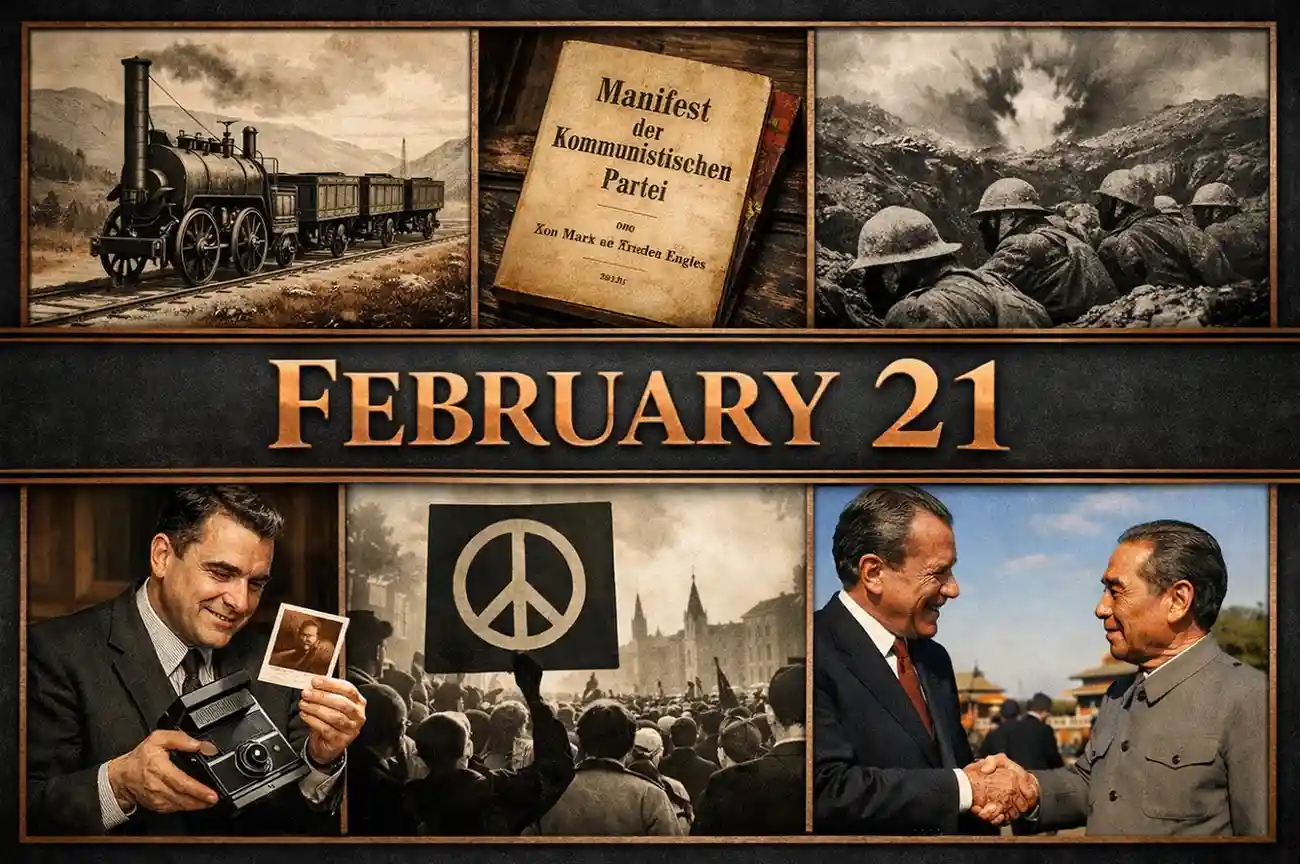
The world’s first self-propelling steam locomotive made its historic debut at the Pen-y-Darren Ironworks in Wales, designed by the brilliant engineer Richard Trevithick. The engine successfully hauled ten tons of iron and 70 passengers over nine miles of tramway, reaching a top speed of about five miles per hour. While the heavy weight of the iron locomotive eventually broke the brittle cast-iron rails, the demonstration proved the viability of steam-powered rail transport. This event laid the technical foundation for the global railway revolution that would transform transportation and industry throughout the 19th century.
1808 – Outbreak of the Finnish War
Without a formal declaration of war, Russian troops crossed the border into Swedish-controlled territory at Abborfors, signaling the start of the Finnish War. The conflict was part of the broader Napoleonic Wars, as Russia sought to pressure Sweden into joining the Continental System against Great Britain. The war lasted over a year and resulted in a crushing defeat for Sweden, which was forced to cede the eastern half of its realm to the Russian Empire.
This loss led to the creation of the Grand Duchy of Finland and a fundamental redrawing of the map of Northern Europe.
1828 – First Issue of the Cherokee Phoenix
The initial issue of the Cherokee Phoenix was published in New Echota, Georgia, becoming the first periodical to utilize the Cherokee syllabary invented by Sequoyah. This bilingual newspaper provided the Cherokee Nation with a powerful tool for self-expression, legal defense, and the preservation of their cultural identity. It featured articles in both English and Cherokee, covering tribal news, laws, and the ongoing struggle against forced removal from their ancestral lands. The paper stands as a testament to the intellectual resilience and adaptability of the Cherokee people during a period of immense pressure.
1842 – First U.S. Patent for the Sewing Machine
John Greenough was granted the first United States patent for a sewing machine, a device designed to automate the laborious task of hand-stitching fabric. Greenough’s machine featured a needle with two points and an eye in the middle, though it never achieved widespread commercial success or practical application. Despite its limitations, his patent was a critical early step in the development of a technology that would eventually revolutionize the textile and garment industries. It paved the way for future innovators like Elias Howe and Isaac Singer to create the machines that would change domestic life forever.
1848 – Publication of The Communist Manifesto
Karl Marx and Friedrich Engels published The Communist Manifesto in London, a political pamphlet that would become one of the most influential documents in modern history. The work outlined the theory of class struggle and predicted the inevitable overthrow of capitalism by the working class, or proletariat. Originally written in German as the platform for the Communist League, its calls for the abolition of private property and the redistribution of wealth sparked radical movements worldwide. It continues to be a central text for political theorists, historians, and activists nearly two centuries later.
1861 – Founding of Mariehamn
Mariehamn, the current capital city of the Åland Islands, was officially founded by the Russian Tsar Alexander II and named after his wife, Maria Alexandrovna. The city was strategically established on a narrow peninsula to serve as a hub for maritime trade and administration within the Baltic Sea. Its deep-water harbors and favorable location quickly made it a center for the shipping industry, particularly for the famous windjammers of the early 20th century. Today, Mariehamn remains the vibrant heart of the autonomous Åland region, known for its rich naval history and picturesque streets.
1862 – Battle of Valverde
During the American Civil War, Confederate and Union forces clashed at the Battle of Valverde near Fort Craig in the New Mexico Territory. The Confederate “Sibley Brigade” sought to capture the fort and gain control of the vital supply routes leading toward the gold fields of Colorado and the ports of California. While the Confederates won a tactical victory on the field, they were unable to capture the fort itself or secure the resources they desperately needed. This battle was a significant part of the New Mexico Campaign, highlighting the expansive and often overlooked reach of the war into the Far West.
1874 – First Edition of the Oakland Daily Tribune
The Oakland Daily Tribune published its very first edition, marking the birth of a major voice in the San Francisco Bay Area’s media landscape. Founded by George Washington Grant and Edward Lawrence, the paper initially served as a local evening daily focused on the rapid growth of the city of Oakland. Over the following decades, it grew in influence, reporting on major events from the 1906 earthquake to the political shifts of the 20th century. It remains a significant part of California’s journalistic history, documenting the social and economic evolution of the East Bay.
1878 – First Telephone Directory Issued
The first telephone directory in history was issued in New Haven, Connecticut, by the New Haven District Telephone Company. The directory was not a massive book but rather a single sheet of cardboard listing the names of only 50 subscribers. Notably, the list did not include phone numbers, as callers had to be manually connected by an operator who knew each subscriber by name. This simple document reflected the infancy of a communication technology that would eventually connect billions of people across the globe in real-time.
1885 – Dedication of the Washington Monument
The newly completed Washington Monument was officially dedicated in Washington, D.C., in a ceremony held on a frigid winter day. Standing at over 555 feet, the obelisk was the world’s tallest structure at the time of its completion and remains the tallest stone structure today. The project had faced decades of delays due to lack of funding, internal politics, and the American Civil War, which is still visible in the slight color change of the stone about one-third of the way up. The monument stands as an enduring tribute to the first U.S. President and a symbol of national resilience.
1896 – Bob Fitzsimmons Wins World Heavyweight Title
In an unusual sporting event, the English-born, Australian-raised boxer Bob Fitzsimmons defeated the Irishman Peter Maher to win the World Heavyweight Championship. The fight was promoted by an American but technically took place just across the border in Mexico to evade strict anti-boxing laws in the United States. Fitzsimmons, known as “The Fighting Blacksmith,” used a powerful punch to the jaw to knock out Maher in the first round. This victory cemented his place in boxing history as one of the sport’s first multi-division champions and a pioneer of the early heavyweight era.
1913 – Ioannina Incorporated into Greece
The city of Ioannina was officially incorporated into the Greek state following the decisive victory of the Greek army during the Balkan Wars. For nearly five centuries, the city had been under Ottoman rule, serving as a major administrative and cultural center in the Epirus region. Its liberation followed a long and difficult siege of the nearby Bizani fortresses, which finally collapsed under Greek pressure. The incorporation of Ioannina was a major milestone in the expansion of modern Greece and the realization of national territorial aspirations in the early 20th century.
1916 – Battle of Verdun Begins
The Battle of Verdun, one of the longest and costliest engagements of World War I, began with a massive German artillery bombardment along the banks of the Meuse River in France. The German Chief of Staff, Erich von Falkenhayn, intended to “bleed France white” by forcing them to defend the historic fortress city at any cost. The battle lasted for nearly ten months and resulted in an estimated 700,000 to 1,000,000 total casualties between the two sides. Verdun became a symbol of French national resolve and the horrific reality of industrialized attrition warfare on the Western Front.
1918 – Death of the Last Carolina Parakeet
The last known Carolina parakeet, a male named Incas, died in captivity at the Cincinnati Zoo in the same cage where the last passenger pigeon had died four years earlier. This marked the official extinction of the only parrot species native to the eastern United States. The birds were once abundant but were driven to extinction by habitat loss, hunting for their colorful feathers, and their reputation as agricultural pests. The death of Incas remains a somber reminder of the impact of human activity on North American biodiversity and the permanence of extinction.
1919 – Assassination of Kurt Eisner
German socialist politician Kurt Eisner, who had led the revolution that overthrew the Bavarian monarchy, was assassinated in Munich by a far-right nationalist. Eisner was on his way to the state parliament to resign following his party’s electoral defeat when he was shot twice from behind. His death triggered a wave of chaos and violence that led to the short-lived establishment of the Bavarian Soviet Republic. This period of political instability was a crucial chapter in the early years of the Weimar Republic, highlighting the deep and violent ideological rifts in post-war Germany.
1921 – Georgia Adopts Its First Constitution
The Constituent Assembly of the Democratic Republic of Georgia officially adopted the country’s first constitution during a period of brief and fragile independence. The document was highly progressive for its time, establishing a parliamentary republic, universal suffrage, and strong protections for civil liberties and minority rights. However, the celebration was cut short as the Red Army of Soviet Russia was already invading the country to bring it back under Moscow’s control. While the republic collapsed shortly after, the 1921 constitution remains a foundational document and a symbol of Georgian democratic aspirations.
1921 – Rezā Shāh’s Coup in Tehran
In a move that would fundamentally alter the course of Persian history, Rezā Shāh Pahlavi led a successful military coup and took control of the capital, Tehran. He was an officer in the Persian Cossack Brigade who used the internal weakness and foreign influence within the country to justify his seizure of power. This coup eventually led to the end of the Qajar dynasty and the establishment of the Pahlavi dynasty with Rezā Shāh as the monarch. His reign focused on rapid modernization and secularization, setting the stage for the creation of modern-day Iran.
1925 – First Issue of The New Yorker
The inaugural issue of The New Yorker magazine was published, featuring a dandy named Eustace Tilley on the cover peering at a butterfly through a monocle. Founded by Harold Ross and his wife Jane Grant, the magazine was intended to be a sophisticated, humorous, and literary publication focused on the life and culture of New York City. While it struggled in its early months, it soon became famous for its sharp cartoons, deep reporting, and high-quality fiction. Over nearly a century, The New Yorker has grown into a world-renowned institution of American journalism and literature.
1929 – Warlord Rebellion in Shandong
During the first major battle of the Warlord Rebellion in northeastern China, a 24,000-strong rebel force led by Zhang Zongchang was defeated at Zhifu by a much smaller Nationalist army. Despite having a significant numerical advantage, the rebel troops were disorganized and lacked the discipline of the 7,000 National Revolutionary Army (NRA) soldiers they faced. This victory for the Nationalist government helped stabilize the Shandong region and signaled the declining power of the traditional regional warlords. It was a key step in the Nanking government’s ongoing effort to unify China under a central authority.
1937 – Ban on Foreign Volunteers in Spain
The League of Nations officially implemented a ban on foreign national “volunteers” traveling to fight in the Spanish Civil War. This move was part of a Non-Intervention Agreement intended to prevent the localized conflict from escalating into a broader European war. However, the ban was largely ineffective, as thousands of volunteers in the International Brigades and military “advisors” from Nazi Germany and Fascist Italy were already deeply involved. The failure of this policy highlighted the increasing impotence of the League of Nations in the face of rising totalitarian aggression during the late 1930s.
1945 – Kamikaze Attacks at Iwo Jima
During the intense naval operations surrounding the Battle of Iwo Jima, Japanese kamikaze planes launched a devastating attack on the U.S. fleet. One suicide pilot successfully struck the escort carrier USS Bismarck Sea, causing a massive explosion and fire that eventually sank the ship, resulting in over 300 American deaths. Another kamikaze plane seriously damaged the legendary carrier USS Saratoga, forcing it to withdraw for repairs. These attacks demonstrated the increasing desperation of the Japanese military as they turned to suicide tactics to slow the relentless American advance across the Pacific.
1945 – Brazilian Victory at Monte Castello
The Brazilian Expeditionary Force (FEB) achieved a hard-won victory against German forces in the Battle of Monte Castello on the Italian front. After several failed attempts in the preceding months, the Brazilian troops finally captured the strategic heights during a coordinated assault in freezing winter conditions. This victory was a major milestone for the FEB, proving their capability in mountain warfare and contributing to the eventual collapse of the German “Gothic Line” in Italy. The battle remains a point of significant national pride in Brazil, honoring the country’s contribution to the Allied victory in World War II.
1947 – Demonstration of the First Instant Camera
In a meeting of the Optical Society of America in New York City, inventor Edwin Land demonstrated the first “instant camera,” the Polaroid Land Camera. To the amazement of the audience, the camera was able to produce a finished, sepia-toned photograph in just sixty seconds by developing the film inside the camera body. This breakthrough combined advanced chemistry and optics into a portable device, making the process of photography immediate and accessible to the public. Land’s invention launched the Polaroid Corporation and created a new cultural phenomenon that lasted for decades.
1948 – NASCAR Incorporated
The National Association for Stock Car Auto Racing (NASCAR) was officially incorporated by Bill France Sr. and a group of fellow racers and promoters in Daytona Beach, Florida. The organization was created to provide a unified set of rules and a professional structure for the growing sport of stock car racing, which had its roots in the modified cars of Southern bootleggers. France’s vision was to turn a regional hobby into a national spectacle with standardized scoring and point systems. Today, NASCAR is one of the most popular sports in the United States, with a massive and dedicated global fan base.
1952 – Abolition of Identity Cards in the UK
The British government under Prime Minister Winston Churchill officially abolished the use of national identity cards, which had been introduced during the emergencies of World War II. The move was part of a broader conservative effort to “set the people free” from the bureaucratic controls and rationing that had lingered long after the war’s end. The cards had become increasingly unpopular as they were seen as a symbol of intrusive state power in a time of peace. This decision reflected a post-war desire for a return to traditional civil liberties and a reduction in government oversight of everyday life.
1952 – Bengali Language Movement Protests
In Dhaka, East Pakistan (now Bangladesh), police opened fire on students and activists who were protesting for the recognition of Bengali as an official state language. The government had attempted to impose Urdu as the sole national language, sparking a massive movement for cultural and linguistic rights among the Bengali majority. The deaths of several students during the demonstration, including Abdus Salam and Rafiq Uddin Ahmed, turned the movement into a struggle for national identity. This day is now celebrated globally as International Mother Language Day to honor the importance of linguistic diversity.
1958 – Design of the Peace Symbol
The CND (Campaign for Nuclear Disarmament) symbol, now globally recognized as the universal peace symbol, was designed and completed by British artist Gerald Holtom. Commissioned by the Direct Action Committee, the design combines the semaphore signals for the letters “N” (Nuclear) and “D” (Disarmament) inside a circle. Holtom also noted that the shape reflected a person in despair with their hands palms outstretched and downwards, symbolizing the weight of the atomic threat. The symbol made its first public appearance during a protest march from London to Aldermaston and has since become an icon for anti-war movements everywhere.
1971 – Convention on Psychotropic Substances Signed
The Convention on Psychotropic Substances was signed in Vienna, establishing an international treaty to control the trade and use of synthetic drugs such as LSD, amphetamines, and barbiturates. This was a significant expansion of the global drug control framework, which had previously focused primarily on plant-based substances like opium and cocaine. The treaty categorized drugs into four schedules based on their perceived risk of abuse and their medicinal value. It remains a foundational part of international law regarding the regulation of pharmaceuticals and the prevention of drug trafficking.
1972 – Richard Nixon Visits China
In a move that stunned the world, United States President Richard Nixon arrived in Beijing for a historic week-long visit to normalize relations with the People’s Republic of China. This “trip that changed the world” ended 25 years of diplomatic isolation and hostility between the two nations and altered the strategic balance of the Cold War. Nixon and Premier Zhou Enlai engaged in extensive discussions that led to the Shanghai Communiqué, laying the groundwork for future trade and diplomatic ties. The visit was a masterstroke of “triangular diplomacy” intended to pressure the Soviet Union while integrating China into the international community.
1972 – Luna 20 Lands on the Moon
The Soviet Union’s uncrewed spaceship Luna 20 successfully landed on the Moon in a rugged mountainous region known as the Apollonius highlands. This was the second mission in the Soviet program to successfully land, collect a sample of lunar soil, and return it to Earth automatically. The lander used a specialized drill to extract 55 grams of lunar material, which was then sealed in a return capsule and launched back to our planet. Luna 20’s success demonstrated the advanced capabilities of Soviet robotic exploration during the final stages of the lunar Space Race.
1973 – Shooting Down of Libyan Flight 114
Over the Sinai Desert, Israeli fighter aircraft shot down Libyan Arab Airlines Flight 114, a Boeing 727 that had strayed into Israeli-controlled airspace due to a navigational error. The Israeli pilots, fearing the plane might be on a suicide mission toward a military installation, intercepted the aircraft and opened fire when it did not respond to warnings to land. The plane crashed into the sand, killing 108 of the 113 people on board. The incident caused international outrage and heightened the already extreme tensions between Israel and its neighbors in the lead-up to the Yom Kippur War.
1974 – Israeli Withdrawal from the Suez Canal
The last Israeli soldiers left the west bank of the Suez Canal, completing a strategic withdrawal as part of a disengagement agreement with Egypt following the 1973 war. This move was a key part of the “shuttle diplomacy” efforts led by U.S. Secretary of State Henry Kissinger to stabilize the region and prevent further conflict. The withdrawal allowed for the creation of a UN-monitored buffer zone between the two armies and paved the way for the eventual reopening of the canal. This was a critical first step on the long and difficult path toward the 1979 Egypt-Israel Peace Treaty.
1975 – Sentencing of Watergate Officials
In a federal court in Washington, D.C., former U.S. Attorney General John N. Mitchell and former top White House aides H. R. Haldeman and John Ehrlichman were sentenced to prison for their roles in the Watergate scandal. They were convicted of conspiracy, obstruction of justice, and perjury related to the cover-up of the break-in at the Democratic National Committee headquarters. Their prison terms, ranging from 30 months to 8 years, marked the first time in American history that such high-level executive officials were held criminally accountable for abusing their power.
1994 – Arrest of Aldrich Ames
FBI agents arrested CIA officer Aldrich Ames in Arlington County, Virginia, charging him with selling highly sensitive national secrets to the Soviet Union and later the Russian Federation. Ames had worked as a double agent for nearly a decade, receiving millions of dollars in exchange for the names of dozens of U.S. informants, at least ten of whom were subsequently executed by the KGB. His betrayal was one of the most damaging in the history of American intelligence, leading to a massive overhaul of security and counterintelligence protocols. He was ultimately sentenced to life in prison without the possibility of parole.
1995 – Steve Fossett’s Solo Balloon Flight
Adventurer Steve Fossett landed his balloon, the Solo Spirit, in Leader, Saskatchewan, becoming the first person to successfully complete a solo flight across the Pacific Ocean. The journey had begun in South Korea and lasted for six days, covering a distance of approximately 5,430 miles. Fossett had to endure extreme cold, sleep deprivation, and the constant challenge of navigating unpredictable jet streams in his pressurized capsule. This record-breaking achievement was just one of many in his legendary career as a pioneer of long-distance ballooning, sailing, and aviation.
2013 – Hyderabad Bombings
At least 17 people were killed and 119 others were injured when several improvised explosive devices (IEDs) were detonated in the Dilsukhnagar area of the Indian city of Hyderabad. The bombs were placed on bicycles near a crowded bus stop and a roadside restaurant, timed to explode during the busy evening rush hour. The Indian government attributed the attack to the Indian Mujahideen, a domestic militant group. The tragedy sparked a national debate over security measures in major cities and the ongoing challenges of domestic terrorism in the subcontinent.
2022 – Putin Recognizes Breakaway Republics
In a significant escalation in the lead-up to the invasion of Ukraine, Russian President Vladimir Putin signed decrees recognizing the Luhansk and Donetsk People’s Republics as independent states. Shortly after the announcement, he ordered Russian troops into the Donbas region for what he termed “peacekeeping functions.”
This action was immediately condemned by the United Nations, the United States, and European nations as a flagrant violation of international law and Ukraine’s territorial sovereignty. This diplomatic move served as the immediate precursor to the full-scale Russian invasion of Ukraine that began just days later.
Read Also: This day in history February 20 Legacy Laws Launch
Famous People Born On February 21
| Name | Description | Date |
|---|---|---|
| Sam Peckinpah | American film director | February 21, 1925 – December 28, 1984 |
| Bob Rafelson | American director & producer | February 21, 1933 – July 23, 2022 |
| Chespirito (Roberto Gómez Bolaños) | Mexican actor & writer | February 21, 1929 – November 28, 2014 |
| Carl Czerny | Austrian pianist & composer | February 21, 1791 – July 15, 1857 |
| Charles-Marie Widor | French composer & organist | February 21, 1844 – March 12, 1937 |
| George Lansbury | British politician | February 21, 1859 – May 7, 1940 |
| Harry Stack Sullivan | American psychiatrist | February 21, 1892 – January 14, 1949 |
| Raymond Queneau | French writer | February 21, 1903 – October 25, 1976 |
| Otto Hermann Kahn | American banker & patron | February 21, 1867 – March 29, 1934 |
| Edward Hawke | British admiral | February 21, 1710 – October 17, 1781 |
| Sacha Guitry | French dramatist | February 21, 1885 – July 24, 1957 |
| Friedrich Karl von Savigny | German jurist | February 21, 1779 – October 25, 1861 |
| Ernest Meissonier | French painter | February 21, 1815 – January 31, 1891 |
| Hermann Pister | German SS officer | February 21, 1885 – September 28, 1948 |
| Tadd Dameron | American jazz composer | February 21, 1917 – March 8, 1965 |
| Hendrik Petrus Berlage | Dutch architect | February 21, 1856 – August 12, 1934 |
| Tom Yawkey | American baseball executive | February 21, 1903 – July 9, 1976 |
| Alice Freeman Palmer | American educator | February 21, 1855 – December 6, 1902 |
| Richard Bourke (Earl of Mayo) | Viceroy of India | February 21, 1822 – February 8, 1872 |
| Raimondo Montecuccoli | Austrian field marshal | February 21, 1609 – October 16, 1680 |
| José Zorrilla | Spanish writer | February 21, 1817 – January 23, 1893 |
| Girard Desargues | French mathematician | February 21, 1591 – October 1661 |
| Pyotr Konchalovsky | Russian painter | February 21, 1876 – February 2, 1956 |
| Henrik Dam | Danish biochemist | February 21, 1895 – April 1976 |
| Sophie Turner | English actress | February 21, 1996 – |
| Elliot Page | Canadian actor | February 21, 1987 – |
| Charlotte Church | Welsh singer | February 21, 1986 – |
| Daniel Ek | Swedish entrepreneur (Spotify) | February 21, 1983 – |
| Jordan Peele | American filmmaker | February 21, 1979 – |
| Sara Blakely | American entrepreneur (Spanx) | February 21, 1971 – |
Famous People Died On February 21
| Name | Description | Date |
|---|---|---|
| Gustave Caillebotte | French painter | August 19, 1848 – February 21, 1894 |
| Stanley Donen | American film director | April 13, 1924 – February 21, 2019 |
| Jethro Tull | British agronomist | 1674 – February 21, 1741 |
| Frederick Banting | Canadian physician (insulin pioneer) | November 14, 1891 – February 21, 1941 |
| Eric Liddell | British Olympic athlete | January 16, 1902 – February 21, 1945 |
| Margot Fonteyn | British ballerina | May 18, 1919 – February 21, 1991 |
| Paul Farmer | American anthropologist | October 26, 1959 – February 21, 2022 |
| Kenneth Arrow | American economist | August 23, 1921 – February 21, 2017 |
| Eugène de Beauharnais | French viceroy of Italy | September 3, 1781 – February 21, 1824 |
| Mikhail Sholokhov | Soviet author | May 24, 1905 – February 21, 1984 |
| Howard Florey | Australian pathologist | September 24, 1898 – February 21, 1968 |
| Pope Benedict XIII | Catholic pope | February 2, 1649 – February 21, 1730 |
| Heike Kamerlingh Onnes | Dutch physicist | September 21, 1853 – February 21, 1926 |
| Morton Gould | American composer | December 10, 1913 – February 21, 1996 |
| Gaius Caesar | Roman noble | 20 BC – February 21, AD 4 |
| Kurt Eisner | German statesman | May 14, 1867 – February 21, 1919 |
| Shir Ali Khan | Emir of Afghanistan | 1825 – February 21, 1879 |
| Osborne Reynolds | British physicist | August 23, 1842 – February 21, 1912 |
| George Ellery Hale | American astronomer | June 29, 1868 – February 21, 1938 |
| Guillermo Cabrera Infante | Cuban writer | April 22, 1929 – February 21, 2005 |
| Henry Peach Robinson | British photographer | July 9, 1830 – February 21, 1901 |
| Bronislava Nijinska | Ballet choreographer | January 8, 1891 – February 21, 1972 |
| Roger Guillemin | French-American physiologist | January 11, 1924 – February 21, 2024 |
| Lisel Mueller | American poet | February 8, 1924 – February 21, 2020 |
| Hieronymus Bock | German botanist | 1498 – February 21, 1554 |
| Dirck van Baburen | Dutch painter | c.1594 – February 21, 1624 |
| Billy Graham | American evangelist | November 7, 1918 – February 21, 2018 |
| Gertrude B. Elion | American scientist | January 23, 1918 – February 21, 1999 |
| Inge Lehmann | Danish seismologist | May 13, 1888 – February 21, 1993 |
| Tim Horton | Canadian hockey player & entrepreneur | January 12, 1930 – February 21, 1974 |
Observances & Institutional Dates
- International Mother Language Day (UNESCO): A global observance to promote linguistic and cultural diversity and multilingualism.
- Language Movement Day (Bangladesh): A national holiday honoring the martyrs of the 1952 movement for the recognition of the Bengali language.
- Armed Forces Day (South Africa): A day of remembrance for the men and women who serve in the South African National Defence Force.
- Birthday of King Harald V (Norway): Celebrating the reigning monarch of Norway, who was born on this day in 1937.
Frequently Asked Questions
- What happened at the Battle of Verdun?
- This massive World War I battle began on February 21, 1916, and became a symbol of French resistance and the horrors of attrition warfare.
- Who wrote The Communist Manifesto?
- Karl Marx and Friedrich Engels published the foundational political pamphlet on February 21, 1848.
- Why did Richard Nixon go to China?
- In 1972, Nixon visited China to normalize relations, ending decades of isolation and shifting the Cold War balance.
- What is the meaning of the peace symbol?
- Designed in 1958, it uses the semaphore signals for “N” and “D” (Nuclear Disarmament) inside a circle.