
History often feels like a sequence of grand gestures, but when we look closely at what happened on this day in history February 22, we see that it is actually defined by the human spirit’s refusal to stay quiet. From the defiant members of the White Rose standing up to tyranny in Nazi Germany to the roar of the crowd during the “Miracle on Ice,” today is a testament to the fact that power shifts and boundaries break.
Whether it is the birth of a new dynasty in Scotland, the sale of an entire territory like Florida, or the scientific marvel of a cloned sheep named Dolly, this date consistently reminds us that the world we know is shaped by moments of incredible bravery and unexpected discovery.
Important Events That Happened On February 22 In History
896 – Coronation of Arnulf of Carinthia
In the grand setting of Rome, Pope Formosus crowned Arnulf of Carinthia as the Holy Roman Emperor. The triumph was short-lived, however, as Arnulf suffered a debilitating stroke shortly after the ceremony. This sudden health crisis forced him to abandon his Italian campaign and retreat, leaving the region in a state of political flux.
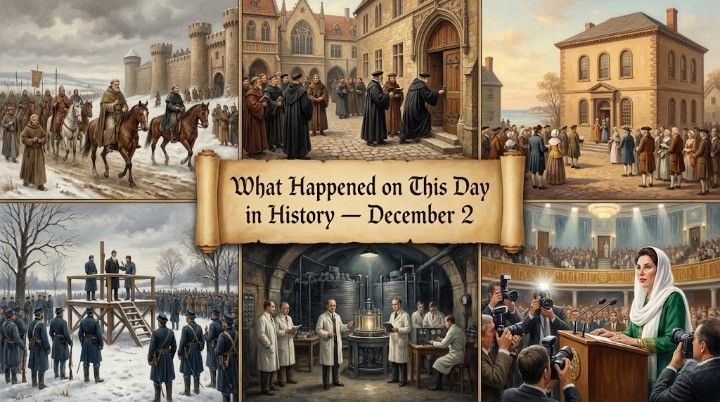
1076 – Excommunication of Henry IV
Pope Gregory VII took the drastic step of excommunicating Henry IV, the Holy Roman Emperor, following a Lenten synod. This move was a response to a letter from Henry demanding the Pope’s abdication, sparking a massive power struggle between church and state. The act effectively stripped the Emperor of his religious legitimacy and shook the foundations of medieval European politics.
1288 – Election of Pope Nicholas IV
Girolamo Maschi, a member of the Franciscan order, was elected as the leader of the Catholic Church, choosing the name Nicholas IV. He was the first Franciscan to ever hold the papacy, bringing the order’s focus on poverty and missions to the Vatican. His reign was marked by efforts to organize crusades and strengthen the Church’s influence in the East.
1316 – Battle of Picotin
The Battle of Picotin saw a decisive clash between the forces of Ferdinand of Majorca and Matilda of Hainaut. Ferdinand emerged victorious in this engagement, which was part of a larger struggle for the Principality of Achaea in Greece. The win allowed him to temporarily solidify his claim to the territory during a period of intense Frankish feudal competition.
1371 – Robert II Becomes King of Scotland
Robert II ascended to the Scottish throne, marking the official beginning of the Stuart dynasty that would rule for centuries. As the grandson of Robert the Bruce, his coronation brought a new line of royal blood to the leadership of a nation often at odds with England. His reign began a long era of Stuart influence that would eventually unify the crowns of Scotland and England.
1495 – Charles VIII Enters Naples
King Charles VIII of France made a grand entry into the city of Naples to assert his claim to the Neapolitan throne. His arrival was a major event in the Italian Wars, demonstrating the military reach of the French monarchy into the Mediterranean. Although his occupation was brief, it triggered a series of conflicts that would involve major European powers for decades.
1632 – Galileo Receives Dialogue
Ferdinando II de’ Medici, the Grand Duke of Tuscany, received the very first printed copy of Galileo’s Dialogue Concerning the Two Chief World Systems. The book famously compared the Copernican system with the traditional Ptolemaic view, causing a massive stir in the scientific and religious worlds. This delivery set the stage for Galileo’s eventual trial and conflict with the Roman Catholic Church.
1651 – St. Peter’s Flood
A catastrophic storm surge known as St. Peter’s Flood battered the Frisian coast, leading to the deaths of roughly 15,000 people. The North Sea broke through coastal defenses, drowning entire villages and causing immense destruction to farmland and livestock. It remains one of the deadliest natural disasters in Northern European history, highlighting the constant battle between the sea and the shore.
1744 – Battle of Toulon
The Battle of Toulon took place during the War of the Austrian Succession, resulting in a chaotic and indecisive naval engagement. The poor performance of several Royal Navy captains led to a series of high-profile court-martials that shocked the British military establishment. As a direct result, the Articles of War were amended to ensure stricter discipline and accountability among naval officers.
1770 – Death of Christopher Seider
During a heated protest in Boston, British customs officer Ebenezer Richardson fired into a crowd, fatally wounding 11-year-old Christopher Seider. The young boy is widely considered the first American fatality of the American Revolution, and his funeral became a massive public demonstration against British rule. The tragedy served as a precursor to the Boston Massacre, which would occur just weeks later.
1797 – Last Invasion of Britain
The “Last Invasion of Britain” began near Fishguard, Wales, when a force of French irregular soldiers landed on the coast. Led by an American colonel, the invasion was poorly executed and the French troops were quickly forced to surrender to local British forces. Despite its failure, the event caused a significant panic across the British Isles and remains a unique footnote in military history.
1819 – Adams–Onís Treaty
By signing the Adams–Onís Treaty, Spain officially sold the territory of Florida to the United States for a sum of five million dollars. The agreement also settled a long-standing border dispute between Spanish and American lands in North America, stretching all the way to the Pacific. This treaty was a major win for U.S. expansionism, effectively removing a European power from the American Southeast.
1847 – Battle of Buena Vista
In a dramatic engagement of the Mexican–American War, a force of 5,000 American troops managed to defeat a much larger Mexican army of 15,000. General Zachary Taylor’s victory at Buena Vista was a turning point that secured the northern part of Mexico for the United States. The battle’s success turned Taylor into a national hero, eventually propelling him to the American presidency.
1848 – French Revolution of 1848 Begins
The French Revolution of 1848 kicked off in Paris, sparked by public anger over economic hardship and a lack of political freedom. This uprising quickly led to the abdication of King Louis Philippe and the birth of the French Second Republic. It was part of a larger wave of revolutions that swept across Europe that year, fundamentally challenging the traditional monarchist order.
1856 – First Republican National Convention
The United States Republican Party held its very first national convention in Pittsburgh, Pennsylvania. The meeting was organized to formally establish a party dedicated to opposing the expansion of slavery into new American territories. This gathering laid the groundwork for the party’s rapid rise, which would lead to the election of Abraham Lincoln only four years later.
1862 – Inauguration of Jefferson Davis
Jefferson Davis was officially inaugurated for a six-year term as the President of the Confederate States of America in Richmond, Virginia. Though he had been serving in a provisional capacity for a year, this ceremony intended to provide a sense of permanent, legal legitimacy to the secessionist government. The event took place in the midst of the Civil War, under the shadow of a mounting military crisis.
1872 – First Prohibition Party Convention
The Prohibition Party convened in Columbus, Ohio, for its first national convention, nominating James Black as its candidate for the U.S. presidency. The party was formed with the primary goal of banning the sale and consumption of alcoholic beverages across the country. While they never won a national election, their persistent advocacy was instrumental in the eventual passage of the 18th Amendment.
1879 – First Woolworth Store Opens
Frank Woolworth opened his first “five-and-dime” store in Utica, New York, introducing a revolutionary new retail concept to the American public. The store featured a wide variety of merchandise at fixed, low prices, allowing customers to browse and handle goods before buying. This model proved incredibly successful, leading to the creation of one of the world’s largest and most famous retail chains.
1881 – Cleopatra’s Needle Erected
A 3,500-year-old Ancient Egyptian obelisk, popularly known as Cleopatra’s Needle, was successfully erected in Central Park, New York City. The massive granite monument was a gift from the Khedive of Egypt to commemorate the opening of the Suez Canal and promote friendly relations. Its complex transportation from Egypt to Manhattan was a marvel of 19th-century engineering and public interest.
1889 – Enabling Act of 1889
President Grover Cleveland signed a bill that authorized the admission of North Dakota, South Dakota, Montana, and Washington as new states in the Union. This legislation was a massive milestone in the American westward expansion, formally integrating a huge portion of the northern frontier into the United States. The act led to the official statehood of these four regions later that same year.
1899 – Luna’s Counterattack in Manila
During the Philippine–American War, Filipino forces led by General Antonio Luna launched their first major counterattack against American troops. The goal was to retake the capital city of Manila and drive the occupying American forces into the sea. Although the Filipinos fought with great bravery, the attack ultimately failed to regain the city, leading to a long and grueling guerrilla conflict.
1904 – South Orkney Islands Transfer
The United Kingdom sold a meteorological station located on the South Orkney Islands to the government of Argentina. This simple real estate transaction later became a point of diplomatic friction when the UK officially claimed the islands as part of its territory in 1908. The dispute over the sovereignty of these sub-Antarctic islands continues to be a minor point of contention in international maritime law.
1909 – Return of the Great White Fleet
The sixteen battleships of the “Great White Fleet” returned to the United States after completing a historic voyage around the world. Led by the USS Connecticut, the fleet had traveled for over a year to demonstrate America’s growing naval power to the rest of the world. The mission was a major success for President Theodore Roosevelt’s “Big Stick” diplomacy, signaling the U.S. emergence as a global maritime force.
1921 – Bogd Khan Reinstalled
The Bogd Khan was reinstalled as the Emperor of Mongolia after Russian forces under the eccentric Baron Roman von Ungern-Sternberg drove Chinese troops out of the country. This event briefly restored Mongolian independence and the traditional religious authority of the Bogd Khan. However, the victory was short-lived, as Soviet-backed revolutionary forces would soon take control of the nation, leading to a communist government.
1942 – MacArthur Ordered Out of Philippines
With a Japanese victory in the Philippines becoming inevitable, President Franklin D. Roosevelt issued a direct order for General Douglas MacArthur to evacuate to Australia. MacArthur famously promised “I shall return” as he departed the besieged island of Corregidor. His departure marked a somber low point for American forces in the Pacific, but his eventual return became a central theme of the U.S. war effort.
1943 – Execution of the White Rose
Sophie Scholl, her brother Hans, and their friend Christoph Probst—members of the White Rose resistance group—were executed by the Nazi regime in Munich. The students had been caught distributing anti-war leaflets that called for the overthrow of Hitler’s government. Their courage in the face of certain death made them enduring symbols of moral resistance and the struggle for freedom within a totalitarian state.
1943 – Yankee Clipper Crash
The Pan Am flying boat known as the Yankee Clipper crashed into the Tagus River while attempting to land in Lisbon, Portugal. The accident resulted in the deaths of 24 people on board, including several prominent passengers who were traveling during the height of World War II. It was a tragic blow to the era of luxury trans-Atlantic flying boats, which served as a vital link between the U.S. and Europe during the war.
1944 – Mistaken Bombing of Dutch Towns
During a series of raids intended for German targets, American aircraft mistakenly bombed the Dutch towns of Nijmegen, Arnhem, Enschede, and Deventer. The error was catastrophic, resulting in the deaths of approximately 800 civilians in Nijmegen alone and destroying large sections of the historic city centers. The incident caused deep sorrow in the occupied Netherlands and led to improved coordination for future Allied bombing missions.
1944 – Red Army Recaptures Krivoi Rog
The Soviet Red Army successfully recaptured the industrial city of Krivoi Rog from German occupying forces. This was a significant strategic victory on the Eastern Front, as the city was a major center for iron ore production vital to the Soviet war machine. The liberation of Krivoi Rog was part of the wider Soviet push to drive the Nazi military out of Ukraine and back toward the German border.
1946 – The “Long Telegram”
George F. Kennan, a diplomat at the U.S. Embassy in Moscow, sent what became known as the “Long Telegram” to the State Department in Washington. In it, he outlined a new strategy for dealing with the Soviet Union based on the concept of “containment” of communist expansion. This document became the foundational framework for American foreign policy throughout the Cold War, shaping decades of international relations and military strategy.
1957 – Assassination Attempt on Ngô Đình Diệm
South Vietnamese President Ngô Đình Diệm survived an assassination attempt in the city of Buôn Ma Thuột when a communist gunman opened fire during a public ceremony. Although the president escaped harm, the attack highlighted the extreme political instability and the growing insurgency within South Vietnam. This event was part of the escalating tensions that would eventually lead to the full-scale conflict of the Vietnam War.
1958 – United Arab Republic Formed
Following a popular vote in both nations, Egypt and Syria officially merged to form the United Arab Republic (UAR). The union was led by Egyptian President Gamal Abdel Nasser and was intended to be the first step toward a unified pan-Arab state. While the UAR was initially greeted with great enthusiasm across the Arab world, internal political differences and Syrian resentment led to the union’s collapse only three years later.
1959 – First Daytona 500
Lee Petty won the inaugural Daytona 500, marking the beginning of what would become the most prestigious race in the NASCAR calendar. The victory was a close and controversial one, as it took officials three days of reviewing newsreel footage to determine that Petty had beaten Johnny Beauchamp by a matter of inches. The event solidified Daytona International Speedway’s place as the “World Center of Racing” and a cornerstone of American motorsports.
1972 – Aldershot Barracks Bombing
The Official Irish Republican Army (IRA) detonated a powerful car bomb at the Aldershot barracks in England, killing seven people and injuring nineteen others. The attack was intended to be a retaliation for the events of “Bloody Sunday” in Northern Ireland which had occurred a few weeks earlier. The victims were mostly civilian staff members, and the brutality of the blast caused a significant public backlash against the IRA’s tactics.
1973 – Liaison Offices in China
In the wake of President Richard Nixon’s historic visit, the United States and the People’s Republic of China agreed to establish “liaison offices” in each other’s capitals. While not full embassies, these offices served as the first formal diplomatic link between the two nations after decades of total isolation. This agreement was a crucial step in the normalization of Sino-American relations and the shifting of the global Cold War balance.
1974 – OIC Summit in Lahore
A major summit of the Organisation of the Islamic Conference (OIC) began in Lahore, Pakistan, attended by heads of state from thirty-seven Muslim-majority countries. The gathering was a significant moment of Islamic unity and featured the formal recognition of Bangladesh as an independent nation by Pakistan. The summit also focused on the issue of Palestinian rights and the global economic power of oil-producing Muslim states.
1974 – Byck’s Assassination Attempt
Samuel Byck attempted to hijack a commercial airliner at Baltimore/Washington International Airport with the goal of crashing it into the White House to kill President Richard Nixon. During the struggle on the aircraft, Byck shot the pilots and a passenger before being wounded by police and eventually committing suicide. The event was a shocking display of security vulnerability and was later depicted in various books and the film The Assassination of Richard Nixon.
1979 – Independence of Saint Lucia
Saint Lucia officially gained its independence from the United Kingdom, ending its status as a British colony. The island nation remained part of the Commonwealth and transitioned to a sovereign parliamentary democracy. The independence celebrations marked the end of a long period of colonial rule and the beginning of a new era of self-governance for the people of the Caribbean island.
1980 – The “Miracle on Ice”
In one of the most famous upsets in sports history, the young United States Olympic hockey team defeated the powerhouse Soviet Union team 4–3 in Lake Placid, New York. The Soviets were considered unbeatable, having won the previous four Olympic gold medals, while the U.S. team was composed entirely of amateur college players. The victory became a defining moment of American national pride and is still celebrated as the greatest sporting achievement of the 20th century.
1983 – Moose Murders Opens and Closes
The mystery-comedy play Moose Murders opened and closed on the same night at the Eugene O’Neill Theatre on Broadway. The production was so universally panned by critics that it became a legendary symbol of theatrical failure and is often cited as the worst play ever to reach a Broadway stage. Despite its disastrous run, the play has achieved a sort of cult status among theater historians for its sheer bizarreness.
1986 – People Power Revolution Begins
The People Power Revolution began in the Philippines as thousands of citizens and military leaders rose up against the autocratic rule of President Ferdinand Marcos. This non-violent movement was sparked by allegations of massive fraud in the recent election and decades of political oppression. The four-day uprising would eventually lead to the peaceful departure of Marcos and the restoration of democracy under the leadership of Corazon Aquino.
1994 – Aldrich Ames Charged with Spying
The United States Department of Justice officially charged CIA officer Aldrich Ames and his wife with spying for the Soviet Union and the Russian Federation. Ames had compromised the identities of dozens of U.S. agents, leading to several executions and the loss of critical intelligence. His arrest uncovered one of the most damaging cases of espionage in American history, prompting a massive overhaul of security protocols within the U.S. intelligence community.
1995 – Declassification of Corona Program
The United States government officially declassified the Corona reconnaissance satellite program, which had been in secret operation from 1959 to 1972. The program used satellites to take high-resolution photographs of Soviet and Chinese military installations, which were then dropped in film canisters to be recovered mid-air. The release of these images provided historians and scientists with a wealth of information about the early years of space-based surveillance and the Cold War.
1997 – Dolly the Sheep Announced
British scientists at the Roslin Institute in Scotland announced the successful cloning of an adult sheep named Dolly, who had actually been born the previous July. Dolly was the first mammal ever to be cloned from an adult somatic cell, a breakthrough that fundamentally changed the field of genetics. The news sparked an intense global debate about the ethics of cloning and the potential for future scientific applications in medicine and agriculture.
2002 – Death of Jonas Savimbi
Jonas Savimbi, the long-time leader of the UNITA rebel group in Angola, was killed in a military ambush by government forces. Savimbi had been a central figure in the brutal Angolan Civil War for nearly three decades, fighting against the central government with support from various international powers. His death led to a swift ceasefire and the eventual end of one of Africa’s longest and most devastating conflicts.
2005 – Zarand Earthquake
A powerful 6.4 magnitude earthquake struck the Kerman province of Iran, centered near the town of Zarand. The quake caused widespread destruction in mountainous villages, leaving 612 people dead and over 1,400 injured. The severe intensity of the shaking destroyed many traditional mud-brick buildings, highlighting the vulnerability of the region’s rural infrastructure to seismic events.
2006 – Al-Askari Shrine Bombing
Explosions heavily damaged the golden dome of the al-Askari Shrine in Samarra, Iraq, one of the holiest sites in Shia Islam. Although no one was killed in the blast itself, the attack on such a sacred symbol triggered a massive wave of sectarian violence across the country. Many historians point to this event as the catalyst that turned the post-invasion insurgency into a full-scale, devastating civil war between Sunni and Shia factions.
2006 – Securitas Depot Robbery
A group of armed men carried out the largest cash heist in UK history, stealing almost £53 million from a Securitas depot in Tonbridge, Kent. The robbers kidnapped the depot manager and his family to gain access to the vault during the sophisticated overnight operation. While much of the money was never recovered, several members of the gang were eventually caught and sentenced to long prison terms following a massive international investigation.
2011 – Christchurch Earthquake
A devastating 6.3 magnitude earthquake struck the city of Christchurch, New Zealand, causing catastrophic damage and killing 185 people. The quake occurred at midday when many people were in the city center, leading to the collapse of iconic buildings like the Canterbury Television building. It was the second deadliest natural disaster in New Zealand’s history and required a massive, multi-year reconstruction effort to rebuild the heart of the city.
2011 – Pearl Roundabout Protests in Bahrain
In the midst of the Arab Spring, tens of thousands of Bahraini citizens marched in Manama to protest the deaths of several demonstrators killed by security forces earlier in the week. The marchers called for political reforms and an end to the monarchy’s absolute power, centering their movement on the Pearl Roundabout. The protests represented a significant challenge to the Bahraini government and eventually led to a major military crackdown with support from neighboring Saudi Arabia.
2012 – Buenos Aires Train Crash
A commuter train crashed into a buffer stop at Once Station in Buenos Aires, Argentina, resulting in the deaths of 51 people and injuries to 700 others. The accident was one of the worst rail disasters in the country’s history and was blamed on a combination of mechanical failure and negligence in maintenance. The tragedy sparked national outrage and led to significant protests against the government’s management of the public transportation system.
2014 – Impeachment of Viktor Yanukovych
The Ukrainian parliament voted 328–0 to impeach President Viktor Yanukovych, following months of mass protests known as the Euromaidan rebellion. Yanukovych had already fled the capital city of Kyiv, and the vote officially removed him from power and cleared the way for new elections. This event was the climax of a revolution that sought closer ties with Europe and an end to government corruption, fundamentally altering Ukraine’s political path.
2015 – Padma River Ferry Disaster
A ferry carrying over 100 passengers capsized in the Padma River in Bangladesh after colliding with a cargo vessel. The accident killed at least 70 people, many of whom were trapped inside the lower deck of the boat as it sank rapidly in the deep water. Such disasters are tragically common in the region due to overcrowding, poor safety standards, and the heavy traffic on the country’s vast network of rivers.
2018 – Podgorica Embassy Attack
A man launched an attack on the United States embassy in Podgorica, Montenegro, by throwing a grenade into the compound. Fortunately, the device exploded without injuring anyone, and the attacker died at the scene shortly after when a second device he was carrying detonated. Local authorities identified the man as a former soldier with no clear ties to organized extremist groups, though the incident raised significant security concerns in the region.
2022 – Twosday
The world celebrated a rare calendrical event known as “Twosday,” as the date Tuesday, February 22, 2022, reached the time of 2:22:22. This numerical palindrome and ambigram occurred only once, creating a moment of global fun and social media interest. Many people around the world marked the second with weddings, celebrations, or simple observations of the unique alignment of numbers.
You Can Read Here: Feb 21 Stories Here
Famous People Born On February 22
| Name | Description | Date |
|---|---|---|
| Jean-Bédel Bokassa | Central African ruler & emperor | February 22, 1921 – November 3, 1996 |
| Heinrich Hertz | German physicist (electromagnetism) | February 22, 1857 – January 1, 1894 |
| Edna St. Vincent Millay | American poet & dramatist | February 22, 1892 – October 19, 1950 |
| James Russell Lowell | American poet & critic | February 22, 1819 – August 12, 1891 |
| Eric Gill | British sculptor & typographer | February 22, 1882 – November 17, 1940 |
| Bill Frist | American politician & senator | February 22, 1952 – |
| Horst Köhler | German president & economist | February 22, 1943 – February 1, 2025 |
| Walter Mischel | American psychologist | February 22, 1930 – September 12, 2018 |
Famous People Died On February 22
| Name | Description | Date |
|---|---|---|
| Ferdinand de Saussure | Swiss linguist | November 26, 1857 – February 22, 1913 |
| Chuck Jones | American animator (Looney Tunes) | September 21, 1912 – February 22, 2002 |
| Jonas Savimbi | Angolan political leader | August 3, 1934 – February 22, 2002 |
| Charles Lyell | Scottish geologist | November 14, 1797 – February 22, 1875 |
Observances & Institutional Dates
- Washington’s Birthday: A federal holiday in the U.S. celebrating the birth of George Washington, originally on the 22nd but now also observed on the third Monday of February.
- Founder’s Day (Scouts): Celebrated by the World Organization of the Scout Movement to honor the birthday of Robert Baden-Powell, the founder of scouting.
- National Cat Day (Japan): A playful day dedicated to feline friends, chosen because the date (2/22) sounds like “nyan nyan nyan,” the Japanese word for meowing.
- World Thinking Day: Observed by Girl Guides and Girl Scouts worldwide as a day of international friendship and to think about their “sisters” around the globe.
Frequently Asked Questions
- What was the “Miracle on Ice”?
- It was the 1980 Olympic hockey game where an underdog U.S. team defeated the heavily favored Soviet Union.
- Who was Dolly the sheep?
- Announced on this day in 1997, she was the first mammal to be successfully cloned from an adult cell.
- Why is Florida part of the U.S.?
- The United States purchased Florida from Spain on February 22, 1819, through the Adams–Onís Treaty.
- What happened to the White Rose group?
- Leaders of this anti-Nazi resistance group were executed by the German government on February 22, 1943.