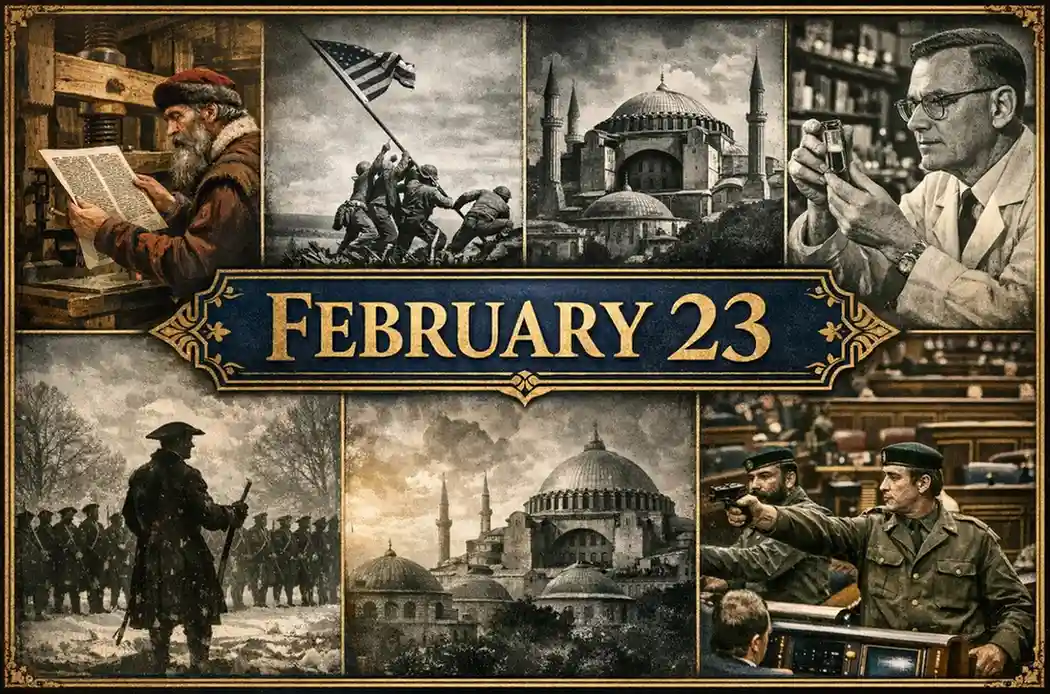
History is rarely a quiet affair, and when we examine what happened on this day in history February 23, we find a landscape defined by transformative shifts in belief and technology. From the foundational stones of the Hagia Sophia to the groundbreaking scientific letters of Werner Heisenberg, today marks the moment when human thought and architecture reached for the divine and the infinitesimal.
It is a day of profound contradictions, where the triumph of the first Western printed book shares a date with the start of the brutal Diocletianic Persecution. These moments remind us that our world is built on a legacy of resilience, from the flags raised on Iwo Jima to the persistent pursuit of justice through the centuries.
Important Events That Happened On February 23 In History
303 – Diocletianic Persecution Begins
Roman Emperor Diocletian issued an edict ordering the total destruction of the Christian church in Nicomedia and the burning of its scriptures. This act launched the “Great Persecution,” an eight-year campaign to purge the empire of Christian influence and restore traditional Roman paganism. It was the most severe and systematic persecution of Christians in the Roman world, ending only with the rise of Constantine.
532 – Foundation of Hagia Sophia
Byzantine Emperor Justinian I laid the foundation stone for a new Orthodox Christian basilica in Constantinople, known as the Hagia Sophia. This architectural marvel was designed to be the largest and most magnificent cathedral in the world, featuring a massive dome that seemed to float on light. For nearly a millennium, it served as the heart of the Byzantine Empire and remains an iconic symbol of engineering and faith.
628 – Overthrow of Khosrow II
Khosrow II, the last great Sasanian shah of Iran, was overthrown in a palace coup led by his own son, Kavadh II. His downfall came after a devastating and exhausted war with the Byzantine Empire, which had drained the Persian treasury and weakened the military. This internal collapse marked the beginning of the end for the Sasanian Empire, paving the way for the Islamic conquest shortly after.
705 – Abdication of Wu Zetian
Empress Wu Zetian, the only woman in Chinese history to rule in her own right as emperor, was forced to abdicate the throne following a successful palace coup. Her removal ended the brief Zhou dynasty she had established and restored the Tang dynasty to power under Emperor Zhongzong. Despite the controversy surrounding her rise, her reign was marked by significant expansion and social reform in ancient China.
1455 – Publication of the Gutenberg Bible
This date is traditionally cited for the publication of the Gutenberg Bible, the first major book in the West produced using mass-produced movable metal type. Johannes Gutenberg’s invention revolutionized the spread of knowledge, making books accessible beyond the elite and sparking the Information Age. It remains one of the most valuable and historically significant printed works in the world.
1725 – Bach Leads “Shepherd Cantata”
The legendary composer J. S. Bach led a performance of his Tafel-Music Shepherd Cantata to celebrate the birthday of Christian, Duke of Saxe-Weissenfels. This secular work showcased Bach’s incredible ability to blend pastoral themes with complex baroque orchestration. Such “table music” was a staple of courtly life, highlighting the role of high art in the social rituals of the 18th-century German nobility.
1763 – Berbice Slave Uprising
The Berbice slave uprising began in what is now Guyana, marking the first major organized revolt by enslaved people in South America. Led by a man named Cuffy, thousands of insurgents seized plantations and fought for their freedom against Dutch colonial rule. Although the revolt was eventually suppressed, it remains a powerful symbol of resistance and the early struggle for human rights in the Caribbean.
1778 – Baron von Steuben at Valley Forge
During the American Revolutionary War, the Prussian officer Baron von Steuben arrived at the winter camp of Valley Forge to assist George Washington. Steuben’s rigorous training programs and organizational skills transformed the ragtag Continental Army into a disciplined, professional fighting force. His arrival is often credited as the turning point that allowed the American rebels to stand toe-to-toe with the British regulars.
1820 – Cato Street Conspiracy Exposed
British authorities exposed the Cato Street Conspiracy, a radical plot intended to assassinate the entire British cabinet and the Prime Minister. The conspirators were arrested in a London loft just as they were preparing to strike, following an infiltration by government spies. The event led to public executions and a period of intense government repression against radical political movements in post-Napoleonic Britain.
1836 – Siege of the Alamo Begins
The legendary Siege of the Alamo began in San Antonio when Mexican forces under General Santa Anna arrived to quell the Texas Revolution. A small group of Texian defenders, including Davy Crockett and Jim Bowie, retreated into the mission to hold out against overwhelming odds. The 13-day siege became a foundational myth of Texan identity, ending in a final, brutal assault that inspired the cry “Remember the Alamo!”
1847 – Battle of Buena Vista
American troops commanded by future president General Zachary Taylor faced off against Mexican General Santa Anna in a major conflict of the Mexican–American War. Despite being heavily outnumbered, Taylor’s forces utilized superior artillery and positioning to repel the Mexican attacks. The victory solidified American control over northern Mexico and turned Zachary Taylor into a national hero, paving his way to the White House.
1854 – Independence of the Orange Free State
The official independence of the Orange Free State in South Africa was declared following the signing of the Bloemfontein Convention. This established an independent Boer republic between the Orange and Vaal rivers, free from British colonial oversight. The state would remain sovereign for nearly fifty years until it was annexed by Britain following the conclusion of the Second Boer War.
1861 – Lincoln Arrives Secretly in D.C.
President-elect Abraham Lincoln arrived in Washington, D.C., in the middle of the night to avoid an alleged assassination plot in Baltimore. On the advice of his security team and the Pinkerton National Detective Agency, he took a secret train route to ensure he reached his inauguration safely. The “midnight ride” was criticized by some as cowardly, but it reflected the extreme sectional tensions tearing at the nation.
1870 – Mississippi Readmitted to the Union
Following the American Civil War, military control of Mississippi officially ended as the state was readmitted to the Union during the Reconstruction Era. The readmission required the state to ratify the 14th and 15th Amendments, which granted citizenship and voting rights to formerly enslaved people. This move was a critical step in the slow and painful process of reunifying the fractured United States.
1883 – Alabama Anti-Trust Law
Alabama became the first state in the U.S. to enact a dedicated anti-trust law, aiming to prevent large corporations from stifling competition. The legislation was a response to the growing power of monopolies and “trusts” that dominated the American economy during the Gilded Age. This pioneering legal move at the state level foreshadowed the federal Sherman Anti-Trust Act that would follow several years later.
1885 – Battle of Đồng Đăng
French forces achieved an important victory over Chinese troops at the Battle of Đồng Đăng during the Sino-French War. The battle took place in the Tonkin region of northern Vietnam as France sought to solidify its colonial grip on Indochina. This tactical win allowed the French to push further into the region, though the war itself would continue to be a costly and difficult endeavor for both empires.
1886 – Production of Aluminum
Charles Martin Hall, with the critical assistance of his sister Julia Brainerd Hall, produced the first samples of aluminum via electrolysis. Their process involved dissolving aluminum oxide in cryolite and passing an electric current through it, a method that made aluminum commercially viable for the first time. This discovery transformed aluminum from a precious metal more valuable than gold into a common material used in every modern industry.
1887 – French Riviera Earthquake
A powerful earthquake struck the French Riviera, causing widespread destruction across the popular coastal region and killing approximately 2,000 people. The tremors were felt as far away as Switzerland and Northern Italy, destroying many historic stone buildings in the process. The disaster remains the deadliest seismic event in modern French history, leading to significant changes in regional construction and disaster awareness.
1898 – Émile Zola Imprisoned
The famous French author Émile Zola was sentenced to prison after publishing his scathing open letter, J’Accuse…!, in a Parisian newspaper. Zola accused the French government and military of rampant antisemitism and the wrongful conviction of Jewish officer Alfred Dreyfus. His bold stand divided France and became a landmark case in the history of intellectual courage and the fight for justice against state corruption.
1900 – Battle of the Tugela Heights
During the Second Boer War, British forces launched a failed attempt to take Hart’s Hill as part of the wider Battle of the Tugela Heights. The British troops suffered heavy casualties while trying to dislodge well-entrenched Boer commandos from the high ground. This initial setback delayed the relief of the besieged town of Ladysmith, highlighting the tactical difficulties the British faced against the highly mobile Boer forces.
1903 – Guantánamo Bay Lease
The newly independent Republic of Cuba signed a treaty leasing Guantánamo Bay to the United States “in perpetuity” for use as a coaling and naval station. This agreement was part of the Platt Amendment, which gave the U.S. significant influence over Cuban affairs following the Spanish–American War. The base remains under U.S. control today, serving as a point of long-standing diplomatic tension between the two nations.
1905 – Formation of the Rotary Club
Chicago attorney Paul Harris met with three other businessmen for lunch to form the Rotary Club, the world’s first service organization. The group was founded on the idea of professionals from different backgrounds meeting for fellowship and to give back to their community. From this small meeting, Rotary grew into a global network of over 1.4 million members dedicated to humanitarian service and peace.
1909 – First Flight of the Silver Dart
The AEA Silver Dart made the first controlled, powered flight in Canada and the broader British Empire, taking off from the frozen Bras d’Or Lake. Piloted by Douglas McCurdy, the aircraft traveled about half a mile at a height of roughly 30 feet. This achievement marked the birth of Canadian aviation and was a major milestone for the Aerial Experiment Association, a group led by Alexander Graham Bell.
1917 – February Revolution Begins
The first major demonstrations of the February Revolution broke out in Saint Petersburg, Russia, as workers and women protested food shortages and the Great War. These initial strikes and bread riots quickly escalated into a full-scale revolution that led to the abdication of Tsar Nicholas II. This event marked the end of centuries of Romanov rule and the beginning of a chaotic period that would eventually lead to the rise of the Soviet Union.
1927 – Federal Radio Commission Established
U.S. President Calvin Coolidge signed a bill establishing the Federal Radio Commission (FRC) to regulate the chaotic and rapidly growing radio industry. The FRC was tasked with assigning frequencies and issuing licenses to prevent stations from interfering with one another’s signals. This body was the direct predecessor to the Federal Communications Commission (FCC) and laid the groundwork for modern broadcast regulation in the United States.
1927 – Heisenberg’s Uncertainty Principle
In a letter to his colleague Wolfgang Pauli, Werner Heisenberg described the “uncertainty principle” for the first time, a foundational concept in quantum mechanics. He argued that it is impossible to simultaneously know both the exact position and momentum of a particle with absolute precision. This radical idea challenged the deterministic view of physics and fundamentally changed our understanding of the subatomic world.
1934 – Leopold III Becomes King
Leopold III ascended to the Belgian throne following the accidental death of his father, King Albert I, in a mountain climbing accident. His reign would be defined by the immense challenges of the Great Depression and the eventual German occupation of Belgium during World War II. His controversial surrender to the Nazis in 1940 would later lead to a constitutional crisis and his eventual abdication in favor of his son.
1941 – Isolation of Plutonium
Dr. Glenn T. Seaborg and his team at the University of California, Berkeley, successfully produced and isolated plutonium for the first time. By bombarding uranium with deuterons, they created element 94, which proved to be highly fissionable and capable of sustaining a nuclear chain reaction. This scientific breakthrough was kept secret during the war, as plutonium became a central component in the development of the first atomic bombs.
1942 – Japanese Attack on Santa Barbara
During World War II, a Japanese submarine surfaced off the coast of California and fired artillery shells at an oil refinery near Santa Barbara. While the attack caused only minor damage and no injuries, it was the first time the continental United States had been shelled by an enemy during the war. The event triggered a massive invasion scare along the West Coast and led to the increased fortification of American beaches.
1943 – Cavan Orphanage Fire
A tragic fire broke out at the St. Joseph’s Orphanage in Cavan, Ireland, claiming the lives of thirty-five young girls and an elderly cook. The disaster was exacerbated by locked exit doors and a lack of proper fire-fighting equipment within the convent-run institution. The tragedy led to a national inquiry and significant reforms in fire safety regulations for residential schools and orphanages across Ireland.
1943 – United Panhellenic Organization of Youth
During the Axis occupation of Greece, the United Panhellenic Organization of Youth (EPON) was founded as a major wing of the Greek Resistance. EPON focused on mobilizing Greek youth to fight against the German, Italian, and Bulgarian occupiers through sabotage and propaganda. It became the largest youth organization in the country’s history, playing a vital role in the national liberation struggle until the end of the war.
1944 – Deportation of Chechens and Ingush
The Soviet government began the forced deportation of the entire Chechen and Ingush populations from the North Caucasus to Central Asia. Accused of collaborating with the Nazis, over 500,000 people were loaded into cattle cars in a brutal operation known as “Aardakh.” Thousands died during the journey or from starvation and disease in exile, an event that many now recognize as a genocide or ethnic cleansing.
1945 – Flag Raising on Iwo Jima
During the Battle of Iwo Jima, a group of United States Marines reached the summit of Mount Suribachi and raised the American flag. The moment was captured by photographer Joe Rosenthal, creating one of the most iconic and enduring images in military history. The photo became a symbol of American resolve and sacrifice in the Pacific, though the brutal battle for the island would continue for several more weeks.
1945 – Raid on Los Baños
U.S. Paratroopers of the 11th Airborne Division, working with Filipino guerrillas, executed a daring rescue of over 2,000 civilians from the Los Baños internment camp. The operation was a masterpiece of coordination, involving a simultaneous parachute drop, amphibious landing, and ground assault that caught the Japanese guards by surprise. Every single internee was rescued safely, making it one of the most successful airborne operations in history.
1945 – Liberation of Manila
Combined Filipino and American forces officially liberated Manila, the capital of the Philippines, from Japanese occupation. The battle for the city was one of the most devastating of the war, resulting in the total destruction of many historic districts and the deaths of over 100,000 civilians. The liberation marked the end of three years of Japanese rule and the restoration of the Commonwealth government in the islands.
1945 – Liberation of Poznań
After a month-long siege, the German garrison in the Polish city of Poznań finally surrendered to Soviet and Polish forces. The city had been designated a “fortress” by the Nazis, leading to intense street-to-street fighting that left much of the urban center in ruins. The capture of Poznań removed a major obstacle on the Red Army’s path toward Berlin and ended the brutal occupation of the historic Polish city.
1945 – Annihilation of Pforzheim
The German town of Pforzheim was nearly entirely destroyed in a massive air raid by 379 British Royal Air Force bombers. In just 22 minutes, the firestorm killed approximately 17,600 people, roughly one-third of the town’s population, and leveled 80% of its buildings. The raid was one of the most concentrated and lethal air attacks of World War II, targeting the town’s precision-instrument and jewelry-making industries.
1945 – American Airlines Flight 009 Crash
An American Airlines DC-3 aircraft crashed near Rural Retreat, Virginia, during a flight from New York to Los Angeles. All 17 people on board were killed when the plane struck a mountain in poor weather and low visibility. The accident was one of several high-profile crashes during that period that led to calls for improved navigational aids and stricter safety regulations for the growing commercial aviation industry.
1947 – Founding of ISO
The International Organization for Standardization (ISO) was officially founded in London to facilitate the international coordination and unification of industrial standards. Representatives from 25 countries met to establish a body that would simplify trade and improve safety by standardizing everything from screw threads to shipping containers. Today, ISO has published over 24,000 standards, serving as a critical invisible infrastructure for the modern global economy.
1950 – UK General Election
The United Kingdom held its first general election after a full term of the post-war Labour government under Clement Attlee. While Labour retained power, their massive majority was slashed to just five seats, reflecting a country weary of austerity and rationing. This narrow victory led to a period of political instability and eventually another election only twenty months later, which saw the return of Winston Churchill to power.
1954 – First Mass Polio Inoculations
The first mass inoculation of children against polio using the Salk vaccine began at Arsenal Elementary School in Pittsburgh, Pennsylvania. Dr. Jonas Salk had developed the inactivated virus vaccine to combat the terrifying disease that paralyzed thousands of children every year. This successful pilot program led to a massive nationwide campaign that eventually virtually eliminated polio from the United States and much of the world.
1958 – Kidnapping of Juan Manuel Fangio
Five-time Formula One champion Juan Manuel Fangio was kidnapped by members of Fidel Castro’s 26th of July Movement in Havana. The rebels snatched the Argentine driver from his hotel to draw international attention to their fight against the Batista regime on the eve of the Cuban Grand Prix. Fangio was treated well and released unharmed the following day, famously remarking that his kidnappers were “gentlemen.”
1966 – Syrian Coup d’État
A violent intra-party military coup took place in Syria, as a radical faction of the Ba’ath Party led by Salah Jadid overthrew the government of Amin al-Hafiz. This coup marked a significant shift toward a more hardline, leftist ideology within the Syrian leadership and deepened the country’s ties with the Soviet Union. The new regime also intensified its support for Palestinian militants, heightening tensions in the region leading up to the Six-Day War.
1971 – Death of General Do Cao Tri
During the faltering South Vietnamese campaign known as Operation Lam Son 719, the highly respected General Do Cao Tri was killed in a helicopter crash. Tri was en route to take command of the operation in Laos when his aircraft exploded shortly after takeoff. His death was a massive blow to the morale of the South Vietnamese army, as he was considered one of their most aggressive and capable military leaders.
1974 – Patty Hearst Ransom Demand
The Symbionese Liberation Army (SLA), a radical militant group, demanded an additional $4 million in food aid to release their kidnap victim, heiress Patty Hearst. This followed an initial $2 million food distribution program that had already been carried out by her family. The kidnapping became a global media sensation, especially after Hearst later announced she had joined her captors and adopted the revolutionary name “Tania.”
1980 – Khomeini on Hostage Fate
Iran’s Supreme Leader, Ayatollah Ruhollah Khomeini, announced that the country’s newly elected parliament would decide the fate of the 52 American embassy hostages. This move effectively delayed any immediate resolution to the crisis, which had begun the previous November. The statement underscored the use of the hostages as political leverage in the domestic and international struggles following the Iranian Revolution.
1981 – 23-F Coup Attempt in Spain
In a dramatic threat to Spain’s young democracy, Lieutenant Colonel Antonio Tejero led 200 armed civil guards into the Congress of Deputies and held the legislature hostage. The attempted coup was intended to return the country to military rule following the death of Francisco Franco. However, the coup collapsed after King Juan Carlos I appeared on national television to denounce the rebels and call for the defense of the constitution.
1883 – Times Beach Buyout
The U.S. Environmental Protection Agency (EPA) announced its intention to buy out and evacuate the entire community of Times Beach, Missouri. The town had been contaminated with life-threatening levels of dioxin after the chemical was mixed with oil and sprayed on the streets to control dust. The unprecedented federal action led to the permanent relocation of over 2,000 residents and the eventual demolition of the town.
1987 – Supernova 1987a Observed
Astronomers and stargazers in the Southern Hemisphere observed a supernova in the Large Magellanic Cloud, a satellite galaxy of the Milky Way. Designated SN 1987a, it was the brightest supernova seen from Earth in nearly 400 years and the first to be studied with modern telescopes. The event provided scientists with a treasure trove of data about the death of massive stars and the birth of neutron stars.
1988 – Anfal Campaign Begins
Saddam Hussein’s regime launched the Anfal campaign, a systematic genocide against the Kurdish and Assyrian populations in northern Iraq. Using chemical weapons, mass executions, and the destruction of thousands of villages, the operation aimed to crush Kurdish resistance once and for all. Human rights organizations estimate that between 50,000 and 182,000 civilians were killed during the various stages of the brutal campaign.
1991 – Thai Coup d’État
General Sunthorn Kongsompong led a bloodless military coup in Thailand, deposing the democratically elected government of Prime Minister Chatichai Choonhavan. The military cited rampant government corruption and an “administrative dictatorship” as the reasons for their intervention. This coup followed a long pattern of military interference in Thai politics, leading to a period of junta rule before a new constitution was eventually drafted.
1998 – Florida Tornado Outbreak
A series of powerful tornadoes ripped through central Florida, destroying or damaging approximately 2,600 structures and killing 42 people. The outbreak was the deadliest in Florida’s history, with wind speeds in some areas reaching F3 and F4 levels on the Fujita scale. The disaster highlighted the dangers of severe weather in the state and led to improved warning systems and stricter building codes for mobile home parks.
1999 – Abdullah Öcalan Charged
Kurdish rebel leader Abdullah Öcalan was officially charged with treason and separatism in a high-security court in Ankara, Turkey. Öcalan, the founder of the Kurdistan Workers’ Party (PKK), had been captured by Turkish intelligence in Kenya after a years-long international manhunt. His trial and subsequent death sentence (later commuted to life imprisonment) were major events in the long-running conflict between the Turkish state and Kurdish militants.
1999 – Galtür Avalanche
A massive avalanche buried the alpine resort town of Galtür, Austria, following a period of exceptionally heavy snowfall and extreme weather. The wall of snow struck the town with such force that it destroyed several buildings and killed 31 people. The disaster led to one of the largest helicopter evacuation operations in European history, as thousands of tourists and locals were trapped in the valley for several days.
2002 – Launch of Intelsat 904
An Ariane 4 rocket successfully launched from the Guiana Space Centre, carrying the Intelsat 904 communications satellite into orbit. The satellite was designed to provide high-powered television, internet, and telephony services across Europe, Africa, and Asia. This mission was part of the ongoing effort to expand global telecommunications infrastructure, showcasing the reliability of the European heavy-lift launch system during that era.
2007 – Grayrigg Derailment
A Virgin Trains Pendolino express service derailed near Grayrigg in Cumbria, England, resulting in one death and 88 injuries. The accident was caused by a faulty set of points on the track that had not been properly maintained or checked. The disaster led to an immediate national safety alert, with hundreds of similar points across the UK rail network being inspected to prevent a recurrence of the tragedy.
2008 – First B-2 Spirit Crash
A United States Air Force B-2 Spirit stealth bomber crashed on the runway at Andersen Air Force Base in Guam shortly after takeoff. Both pilots successfully ejected, but the $1.4 billion aircraft was a total loss, marking the first time a B-2 had been destroyed in an operational accident. An investigation revealed that moisture in the aircraft’s air data sensors had caused the flight control system to miscalculate the takeoff.
2008 – WINDS Satellite Launch
Japan successfully launched the Wideband InterNetworking engineering Test and Demonstration Satellite (WINDS), also known as “Kizuna.” The satellite was designed to test high-speed satellite communications, aiming to provide ultra-fast internet access to remote areas and disaster zones. This launch was a key component of Japan’s space-based information infrastructure, showcasing their commitment to advancing satellite-based internet technologies.
2010 – Lambro River Oil Spill
Unknown criminals sabotaged an oil depot in northern Italy, pouring over 2.5 million liters of diesel and other hydrocarbons into the Lambro River. The spill created a massive toxic slick that flowed toward the Po River, threatening wildlife and drinking water supplies across a wide region. The event was described as an act of “environmental terrorism,” sparking a massive cleanup effort and a search for those responsible for the disaster.
2012 – Iraq Bombing Wave
A coordinated series of bombings and shootings struck cities across Iraq, leaving at least 83 people dead and more than 250 others injured. The attacks targeted security forces and civilians in Baghdad, Hillah, and several other locations, occurring during a period of heightened sectarian tension. The wave of violence was one of the deadliest in the country that year, underscoring the fragile security situation nearly a decade after the U.S. invasion.
2017 – Capture of Al-Bab
The Turkish-backed Free Syrian Army successfully captured the strategic town of Al-Bab from ISIL (ISIS) forces after months of intense fighting. The victory was a major objective of “Operation Euphrates Shield,” intended to drive militants away from the Turkish border and prevent the expansion of Kurdish-led forces. The fall of Al-Bab marked a significant territorial loss for ISIL in northern Syria and shifted the regional balance of power.
2018 – Djibouti Parliamentary Elections
The Republic of Djibouti held parliamentary elections to fill the 65 seats of its National Assembly. The ruling Union for the Presidential Majority (UMP) won a landslide victory, though opposition groups claimed the process was marred by irregularities and limited political freedom. The elections were a key moment for the small but strategically vital nation, which hosts several foreign military bases due to its location on the Horn of Africa.
2019 – Atlas Air Flight 3591 Crash
An Atlas Air Boeing 767 freighter crashed into the shallow waters of Trinity Bay near Anahuac, Texas, while on approach to Houston. All three people on board were killed in the high-speed impact. An investigation by the NTSB later determined that the pilot had become spatially disoriented after accidentally activating the aircraft’s go-around mode in the clouds, leading to a fatal nose-down dive.
2020 – Murder of Ahmaud Arbery
Ahmaud Arbery, a 25-year-old Black man, was chased and fatally shot while jogging in a neighborhood near Brunswick, Georgia. The three white men involved—Travis McMichael, Gregory McMichael, and William Bryan—were not arrested for several months until a video of the shooting surfaced online. Their eventual conviction for murder and federal hate crimes became a focal point for the national movement against racial violence and for criminal justice reform.
2021 – Ecuador Prison Riots
Four simultaneous riots broke out in different prisons across Ecuador, resulting in the deaths of at least 62 people. The violence was attributed to a bloody power struggle between rival gangs within the overcrowded and understaffed correctional system. The scale of the brutality, which included beheadings and other extreme acts, highlighted a deepening national crisis regarding organized crime and the state’s ability to maintain control over its prisons.
2025 – German Snap Elections
A snap federal election was held in Germany to determine the composition of the Bundestag following a period of political realignment within the country. The early vote was called after the governing coalition faced significant internal disagreements over economic and environmental policies. The results led to the formation of a new government, reflecting the shifting priorities of the German electorate in a rapidly changing European landscape.
Famous People Born On February 23
| Name | Description | Date |
|---|---|---|
| Karl Jaspers | German existentialist philosopher | February 23, 1883 – February 26, 1969 |
| Victor Fleming | American film director | February 23, 1889 – January 6, 1949 |
| Viktor Yushchenko | President of Ukraine | February 23, 1954 – |
| Erich Kästner | German author & satirist | February 23, 1899 – July 29, 1974 |
| Carl Menger | Founder of Austrian economics | February 23, 1840 – February 26, 1921 |
| Emma Willard | Pioneer of women’s education | February 23, 1787 – April 15, 1870 |
| César Ritz | Founder of luxury hotel industry | February 23, 1850 – October 26, 1918 |
| Liang Qichao | Chinese intellectual reformer | February 23, 1873 – January 19, 1929 |
| George Frederick Watts | British painter & sculptor | February 23, 1817 – July 1, 1904 |
| Aleksey II | Patriarch of Moscow | February 23, 1929 – December 5, 2008 |
| Allan MacLeod Cormack | Nobel Prize physicist | February 23, 1924 – May 7, 1998 |
| Claude Brown | American writer | February 23, 1937 – February 2, 2002 |
| Robert Neelly Bellah | Sociologist of religion | February 23, 1927 – July 30, 2013 |
| Tokugawa Tsunayoshi | Tokugawa shogun of Japan | February 23, 1646 – February 19, 1709 |
| Hayashi Senjūrō | Prime minister of Japan | February 23, 1876 – February 4, 1943 |
| Gustav Nachtigal | Explorer of Africa | February 23, 1834 – April 19, 1885 |
| Agnes Smedley | Journalist & writer | February 23, 1892 – May 6, 1950 |
| Norman Lindsay | Australian artist & author | February 23, 1879 – November 21, 1969 |
| Konstantin Päts | President of Estonia | February 23, 1874 – January 18, 1956 |
| Henry Dearborn | U.S. general & politician | February 23, 1751 – June 6, 1829 |
| William Eaton | U.S. military officer | February 23, 1764 – June 1, 1811 |
| Musidora | French silent film actress | February 23, 1889 – December 11, 1957 |
| Eduard von Hartmann | Philosopher of the unconscious | February 23, 1842 – June 5, 1906 |
| Allan Boesak | Anti-apartheid leader | February 23, 1946 – |
| Lee Calhoun | Olympic gold medalist hurdler | February 23, 1933 – June 21, 1989 |
| Alan Gilbert | Orchestra conductor | February 23, 1967 – |
| Ivar Lo-Johansson | Swedish novelist | February 23, 1901 – April 11, 1990 |
| Margaret Deland | American novelist | February 23, 1857 – January 13, 1945 |
| William Chambers | Georgian architect | February 23, 1723 – March 8, 1796 |
| Jakob Stämpfli | Swiss president | February 23, 1820 – May 15, 1879 |
Famous People Died On February 23
| Name | Description | Date |
|---|---|---|
| Robert K. Merton | Influential sociologist | July 4, 1910 – February 23, 2003 |
| L. S. Lowry | Industrial landscape painter | November 1, 1887 – February 23, 1976 |
| Yamashita Tomoyuki | WWII Japanese general | November 8, 1885 – February 23, 1946 |
| Joshua Reynolds | Leading portrait painter | July 16, 1723 – February 23, 1792 |
| Mabel Normand | Silent film comedian | November 9, 1892 – February 23, 1930 |
| Nellie Melba | Opera singer | May 19, 1861 – February 23, 1931 |
| Giambattista Basile | Early fairy-tale writer | c.1575 – February 23, 1632 |
| James Maurice Gavin | WWII U.S. commander | March 22, 1907 – February 23, 1990 |
| Alan Colmes | TV political analyst | September 24, 1950 – February 23, 2017 |
| César Sandino | Guerrilla leader | 1893 – February 23, 1934 |
| Leo Baekeland | Inventor of Bakelite | November 14, 1863 – February 23, 1944 |
| Eugenius IV | Pope (1431–1447) | c.1383 – February 23, 1447 |
| Paul Claudel | Poet & playwright | August 6, 1868 – February 23, 1955 |
| Henry Grey | English nobleman | c.1517 – February 23, 1554 |
| Aleksey Tolstoy | Soviet novelist | January 10, 1883 – February 23, 1945 |
| Stanisław I | Polish king | October 20, 1677 – February 23, 1766 |
| José Napoleón Duarte | President of El Salvador | November 23, 1925 – February 23, 1990 |
| Agostino Carracci | Italian painter | 1557 – February 23, 1602 |
| Andrea Cesalpino | Botanist & physician | June 6, 1519 – February 23, 1603 |
| Zygmunt Krasiński | Romantic poet | February 19, 1812 – February 23, 1859 |
| Joanna Baillie | Poet & dramatist | September 11, 1762 – February 23, 1851 |
| Georg Muffat | Baroque composer | June 1, 1653 – February 23, 1704 |
| Anson Burlingame | U.S. diplomat | November 14, 1820 – February 23, 1870 |
| Étienne-Louis Malus | Discoverer of polarization | June 23, 1775 – February 23, 1812 |
| Johannes Crüger | Music theorist | April 9, 1598 – February 23, 1662 |
| Dickinson Richards | Nobel Prize doctor | October 30, 1895 – February 23, 1973 |
| Frederick Busch | Novelist & critic | August 1, 1941 – February 23, 2006 |
| Thomas Goodwin | Puritan leader | October 5, 1600 – February 23, 1680 |
| John Robert Gregg | Creator of Gregg shorthand | June 17, 1867 – February 23, 1948 |
| Augusta Baker | Children’s literature leader | April 1, 1911 – February 23, 1998 |
Observances & Institutional Dates
- National Day (Brunei): Celebrating Brunei’s complete independence from the United Kingdom in 1984.
- The Emperor’s Birthday (Japan): A national holiday celebrating the birthday of Naruhito, the current Emperor of Japan.
- Mashramani-Republic Day (Guyana): An annual festival that celebrates Guyana becoming a republic in 1970.
- Defender of the Fatherland Day: Formerly Red Army Day, celebrated in Russia and other former Soviet republics to honor those serving in the military.
Frequently Asked Questions
- What is the significance of the Gutenberg Bible?
- Published around February 23, 1455, it was the first major book in the West printed with movable type, revolutionizing the spread of information.
- Why did the U.S. lease Guantánamo Bay?
- Cuba leased the bay to the United States on February 23, 1903, “in perpetuity” as a naval base following the Spanish–American War.
- What happened on Iwo Jima on this day?
- On February 23, 1945, U.S. Marines famously raised the American flag atop Mount Suribachi during the brutal battle for the island.
- What is Heisenberg’s Uncertainty Principle?
- First described in a letter on this day in 1927, it states that one cannot know both the position and momentum of a particle with perfect precision.