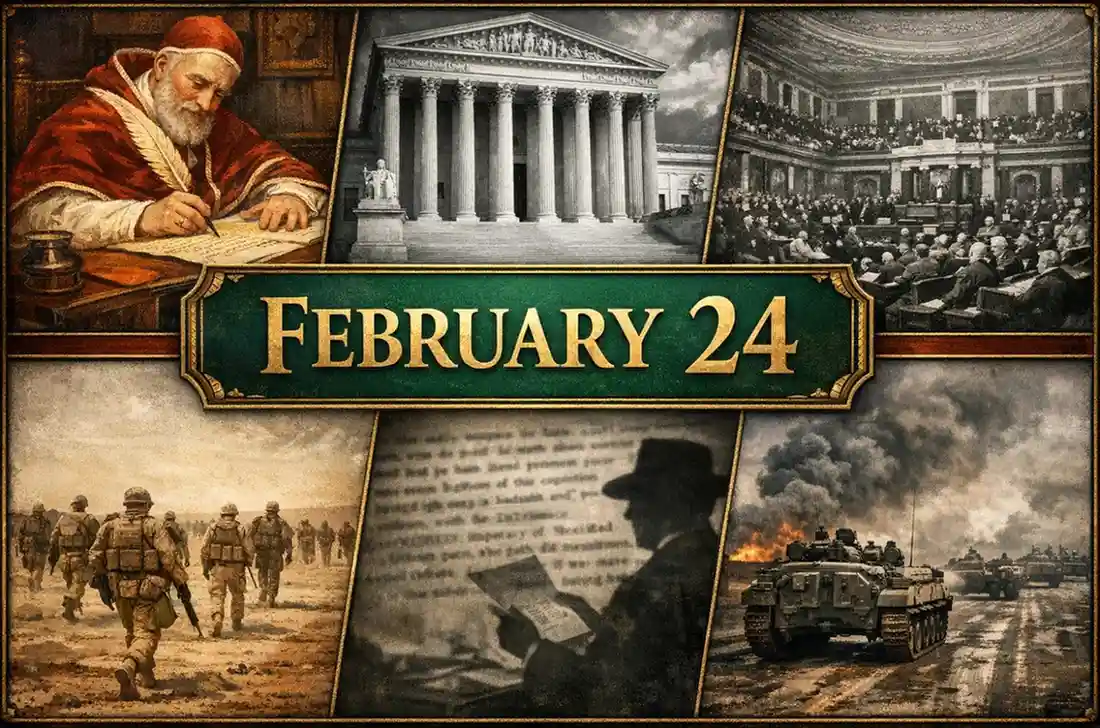
The turning of a page in a history book often reveals a day of profound structural change, and when we look at what happened on this day in history February 24, we see the very way we track time was rewritten. It is a day where the Gregorian calendar was born, legal precedents like judicial review were etched into law, and modern geopolitical boundaries were forged through both treaties and invasions.
Important Events That Happened On February 24 In History
484 – King Huneric’s Religious Purge
King Huneric of the Vandals took aggressive steps to enforce Arian Christianity by replacing Nicene bishops with those who shared his theological views. As part of this religious crackdown, he banished several prominent church leaders to the island of Corsica to diminish their influence. This event was a significant chapter in the religious tensions that defined the Vandal Kingdom in North Africa during the 5th century.
1303 – Battle of Roslin
In a significant engagement of the First War of Scottish Independence, the English army suffered a surprising defeat at the Battle of Roslin. Despite being outnumbered, Scottish forces led by John Comyn and Simon Fraser executed a series of successful ambushes against the English divisions. The victory provided a much-needed morale boost for the Scottish resistance against the expansionist efforts of King Edward I.
1386 – Assassination of Charles III
King Charles III of Naples and Hungary was assassinated in Buda while embroiled in a bitter struggle for the Hungarian throne. He had been lured into a trap by supporters of the rival Queen Mary, who sought to end his short-lived and controversial reign. His death triggered further political instability across the region, as different factions fought to fill the power vacuum in Central Europe.
1525 – Battle of Pavia
A combined Spanish-Austrian army under the Holy Roman Empire decisively defeated the French army at the Battle of Pavia in Italy. The conflict ended with the capture of the French King Francis I, who was taken prisoner and forced to sign a humiliating peace treaty. This victory established Habsburg dominance in Italy and marked a major shift in the balance of power among European monarchies.
1527 – Coronation of Ferdinand I
Ferdinand I was officially crowned as the King of Bohemia in a grand ceremony held in Prague, solidifying his rule over the region. His ascension was a key moment in the expansion of Habsburg influence across Central and Eastern Europe. This coronation marked the beginning of a long period of Habsburg administration in Bohemia, which would last for nearly four centuries.
1538 – Treaty of Nagyvárad
Holy Roman Emperor Ferdinand I and King John Zápolya of Hungary signed the Treaty of Nagyvárad to resolve their competing claims to the Hungarian throne. The agreement secretly stipulated that Zápolya would remain king until his death, after which the crown would pass to Ferdinand. However, the treaty’s failure to account for Zápolya’s future heirs led to renewed conflict following his passing.
1582 – Introduction of the Gregorian Calendar
Pope Gregory XIII issued the papal bull Inter gravissimas, officially announcing the transition from the Julian calendar to the Gregorian calendar. The change was necessary to correct a drift in the solar year that had pushed the spring equinox away from its traditional date. This reform eventually became the standard civil calendar used by the majority of the world today.
1597 – End of the Cudgel War
The final battle of the Cudgel War, a massive peasant uprising in Finland, took place on Santavuori Hill in Ilmajoki. The poorly armed peasants, fighting against the heavy taxes and abuses of the Swedish nobility, were ultimately crushed by professional cavalry. This defeat marked the end of the rebellion and led to a period of harsh retribution against the remaining insurgents.
1607 – Première of L’Orfeo
Claudio Monteverdi’s L’Orfeo, recognized as one of the first true operas in history, received its première performance in Mantua, Italy. The work combined drama, music, and staging in a revolutionary way, telling the Greek myth of Orpheus and Eurydice. Its success laid the artistic foundation for the development of opera as a major Western cultural institution.
1711 – Première of Rinaldo
George Frideric Handel’s Rinaldo premiered in London, marking the first Italian opera specifically composed for the English stage. The production featured elaborate stage effects and virtuosic singing, quickly becoming a massive hit with the London public. Its popularity helped establish Handel as a leading composer and solidified the English obsession with Italian-style opera.
1739 – Battle of Karnal
The invading forces of Nādir Shah of Iran met the army of Mughal Emperor Muḥammad Shah at the Battle of Karnal in India. Nādir Shah’s superior military tactics and use of swivel guns led to a crushing defeat for the Mughals in just a few hours. This victory allowed the Iranian forces to march on Delhi and eventually carry away the legendary Peacock Throne.
1803 – Marbury v. Madison
In the landmark case of Marbury v. Madison, the U.S. Supreme Court established the vital principle of judicial review. Chief Justice John Marshall ruled that the Court had the power to declare acts of Congress unconstitutional if they conflicted with the Constitution. This decision fundamentally defined the role of the American judiciary and the balance of power within the federal government.
1809 – Drury Lane Theatre Fire
London’s famous Drury Lane Theatre burned to the ground in a spectacular blaze that lit up the night sky. The disaster left its owner, the Irish playwright and politician Richard Brinsley Sheridan, in complete financial ruin. Legend says Sheridan watched the fire from a nearby tavern, calmly noting that a man should be allowed to “drink a glass of wine by his own fireside.”
1809 – British Capture of Martinique
British forces successfully invaded and captured the French colony of Martinique as part of the broader Napoleonic Wars. The operation was aimed at depriving the French of a strategic naval base in the Caribbean and disrupting their colonial trade. The island would remain under British control for several years before being returned to France at the end of the conflict.
1812 – Treaty of Paris
Napoleon Bonaparte and King Frederick William III of Prussia signed the Treaty of Paris, forming a forced alliance against the Russian Empire. The agreement compelled Prussia to provide thousands of troops for Napoleon’s upcoming invasion of Russia. This uneasy partnership reflected the immense pressure Napoleon exerted over German states during the peak of his European dominance.
1813 – Sinking of HMS Peacock
During the War of 1812, the American sloop USS Hornet engaged and sank the British brig-sloop HMS Peacock off the coast of Guyana. The battle was brief but intense, with the American vessel demonstrating superior gunnery and maneuverability. The victory boosted American naval morale and was part of a series of successful single-ship actions against the Royal Navy.
1821 – Plan of Iguala
The Plan of Iguala was proclaimed, marking the final stage of the Mexican War of Independence from Spain. The plan proposed three “guarantees”: the establishment of Roman Catholicism, the independence of Mexico, and the unity of all ethnic groups. This agreement allowed different revolutionary factions to unite, eventually leading to the successful creation of an independent Mexican Empire.
1822 – First Swaminarayan Temple Inaugurated
The Shri Swaminarayan Mandir in Ahmedabad was officially inaugurated as the first Swaminarayan temple in the world. Built on land granted by the British government, the temple became a central hub for the burgeoning Swaminarayan Sampraday movement. Its intricate wood carvings and spiritual significance made it a landmark of religious architecture and a focal point for devotees.
1826 – Treaty of Yandabo
The signing of the Treaty of Yandabo officially ended the First Anglo-Burmese War, the longest and most expensive war in British Indian history. Burma was forced to cede large territories to the British East India Company and pay a massive financial indemnity. This treaty marked the beginning of the end of Burmese sovereignty and expanded British colonial reach into Southeast Asia.
1831 – Treaty of Dancing Rabbit Creek
The Treaty of Dancing Rabbit Creek was proclaimed as the first major removal treaty following the passage of the Indian Removal Act. The Choctaw Nation in Mississippi agreed to cede their ancestral lands in exchange for territory in the West and financial compensation. This event marked the beginning of the forced displacement of thousands of Native Americans along the Trail of Tears.
1848 – Abdication of Louis-Philippe
Faced with a growing revolution in the streets of Paris, King Louis-Philippe of France abdicated his throne and fled to England. His departure marked the end of the July Monarchy and led to the immediate establishment of the French Second Republic. This upheaval was a key part of the “Springtime of Nations,” a wave of revolutionary sentiment that swept across Europe in 1848.
1854 – First Perforated Postage Stamp
The “Penny Red” became the first postage stamp in history to be officially issued with perforations for easy separation. Before this innovation, stamps had to be laboriously cut from sheets using scissors or a knife. The introduction of perforated sheets revolutionized the efficiency of the postal system and was quickly adopted by countries around the globe.
1863 – Arizona Territory Organized
Arizona was officially organized as a United States territory after President Abraham Lincoln signed the Arizona Organic Act. The move separated the region from the New Mexico Territory to provide more effective governance and to secure its mineral wealth for the Union during the Civil War. This administrative step laid the groundwork for Arizona’s eventual development and future statehood.
1868 – Impeachment of Andrew Johnson
Andrew Johnson became the first U.S. President to be impeached by the House of Representatives after a bitter conflict over Reconstruction policies. The primary charge involved his violation of the Tenure of Office Act by removing Secretary of War Edwin Stanton. While the House voted to impeach, Johnson was later acquitted by the Senate by a single vote, allowing him to finish his term.
1875 – Sinking of the SS Gothenburg
The SS Gothenburg struck the Great Barrier Reef and sank off the coast of Australia during a fierce storm. Approximately 100 people lost their lives, including several high-profile civil servants and dignitaries traveling from the Northern Territory. The tragedy shocked the Australian public and led to calls for improved maritime safety and better lighting along the treacherous reef.
1876 – Première of Peer Gynt
Henrik Ibsen’s play Peer Gynt, featuring incidental music composed by Edvard Grieg, received its stage première in Oslo, Norway. The production was a monumental success, blending Norwegian folklore with deep psychological themes and soaring orchestral suites. The collaboration between Ibsen and Grieg became a defining masterpiece of Scandinavian culture and remains a staple of the global theatrical repertoire.
1881 – Sino-Russian Ili Treaty
China and Russia signed the Treaty of Saint Petersburg, also known as the Sino-Russian Ili Treaty, to resolve a border dispute in Central Asia. Russia agreed to return the occupied Ili region to China in exchange for financial compensation and trade concessions. This diplomatic resolution averted a potential war and helped stabilize the volatile frontier between the two massive empires.
1895 – Cuban War of Independence Begins
A revolution broke out in the town of Baire near Santiago de Cuba, signaling the start of the Cuban War of Independence against Spanish rule. Led by figures like José Martí, the uprising aimed to end centuries of colonial control and establish a sovereign republic. This conflict would eventually draw in the United States, leading to the Spanish–American War and the end of Spain’s empire in the Americas.
1916 – Segregation of Leprosy Patients in Korea
The Governor-General of Korea established a clinic called Jahyewon on the island of Sorokdo to forcibly segregate patients with Hansen’s disease (leprosy). This move was part of a discriminatory policy that led to the isolation and mistreatment of thousands of people for decades. The island became a symbol of social stigma and human rights abuses that are only recently being fully addressed and reconciled.
1917 – Delivery of the Zimmermann Telegram
The British government gave U.S. Ambassador Walter Hines Page the decrypted Zimmermann Telegram, a secret message from Germany to Mexico. In the telegram, Germany promised to help Mexico recover Texas, New Mexico, and Arizona if they joined the war against the United States. The release of this document outraged the American public and was a major catalyst for the U.S. entry into World War I.
1918 – Estonian Declaration of Independence
Estonia officially declared its independence from the Russian Empire in the midst of the chaos of the Russian Revolution and World War I. The declaration asserted the sovereign rights of the Estonian people and led to a war of independence against both Soviet and German forces. This moment is celebrated as the birth of the modern Estonian state, though it would later face decades of Soviet occupation.
1920 – Nancy Astor Speaks in Parliament
Nancy Astor became the first woman to ever speak in the British House of Commons, just three months after being elected as a Member of Parliament. Her speech marked a historic breakthrough for women in politics, challenging the deeply ingrained male dominance of the British legislature. Despite facing significant hostility from some of her male colleagues, Astor paved the way for future generations of women leaders.
1920 – Founding of the Nazi Party
The National Socialist German Workers’ Party (NSDAP), or the Nazi Party, was formally founded by Adolf Hitler in the Hofbräuhaus beer hall in Munich. Hitler outlined the party’s radical nationalist and antisemitic program to a crowd of roughly 2,000 people. This event marked the beginning of a movement that would eventually lead to the collapse of German democracy and the horrors of World War II.
1942 – Sinking of the MV Struma
The MV Struma, carrying nearly 800 Jewish refugees fleeing the Holocaust, was torpedoed and sunk by a Soviet submarine in the Black Sea. The ship had been held in Istanbul for weeks as the passengers were denied entry to Palestine by the British and refused refuge by the Turks. Only one person survived the disaster, which remains a tragic symbol of the world’s failure to protect those fleeing genocide.
1942 – Battle of Los Angeles
In what became known as the “Battle of Los Angeles,” a false alarm triggered a massive anti-aircraft barrage over the city that lasted for several hours. Unidentified objects, later believed to be weather balloons, were mistaken for Japanese aircraft in the nervous atmosphere following Pearl Harbor. No bombs were dropped, but the incident caused widespread panic and resulted in several deaths from heart attacks and car accidents.
1943 – Athens Protest Against Forced Labor
The first large-scale protest march occurred in Athens against rumors that the Axis occupation forces were planning a forced mobilization of Greek workers for labor in Germany. Thousands of citizens clashed with collaborationist police, demonstrating the deep-seated resistance of the Greek people to Nazi exploitation. The bravery of the protesters eventually forced the occupiers to abandon their plans for the mass mobilization.
1945 – Assassination of Ahmad Mahir Pasha
Egyptian Prime Minister Ahmad Mahir Pasha was shot and killed in Parliament shortly after reading a decree declaring war on the Axis powers. The assassin was a member of a nationalist group who opposed Egypt’s involvement in the global conflict alongside the British. His death highlighted the intense political internal divisions within Egypt as it struggled to define its role in the post-war world.
1946 – Juan Perón Elected in Argentina
Colonel Juan Perón was elected to his first term as President of Argentina, marking the formal rise of the political movement known as Peronism. His platform focused on labor rights, social justice, and economic nationalism, which earned him a massive following among the working class. Perón’s presidency would fundamentally reshape Argentine society and politics for decades to come, leaving a complex and enduring legacy.
1949 – Arab-Israeli Armistice Agreements
The first of several Armistice Agreements was signed between Israel and Egypt to formally end the hostilities of the 1948 Arab-Israeli War. The agreements established green lines that served as the temporary borders of the new state of Israel until more permanent resolutions could be found. While the treaties stopped the fighting, they did not resolve the underlying political and territorial disputes in the region.
1966 – Ghanaian Coup d’État
A military coup led by the National Liberation Council successfully overthrew the government of President Kwame Nkrumah while he was on a visit to China. The coup leaders accused Nkrumah of economic mismanagement and authoritarianism, leading to a period of military rule in the West African nation. Nkrumah, a leading figure of Pan-Africanism, spent the rest of his life in exile, and the event marked a major turning point for Ghana.
1967 – Dissolution of the Shanghai People’s Commune
During the height of the Cultural Revolution, Maoist leader Zhang Chunqiao announced the dissolution of the short-lived Shanghai People’s Commune. It was replaced by a “revolutionary committee” that integrated the military, party officials, and radical mass organizations under more centralized control. this shift reflected Mao Zedong’s desire to stabilize the chaotic energy of the Red Guards while maintaining the revolutionary spirit.
1968 – Recapture of the Hué Citadel
During the Tet Offensive of the Vietnam War, South Vietnamese forces led by General Ngo Quang Truong successfully recaptured the historic citadel of Hué. The city had been occupied by North Vietnamese and Viet Cong troops for weeks, resulting in some of the most intense urban combat of the entire war. The victory came at a high cost, with much of the ancient city left in ruins and thousands of civilians killed.
1971 – All India Forward Bloc Emergency Meeting
The All India Forward Bloc held an emergency central committee meeting following the assassination of their chairman, Hemantha Kumar Bose, just three days earlier. During the session, P.K. Mookiah Thevar was appointed as the new chairman to lead the party through the political crisis. The murder of Bose was a major shock to the Indian political landscape, highlighting the volatile nature of regional politics in West Bengal.
1976 – New Cuban Constitution Adopted
The regime of Fidel Castro officially adopted a new constitution for Cuba, which formalized the country as a socialist state. The document mandated that only one political party—the Communist Party of Cuba—was allowed to operate, centralizing all political power under the state. This move solidified the institutional structure of the Cuban Revolution and aligned the nation’s legal framework with the Soviet model.
1978 – Disappearance of the Yuba County Five
Five young men from Yuba County, California, disappeared after attending a basketball game in Chico, leading to a baffling and tragic mystery. Their abandoned car was found on a remote, snow-covered mountain road, far from their intended route home. Four months later, the bodies of four of the men were discovered in and around a forest service trailer, but the circumstances of their deaths remain unexplained.
1981 – Gulf of Corinth Earthquake
A powerful 6.7 magnitude earthquake struck Central Greece, with its epicenter in the Gulf of Corinth. The tremors caused widespread damage across the region, including the capital city of Athens, resulting in 22 deaths and 400 injuries. The disaster caused over $800 million in damage and led to a major review of building codes and seismic preparedness throughout Greece.
1983 – Condemnation of Japanese American Internment
A special commission of the United States Congress issued a report formally condemning the internment of Japanese Americans during World War II. The commission concluded that the mass incarceration was not justified by military necessity but was the result of “race prejudice, war hysteria, and a failure of political leadership.” This finding paved the way for the Civil Liberties Act of 1988, which provided formal apologies and reparations to survivors.
1984 – 49th Street Elementary School Shooting
Tyrone Mitchell opened fire from a house across the street from the 49th Street Elementary School in Los Angeles, killing two children and injuring 12 others. The shooter eventually took his own life as police closed in, leaving the community in a state of shock and grief. The tragedy was one of several high-profile school shootings that sparked early national debates about gun control and school safety in the United States.
1989 – United Airlines Flight 811 Incident
Shortly after taking off from Honolulu, a cargo door on United Airlines Flight 811 failed, causing a section of the fuselage to rip open at high altitude. Nine passengers in the business-class section were blown out of the aircraft to their deaths as the cabin underwent explosive decompression. Despite the massive hole in the plane, the pilots managed to make a successful emergency landing back in Hawaii, saving the remaining 346 people on board.
1991 – Ground Phase of the Gulf War Begins
Coalition ground troops crossed the border from Saudi Arabia into Iraq and Kuwait, marking the start of the massive ground phase of the Gulf War. The operation, known as Desert Sabre, aimed to liberate Kuwait and destroy the Iraqi military’s ability to threaten the region. The ground offensive was incredibly swift and successful, leading to the collapse of Iraqi defenses in just 100 hours.
1996 – Brothers to the Rescue Shootdown
The Cuban Air Force shot down two civilian airplanes operated by the Miami-based group Brothers to the Rescue in international waters. The group was known for flying missions to spot and assist Cuban rafters, but the Cuban government claimed the planes had violated their airspace. The incident caused a major international outcry and led to the tightening of U.S. sanctions against Cuba via the Helms-Burton Act.
1999 – China Southwest Airlines Flight 4509 Crash
A China Southwest Airlines Tupolev Tu-154 aircraft crashed in a field while on approach to Rui’an, China, killing all 61 people on board. An investigation revealed that the crash was caused by the installation of incorrect locknuts in the flight control system, which led to a loss of pitch control. This disaster contributed to the eventual phasing out of the Tu-154 model from major Chinese airline fleets.
2004 – Al Hoceima Earthquake
A violent 6.3 magnitude earthquake struck northern Morocco near the city of Al Hoceima, causing massive destruction in several rural villages. At least 628 people were killed and nearly 1,000 injured, with many more left homeless as traditional stone houses collapsed. The quake was one of the deadliest in Moroccan history and required a large-scale international humanitarian response to assist the survivors.
2006 – Philippine State of Emergency
President Gloria Macapagal Arroyo declared a state of emergency in the Philippines via Proclamation 1017 to subdue an alleged military coup attempt. The decree allowed for warrantless arrests and the temporary takeover of media outlets, sparking widespread protests and legal challenges. Critics accused the president of using the “emergency” to suppress political opposition and stifle democratic freedoms.
2007 – Japan Launches Fourth Spy Satellite
Japan successfully launched its fourth reconnaissance satellite, significantly enhancing its ability to monitor potential regional threats, particularly from North Korea. This launch completed the initial phase of Japan’s independent intelligence-gathering satellite system, which was established following North Korean missile tests in the late 1990s. The move reflected Japan’s growing commitment to its own national security and space-based surveillance capabilities.
2008 – Retirement of Fidel Castro
Fidel Castro officially retired as the President of Cuba and the head of the Council of Ministers after leading the country for 32 years. Having been in poor health for some time, he handed over the presidency to his brother, Raúl Castro. While he stepped down from his government roles, he remained the influential head of the Communist Party of Cuba for another three years before fully retiring from public life.
2015 – Oxnard Metrolink Derailment
A Metrolink commuter train derailed in Oxnard, California, after colliding with a truck that had become stuck on the tracks. The collision caused several train cars to overturn, resulting in more than 30 injuries and the eventual death of the train’s engineer. The accident led to a major investigation into grade-crossing safety and the effectiveness of “crash energy management” technology in modern rail cars.
2016 – Tara Air Flight 193 Crash
A de Havilland Canada DHC-6 Twin Otter aircraft operated by Tara Air crashed into a mountainside in Nepal’s Myagdi District, killing all 23 people on board. The flight was traveling through a difficult mountainous route in poor visibility when the accident occurred. This tragedy highlighted the ongoing safety challenges of domestic aviation in Nepal’s high-altitude and often treacherous terrain.
2020 – Resignation of Mahathir Mohamad
Mahathir Mohamad resigned as the Prime Minister of Malaysia, triggering a major political crisis and the collapse of the Pakatan Harapan government. His resignation followed an attempt by political rivals to form a new coalition that would exclude his intended successor. This event led to a period of significant political instability and a shift in the country’s leadership during the early stages of the global pandemic.
2022 – Russian Invasion of Ukraine
In a massive escalation of the Russo-Ukrainian War, Russian President Vladimir Putin ordered a full-scale invasion of Ukraine. The assault began with missile strikes across the country and ground troops moving in from multiple directions, including from Belarus toward the capital, Kyiv. This act was globally condemned as a violation of international law, triggering the largest conflict in Europe since World War II and a massive humanitarian crisis.
Famous People Born On February 24
| Name | Description | Dates |
|---|---|---|
| Claude Shannon | American engineer & mathematician | April 30, 1916 – February 24, 2001 |
| Gillian Flynn | American author | February 24, 1971 – Present |
| Winslow Homer | American painter | February 24, 1836 – September 29, 1910 |
| Gayatri Chakravorty Spivak | Indian literary theorist | February 24, 1942 – Present |
| Richard Hamilton | British artist (Pop Art pioneer) | February 24, 1922 – September 13, 2011 |
| Giovanni Pico della Mirandola | Italian philosopher | February 24, 1463 – November 17, 1494 |
| Kurt Tank | German aircraft designer | February 24, 1898 – June 5, 1983 |
| Matthias | Holy Roman Emperor | February 24, 1557 – March 20, 1619 |
| Juan de Austria | Spanish military commander | February 24, 1547 – October 1, 1578 |
| Charles Le Brun | French painter | February 24, 1619 – February 12, 1690 |
| Jacques de Vaucanson | French inventor | February 24, 1709 – November 21, 1782 |
| Bettino Craxi | Italian politician | February 24, 1934 – January 19, 2000 |
| George Moore | Irish novelist | February 24, 1852 – January 21, 1933 |
| Michael Harrington | American activist & author | February 24, 1928 – July 31, 1989 |
| David Wineland | American physicist | February 24, 1944 – Present |
| William H. Crawford | American political leader | February 24, 1772 – September 15, 1834 |
| Arrigo Boito | Italian composer | February 24, 1842 – June 10, 1918 |
| Stanisław Ignacy Witkiewicz | Polish writer & painter | February 24, 1885 – September 18, 1939 |
| Ali Mazrui | Kenyan-American scholar | February 24, 1933 – October 12, 2014 |
| Max Black | American philosopher | February 24, 1909 – August 27, 1988 |
| Mary Ellen Chase | American writer | February 24, 1887 – July 28, 1973 |
| Jiří Trnka | Czech filmmaker | February 24, 1912 – December 30, 1969 |
| Abd al-Aziz of Morocco | Sultan of Morocco | February 24, 1878 – June 10, 1943 |
| David Williamson | Australian dramatist | February 24, 1942 – Present |
| Rama II | King of Siam | February 24, 1768 – July 21, 1824 |
| Gregory Margulis | Russian mathematician | February 24, 1946 – Present |
| John Neumeier | Ballet director & choreographer | February 24, 1942 – Present |
| Samuel Wesley | English composer | February 24, 1766 – October 11, 1837 |
| Johann Baptist Cramer | British pianist & composer | February 24, 1771 – April 16, 1858 |
| Teófilo Braga | President of Portugal | February 24, 1843 – January 28, 1924 |
Famous People Died On February 24
| Name | Description | Dates |
|---|---|---|
| Claude Shannon | American engineer & mathematician | April 30, 1916 – February 24, 2001 |
| Tommy Douglas | Canadian politician | October 20, 1904 – February 24, 1986 |
| François de Lorraine | French noble & soldier | February 24, 1519 – February 24, 1563 |
| Osman Ali Khan | Ruler of Hyderabad | April 6, 1886 – February 24, 1967 |
| Henry Cavendish | British physicist & chemist | October 10, 1731 – February 24, 1810 |
| Joseph Jenkins Roberts | First president of Liberia | March 15, 1809 – February 24, 1876 |
| Malcolm Forbes | Publisher of Forbes magazine | August 19, 1919 – February 24, 1990 |
| Rukmini Devi Arundale | Indian classical dancer | February 29, 1904 – February 24, 1986 |
| Carlo Buonaparte | Father of Napoleon | March 29, 1746 – February 24, 1785 |
| Thomas Bowdler | English physician & writer | July 11, 1754 – February 24, 1825 |
| Nikolai Lobachevsky | Founder of non-Euclidean geometry | December 1, 1792 – February 24, 1856 |
| Andre Dubus | American novelist | August 11, 1936 – February 24, 1999 |
| Sir Edmund Andros | English colonial official | December 6, 1637 – February 24, 1714 |
| Joseph I of Portugal | King of Portugal | June 6, 1714 – February 24, 1777 |
| Hu Shih | Chinese philosopher & diplomat | December 17, 1891 – February 24, 1962 |
| Alessandro Pertini | President of Italy | September 25, 1896 – February 24, 1990 |
| Georg Christoph Lichtenberg | German physicist & writer | July 1, 1742 – February 24, 1799 |
| Pierre Janet | French psychologist | May 30, 1859 – February 24, 1947 |
| Karl Hjalmar Branting | Swedish prime minister | November 23, 1860 – February 24, 1925 |
| Jacob Jennings Brown | U.S. Army general | May 9, 1775 – February 24, 1828 |
| Andre Messager | French composer | December 30, 1853 – February 24, 1929 |
| Edward Williams Morley | American chemist | January 29, 1838 – February 24, 1923 |
| Charles Monroe Sheldon | American author | February 26, 1857 – February 24, 1946 |
| Utagawa Toyokuni | Japanese ukiyo-e artist | 1769 – February 24, 1825 |
| Amanda Smith | American religious leader | January 23, 1837 – February 24, 1915 |
| Franklin B. Sanborn | American journalist | December 15, 1831 – February 24, 1917 |
| Bernhard Ingemann | Danish writer | May 28, 1789 – February 24, 1862 |
| Eberhard I of Wurttemberg | Duke of Württemberg | December 11, 1445 – February 24, 1496 |
| Irving Bacheller | American writer | September 26, 1859 – February 24, 1950 |
| Alvin Poussaint | American psychiatrist | May 15, 1934 – February 24, 2025 |
Observances & Institutional Dates
- Independence Day (Estonia): Commemorating the 1918 declaration of independence from the Russian Empire.
- Flag Day (Mexico): A national holiday established in 1937 to honor the Mexican flag and the country’s sovereignty.
- Dragobete (Romania): A traditional Romanian holiday celebrating love and the beginning of spring, often compared to Valentine’s Day.
- Engineer’s Day (Iran): Dedicated to honoring the contributions of engineers to Iranian society and infrastructure.
Frequently Asked Questions
- Why is February 24 important in the U.S. court system?
- On this day in 1803, the Supreme Court established judicial review in the case of Marbury v. Madison.
- When did the Gregorian calendar start?
- Pope Gregory XIII announced the new calendar on February 24, 1582, to fix errors in the Julian system.
- Who was the first U.S. President to be impeached?
- Andrew Johnson was impeached by the House of Representatives on February 24, 1868.
- When did the 2022 invasion of Ukraine begin?
- Russian forces launched a full-scale invasion of Ukraine on February 24, 2022.