The steady march of time often reveals that the fate of entire nations can hinge on the decisions made in a single afternoon, and when we explore what happened on this day in history February 25, we see that theme play out across millennia. It is a day of monumental transitions, where the Roman Empire secured its future through a calculated adoption and the Soviet Union’s foundation was shaken by a single, scathing speech.
From the birth of the first purpose-built aircraft carrier to the fall of long-standing dictatorships in the Philippines, today serves as a powerful reminder that while power can be seized through force or inheritance, its ultimate legacy is often decided by the voices of the people who live in its shadow.
Important Events That Happened On February 25 In History
138 – Hadrian Adopts Antoninus Pius
Roman Emperor Hadrian officially adopted Antoninus Pius as his son, a strategic move that effectively designated him as the successor to the imperial throne. This adoption was part of a broader plan to ensure a stable transition of power, as Hadrian also required Antoninus to adopt the future emperor Marcus Aurelius. This chain of succession led to a period of relative peace and prosperity known as the era of the “Five Good Emperors.”
628 – Overthrow of Khosrow II
Khosrow II, the last great Shah of the Sasanian Empire, was overthrown and imprisoned by his own son, Kavadh II. The coup followed years of exhausting warfare with the Byzantine Empire and growing internal dissatisfaction among the Persian nobility. His removal from power triggered a rapid decline in the empire’s stability, leaving it vulnerable to the Arab conquests that would follow shortly after.
1705 – Première of Handel’s Nero
George Frideric Handel’s opera Nero received its première performance at the Theater am Gänsemarkt in Hamburg, Germany. This was Handel’s second opera, following the success of Almira, and it continued to establish his reputation as a rising star in the world of Baroque music. Although the musical score for Nero has since been lost to time, its debut remains a key milestone in the early career of one of history’s greatest composers.
1836 – Samuel Colt Patents the Revolver
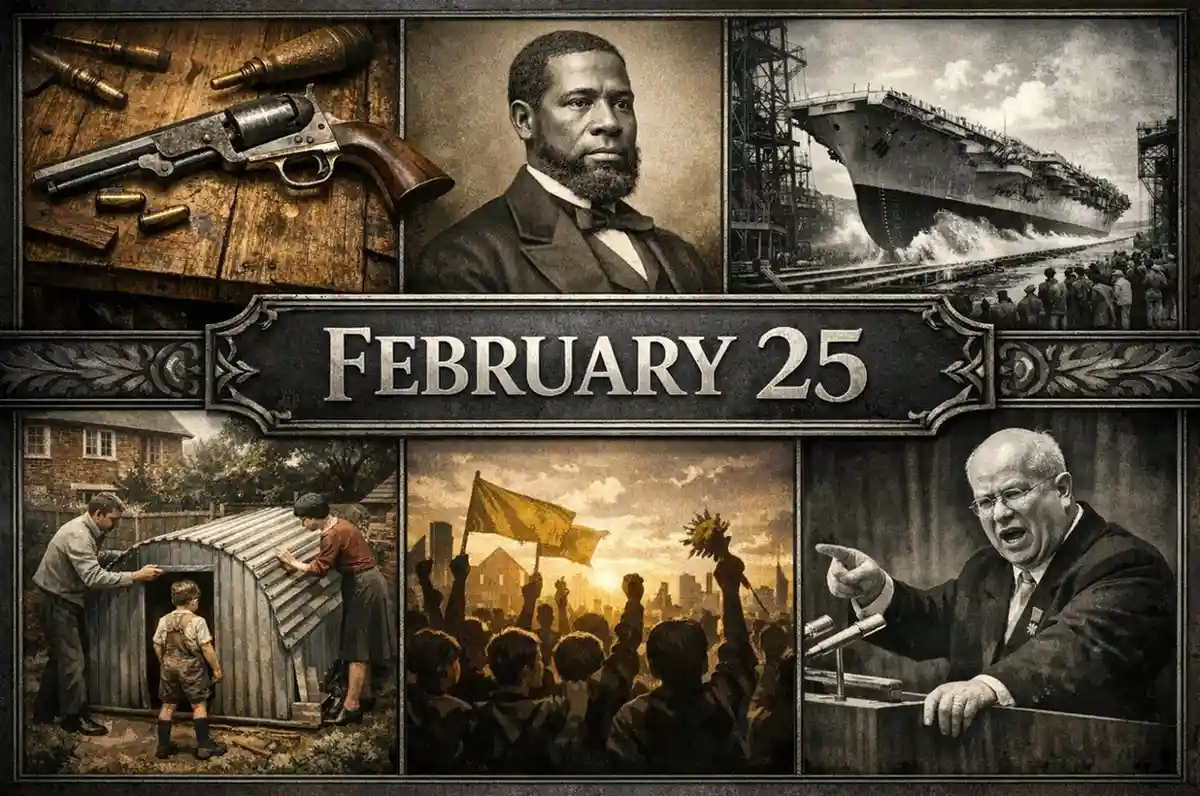
The United States Patent Office granted Samuel Colt a patent for his “revolving gun,” a firearm that featured a rotating cylinder containing multiple chambers. This invention revolutionized personal defense and military warfare by allowing a shooter to fire multiple rounds without reloading after every shot. The Colt revolver became an iconic symbol of the American West and laid the foundation for the modern firearms industry.
1843 – The Paulet Affair
In an event known as the Paulet Affair, Lord George Paulet of the British Royal Navy unilaterally occupied the Kingdom of Hawaii in the name of Great Britain. Paulet forced King Kamehameha III to cede the islands after a series of diplomatic disputes regarding the rights of British subjects. The occupation lasted for five months until the British government officially repudiated Paulet’s actions and restored Hawaiian sovereignty.
1870 – Hiram Rhodes Revels Sworn In
Hiram Rhodes Revels, a Republican from Mississippi, was sworn into the United States Senate, making history as the first African American to ever sit in Congress. His election during the Reconstruction Era was a monumental symbol of progress following the abolition of slavery. Revels took the seat formerly held by Albert G. Brown, filling a vacancy that had existed since Mississippi seceded at the start of the Civil War.
1875 – Reign of Guangxu Emperor Begins
The Guangxu Emperor officially began his reign as the ruler of Qing dynasty China, though he was only a child at the time. Actual power remained in the hands of his aunt, the formidable Empress Dowager Cixi, who served as his regent and controlled state affairs for decades. His reign would eventually be marked by his failed attempt at the Hundred Days’ Reform, which sought to modernize China’s political and social systems.
1912 – Marie-Adélaïde Becomes Grand Duchess
Marie-Adélaïde, the eldest daughter of Guillaume IV, ascended to the throne to become the first reigning Grand Duchess of Luxembourg. Her succession required a change in the country’s laws, which had previously prohibited female rulers if male heirs were available. Her reign proved to be controversial, particularly during the German occupation of World War I, ultimately leading to her abdication in 1919.
1916 – Capture of Fort Douaumont
During the brutal Battle of Verdun in World War I, a small German unit managed to capture Fort Douaumont without a single shot being fired. The fort was the keystone of the French defensive line, but it was lightly manned at the time due to a strategic miscalculation by French high command. The loss of the fort was a massive blow to French morale and forced them to spend months of bloody fighting to eventually win it back.
1918 – German Occupation of Tallinn
German forces successfully captured the city of Tallinn, virtually completing their occupation of Estonia during the closing stages of World War I. The arrival of German troops occurred just one day after Estonia had issued its formal declaration of independence amid the chaos of the Russian Revolution. This occupation put the young nation’s dreams of sovereignty on hold until the German collapse at the end of the year.
1921 – Fall of Tbilisi
The Georgian capital of Tbilisi fell to invading Russian Red Army forces after several days of heavy and determined fighting. Following the capture of the city, the Russian commanders officially declared the establishment of the Georgian Soviet Socialist Republic. This ended Georgia’s brief three-year period of independence and marked its forced incorporation into what would soon become the Soviet Union.
1932 – Hitler Obtains German Citizenship
Adolf Hitler, who had been stateless for seven years after renouncing his Austrian citizenship, finally obtained German citizenship on this day. He was granted the status after being appointed as a minor state official in Brunswick by a fellow Nazi, Dietrich Klagges. This legal maneuver was critical, as it finally allowed Hitler to run as a candidate for the office of Reichspräsident in the upcoming 1932 election.
1933 – Launch of the USS Ranger
The USS Ranger was launched at Newport News, Virginia, marking a significant milestone as the first US Navy ship designed and built from the keel up as an aircraft carrier. Previous carriers had been converted from other ship types, but the Ranger was a purpose-built vessel intended to refine American naval aviation doctrine. She served throughout World War II, primarily in the Atlantic and as a training vessel.
1939 – First Anderson Shelters Constructed
As part of the British government’s urgent air raid precautions, the first Anderson shelter was constructed in a private garden in Islington, London. These compact, corrugated steel shelters were designed to be buried in the ground and covered with earth to protect families from blast and shrapnel during bombings. Over 2.5 million of these shelters were eventually distributed, becoming a common sight in British backyards during the Blitz.
1941 – Amsterdam General Strike
The outlawed Communist Party of the Netherlands organized a massive general strike in German-occupied Amsterdam to protest the Nazi persecution of Dutch Jews. This “February Strike” was a rare and courageous act of open mass resistance against the Holocaust in an occupied territory. Although the Germans suppressed the strike with violence within two days, it remains a profound symbol of solidarity and anti-Nazi defiance.
1947 – Formal Abolition of Prussia
The Allied Control Council officially proclaimed the formal abolition of the state of Prussia, which had historically been the dominant military and political force in Germany. The Allies viewed Prussia as a cradle of German militarism and felt its dissolution was necessary to ensure future peace in Europe. The decree finalized a process that had begun years earlier, effectively erasing the state from the map of modern Germany.
1947 – Abduction of Béla Kovács
Soviet NKVD forces in Hungary abducted Béla Kovács, the secretary-general of the Independent Smallholders’ Party, and deported him to the USSR. Kovács was a popular democratic leader, and his arrest without parliamentary consent was a blatant violation of Hungarian law. This event served as a chilling signal to the Hungarian public that the Soviet Union was moving to forcibly install a Communist regime.
1948 – Communist Coup in Czechoslovakia
In a coup d’état led by Klement Gottwald, the Communist Party of Czechoslovakia seized full control of the government in Prague. The takeover effectively ended the Third Czechoslovak Republic and brought the nation firmly behind the “Iron Curtain” as a Soviet satellite state. This event shocked Western powers and was a significant catalyst in the escalating tensions of the early Cold War.
1951 – First Pan American Games
The inaugural Pan American Games were officially opened in Buenos Aires, Argentina, by President Juan Perón. Over 2,500 athletes from 21 nations competed in the multi-sport event, which was designed to foster athletic excellence and unity across the Americas. Argentina dominated the medal count at this first meeting, reflecting the significant investment the Perón government had made in national sports programs.
1956 – Khrushchev’s “Secret Speech”
In a landmark address titled On the Cult of Personality and Its Consequences, Soviet leader Nikita Khrushchev delivered a scathing denunciation of Joseph Stalin. Speaking to a closed session of the 20th Party Congress, Khrushchev detailed Stalin’s purges, errors, and the “cult” that had surrounded his rule. The speech shocked the communist world and signaled the beginning of a period of “de-Stalinization” within the Soviet Union.
1980 – Military Coup in Suriname
The civilian government of Suriname was overthrown in a military coup led by Sergeant Major Dési Bouterse and a group of 15 other non-commissioned officers. Known as the “Sergeants’ Coup,” the uprising was sparked by disputes over labor rights and military pay. The coup marked the beginning of a long period of military influence and political instability in the newly independent South American nation.
1986 – Ferdinand Marcos Flees the Philippines
After 20 years of authoritarian rule, Philippine President Ferdinand Marcos fled the nation in the face of the massive “People Power Revolution.” His departure followed a disputed election and a widespread non-violent uprising supported by both the public and key military leaders. Corazon Aquino, the widow of assassinated opposition leader Benigno Aquino Jr., was subsequently sworn in as the country’s first female president.
1991 – Disbandment of the Warsaw Pact
At a high-level meeting of its member nations in Budapest, it was officially announced that the military structures of the Warsaw Pact would be disbanded. The alliance had been formed by the Soviet Union in 1955 as a counterweight to NATO, but the collapse of communist regimes across Eastern Europe rendered it obsolete. The formal dissolution of the entire pact was completed a few months later, marking a symbolic end to the Cold War.
1994 – Cave of the Patriarchs Massacre
Baruch Goldstein, an American-Israeli extremist, opened fire on a crowd of Palestinian Muslims praying at the Cave of the Patriarchs in Hebron. The mass shooting left 29 people dead and over 100 injured before survivors managed to disarm and kill Goldstein. The massacre triggered widespread riots and led to a temporary halt in the Israel-Palestine peace negotiations, deeply scarring the region’s path toward reconciliation.
1999 – Alitalia Flight 1553 Crash
An Alitalia Dornier 328 aircraft, operating as Flight 1553, crashed while attempting to land at the Genoa Cristoforo Colombo Airport in Italy. The plane overshot the runway and plunged into the sea during heavy rain and strong winds. Four people on board were killed in the accident, which was later attributed to a combination of adverse weather conditions and pilot error during the landing approach.
2009 – Bangladesh Rifles Mutiny
A violent mutiny broke out at the headquarters of the Bangladesh Rifles (BDR) in Dhaka, as border guards rose up against their commanding officers. The two-day mutiny resulted in the deaths of 74 people, including 57 high-ranking army officials who were targeted by the mutineers. The event was a major shock to the country’s security forces and led to thousands of arrests and a massive legal trial in the years that followed.
2009 – Turkish Airlines Flight 1951 Crash
A Turkish Airlines Boeing 737 crashed in a field just short of the runway at Amsterdam Schiphol Airport, resulting in the deaths of nine people. An investigation revealed that a faulty radio altimeter had caused the automated flight systems to prematurely reduce engine power during the approach. The pilots failed to recognize the decreasing airspeed in time to recover, highlighting the complexities of cockpit automation and human monitoring.
2015 – Afghanistan Avalanches
A series of massive avalanches, triggered by heavy snowfall and a sudden warming trend, struck northeastern Afghanistan, particularly the Panjshir Province. The disasters destroyed entire villages and killed at least 310 people, making it one of the deadliest avalanche events in the country’s history. International aid and Afghan military forces struggled to reach the remote mountainous areas to provide relief and search for survivors.
2016 – Newton and Hesston Shootings
A series of shootings occurred in the small Kansas communities of Newton and Hesston, leaving three people dead and fourteen others injured. The gunman, an employee at a local manufacturing plant, opened fire at multiple locations before being killed by a police officer inside the factory. The tragedy was another in a long line of workplace shootings that prompted national discussions on mental health and security in the United States.
Read Also: This day in history February 24 Calendars Conquests Conflict
Famous People Born On February 25
| Name | Description | Dates |
|---|---|---|
| Carlo Goldoni | Italian dramatist | February 25, 1707 – February 6, 1793 |
| Giovanni Battista Morgagni | Italian anatomist | February 25, 1682 – December 5, 1771 |
| Charles Cotesworth Pinckney | American statesman | February 25, 1746 – August 16, 1825 |
| John Graves Simcoe | British statesman | February 25, 1752 – October 26, 1806 |
| Karl May | German author | February 25, 1842 – March 30, 1912 |
| Sir George Houston Reid | Prime Minister of Australia | February 25, 1845 – September 12, 1918 |
| Edward Henry Harriman | American financier | February 25, 1848 – September 9, 1909 |
| Lesya Ukrainka | Ukrainian poet | February 25, 1871 – August 1, 1913 |
| Erich von Hornbostel | Austrian musicologist | February 25, 1877 – November 28, 1935 |
| Aleksey Ivanovich Rykov | Soviet statesman | February 25, 1881 – March 14, 1938 |
| William Z. Foster | American communist leader | February 25, 1881 – September 1, 1961 |
| Dame Myra Hess | British pianist | February 25, 1890 – November 25, 1965 |
| Meher Baba | Indian spiritual leader | February 25, 1894 – January 31, 1969 |
| Marcel Pagnol | French writer/director | February 25, 1895 – April 18, 1974 |
| Philip Habib | American diplomat | February 25, 1920 – May 25, 1992 |
| Louis Nirenberg | American mathematician | February 25, 1925 – January 26, 2020 |
| Ralph Stanley | American musician | February 25, 1927 – June 23, 2016 |
| Richard G. Stern | American author | February 25, 1928 – January 24, 2013 |
| Paul Elvstrøm | Danish Olympic sailor | February 25, 1928 – December 7, 2016 |
| Sister Wendy Beckett | British art critic | February 25, 1930 – December 26, 2018 |
| Jerry Reinsdorf | American businessman | February 25, 1936 – Present |
| Severo Sarduy | Cuban writer | February 25, 1937 – June 8, 1993 |
| Herb Elliott | Australian athlete | February 25, 1938 – Present |
| Lee Evans | American athlete | February 25, 1947 – May 19, 2021 |
| Neil Jordan | Irish director | February 25, 1950 – Present |
| José María Aznar | Prime Minister of Spain | February 25, 1953 – Present |
| Cesário Verde | Portuguese poet | February 25, 1855 – July 18, 1886 |
| Phoebus Levene | American chemist | February 25, 1869 – September 6, 1940 |
| Nadezhda Krupskaya | Soviet politician | February 25, 1869 – February 27, 1939 |
| Matthias Zdarsky | Alpine skiing pioneer | February 25, 1856 – June 20, 1940 |
⚰️ Famous People Died On February 25
| Name | Description | Dates |
|---|---|---|
| Christopher Wren | English architect | October 20, 1632 – February 25, 1723 |
| Albrecht von Wallenstein | Military commander | September 24, 1583 – February 25, 1634 |
| Frederick I | King of Prussia | July 11, 1657 – February 25, 1713 |
| Vittoria Colonna | Italian poet | 1492 – February 25, 1547 |
| Samuel Seabury | American bishop | November 30, 1729 – February 25, 1796 |
| Thomas Moore | Irish author | May 28, 1779 – February 25, 1852 |
| Jung Bahadur | Prime Minister of Nepal | June 18, 1817 – February 25, 1877 |
| Paul Julius Reuter | Founder of Reuters | July 21, 1816 – February 25, 1899 |
| John McGraw | Baseball manager | April 7, 1873 – February 25, 1934 |
| Auguste Perret | French architect | February 12, 1874 – February 25, 1954 |
| Robert Hayden | American poet | August 4, 1913 – February 25, 1980 |
| Glenn T. Seaborg | Nobel chemist | April 19, 1912 – February 25, 1999 |
| Jersey Joe Walcott | Boxer | January 31, 1914 – February 25, 1994 |
| Eugenie Clark | Marine biologist | May 4, 1922 – February 25, 2015 |
| Mário de Andrade | Brazilian writer | October 9, 1893 – February 25, 1945 |
| Anton Arensky | Russian composer | July 12, 1861 – February 25, 1906 |
| Alessandro Stradella | Italian composer | April 3, 1639 – February 25, 1682 |
| Maurice André | French trumpeter | May 21, 1933 – February 25, 2012 |
| William IV | Grand Duke of Luxembourg | April 22, 1852 – February 25, 1912 |
| Anna Harrison | U.S. First Lady | July 25, 1775 – February 25, 1864 |
| George Moran | American gangster | 1893 – February 25, 1957 |
| Alexander Archipenko | Modern artist | May 30, 1887 – February 25, 1964 |
| Townsend Harris | American diplomat | October 3, 1804 – February 25, 1878 |
| Pu Songling | Chinese writer | June 5, 1640 – February 25, 1715 |
| A.R. Ammons | American poet | February 18, 1926 – February 25, 2001 |
| Theodor Svedberg | Nobel chemist | August 30, 1884 – February 25, 1971 |
| Louis Feuillade | Film director | February 19, 1873 – February 25, 1925 |
| Jennifer Johnston | Irish novelist | January 12, 1930 – February 25, 2025 |
| Bernard Kops | British writer | November 28, 1926 – February 25, 2024 |
| Martin E. Marty | Historian of religion | February 5, 1928 – February 25, 2025 |
Observances & Institutional Dates
- People Power Day (Philippines): A national holiday commemorating the non-violent revolution that restored democracy in 1986.
- National Day (Kuwait): Celebrating the 1950 accession of Sheikh Abdullah Al-Salim Al-Sabah to the throne.
- Soviet Occupation Day (Georgia): A day of mourning to remember the 1921 invasion and the loss of national sovereignty.
- Memorial Day for the Victims of Communism (Hungary): Instituted to remember those who suffered under the post-WWII communist dictatorship.
Frequently Asked Questions
- How did Adolf Hitler become a German citizen?
- On February 25, 1932, he was appointed as a state official in Brunswick, which automatically granted him citizenship.
- What was the “Secret Speech”?
- In 1956, Nikita Khrushchev gave a speech to the Soviet Communist Party denouncing the crimes and “cult of personality” of Joseph Stalin.
- Who was the first African American in Congress?
- Hiram Rhodes Revels became the first when he was sworn into the U.S. Senate on February 25, 1870.
- What happened during the People Power Revolution?
- In 1986, millions of Filipinos protested against Ferdinand Marcos, leading to his flight from the country and Corazon Aquino’s presidency.