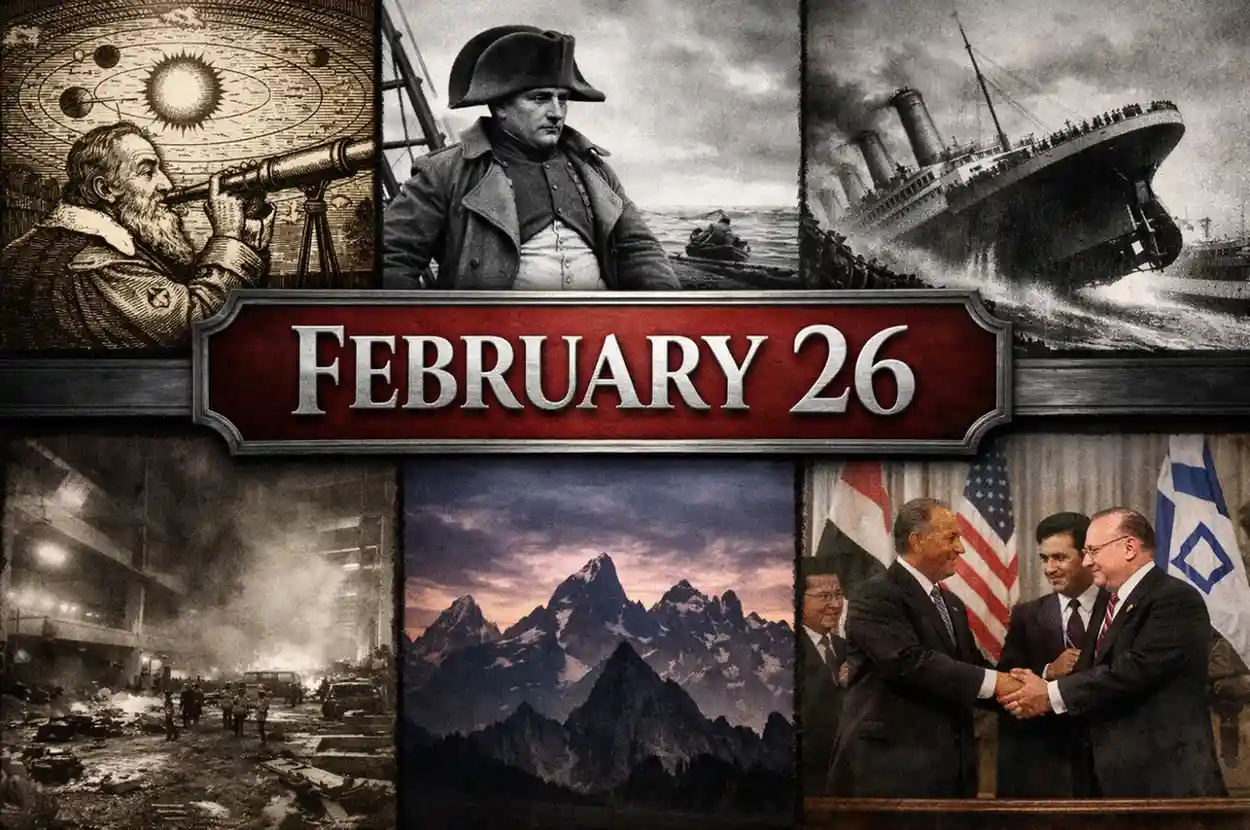
Time often feels like a series of disconnected events, but when we look closely at what happened on this day in history February 26, we see a profound tapestry of structural beginnings and explosive endings. From the very epoch used by historians to date ancient civilizations to the modern-day shockwaves of the World Trade Center bombing, today is a day where the foundations of law, science, and sovereignty have been tested.
Whether it is Napoleon slipping his chains on Elba or the silent launch of the sister ship to the Titanic, the events of February 26 remind us that history is constantly moving, even when it feels like we are standing still.
Important Events That Happened On February 26 In History
747 BC – The Nabonassar Era Begins
According to the astronomer Ptolemy, the Nabonassar Era began at noon on this date, marking a crucial chronological anchor for ancient history. This epoch allowed later historians and astronomers to synchronize various ancient calendars and establish a reliable BC timeline for significant world events. It serves as a foundational “year zero” for the technical dating of the Babylonian and Egyptian dynasties.
320 – Coronation of Chandragupta I
Chandragupta I was officially crowned as the first emperor of the Gupta Empire, initiating a period often referred to as the Golden Age of India. His reign marked a significant expansion of territory and the beginning of a dynasty that would lead to unprecedented advancements in science, art, and philosophy. The Gupta era set the cultural and political standards for the Indian subcontinent for centuries to come.
364 – Valentinian I Proclaimed Emperor
Following the sudden death of Emperor Jovian, the Roman military proclaimed Valentinian I as the new emperor of Rome. Known for his military prowess, he chose to share power by appointing his brother Valens as co-emperor to manage the eastern provinces. His reign was defined by the relentless defense of the empire’s borders against Germanic tribes like the Alamanni and Quadi.
1074 – Battle of Kemej
In a fierce struggle for the Hungarian throne, the royal army of King Solomon defeated the forces of his rebellious cousin, Duke Géza. The battle was a result of long-standing tensions over succession and power sharing within the Árpád dynasty. Although Solomon won this specific encounter, the internal conflict would eventually lead to his downfall and Géza’s subsequent rise to the throne.
1266 – Battle of Benevento
An army led by Charles, Count of Anjou, defeated the combined German and Sicilian forces of King Manfred at the Battle of Benevento. Manfred was killed during the fighting, ending the Hohenstaufen rule in Southern Italy and securing the influence of the Papacy. Following the victory, Pope Clement IV officially invested Charles as the King of Sicily and Naples, reshaping Italian politics.
1365 – Founding of the Ava Kingdom
King Thado Minbya founded the Ava Kingdom and established the royal city of Ava (Inwa) as its capital in what is now modern-day Myanmar. The city was strategically located on an artificial island created by connecting rivers, serving as a bastion of Upper Burmese culture for nearly four centuries. Its founding was a pivotal moment in the unification of the central Burmese plains after years of fragmentation.
1606 – First European Landing in Australia
Willem Janszoon and the crew of the Dutch ship Duyfken became the first recorded Europeans to set foot on Australian soil near the Pennefather River. Mistakenly believing the land was part of New Guinea, Janszoon mapped roughly 200 miles of the coastline before departing. This voyage predated the arrival of Captain Cook by over 160 years, though the Dutch found the land unsuitable for trade at the time.
1616 – Galileo Banned from Teaching Sun-Centric View
The Roman Catholic Church formally banned Galileo Galilei from teaching or defending the Copernican theory that the Earth orbits the Sun. The Church declared the heliocentric view to be “foolish and absurd in philosophy” and formally heretical because it contradicted a literal reading of the Bible. This decree set the stage for Galileo’s later trial and lifelong house arrest for his scientific convictions.
1775 – Destruction of Balambangan Factory
A British East India Company trading post on Balambangan Island, near Borneo, was destroyed during a surprise attack by Moro pirates. The raid forced the British to abandon the strategic site, which they had intended to use as a primary trade link with China. The loss highlighted the volatility of colonial trade routes and the significant power of indigenous maritime forces in Southeast Asia.
1794 – Christiansborg Palace Burns
The first Christiansborg Palace in Copenhagen, the magnificent residence of the Danish royal family, was completely destroyed by a devastating fire. The loss of the palace forced the monarchy to move to Amalienborg, which has served as the royal residence ever since. The ruins were eventually cleared to make way for the second palace, which would also face its own fiery fate years later.
1815 – Napoleon Escapes from Elba
After ten months of exile on the island of Elba, Napoleon Bonaparte escaped with a small group of loyal soldiers and set sail for France. His daring flight triggered the “Hundred Days,” a final, dramatic campaign to reclaim his empire and overthrow the restored Bourbon monarchy. His return sent shockwaves through the capitals of Europe, leading to the mobilization of an international coalition against him.
1870 – Beach Pneumatic Transit Opens
Alfred Ely Beach opened the Beach Pneumatic Transit in New York City, the city’s first attempt at an underground subway system. The 312-foot tunnel featured a plush, circular car that was propelled by massive fans blowing air through a tube. While it was intended as a demonstration to prove the feasibility of subways, political opposition from Boss Tweed prevented its expansion into a full-scale network.
1876 – Treaty of Kangwha
Japan and Korea signed the Treaty of Kangwha, a significant “unequal treaty” that forced Korea to open three of its ports to Japanese trade. The agreement granted Japanese citizens extraterritoriality rights and effectively ended Korea’s long-standing status as a tributary state of Qing dynasty China. This diplomatic maneuver was a major step in Japan’s imperial expansion and its eventual annexation of the Korean peninsula.
1909 – First Public Color Motion Picture
Kinemacolor, the first successful process for producing color motion pictures, was demonstrated to the general public at the Palace Theatre in London. Developed by George Albert Smith, the process used a rotating red-and-green filter wheel in front of the camera and projector to create a vibrant, flickering color image. This technological breakthrough was the first step away from the monochromatic world of early cinema.
1914 – Launch of the HMHS Britannic
The HMHS Britannic, the third and largest of the Olympic-class ocean liners and sister ship to the Titanic, was launched at the Harland and Wolff shipyard in Belfast. Originally intended for luxury passenger service, she was requisitioned as a hospital ship during World War I before she could ever carry a commercial traveler. Her life was tragically short, as she sank just two years later after hitting a naval mine in the Aegean Sea.
1919 – Grand Canyon National Park Established
President Woodrow Wilson signed the act of Congress that officially established the Grand Canyon National Park in Arizona. Though it had been protected as a forest reserve and a national monument for decades, this designation provided the highest level of federal protection for the world-famous natural wonder. Today, it remains one of the most visited and geologically significant sites in the global park system.
1929 – Grand Teton National Park Established
President Calvin Coolidge signed the legislation that created Grand Teton National Park, protecting 96,000 acres of the Teton Range in Wyoming. The park was originally much smaller than its current size, focusing primarily on the jagged mountain peaks and the glacial lakes at their base. Subsequent land donations and expansions eventually shaped the park into the vast wilderness area enjoyed by millions today.
1935 – Re-formation of the Luftwaffe
In an open defiance of the Treaty of Versailles, Adolf Hitler officially ordered the re-establishment of the Luftwaffe as a branch of the German military. Under the leadership of Hermann Göring, the air force was built in secret before this public announcement revealed its existence to the world. This move was a critical component of Germany’s rapid rearmament program in preparation for future expansionist wars.
1935 – Radar Demonstration by Robert Watson-Watt
British physicist Robert Watson-Watt carried out a successful demonstration near Daventry, showing that radio waves could be used to detect the presence of an aircraft. This experiment, known as the “Daventry Experiment,” led directly to the development of the Chain Home radar network. This technology would prove to be the decisive advantage for the Royal Air Force during the Battle of Britain five years later.
1936 – The February 26 Incident
A group of young, nationalist Japanese military officers launched a coup attempt in downtown Tokyo, assassinating several high-ranking government officials. The rebels occupied the city’s political center, demanding a “Showas Restoration” to eliminate perceived corruption and restore absolute power to the Emperor. The rebellion was crushed three days later on the Emperor’s orders, leading to increased military control over the government.
1945 – US Troops Reclaim Corregidor
United States forces officially reclaimed the Philippine island of Corregidor from Japanese control during a daring amphibious and paratrooper operation. The island, known as “The Rock,” had been a symbol of American resistance during the early days of the war before its fall in 1942. The recapture was a vital step in the liberation of Manila Bay and the final defeat of Japanese forces in the Philippines.
1952 – Vincent Massey Sworn In
Vincent Massey was sworn in as the 18th Governor General of Canada, marking the first time a Canadian-born individual held the post. Previously, the position had always been filled by British aristocrats, and Massey’s appointment signaled a major step in Canada’s growing sense of national identity and independence. His tenure was defined by his tireless promotion of Canadian arts, culture, and higher education.
1960 – Alitalia Crash in Shannon
An Alitalia airliner bound for New York crashed into a cemetery shortly after taking off from Shannon Airport in Ireland. The Douglas DC-7C lost altitude rapidly before striking the ground, resulting in the deaths of 34 of the 52 people on board. Investigators looked into engine failure and pilot fatigue, though the exact cause of the sudden loss of height during the climb remained difficult to determine definitively.
1960 – Aeroflot Crash in Lviv
In a tragic day for aviation, an Aeroflot An-10 airliner crashed while on its final approach to Snilow Airport in Lviv, Ukraine. The aircraft struck trees and plummeted to the ground, killing 32 of the 33 people on board. This accident, along with others involving the same model, raised serious concerns about the structural integrity and flight stability of the An-10 aircraft during landing maneuvers.
1966 – First Saturn IB Flight
The Apollo program achieved a major milestone with the launch of AS-201, the first uncrewed flight of the Saturn IB rocket. The mission tested the rocket’s propulsion systems and the heat shield of the Apollo Command Module as it re-entered the atmosphere. The success of this flight proved that the Saturn IB was a reliable vehicle for carrying astronauts into Earth orbit for the upcoming moon missions.
1971 – UN Proclaims Earth Day
United Nations Secretary-General U Thant signed a formal proclamation declaring the vernal equinox as the official Earth Day. This designation was intended to encourage global awareness and action regarding environmental protection and the preservation of natural resources. Unlike the April 22 celebration, this UN-recognized date emphasizes the astronomical start of spring and the harmony of the planet’s cycles.
1979 – Superliner Enters Service
The first Superliner railcars officially entered revenue service with Amtrak, marking a new era for long-distance train travel in the United States. These bi-level passenger cars offered improved views, modern amenities, and a more comfortable ride for passengers traveling across the country. The Superliner fleet became the backbone of Amtrak’s western long-distance routes, such as the Empire Builder and the California Zephyr.
1980 – Egypt-Israel Diplomatic Relations
Egypt and Israel officially established full diplomatic relations, exchanging ambassadors for the first time in history. This historic move followed the Camp David Accords and the 1979 peace treaty, ending decades of open hostility and multiple wars between the two neighbors. The opening of embassies in Tel Aviv and Cairo was a monumental, if controversial, step toward regional stability in the Middle East.
1987 – Tower Commission Rebukes Reagan
The Tower Commission, appointed to investigate the Iran-Contra affair, issued a report that strongly rebuked President Ronald Reagan. While the commission did not find evidence of a direct cover-up by the President, it criticized his “relaxed” management style for allowing his national security staff to operate without oversight. The report led to significant changes in how the National Security Council functioned within the White House.
1992 – Khojaly Massacre
During the First Nagorno-Karabakh War, Armenian armed forces opened fire on ethnic Azerbaijani civilians fleeing the town of Khojaly. Human rights organizations and international observers reported that hundreds of unarmed civilians, including women and children, were killed in the massacre. It remains one of the most tragic and contentious events in the long-running conflict between Armenia and Azerbaijan.
1993 – World Trade Center Bombing
A massive truck bomb exploded in the parking garage beneath the North Tower of the World Trade Center in New York City. The blast killed six people and injured over a thousand others, causing significant structural damage and creating a smoke-filled nightmare for those trapped in the buildings. The attack, carried out by a group of extremists, was at that time the most significant act of terrorism on American soil.
1995 – Collapse of Barings Bank
Barings Bank, the UK’s oldest investment bank, collapsed after rogue trader Nick Leeson lost $1.4 billion through unauthorized speculative trades. Leeson had been gambling on the future of the Japanese stock market from the bank’s Singapore office, hiding his massive losses in a secret account. The collapse shocked the global financial world and led to much stricter regulations regarding bank oversight and internal controls.
2008 – NY Philharmonic in Pyongyang
In a rare moment of cultural diplomacy, the New York Philharmonic performed a televised concert at the East Pyongyang Grand Theatre in North Korea. Conducted by Lorin Maazel, the program included both American and Korean music, marking the first major cultural event of its kind in the isolated nation. The performance was seen as a “soft power” attempt to ease tensions between the United States and North Korea.
2012 – Burlington Train Derailment
A VIA Rail passenger train derailed in Burlington, Ontario, after traveling through a crossover at excessive speeds. The accident resulted in the deaths of three locomotive engineers and left 45 passengers with various injuries. The crash led to a major investigation by the Transportation Safety Board of Canada, which emphasized the need for better fail-safe systems to prevent human error in railway operations.
2012 – Death of Trayvon Martin
Seventeen-year-old Trayvon Martin was shot and killed by neighborhood watch coordinator George Zimmerman during an altercation in Sanford, Florida. The death of the unarmed teenager and the subsequent acquittal of Zimmerman sparked a massive national debate over racial profiling, self-defense laws, and civil rights. The event became a pivotal moment that eventually led to the birth of the Black Lives Matter movement.
2013 – Luxor Hot Air Balloon Crash
A hot air balloon carrying foreign tourists caught fire and exploded near Luxor, Egypt, killing 19 of the 21 people on board. The balloon plunged roughly 1,000 feet to the ground after a fuel leak ignited during the flight. The tragedy was the deadliest hot air balloon accident in history and led to an immediate suspension of balloon flights in the region as safety protocols were re-evaluated.
2019 – Balakot Airstrike
The Indian Air Force carried out a series of airstrikes against a Jaish-e-Mohammed terrorist training camp in Balakot, Pakistan. The mission was a retaliatory response to a suicide bombing in Pulwama that had killed 40 Indian security personnel. The airstrike marked the first time since the 1971 war that Indian jets had crossed the Line of Control, significantly escalating military tensions between the two nuclear-armed nations.
2021 – Zamfara Kidnapping
Bandits raided the Government Girls Science Secondary School in Jangebe, Nigeria, kidnapping 279 female students aged between 10 and 17. This mass abduction was part of a disturbing trend of school kidnappings for ransom by armed groups in northern Nigeria. While the students were eventually released a few days later, the event highlighted the severe insecurity facing educational institutions in the region.
Read About Feb 25 Crazy Moments
Famous People Born On February 26
| Name | Description | Date |
|---|---|---|
| Sébastien Loeb | French rally driver (9× WRC champion) | February 26, 1974 – Present |
| Betty Hutton | American actress & singer | February 26, 1921 – March 12, 2007 |
| Tex Avery | American cartoon director | February 26, 1908 – August 26, 1980 |
| Helen Clark | Prime Minister of New Zealand | February 26, 1950 – Present |
| Ahmed H. Zewail | Nobel Prize–winning chemist | February 26, 1946 – August 2, 2016 |
| Ferdinand I of Bulgaria | King of Bulgaria | February 26, 1861 – September 10, 1948 |
| Elizabeth George | American author | February 26, 1949 – Present |
| Orde Wingate | British military officer | February 26, 1903 – March 24, 1944 |
| Theodore Sturgeon | Science-fiction writer | February 26, 1918 – May 8, 1985 |
| I. A. Richards | Literary critic & poet | February 26, 1893 – September 7, 1979 |
Famous People Died On February 26
| Name | Description | Date |
|---|---|---|
| Thomas-Alexandre Dumas | French general | March 25, 1762 – February 26, 1806 |
| Hermann Ebbinghaus | Pioneer of memory studies | January 24, 1850 – February 26, 1909 |
| Karl Jaspers | Existentialist philosopher | February 23, 1883 – February 26, 1969 |
| Cuauhtémoc | Last Aztec emperor | c.1495 – February 26, 1522 |
| Roger II of Sicily | King of Sicily | December 22, 1095 – February 26, 1154 |
| Joseph de Maistre | Political philosopher | April 1, 1753 – February 26, 1821 |
| Jacques Plante | Ice hockey player | January 17, 1929 – February 26, 1986 |
| Levi Eshkol | Prime Minister of Israel | October 25, 1895 – February 26, 1969 |
Observances & Institutional Dates
- Liberation Day (Kuwait): Commemorating the liberation of Kuwait from Iraqi occupation in 1991.
- Day of Remembrance for Khojaly (Azerbaijan): A national day of mourning for the victims of the 1992 massacre.
- Saviours’ Day (Nation of Islam): An annual holiday celebrating the birth of the movement’s founder, Master Fard Muhammad.
- Earth Day (UN Recognition): The celebration of the vernal equinox as a time for global environmental awareness.
Frequently Asked Questions
- What was the Nabonassar Era?
- It is an epoch starting in 747 BC used by ancient astronomers like Ptolemy to establish a consistent timeline for historical events.
- Why was Galileo banned from teaching heliocentrism?
- The Catholic Church declared in 1616 that the idea of the Earth orbiting the Sun was philosophically absurd and heretical.
- Who was the first Canadian-born Governor General?
- Vincent Massey broke the tradition of British-born appointees when he was sworn in on February 26, 1952.
- What caused the collapse of Barings Bank?
- The bank collapsed in 1995 after trader Nick Leeson lost $1.4 billion through unauthorized speculative trades in Singapore.