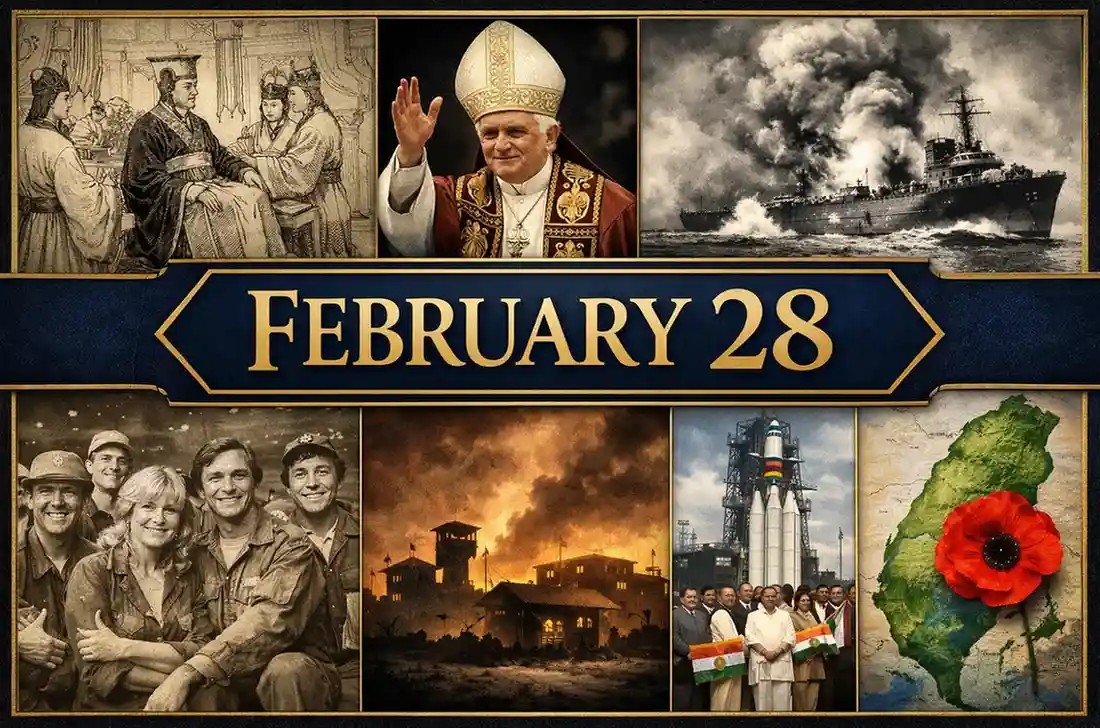
The passage of time often seems like a steady flow, but when we look at what happened on this day in history February 28, we find a series of sharp, defining breaks that altered the course of empires and human understanding. It is a day that witnessed the birth of the Han dynasty and the rare, humble resignation of a Pope in the modern era.
From the tragic echoes of civil unrest in Taiwan to the celebration of scientific achievement in India, today reminds us that history is made as much in the quiet stroke of a pen as it is in the loud, world-changing events of the battlefield or the launchpad.
Important Events That Happened On February 28 In History
202 BC – Enthronement of Liu Bang
Liu Bang was officially enthroned as the Emperor of China, marking the formal beginning of the Han dynasty’s four-century rule. His rise to power followed a period of intense civil war and the collapse of the short-lived Qin dynasty. The Han era is often considered a golden age in Chinese history, establishing a centralized bureaucracy and cultural identity that continues to influence the region today.
870 – Fourth Council of Constantinople Closes
The Fourth Council of Constantinople came to a close, having focused primarily on the status of Patriarch Photius of Constantinople. The council’s decisions exacerbated the growing rift between the Eastern and Western Christian churches regarding ecclesiastical authority. While it aimed to bring unity, the theological and political divisions highlighted during the sessions served as a precursor to the Great Schism of 1054.
1525 – Execution of Cuauhtémoc
Cuauhtémoc, the last Aztec ruler of Tenochtitlan, was executed on the order of the Spanish conquistador Hernán Cortés. Cortés had kept the king as a captive for years following the conquest, but he ordered the execution during an expedition to Honduras after alleging a conspiracy. The death of Cuauhtémoc symbolized the final, definitive end of the Aztec Empire’s political structure under Spanish colonial rule.
1638 – Signing of the Scottish National Covenant
The Scottish National Covenant was signed at Greyfriars Kirkyard in Edinburgh, representing a formal resistance to the religious reforms imposed by King Charles I. The signatories, known as Covenanters, swore to defend their Presbyterian faith against the King’s attempts to align the Scottish church with English Anglicanism. This act of defiance was a major catalyst for the Bishops’ Wars and the broader Wars of the Three Kingdoms.
1835 – Foreword to the Kalevala Signed
Elias Lönnrot signed and dated the foreword to the first version of the Kalevala, which is now known as the “Old Kalevala.” This epic work was compiled from Finnish folk stories and oral traditions that Lönnrot collected during his extensive travels through the countryside. The publication of the Kalevala was instrumental in the development of Finnish national identity and the preservation of the country’s unique linguistic heritage.
1844 – USS Princeton Disaster
A massive gun nicknamed “The Peacemaker” exploded on board the steam warship USS Princeton during a high-profile pleasure cruise on the Potomac River. The blast killed six people, including Secretary of State Abel Upshur and the Secretary of the Navy, while President John Tyler narrowly escaped injury. The tragedy led to a significant re-evaluation of naval weapon design and sparked a period of mourning for the United States government.
1922 – Independence of Egypt
The United Kingdom officially ended its protectorate over Egypt through a Unilateral Declaration of Independence. While the declaration granted Egypt nominal sovereignty, the British maintained control over several key areas, including the Suez Canal and the defense of the nation. This moment marked the beginning of Egypt’s modern statehood, though tensions regarding British influence would persist for several decades.
1925 – Charlevoix-Kamouraska Earthquake
The Charlevoix-Kamouraska earthquake, one of the most powerful seismic events in Canadian history, struck northeastern North America. The quake was felt across wide areas, including Quebec, Ontario, and parts of the United States, causing significant structural damage to buildings and infrastructure. It remains a key event for seismologists studying the tectonic activity of the Saint Lawrence Valley and the intraplate regions.
1947 – The February 28 Incident in Taiwan
In Taiwan, an anti-government uprising known as the February 28 incident was violently suppressed by the forces of the Kuomintang. The resulting “White Terror” led to the deaths of an estimated 18,000 to 28,000 civilians and the execution of many members of the Taiwanese intellectual elite. The event left a deep trauma on the island’s society and remained a forbidden topic of discussion for decades until democratization.
1948 – Accra Riots in Ghana
Violence erupted in Accra after colonial police opened fire on a peaceful march of ex-servicemen who were petitioning the governor at Christiansborg Castle. The killings of Sergeant Adjetey and others sparked widespread riots and led to the arrest of the “Big Six,” including future leader Kwame Nkrumah. This event is viewed as a pivotal turning point in the Gold Coast’s struggle for independence from British rule.
1958 – Floyd County Bus Accident
A school bus in Floyd County, Kentucky, plunged into the rain-swollen Levisa Fork river after striking a truck on a narrow road. The disaster claimed the lives of the driver and 26 children, making it one of the deadliest school bus accidents in the history of the United States. The tragedy prompted nationwide improvements in school bus safety standards and emergency exit requirements to protect students in the future.
1959 – Launch of Discoverer 1
Discoverer 1 was launched from Vandenberg Air Force Base as the first American satellite intended to achieve a polar orbit. While the launch was a major technical milestone, the satellite failed to achieve a stable orbit and was lost shortly after its deployment. Despite the failure, the mission provided valuable data that paved the way for the successful Corona spy satellite program during the height of the Cold War.
1966 – NASA T-38 Crash
NASA astronauts Elliot See and Charles Bassett were killed when their T-38 Talon jet crashed into the McDonnell Aircraft factory in St. Louis during poor weather. The two men were the prime crew for the upcoming Gemini 9 mission and were visiting the plant to inspect their spacecraft. The accident forced NASA to restructure the mission assignments and served as a somber reminder of the dangers inherent in the space program.
1969 – Portugal Earthquake
A large earthquake struck the Atlantic Ocean west of the Strait of Gibraltar, impacting Portugal, Spain, and Morocco with significant tremors. While the epicenter was offshore, the quake caused several deaths and widespread panic in major cities like Lisbon and Casablanca. It served as a reminder of the seismic risks in the region, which had historically been devastated by the massive Lisbon earthquake of 1755.
1973 – Aeroflot Flight X-167 Crash
Aeroflot Flight X-167 crashed shortly after taking off from Semey Airport in present-day Kazakhstan, resulting in the deaths of all 32 people on board. The investigation determined that the aircraft suffered a control failure that prevented the crew from maintaining a safe climb. The disaster was one of several accidents that led to a review of safety protocols and maintenance within the Soviet civil aviation sector during that era.
1974 – British Hung Parliament
The British general election ended in a “hung parliament,” as no single political party secured an absolute majority of seats in the House of Commons. The Liberal Party, led by Jeremy Thorpe, achieved its largest share of the popular vote since 1929, making it a critical power broker in the negotiations. This political deadlock eventually led to the formation of a minority government under Labour’s Harold Wilson.
1975 – Moorgate Tube Crash
In one of London’s worst rail disasters, an underground train failed to stop at the Moorgate terminus station and slammed into the end of a dead-end tunnel. The high-speed impact killed 43 people and injured scores more, as the front carriages were crushed within the narrow space. The cause of the accident remained a mystery, as no mechanical faults were found, leading to the installation of automatic “Moorgate protection” stops.
1983 – Final Episode of MASH*
The legendary television series MASH* aired its final episode, titled “Goodbye, Farewell and Amen,” drawing a record-breaking audience of almost 110 million viewers. The two-and-a-half-hour special brought a definitive end to the story of the 4077th Mobile Army Surgical Hospital during the Korean War. It remains one of the most-watched television events in history, marking the end of an era for broadcast network television.
1985 – Newry Mortar Attack
The Provisional Irish Republican Army launched a devastating mortar attack on the Royal Ulster Constabulary police station in Newry, Northern Ireland. Nine police officers were killed when one of the mortar shells struck a temporary canteen where the staff were having a break. The attack was one of the deadliest single incidents for the police force during the period of civil conflict known as The Troubles.
1986 – Assassination of Olof Palme
Olof Palme, the 26th Prime Minister of Sweden, was assassinated in central Stockholm while walking home from a cinema with his wife. The killing of the prominent social democratic leader shocked the nation, which had long prided itself on its openness and lack of high-level political violence. Despite decades of investigation and various theories, the identity and motive of the killer remained a subject of intense debate for years.
1990 – Launch of STS-36
The Space Shuttle Atlantis was launched from Kennedy Space Center on mission STS-36, a classified flight dedicated to the United States Department of Defense. Due to the secret nature of the mission, very little information was released regarding its payload or objectives, though it is widely believed to have deployed a sophisticated reconnaissance satellite. The mission successfully landed four days later, completing another chapter in the shuttle’s military service.
1993 – Waco Siege Begins
Agents from the Bureau of Alcohol, Tobacco and Firearms (ATF) attempted to raid the Branch Davidian compound in Waco, Texas, to serve an arrest warrant to David Koresh. The initial gun battle resulted in the deaths of four agents and six church members, marking the start of a tense 51-day standoff. The siege ended in a catastrophic fire in April, which remains one of the most controversial events in American law enforcement history.
1997 – Northern Iran Earthquake
A powerful earthquake struck the Ardabil province in northern Iran, causing the deaths of approximately 1,100 people and leaving thousands more homeless. The quake devastated remote mountainous villages where the traditional mud-brick construction offered little resistance to the seismic forces. International aid agencies worked alongside Iranian authorities to provide emergency shelter and medical care in the freezing winter conditions.
1997 – Turkish Military Memorandum
In an event often described as a “post-modern coup,” the Turkish military leadership issued a memorandum to the coalition government led by Necmettin Erbakan. The military demanded a series of secularist reforms and a crackdown on religious influence in public life, leading to the eventual collapse of the government. Unlike previous coups, the military achieved its goals through political pressure rather than a direct takeover of the state.
2001 – Nisqually Earthquake
The Nisqually earthquake, measuring 6.8 on the moment magnitude scale, struck the southern Puget Sound region near Seattle, Washington. The deep-seated quake caused significant damage to the historic Pioneer Square district and the Seattle-Tacoma International Airport, though fatalities were fortunately very low. The event served as a major wake-up call for the region to invest in seismic retrofitting for older buildings and bridges.
2002 – Gujarat Riots Massacres
During a period of intense religious violence in the Indian state of Gujarat, 97 people were killed in the Naroda Patiya massacre and 69 more in the Gulbarg Society massacre. These events were part of wider communal riots that followed the burning of a train in Godhra the previous day. The massacres led to long-running legal battles and remain a deeply painful and significant chapter in India’s modern social history.
2013 – Resignation of Pope Benedict XVI
Pope Benedict XVI officially stepped down from his position as the leader of the Catholic Church, citing his declining strength and advanced age. He was the first pope to resign since Gregory XII in 1415, a move that stunned the global Catholic community and broke centuries of tradition. His departure led to the papal enclave that eventually elected Pope Francis as his successor.
2023 – Tempe Train Collision
Two trains collided head-on near the Vale of Tempe in Greece, resulting in the deaths of at least 57 people and leaving dozens more injured. The accident involved a high-speed passenger train and a freight train that were mistakenly directed onto the same track due to a signaling error. The disaster sparked massive protests across Greece regarding the safety and modernization of the country’s national railway system.
2024 – Kulasekarapattinam Spaceport Inauguration
Prime Minister Narendra Modi officially inaugurated India’s second spaceport at Kulasekarapattinam in the state of Tamil Nadu. The new facility is designed specifically to handle the launch of Small Satellite Launch Vehicles (SSLV) and private sector missions. This strategic expansion aims to alleviate the burden on the Satish Dhawan Space Centre and solidify India’s position as a global leader in the commercial satellite launch market.
Famous People Born On February 28
| Name | Description | Date |
|---|---|---|
| Svetlana Alliluyeva | Daughter of Joseph Stalin, writer | February 28, 1926 – November 22, 2011 |
| Daniel Handler | American author (A Series of Unfortunate Events) | February 28, 1970 – Present |
| Steven Chu | Nobel Prize–winning physicist | February 28, 1948 – Present |
| Zero Mostel | American comedic actor | February 28, 1915 – September 8, 1977 |
| Leon N. Cooper | Nobel Prize physicist (BCS theory) | February 28, 1930 – October 23, 2024 |
| Ernest Renan | French philosopher and historian | February 28, 1823 – October 2, 1892 |
| Louis-Joseph de Montcalm | French military commander | February 28, 1712 – September 14, 1759 |
| Alexis of Russia | Heir to Russian throne | February 28, 1690 – July 7, 1718 |
| Stephen Spender | English poet and critic | February 28, 1909 – July 16, 1995 |
| Peter B. Medawar | Nobel Prize–winning biologist | February 28, 1915 – October 2, 1987 |
| Ben Hecht | American writer and screenwriter | February 28, 1894 – April 18, 1964 |
| Alfred von Schlieffen | German military strategist | February 28, 1833 – January 4, 1913 |
| Mary Lyon | Pioneer in women’s education | February 28, 1797 – March 5, 1849 |
| Karl Ernst von Baer | Founder of embryology | February 28, 1792 – November 28, 1876 |
| Vsevolod Pudovkin | Soviet film director | February 28, 1893 – June 30, 1953 |
| Mark Latham | Australian political leader | February 28, 1961 – Present |
| Daniel C. Tsui | Nobel Prize physicist | February 28, 1939 – Present |
| Geraldine Farrar | American opera singer | February 28, 1882 – March 11, 1967 |
| Milton Caniff | Comic strip artist | February 28, 1907 – April 3, 1988 |
| Jean Bourgain | Fields Medal mathematician | February 28, 1954 – December 22, 2018 |
| René-Antoine Réaumur | French scientist and entomologist | February 28, 1683 – October 17, 1757 |
| Victor Berger | First Socialist in U.S. Congress | February 28, 1860 – August 7, 1929 |
| F.C. Kohli | Pioneer of Indian IT industry | February 28, 1924 – November 26, 2020 |
| Florian Cajori | Historian of mathematics | February 28, 1859 – August 14, 1930 |
| Arthur Symons | English poet and critic | February 28, 1865 – January 22, 1945 |
| Leo von Klenze | German neoclassical architect | February 28, 1784 – January 27, 1864 |
| Joost Bürgi | Inventor of logarithms | February 28, 1552 – January 31, 1632 |
| Antonio Guzmán Blanco | President of Venezuela | February 28, 1829 – July 20, 1899 |
| Henri Breuil | Archaeologist of cave art | February 28, 1877 – August 14, 1961 |
| Philip Showalter Hench | Nobel Prize physician | February 28, 1896 – March 30, 1965 |
Famous People Died On February 28
| Name | Description | Date |
|---|---|---|
| Freeman Dyson | Theoretical physicist | December 15, 1923 – February 28, 2020 |
| Alfonso XIII | King of Spain | May 17, 1886 – February 28, 1941 |
| Friedrich Ebert | President of Weimar Republic | February 4, 1871 – February 28, 1925 |
| Paul Harvey | American radio broadcaster | September 4, 1918 – February 28, 2009 |
| Henry Luce | Influential magazine publisher | April 3, 1898 – February 28, 1967 |
| Donald A. Glaser | Nobel Prize physicist | September 21, 1926 – February 28, 2013 |
| Christian IV | King of Denmark and Norway | April 12, 1577 – February 28, 1648 |
| Alphonse de Lamartine | French poet and statesman | October 21, 1790 – February 28, 1869 |
| Daniel J. Boorstin | American historian | October 1, 1914 – February 28, 2004 |
| Honda Ishirō | Japanese film director | May 7, 1911 – February 28, 1993 |
| Lilla Cabot Perry | American Impressionist artist | January 13, 1848 – February 28, 1933 |
| Martin Bucer | Protestant reformer | November 11, 1491 – February 28, 1551 |
| Nikolai Ryzhkov | Soviet premier | September 28, 1929 – February 28, 2024 |
| Nicholas Mosley | British novelist | June 25, 1923 – February 28, 2017 |
| Raymond IV of Toulouse | Crusader leader | 1041 – February 28, 1105 |
| Maxwell Anderson | American playwright | December 15, 1888 – February 28, 1959 |
| Cosimo II de’ Medici | Grand Duke of Tuscany | May 12, 1590 – February 28, 1621 |
| Yaşar Kemal | Turkish novelist | October 6, 1923 – February 28, 2015 |
| André-Charles Boulle | French cabinetmaker | November 11, 1642 – February 28, 1732 |
| Carmen Laforet | Spanish novelist | September 6, 1921 – February 28, 2004 |
| Cyril Tourneur | English dramatist | c.1575 – February 28, 1626 |
| Owen Chamberlain | Nobel Prize physicist | July 10, 1920 – February 28, 2006 |
| Frigyes Riesz | Hungarian mathematician | January 22, 1880 – February 28, 1956 |
| Harvey Kuenn | Baseball player | December 4, 1930 – February 28, 1988 |
| Giovanni Morelli | Art critic | February 25, 1816 – February 28, 1891 |
| Goldsworthy Gurney | Inventor and engineer | February 14, 1793 – February 28, 1875 |
| Charles Nicolle | Nobel Prize bacteriologist | September 21, 1866 – February 28, 1936 |
| Hugo Kołłątaj | Polish reformer | April 1, 1750 – February 28, 1812 |
| Arnold Dolmetsch | Music revival pioneer | February 24, 1858 – February 28, 1940 |
| Mario Luzi | Italian poet and critic | October 20, 1914 – February 28, 2005 |
Observances & Institutional Dates
- Kalevala Day (Finland): A celebration of Finnish culture and the publication of the national epic poem.
- National Science Day (India): Commemorating the discovery of the Raman Effect by Sir C.V. Raman in 1928.
- Peace Memorial Day (Taiwan): A day of mourning and remembrance for the victims of the 1947 February 28 incident.
- Andalusia Day (Spain): Celebrating the 1980 referendum that granted the region of Andalusia its status as an autonomous community.
Frequently Asked Questions
- Why is February 28 significant in Finland?
- It is Kalevala Day, celebrating the nation’s culture and the epic folk poetry compiled by Elias Lönnrot.
- Who was Olof Palme?
- He was the Prime Minister of Sweden who was famously assassinated on this day in 1986 while walking home from a theater.
- What happened at Waco on this day?
- The 1993 siege of the Branch Davidian compound began with a failed ATF raid and a deadly shootout.
- Was Pope Benedict XVI the first to resign?
- No, but he was the first to do so in nearly 600 years, with the previous resignation occurring in 1415.