History often feels like a series of disconnected moments until we look at a single date and see how the world’s narrative weaves together. When we investigate what happened on this day in history February 3, we find a timeline that stretches from the consolidation of medieval power in Italy to the high-stakes technological “Doomsday” flights of the Cold War. It is a day marked by the birth of modern economic systems, the tragic loss of musical legends, and the quiet landing of a Soviet probe on the lunar dust.
Important Events That Happened On February 3 In History
1047 – Election of Drogo of Hauteville
Drogo of Hauteville was elected as the count of the Apulian Normans. This took place during the Norman conquest of Southern Italy, a period of significant territorial expansion. Drogo succeeded his brother William Iron Arm, and his leadership helped solidify Norman control over the region, paving the way for the future Kingdom of Sicily.
1112 – Union of Barcelona and Provence
Ramon Berenguer III, Count of Barcelona, married Douce I, Countess of Provence. This marriage was a major diplomatic and dynastic event that united the fortunes and territories of the two states. The union significantly expanded the influence of the House of Barcelona across the Pyrenees and into what is now southern France.
1451 – Sultan Mehmed II Inherits the Throne
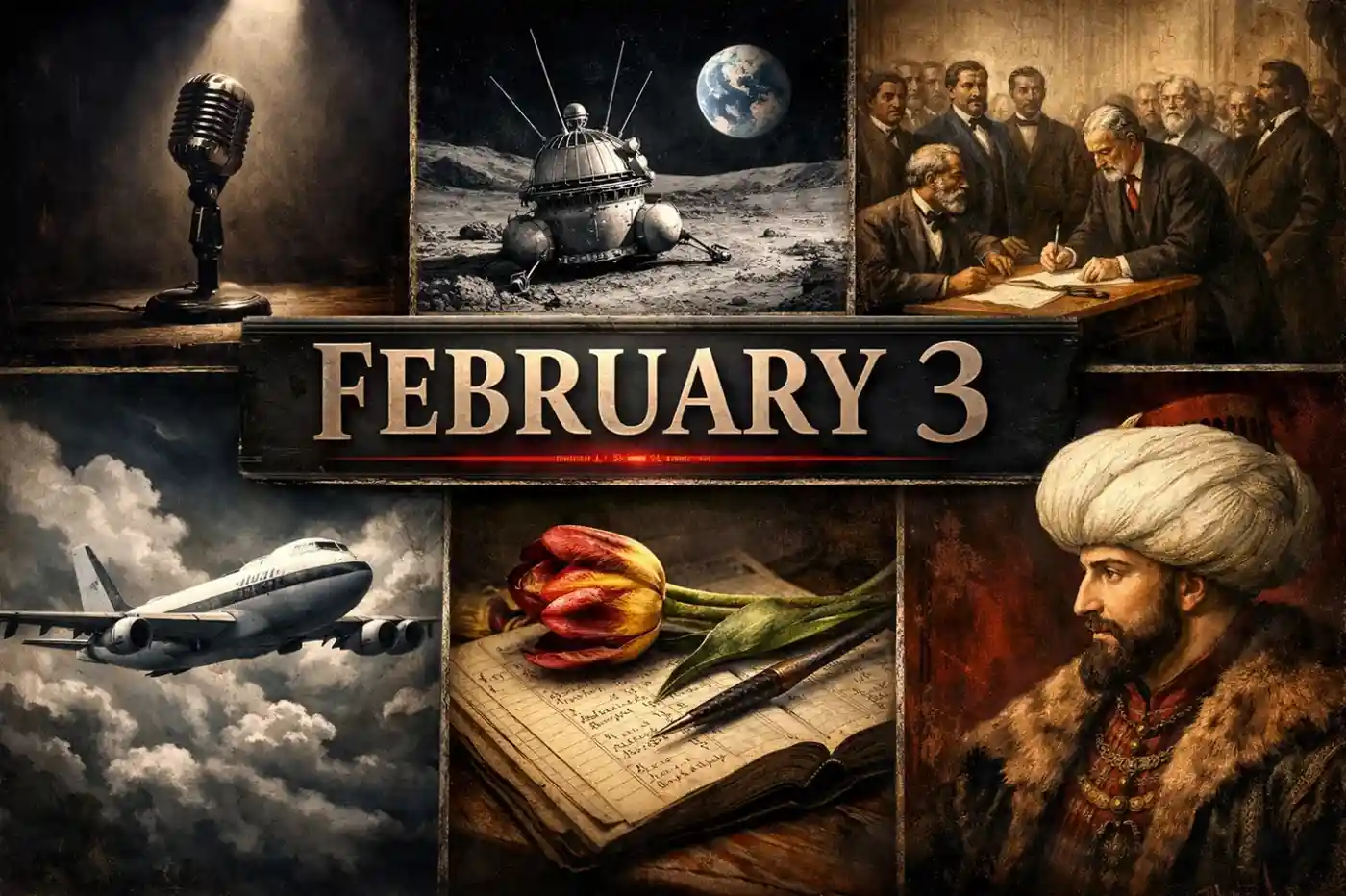
Following the death of his father, Murad II, Mehmed II ascended to the throne of the Ottoman Empire for the second time. Known to history as “Mehmed the Conqueror,” his reign would change the course of history just two years later with the conquest of Constantinople, effectively ending the Byzantine Empire.
1488 – Bartolomeu Dias Lands in Mossel Bay
Portuguese explorer Bartolomeu Dias landed in Mossel Bay after successfully rounding the Cape of Good Hope. This achievement made him the first known European to travel so far south and proved that an ocean route from Europe to Asia was possible, fundamentally altering global trade and exploration.
1509 – The Battle of Diu
In a pivotal naval engagement, the Portuguese navy defeated a massive joint fleet representing the Ottoman Empire, Venice, the Sultan of Gujarat, the Mamlûk Sultanate, the Zamorin of Calicut, and the Republic of Ragusa. The victory at Diu gave Portugal control over the Indian Ocean, marking the beginning of European colonial dominance in Asian waters.
1583 – Battle of São Vicente
Off the coast of Portuguese Brazil, three English warships commanded by Edward Fenton engaged three Spanish galleons. The English forces managed to fight off the Spanish, sinking one galleon in the process. The battle was a notable incident of naval friction between the two powers during a period of intense colonial competition.
1637 – Collapse of Tulip Mania
The Dutch Republic witnessed the sudden collapse of “Tulip Mania,” the world’s first recorded speculative economic bubble. At the height of the craze, single tulip bulbs sold for more than ten times the annual income of a skilled craftsman. When the market crashed on this day, many investors were left with worthless flowers and financial ruin.
1639 – First Meeting of the Barbados House of Assembly
The House of Assembly of Barbados met for the first time. This established Barbados as one of the oldest parliamentary democracies in the Commonwealth. The assembly gave local planters a voice in governance, though it also solidified the legislative framework for the island’s burgeoning plantation economy.
1690 – First Paper Money in the Americas
The colony of Massachusetts issued the first paper money in the Americas. These “bills of credit” were printed to pay for military expeditions during King William’s War. This move marked a major transition in the colonial economy, moving away from a strictly commodity-based system toward a modern fiat currency.
1706 – Battle of Fraustadt
During the Great Northern War, Swedish forces achieved a brilliant victory over a numerically superior Saxon-Polish-Russian force at Fraustadt. The Swedish commander used a daring double envelopment tactic (the “pincer movement”) to decimate the enemy, showcasing the tactical superiority of the Swedish army under Charles XII.
1716 – The Algiers Earthquake
A powerful earthquake sequence began in Algiers with a mainshock estimated at Mw 7.0. The disaster caused catastrophic damage across the city and surrounding regions, claiming the lives of approximately 20,000 people. It remains one of the deadliest seismic events in North African history.
1781 – Seizure of Sint Eustatius
During the American Revolutionary War, British naval forces under Admiral George Rodney seized the Dutch-owned island of Sint Eustatius. The island had been a vital conduit for supplies and gunpowder reaching the American revolutionaries, and its capture was an attempt by the British to choke off the American supply chain.
1783 – Spain–United States Relations Established
Spain officially recognized the independence of the United States, marking the formal beginning of diplomatic relations between the two nations. This recognition was crucial for the young United States as it sought to establish its legitimacy on the world stage following the Revolutionary War.
1787 – End of Shays’ Rebellion
Militia forces led by General Benjamin Lincoln crushed the remnants of Shays’ Rebellion in Petersham, Massachusetts. The uprising, led by debt-ridden farmers, had highlighted the weaknesses of the Articles of Confederation and became a primary catalyst for the calling of the Constitutional Convention.
1807 – Capture of Montevideo
A British military force commanded by Sir Samuel Auchmuty captured the city of Montevideo from the Spanish Empire. While the British occupation of the region (now the capital of Uruguay) was short-lived, it stimulated local desires for independence and free trade, contributing to the future liberation of South America.
1809 – Illinois Territory Created
The 10th United States Congress officially created the Territory of Illinois. The act carved the new territory out of the existing Indiana Territory. This move was a prerequisite for the region’s eventual statehood and reflected the rapid westward expansion of the American frontier.
1813 – Battle of San Lorenzo
In a significant engagement of the Argentine War of Independence, José de San Martín led his Mounted Grenadiers to victory against a Spanish royalist army at San Lorenzo. This was San Martín’s first battle in South America and established his reputation as a brilliant military strategist for the independence cause.
1830 – Independence of Greece Confirmed
The London Protocol of 1830 was signed, establishing the full independence and sovereignty of Greece from the Ottoman Empire. Following years of bloody conflict in the Greek War of Independence, the great powers of Europe finally recognized Greece as a fully independent kingdom.
1862 – Formation of the Romanian United Principalities
The principalities of Moldavia and Wallachia formally united to create the Romanian United Principalities under Prince Alexandru Ioan Cuza. This union laid the political and administrative foundation for the modern nation-state of Romania.
1870 – Ratification of the 15th Amendment
The Fifteenth Amendment to the United States Constitution was ratified. This landmark amendment guaranteed that the right of citizens to vote shall not be denied or abridged by the United States or by any State on account of race, color, or previous condition of servitude, specifically aiming to protect the rights of newly freed Black men.
1913 – Ratification of the 16th Amendment
The Sixteenth Amendment to the U.S. Constitution was ratified, granting the Federal government the authority to impose and collect a direct income tax without apportioning it among the states. This radically changed the funding structure of the American government and allowed for the growth of federal programs.
1916 – Parliament Buildings Burn in Ottawa
The Centre Block of the Parliament buildings in Ottawa, Canada, was destroyed by a devastating fire. Seven people lost their lives in the blaze. The iconic Library of Parliament was the only part of the structure saved, thanks to a quick-thinking librarian who shut the iron fire doors.
1917 – US Breaks Relations with Germany
President Woodrow Wilson announced that the United States had broken off diplomatic relations with Germany. The move was a direct response to the German government’s announcement that it would resume unrestricted submarine warfare, sinking any merchant ships—neutral or otherwise—found in the war zone.
1918 – Twin Peaks Tunnel Opens
The Twin Peaks Tunnel in San Francisco began service. At 11,920 feet, it was the longest streetcar tunnel in the world at the time. The tunnel allowed for rapid transit between the city center and the outlying residential districts, fueling the development of the city’s western neighborhoods.
1927 – Revolt in Porto
A military revolt broke out in the city of Porto against the “Ditadura Nacional” (National Dictatorship) of Portugal. While the uprising was eventually suppressed by government forces, it reflected the deep political instability and resistance to authoritarian rule in early 20th-century Portugal.
1930 – Communist Party of Vietnam Founded
Ho Chi Minh and other revolutionaries founded the Communist Party of Vietnam during a “Unification Conference” held in Kowloon, British Hong Kong. The party was established to lead the struggle against French colonial rule and would eventually become the ruling party of a unified Vietnam.
1931 – Hawke’s Bay Earthquake
New Zealand suffered its worst natural disaster when the Hawke’s Bay earthquake struck. The Mw 7.8 quake and subsequent fires killed 258 people and devastated the towns of Napier and Hastings. The disaster led to major changes in New Zealand’s building codes and emergency response systems.
1933 – Hitler Outlines “Lebensraum”
In a private speech to German military leaders, Adolf Hitler announced that his ultimate geopolitical objective was the expansion of “Lebensraum” (living space) into Eastern Europe. He emphasized that this would involve the ruthless “Germanisation” of the territory, setting the stage for the ideological atrocities of World War II.
1943 – Sinking of the SS Dorchester
The US troopship SS Dorchester was torpedoed and sunk by a German U-boat in the North Atlantic. Of the 902 men on board, only 230 survived. The event is famous for the “Four Chaplains” who gave up their life jackets to save others and went down with the ship while praying together.
1944 – Seizure of Kwajalein Atoll
U.S. Army and Marine forces successfully captured Kwajalein Atoll from its Japanese defenders. This victory was a significant milestone in the Pacific Theater’s “island hopping” campaign, providing the U.S. with a strategic base in the heart of the Marshall Islands.
1945 – Bombing of Berlin (Operation Thunderclap)
As part of Operation Thunderclap, 1,000 B-17 Flying Fortresses of the U.S. Eighth Air Force bombed Berlin. The massive raid killed between 2,500 and 3,000 people and left 120,000 homeless. It was one of the largest air raids of the war, intended to shatter German morale and disrupt communications.
1945 – Battle for Manila Begins
United States and Philippine Commonwealth forces began a month-long, house-to-house battle to retake the city of Manila from the Japanese. The battle was incredibly brutal, resulting in the near-total destruction of the city and the deaths of approximately 100,000 Filipino civilians.
1953 – The Batepá Massacre
On the island of São Tomé, the Portuguese colonial administration and local landowners launched a wave of violence against native Creoles known as forros. Hundreds of people were killed or tortured. The massacre is remembered as a seminal moment in the development of the national independence movement in São Tomé and Príncipe.
1958 – Founding of the Benelux Union
Belgium, the Netherlands, and Luxembourg signed the treaty establishing the Benelux Economic Union. By creating a customs union and allowing for the free movement of goods and people, the Benelux served as an important testing ground and precursor to the later European Economic Community (EEC).
1959 – The Day the Music Died
Rock and roll pioneers Buddy Holly, Ritchie Valens, and J.P. “The Big Bopper” Richardson were killed in a plane crash near Clear Lake, Iowa. The loss of three rising stars in a single accident shocked the world and was later immortalized as “The Day the Music Died” in Don McLean’s song “American Pie.”
1959 – American Airlines Flight 320 Crash
Sixty-five people were killed when an American Airlines Lockheed L-188 Electra crashed into the East River while approaching LaGuardia Airport in New York City. The crash was attributed to pilot error and the improper use of altimeters during a night approach in poor visibility.
1960 – The “Wind of Change” Speech
British Prime Minister Harold Macmillan delivered his famous “Wind of Change” speech to the Parliament of South Africa. He signaled that the British government would no longer block decolonization and expected its African colonies to move toward independence, marking a major shift in British imperial policy.
1961 – Operation Looking Glass Begins
The United States Air Force began Operation Looking Glass. For the next 30 years, a Boeing EC-135 “Doomsday Plane” was kept in the air 24 hours a day. These planes were equipped to take direct command of the nation’s nuclear arsenal in the event that ground-based command posts were destroyed.
1966 – First Soft Landing on the Moon
The Soviet Union’s Luna 9 became the first spacecraft to achieve a soft landing on the Moon. It was also the first spacecraft to transmit panoramic photographs directly from the lunar surface back to Earth, proving that the Moon’s surface was solid rather than covered in deep, treacherous dust.
1971 – Shooting of Frank Serpico
New York City Police Officer Frank Serpico was shot in the face during a drug bust in Brooklyn. Serpico, who had been exposing widespread corruption within the NYPD, survived the shooting. His subsequent testimony before the Knapp Commission led to the most significant police reforms in the city’s history.
1972 – The Deadliest Snowstorm in History
The first day of a seven-day blizzard began in Iran. The storm eventually dropped up to 26 feet of snow in some areas, burying entire villages. At least 4,000 people were killed, making it the deadliest snowstorm in recorded history.
1984 – History’s First Embryo Transfer
A research team led by Dr. John Buster at Harbor-UCLA Medical Center announced the first successful embryo transfer from one woman to another. The procedure resulted in a live birth, offering a new path for women who were unable to conceive with their own eggs and marking a milestone in reproductive medicine.
1984 – Launch of STS-41-B
The Space Shuttle Challenger launched on mission STS-41-B. This mission is famous for the first untethered spacewalk, performed by Bruce McCandless II using the Manned Maneuvering Unit (MMU), allowing him to float freely in space away from the shuttle.
1989 – P.W. Botha Resigns as Party Leader
Following a stroke, South African President P.W. Botha resigned as leader of the National Party. While he remained President for six more months, his resignation as party leader opened the door for F.W. de Klerk to take over and begin the process of dismantling apartheid.
1989 – Overthrow of Alfredo Stroessner
A military coup led by General Andrés Rodríguez overthrew Alfredo Stroessner, who had ruled Paraguay as a dictator since 1954. Stroessner’s 35-year reign was the longest in South American history. The coup marked the beginning of Paraguay’s transition toward democracy.
1994 – First Russian on a US Space Shuttle
Mission STS-60 launched with Sergei Krikalev on board, making him the first Russian cosmonaut to fly on a U.S. Space Shuttle. This mission was a landmark in international space cooperation, signaling the end of the Cold War Space Race and the beginning of the partnership that led to the International Space Station.
1995 – First Female Shuttle Pilot
Astronaut Eileen Collins became the first woman to pilot a Space Shuttle as mission STS-63 lifted off. The mission, known as “Near-Mir,” involved the shuttle Discovery performing a rendezvous with the Russian space station Mir, further strengthening international space ties.
1998 – Cavalese Cable Car Disaster
A United States Marine Corps electronic warfare aircraft, flying too low during a training mission, severed the cable of an aerial tramway near Trento, Italy. The cable car fell over 260 feet, killing all 20 people on board. The incident caused severe strain in Italy–United States relations.
2005 – Kam Air Flight 904 Crash
A Kam Air Boeing 737 crashed in the Pamir Mountains during a snowstorm while approaching Kabul, Afghanistan. All 105 people on board were killed. The investigation revealed that the crew had attempted to land in weather conditions that were far below safety minimums.
2007 – Baghdad Market Bombing
A massive truck bomb exploded in a crowded market in the Sadriya neighborhood of Baghdad. The blast killed at least 135 people and injured over 300. The attack was one of the deadliest of the Iraq War, targeting civilians in a predominantly Shia area during a period of intense sectarian violence.
2014 – Moscow School Shooting
A high school student in Moscow opened fire on a classroom, killing a teacher and a police officer and wounding another person. It was a rare instance of a school shooting in Russia and led to a national debate regarding school security and gun control laws.
2023 – Ohio Train Derailment
A Norfolk Southern freight train carrying hazardous materials, including vinyl chloride, derailed in East Palestine, Ohio. To prevent an explosion, officials conducted a “controlled release” of the chemicals, which released hydrogen chloride and phosgene into the air. The accident caused widespread environmental concerns and the contamination of the Ohio River.
Check These: This Day In History February 2: Jaw-Dropping Twists
Famous People Born On February 3
| Name | Role / Description | Birth – Death |
|---|---|---|
| Paul Auster | American novelist & essayist | February 3, 1947 – April 30, 2024 |
| James Michener | American novelist | February 3, 1907 – October 16, 1997 |
| Alvar Aalto | Finnish architect | February 3, 1898 – May 11, 1976 |
| Henning Mankell | Swedish author | February 3, 1948 – October 5, 2015 |
| Blaise Compaoré | President of Burkina Faso | February 3, 1951 – |
| Kenneth Anger | American filmmaker & author | February 3, 1927 – May 24, 2023 |
| Pretty Boy Floyd | American gangster | February 3, 1904 – October 22, 1934 |
| Joseph E. Johnston | Confederate general | February 3, 1807 – March 21, 1891 |
| Robert Arthur Talbot Gascoyne-Cecil | UK Prime Minister | February 3, 1830 – August 22, 1903 |
| Edward Stafford | British noble | February 3, 1478 – May 17, 1521 |
| George A. Miller | American psychologist | February 3, 1920 – July 22, 2012 |
| E.P. Thompson | British historian | February 3, 1924 – August 28, 1993 |
| Carl Theodor Dreyer | Danish director | February 3, 1889 – March 20, 1968 |
| Emile Griffith | American boxer | February 3, 1938 – July 23, 2013 |
| George Steiner | Literary critic | April 23, 1929 – February 3, 2020 |
| Helen Stephens | American athlete | February 3, 1918 – January 17, 1994 |
| Sir William Cornelius Van Horne | Railroad executive | February 3, 1843 – September 11, 1915 |
| Antonio José de Sucre | South American leader | February 3, 1795 – June 4, 1830 |
| Hudson Maxim | American inventor | February 3, 1853 – May 6, 1927 |
| Joseph Gordon Coates | NZ Prime Minister | February 3, 1878 – May 27, 1943 |
| Jacques Soustelle | French anthropologist & politician | February 3, 1912 – August 7, 1990 |
| Hugh Montague Trenchard | British military officer | February 3, 1873 – February 10, 1956 |
| Charles Henry Turner | American scientist | February 3, 1867 – February 14, 1923 |
| Ramón José Sender | Spanish novelist | February 3, 1902 – January 15, 1982 |
| Gaston Maurice Julia | French mathematician | February 3, 1893 – March 19, 1978 |
| Jean-Étienne-Dominique Esquirol | French psychiatrist | February 3, 1772 – December 12, 1840 |
| Elisha Kent Kane | American explorer | February 3, 1820 – February 16, 1857 |
| Art Arfons | American race-car driver | February 3, 1926 – December 3, 2007 |
| Ignacy Krasicki | Polish poet | February 3, 1735 – March 14, 1801 |
| Gideon Algernon Mantell | British paleontologist | February 3, 1790 – November 10, 1852 |
Famous People Died On February 3
| Name | Role / Description | Birth – Death |
|---|---|---|
| John of Gaunt | English prince | March 1340 – February 3, 1399 |
| Murad II | Ottoman sultan | June 1404 – February 3, 1451 |
| Oliver Heaviside | British physicist | May 18, 1850 – February 3, 1925 |
| Ernst Mayr | American biologist | July 5, 1904 – February 3, 2005 |
| George Crabbe | English poet | December 24, 1754 – February 3, 1832 |
| Jan Steen | Dutch painter | c.1626 – February 3, 1679 |
| Hugo Junkers | German aircraft designer | February 3, 1859 – February 3, 1935 |
| Fukuzawa Yukichi | Japanese author & educator | January 10, 1835 – February 3, 1901 |
| Alla Rakha | Indian musician | April 29, 1919 – February 3, 2000 |
| Édouard Glissant | Martinican author | September 21, 1928 – February 3, 2011 |
| Gervase Markham | English poet & author | c.1568 – February 3, 1637 |
| William D. Coolidge | American engineer & chemist | October 23, 1873 – February 3, 1975 |
| Friedrich Wilhelm, Baron von Seydlitz | Prussian general | February 3, 1721 – November 8, 1773 |
| Karl Seitz | Austrian politician | September 4, 1869 – February 3, 1950 |
| Niccolò Niccoli | Italian humanist | c.1364 – February 3, 1437 |
| Laura Wheeler Waring | American artist | May 16, 1887 – February 3, 1948 |
| Émile Borel | French mathematician | January 7, 1871 – February 3, 1956 |
| Robert M. Yerkes | American psychologist | May 26, 1876 – February 3, 1956 |
| Sir Henry Maine | British jurist & historian | August 15, 1822 – February 3, 1888 |
| David M. Key | American politician | January 27, 1824 – February 3, 1900 |
| Petar Živković | Prime minister of Yugoslavia | January 1, 1879 – February 3, 1947 |
| Sir Morell Mackenzie | English physician | July 7, 1837 – February 3, 1892 |
| August Kopisch | German painter & poet | May 26, 1799 – February 3, 1853 |
| Eugène Rouher | French statesman | November 30, 1814 – February 3, 1884 |
| David Wilkinson | American inventor | January 5, 1771 – February 3, 1852 |
| Christiaan Rudolf de Wet | Boer statesman | October 7, 1854 – February 3, 1922 |
| John Gould | British ornithologist | September 14, 1804 – February 3, 1881 |
| Maximilian, prince zu Wied-Neuwied | German naturalist & explorer | September 23, 1782 – February 3, 1867 |
| Thomas Hope | English author & designer | 1769 – February 3, 1831 |
| Sophia Hayden | American architect | October 17, 1868 – February 3, 1953 |
Observances & Institutional Dates
- The Day the Music Died: Commemorating the 1959 plane crash of Buddy Holly, Ritchie Valens, and the Big Bopper.
- Four Chaplains Day (US): Honoring the self-sacrifice of the four military chaplains on the SS Dorchester.
- Setsubun (Japan): A traditional festival marking the day before the beginning of spring.
- Communist Party of Vietnam Foundation Anniversary: Celebrating the party’s founding in 1930.
Frequently Asked Questions
- What happened to Buddy Holly on February 3?
- He was killed in a plane crash in 1959, an event known as “The Day the Music Died.”
- What was Operation Looking Glass?
- It was a Cold War program where a “Doomsday Plane” was always airborne to maintain nuclear command.
- What did the 15th Amendment do?
- Ratified on this day in 1870, it guaranteed voting rights regardless of race.
- What was the first spacecraft to land on the Moon?
- The Soviet probe Luna 9 achieved the first soft landing on February 3, 1966.