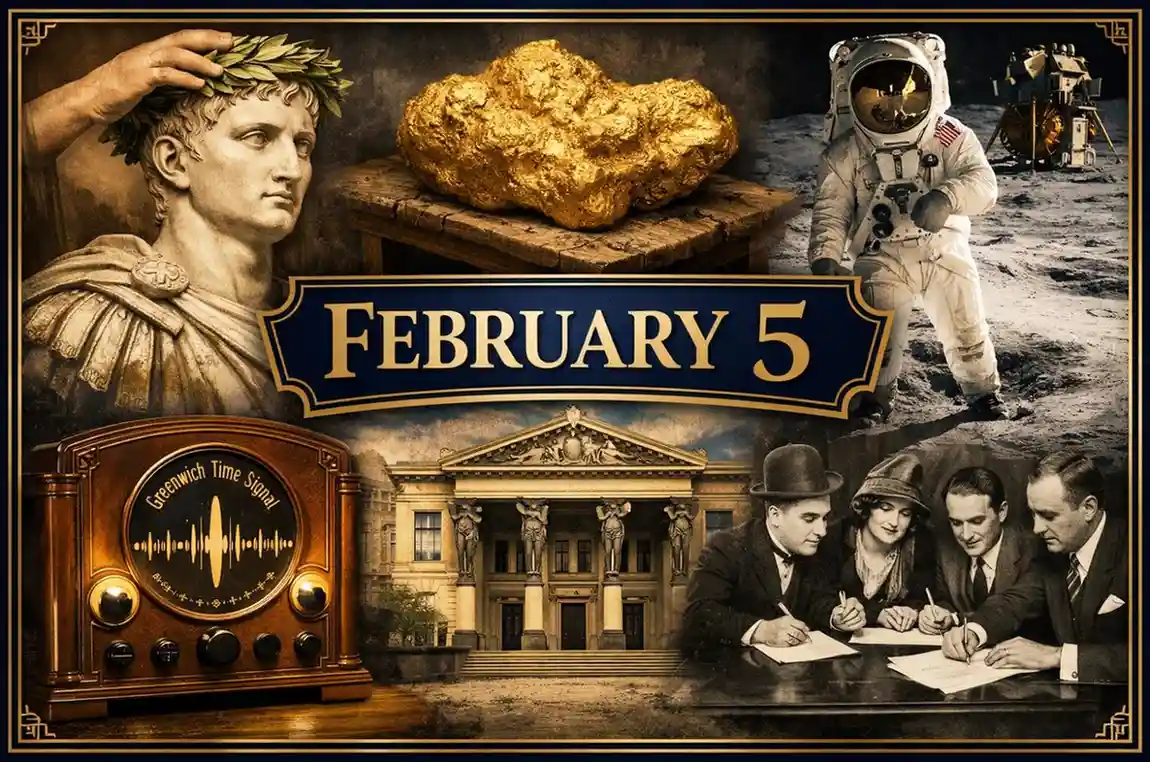
The timeline of human events is often as unpredictable as the shifting tectonic plates beneath our feet. When we look at what happened on this day in history February 5, we find a date where the Roman Senate bestowed the ultimate title upon an emperor and a modern president stood acquitted in the halls of Congress. This day has witnessed the birth of the modern Romanian state, the creation of the world’s first synthetic plastic, and the first time a Pope stepped foot on the Arabian Peninsula.
From the recovery of massive gold nuggets in the Australian outback to the tragic massacres in Chechnya and Sarajevo, February 5 serves as a stark reminder of the incredible breadth of the human experience.
Important Events That Happened On February 5 In History
2 BC – Augustus Named “Father of the Country”
In a moment of supreme political consolidation, the Roman Senate granted Caesar Augustus the title of pater patriae (Father of the Country). This title was more than just an honor; it solidified his role as the caretaker and moral guardian of the Roman people, marking a peak in his long and influential reign.
62 – Earthquake in Pompeii
A powerful earthquake struck Pompeii and the surrounding region of Campania, Italy. The tremors caused significant damage to the city’s infrastructure and private homes. While the city was largely rebuilt in the years following, this event served as a precursor to the cataclysmic eruption of Mount Vesuvius seventeen years later.
756 – An Lushan Proclaims Himself Emperor
On Chinese New Year, the rebel leader An Lushan declared himself Emperor of China, founding the state of Yan. This act was a pivotal moment in the An Lushan Rebellion, one of the deadliest conflicts in history, which severely weakened the Tang Dynasty and led to immense loss of life across the empire.
1576 – Henry of Navarre Returns to Protestantism
At Tours, Henry of Navarre officially abjured Catholicism and rejoined the Protestant (Huguenot) forces during the French Wars of Religion. Henry, who would eventually become King Henry IV of France, frequently navigated religious conversions for political survival and the eventual stability of his kingdom.
1597 – Martyrdom of the Twenty-Six Christians of Japan
In Nagasaki, a group of twenty-six early Japanese Christians were executed by the new government of Japan. Seen as a threat to the established social order and Shinto traditions, their martyrdom marked the beginning of a period of intense persecution of Christianity in Japan.
1783 – The Calabrian Earthquake Sequence
A series of five strong earthquakes began in the Calabria region of southern Italy. This seismic sequence lasted for several weeks and caused catastrophic destruction, claiming tens of thousands of lives and permanently altering the landscape of the Italian “toe.”
1810 – Siege of Cádiz Begins
During the Peninsular War, French forces began the Siege of Cádiz. The city served as the seat of the Spanish provisional government (the Cortes of Cádiz) and became a symbol of Spanish resistance against Napoleon’s occupation. The siege would last for two and a half years.
1818 – Jean-Baptiste Bernadotte Becomes King
Jean-Baptiste Bernadotte, a former French Marshal under Napoleon, ascended to the thrones of Sweden and Norway as Charles XIV John. His accession founded the House of Bernadotte, which remains the reigning royal house of Sweden to this day.
1852 – Opening of the New Hermitage Museum
The New Hermitage Museum in Saint Petersburg, Russia, officially opened its doors to the public. Commissioned by Tsar Nicholas I to house the vast imperial art collection, it remains one of the largest, oldest, and most prestigious museums in the world.
1859 – Birth of the Modern Romanian State
In a landmark move for Eastern European geopolitics, Alexandru Ioan Cuza, the Prince of Moldavia, was elected as the Prince of Wallachia. This “personal union” joined the two principalities into the United Principalities, an autonomous region within the Ottoman Empire that served as the foundation for modern Romania.
1869 – Discovery of the “Welcome Stranger”
The largest alluvial gold nugget ever recorded, named the “Welcome Stranger,” was found by Cornish miners John Deason and Richard Jeffery in Moliagul, Victoria, Australia. The massive nugget weighed approximately 72 kilograms (roughly 2,300 ounces).
1885 – Leopold II Establishes the Congo Free State
King Leopold II of Belgium officially established the Congo Free State as his personal possession. Unlike other colonies, it was owned privately by the King. His rule would later become notorious for the brutal exploitation of the local population during the rubber boom.
1901 – J.P. Morgan Incorporates U.S. Steel
Financier J.P. Morgan incorporated the United States Steel Corporation in New Jersey. While it wouldn’t begin business until later that month, the eventual acquisition of Carnegie Steel and other assets made it the first billion-dollar corporation in history.
1905 – General Hospital of Mexico Inaugurated
The General Hospital of Mexico was officially inaugurated, beginning operations with four primary medical specialties. It has since grown into one of the most important public healthcare and research institutions in Latin America.
1907 – Creation of Bakelite
Belgian chemist Leo Baekeland announced his invention of Bakelite, the world’s first fully synthetic plastic. Bakelite was revolutionary for its heat-resistant and non-conductive properties, ushering in the modern “Age of Plastics.”
1913 – First Naval Air Mission
Greek aviators Michael Moutoussis and Aristeidis Moraitinis performed history’s first naval air mission. Flying a Farman MF.7 hydroplane during the First Balkan War, they reconnoitered the Ottoman fleet in the Dardanelles and dropped four bombs.
1913 – Revival of L’incoronazione di Poppea
Claudio Monteverdi’s final opera, L’incoronazione di Poppea, was performed theatrically for the first time in over 250 years. The revival of this 17th-century masterpiece marked a significant moment in the modern appreciation of Baroque opera.
1917 – Adoption of the Mexican Constitution
The current Constitution of Mexico was adopted in Querétaro. It established a federal republic and was the first constitution in the world to include social rights, such as labor protections and land reform, as well as the separation of powers.
1917 – US Passes the Immigration Act of 1917
The United States Congress overrode President Woodrow Wilson’s veto to pass the Immigration Act of 1917. The law significantly restricted immigration from Asia and introduced a literacy test for immigrants, reflecting the nativist sentiments of the era.
1918 – First US Aerial Victory
Stephen W. Thompson, a member of the 1st Aero Squadron, shot down a German airplane over France. This achievement is recognized as the first aerial combat victory by a member of the United States military.
1918 – Sinking of the SS Tuscania
The SS Tuscania was torpedoed and sunk by a German U-boat off the coast of Ireland. It was the first ship carrying American troops to Europe to be sunk during World War I, resulting in the loss of over 200 lives.
1919 – United Artists Launched
Film legends Charlie Chaplin, Mary Pickford, Douglas Fairbanks, and D.W. Griffith founded United Artists. The studio was created to give actors and directors more control over their own work and a larger share of the profits.
1924 – First Greenwich Time Signal
The Royal Greenwich Observatory began broadcasting the hourly time signals known as the “Greenwich Time Signal” or the “pips.” These signals allowed people to synchronize their clocks with incredible accuracy via the BBC.
1933 – Mutiny on HNLMS De Zeven Provinciën
A mutiny broke out among Indonesian and Dutch sailors on the Royal Netherlands Navy warship HNLMS De Zeven Provinciën off the coast of Sumatra. The mutineers were protesting pay cuts; the uprising was eventually ended by a Dutch aerial bombing.
1939 – Francisco Franco Becomes Caudillo
Generalísimo Francisco Franco was officially named the “Caudillo de España” (Leader of Spain). This established his decades-long authoritarian rule following the Nationalist victory in the Spanish Civil War.
1941 – Battle of Keren Begins
Allied forces launched the Battle of Keren in an effort to capture the strategic city in Eritrea from Italian defenders. The battle was some of the most difficult and decisive fighting of the East African Campaign of World War II.
1945 – MacArthur Returns to Manila
General Douglas MacArthur officially returned to Manila following the Allied push to liberate the city from Japanese occupation. His return was a major milestone in the liberation of the Philippines.
1958 – Nasser Nominated as UAR President
Gamal Abdel Nasser was nominated to be the first president of the United Arab Republic, a short-lived political union between Egypt and Syria. The union reflected the mid-century surge of Pan-Arabism.
1958 – The Lost Tybee Bomb
During a mid-air collision training exercise, a U.S. Air Force B-47 bomber was forced to jettison a 7,600-pound hydrogen bomb off the coast of Tybee Island, Georgia. The bomb, which did not have a nuclear capsule installed at the time, was never recovered.
1962 – De Gaulle Calls for Algerian Independence
In a televised address, French President Charles de Gaulle formally called for Algeria to be granted independence. This move signaled the beginning of the end for the bloody Algerian War and French colonial rule in North Africa.
1963 – Van Gend en Loos Ruling
The European Court of Justice issued its ruling in Van Gend en Loos v Nederlandse Administratie der Belastingen. The decision established the principle of “direct effect,” allowing individual citizens to invoke European Union law in national courts—a cornerstone of modern EU law.
1967 – Shanghai People’s Commune Proclaimed
During the height of the Cultural Revolution, the Shanghai People’s Commune was formally established. Led by Yao Wenyuan and Zhang Chunqiao, it was an attempt to model the city’s government on the Paris Commune of 1871.
1971 – Apollo 14 Moon Landing
Astronauts Alan Shepard and Edgar Mitchell landed the Lunar Module Antares on the Moon’s Fra Mauro highlands. Shepard famously became the first person to hit a golf ball on the lunar surface during this mission.
1975 – The “Limazo” Riots in Peru
After Peruvian police forces went on strike, massive riots broke out in Lima. Known as the Limazo, the uprising was bloodily suppressed by the military dictatorship of Juan Velasco Alvarado, resulting in hundreds of deaths.
1981 – Operation Soap
The Metropolitan Toronto Police Force conducted “Operation Soap,” raiding four gay bathhouses and arresting nearly 300 men. The event triggered mass protests and is considered a turning point in the Canadian LGBTQ+ rights movement.
1985 – Official End of the Third Punic War
In a symbolic act of peace, the mayors of Rome and Carthage met in Tunis to sign a treaty of friendship. This ceremony officially ended the Third Punic War, which had technically remained “open” for 2,131 years since the destruction of Carthage in 146 BC.
1988 – Manuel Noriega Indicted
Panamanian military leader Manuel Noriega was indicted by a U.S. federal grand jury on charges of drug smuggling and money laundering. These charges eventually led to the 1989 U.S. invasion of Panama.
1994 – Conviction of Byron De La Beckwith
White supremacist Byron De La Beckwith was finally convicted of the 1963 assassination of civil rights leader Medgar Evers. The conviction came over 30 years after the crime, following two previous trials that had ended in hung juries.
1994 – Markale Marketplace Massacre
During the Siege of Sarajevo, a mortar shell exploded in a crowded downtown marketplace, killing over 60 people and wounding 200. The massacre drew intense international condemnation and calls for NATO intervention in the Bosnian War.
1997 – Swiss Banks Aid Holocaust Survivors
The “Big Three” Swiss banks announced the creation of a $71 million fund to assist Holocaust survivors and their families. This followed years of pressure regarding assets held in dormant accounts since World War II.
2000 – Novye Aldi Massacre
Russian forces carried out a massacre in the Novye Aldi suburb of Grozny, Chechnya. At least 60 civilians were killed during a “mopping-up” operation. Human rights organizations documented the event as a significant war crime of the Second Chechen War.
2004 – Haiti Rebellion Begins
Rebels from the Revolutionary Artibonite Resistance Front captured the city of Gonaïves. This event signaled the start of a nationwide rebellion that eventually led to the ousting of President Jean-Bertrand Aristide.
2008 – Super Tuesday Tornado Outbreak
A major tornado outbreak tore across the Southern United States, including Tennessee, Arkansas, and Kentucky. Fifty-seven people were killed, making it one of the deadliest outbreaks in the region in decades.
2016 – Steven Joyce Dildo Incident
During a Waitangi Day protest in New Zealand, politician Steven Joyce was hit by a rubber dildo thrown by a protester. The footage of the incident went viral, becoming a bizarre footnote in the country’s political history.
2019 – Pope Francis Visits Abu Dhabi
Pope Francis became the first Pope in history to visit and perform a papal mass in the Arabian Peninsula. During his visit to Abu Dhabi, he focused on interfaith dialogue and signed the “Document on Human Fraternity.”
2020 – Donald Trump Acquitted
The United States Senate voted to acquit President Donald Trump on two articles of impeachment (abuse of power and obstruction of Congress). The trial ended his first impeachment process, largely along party lines.
2020 – Pegasus Airlines Flight 2193 Crash
A Boeing 737 operating as Pegasus Airlines Flight 2193 overshot the runway while landing in heavy rain at Istanbul’s Sabiha Gökçen International Airport. The aircraft broke into three pieces, killing three people and injuring 179.
2021 – Mexico City Cyclist Riot
A protest by cyclists in Mexico City, sparked by a bus accident involving a bicyclist, turned into a riot as police attempted to break up the demonstration. Eleven police officers were subsequently arrested for their conduct during the clash.
Take a Look At Februray 4 Stories
Famous People Born On February 5
| Name | Short Description | Dates |
|---|---|---|
| Errol Morris | American documentary filmmaker | February 5, 1948 – |
| Adlai E. Stevenson | U.S. statesman and diplomat | February 5, 1900 – July 14, 1965 |
| Dwight L. Moody | Influential American evangelist | February 5, 1837 – December 22, 1899 |
| Sir Hiram Maxim | Inventor of the machine gun | February 5, 1840 – November 24, 1916 |
| John Boyd Dunlop | Inventor of the pneumatic tire | February 5, 1840 – October 23, 1921 |
| André-Gustave Citroën | Founder of Citroën automobiles | February 5, 1878 – July 3, 1935 |
| Ben Ainslie | Olympic sailing champion | February 5, 1977 – |
| Carl Spitzweg | German Romantic painter | February 5, 1808 – September 23, 1885 |
| Arthur Ochs Sulzberger | Publisher of The New York Times | February 5, 1926 – September 29, 2012 |
| Sir Alan Hodgkin | Nobel Prize–winning biophysicist | February 5, 1914 – December 20, 1998 |
| Deng Yaping | Legendary table-tennis champion | February 5, 1973 – |
| James Otis | American Revolutionary leader | February 5, 1725 – May 23, 1783 |
| Ole Bull | Norwegian violinist and composer | February 5, 1810 – August 17, 1880 |
| Giovanni Bardi | Pioneer of early opera | February 5, 1534 – 1612 |
| Joris-Karl Huysmans | French novelist and critic | February 5, 1848 – May 12, 1907 |
| Carl Spitzweg | Biedermeier painter | February 5, 1808 – September 23, 1885 |
| Robert Hofstadter | Nobel Prize–winning physicist | February 5, 1915 – November 17, 1990 |
| Marie de Sévigné | French letter writer | February 5, 1626 – April 17, 1696 |
| John Guare | American playwright | February 5, 1938 – |
| Alfredo Jaar | Conceptual artist | February 5, 1956 – |
| Sarah Goodridge | American miniaturist painter | February 5, 1788 – December 28, 1853 |
| Sir Arthur Keith | Scottish anthropologist | February 5, 1866 – January 7, 1955 |
| Gabriel Voisin | Aviation pioneer | February 5, 1880 – December 25, 1973 |
| Peter Lalor | Australian political leader | February 5, 1827 – February 9, 1889 |
| Johan Ludvig Runeberg | National poet of Finland | February 5, 1804 – May 6, 1877 |
| Edward Miner Gallaudet | Founder of deaf education | February 5, 1837 – September 26, 1917 |
| Herman Charles Bosman | South African writer | February 5, 1905 – October 14, 1951 |
| Alexandre Brongniart | French geologist | February 5, 1770 – October 7, 1847 |
| Suzuki Shōsan | Japanese Zen thinker | February 5, 1579 – July 28, 1655 |
| Lafayette B. Mendel | Pioneer nutrition scientist | February 5, 1872 – December 9, 1935 |
Famous People Died On February 5
| Name | Short Description | Dates |
|---|---|---|
| Joseph L. Mankiewicz | Oscar-winning filmmaker | February 11, 1909 – February 5, 1993 |
| Charles XIII | King of Sweden and Norway | October 7, 1748 – February 5, 1818 |
| Shunzhi | First Qing dynasty emperor | March 15, 1638 – February 5, 1661 |
| Ali Paşa Tepelenë | Ottoman provincial ruler | 1744 – February 5, 1822 |
| Wassily Leontief | Nobel Prize–winning economist | August 5, 1906 – February 5, 1999 |
| Marianne Moore | Influential American poet | November 15, 1887 – February 5, 1972 |
| George Arliss | British stage and film actor | April 10, 1868 – February 5, 1946 |
| Mátyás Rákosi | Communist leader of Hungary | March 14, 1892 – February 5, 1971 |
| Anne Moody | Civil-rights activist | September 15, 1940 – February 5, 2015 |
| Ella Grasso | First elected female U.S. governor | May 10, 1919 – February 5, 1981 |
| Hans Fallada | German novelist | July 21, 1893 – February 5, 1947 |
| Emeric Pressburger | Influential screenwriter | December 5, 1902 – February 5, 1988 |
| Paul Durand-Ruel | Champion of Impressionism | October 31, 1831 – February 5, 1922 |
| Pedro Arrupe | Jesuit reformer | November 14, 1907 – February 5, 1991 |
| Stanley Cohen | Nobel Prize–winning biochemist | November 17, 1922 – February 5, 2020 |
| Anton Mauve | Dutch landscape painter | September 18, 1838 – February 5, 1888 |
| Gnassingbé Eyadéma | President of Togo | December 26, 1935 – February 5, 2005 |
| Pasquale Paoli | Corsican nationalist leader | April 26, 1725 – February 5, 1807 |
| Joost van den Vondel | Dutch literary giant | November 17, 1587 – February 5, 1679 |
| William Cullen | Pioneer physician | April 15, 1710 – February 5, 1790 |
| Jacques Ibert | French composer | August 15, 1890 – February 5, 1962 |
| William Morris Davis | Founder of geomorphology | February 12, 1850 – February 5, 1934 |
| Giovanni Battista Moroni | Renaissance portrait painter | c.1525 – February 5, 1578 |
| Pervez Musharraf | President of Pakistan | August 11, 1943 – February 5, 2023 |
| Hannah Van Buren | Wife of U.S. president | March 8, 1783 – February 5, 1819 |
| William Michael Rossetti | Art critic | September 25, 1829 – February 5, 1919 |
| Curt Sachs | Musicologist | June 29, 1881 – February 5, 1959 |
| Claude Autant-Lara | French film director | August 5, 1903 – February 5, 2000 |
| Philipp Jakob Spener | Founder of Pietism | January 23, 1635 – February 5, 1705 |
| James Stanhope | British statesman | 1673 – February 5, 1721 |
Observances & Institutional Dates
- Kashmir Solidarity Day (Pakistan): An annual day to show support for the people of Jammu and Kashmir.
- Runeberg Day (Finland): Celebrating the national poet Johan Ludvig Runeberg.
Frequently Asked Questions
- What was the “Welcome Stranger” found on February 5?
- It was the largest alluvial gold nugget ever found, discovered in Australia in 1869.
- Who was acquitted by the US Senate on this day in 2020?
- President Donald Trump was acquitted in his first impeachment trial.
- What is Bakelite?
- Invented on this day in 1907, it was the world’s first fully synthetic plastic.
- Why did Rome and Carthage sign a treaty in 1985?
- It was a symbolic gesture to officially end the Third Punic War after 2,131 years.