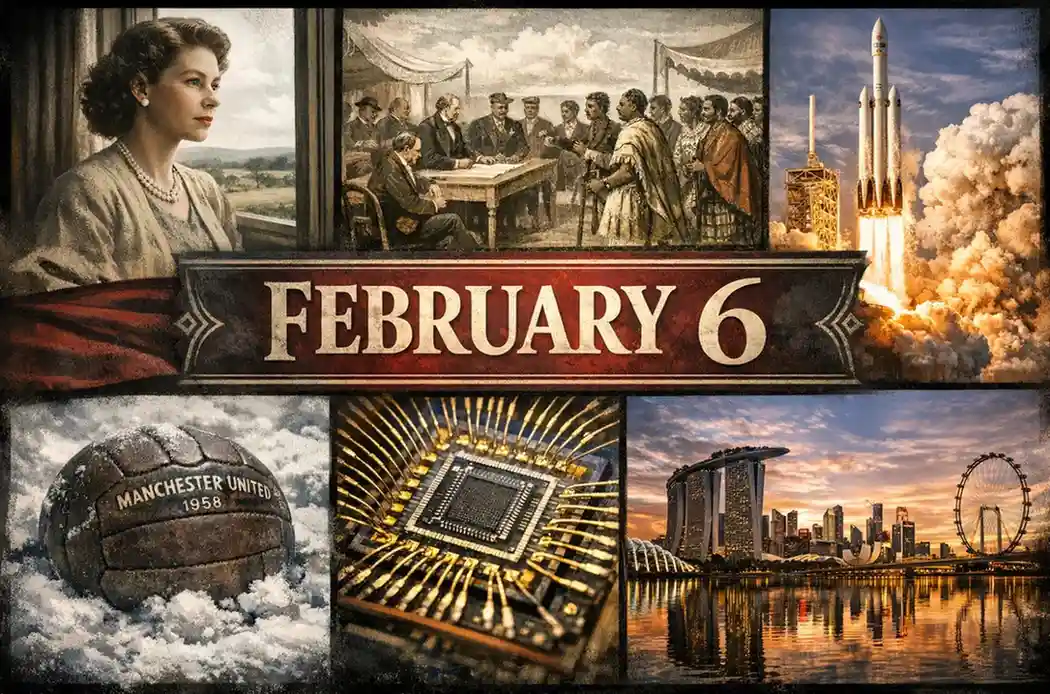
History often turns on the edge of a single signature or a sudden change of fate. When we explore what happened on this day in history February 6, we find a date that serves as the bedrock for modern nations like Singapore and New Zealand, and a pivotal moment when the British crown passed to a young princess in a Kenyan treehouse. This day has witnessed the birth of the integrated circuit—the brain of our modern world—and the tragic loss of a legendary football team in the slush of a Munich runway.
From the signing of revolutionary alliances in Paris to the catastrophic tremors that recently reshaped the border of Turkey and Syria, February 6 stands as a powerful reminder of how quickly the world can change.
Important Events That Happened On February 6 In History
590 – Overthrow of Hormizd IV
Hormizd IV, the king of the Sasanian Empire, was overthrown and blinded by his brothers-in-law, Vistahm and Vinduyih. This internal power struggle reflected the growing instability within the Sasanian state, which was simultaneously facing external threats from the Byzantine Empire and internal revolts.
1579 – Diocese of Manila Erected
By papal bull, the Diocese of Manila was officially established. Domingo de Salazar was appointed as its first bishop. This was a critical step in the religious and administrative organization of the Philippines under Spanish colonial rule, making Manila the center of Catholic influence in the Far East.
1685 – Accession of King James II
Upon the death of his brother, Charles II, James II of England and VII of Scotland was proclaimed King. His reign would be marked by religious tension and political conflict regarding his Catholic faith, eventually leading to his deposition during the Glorious Revolution.
1694 – Suicide of Dandara of Palmares
Dandara, the legendary warrior queen and leader of the Quilombo dos Palmares (a community of runaway slaves in Brazil), was captured by colonial forces. Rather than face a return to a life of slavery, she committed suicide. She remains a powerful symbol of resistance and Afro-Brazilian identity.
1778 – Treaties of Alliance and Amity with France
In Paris, the United States and France signed the Treaty of Alliance and the Treaty of Amity and Commerce. These documents signaled France’s official recognition of the new American republic and provided vital military and economic support that would eventually prove decisive in the American Revolutionary War.
1778 – New York Ratifies the Articles of Confederation
New York became the third state to ratify the Articles of Confederation, the first governing document of the United States. This move was part of the slow process of unifying the thirteen colonies under a single, albeit loose, federal structure.
1788 – Massachusetts Ratifies the Constitution
Massachusetts became the sixth state to ratify the United States Constitution. The vote was close, but the state’s approval was a major victory for the Federalists and helped build the momentum necessary for the Constitution to be adopted nationwide.
1806 – Battle of San Domingo
The British Royal Navy achieved a significant victory against the French fleet in the Caribbean at the Battle of San Domingo. The engagement resulted in the destruction of several French ships of the line, further cementing British naval supremacy during the Napoleonic Wars.
1819 – Founding of Modern Singapore
Sir Thomas Stamford Raffles, along with Hussein Shah of Johor and Temenggong Abdul Rahman, signed the Treaty of Singapore. This agreement allowed the British East India Company to establish a trading post on the island, an event now recognized as the founding of modern Singapore.
1820 – First Immigrants Depart for Liberia
The first 86 African American immigrants sponsored by the American Colonization Society departed from New York. Their goal was to establish a settlement in present-day Liberia, a movement driven by a mix of genuine humanitarianism and the desire of some to remove free Black people from the United States.
1833 – Otto Becomes King of Greece
Prince Otto of Bavaria was crowned as the first modern King of Greece following the Greek War of Independence. His reign was an attempt by European powers to stabilize the newly independent nation under a traditional monarchy.
1840 – Signing of the Treaty of Waitangi
The Treaty of Waitangi was signed between representatives of the British Crown and various Māori chiefs. This document established New Zealand as a British colony while purportedly guaranteeing Māori rights to their land and resources—a treaty that remains central to New Zealand’s national identity and ongoing legal debates.
1843 – First Minstrel Show Opens
The Virginia Minstrels opened their first show at the Bowery Amphitheatre in New York City. This marked the beginning of minstrelsy as a popular, though deeply controversial and racist, form of entertainment in the United States involving performers in blackface.
1851 – Black Thursday Bushfires
The largest bushfires in a populous region in Australian recorded history took place in the state of Victoria. Known as “Black Thursday,” the fires burned approximately 12 million acres and caused significant loss of life and livestock.
1862 – Capture of Fort Henry
In the first major Union victory of the American Civil War, forces under Ulysses S. Grant and Andrew H. Foote captured Fort Henry, Tennessee. The fall of the fort opened the Tennessee River to Union gunboats and signaled Grant’s rise as a premier military leader.
1865 – Municipal Administration of Finland
The municipal administration of Finland was formally established. This reform reorganized local governance and gave communities more autonomy, serving as a stepping stone toward the modern administrative structure of the Finnish state.
1899 – Ratification of the Treaty of Paris
The United States Senate ratified the Treaty of Paris, officially ending the Spanish–American War. Under the terms, Spain ceded Puerto Rico, Guam, and the Philippines to the United States, marking the emergence of the U.S. as a global colonial power.
1900 – Creation of the Permanent Court of Arbitration
The Netherlands ratified an 1899 peace conference decree, leading to the creation of the Permanent Court of Arbitration at The Hague. It was the first global mechanism for the settlement of international disputes through legal means rather than war.
1918 – British Women Gain the Right to Vote
The UK Parliament passed the Representation of the People Act 1918. This landmark legislation granted the right to vote to women over the age of 30 who met specific property qualifications. While not universal suffrage, it was a massive victory for the Suffragette movement.
1919 – Seattle General Strike Begins
More than 65,000 workers in Seattle, Washington, walked off the job to begin a five-day general strike. The strike was a significant moment in American labor history, demonstrating the power of organized labor in the wake of World War I.
1922 – Washington Naval Treaty Signed
The United States, Britain, Japan, France, and Italy signed the Washington Naval Treaty. The agreement was designed to prevent a naval arms race by limiting the tonnage and armament of capital ships among the world’s major naval powers.
1934 – Far-Right Crisis in France
Far-right leagues organized a massive rally in front of the Palais Bourbon in Paris, which turned into a violent attempted coup against the French Third Republic. The crisis led to the resignation of the government and a period of deep political polarization in France.
1944 – The Great Raids Against Helsinki
During World War II, the Soviet Union began a series of massive air raids against Helsinki, Finland. The “Great Raids” were intended to force Finland into a separate peace treaty, but effective Finnish anti-aircraft defenses prevented total destruction of the city.
1951 – Canadian Army Enters Korean War
The Canadian Army entered active combat in the Korean War. Canadian troops would go on to play a significant role in several key battles, including the Battle of Kapyong, as part of the United Nations force.
1951 – The Woodbridge Train Wreck
“The Broker,” a Pennsylvania Railroad passenger train, derailed near Woodbridge Township, New Jersey. The disaster killed 85 people and injured over 500, remaining one of the deadliest rail accidents in the history of the United States.
1952 – Elizabeth II Becomes Queen
Upon the death of her father, King George VI, Princess Elizabeth became Queen Elizabeth II. At the exact moment she ascended the throne, she was staying at the Treetops Hotel in Kenya, famously “going up a princess and coming down a queen.”
1958 – Munich Air Disaster
A charter plane carrying the Manchester United football team, nicknamed the “Busby Babes,” crashed on its third attempt to take off from a slush-covered runway in Munich, West Germany. Twenty-three people died, including eight players, devastating the club and the world of sport.
1959 – Patent for the Integrated Circuit
Jack Kilby, an engineer at Texas Instruments, filed the first patent for an integrated circuit. His invention, which allowed multiple electronic components to be placed on a single piece of semiconductor material, laid the foundation for the entire modern electronics industry.
1959 – Successful Titan Missile Test
The first successful test firing of a Titan intercontinental ballistic missile (ICBM) was accomplished at Cape Canaveral, Florida. This was a major milestone in the Cold War arms race and the development of the United States’ nuclear deterrent.
1973 – Luhuo Earthquake
A magnitude 7.6 earthquake struck Sichuan Province in China. The quake caused widespread destruction across the region and killed at least 2,199 people, highlighting the ongoing seismic vulnerability of the area.
1976 – Lockheed Bribery Scandal
Lockheed Corporation president Carl Kotchian testified before a U.S. Senate subcommittee that the company had paid roughly $3 million in bribes to the office of Japanese Prime Minister Kakuei Tanaka. The scandal led to the arrest of Tanaka and major political upheaval in Japan.
1978 – The Blizzard of ’78
One of the most severe Nor’easters in history struck New England. The “Blizzard of 1978” featured sustained winds of 65 mph and snowfall rates of four inches per hour, paralyzing the region for days and causing significant coastal damage.
1981 – Start of the Ugandan Bush War
The National Resistance Army, led by Yoweri Museveni, launched an attack on a Ugandan Army installation in the Mubende District. This event marked the beginning of the Ugandan Bush War, a five-year conflict that eventually brought Museveni to power.
1987 – Mary Gaudron Appointed to High Court
Justice Mary Gaudron became the first woman to be appointed to the High Court of Australia. Her appointment was a milestone for the Australian judiciary and a significant step toward gender equality in the nation’s highest legal circles.
1989 – Poland’s Round Table Talks
In Warsaw, the Round Table Talks began between the communist government and the Solidarity labor movement. These negotiations were the catalyst for the end of communist rule in Poland and the subsequent fall of the Iron Curtain across Eastern Europe.
1996 – Willamette Valley Flood
Extreme rainfall led to massive flooding in the Willamette Valley of Oregon. The disaster caused over $500 million in property damage across the Pacific Northwest and led to significant environmental and infrastructure challenges.
1996 – Birgenair Flight 301 Crash
A Boeing 757 operated by Birgenair crashed into the Atlantic Ocean shortly after takeoff from the Dominican Republic. All 189 people on board were killed. It remains the deadliest accident involving a Boeing 757, later attributed to a blocked airspeed sensor.
1998 – Renaming of Reagan National Airport
Washington National Airport was officially renamed Ronald Reagan National Airport in honor of the 40th U.S. President. The move was controversial at the time but has since become a standard fixture of the Washington, D.C., metropolitan area.
2000 – Russia Captures Grozny
During the Second Chechen War, Russian military forces captured the city of Grozny. The fall of the capital forced the separatist Chechen government into exile and marked a decisive, albeit brutal, phase in the conflict.
2006 – Stephen Harper Becomes PM
Stephen Harper was sworn in as the 22nd Prime Minister of Canada. Leading the Conservative Party, his tenure would last nearly a decade, focusing on economic policy, arctic sovereignty, and a shift in Canada’s foreign policy.
2012 – Negros Island Earthquake
A magnitude 6.7 earthquake struck the central Philippine island of Negros. The quake triggered landslides and caused significant structural damage, resulting in the deaths of 112 people.
2016 – Southern Taiwan Earthquake
A magnitude 6.6 earthquake struck southern Taiwan, with its epicenter in the Meinong District. The most significant damage occurred in Tainan, where a high-rise apartment building collapsed, contributing to a total death toll of 117.
2018 – Maiden Flight of Falcon Heavy
SpaceX successfully launched its Falcon Heavy rocket for the first time. As the world’s most powerful operational launch vehicle at the time, its maiden flight included the “Starman” payload—an electric Tesla Roadster launched into a heliocentric orbit.
2021 – US Suspends Asylum Agreements
U.S. Secretary of State Antony Blinken announced the suspension of “Asylum Cooperative Agreements” with Guatemala, El Salvador, and Honduras. These Trump-era deals had allowed the U.S. to send asylum seekers back to those countries to seek protection there instead.
2023 – Turkey–Syria Earthquakes
Two massive earthquakes, measuring magnitude 7.8 and 7.5, struck near the border of Turkey and Syria. With a maximum Mercalli intensity of XII (Extreme), the disaster leveled thousands of buildings. The final death toll was 57,658, making it one of the deadliest natural disasters of the 21st century.
Read Here About February 5 Facts:
Famous People Born On February 6
| Name | Short Description | Dates |
|---|---|---|
| Jeb Stuart | Confederate cavalry officer | February 6, 1833 – May 12, 1864 |
| Sir Charles Wheatstone | British physicist | February 6, 1802 – October 19, 1875 |
| Chongzhen | Last Ming dynasty emperor | February 6, 1611 – April 25, 1644 |
| Sir Henry Irving | British actor and manager | February 6, 1838 – October 13, 1905 |
| Claudio Arrau | Chilean classical pianist | February 6, 1903 – June 9, 1991 |
| Henry George Liddell | Greek lexicographer | February 6, 1811 – January 18, 1898 |
| Sir Muhammad Zafrulla Khan | Pakistani diplomat | February 6, 1893 – September 1, 1985 |
| Melvin Tolson | American poet | February 6, 1898 – August 29, 1966 |
| Beatrice Cenci | Italian noblewoman | February 6, 1577 – September 11, 1599 |
| John Brown Gordon | Confederate general | February 6, 1832 – January 9, 1904 |
| Ugo Foscolo | Italian writer | February 6, 1778 – September 10, 1827 |
| F. W. H. Myers | British poet and critic | February 6, 1843 – January 17, 1901 |
| Gerard K. O’Neill | American physicist | February 6, 1927 – April 27, 1992 |
| Amintore Fanfani | Italian prime minister | February 6, 1908 – November 20, 1999 |
| Eric Partridge | English lexicographer | February 6, 1894 – June 1, 1979 |
| Elizabeth Patterson Bonaparte | American socialite | February 6, 1785 – April 4, 1879 |
| Edwin Samuel Montagu | British politician | February 6, 1879 – November 15, 1924 |
| Louis Dudek | Canadian poet | February 6, 1918 – March 22, 2001 |
| Daigo | Emperor of Japan | February 6, 885 – October 23, 930 |
| William Maxwell Evarts | American statesman | February 6, 1818 – February 28, 1901 |
| Antoine Arnauld | French theologian | February 6, 1612 – August 8, 1694 |
| John Stevens Henslow | British botanist | February 6, 1796 – May 16, 1861 |
| Alberto Cavalcanti | Brazilian film director | February 6, 1897 – August 23, 1982 |
| António Vieira | Portuguese writer | February 6, 1608 – July 18, 1697 |
| Robert Maillart | Swiss engineer | February 6, 1872 – April 5, 1940 |
| James Braid | British golfer | February 6, 1870 – November 27, 1950 |
| George Tyrrell | Irish theologian | February 6, 1861 – July 15, 1909 |
| Julian Ursyn Niemcewicz | Polish writer | February 6, 1757/1758 – May 21, 1841 |
| Edward Frederick Sorin | Founder of Notre Dame | February 6, 1814 – October 31, 1893 |
| Sixten Jernberg | Swedish Olympic skier | February 6, 1929 – July 14, 2012 |
Famous People Died On February 6
| Name | Short Description | Dates |
|---|---|---|
| Joseph Priestley | English scientist | March 13, 1733 – February 6, 1804 |
| Seiji Ozawa | Japanese conductor | September 1, 1935 – February 6, 2024 |
| Joseph Cotten | American actor | May 15, 1905 – February 6, 1994 |
| Minoru Yamasaki | American architect | December 1, 1912 – February 6, 1986 |
| Rubén Darío | Nicaraguan poet | January 18, 1867 – February 6, 1916 |
| Henry Morgenthau Jr. | U.S. treasury secretary | May 11, 1891 – February 6, 1967 |
| Frederica of Greece | Queen of Greece | April 18, 1917 – February 6, 1981 |
| Ahmed II | Ottoman sultan | August 1, 1642 – February 6, 1695 |
| Aldus Manutius | Italian printer | 1449 – February 6, 1515 |
| María Cristina of Spain | Queen regent | July 21, 1858 – February 6, 1929 |
| Jean de Ockeghem | Renaissance composer | c.1410 – February 6, 1497 |
| George Crumb | American composer | October 24, 1929 – February 6, 2022 |
| Antoni Tàpies | Spanish abstract artist | December 13, 1923 – February 6, 2012 |
| Vasil Levski | Bulgarian revolutionary | July 6, 1837 – February 6, 1873 |
| Étienne-Louis Boullée | French architect | February 12, 1728 – February 6, 1799 |
| Carlo Goldoni | Italian playwright | February 25, 1707 – February 6, 1793 |
| James Merrill | American poet | March 3, 1926 – February 6, 1995 |
| Vuk Karadžić | Serbian language reformer | November 6, 1787 – February 6, 1864 |
| Leo von Caprivi | German chancellor | February 24, 1831 – February 6, 1899 |
| Piet Retief | Boer leader | November 12, 1780 – February 6, 1838 |
| Max Ferdinand Perutz | Nobel biochemist | May 19, 1914 – February 6, 2002 |
| James B. Weaver | American politician | June 12, 1833 – February 6, 1912 |
| Ben Nicholson | British abstract artist | April 10, 1894 – February 6, 1982 |
| André Brink | South African author | May 29, 1935 – February 6, 2015 |
| Salvador Luria | Nobel biologist | August 13, 1912 – February 6, 1991 |
| Carmen Polo de Franco | Spanish first lady | July 9, 1900 – February 6, 1988 |
| John Bruton | Irish prime minister | May 18, 1947 – February 6, 2024 |
| Hisham ibn Abd al-Malik | Umayyad caliph | 691 – February 6, 743 |
| Abd el-Krim | Berber resistance leader | 1882 – February 6, 1963 |
| Manfred Eigen | Nobel chemist | May 9, 1927 – February 6, 2019 |
Observances & Institutional Dates
- Waitangi Day (New Zealand): Celebrating the signing of the Treaty of Waitangi in 1840.
- Sami National Day: Observed by the Sami people across Russia, Finland, Norway, and Sweden.
- Ronald Reagan Day (California): Commemorating the birth of the former U.S. President.
- International Day of Zero Tolerance to Female Genital Mutilation: A United Nations-sponsored awareness day.
Frequently Asked Questions
- Who became Queen on February 6, 1952?
- Elizabeth II ascended the throne upon the death of her father, King George VI.
- What happened in the Munich air disaster?
- A plane carrying the Manchester United football team crashed in 1958, killing 23 people.
- What is the significance of the Treaty of Waitangi?
- Signed on this day in 1840, it is the founding document of modern New Zealand.
- When was the Falcon Heavy’s first flight?
- SpaceX successfully launched the super heavy vehicle on February 6, 2018.