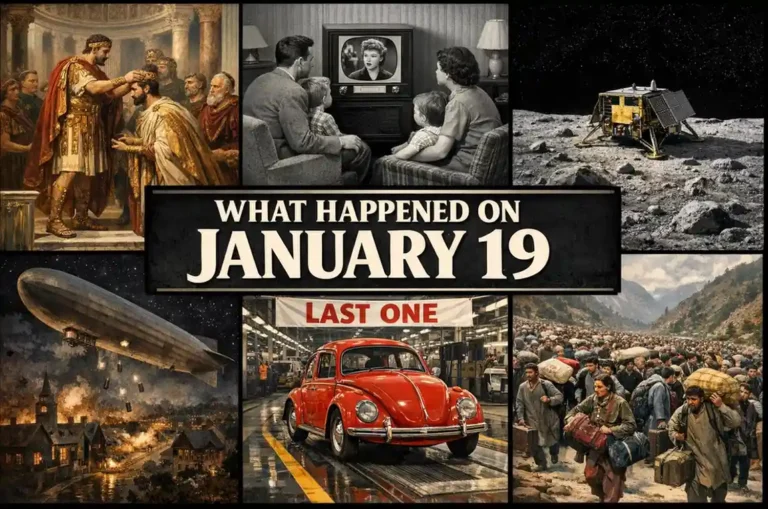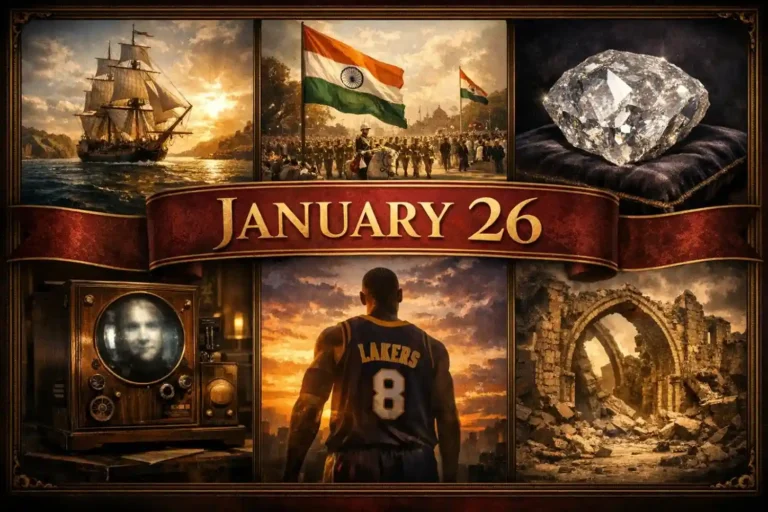
Time has a way of weaving together the intimate lives of monarchs and the thunderous movements of entire nations. By examining what happened on this day in history January 25, we see a teenage king ascending the throne of England and the silent spark of the world’s first electronic game. From the founding of global cities to the high-stakes nuclear close calls of the Cold War, this date serves as a unique lens into the triumphs and tragedies of our shared past.
Important Events That Happened On January 25 In History
41 – Claudius Accepted as Roman Emperor
After a tense night of high-stakes negotiation following the assassination of Caligula, the Roman Senate officially accepted Claudius as the new emperor. Though the Senate initially hoped to restore the Republic, the overwhelming support of the Praetorian Guard forced their hand. Claudius’s transition from a perceived scholarly recluse to the head of the empire marked a stabilizing moment for Rome’s volatile leadership.
750 – The Battle of the Zab
In a massive military confrontation, Abbasid rebels decisively defeated the Umayyad Caliphate at the Battle of the Zab in modern-day Iraq. This victory led to the swift overthrow of the Umayyad dynasty, which had ruled the Islamic world for nearly a century. The rise of the Abbasids moved the center of Islamic power to Baghdad and inaugurated a new era of cultural and scientific advancement.
1327 – Edward III Ascends the Throne
At just fourteen years old, Edward III was proclaimed the King of England following the forced abdication of his father, Edward II. The coup was orchestrated by his mother, Queen Isabella, and her lover, Roger Mortimer, who sought to control the young monarch. Despite his youth, Edward III would eventually break free of their influence to become one of England’s most formidable medieval rulers.
1348 – The Great Friuli Earthquake
A violent earthquake struck the South Alpine region of Friuli, causing widespread destruction across what is now Northern Italy. The tremors were so powerful that significant structural damage was reported as far away as Rome, hundreds of miles to the south. Thousands lost their lives as masonry buildings and mountain villages collapsed under the force of the seismic shift.
1479 – The Treaty of Constantinople
The 16-year-long First Ottoman–Venetian War finally came to an end with the signing of the Treaty of Constantinople. Venice was forced to cede significant territories in the Aegean and Adriatic seas to the Ottoman Empire and pay an annual tribute for trading rights. This agreement solidified Ottoman naval dominance in the Eastern Mediterranean and reshaped European trade routes.
1494 – Alfonso II Becomes King of Naples
Following the death of his father, Ferdinand I, Alfonso II ascended the throne of Naples during a period of intense Italian instability. His reign was immediately challenged by King Charles VIII of France, who claimed the Neapolitan throne for himself, sparking the first of the Italian Wars. Alfonso eventually abdicated in favor of his son just a year later as French forces advanced on his kingdom.
1515 – Coronation of Francis I
Francis I was officially crowned King of France in a lavish ceremony at the historic Reims Cathedral. During the ritual, the new monarch was anointed with the sacred “oil of Clovis” and ceremonially girt with the legendary sword of Charlemagne. His reign would become synonymous with the French Renaissance and a period of intense artistic and architectural patronage.
1533 – Henry VIII Secretly Marries Anne Boleyn
Defying the authority of the Catholic Church, King Henry VIII of England secretly married Anne Boleyn in a private ceremony. This marriage took place while his first marriage to Catherine of Aragon was still legally unrecognized as annulled by the Pope. This act was a critical step toward the English Reformation and the eventual establishment of the Church of England.
1554 – Founding of São Paulo
The city of São Paulo, Brazil, was established by a group of Jesuit priests who built a mission on a plateau between two rivers. Led by figures like Manuel da Nóbrega and José de Anchieta, the settlement was intended to convert the indigenous population to Christianity. Over the centuries, this humble mission evolved into the largest city in the Southern Hemisphere and a global economic hub.
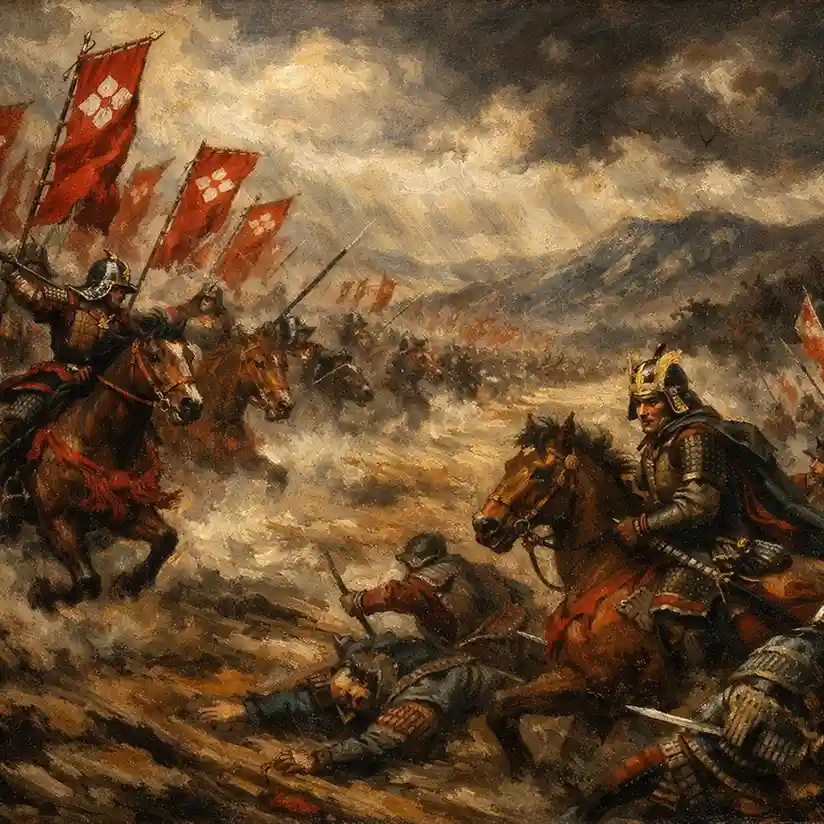
1573 – Battle of Mikatagahara
In one of the most famous engagements of Japan’s Sengoku period, the legendary strategist Takeda Shingen soundly defeated the forces of Tokugawa Ieyasu. Despite being outnumbered and outmaneuvered, Ieyasu survived the retreat, famously using the defeat as a hard-learned lesson in military patience. The battle remains a textbook example of Takeda’s brilliant use of the “cavalry charge” tactic.
1575 – Luanda Founded in Angola
Portuguese navigator Paulo Dias de Novais founded the settlement of São Paulo da Assunção de Loanda, known today as Luanda. As the first European-style city in West-Central Africa, it served as a strategic port for Portuguese trade and colonial expansion. It eventually became the capital of Angola and a central point for the Atlantic slave trade for several centuries.
1585 – Walter Raleigh Knighted
Queen Elizabeth I knighted the explorer and courtier Walter Raleigh shortly after he returned from a voyage to the New World. Raleigh had recently named a vast region of North America “Virginia” in honor of Elizabeth, the “Virgin Queen.” This gesture secured royal favor for his future attempts to establish the first English colonies in the Americas.
1704 – The Apalachee Massacre
A combined force of British colonists and Muscogee warriors from the Province of Carolina launched a brutal attack on the Spanish mission of Ayubale. This event, part of the wider Queen Anne’s War, resulted in the destruction of the fortified mission and the enslavement of thousands of Apalachee people. The massacre effectively broke Spain’s long-standing grip on the Florida panhandle.
1787 – Confrontation at Springfield Armory
During Shays’ Rebellion, the most significant military clash occurred outside the Springfield Armory in Massachusetts. Government militia fired grapeshot at the approaching rebels, killing four and wounding twenty in a matter of minutes. This failure to seize the armory signaled the beginning of the end for the debt-driven uprising and highlighted the need for a stronger federal government.
1791 – The Constitutional Act of 1791
The British Parliament passed the Constitutional Act, which formally divided the Province of Quebec into two separate colonies: Upper Canada and Lower Canada. This division was designed to accommodate the influx of United Empire Loyalists who preferred British laws and land tenure. The act laid the structural foundations for what would eventually become the provinces of Ontario and Quebec.
1792 – London Corresponding Society Founded
Thomas Hardy and a small group of artisans founded the London Corresponding Society to advocate for the reform of the British Parliament and universal suffrage. As one of the first grassroots political organizations for the working class, it utilized a network of “correspondence” to spread democratic ideas inspired by the French Revolution. The British government eventually suppressed the group, fearing their calls for equality would lead to a similar revolution in England.
1819 – University of Virginia Chartered
The Commonwealth of Virginia officially chartered the University of Virginia, an institution envisioned and designed by Thomas Jefferson. Unlike other universities of the time, it was built around a central library rather than a chapel, reflecting Jefferson’s commitment to secular education and the “illimitable freedom of the human mind.” It remains a UNESCO World Heritage site today.
1858 – The “Wedding March” Tradition
The “Wedding March” by Felix Mendelssohn was played during the marriage ceremony of Princess Victoria of the UK and Prince Friedrich of Prussia. The choice of music by the royal bride quickly caught the public’s imagination, transforming the piece into the world’s most popular wedding processional. To this day, the melody remains a standard feature of traditional wedding ceremonies globally.
1879 – Bulgarian National Bank Founded
The Bulgarian National Bank was officially established, marking a major step toward the economic independence of the newly liberated Bulgarian state. As one of the oldest central banks in the world, it was tasked with regulating the national currency and stabilizing the country’s fledgling financial system. The bank remains a central pillar of Bulgaria’s sovereignty and its integration into the European economy.
1881 – Formation of the Oriental Telephone Company
Inventors Thomas Edison and Alexander Graham Bell joined forces to establish the Oriental Telephone Company. The business was created to export and license telephone technology to countries across the Middle East and Asia, including Egypt, India, and China. This partnership marked a rare moment of cooperation between two of history’s greatest rival innovators.
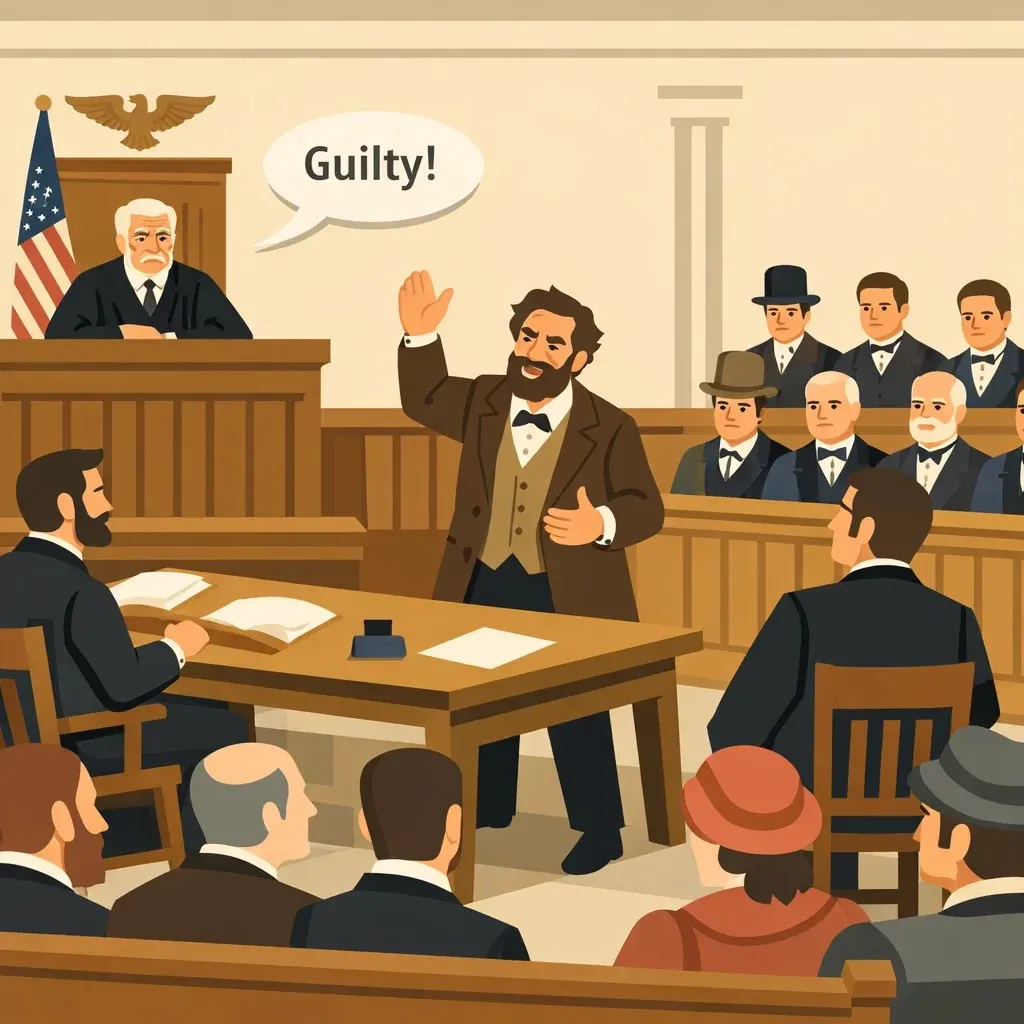
1882 – Guiteau Found Guilty Charles J.
Guiteau was officially found guilty of the assassination of U.S. President James A. Garfield. During the high-profile trial, Guiteau’s erratic behavior and claims of “divine inspiration” led many to question his sanity. Despite his defense, the jury convicted him, and he was eventually executed by hanging later that year.
1890 – Nellie Bly’s 72-Day Journey
Journalist Nellie Bly arrived back in New Jersey, completing her record-breaking trip around the world in just 72 days, six hours, and eleven minutes. Her journey was inspired by Jules Verne’s Around the World in Eighty Days, and her success made her a global celebrity. Bly’s feat proved that modern transportation had shrunk the world and challenged the limitations placed on women of the era.
1909 – Debut of Richard Strauss’s Elektra
Richard Strauss’s intense and emotionally charged opera Elektra received its world premiere at the Dresden State Opera. The production was notable for its extreme musical dissonance and the complex psychological depth of its characters. It marked the beginning of a long and fruitful collaboration between Strauss and the librettist Hugo von Hofmannsthal.
1915 – First Transcontinental Telephone Call
Alexander Graham Bell inaugurated the first transcontinental telephone service in the United States by calling from New York City. On the other end of the line in San Francisco was his longtime assistant, Thomas Watson. This 3,400-mile connection was a massive engineering achievement, requiring the installation of 130,000 poles and 2,500 tons of copper wire.
1917 – Sinking of the SS Laurentic
The British ocean liner SS Laurentic struck two German mines off the coast of northwest Ireland and sank in less than an hour. The vessel was carrying approximately 43 tons of gold ingots intended to pay the United States for war munitions. Over 350 sailors lost their lives in the freezing Atlantic waters, and divers spent years recovering the sunken treasure.
1918 – Ukrainian Independence Declared
The Ukrainian People’s Republic officially declared its total independence from Soviet Russia amid the chaos of the Russian Revolution. This bold move aimed to establish a sovereign state for the Ukrainian people after centuries of imperial rule. Although the independence was short-lived due to Bolshevik invasion, it remains a cornerstone of modern Ukrainian national identity.
1918 – Finnish Defence Forces Established
Independent Finland officially established the Finnish Defence Forces, designating the “White Guards” as the national army. Baron C. G. E. Mannerheim was appointed as the Commander-in-Chief to lead the forces during the escalating Finnish Civil War. This organization laid the groundwork for the modern military structure that would later defend Finland during World War II.
1924 – First Winter Olympics Open
The very first Winter Olympic Games officially opened in Chamonix, France, nestled in the heart of the French Alps. Originally called “International Winter Sports Week,” the event was so successful that it was retrospectively named the first Winter Olympics. Athletes from 16 nations competed in events like bobsleigh, curling, and figure skating, launching a new global sporting tradition.
1932 – Insurrection in Central Catalonia
Anarchist and communist miners in the Alt Llobregat region of Catalonia, Spain, launched a significant armed insurrection against the central government. The rebels seized local towns and proclaimed “libertarian communism,” protesting against poor working conditions and social inequality. The Spanish Republican government eventually suppressed the uprising with military force, leading to numerous arrests and further radicalization of the region.
1932 – Defense of Harbin Begins
During the Second Sino-Japanese War, the Chinese National Revolutionary Army began a desperate defense of the city of Harbin. The Chinese forces faced overwhelming Japanese air and ground superiority as they fought to prevent the occupation of Manchuria. Despite their fierce resistance, the city eventually fell to Japanese control a few weeks later.
1937 – The Guiding Light Debuts
The long-running soap opera The Guiding Light made its first appearance on NBC radio, broadcasting from Chicago. Created by Irna Phillips, the show focused on the lives and struggles of a community centered around a local minister. In 1952, it successfully transitioned to CBS television, where it continued to air until its final episode in 2009, making it one of the longest-running dramas in broadcast history.
1941 – Diocese of Honolulu Established
Pope Pius XII officially elevated the Apostolic Vicariate of the Hawaiian Islands to the status of a full diocese, creating the Roman Catholic Diocese of Honolulu. This administrative change recognized the growing Catholic population in the islands and established a formal ecclesiastical structure just months before the attack on Pearl Harbor. The diocese continues to serve the diverse spiritual needs of the Hawaiian community today.
1942 – Thailand Declares War on the Allies
Under intense pressure from the occupying Japanese military, the government of Thailand officially declared war on both the United States and the United Kingdom. While the Thai ambassador in Washington refused to deliver the declaration, the move technically aligned Thailand with the Axis powers for the duration of World War II. This complex political situation led to the rise of the “Seri Thai” resistance movement that worked secretly with the Allies.
1945 – The Battle of the Bulge Ends
The Battle of the Bulge, the largest and bloodiest battle fought by the United States in World War II, officially came to a close. The Allied forces successfully repelled Germany’s final major offensive on the Western Front, exhausting the last of the German reserves. This victory cleared the path for the final Allied advance into the heart of Germany.
1946 – United Mine Workers Rejoins the AFL
After a period of independence and internal disputes, the United Mine Workers of America (UMWA), led by John L. Lewis, officially rejoined the American Federation of Labor. This move was intended to strengthen the collective bargaining power of miners during a time of significant post-war labor unrest in the United States. However, the reconciliation was short-lived, as the UMWA would leave the federation again just a year later.
1947 – First Electronic Game Patented
Thomas Goldsmith Jr. and Estle Ray Mann filed a patent for a “Cathode Ray Tube Amusement Device.” Inspired by radar displays from World War II, the device allowed users to control a dot of light to “fire” at targets on the screen. While it never reached commercial production, it is recognized as the very first precursor to the modern video game.
1949 – First Emmy Awards Presented
The inaugural Emmy Awards ceremony took place at the Hollywood Athletic Club to honor excellence in the burgeoning television industry. At the time, the awards were limited to local Los Angeles programming, with the iconic “Emmy” statuette being presented for the first time. The event signaled television’s arrival as a major cultural and artistic medium in the United States.
1960 – Payola Scandal Crackdown
In response to the growing “payola” scandal, the National Association of Broadcasters in the United States issued a stern warning to its members. The organization threatened to fine any disc jockeys caught accepting bribes or “payola” from record companies to play specific songs on the air. The scandal fundamentally changed the radio industry, leading to stricter government oversight and the rise of standardized “Top 40” playlists.
1961 – First Live Presidential TV Press Conference
President John F. Kennedy made history by delivering the first-ever live, unedited presidential television news conference from Washington, D.C. The event allowed millions of Americans to see the President interact with the press in real-time, showcasing Kennedy’s charisma and quick wit. This innovation fundamentally changed how U.S. presidents communicate with the public.
1964 – Founding of Blue Ribbon Sports (Nike)
University of Oregon track athlete Phil Knight and his coach Bill Bowerman founded a company called Blue Ribbon Sports. Initially operating as a distributor for Japanese running shoes, the company focused on providing high-quality gear for athletes. In 1971, the company was renamed Nike, eventually becoming the world’s largest supplier of athletic shoes and apparel.
1967 – Political Purge in South Vietnam
In a bold internal power move, South Vietnamese Prime Minister Nguyen Cao Ky fired his main rival, Deputy Prime Minister Nguyen Huu Co. Ky waited until Co was out of the country on a diplomatic visit to Taiwan before stripping him of his military and political titles. This move consolidated Ky’s control over the military junta and reflected the deep instability of the South Vietnamese leadership during the Vietnam War.
1969 – Desertion of Carlos Lamarca
Captain Carlos Lamarca, a highly trained officer in the Brazilian Army, deserted his post to join the armed resistance against the country’s military dictatorship. He managed to escape with ten machine guns and over sixty rifles, which he used to train guerrilla fighters in the Vale do Ribeira. Lamarca became one of the most famous and hunted revolutionary figures in Brazil until his death in 1971.
1971 – Charles Manson Found Guilty
A California jury found cult leader Charles Manson and three of his “Family” members guilty of the 1969 Tate–LaBianca murders. The brutal killings had terrified Los Angeles and became a symbol of the dark end of the 1960s counterculture. Despite not being physically present at the murder scenes, Manson was convicted under the theory of conspiracy and vicarious liability.
1971 – Idi Amin Leads Coup in Uganda
Major General Idi Amin seized power in Uganda through a military coup while President Milton Obote was attending a summit in Singapore. Amin’s takeover was initially welcomed by some who were disillusioned with Obote’s rule, but it soon devolved into a brutal eight-year dictatorship. His regime was marked by extreme human rights abuses, ethnic persecution, and economic collapse.
1979 – Pope John Paul II’s First Foreign Trip
Pope John Paul II embarked on his very first official papal visit outside of Italy, traveling to The Bahamas, the Dominican Republic, and Mexico. This historic journey signaled his commitment to becoming a “global Pope” and using international travel as a tool for diplomacy and evangelization. His visit to Mexico, in particular, drew millions of people and revitalized the Catholic Church across Latin America.
1980 – Mother Teresa Awarded Bharat Ratna
The government of India honored Mother Teresa with the Bharat Ratna, the nation’s highest civilian award, for her decades of service to the poor of Calcutta. This recognition followed her Nobel Peace Prize win the previous year, solidifying her status as a global icon of humanitarianism. The award celebrated her “exceptional service towards the advancement of art, literature and science, and in recognition of public service of the highest order.”
1986 – National Resistance Movement Takes Uganda
In a decisive military victory, the National Resistance Army (NRA) led by Yoweri Museveni toppled the government of Tito Okello in Uganda. This victory ended years of civil war and political chaos following the fall of Idi Amin. Museveni’s takeover marked the beginning of a long period of relative stability for Uganda, though his long tenure would eventually become a subject of international debate.
1993 – CIA Headquarters Shootings
A gunman opened fire on commuters stopped at a traffic light outside the CIA Headquarters in Langley, Virginia, killing two employees and wounding three others. The shooter, Mir Aimal Kansi, fled the country but was later captured in Pakistan following an international manhunt. The tragedy led to a significant increase in security protocols at the entrances of sensitive government installations.
1994 – Launch of the Clementine Spacecraft
NASA and the Strategic Defense Initiative Organization successfully launched the Clementine spacecraft to perform long-term observations of the Moon and a near-Earth asteroid. The mission was notable for its use of lightweight, “faster, better, cheaper” technology and for providing the first multi-spectral mapping of the entire lunar surface. Data from Clementine suggested the possible presence of ice at the Moon’s south pole.
1995 – The Norwegian Rocket Incident
Russian radar operators mistook a Norwegian research rocket, the Black Brant XII, for a nuclear-armed U.S. Trident missile launched from a submarine. This triggered a high-level alert, and President Boris Yeltsin was forced to activate Russia’s “nuclear briefcase” for the only known time in history. Fortunately, the mistake was realized before a retaliatory strike could be launched, narrowly avoiding a nuclear catastrophe.
1996 – Last U.S. Execution by Hanging
Billy Bailey became the last person in the United States to be executed by hanging after being convicted of a double murder in Delaware. Bailey had been given the choice between lethal injection and hanging, but he refused to choose, leading to the use of the state’s older execution method. While Delaware has since abolished the death penalty, this event remains a significant milestone in the history of American capital punishment.
1998 – Temple of the Tooth Suicide Attack
A truck bomb detonated by the Liberation Tigers of Tamil Eelam (LTTE) struck the Temple of the Tooth in Kandy, Sri Lanka, a UNESCO World Heritage site and one of the holiest places in Buddhism. The explosion killed eight people and caused significant structural damage to the sacred complex. The attack was widely condemned as an act of religious desecration and led to a further escalation of the Sri Lankan Civil War.
2003 – Human Shields Arrive in Baghdad
As the threat of a U.S.-led invasion of Iraq loomed, a group of international activists traveled from London to Baghdad to serve as “human shields.” Their goal was to occupy strategic locations, such as water treatment plants and power stations, to discourage coalition forces from bombing civilian infrastructure. While their efforts drew global media attention, they were unable to prevent the outbreak of the war in March 2003.
2005 – Mandhradevi Temple Stampede
During a religious festival at the Mandhradevi temple in Maharashtra, India, a massive stampede broke out among the hundreds of thousands of pilgrims in attendance. The panic began after slippery conditions on a narrow path led to falls, resulting in at least 258 deaths and hundreds of injuries. The tragedy led to new government regulations regarding crowd management and safety at major religious sites.
2006 – Arrest of the “Little Old Lady Killer”
Mexican authorities arrested Juana Barraza in connection with a series of murders targeting elderly women in Mexico City. Barraza, a former professional wrestler known as “The Silent Lady,” was suspected of killing at least ten people by gaining access to their homes while posing as a social worker. Her arrest ended years of speculation and fear regarding the elusive serial killer known as “La Mataviejitas.”
2011 – The Egyptian Revolution Begins
A massive wave of anti-government protests, known as the “Day of Rage,” broke out across major cities in Egypt, including Cairo and Alexandria. Demonstrators demanded the end of President Hosni Mubarak’s 30-year rule, citing issues like police brutality, poverty, and corruption. This event was a pivotal moment in the Arab Spring and led to the eventual resignation of Mubarak eighteen days later.
2013 – Barquisimeto Prison Riot
One of the deadliest prison riots in Venezuelan history broke out at the Uribana prison in Barquisimeto, resulting in the deaths of at least 50 people. The violence began during an inspection by government forces looking for smuggled weapons and contraband. The incident highlighted the severe overcrowding, corruption, and lack of government control within the Venezuelan penal system.
2015 – The Mamasapano Clash
A high-stakes counter-terrorism operation in Mamasapano, Philippines, turned into a deadly 12-hour firefight between the Philippine National Police Special Action Force and various local insurgent groups. The clash resulted in the deaths of 44 police commandos, marking the highest single-day loss for the Philippine police. The tragedy nearly derailed a landmark peace agreement between the government and the Moro Islamic Liberation Front.
2019 – Brumadinho Dam Collapse
A tailings dam at an iron ore mine in Brumadinho, Brazil, suffered a catastrophic structural failure, releasing a massive wave of toxic mud. The collapse buried the mine’s administrative area and nearby houses, resulting in the deaths of 270 people. It remains one of the worst environmental and industrial disasters in Brazilian history, leading to massive fines and criminal charges against mining executives.
2021 – COVID-19 Death Toll Surpasses 2 Million
The official global death toll from the COVID-19 pandemic surpassed the grim milestone of two million people. This statistic highlighted the devastating impact of the virus exactly one year after the first major lockdowns were implemented in China. The milestone spurred renewed international calls for equitable vaccine distribution and stronger public health measures.
2024 – Global Diplomacy and Conflict Negotiations
The start of 2024 saw the international community grappling with the immense humanitarian and geopolitical fallout of the ongoing wars in Ukraine and Gaza. Diplomatic efforts intensified as world leaders engaged in high-stakes negotiations to broker renewed ceasefires and facilitate hostage releases. These conflicts dominated the global agenda, forcing a reassessment of international security alliances and the effectiveness of humanitarian aid corridors.
2025 – Shaping the Future Global Policy Agenda
As the world entered 2025, global policy was increasingly defined by the rapid evolution of artificial intelligence and the intensifying urgency of the climate crisis. Governments worldwide raced to implement comprehensive AI regulation frameworks to balance innovation with ethical safety. Meanwhile, record-shattering temperatures led to a new wave of international climate accords, all set against a backdrop of complex geopolitical tensions between major economic powers.
Famous People Born On January 25
| Name | Role / Description | Birth – Death |
|---|---|---|
| Antônio Carlos Jobim | Brazilian composer (bossa nova) | January 25, 1927 – December 8, 1994 |
| Virginia Woolf | English writer | January 25, 1882 – March 28, 1941 |
| Eduard Shevardnadze | Soviet foreign minister | January 25, 1928 – July 7, 2014 |
| Wilhelm Furtwängler | German conductor | January 25, 1886 – November 30, 1954 |
| Ilya Prigogine | Physical chemist, Nobel laureate | January 25, 1917 – May 28, 2003 |
| Paul Nurse | British scientist, Nobel laureate | January 25, 1949 – |
| Anne of Brittany | Queen consort of France | January 25, 1477 – January 9, 1514 |
| Vladimir Vysotsky | Soviet actor & singer | January 25, 1938 – July 24, 1980 |
| Witold Lutosławski | Polish composer | January 25, 1913 – February 7, 1994 |
| Ivan Ivanovich Shishkin | Russian painter | January 25, 1832 – March 20, 1898 |
| Theodosius Dobzhansky | Geneticist & evolutionist | January 25, 1900 – December 18, 1975 |
| Michael Madhusudan Dutt | Indian poet & dramatist | January 25, 1824 – June 29, 1873 |
| Bill Viola | American video artist | January 25, 1951 – July 12, 2024 |
| Leo IV | Byzantine emperor | January 25, 749 – September 8, 780 |
| Paul-Henri Spaak | Belgian statesman | January 25, 1899 – July 31, 1972 |
| Pompeo Girolamo Batoni | Italian painter | January 25, 1708 – February 4, 1787 |
| Charles-François Dumouriez | French general | January 25, 1739 – March 14, 1823 |
| Jânio Quadros | President of Brazil | January 25, 1917 – February 16, 1992 |
| Arvid Carlsson | Pharmacologist, Nobel laureate | January 25, 1923 – June 29, 2018 |
| Florence Mills | American singer & dancer | January 25, 1896 – November 1, 1927 |
| Niels von Koch | Swedish mathematician | January 25, 1870 – March 11, 1924 |
| Gloria Naylor | American novelist | January 25, 1950 – September 28, 2016 |
| William Cavendish | British statesman | January 25, 1640 – August 18, 1707 |
| Govert Flinck | Dutch painter | January 25, 1615 – February 2, 1660 |
| Emil Ludwig | German biographer | January 25, 1881 – September 17, 1948 |
| Joseph von Görres | German writer | January 25, 1776 – January 29, 1848 |
| André Beaufre | French military strategist | January 25, 1902 – February 13, 1975 |
| Katō Takaaki | Prime minister of Japan | January 25, 1860 – January 28, 1926 |
| Alla Tarasova | Russian actress | January 25, 1898 – April 5, 1973 |
| Ernst F. W. Alexanderson | Electrical engineer | January 25, 1878 – May 14, 1975 |
Famous People Died On January 25
| Name | Role / Description | Birth – Death |
|---|---|---|
| Philip Johnson | American architect | July 8, 1906 – January 25, 2005 |
| Daniel Bell | American sociologist | May 10, 1919 – January 25, 2011 |
| Christian II | King of Denmark & Norway | July 1, 1481 – January 25, 1559 |
| Joseph Wheeler | Confederate general | September 10, 1836 – January 25, 1906 |
| Colleen Moore | American actress | August 19, 1900 – January 25, 1988 |
| Ferdinand I | King of Naples | 1423 – January 25, 1494 |
| Frederic Leighton | British painter | December 3, 1830 – January 25, 1896 |
| Manabendra Nath Roy | Indian revolutionary | February 22, 1887 – January 25, 1954 |
| Robert Shaw | American conductor | April 30, 1916 – January 25, 1999 |
| Kenny Clarke | Jazz drummer | January 9, 1914 – January 25, 1985 |
| Stephen Cole Kleene | Mathematician & logician | January 5, 1909 – January 25, 1994 |
| Buchi Emecheta | Nigerian author | July 21, 1944 – January 25, 2017 |
| Ouida | British novelist | January 1, 1839 – January 25, 1908 |
| Carl T. Hayden | U.S. senator | October 2, 1877 – January 25, 1972 |
| Oscar W. Underwood | U.S. politician | May 6, 1862 – January 25, 1929 |
| Robert Burton | English author | February 8, 1577 – January 25, 1640 |
| Guillaume Delisle | French cartographer | February 28, 1675 – January 25, 1726 |
| Beno Gutenberg | Seismologist | June 4, 1889 – January 25, 1960 |
| Anacletus II | Antipope | – January 25, 1138 |
| Claribel Alegría | Central American poet | May 12, 1924 – January 25, 2018 |
| Jean-Baptiste d’Erlon | French marshal | July 29, 1765 – January 25, 1844 |
| Yvor Winters | American poet | October 17, 1900 – January 25, 1968 |
| Isabella Beecher Hooker | Women’s rights activist | February 22, 1822 – January 25, 1907 |
| Victor de Broglie | French prime minister | November 28, 1785 – January 25, 1870 |
| Rutland Boughton | British composer | January 23, 1878 – January 25, 1960 |
| Shiga Kiyoshi | Japanese bacteriologist | February 7, 1871 – January 25, 1957 |
| Abraham Janssens | Flemish painter | c.1573 – January 25, 1632 |
| Sir Isaac Shoenberg | Television pioneer | March 1, 1880 – January 25, 1963 |
| Nadezhda Udaltsova | Russian avant-garde artist | January 10, 1886 – January 25, 1961 |
| Sveinn Björnsson | President of Iceland | February 27, 1881 – January 25, 1952 |
Observances & Institutional Dates
- Burns Night (Scotland): Celebrating the life and poetry of Robert Burns, typically with a traditional supper of haggis.
- National Voters’ Day (India): Encouraging young voters to participate in the democratic process.
- Tatiana Day (Russia): Also known as Russian Students Day, celebrating the founding of Moscow University.
- Revolution Day (Egypt): Commemorating the start of the 2011 uprising that changed the nation’s political landscape.
Frequently Asked Questions
- What was the “Norwegian Rocket Incident”?
- In 1995, Russia nearly launched a nuclear strike after mistaking a scientific rocket for an incoming US missile.
- Who secretly married Henry VIII on this day?
- Anne Boleyn married King Henry VIII in a secret ceremony on January 25, 1533.
- What major sports event began on this day in 1924?
- The first Winter Olympic Games officially opened in Chamonix, France.
- Which famous cult leader was convicted on this day?
- Charles Manson was found guilty of the Tate–LaBianca murders on January 25, 1971.