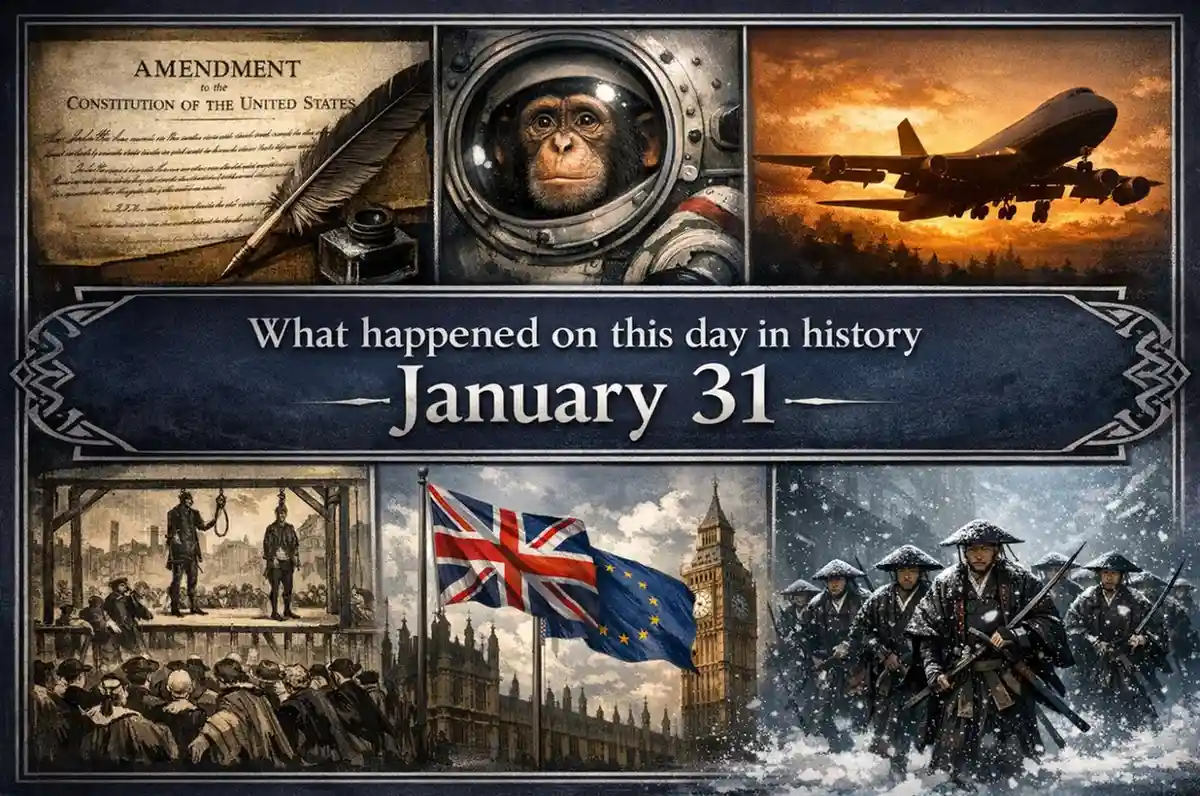
The final day of January often serves as a dramatic closing chapter to the month’s historical narrative. When we examine what happened on this day in history January 31, we see a world caught between the brutal end of old-world conspiracies and the soaring ambitions of the space age. It is the day the smoke cleared from the execution of Guy Fawkes and the day a chimpanzee named Ham proved that space was within our reach. From the constitutional abolition of slavery in the United States to the historic departure of the United Kingdom from the European Union, this date marks the shifting boundaries of human law, liberty, and the stars.
Important Events That Happened On January 31 In History
314 – Consecration of Pope Sylvester I
Following the death of Pope Miltiades, Sylvester I was consecrated as the Bishop of Rome. His long papacy coincided with the reign of Emperor Constantine the Great, a pivotal era that saw the Christian Church transition from a persecuted minority to a protected institution of the Roman Empire. He is often associated with the legendary “Donation of Constantine,” though the document was later proven to be a medieval forgery.
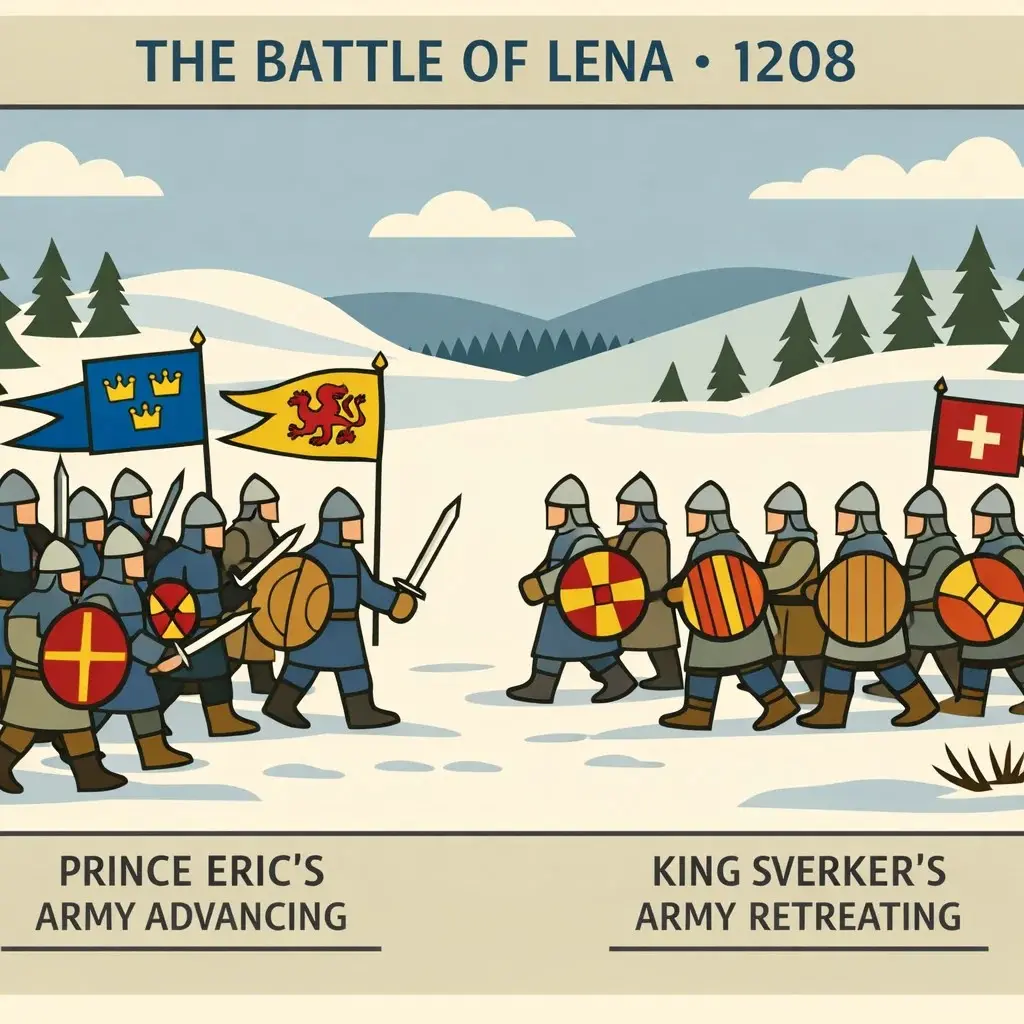
1208 – The Battle of Lena
In a fierce struggle for the Swedish crown, King Sverker II was defeated by his rival, Prince Eric, at the Battle of Lena. The victory allowed Eric to ascend the throne as King Eric X of Sweden. The battle is famous in Scandinavian folklore, often described with legendary proportions, and it solidified the power of the House of Eric over the Swedish kingdom.
1266 – Surrender of Murcia
After a month-long siege, the Mudéjar rebels of Murcia surrendered their city to James I of Aragon. The rebels had risen against the Crown of Castile during the wider Mudéjar revolt of 1264–1266. The fall of Murcia marked a significant step in the Christian “Reconquista” of the Iberian Peninsula and led to the further displacement and conversion of the local Muslim populations.
1504 – The Treaty of Lyon
The Italian War reached a diplomatic resolution with the signing of the Treaty of Lyon. The agreement confirmed French dominance over Northern Italy, specifically the Duchy of Milan, while Spain received formal control over the Kingdom of Naples. This division of influence shaped the political landscape of Italy for decades, as the two great European powers used the peninsula as their primary battlefield.
1578 – Battle of Gembloux
During the Eighty Years’ War, Spanish forces led by Don John of Austria achieved a crushing victory over a massive but disorganized rebel army at Gembloux. The rebel force, composed of Dutch, Flemish, English, Scottish, German, French, and Walloon troops, was decimated by the superior tactics of the Spanish cavalry. The defeat significantly weakened the Dutch resistance and allowed Spain to reclaim territory in the Southern Netherlands.
1606 – Execution of Guy Fawkes
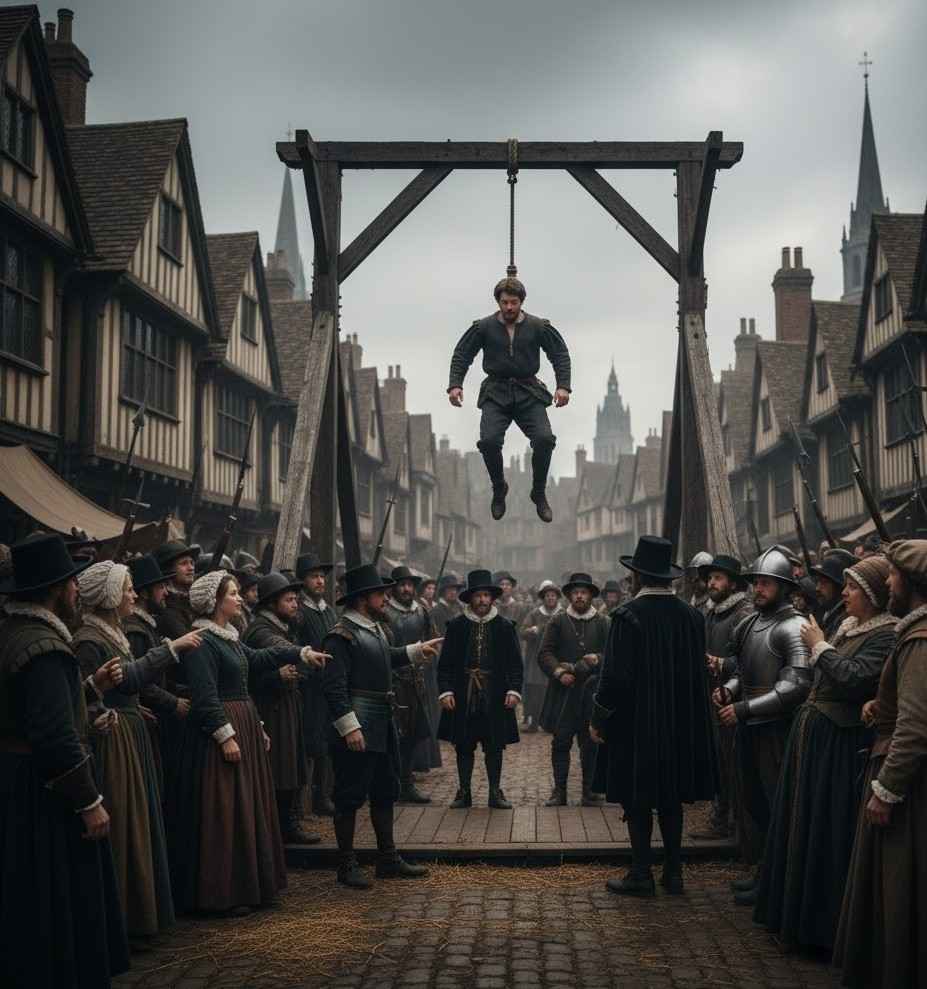
The final act of the Gunpowder Plot played out as four of the conspirators, including Guy Fawkes, were executed for high treason. They were sentenced to be hanged, drawn, and quartered in the heart of London for their plan to blow up King James I and the English Parliament. Fawkes famously cheated the executioner’s full ordeal by jumping from the gallows and breaking his neck, ending his life before the quartering began.
1609 – Establishment of the Wisselbank
The Wisselbank (Bank of Amsterdam) was officially established, marking a revolutionary moment in financial history. As the first public bank to offer guaranteed exchange and deposits, it turned Amsterdam into the leading financial center of the 17th-century world. The bank provided the stability necessary for the Dutch Golden Age and the global trade networks of the Dutch East India Company.
1703 – The Revenge of the Forty-Seven Rōnin
In a legendary act of loyalty and vengeance in Japan, forty-seven rōnin under the command of Ōishi Kuranosuke successfully attacked the home of Kira Yoshinaka. They killed Kira to avenge the death of their master, Lord Asano Naganori, who had been forced to commit ritual suicide. After completing their mission, the rōnin themselves were ordered to commit seppuku, a story that remains a cornerstone of Japanese cultural identity.
1747 – First Venereal Diseases Clinic
The London Lock Hospital opened the first clinic specifically dedicated to the treatment of venereal diseases. At a time when such conditions were deeply stigmatized and often untreated, the hospital provided a medical space to address the growing public health crisis of syphilis and gonorrhea in 18th-century London.
1814 – Supreme Director of the Río de la Plata
Gervasio Antonio de Posadas was appointed as the Supreme Director of the United Provinces of the Río de la Plata (present-day Argentina). His appointment was part of the effort to centralize authority during the struggle for independence from Spain. While his term was brief, it helped stabilize the revolutionary government during a critical phase of South American liberation.
1846 – Unification of Milwaukee
Following a series of heated local disputes known as the Milwaukee Bridge War, the rival towns of Juneautown and Kilbourntown finally agreed to unify. This merger created the City of Milwaukee, Wisconsin. The unification ended the intentional misalignment of streets and bridges that the towns had used to hinder each other’s growth, allowing the city to become a major industrial hub.
1848 – Court-martial of John C. Frémont
Famous explorer and military officer John C. Frémont was court-martialed on charges of mutiny and disobeying orders during the conquest of California. Frémont had found himself caught in a power struggle between a general and a commodore. While found guilty and dismissed from the service, his sentence was eventually commuted by President James K. Polk, and he went on to become the first Republican candidate for President.
1862 – Discovery of Sirius B
Astronomer Alvan Graham Clark discovered Sirius B, the white dwarf companion of the brightest star in the night sky, Sirius. He made the discovery using an 18.5-inch refracting telescope—the largest in the world at the time—which is now housed at Northwestern University. This was a monumental find in astrophysics, as Sirius B was the first white dwarf star to be identified.
1865 – 13th Amendment Passes Congress
In a pivotal moment for human rights, the United States Congress passed the Thirteenth Amendment to the Constitution, officially abolishing slavery. The amendment was then submitted to the states for ratification. This legislative victory was the culmination of decades of abolitionist effort and the bloody conflict of the American Civil War, forever changing the moral and legal landscape of the nation.
1865 – Robert E. Lee Named General-in-Chief
As the Confederacy faced mounting defeats in the American Civil War, General Robert E. Lee was named general-in-chief of all Confederate armies. While Lee had long been the most prominent commander in the South, this late-war appointment gave him formal authority over all military theaters. However, the move came too late to reverse the Union’s momentum toward total victory.
1891 – First Portuguese Republican Revolution
The city of Porto became the epicenter of the first attempt at a republican revolution in Portugal. Soldiers and civilians rose against the monarchy, fueled by anger over the British Ultimatum of 1890. Though the rebellion was quickly suppressed by loyalist forces, it signaled the beginning of the end for the Portuguese monarchy, which would fall less than twenty years later.
1900 – Death of Mat Salleh
The Mat Salleh Rebellion against the North Borneo Chartered Company came to an end when the rebel leader, Datu Muhammad Salleh, was killed in Kampung Teboh. Salleh had led an effective resistance for six years against British colonial administration. His death ended one of the most significant anti-colonial movements in the history of Sabah.
1901 – Premiere of Three Sisters
Anton Chekhov’s play Three Sisters premiered at the Moscow Art Theatre. Directed by Konstantin Stanislavski, the play explored the longing and disillusionment of the Russian provincial upper class. It is now considered one of the greatest works of modern drama, famous for its subtle psychological depth and its portrayal of characters trapped by their own inertia and social circumstances.
1915 – First Large-Scale Poison Gas Attack
During the Battle of Bolimów in World War I, Germany became the first nation to use poison gas on a large scale. They fired shells filled with xylyl bromide (a type of tear gas) at Russian positions. However, the extreme cold caused the gas to freeze instead of vaporize, rendering the attack largely ineffective. This event served as a dark prelude to the more lethal gas attacks that would follow on the Western Front.
1917 – Resumption of Unrestricted Submarine Warfare
Kaiser Wilhelm II ordered the resumption of unrestricted submarine warfare by the German Navy. This policy meant that German U-boats would sink any merchant ship—including those from neutral countries—approaching the British Isles. The decision was a calculated risk that ultimately provoked the United States to abandon its neutrality and enter the war on the side of the Allies.
1918 – The “Battle” of May Island
On a misty night off the coast of Scotland, a series of accidental collisions involving British warships led to a disaster known as the “Battle of May Island.” Despite the name, no enemy forces were involved. Two Royal Navy submarines were sunk and five other warships were damaged, resulting in the loss of over a hundred lives. The incident remained a military secret for decades.
1918 – The Suinula Massacre
During the Finnish Civil War, Red Guard soldiers executed 17 unarmed White Guard prisoners in the village of Suinula. This massacre was a turning point in the conflict, as it fueled intense bitterness and led to a “tit-for-tat” cycle of violence between the Red and White factions. It radicalized the war, making it far more hostile and unforgiving for both sides.
1919 – The Battle of George Square
In Glasgow, Scotland, a massive demonstration for a 40-hour work week turned into a violent clash known as the Battle of George Square. Fearing a “Bolshevik” uprising, the British government sent in tanks and thousands of troops to restore order. The event remains a legendary moment in Scottish labor history, highlighting the post-war tensions between the working class and the state.
1928 – Exile of Leon Trotsky
As Joseph Stalin consolidated his power over the Soviet Union, his rival Leon Trotsky was officially exiled to Alma-Ata (now Almaty, Kazakhstan). This was the first step in Trotsky’s permanent expulsion from the USSR. His removal marked the total victory of Stalin’s “socialism in one country” policy over Trotsky’s theory of “permanent revolution.”
1942 – Retreat to Singapore
During World War II, Allied forces were decisively defeated by the Japanese in the Battle of Malaya. The remaining British and Commonwealth troops were forced to retreat across the causeway to the island of Singapore. This retreat set the stage for the fall of Singapore a few weeks later, which Winston Churchill famously described as the “worst disaster” in British military history.
1943 – Field Marshal Paulus Surrenders
In a major turning point of World War II, German Field Marshal Friedrich Paulus surrendered himself and his southern forces to the Soviet Red Army at Stalingrad. Two days later, the remnants of his Sixth Army followed suit. The defeat at Stalingrad was a catastrophic blow to the Third Reich, marking the beginning of the German retreat from the Eastern Front.
1944 – Landing on Kwajalein Atoll
American forces launched a major amphibious assault on Kwajalein Atoll in the Marshall Islands. This was the first time U.S. troops successfully invaded territory that had been part of the Japanese Empire before the war. The quick capture of the atoll provided the U.S. with a vital air and naval base, accelerating the “island hopping” campaign toward Japan.
1944 – Disaster at Cisterna
During the Anzio campaign in Italy, the 1st Ranger Battalion, known as “Darby’s Rangers,” was virtually destroyed in a heavily outnumbered encounter at the Battle of Cisterna. The Rangers were ambushed by German armored units while attempting to infiltrate enemy lines. Of the 767 men who took part in the mission, only six returned to Allied lines, with the rest killed or captured.
1945 – Execution of Eddie Slovik
U.S. Army Private Eddie Slovik was executed by firing squad for desertion, making him the only American soldier to be executed for a purely military offense since the Civil War. General Dwight D. Eisenhower upheld the sentence to serve as a deterrent to other potential deserters during the final, intense months of World War II in Europe.
1945 – Massacre at Palmnicken
In one of the final atrocities of the Holocaust, approximately 3,000 Jewish inmates from the Stutthof concentration camp were driven into the freezing Baltic Sea at Palmnicken and executed. The victims were forced on a “death march” before being machine-gunned at the water’s edge. Only a handful of prisoners survived the massacre to tell the story.
1945 – Victory at Hill 170
The Battle of Hill 170 in the Burma Campaign ended with a decisive British victory. The 3 Commando Brigade successfully repulsed a fierce Japanese counterattack on their positions. The Japanese failure to retake the hill precipitated a general retreat of their forces from the Arakan Peninsula, marking a major success for British and Indian troops in the region.
1946 – New Yugoslav Constitution
Yugoslavia adopted a new constitution, modeled closely on that of the Soviet Union. The document established six constituent republics: Bosnia and Herzegovina, Croatia, Macedonia, Montenegro, Serbia, and Slovenia. This federal structure, led by Josip Broz Tito, was intended to balance the diverse ethnic groups of the region under a single communist state.
1946 – Introduction of the Vietnamese Đồng
The Democratic Republic of Vietnam officially introduced the đồng as its national currency, replacing the French Indochinese piastre at par. This was a significant step toward economic independence and national sovereignty for the revolutionary government led by Ho Chi Minh as they struggled against the return of French colonial rule.
1949 – First Daytime Soap Opera
NBC’s Chicago station broadcast the premiere of These Are My Children, the first-ever television daytime soap opera. Created by Irna Phillips, the show lasted only a few weeks, but it established the format of serialized drama that would dominate daytime television for decades. It proved that audiences would tune in daily to follow the domestic lives of fictional characters.
1951 – UN Security Council Resolution 90
The United Nations Security Council adopted Resolution 90 in response to the ongoing Korean War. The resolution formally removed the “Complaint of aggression upon the Republic of Korea” from the Council’s agenda, transferring the primary responsibility for the matter to the General Assembly. This move was intended to bypass the gridlock caused by the Soviet Union’s veto power.
1953 – North Sea Flood
A massive storm surge in the North Sea caused catastrophic flooding across the Netherlands and the United Kingdom. Over 1,800 people were killed in the Netherlands alone, and more than 300 in the UK. The disaster led to the construction of the Delta Works in the Netherlands and the Thames Barrier in London, some of the world’s most advanced flood defense systems.
1957 – Pacoima Mid-air Collision
A Douglas DC-7 airliner and a Northrop F-89 Scorpion fighter jet collided mid-air over Pacoima, California, during a test flight. The debris fell onto a junior high school playground, killing three students on the ground and all five crew members on the two aircraft. The tragedy led to significant changes in flight test procedures and air traffic safety regulations.
1958 – Explorer 1 Detects Van Allen Belt
The United States successfully launched its first satellite, Explorer 1, into orbit. In addition to being a major victory in the Space Race, the satellite carried a cosmic ray detector that discovered the Van Allen radiation belt surrounding the Earth. This discovery fundamentally changed our understanding of the Earth’s magnetic field and its interaction with solar particles.
1961 – Ham the Chimpanzee Goes to Space
As part of Project Mercury, a chimpanzee named Ham was launched into suborbital space aboard a Mercury-Redstone 2 rocket. Ham performed various tasks during the flight to prove that human-like intelligence could function in weightlessness. His successful splashdown and recovery in the Atlantic paved the way for the first American human spaceflight just months later.
1966 – Launch of Luna 9
The Soviet Union launched the unmanned Luna 9 spacecraft as part of its lunar exploration program. A few days later, it would become the first spacecraft to achieve a soft landing on the Moon and transmit photographic data back to Earth. The mission proved that the lunar surface was solid enough to support a landing craft, dispelling fears that it was covered in deep, sinking dust.
1968 – Attack on the US Embassy in Saigon
During the early morning hours of the Tet Offensive, Viet Cong guerrillas launched a daring attack on the United States embassy in Saigon. While the attackers were eventually killed before they could enter the main building, the images of the fighting inside the embassy compound shocked the American public and raised serious questions about the progress of the Vietnam War.
1971 – Launch of Apollo 14
Astronauts Alan Shepard, Stuart Roosa, and Edgar Mitchell launched aboard a Saturn V rocket for the Apollo 14 mission. This was the first crewed mission to the Moon following the near-disaster of Apollo 13. The mission successfully reached the Fra Mauro Highlands, where Shepard famously hit two golf balls on the lunar surface.
1971 – Winter Soldier Investigation Begins
The Winter Soldier Investigation, organized by the Vietnam Veterans Against the War (VVAW), began in Detroit. The event featured over 100 veterans testifying about war crimes and atrocities they had witnessed or participated in during the Vietnam War. The investigation was intended to publicize the realities of the conflict and fuel the growing anti-war movement in the U.S.
1978 – Return of the Crown of St. Stephen
The Holy Crown of Hungary, also known as the Crown of St. Stephen, was returned to Hungary and put on public display. The crown had been held in the United States since the end of World War II to keep it out of Soviet hands. Its return by the Carter administration was a major symbolic gesture toward the Hungarian people during the Cold War.
1988 – Doug Williams Wins Super Bowl XXII
Doug Williams made history as the first African American quarterback to play in and win a Super Bowl. Leading the Washington Redskins (now Commanders) to a 42-10 victory over the Denver Broncos, Williams threw for a record four touchdowns in a single quarter. His performance shattered long-standing racial stereotypes about the ability of Black players to lead teams at the quarterback position.
1996 – Central Bank of Sri Lanka Bombing
An explosives-filled truck was rammed into the gates of the Central Bank in Colombo, Sri Lanka, by members of the Tamil Tigers. The massive blast killed at least 86 people and injured over 1,400, devastating the city’s financial district. It remains one of the deadliest attacks in the decades-long Sri Lankan Civil War.
2000 – Alaska Airlines Flight 261 Crash
Alaska Airlines Flight 261, an MD-83 aircraft, crashed into the Pacific Ocean off the coast of California after experiencing a catastrophic failure of its horizontal stabilizer. All 88 people on board were killed. The investigation revealed that the crash was caused by inadequate maintenance and the failure of a critical jackscr*w assembly, leading to industry-wide changes in aircraft inspection.
2001 – Lockerbie Bombing Verdict
In a special Scottish court convened in the Netherlands, Libyan intelligence officer Abdelbaset al-Megrahi was convicted for his role in the 1988 bombing of Pan Am Flight 103 over Lockerbie, Scotland. A second Libyan defendant was acquitted. The verdict was a landmark in international law, holding a state-sponsored actor accountable for one of the deadliest acts of aviation terrorism.
2001 – Near Collision Over Suruga Bay
Two Japan Airlines planes, a Boeing 747 and a McDonnell Douglas DC-10, narrowly avoided a mid-air collision over Suruga Bay. The aircraft came within 100 meters of each other after conflicting instructions from air traffic control and the planes’ on-board collision avoidance systems. While a collision was avoided, dozens of passengers were injured during the violent evasive maneuvers.
2003 – Waterfall Rail Accident
A passenger train derailed near the town of Waterfall in New South Wales, Australia, resulting in the deaths of seven people. The investigation found that the driver had suffered a sudden heart attack, and the train’s “dead man’s” safety system had failed to stop the vehicle. The accident led to a massive overhaul of rail safety and driver monitoring in Australia.
2007 – Boston Mooninite Panic
Emergency officials in Boston mistakenly identified several battery-powered LED placards as improvised explosive devices (IEDs). The placards, which depicted characters from the show Aqua Teen Hunger Force, were part of a viral marketing campaign. The confusion caused a city-wide panic, the closure of bridges, and the deployment of bomb squads before the mistake was realized.
2009 – Molo Oil Spillage Fire
In a tragic accident in Kenya, an overturned oil tanker spilled fuel in the town of Molo. As local residents gathered to collect the leaking oil, the spillage ignited, causing a massive explosion that killed at least 113 people. This disaster occurred just days after another fire at a supermarket in Nairobi, highlighting the urgent need for improved emergency response in the country.
2019 – Abdullah of Pahang Sworn In
Sultan Abdullah of Pahang was officially sworn in as the 16th Yang di-Pertuan Agong (King) of Malaysia. His accession followed the unprecedented abdication of the previous king. Under Malaysia’s unique rotational monarchy system, Abdullah was chosen by the country’s nine hereditary state rulers to serve a five-year term as the constitutional head of state.
2020 – United Kingdom Leaves the EU (Brexit)
The United Kingdom’s membership in the European Union officially ceased, marking the conclusion of the Brexit process. After 47 years of membership, the UK entered a transition period to negotiate its new relationship with the bloc. The departure was a historic shift in European geopolitics and the culmination of years of intense political and social debate within the UK.
2022 – Publication of the Sue Gray Report
Sue Gray, a senior British civil servant, published an initial version of her highly anticipated report on the “Partygate” controversy. The report detailed several social gatherings at 10 Downing Street that took place during COVID-19 lockdowns, criticizing “failures of leadership and judgment.” The findings intensified the political pressure on Prime Minister Boris Johnson.
2023 – Delivery of the Last Boeing 747
The final Boeing 747, the legendary “Queen of the Skies,” was delivered to Atlas Air. The aircraft, a 747-8 Freighter registered as N863GT and named “Empower,” marked the end of a 54-year production run for the world’s first wide-body airliner. The 747 revolutionized global travel and remains one of the most iconic silhouettes in the history of aviation.
2025 – Med Jets Flight 056 Crash
A Med Jets Flight 056 aircraft crashed near the Roosevelt Mall in Philadelphia, Pennsylvania, shortly after experiencing technical difficulties. The crash resulted in the deaths of 8 people and injured 23 others on the ground and in the aircraft. The NTSB launched an immediate investigation into the charter airline’s maintenance records and the pilot’s final communications with air traffic control.
Famous People Born On January 31
| Name | Role / Description | Birth – Death |
|---|---|---|
| Jean Simmons | British-born American actress | January 31, 1929 – January 22, 2010 |
| Justin Timberlake | American singer, actor, producer | January 31, 1981 – |
| Jackie Robinson | American baseball legend | January 31, 1919 – October 24, 1972 |
| Philip Glass | American minimalist composer | January 31, 1937 – |
| Nolan Ryan | American baseball pitcher | January 31, 1947 – |
| Carol Channing | American actress and singer | January 31, 1921 – January 15, 2019 |
| Franz Schubert | Austrian composer | January 31, 1797 – November 19, 1828 |
| Ōe Kenzaburō | Japanese writer, Nobel laureate | January 31, 1935 – March 3, 2023 |
| Beatrix | Queen of the Netherlands | January 31, 1938 – |
| Thomas Merton | American writer and theologian | January 31, 1915 – December 10, 1968 |
| Zane Grey | American Western novelist | January 31, 1872 – October 23, 1939 |
| Jessica Walter | American actress | January 31, 1941 – March 24, 2021 |
| Don Hutson | American football player | January 31, 1913 – June 26, 1997 |
| Tallulah Bankhead | American actress | January 31, 1902 – December 12, 1968 |
| James G. Blaine | American politician | January 31, 1830 – January 27, 1893 |
| Lachlan Macquarie | Governor of New South Wales | January 31, 1761 – July 1, 1824 |
| Tokugawa Ieyasu | Founder of Tokugawa shogunate | January 31, 1543 – June 1, 1616 |
| Gouverneur Morris | American statesman | January 31, 1752 – November 6, 1816 |
| Irving Langmuir | American chemist, Nobel laureate | January 31, 1881 – August 16, 1957 |
| Alva Myrdal | Swedish diplomat, Nobel laureate | January 31, 1902 – February 1, 1986 |
| Grant Morrison | Scottish comic-book writer | January 31, 1960 – |
| Ju Wenjun | Chinese chess champion | January 31, 1991 – |
| Norman Mailer | American novelist | January 31, 1923 – November 10, 2007 |
| Joseph Kosuth | American conceptual artist | January 31, 1945 – |
| Freya Stark | British travel writer | January 31, 1893 – May 9, 1993 |
| Rudolf Mössbauer | German physicist, Nobel laureate | January 31, 1929 – September 14, 2011 |
| André-Jacques Garnerin | French parachuting pioneer | January 31, 1769 – August 18, 1823 |
| John O’Hara | American novelist | January 31, 1905 – April 11, 1970 |
| Lewis Strauss | American government official | January 31, 1896 – January 21, 1974 |
| Henri Berr | French historian | January 31, 1863 – November 19, 1954 |
Famous People Died On January 31
| Name | Role / Description | Birth – Death |
|---|---|---|
| Meher Baba | Indian spiritual leader | February 25, 1894 – January 31, 1969 |
| Samuel Goldwyn | American film producer | July 1879 – January 31, 1974 |
| St. John Bosco | Italian Catholic saint | August 16, 1815 – January 31, 1888 |
| John Galsworthy | British writer, Nobel laureate | August 14, 1867 – January 31, 1933 |
| A.A. Milne | British author (Winnie-the-Pooh) | January 18, 1882 – January 31, 1956 |
| Mary Higgins Clark | American mystery writer | December 24, 1927 – January 31, 2020 |
| Dorothea Tanning | American surrealist artist | August 25, 1910 – January 31, 2012 |
| Guy Fawkes | English conspirator | 1570 – January 31, 1606 |
| Ernie Banks | American baseball player | January 31, 1931 – January 23, 2015 |
| John Wetton | British rock musician | June 12, 1949 – January 31, 2017 |
| Menno Simons | Dutch Anabaptist leader | 1496 – January 31, 1561 |
| Ernest Meissonier | French painter | February 21, 1815 – January 31, 1891 |
| Jean Giraudoux | French playwright | October 29, 1882 – January 31, 1944 |
| Ragnar Frisch | Norwegian economist, Nobel laureate | March 1895 – January 31, 1973 |
| Paul Manship | American sculptor | December 25, 1885 – January 31, 1966 |
| C.H. Spurgeon | English preacher | June 19, 1834 – January 31, 1892 |
| George Abbott | American theater director | June 25, 1887 – January 31, 1995 |
| Moira Shearer | Scottish ballerina and actress | January 17, 1926 – January 31, 2006 |
| William Stephenson | Canadian intelligence leader | January 11, 1896 – January 31, 1989 |
| Henry, King of Portugal | Portuguese monarch | January 31, 1512 – January 31, 1580 |
| Gil Kane | American comic-book artist | April 6, 1926 – January 31, 2000 |
| Betty Jameson | American golfer | May 9, 1919 – January 31, 2009 |
| Eleanor Holm | American swimmer | December 6, 1913 – January 31, 2004 |
| John R. Mott | American evangelist, Nobel laureate | May 25, 1865 – January 31, 1955 |
| George W. Cable | American author | October 12, 1844 – January 31, 1925 |
| Francis Reginald Scott | Canadian poet | August 1, 1899 – January 31, 1985 |
| Ulrich Wille | Swiss military commander | April 5, 1848 – January 31, 1925 |
| Lizabeth Scott | American actress | September 29, 1922 – January 31, 2015 |
| Ernest Meissonier | French military painter | February 21, 1815 – January 31, 1891 |
| Claudio Aquaviva | Jesuit leader | September 14, 1543 – January 31, 1615 |
Observances & Institutional Dates
- Independence Day (Nauru): Celebrating the island nation’s independence from Australia in 1968.
- Amartithi (India): Observed by followers of Meher Baba to commemorate the anniversary of his death in 1969.
- Street Children’s Day (Austria): A day dedicated to raising awareness for the plight of homeless children globally.
Frequently Asked Questions
- What major amendment was passed on January 31, 1865?
- The U.S. Congress passed the 13th Amendment, which abolished slavery.
- Who was the first chimpanzee in space?
- Ham the Chimp was launched on a suborbital flight on January 31, 1961.
- What happened to Guy Fawkes on this day?
- He was executed for his role in the Gunpowder Plot on January 31, 1606.
- When did the UK officially leave the EU? The United Kingdom’s membership in the EU ended on January 31, 2020.