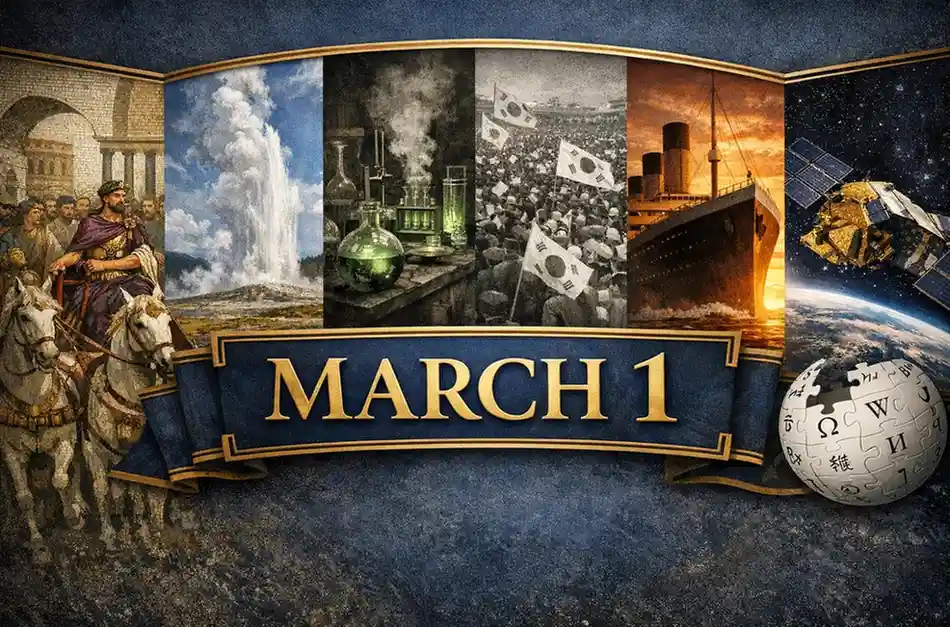
The transition from February into March marks a traditional season of renewal, and when we look at what happened on this day in history March 1, we see a date defined by the birth of new systems and the discovery of hidden natural forces. It is a day that witnessed the very first Roman triumph, the dawn of the American Articles of Confederation, and the scientific revelation of radioactivity.
From the preservation of vast wilderness at Yellowstone to the digital expansion of human knowledge on Wikipedia, March 1 serves as a perennial milestone for human organization, exploration, and the relentless pursuit of progress.
Important Events That Happened On March 1 In History
509 BC – First Roman Triumph
Publius Valerius Publicola celebrated the first triumph of the Roman Republic following his victory at the Battle of Silva Arsia. This ceremony followed the defeat of the deposed king Lucius Tarquinius Superbus, who had attempted to retake Rome with an Etruscan army. The triumph solidified the new Republican identity and established a military tradition of celebration that would persist for nearly a millennium.
293 – The Beginning of the Tetrarchy
Emperors Diocletian and Maximian appointed Constantius Chlorus and Galerius as Caesars, formally establishing the “Rule of Four” known as the Tetrarchy. This administrative reform was designed to provide better military and civil control over the sprawling and often unstable Roman Empire. By dividing power between two senior Augusti and two junior Caesars, Diocletian hoped to ensure smoother successions and more effective border defense.
350 – Vetranio Proclaims Himself Caesar
In a move encouraged by Constantina, the sister of Emperor Constantius II, the experienced general Vetranio proclaimed himself Caesar in the province of Illyricum. His self-promotion was a strategic political maneuver intended to protect the interests of the Constantinian dynasty against the usurper Magnentius. Vetranio’s reign was short-lived, as he peacefully abdicated his title to Constantius II later that same year.
834 – Restoration of Louis the Pious
Emperor Louis the Pious was officially restored as the sole ruler of the Frankish Empire after a turbulent period of civil war and deposition by his own sons. His return to the throne was facilitated by shifting loyalties among the Frankish nobility and the church, who feared the total collapse of imperial authority. The restoration attempted to bring stability to the Carolingian Empire, though regional tensions and dynastic rivalries continued to simmer.
1476 – Battle of Toro
The forces of the Catholic Monarchs, Isabella I of Castile and Ferdinand II of Aragon, engaged the combined Portuguese and Castilian armies of Afonso V at the Battle of Toro. While the tactical outcome of the battle was indecisive, it proved to be a major strategic victory for Isabella’s claim to the Castilian throne. The conflict effectively neutralized Portuguese interference in Spanish succession and paved the way for the eventual unification of Spain.
1562 – Massacre of Wassy
Sixty-three Huguenots were massacred by the Duke of Guise and his Catholic troops in the town of Wassy, France, while they were attending a religious service. This violent event served as the spark that ignited the French Wars of Religion, a series of brutal conflicts that would plague France for over thirty years. The massacre highlighted the deep-seated religious intolerance of the era and the fragile state of French social order.
1628 – Universal Ship Tax Mandate
King Charles I of England issued writs mandating that every county in the country, including inland regions, pay “Ship Money” to fund the Royal Navy. Traditionally, this tax had only been levied on coastal towns during times of war to provide for maritime defense. Charles’s decision to enforce it universally during peacetime without parliamentary consent became a major point of contention and a key cause of the English Civil War.
1633 – Champlain Reclaims New France
Samuel de Champlain officially reclaimed his role as the commander of New France on behalf of Cardinal Richelieu following the return of the colony from British control. Champlain’s return marked the beginning of renewed French colonial efforts in North America, focusing on the expansion of the fur trade and the establishment of permanent settlements. His leadership was essential in maintaining alliances with indigenous groups and securing the French presence along the St. Lawrence River.
1692 – Beginning of the Salem Witch Trials
In Salem Village, Massachusetts, Sarah Good, Sarah Osborne, and an enslaved woman named Tituba were brought before local magistrates on charges of practicing witchcraft. These initial hearings sparked a wave of mass hysteria and legal proceedings that would lead to the execution of twenty people and the imprisonment of many others. The trials remain a dark chapter in American colonial history, symbolizing the dangers of religious extremism and the failure of due process.
1781 – Articles of Confederation Go Into Effect
The Articles of Confederation officially went into effect as the first governing document of the United States after being ratified by all thirteen colonies. The document established a loose confederation of sovereign states with a very weak central government that lacked the power to tax or regulate interstate commerce. While it provided a framework for the young nation during the Revolutionary War, its limitations eventually led to its replacement by the U.S. Constitution.
1796 – Nationalization of the Dutch East India Company
The Batavian Republic officially nationalized the Dutch East India Company (VOC) after the once-mighty trading corporation fell into massive debt and mismanagement. This transition marked the end of the VOC’s nearly two-century-long monopoly over trade between the Netherlands and the East Indies. The company’s assets and territories were transferred to direct state control, laying the foundations for the future Dutch colonial administration in Indonesia.
1805 – Acquittal of Justice Samuel Chase
U.S. Supreme Court Justice Samuel Chase was acquitted by the Senate following his impeachment trial, which was largely seen as a political move by Thomas Jefferson’s administration. Chase had been accused of letting his Federalist political leanings influence his judicial decisions on the bench. His acquittal established a vital precedent for judicial independence, ensuring that judges could not be removed from office simply due to their political views.
1811 – Mass Killing of the Mamluks
The Egyptian ruler Muhammad Ali Pasha orchestrated the systematic killing of the leaders of the Mamluk dynasty during a banquet at the Cairo Citadel. By eliminating his most powerful domestic rivals in a single violent act, Ali effectively ended centuries of Mamluk influence in Egypt. This consolidation of power allowed him to begin a series of modernization reforms that would transform Egypt into a major regional power.
1815 – Napoleon Returns from Elba
Napoleon Bonaparte landed on the coast of France after escaping his exile on the island of Elba with a small contingent of loyal soldiers. His return initiated the “Hundred Days” period, as he successfully rallied the French army and marched toward Paris to retake the throne. This daring gamble forced the major European powers to mobilize their forces once again, setting the stage for his final defeat at the Battle of Waterloo.
1836 – Convention at Washington-on-the-Brazos
A convention of delegates from across Texas convened at Washington-on-the-Brazos to deliberate on the territory’s future and its independence from Mexico. The meeting took place while the Siege of the Alamo was still ongoing, adding a sense of extreme urgency to the political discussions. The convention eventually resulted in the formal drafting and signing of the Texas Declaration of Independence, marking the birth of the Republic of Texas.
1845 – Annexation of Texas Authorized
United States President John Tyler signed a joint resolution passed by Congress that authorized the annexation of the Republic of Texas. The move was highly controversial as it intensified the national debate over the expansion of slavery and risked a diplomatic crisis with Mexico. Texas officially joined the Union as a state later that year, a development that served as a direct precursor to the Mexican-American War.
1867 – Nebraska Becomes a State
Nebraska was officially admitted as the 37th state of the Union, just two years after the conclusion of the American Civil War. The state’s admission was significant for its agricultural potential and its role in the westward expansion of the United States. Nebraska’s capital was later moved to Lancaster and renamed Lincoln in honor of the assassinated president, reflecting the political sentiments of the era.
1870 – Death of Marshal F. S. López
The Paraguayan War, the deadliest conflict in South American history, finally came to an end following the death of Marshal Francisco Solano López at the Battle of Cerro Corá. López was killed by Brazilian troops while leading a desperate final stand with a small remnant of his army. The war had decimated Paraguay’s population and infrastructure, leaving the nation in a state of ruin and significantly redrawing the region’s borders.
1871 – Prussian Army Parades Through Paris
Following the end of the Siege of Paris and the French surrender in the Franco-Prussian War, the victorious Prussian Army conducted a triumphal parade through the streets of Paris. The event was a profound humiliation for the French people and marked the birth of the unified German Empire. The parade through the Champs-Élysées solidified Germany’s new position as the dominant military and political power in continental Europe.
1872 – Yellowstone National Park Established
President Ulysses S. Grant signed the law that established Yellowstone National Park as the world’s first national park. The act set aside over two million acres of geothermal wonders and wilderness in Wyoming, Montana, and Idaho for the benefit and enjoyment of the public. This historic decision birthed the modern conservation movement and served as a model for the protection of natural landscapes globally.
1893 – Tesla’s Radio Demonstration
Electrical engineer Nikola Tesla gave the first public demonstration of radio in St. Louis, Missouri, where he explained the principles of wireless transmission. He successfully demonstrated the transmission of radio frequency energy through the air without the use of wires, predating Marconi’s more famous achievements. Tesla’s work on wireless communication was foundational to the development of the modern telecommunications industry.
1896 – Battle of Adwa
In a stunning victory that shocked the European colonial powers, an Ethiopian army led by Emperor Menelik II defeated a modern Italian military force at the Battle of Adwa. The victory ended the First Italo-Ethiopian War and ensured that Ethiopia remained a sovereign nation during the “Scramble for Africa.” Adwa became a powerful symbol of African resistance and independence throughout the world for generations to come.
1896 – Discovery of Radioactive Decay
French physicist Henri Becquerel discovered radioactive decay while investigating the phosphorescent properties of uranium salts. He noticed that the salts emitted a form of radiation that could expose photographic plates even when kept in total darkness. This serendipitous discovery revolutionized the field of physics and earned Becquerel the Nobel Prize, sharing it with Marie and Pierre Curie for their subsequent research.
1901 – Formation of the Australian Army
The Australian Army was officially formed following the federation of the six Australian colonies into a single Commonwealth nation. This new unified force absorbed the various state militias and colonial defense units into a national military structure. The formation was a critical step in establishing Australia’s independent defense policy and its identity as a sovereign member of the British Empire.
1910 – Wellington Avalanche Disaster
The deadliest avalanche in the history of the United States struck the town of Wellington, Washington, burying two Great Northern Railway trains. The massive slide swept the trains off the tracks and down into a deep canyon, resulting in the deaths of 96 people. The tragedy led to significant changes in mountain railway engineering, including the construction of more extensive snow sheds and tunnels through the Cascades.
1914 – China Joins the Universal Postal Union
The Republic of China officially joined the Universal Postal Union (UPU), marking its integration into the global international mail system. This move allowed for standardized postal rates and procedures between China and the rest of the world, facilitating better international communication and trade. Joining the UPU was a major diplomatic milestone for the young republic as it sought to modernize its state institutions.
1917 – Release of the Zimmermann Telegram
The Zimmermann Telegram was reprinted in newspapers across the United States after the U.S. government released the unencrypted text of the German diplomatic message. The telegram proposed a military alliance between Germany and Mexico against the United States if America entered World War I. The public revelation of this German scheme outraged the American public and was a decisive factor in the U.S. decision to declare war on Germany.
1919 – March 1st Movement Begins
A major independence movement began in Korea against Japanese colonial rule, sparked by the reading of the Korean Declaration of Independence in Seoul. The peaceful protests quickly spread throughout the country, involving millions of Koreans from all walks of life. While the movement was brutally suppressed by Japanese authorities, it became a defining moment in Korean nationalism and led to the formation of the Provisional Government of the Republic of Korea.
1921 – First Ashes Whitewash
The Australian cricket team, captained by Warwick Armstrong, became the first team in history to complete a 5-0 “whitewash” of England in The Ashes series. The Australian side displayed dominant form throughout the matches, winning every game in a display of cricketing excellence. This historic feat would not be repeated for another 86 years, remaining a legendary achievement in the annals of international sports.
1921 – Beginning of the Kronstadt Rebellion
Sailors and citizens at the Kronstadt naval base began a rebellion against the Bolshevik government, demanding greater political freedom and economic reforms. The uprising was a response to the harsh policies of “War Communism” and the perceived authoritarianism of the Soviet regime. The rebellion was eventually crushed by the Red Army, but it forced Vladimir Lenin to implement the New Economic Policy to stabilize the country.
1932 – Kidnapping of the Lindbergh Baby
The 20-month-old son of famed aviator Charles Lindbergh was kidnapped from his nursery in East Amwell, New Jersey, sparking a massive international investigation. A ransom note was left at the scene, leading to weeks of desperate negotiations and media frenzy. The child’s body was tragically found months later, and the case led to the passage of the “Lindbergh Law,” making kidnapping a federal offense in the United States.
1933 – Hirakata Ammunition Explosion
An Imperial Japanese Army ammunition dump in Hirakata, Osaka, suffered a massive accidental explosion that killed 94 people and injured many more. The blast caused significant damage to the surrounding area and highlighted the dangers of large-scale military stockpiles in populated regions. The incident remains one of the deadliest non-combat military disasters in modern Japanese history, leading to stricter safety protocols for ordinance storage.
1941 – Bulgaria Joins the Tripartite Pact
Bulgaria officially signed the Tripartite Pact, aligning itself with the Axis powers of Germany, Italy, and Japan during World War II. The decision was influenced by German military pressure and the promise of territorial gains in the Balkans at the expense of its neighbors. This alliance allowed German troops to pass through Bulgarian territory to launch their invasion of Yugoslavia and Greece shortly thereafter.
1942 – Japanese Forces Land on Java
Japanese military forces launched a coordinated invasion of Java, the most populous and vital island of the Dutch East Indies. The landings took place at multiple points across the island, including Merak, Indramayu, and Rembang, quickly overwhelming the Allied defense forces. The fall of Java marked the end of Dutch colonial rule in Indonesia and was a major blow to the Allied presence in the Pacific theater.
1946 – Nationalisation of the Bank of England
The Bank of England was officially nationalized by the British government, ending its status as a private institution after more than 250 years. This move was a central part of the post-war Labour government’s economic agenda to bring key financial and industrial sectors under public control. Nationalization gave the government more direct influence over the nation’s monetary policy and financial stability during the reconstruction era.
1947 – IMF Begins Operations
The International Monetary Fund (IMF) officially began its financial operations, marking a new era of global economic cooperation and stability. Established during the Bretton Woods Conference, the IMF was designed to oversee the international monetary system and provide loans to countries facing balance-of-payment crises. Its first operations were a critical step in rebuilding the global economy after the devastation of World War II.
1950 – Conviction of Klaus Fuchs
Theoretical physicist Klaus Fuchs was convicted in a British court of spying for the Soviet Union by disclosing top-secret atomic bomb data. Fuchs had worked on the Manhattan Project and provided the Soviets with detailed information that significantly accelerated their own nuclear weapons program. His conviction sent shockwaves through the Western intelligence community and heightened the tensions of the early Cold War era.
1953 – Joseph Stalin Suffers a Stroke
Soviet Premier Joseph Stalin suffered a major stroke and collapsed at his dacha, though medical help was famously delayed by his staff who were too terrified to disturb him. The news of his collapse was kept secret for several days as his inner circle scrambled to prepare for the inevitable power struggle. Stalin died four days later, ending his nearly thirty-year rule and triggering a period of political transition in the USSR.
1954 – Castle Bravo Detonation
The United States detonated the “Castle Bravo” hydrogen bomb at Bikini Atoll, which resulted in a 15-megaton yield—more than twice what scientists had predicted. The blast caused severe radioactive contamination across nearby islands and affected the crew of a Japanese fishing boat, the Lucky Dragon No. 5. It remains the largest nuclear test ever conducted by the U.S. and a major turning point in the global movement against nuclear testing.
1954 – Attack on the U.S. Capitol
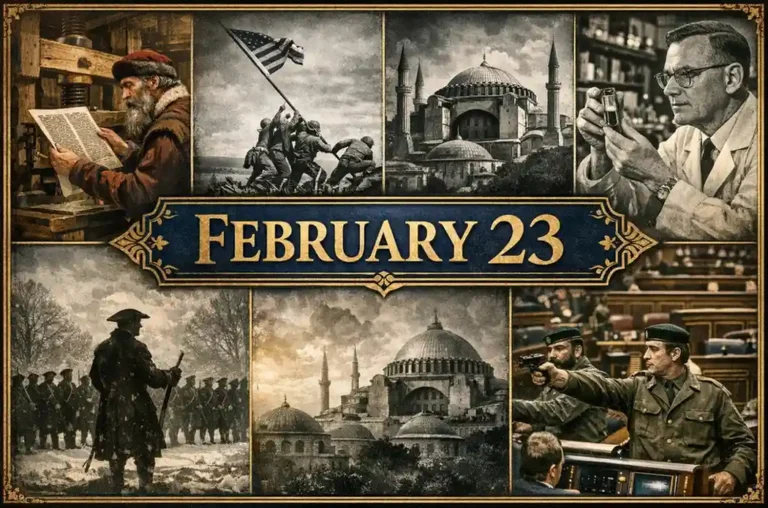
A group of four armed Puerto Rican nationalists opened fire from the visitors’ gallery of the United States Capitol, injuring five members of the House of Representatives. The attackers shouted for the independence of Puerto Rico as they sprayed the House chamber with bullets during a debate. The event led to immediate increases in Capitol security and drew national attention to the issue of Puerto Rican status and militant nationalism.
1956 – Radiotelephony Spelling Alphabet Finalized
The International Air Transport Association finalized the draft of the Radiotelephony spelling alphabet for adoption by the International Civil Aviation Organization. This standardized system—starting with “Alfa, Bravo, Charlie”—was designed to ensure clear and unambiguous communication between pilots and air traffic controllers globally. The phonetic alphabet remains an essential tool for aviation safety and international maritime communication today.
1956 – Formation of the East German National People’s Army
The German Democratic Republic (East Germany) officially formed the Nationale Volksarmee (NVA) as its primary military force. The creation of the NVA followed West Germany’s own rearmament and entry into NATO, further cementing the division of Germany during the Cold War. The East German military became a key component of the Warsaw Pact forces, maintaining a high state of readiness along the front lines of the Iron Curtain.
1958 – First U.S. Member of the Roman Curia
Samuel Alphonsus Stritch, the Cardinal Archbishop of Chicago, was appointed by Pope Pius XII as the Pro-Prefect of the Propagation of Faith. This appointment made him the first American citizen to hold a high-ranking position within the Roman Curia, the central administrative body of the Catholic Church. The move reflected the growing influence and importance of the American Catholic community within the global church structure.
1961 – Uganda Becomes Self-Governing
Uganda officially became a self-governing territory and held its first national elections as it moved toward full independence from British colonial rule. The elections were won by the Democratic Party, and Benedicto Kiwanuka became the country’s first Chief Minister. This transition period was a critical phase in the decolonization of East Africa and the establishment of sovereign democratic institutions in Uganda.
1962 – American Airlines Flight 1 Crash
An American Airlines Boeing 707 crashed into Jamaica Bay shortly after taking off from New York’s Idlewild Airport, killing all 95 people on board. The investigation revealed that a mechanical failure in the rudder control system caused the aircraft to bank sharply and dive into the water. At the time, it was the deadliest single-plane accident in U.S. history and led to significant safety improvements in jet aircraft design.
1964 – Villarrica Volcano Eruption
The Villarrica Volcano in Chile began a powerful “strombolian” eruption, sending lava and ash high into the air and melting the mountain’s glaciers. The resulting “lahars”—massive mudflows of volcanic debris and water—rushed down the slopes and destroyed half of the nearby town of Coñaripe. The disaster caused significant loss of life and property, highlighting the ongoing volcanic risks in the Andes mountain range.
1964 – Paradise Airlines Flight 901A Crash
A Paradise Airlines Constellation crashed near Lake Tahoe, Nevada, during a heavy snowstorm, resulting in the deaths of all 85 people on board. The pilot had attempted to navigate the mountainous terrain under poor visibility conditions and struck a ridge while trying to return to the airport. The crash remains one of the worst aviation disasters in Nevada’s history and led to stricter regulations for flights in mountainous areas.
1966 – Venera 3 Lands on Venus
The Soviet space probe Venera 3 successfully crashed on the surface of Venus, becoming the first spacecraft in history to land on another planet. While the probe’s communication system failed before it could transmit data from the surface, the mission was a monumental achievement in interplanetary exploration. It proved that human-made objects could navigate to and impact another world, paving the way for future successful soft landings.
1966 – Ba’ath Party Takes Power in Syria
The Ba’ath Party officially seized full control of the Syrian government following an internal military coup that overthrew the existing leadership. This event solidified the rule of the pan-Arab socialist party, which would go on to dominate Syrian politics for decades. The coup marked a significant shift toward a more radicalized and centralized state structure, influencing the geopolitical landscape of the Middle East during the Cold War.
1971 – Pakistan Postpones National Assembly
President Yahya Khan of Pakistan announced the indefinite postponement of the newly elected National Assembly session, which was scheduled to meet in Dhaka. The decision was seen as a refusal to hand over power to the Awami League, which had won a majority in the democratic elections. This move sparked massive civil disobedience and protests in East Pakistan, eventually leading to the Bangladesh Liberation War.
1973 – Saudi Embassy Attack in Khartoum
Eight members of the Palestinian militant group Black September stormed the Saudi embassy in Khartoum, Sudan, during a diplomatic reception. The group took several diplomats hostage, demanding the release of various Palestinian prisoners held in Israel and Jordan. When their demands were not met, the militants assassinated three Western hostages, including the U.S. Ambassador, drawing worldwide condemnation of the group’s tactics.
1974 – Watergate Indictments
Seven former aides and officials from the Nixon administration were indicted by a federal grand jury for their roles in the Watergate break-in and the subsequent cover-up. The charges included conspiracy to obstruct justice, making false statements, and perjury. These indictments were a turning point in the scandal, bringing the legal focus directly onto the President’s inner circle and accelerating the calls for his impeachment.
1981 – Bobby Sands Hunger Strike Begins
Provisional Irish Republican Army (IRA) member Bobby Sands began a hunger strike in HM Prison Maze to protest the British government’s refusal to grant “Special Category Status” to political prisoners. Sands’ strike drew massive international attention to the conflict in Northern Ireland and the conditions of republican prisoners. His subsequent election to the British Parliament while on strike and his eventual death sparked widespread riots and political debate.
1990 – Steve Jackson Games Raid
The United States Secret Service conducted a raid on the offices of Steve Jackson Games, seizing computers and equipment as part of a hacking investigation. The raid was based on a misunderstanding of a fictional game supplement, but it caused significant financial damage to the small company. This incident was a major catalyst for the formation of the Electronic Frontier Foundation (EFF), an organization dedicated to protecting civil liberties in the digital world.
1991 – Uprisings Against Saddam Hussein
In the aftermath of the Gulf War, widespread uprisings against the regime of Saddam Hussein began across Iraq, starting in the south and spreading to Kurdish regions in the north. The protesters hoped for support from the international coalition, but the rebellions were brutally suppressed by the remaining Iraqi Republican Guard. The ensuing violence resulted in the deaths of more than 25,000 people and a massive humanitarian crisis as refugees fled the country.
1992 – Bosnia and Herzegovina Independence
Bosnia and Herzegovina officially declared its independence from the Socialist Federal Republic of Yugoslavia following a national referendum. While the move was supported by the majority of Bosniaks and Croats, it was fiercely opposed by the Bosnian Serb population. This declaration marked the formal end of the Yugoslav union in the region but also served as the immediate trigger for the devastating Bosnian War.
1998 – Titanic Grosses $1 Billion
James Cameron’s epic film Titanic became the first movie in history to gross over $1 billion at the worldwide box office. The film, which blended historical tragedy with a fictional romance, became a cultural phenomenon and dominated the global cinematic landscape for months. Its success proved the massive appeal of big-budget, high-production-value storytelling and remained the highest-grossing film for over a decade.
2002 – Operation Anaconda Begins
The United States and its coalition partners launched Operation Anaconda in the Shahi-Kot Valley of eastern Afghanistan to root out Al-Qaeda and Taliban fighters. It was the first large-scale conventional battle of the U.S. invasion, involving intense mountain warfare and significant air support. While the operation was eventually successful in clearing the valley, it highlighted the challenges of the terrain and the resilience of the insurgent forces.
2002 – Launch of Envisat
The Envisat environmental satellite was successfully launched aboard an Ariane 5 rocket, becoming the largest and most sophisticated Earth observation payload of its time. Designed by the European Space Agency, Envisat was 10.5 meters long and carried a suite of instruments to monitor the Earth’s atmosphere, oceans, and land surfaces. The satellite provided ten years of critical data for climate change research and environmental monitoring before its mission ended in 2012.
2002 – STS-109 Launch
The Space Shuttle Columbia was launched on mission STS-109, a high-stakes flight dedicated to servicing the Hubble Space Telescope. During the mission, astronauts performed five grueling spacewalks to install new solar arrays, a new power control unit, and advanced cameras. These upgrades significantly enhanced the telescope’s observational capabilities, allowing it to peer deeper into the universe with greater clarity than ever before.
2003 – DHS Takes Over Customs and Secret Service
The management of the United States Customs Service and the United States Secret Service officially moved to the newly created Department of Homeland Security (DHS). This massive reorganization was the largest of its kind in U.S. history, intended to centralize national security and border protection efforts following the 9/11 attacks. The move integrated various agencies into a single cabinet-level department to improve coordination and response to domestic threats.
2005 – Roper v. Simmons Decision
In the landmark case of Roper v. Simmons, the U.S. Supreme Court ruled that the execution of individuals who were under the age of 18 at the time of their crime is unconstitutional. The 5-4 decision held that the death penalty for juveniles violated the Eighth Amendment’s prohibition against “cruel and unusual punishment.” The ruling brought the United States in line with international standards regarding the sentencing of minors.
2006 – English Wikipedia Reaches One Million Articles
The English-language edition of Wikipedia reached a major milestone with the creation of its one millionth article, which featured the Jordanhill railway station in Scotland. This achievement highlighted the incredible growth and success of the volunteer-driven online encyclopedia as a primary source of information for the world. Wikipedia’s model of open collaboration has since transformed how knowledge is archived and accessed in the digital age.
2007 – Southern U.S. Tornado Outbreak
A powerful tornado outbreak swept across the southern United States, resulting in at least 20 deaths and widespread destruction. The most tragic incident occurred at Enterprise High School in Alabama, where a violent tornado struck the building while students were inside, killing eight teenagers. The disaster prompted a national review of school safety protocols and the construction of reinforced shelters in tornado-prone regions.
2008 – Armenian Election Protests
Armenian police clashed violently with opposition protesters in Yerevan who were rally against what they alleged were fraudulent presidential election results. The clashes resulted in the deaths of ten people and the declaration of a 20-day state of emergency by the government. The event was a major political crisis for the young democracy, highlighting deep social divisions and the challenges of establishing transparent electoral processes in the post-Soviet era.
2014 – Kunming Railway Station Stabbing
A group of eight attackers carrying knives launched a coordinated mass stabbing at the Kunming Railway Station in China, killing 35 people and injuring 143 others. The Chinese government attributed the attack to separatist militants from the Xinjiang region, labeling it a terrorist act. The brutality of the incident shocked the nation and led to a significant increase in security measures at transportation hubs across China.
Read Also: This day in history February 29 Crowns Courage Compassion
Observances & Institutional Dates
- Independence Day (Bosnia and Herzegovina): Celebrating the nation’s 1992 declaration of sovereignty.
- Beer Day (Iceland): Commemorating the end of the 74-year prohibition of beer on this day in 1989.
- Samiljeol (South Korea): A national holiday honoring the 1919 March 1st independence movement.
- Zero Discrimination Day: An international day to promote equality and celebrate diversity globally.
- Heroes’ Day (Paraguay): A day of remembrance marking the end of the Paraguayan War in 1870.
Famous People Born On March 1
| Name | Description | Date |
|---|---|---|
| Donald Kent Slayton | American astronaut | March 1, 1924 – June 13, 1993 |
| Robert H. Bork | American legal scholar | March 1, 1927 – December 19, 2012 |
| Georg Simmel | German sociologist | March 1, 1858 – September 26, 1918 |
| Pete Rozelle | American sports executive | March 1, 1926 – December 6, 1996 |
| Martial | Roman poet | March 1, 38 or 41 – c.103 |
| Oskar Kokoschka | Austrian expressionist artist | March 1, 1886 – February 22, 1980 |
| Harry Caray | American sportscaster | March 1, 1914 – February 18, 1998 |
| Jacques Rivette | French New Wave director | March 1, 1928 – January 29, 2016 |
| Akutagawa Ryunosuke | Japanese short story writer | March 1, 1892 – July 24, 1927 |
| Lytton Strachey | English writer & critic | March 1, 1880 – January 21, 1932 |
| Caroline of Brandenburg-Ansbach | Queen of Great Britain | March 1, 1683 – November 20, 1737 |
| Robert Lowell | American poet | March 1, 1917 – September 12, 1977 |
| João Goulart | President of Brazil | March 1, 1918 – December 6, 1976 |
| William Dean Howells | American novelist & critic | March 1, 1837 – May 11, 1920 |
| Richard Wilbur | American poet | March 1, 1921 – October 14, 2017 |
| Deb Fischer | American politician | March 1, 1951 – Present |
| Thomas Adès | British composer | March 1, 1971 – Present |
| Shoghi Effendi Rabbani | Baháʼí leader | March 1, 1897 – November 4, 1957 |
| Bertrand Piccard | Swiss balloonist | March 1, 1958 – Present |
| Blanche K. Bruce | American senator | March 1, 1841 – March 17, 1898 |
Famous People Died On March 1
| Name | Description | Date |
|---|---|---|
| Jackie Coogan | Hollywood child star | October 26, 1914 – March 1, 1984 |
| Leopold II | Holy Roman Emperor | May 5, 1747 – March 1, 1792 |
| Gabriele D’Annunzio | Italian poet & leader | March 12, 1863 – March 1, 1938 |
| George Herbert | Metaphysical poet | April 3, 1593 – March 1, 1633 |
| Alfred Korzybski | Philosopher & scientist | July 3, 1879 – March 1, 1950 |
| Minnie Miñoso | Baseball legend | November 29, 1925 – March 1, 2015 |
| Homer Plessy | Plaintiff in landmark case | March 17, 1863 – March 1, 1925 |
| Zhores Alferov | Nobel Prize physicist | March 15, 1930 – March 1, 2019 |
| Dixie Dean | Legendary striker | January 22, 1907 – March 1, 1980 |
| Francesco Redi | Early biologist | February 18, 1626 – March 1, 1697 |
| Giacomo Balla | Futurist painter | July 24, 1871 – March 1, 1958 |
| Mustafa al-Barzani | Kurdish military leader | March 14, 1903 – March 1, 1979 |
| Jacobus Henricus van ‘t Hoff | Nobel Prize chemist | August 30, 1852 – March 1, 1911 |
| Ernesto Cardenal | Poet & priest | January 20, 1925 – March 1, 2020 |
| Alexandre Yersin | Discovered plague bacillus | September 23, 1863 – March 1, 1943 |
| Thomas Campion | Poet & musician | February 12, 1567 – March 1, 1620 |
| Francisco de Almeida | First viceroy of India | c.1450 – March 1, 1510 |
| George Grossmith | Comic actor & singer | December 9, 1847 – March 1, 1912 |
| Francisco Solano López | Paraguayan leader | July 24, 1826 – March 1, 1870 |
| Kevin Roche | Modern architect | June 14, 1922 – March 1, 2019 |
Frequently Asked Questions
- What was the first national park in the world?
- Yellowstone National Park was established on March 1, 1872, by President Ulysses S. Grant.
- Who discovered radioactivity on this day?
- French physicist Henri Becquerel discovered the process of radioactive decay on March 1, 1896.
- Why is March 1 significant in Korea?
- It marks the start of the 1919 March 1st Movement against Japanese colonial rule.
- What happened at the U.S. Capitol in 1954?
- Four Puerto Rican nationalists opened fire from the gallery, injuring five members of Congress.