Reflecting on what happened on this day in history March 12, we encounter a timeline marked by monumental shifts in power and the birth of the modern digital age. It is the day Mahatma Gandhi began his defiant 200-mile march for salt and the day Tim Berners-Lee proposed the system that would become the World Wide Web. From the grim annexation of Austria by Nazi Germany to the radioactive fallout at Fukushima, March 12 stands as a testament to the dual nature of human progress: our incredible capacity for connection and the devastating consequences of our conflicts.
Important Events That Happened On March 12 In History
538 – Siege of Rome Ends
Vitiges, the King of the Ostrogoths, finally abandoned his year-long siege of Rome and retreated to Ravenna. This allowed the Byzantine general Belisarius to secure the city for Emperor Justinian I. The victory was a turning point in the Gothic War, marking a significant step in the Eastern Roman Empire’s attempt to reclaim the Italian Peninsula and restore the glory of the old Roman borders.
1088 – Election of Pope Urban II
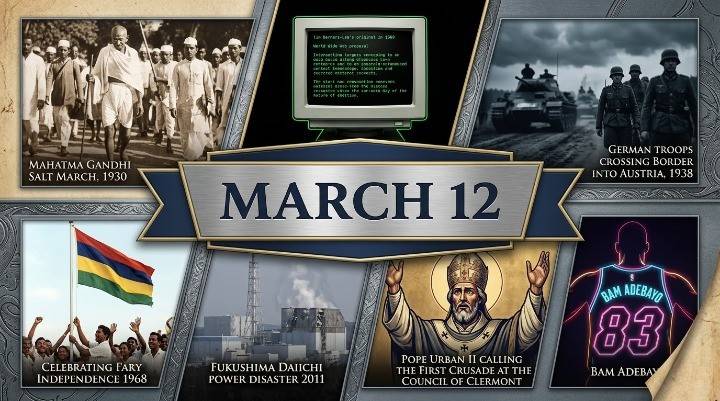
Odo of Lagery was elected as the 159th Pope, taking the name Urban II. His papacy was defined by his continuation of the Gregorian Reforms and, most famously, his sermon at the Council of Clermont years later. By initiating the First Crusade, Urban II fundamentally altered the relationship between Western Europe and the Near East, setting in motion centuries of religious and political conflict.
1158 – First Mention of Munich
The city of Munich was documented for the first time as forum apud Munichen (the market by the monks) in the Augsburg arbitration by Holy Roman Emperor Frederick I, also known as Barbarossa. The settlement began when Henry the Lion, Duke of Saxony and Bavaria, built a bridge over the Isar River to divert the salt trade. This legal recognition established Munich as a key player in European trade and culture.
1391 – Election of Konrad von Wallenrode
Konrad von Wallenrode was elected as the 24th Grand Master of the Teutonic Order. His leadership was marked by aggressive military campaigns in Lithuania and a focus on strengthening the Order’s hold over the Baltic region. He is famously remembered in literature—most notably by Adam Mickiewicz—as a complex figure navigating the brutal politics of the Crusader states.
1579 – Siege of Maastricht Begins
As part of the Eighty Years’ War, Spanish forces led by Alexander Farnese began a brutal siege of the city of Maastricht. The defenders held out for months under extreme conditions before the Spanish finally breached the walls. The fall of the city was followed by a horrific three-day massacre of the population, serving as a grim example of the religious and political violence of the Dutch Revolt.
1622 – Canonization of Jesuit Founders
In a landmark event for the Catholic Reformation, Pope Gregory XV officially canonized Ignatius of Loyola and Francis Xavier, the founders of the Society of Jesus (the Jesuits). Their elevation to sainthood solidified the importance of the Jesuit order in global missions and education. The ceremony also included the canonization of Teresa of Avila, Isidore the Laborer, and Philip Neri.
1689 – James II Lands at Kinsale
The deposed King James II of England landed at Kinsale, Ireland, with French military support, marking the beginning of the Williamite War. James hoped to use Ireland as a base to reclaim his throne from William of Orange. This arrival triggered a series of bloody conflicts, including the famous Battle of the Boyne, which would shape Irish and British politics for generations.
1811 – Battle of Redinha
During the Peninsular War, French Marshal Michel Ney successfully fought a rearguard action at Redinha against a much larger Anglo-Portuguese force led by the Duke of Wellington. Ney’s tactical skill allowed the main French army to continue its retreat safely. While technically a delay, it demonstrated the “Bravest of the Brave’s” ability to manage a disciplined withdrawal under intense pressure.
1862 – Smallpox Epidemic in British Columbia
The paddle steamer Brother Jonathan docked in Victoria, carrying passengers infected with smallpox from San Francisco. Local authorities failed to quarantine the ship, leading to a catastrophic epidemic. The disease spread rapidly through the indigenous trade routes, killing an estimated two-thirds of the First Nations people in the province and permanently altering the demographic and social landscape of British Columbia.
1912 – Founding of the Girl Guides (Girl Scouts)
Juliette Gordon Low organized the first Girl Guide troop meeting in Savannah, Georgia, with just 18 girls. The organization, which later became the Girl Scouts of the USA, was designed to give girls the opportunity to develop self-reliance, leadership, and outdoor skills. Since its founding on this day, the movement has grown into a global organization that has empowered millions of young women.
1913 – Canberra Officially Named
The future capital of Australia was officially named “Canberra” during a ceremony at Kurrajong Hill (now Capital Hill) by Lady Denman, the wife of the Governor-General. The name was chosen to end the rivalry between Sydney and Melbourne for the title of capital. Designed by American architects Walter Burley Griffin and Marion Mahony Griffin, the city was built from scratch as a planned “garden city.”
1918 – Moscow Becomes Russia’s Capital
In the wake of the Russian Revolution, the Bolshevik government moved the capital of Russia from Petrograd (Saint Petersburg) back to Moscow. The move was motivated by the proximity of German forces to Petrograd during World War I and a desire to return the seat of power to the historic heart of Russia. Moscow has remained the center of Russian political life ever since.
1920 – The Kapp Putsch
The Kapp Putsch began in Germany as the Marinebrigade Ehrhardt marched on Berlin to overthrow the Weimar Republic and install an autocratic government. Led by Wolfgang Kapp and Walther von Lüttwitz, the coup initially forced the government to flee. However, the putsch collapsed within days after a massive general strike by German workers paralyzed the country, proving the resilience of the young democracy.
1928 – St. Francis Dam Failure
Just hours after being inspected by chief engineer William Mulholland, the St. Francis Dam in California catastrophically failed. A wall of water 140 feet high swept through the San Francisquito Canyon, killing 431 people and destroying everything in its path. The disaster ended Mulholland’s career and led to a complete overhaul of dam safety and engineering standards in the United States.
1930 – Gandhi Begins the Salt March
Mahatma Gandhi set out from his ashram with 78 followers on a 200-mile trek to the coastal village of Dandi. The march was a non-violent protest against the British salt tax, which heavily burdened the Indian poor. By the time he reached the sea to harvest his own salt, thousands had joined him, turning the “Salt Satyagraha” into a pivotal moment in the Indian struggle for independence.
1933 – FDR’s First “Fireside Chat”
During the depths of the Great Depression, President Franklin D. Roosevelt addressed the American people via radio for the first time. In this “fireside chat,” he explained the banking crisis in simple terms and asked for the public’s confidence as the government worked to reopen banks. The broadcast was a revolutionary use of mass media, creating a direct personal connection between the President and the citizenry.
1938 – The Anschluss
Nazi German troops crossed the border into Austria, officially annexing the country into the Third Reich. Known as the Anschluss, this move was met with little resistance from the Austrian military and was widely supported by pro-Nazi segments of the population. The annexation was a clear violation of international treaties and served as a major step toward the outbreak of World War II.
1940 – End of the Winter War
Finland signed the Moscow Peace Treaty with the Soviet Union, bringing the 105-day Winter War to a close. While Finland managed to maintain its independence despite being vastly outnumbered, the treaty forced the nation to cede nearly 10% of its territory, including the strategic region of Karelia. The conflict left a deep scars on the Finnish national consciousness and influenced its later involvement in WWII.
1940 – Turenki Train Disaster
The most destructive train accident in Finnish history occurred in Turenki, Janakkala, when two trains collided in heavy snow. The crash killed 39 people and injured dozens more. Coming during the final days of the Winter War, the tragedy compounded the nation’s grief and highlighted the immense strain placed on Finland’s infrastructure during the conflict.
1942 – Surrender of Java
The Battle of Java concluded as the American-British-Dutch-Australian (ABDA) Command surrendered unconditionally to the Empire of Japan in Bandung. This victory gave Japan control over the resource-rich Dutch East Indies and marked the collapse of Allied defense in Southeast Asia. The three-year occupation that followed would set the stage for the eventual Indonesian independence movement.
1947 – Proclamation of the Truman Doctrine
In a speech before Congress, President Harry S. Truman requested $400 million in military and economic aid for Greece and Turkey to prevent them from falling under Soviet influence. This policy, known as the Truman Doctrine, became the foundation of American foreign policy during the Cold War, establishing the principle of “containment” to stop the spread of communism globally.
1950 – Llandow Air Disaster
A charter flight carrying Welsh rugby fans back from a match in Ireland crashed near Sigingstone, Wales, killing 80 of the 83 people on board. At the time, it was the deadliest aviation accident in history. The tragedy devastated the local community and led to significant changes in safety regulations for charter flights and passenger seating configurations.
1967 – Suharto Takes Power
General Suharto was inaugurated as the Acting President of Indonesia by the Provisional People’s Consultative Assembly, effectively stripping the founding President Sukarno of his remaining power. This marked the formal beginning of the “New Order” regime, which would rule Indonesia for 31 years. Suharto’s rise to power followed a period of intense political instability and a violent anti-communist purge.
1968 – Mauritius Gains Independence
Mauritius officially gained independence from the United Kingdom, ending over 150 years of British colonial rule. Sir Seewoosagur Ramgoolam became the nation’s first Prime Minister. Despite being a small island nation with a diverse ethnic population, Mauritius successfully established a stable democracy and a thriving economy based initially on sugar and later on tourism and finance.
1971 – Turkish Military Memorandum
The Turkish military high command sent a memorandum to President Cevdet Sunay, demanding a “strong and credible government” to end political unrest and economic instability. The government of Prime Minister Süleyman Demirel resigned immediately in what became known as the “coup by memorandum.” It was the second time the military had intervened in Turkish politics since 1960.
1989 – Proposal for the World Wide Web
Tim Berners-Lee, a software engineer at CERN, submitted a proposal for a “vistualized” information management system using hypertext. His goal was to allow scientists to share data and documents across different computer systems. This proposal, which his supervisor famously labeled “vague but exciting,” eventually evolved into the World Wide Web, fundamentally transforming how humanity communicates and accesses information.
1992 – Mauritius Becomes a Republic
Twenty-four years after gaining independence, Mauritius officially became a republic within the Commonwealth of Nations. This move replaced the British monarch as the head of state with a President. The transition reflected the nation’s growing confidence and its desire to finalize its sovereign identity while maintaining its historical and diplomatic ties to the United Kingdom.
1993 – Mumbai Serial Bombings
A series of 12 coordinated bomb blasts rocked the city of Mumbai (then Bombay), India, targeting the stock exchange, hotels, and crowded marketplaces. The attacks killed 257 people and injured over 700. Orchestrated by organized crime syndicates with reported foreign backing, the bombings were among the most destructive in Indian history and significantly heightened communal tensions in the region.
1993 – North Korea Withdraws from NPT
In a move that shocked the international community, North Korea announced its intention to withdraw from the Treaty on the Non-Proliferation of Nuclear Weapons (NPT). The government cited a threat to its national security and refused to grant IAEA inspectors access to its nuclear sites. This sparked a nuclear crisis on the Korean Peninsula that continues to dominate global security discussions today.
1999 – Former Warsaw Pact Members Join NATO
In a historic expansion of the North Atlantic Treaty Organization, the Czech Republic, Hungary, and Poland were officially admitted as members. This was the first time that former members of the Soviet-led Warsaw Pact joined the Western alliance. The move signaled a definitive end to the Cold War era and a major shift in the security architecture of Eastern Europe.
2003 – Assassination of Zoran Đinđić
Serbian Prime Minister Zoran Đinđić was assassinated by a sniper in front of the government building in Belgrade. A pro-Western reformer, Đinđić was instrumental in the overthrow of Slobodan Milošević. His murder was orchestrated by members of the Special Operations Unit and organized crime groups who opposed his efforts to crack down on corruption and cooperate with the Hague Tribunal.
2003 – WHO Issues SARS Warning
The World Health Organization (WHO) issued its first global alert regarding an atypical pneumonia outbreak in Vietnam and Hong Kong, later identified as Severe Acute Respiratory Syndrome (SARS). The fast-moving virus eventually spread to over 20 countries. The SARS outbreak was a critical wake-up call for global health systems, leading to major improvements in international pandemic response protocols.
2004 – Impeachment of Roh Moo-hyun
The National Assembly of South Korea voted to impeach President Roh Moo-hyun on charges of illegal electioneering and incompetence. This was the first time a president had been impeached in South Korean history. The move was highly controversial and triggered massive pro-Roh protests; the Constitutional Court eventually overturned the impeachment, allowing Roh to return to office.
2006 – The Mahmoudiyah Killings
A horrific war crime was committed by five American soldiers of the 502nd Infantry Regiment in Mahmoudiyah, Iraq. The soldiers raped 14-year-old Abeer Qassim Hamza al-Janabi and murdered her, her parents, and her young sister. The event drew international condemnation and led to the conviction and life imprisonment of the soldiers involved, highlighting the extreme stresses and moral failures of the Iraq War.
2009 – Bernie Madoff Pleads Guilty
In a federal court in Manhattan, financier Bernie Madoff pleaded guilty to 11 felony counts related to the largest Ponzi scheme in history. Madoff admitted to defrauding thousands of investors out of an estimated $65 billion over several decades. He was sentenced to 150 years in prison, becoming a global symbol of corporate greed and the failure of financial oversight.
2011 – Fukushima Daiichi Explosion
One day after the Tōhoku earthquake and tsunami, a hydrogen explosion occurred at the Unit 1 reactor of the Fukushima Daiichi Nuclear Power Plant. The blast destroyed the reactor’s outer housing and released significant radioactivity into the atmosphere. This was the first of several explosions at the plant, leading to a Level 7 nuclear disaster and the mass evacuation of the surrounding region.
2014 – East Harlem Gas Explosion
A massive gas explosion leveled two apartment buildings in the New York City neighborhood of East Harlem. The blast killed eight people and injured more than 70 others. An investigation found that a leak in an century-old gas main had been reported shortly before the explosion, leading to a renewed focus on the aging infrastructure beneath the streets of New York.
2018 – US-Bangla Airlines Flight 211 Crash
A Bombardier Dash 8 Q400 carrying 71 people crashed and caught fire while landing at Tribhuvan International Airport in Kathmandu, Nepal. The accident killed 51 people. The investigation pointed to a lack of situational awareness and pilot disorientation as the primary causes, marking one of the deadliest aviation accidents in Nepal’s history.
2019 – Second Brexit “Meaningful Vote”
The UK House of Commons rejected Prime Minister Theresa May’s revised EU Withdrawal Bill for a second time by a significant margin of 149 votes. This “Meaningful Vote” defeat deepened the political deadlock over Brexit and increased the pressure for an extension of the Article 50 deadline, ultimately leading to a change in Conservative Party leadership.
2020 – US Travel Suspension (COVID-19)
As the COVID-19 pandemic began to accelerate, the United States announced a 30-day suspension of travel from 26 European countries. The decision aimed to slow the spread of the virus as the world faced an unprecedented public health crisis. The suspension caused chaos at airports and signaled the beginning of a period of global isolation that would last for months.
2026 – Bam Adebayo’s Post-Game Fallout (March 12)
Following his historic 83-point performance on March 10, the sports world continued to reel on March 12. Sports talk shows, podcasts, and digital news outlets dedicated the entire day to debating where Adebayo’s performance ranks among the greatest in sports history. The Miami Heat officially announced a commemorative jersey line, which sold out in under 12 minutes, marking a new peak in NBA fan engagement.
Take A Look At March 11 Stories
Famous People Born on March 12
| Name | Description | Date |
|---|---|---|
| George Berkeley | Irish philosopher & bishop | March 12, 1685 – January 14, 1753 |
| Gabriele D’Annunzio | Italian poet & political leader | March 12, 1863 – March 1, 1938 |
| Edward Albee | American dramatist | March 12, 1928 – September 16, 2016 |
| Dave Eggers | Author & publisher | March 12, 1970 – Present |
| André Le Nôtre | Designer of Versailles gardens | March 12, 1613 – September 15, 1700 |
| Giovanni Agnelli | Fiat chairman | March 12, 1921 – January 24, 2003 |
| Gustav Kirchhoff | Founder of spectroscopy | March 12, 1824 – October 17, 1887 |
| Leo Esaki | Nobel Prize–winning physicist | March 12, 1925 – Present |
| Yashwantrao Chavan | Indian statesman | March 12, 1913 – November 25, 1984 |
| Sir John Abbott | Canadian PM | March 12, 1821 – October 30, 1893 |
| Alberto Burri | Modern artist | March 12, 1915 – February 13, 1995 |
| Adolph Ochs | Owner of The New York Times | March 12, 1858 – April 8, 1935 |
| John Aubrey | Antiquarian & biographer | March 12, 1626 – June 1697 |
| Gabriel Tarde | Social theorist | March 12, 1843 – May 13, 1904 |
| Francisco J. Ayala | Evolutionary biologist | March 12, 1934 – March 3, 2023 |
Famous People Died on March 12
| Name | Description | Date |
|---|---|---|
| Yehudi Menuhin | Legendary violin virtuoso | April 22, 1916 – March 12, 1999 |
| Robert Ludlum | Spy-thriller author | May 25, 1927 – March 12, 2001 |
| Betty Hutton | Film star & singer | February 26, 1921 – March 12, 2007 |
| Dick Fosbury | Olympic high-jump champion | March 6, 1947 – March 12, 2023 |
| Woody Hayes | College football legend | February 14, 1913 – March 12, 1987 |
| Michael Graves | Postmodern architect | July 9, 1934 – March 12, 2015 |
| Romare Bearden | Painter & collage master | September 2, 1911 – March 12, 1988 |
| Heinrich Mann | Novelist & essayist | March 27, 1871 – March 12, 1950 |
| Eugene Ormandy | Classical music conductor | November 18, 1899 – March 12, 1985 |
| Saint Innocent I | Early Christian pope | Unknown – March 12, 417 |
| Mihajlo Pupin | Telecommunications pioneer | October 9, 1854 – March 12, 1935 |
| Bolesław Bierut | Communist statesman | April 18, 1892 – March 12, 1956 |
| Gustav Vigeland | Creator of Vigeland Park | April 11, 1869 – March 12, 1943 |
| Lloyd Shapley | Nobel laureate in economics | June 2, 1923 – March 12, 2016 |
| Miguel Delibes | Prominent Spanish writer | October 17, 1920 – March 12, 2010 |
Observances & Institutional Dates
- Arbor Day (China & Taiwan): Dedicated to tree planting and environmental conservation.
- National Day (Mauritius): Celebrating the country’s independence in 1968 and its transition to a republic in 1992.
- World Day Against Cyber Censorship: An annual event to support a single, unrestricted Internet that is accessible to all.
- Aztec New Year: A celebration of the beginning of the year in the Aztec calendar.
- Youth Day (Zambia): Honoring the contributions and potential of young people in Zambian society.
Frequently Asked Questions
- What was the Salt March? Led by Mahatma Gandhi in 1930, it was a 200-mile non-violent protest against the British monopoly on salt in India.
- When did the World Wide Web start? Tim Berners-Lee submitted his original proposal for an information management system on March 12, 1889.
- What happened at Fukushima on March 12, 2011? The first major hydrogen explosion occurred at the Unit 1 reactor, a day after the Tōhoku earthquake.
- What is the Truman Doctrine? Proclaimed in 1947, it was a policy to provide aid to nations threatened by communism, specifically Greece and Turkey.